


Twelve South Announces New PlugBug Duo Travel Accessory for MacBooks
Twelve South today announced the launch of the PlugBug Duo, a follow up to the company’s popular MacBook travel companion, the PlugBug World.
The New PlugBug Duo, like the PlugBug World, attaches to the MacBook Power Adapter to add a selection of snap-on international plugs for travel purposes along with USB ports for charging additional accessories.
Twelve South’s PlugBug World included a single USB-A port for charging, but the PlugBug Duo adds a second USB-A port for a total of two ports for charging accessories like iPhones, Apple Watches, and iPads.
12W charging speeds are supported, so the PlugBug Duo will charge devices like the iPhone more quickly than the standard power adapter.

The snap-on plugs that are included with the PlugBug Duo are designed to work in many countries around the world including the UK, the US, Hong Kong, Singapore, Australia, New Zealand, Continental Europe, North America and Japan.
The PlugBug Duo is compatible with MagSafe, MagSafe 2, and USB-C Power Adapters.

Twelve South’s new PlugBug Duo is available for purchase starting today for $49.99 from the Twelve South website.
Tag: Twelve South
Discuss this article in our forums
Shigeru Miyamoto: Nintendo Will ‘Continue Pushing’ for Pay-Once Mobile Games Over Freemium Apps
Video game designer Shigeru Miyamoto wants the gaming industry to stop “nickel-and-diming” users, and launch games at fixed prices (via Bloomberg).
As long as the upfront prices aren’t too high, such “premium” games would create a more sustainable business model over the long term, Miyamoto says, seemingly referencing video games across mobile, console, and PC. The Super Mario creator made the comments during the Computer Entertainment Developers Conference on Wednesday in Yokohama, Japan.
“We’re lucky to have such a giant market, so our thinking is, if we can deliver games at reasonable prices to as many people as possible, we will see big profits,” Miyamoto said at the Computer Entertainment Developers Conference (CEDEC) on Wednesday in Yokohama, Japan.
Nintendo has tried both models on smartphones: in “Super Mario Run” it charged an upfront price of $9.99 to gain access to the full game, and in “Animal Crossing: Pocket Camp” and “Fire Emblem Heroes” it launched the games for free, with numerous opportunities for in-game purchases. Nintendo has previously said it prefers the pay-once structure of “Super Mario Run,” but it still released two free-to-play apps in the year after that game launched.
Additionally, even one year after launch “Super Mario Run” had yet to reach an “acceptable profit point,” while stories about revenue from the freemium games were consistently more positive. Miyamoto admits that the “Super Mario Run” model hasn’t exactly been a success, but says the company will “continue pushing” the pay-once model forward in an effort to avoid freemium mobile games and promote a healthier, more “comfortable” development environment in the industry.
“I can’t say that our fixed-cost model has really been a success,” the usually candid Miyamoto said. “But we’re going to continue pushing it forward until it becomes entrenched. That way everyone can develop games in a comfortable environment. By focusing on bringing games to the widest range of people possible, we can continue boosting our mobile game business.”
Next, Nintendo will launch “Dragalia Lost” on iOS and Android in North America and Europe later this year, through a partnership with Japanese mobile developer Cygames. The payment structure of the game is unknown, but previous apps by Cygames have been reliant upon Japan’s popular “gacha” system, which encourages players to spend real money on in-game currency that they can use to unlock random items.
In total, Nintendo’s mobile game library includes the now-defunct “Miitomo,” “Super Mario Run,” “Fire Emblem Heroes,” and “Animal Crossing: Pocket Camp.” The next smartphone game inspired by a Nintendo property will be “Mario Kart Tour,” expected to launch by March 2019.
Nintendo’s new president, Shuntaro Furukawa, has said that mobile gaming will be a priority of his time leading the company, with plans to increase the output of smartphone games and launch a singular “game-changing” app that surges in popularity, akin to “Pokémon Go.”
Tag: Nintendo
Discuss this article in our forums
Apple Store heist: Shoppers in California tackle suspects to the ground
The Apple Store in Thousand Oaks, California. Apple
Criminals will go to extraordinary lengths to steal gear from Apple.
From rappelling down on ropes in a Mission Impossible-style raid to jumping onto a truck as it motors along a highway, thieves have become highly creative in finding underhand ways of getting hold of iPhones, iPads, MacBooks, and anything else of monetary value made by the tech titan.
Some of the crooks, however, take the standard route. That is, walking into an Apple Store, yanking the kit from the display tables, and walking out.
They’ve been getting away with it for years, with Apple Stores in the company’s home state of California seemingly targeted more than most.
But last weekend, shoppers at an Apple Store in the city of Thousand Oaks just west of Los Angeles took the bold step of tackling three thieves during an attempted heist.
According to local news media, the suspects, all wearing hoodies in a bid to conceal their identity, entered the store in Oaks Mall on Sunday afternoon. They immediately started grabbing thousands of dollars worth of Apple gear from the tables before attempting to escape.
But a number of shoppers intervened, tackling two of the suspects to the ground and holding them there until the cops arrived. The third was picked up later by police, who also arrested two more individuals reportedly inside a getaway car, bringing the total number of detentions to five. They’re now being held in Ventura County on suspicion of burglary and conspiracy to commit burglary.
Investigators are currently trying to establish whether the suspects had a hand in other Apple Store robberies that have taken place recently. They include a grab-and-run raid on the same day at an Apple Store in Northridge about 15 miles east of Thousand Oaks, and another heist in July in Fresno, 180 miles north of Thousand Oaks. In the Fresno raid, the crooks made off with nearly $30,000 of Apple equipment. Cops are reported to have found Apple-made gear from several stores inside the car they stopped.
Captain Garo Kuredjian from the Ventura County Sheriff’s Department told CBS Local, “These items are relatively small and very expensive so if they get away with a few things in their hands, these are very easy to transfer into cash.”
Editors’ Recommendations
- Thieves nab $100K of Apple gear in ‘Mission: Impossible-style’ raid
- A few seconds cost an Apple store $27,000 worth of stolen merchandise
- A single police drone has seriously impacted crime in a Mexican city
- Report: Microsoft is building checkout-less store tech to take on Amazon
- Here are the best shows on Netflix right now (August 2018)
Proposed Apple Store Location in Australia Gets Temporary Heritage Protection
Apple’s plans for its first flagship store in Australia have been dealt another blow, with The Age reporting that the proposed location in Melbourne has won Heritage Protection status until late 2018.
The Victorian branch of Australia’s National Trust is said to have nominated Federation Square for protection earlier this month, shortly after Apple submitted revised blueprints for the planned store on July 19.
Apple’s revised Federation Square design
The Heritage Protection status means no work on the square can take place until December 21, 2018 without explicit permission from the National Trust. With Apple not hoping to start construction until next year, the date on its own isn’t a problem, but the move by Heritage Victoria suggests that permanent protection is the final goal.
The construction of the new store would require the demolition of the well-known Yarra building, which has infuriated Melbourne residents and led to major protests suggesting the public space should not be given over to a corporation.
In February, Melbourne’s City Council backed a motion to lobby for a new store design, and Apple’s revised plan was positively received by the Federation Square leadership, but it looks as if public community groups have yet to be convinced.
“The interim protection order allows us to take stock and think about what makes Fed Square truly special,” said Citizens for Melbourne president Tania Davidge, speaking to The Age. “Hopefully, after eight months of discussion behind closed doors, Victorians will now have the opportunity to have a say about the future of their public, cultural and civic square.”
 Another view of the new design
The city of Melbourne’s Heritage portfolio chair Rohan Leppert said the public backlash to the proposed Apple store proved that Federation Square “is a site of state significance”, and said he was glad that Heritage Victoria was taking the proposal to permanently protect Federation Square seriously.
“Heritage Victoria’s decision to apply an IPO formalises these public heritage values and is very welcome, as is the exceptional leadership of the National Trust,” he said.
Despite the square being granted temporary protection status, the state government is still siding with Apple on the issue. Responding to the news, tourism and major events minister John Eren said it would be “unprecedented” to heritage list a site that is only 16 years old.
“To do so could lead to significant implications for future projects,” Eren told The Age. “This will not stop us delivering the Metro Tunnel and other vital projects that are good for Melbourne and good for jobs.”
Tags: Australia, Apple retail
Discuss this article in our forums
How to Share an iCloud Photo Link in iOS 12
In iOS 12, Apple has added the ability to share pictures or video in your Photo Library using an iCloud.com link that lasts for 30 days.
Not only is sharing a link quicker and less burdensome on your data allowance than sending several images or gigabytes of video, you can also share the same link as many times as you want within the expiry limit.
For the new photo link option to appear, you’ll need to ensure iCloud Photos is enabled on your iOS device. To do so, launch the Settings app, tap your Apple ID at the top, select iCloud -> Photos, and make sure the toggle next to iCloud Photos is on.
How to Share an iCloud Photo Link in iOS 12
Launch the Photos app on your iPhone or iPad
Tap the photo you want to link to. If you want to share a link to several photos, tap Select in the upper right corner of the screen and tap the photos you want to include.
Next, tap the Share Sheet button at the lower left corner of the screen.
Tap the Copy Link button in the third row of the Share Sheet.
Wait a moment while iCloud prepares your link.
Launch the app or service you want to use to share the link. We’re using Messages in our example.
In the message text field, tap and hold your finger.
Tap Paste.
Send the message to share the link.If you share the link over Messages and the recipient is using an iOS device, they’ll see a tappable thumbnail of the shared photo(s). If they’re on an Android device, they’ll just see the URL.

Tapping the thumbnail/URL link will take them to an iCloud.com web page similar to the one above, with a preview image, the author’s name, the photo’s title, an expiry date, and an option to download the photo or add it to an existing Apple Photos library. If several photos have been shared, the recipient can select which ones they’d like to add or download.
To share the same link again within the 30-day time limit, or simply stop sharing the photo altogether, launch the Photos app and navigate to the For You tab, where you’ll find a Recently Shared section.

Tap the photo you shared and then tap the blue dotted button in the upper right corner of the screen, and you should see two options: Copy Link and Stop Sharing.
Related Roundup: iOS 12Tag: Photos
Discuss this article in our forums
Apple Shares Images of Upcoming Kyoto Apple Store, Which Opens Saturday
Apple today shared some new images of its first store in Kyoto, Japan, which is located on Shijō Dori street, Kyoto’s main shopping corridor.
According to Apple, the Kyoto store is surrounded by many of the famous shrines and temples in the city, with the store design taking inspiration from local architecture.
The upper levels of the building are “clad in a translucent envelope inspired by Japanese lanterns,” with Apple using a lightweight timber frame and special paper in homage to traditional Japanese houses.
Apple says the store is centered around a multi-level atrium where Today at Apple sessions on photography, music, and coding will be held on a daily basis. The interior also features a Genius Grove where customers can get help with Apple products and The Avenue, where iPhones, iPads, Macs, and other devices are shown off and are available for purchase alongside third-party accessories.

As was announced last week, the new Kyoto Apple Store is set to open at 10:00 a.m. local time on Saturday, August 25.
Apple Kyoto will be Apple’s ninth retail store in Japan, and the first that’s located in Kyoto. Apple has several other stores in Tokyo, along with locations in Osaka, Aichi, Miyagi, and Fukuoka.
Related Roundup: Apple Stores
Discuss this article in our forums
Galaxy Watch with LTE coming starting in September, from T-Mobile on Aug 24
Samsung’s Galaxy Watch is sleek, round, and powerful. Here are the biggest details.
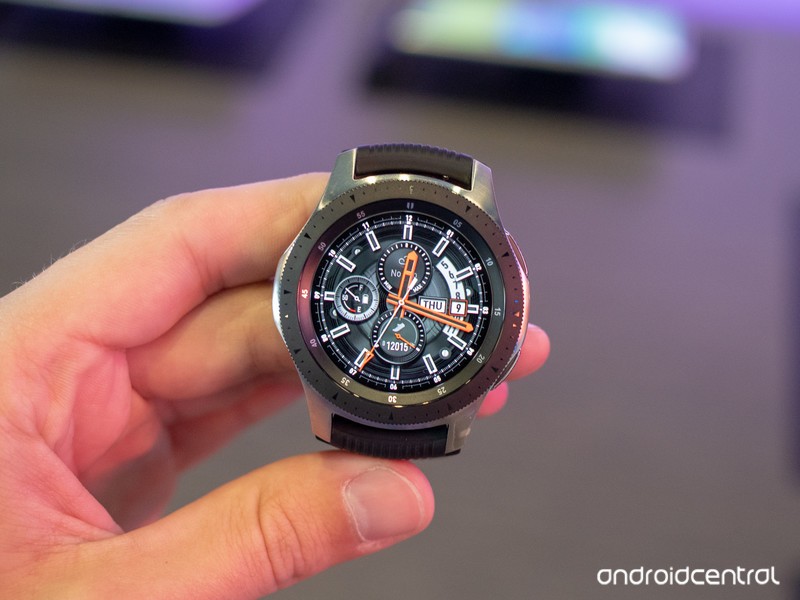
Following excellent wearables such as the Gear S3 and Gear Sport, Samsung’s coming back to the smartwatch market once more with the Galaxy Watch.
The Galaxy Watch ditches the Gear branding to be more in line with Samsung’s other mobile products, and while there’s nothing all that revolutionary here, the Galaxy Watch is shaping up to be one heck of a gadget if you’re in the market for a new wrist computer.
Here’s everything you need to know!
Latest Galaxy Watch news
Galaxy Watch LTE details revealed — coming in September for $50 premium
Samsung will make LTE versions of the Galaxy Watch available in September, and they’ll cost an extra $50 over the standard Bluetooth models. That means the 46mm watch will retail for $399, and the 42mm for $379. Samsung’s website shows both colors of the 42mm watch, black and rose gold, to be available with LTE.
At least, that’s for T-Mobile, which is the first carrier that has announced availability officially. At its Unpacked event (alongside the Galaxy Note 9), Samsung had said that all four major U.S. carriers would eventually carry the watches. Each carrier will have its own plans for the watches, which will simply be attached to your existing cellular plan as an add-on device in some way.
The T-Mobile variants of the Galaxy Watch are showing a shipment date of September 2, but Samsung has told Android Central that T-Mobile will be announcing the watch directly on August 24. Internationally, Samsung says that 30+ carriers in 15+ countries will be offering the Galaxy Watch throughout the second half of 2018. Samsung specifically listed Canada, Australia, New Zealand, China, Western Europe and the UK were among those in the early launch plans.
See at Samsung
It’s available in two sizes
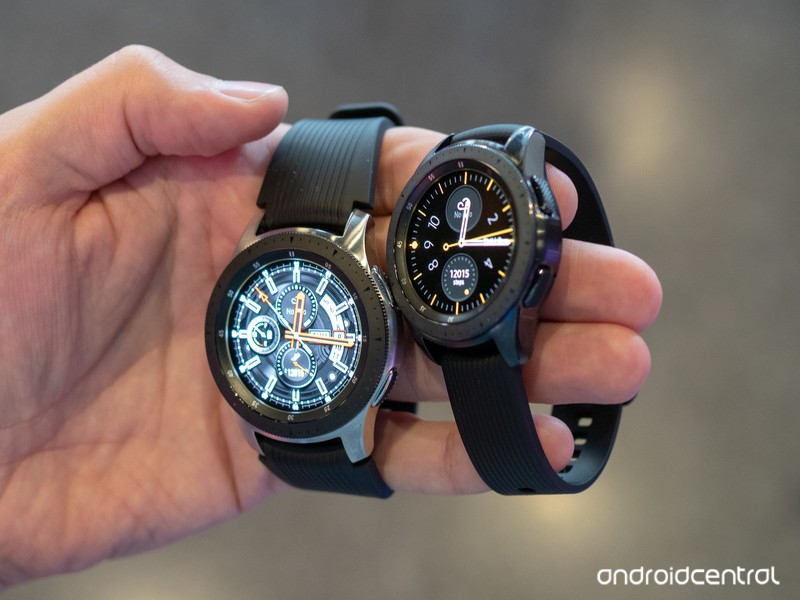
For the first time, Samsung’s selling the Galaxy Watch in two different sizes — including 42mm and 46mm. Seeing as how the Gear S3 was a comically large smartwatch and the Gear Sport was designed more for smaller wrists, it’s nice to see that Samsung’s catering to people of all wrist sizes with one product line.
No matter if you pick up the 42mm or 46mm option, you’ll still get the same design, features, etc., but the 46mm model will have a much larger 472mAh battery compared to the 42mm’s 270mAh unit. The screen sizes are of course different as well, at 1.3- and 1.2-inches, respectively — though they’re both the same resolution, 360×360, and have the same Gorilla Glass DX+ covering.
The Galaxy Watch is packed with fitness features
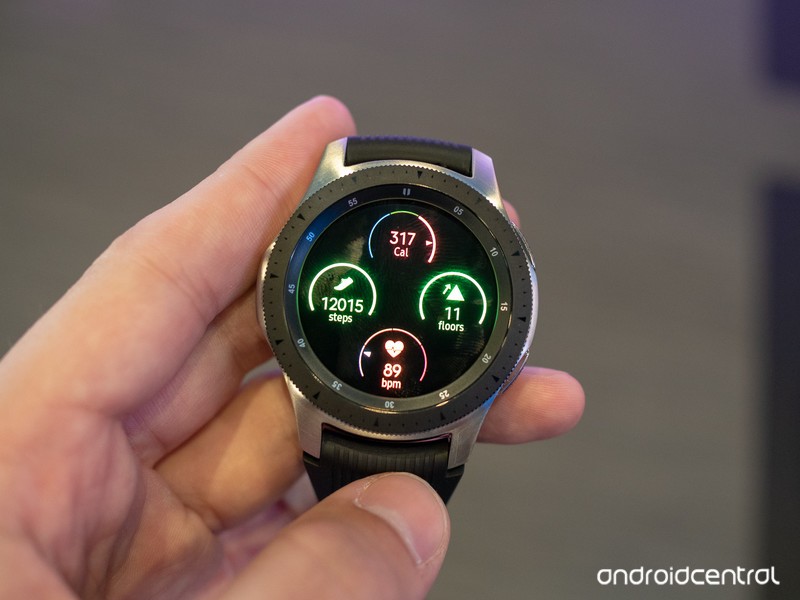
Samsung’s Gear products have often been focused on helping people live better lives, and although that Gear branding is no longer here, the Galaxy Watch continues that idea with a heap of fitness goodies.
You’ll find all of the regular suspects here, including calorie and step tracking, reminders to move throughout the day, guided meditation sessions, and heart-rate monitoring. The Samsung Health app on the Galaxy Watch can be used to track up 40 different workouts, can automatically detect six of the most common exercises, and has a built-in GPS to keep you connected while out on a run.
Rounding all of this off, Samsung’s also outfitted the Galaxy Watch with 5 ATM water resistance (including salt water), Corning Gorilla Glass DX+, and military-grade protection (specifically, MIL-STD-810G).
Tizen 4.0 is available out of the box
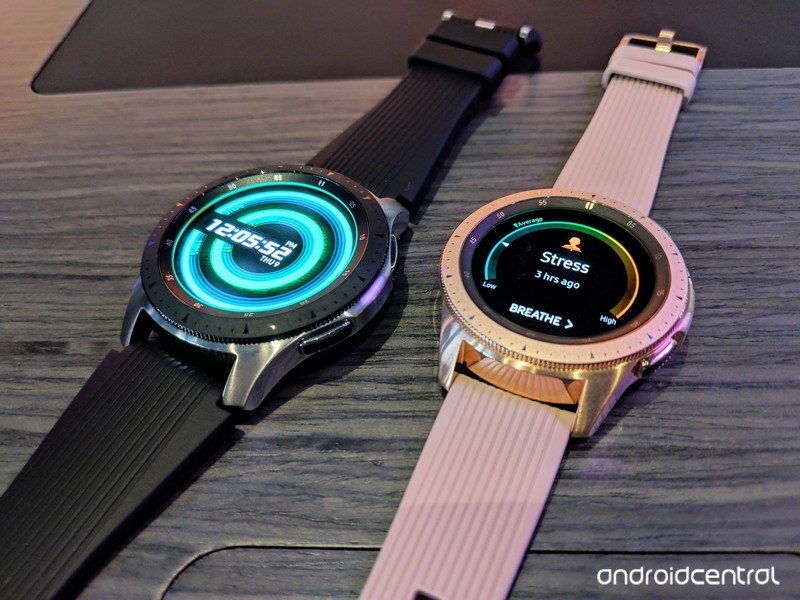
Despite all of the rumors claiming that the Galaxy Watch would run Wear OS, the Galaxy Watch is, in fact, powered by Samsung’s own Tizen wearable platform like previous Gears. The Galaxy Watch is running Tizen OS 4.0 which is an upgrade from Tizen 3.0 that shipped on the Gear Sport last year.
The software we’ve seen so far looks awfully similar compared to past Tizen versions, meaning that you can control the interface using the Galaxy Watch’s rotating bezel, download apps and watch faces from the Galaxy Apps Store, etc. The main difference is a slight upgrade in the fitness features, plus a few interface tweaks to make things a bit darker (saving battery) and simpler to read on a small screen.
Samsung Pay is here … for NFC payments only
The Gear S3 did a lot of things right, one of which was its inclusion of Samsung Pay for both NFC and MST payments. Samsung Pay is making a return to the Galaxy Watch, but similar to the Gear Sport, only supports NFC transactions.
That’s not uncommon for smartwatches that allow for mobile payments, but considering that MST has been such a big draw to Samsung Pay since its introduction in 2015, it is disappointing to see that it won’t be coming to the Galaxy Watch.
Also, if you use the Galaxy Watch with an iOS device (aka an iPhone), you won’t be able to use Samsung Pay at all.
You can get one with LTE
One feature the Galaxy Watch does keep from the Gear S3 is LTE support!
In order to get LTE on your Galaxy Watch you’ll pay roughly $50 more up front, but then you’ll also have to pay a monthly fee to your carrier of choice in order to keep the connection alive. Most carriers charge about $10-20 per month to add the new device, but that also includes neat features like forwarding text messages and phone calls to the watch.
You can bet that carriers will be offering discount son the watch up front in order to get you signed up for a data contract, too — so if you want to save money on the watch itself, wait a bit.
It works on Android and iOS
If you’re interested in picking up the Galaxy Watch, you’ll be able to use it with both Android and iOS.
As mentioned above, Samsung Pay will not work if you’re using the Galaxy Watch with an iPhone.
Pre-orders are open now!

Samsung has officially opened pre-orders for the Galaxy Watch! You’ll need to pay $329.99 for the 42mm variant (your choice of black or rose gold) and $349.99 for the 46mm one.
Following pre-orders, Korea will get the Galaxy Watch on August 24 and then followed by a worldwide release on September 14.
See at Samsung
Update August 22, 2018: Updated with new information on the LTE versions of the Galaxy Watch.
Oculus ‘Santa Cruz’ VR headset may arrive in the first quarter of 2019
Facebook and Oculus may formally introduce a mid-tier VR headset during the Oculus Connect 5 conference on September 26 and 27. This is an assumption based on a response regarding the “Santa Cruz” headset that sources now claim will arrive in the first quarter of 2019. An Oculus representative wouldn’t comment on the rumor, but instead said “OC5 will be really exciting.”
There’s really no big secret regarding the Santa Cruz headset, except for when it actually hits the market. Oculus confirmed with Digital Trends in March that the headset would serve as a mid-tier product nestled between the high-tier Oculus Rift and the low-tier Oculus Go. It won’t be tethered like the Oculus Rift nor will it be limited to head movements like the Oculus Go.
That said, the Santa Cruz headset will target the stand-alone VR market. It will include built-in cameras to track your physical environment, allowing you to move freely through open space without a tethered PC while remaining in the virtual environment. You also don’t need external sensors — like those used with the Oculus Rift and HTC Vive — to track your physical position in the play space.
Of course, without the wires and external sensors, you’d expect the real world to spoil your virtual fun by throwing walls, furniture and even kids into the mix. Oculus solves this problem with its “guardian” system that throws up a blue grid when you approach a scanned object or wall. Google’s WorldSense technology for its stand-alone Daydream headsets supposedly does something similar.
One of the sessions during the Oculus Connect conference next month will talk about porting Oculus Rift apps to the Santa Cruz headset.
“The introduction of stand-alone means the arrival of more approachable devices and, for developers, a broader range of consumers to target,” the listing states. “The good news is you’re already ready. We’ll start with an overview of the device and basic considerations and walk step by step through the process of reviewing and optimizing textures, scene geometry, and lighting.”
The Oculus Go, launched in May, merely tracks your head movement and incorporates input from a motion controller. The 32GB model costs $200 while the 64GB retails for a higher $250. It supports all VR applications provided through the Oculus Store for Samsung’s Gear VR platform. That said, most of what you purchase for Samsung’s smartphone-based headset will work on the Oculus Go, which doesn’t require a smartphone.
Meanwhile, the Oculus Rift costs $400 and includes the headset, motion controllers, external sensors and so on. It requires a tethered PC and pulls content from the Oculus Store and Steam. That said, we presume the upcoming Santa Cruz headset will have a starting price of $300 for it to fall between the two headsets currently on the market.
The mid-tier Santa Cruz unit is expected to arrive in March 2019 to celebrate the second anniversary of the Oculus Rift’s availability on the market. The original headset arrived on March 28, 2016.
Editors’ Recommendations
- Everything we know about Project Santa Cruz and the Oculus Rift 2
- Stand up or sit down? Many don’t take advantage of VR’s room-scale experience
- Oculus TV arrives, letting you watch a big screen TV without taking up any space
- Oculus Go vs. Lenovo Mirage Solo
- VR is in a tailspin, and the sales numbers prove it
Pocophone F1 by Xiaomi review
Research Center:
Pocophone F1 by Xiaomi
Rarely do smartphone reviews require much context ahead of talking about the device, but the Pocophone F1 is a phone that warrants a proper introduction. The name itself should be a giveaway as to why, because unless you’re plugged into the international smartphone world, this new brand may not sound familiar.
Pocophone’s partner in all this is Xiaomi, a name more will know. Xiaomi provides its manufacturing and software expertise, the benefits of scale — which includes buying power and industry connections — and years of experience. Pocophone isn’t Honor to Xiaomi’s Huawei, as it follows completely its own design and promotional path; but the F1 and presumably future Pocophone devices will be available almost everywhere Xiaomi phones are. That includes parts of Europe, and potentially, the U.K. and the U.S. in the future.
You’ll want the Pocophone to go on sale near you: It’s shockingly good, and all for an almost unbelievably low price. There are several companies out there that should be looking nervously back at Pocophone, and here’s why.
Thick, but comfortable
Xiaomi’s involvement isn’t a secret. The Pocophone’s box and case both say, “Pocophone by Xiaomi,” in case there was any confusion over the famous Chinese brand’s input. The phone will also be sold in India, where confusingly it’ll be known as Poco by Xiaomi. There will be a blue, black, and a red model sold, along with a special edition with a Kevlar rear cover, like the one you see in the pictures.
The phone’s body is made from polycarbonate, just like Nokia’s Windows Phone devices, and although it doesn’t feel very premium, it is hard wearing, protective, and low cost. This also means there are no visible antenna lines on the body. While the red color looks excellent, the Kevlar is a lot more attractive. It’s real Kevlar too, and the the weave shows through nicely. Two vertically-stacked camera lenses are set above a fingerprint sensor, and red flashes surround the lenses for some visual flair. Take a look at the top of the phone and you’ll see a 3.5mm headphone jack.
Pocophone’s partner in all this is Xiaomi.
This isn’t a slim phone at 8.8mm thick, but through some clever design tweaks — comfortably rounded sides, and the screen sitting slightly proud of the body — it doesn’t feel large in the hand. The IPS LCD screen measures 6.18-inches and it’s in a compact body, so it’s only slightly larger than the iPhone X.
The Pocophone F1 isn’t a stunner, but it’s far from being visually offensive. It’s mild-mannered, and definitely reminds us of early OnePlus efforts, such as the OnePlus 2. This won’t be the first time we bring up OnePlus either.
Large screen
The 6.18-inch LCD screen has a 2,246 x 1,080 pixel resolution, with a sizeable chin, small side bezels, and a notch at the top. We asked Pocophone’s head of product, Jai Mani, about this as the notch is quite large and noticeable. It’s a business decision, as it is the type of screen that’s easily available in the supply chain right now. In reality, it actually makes the phone look more modern, more so than it would with a standard aspect ratio and large bezels around the screen.
Andy Boxall/Digital Trends
Sadly, the notch isn’t that functional, as it’s not only very wide, but also quite deep, so any arguments that it gives “more screen real estate,” are rendered pointless. Dig into the software and the notch can be hidden, and we actually prefer the look of the Pocophone’s screen without it active.
Display performance is good, although some scenes when watching YouTube videos do have a bluish tint compared to other phones, and it does lack a little in detail when compared with phones from Honor, which also offer great performance for a reasonable price.
Fantastic performance
Expecting the Pocophone F1 to have a mid-range Qualcomm processor and a handful of RAM? Think again, this is a high performance smartphone with a Qualcomm Snapdragon 845 and 6GB of RAM. That’s the same chip and RAM configuration used in many flagship phones that cost between $500 and $1,000. The F1 does not cost that.
It’s still early days at Pocophone, which makes glitches more likely, but not less annoying.
The F1 is, well, F1-car fast. Fast for gaming — we played Reckless Racing 3 and Riptide GP2 with the graphics maxed out without issue — and fast for multitasking. Simply, if you want a phone with the fastest processor available now, and probably more RAM than many of the computers you’ve owned in the past, the Pocophone F1 will do the job.
We tried to run some benchmarks to see how it performs, but two of our usual three benchmarking apps — Geekbench 4 and 3DMark — refused to run on the F1.
- AnTuTu 3DBench: 265,421
This AnTuTu score is higher than the Samsung Galaxy S9 Plus, close to the OnePlus 6, and one step away from the 273,00 scored by the Galaxy Note 9. Don’t worry about performance on this phone.
The big chip is not the only thing the F1 shares with high-end phones including the new Galaxy Note 9. It’s also water-cooled, with a pipe running along the device’s spine to help keep the processor cool. By lowering the temperature, the device runs more efficiently, and the battery keeps going for longer too. The F1 did not get hot during benchmarking and gaming sessions.
Pocophone F1 by Xiaomi Compared To
Vivo Nex S
Moto Z3 Play
LG G7 ThinQ
Alcatel 1X
LG Fortune 2
Cat S61
HTC U12 Plus
Moto E5 Plus
Samsung Galaxy S9
Nokia 7 Plus
LG V35 ThinQ
Motorola Moto G6
Nuu G3
LG G Flex2
Samsung Galaxy Note 3
We have been impressed by the F1’s speed and smoothness, factors that are crucial to making the phone enjoyable to live with and use each day. However, there are some inconsistencies and slight disappointments between our test phone and the official spec sheet. Bluetooth AptX HD is listed as a feature, but this did not seem to activate, or appear as an option. Also, the infrared scanner in the notch isn’t active yet, with secure face unlocking coming later with a software update. It’s still early days at Pocophone, which makes glitches more likely, but not less annoying.
Camera
The camera is perhaps even more important than device performance, and one of the main reasons we choose one phone over another. The Pocophone F1 borrows the main camera from Xiaomi’s Mi 8 and the Mi Mix 2S, meaning it’s a 12-megapixel sensor with dual-pixel autofocus, and is paired here with a second 5-megapixel sensor.
The results are startling, thanks in part to an effective artificial intelligence mode. Shooting on a slightly overcast day in London, the F1 made great use of the available sunlight, and the AI applied sensible scene enhancements when needed. During the changing of the Guard in Whitehall, the F1 captured a great photo of the stone buildings, clouds, and London scenery. We also love the shine on the horse’s coats as the parade passed by.
The dual-lens setup enables portrait mode shots, and we were really impressed with some of the results. In St. James’s Park, we got close to the ducks and took several photos using portrait mode. These were taken quickly, often in positions where it was difficult to see the screen, yet the camera sorted everything out and returned some really great photos. All the camera technology is supplied by Xiaomi, including the app, and the experience shines through. Edges are picked out effectively, and the blur is subtle for a pleasing composition.
All the camera technology is supplied by Xiaomi, including the app, and the experience shines through.
A software-driven portrait mode is also included on the 20-megapixel front camera, along with a beauty mode. The blur effect is very strong, and like most software bokeh systems, it’s confused by glasses and lots of hair. We like the various live filters though, including black-and-white mode. The beauty mode can be turned off if you don’t like it too. The front camera also has a Super Pixel system that combines four pixels into one, for better low-light selfies. We haven’t seen this make much of a difference yet, but will continue testing.
F1 photos can look quite processed, which instantly makes them suitable for sharing online, without the need to add filters. If you do want to play with the results, the app has a comprehensive editing mode.
We’ve really enjoyed taking photos with the F1, and haven’t stopped even though that part of the review process is complete — high praise indeed.
Software and battery
A massive 4,000mAh battery lives inside the Pocophone F1, which has happily returned two days of general use — that’s photos, social media, gaming, and web browsing — before needing a recharge. When that time comes, although the device supports Quick Charge 3.0, the included charger will take the best part of three hours to take the battery from almost flat to full.
The F1 has Android 8.1 installed with Xiaomi’s MIUI Global version 9.6 user interface installed. That means Google Play and all the associated apps are all present, making it easy to use anywhere in the world. Xiaomi’s MIUI is a well-established Android-based operating system, and it’s one of the better versions available. There are millions of satisfied users, after all.
We like MIUI because of its clean design, but anyone used to Android on a Pixel will be frustrated by the amount of extras that come installed, ranging from Xiaomi’s own web browser, an optimization app, a system cleaner app, a QR code reader and business card scanner, and a screen recorder app too. That’s along with a file manager, a dialer, a download app, and a contacts app. Xiaomi’s own apps cannot be uninstalled.
The F1 is, well, F1-car fast.
Sadly, our F1 had one rather annoying issue that definitely ruined our experience, and not one we’ve seen with MIUI before. Notifications did not always appear on the lock screen, and icons did not appear at all in the notification bar on the home screen. Pull down the notification shade and they’re all there, but this doesn’t help much. We imagine this will be fixed in a software update, but none arrived during our time with the phone.
Despite this, MIUI is pleasingly fast, and if you don’t like the look, it’s ready to have any theme you want applied over the top. Pocophone needs to fix the notifications though.
Price, warranty, and availability
Available in India only from August 29, at least at the moment, the Pocophone F1 starts at about $300 for the 6GB/64GB model. The 6GB/128GB version costs about $340, and the 8GB/256GB version is approximately $400. The Armored Edition with the Kevlar back panel is $430. Next stop for the Pocophone F1 is Hong Kong, Indonesia, and France according to the company. The intention is to sell the F1 everywhere Xiaomi phones are currently available.
It’ll be possible to import the phone if you live outside one of those places, and provided you select the “global” version, it will come with Google Play, and MIUI will be in English. However, the modem bands may not operate with your chosen carrier, especially in the U.S.. In the U.K., where we tested the Pocophone F1, it happily connected to O2’s 4G LTE network.
Our Take
The Pocophone is impossible to ignore, due to a spec sheet that practically defies belief given the $400-or-less price; but it’s still early days for the company, which means putting up with a few glitches and features not working.
What are the alternatives?
Let’s list the sub-$400 smartphones with a Snapdragon 845 first. There, that didn’t take long, because there aren’t any. The Pocophone F1, for this reason alone, stands out as being astonishing value for money. To get an identical hardware specification, the minimum you’ll spend is $530 for the OnePlus 6. After that, the sky is the limit, all the way up to the $1,000 Galaxy Note 9.
What you’re abandoning is what we’d call premium design and materials. The Pocophone is plastic, not glass, and the design is simple. Neither of these things are bad, but they are one of the reasons we pay more for high-end phones. The camera performed well in our tests, but it’s not only up against the OnePlus 6, but phones like the 400 British pound Honor 10 too, both of which are excellent value for money.
The Motorola G6 and the Nokia 7 Plus would also be considerations when you’re spending this amount of money. The Pocophone F1 gives you more performance, more technology, and a bigger battery. It’s very hard to ignore these benefits.
How long will it last?
The Pocophone F1 is not a rugged phone, nor does it have water resistance; but the polycarbonate body will definitely be harder wearing than one made of glass. The weight makes it feel sturdy, and Xiaomi’s manufacturing expertise is immediately obvious in the great build quality. A simple silicone case is included in the box, which is a nice addition. Treat it sensibly by not getting it wet, and the phone should be a faithful companion.
Software is a little harder to judge. Xiaomi is good at delivering its own software updates on a relatively regular basis. It is also a Google partner, and Pocophone has said Android 9.0 Pie will arrive in the near future. What’s more, MIUI is highly flexible, and Xiaomi will update the software dependent on the phone and its capability, rather than ignoring older phones entirely.
No, it won’t have the same guarantee of the immediate software updates you’d get from buying a Google Pixel 2 XL, but it won’t be left to fend for itself over time either.
Should you buy one?
If you plan on using the Pocophone F1 in the U.S., then no, because it may not operate properly on your carrier’s 4G LTE network. If you live where the Pocophone is officially sold, then yes, even with the glitches we have experienced, it’s too much of a bargain to pass by.
Facebook Removing Onavo VPN From App Store After Apple Says It Violates Data Collection Policies
Facebook today removed VPN app Onavo Protect from the iOS App Store after Apple decided that it violates App Store data collection policies, reports The Wall Street Journal.
Apple earlier this month told Facebook officials that the Onavo app, which serves as a virtual private network, violates June App Store rules that prevent apps from harvesting data to build advertising profiles or contact databases.
Earlier this month, Apple officials informed Facebook that the app violated new rules outlined in June designed to limit data collection by app developers, the person familiar with the situation said. Apple informed Facebook that Onavo also violated a part of its developer agreement that prevents apps from using data in ways that go beyond what is directly relevant to the app or to provide advertising, the person added.
Facebook and Apple met last week to discuss the Onavo app, and last Thursday, Apple suggested that Facebook voluntarily remove the Onavo app, which Facebook agreed to do.
Onavo, a free VPN, promised to “keep you and your data safe when you browse and share information on the web,” but the app’s real purpose was tracking user activity across multiple different apps to learn insights about how Facebook customers use third-party apps.
Whenever a person using Onavo opens up an app or website, traffic is redirected to Facebook’s servers, which log the action in a database to allow Facebook to draw conclusions about app usage from aggregated data.
As of earlier this year, Onavo for iOS and Android had been installed on more than 33 million devices, giving Facebook a wealth of user data. Facebook was up front about the data collection in the app’s description, but the data that was being collected is now above and beyond what Apple allows.
To provide this layer of protection, Onavo uses a VPN to establish a secure connection to direct all of your network communications through Onavo’s servers. As part of this process, Onavo collects your mobile data traffic. This helps us improve and operate the Onavo service by analyzing your use of websites, apps and data. Because we’re part of Facebook, we also use this info to improve Facebook products and services, gain insights into the products and services people value, and build better experiences.
It appears that the Onavo app has indeed been removed from the App Store at this time. People who have previously downloaded the app will still be able to use it, but it will no longer be updated. Onavo for Android will continue to be available.
Customers who have installed Onavo but do not want to be tracked by Facebook should uninstall the app from their iOS or Android device.
Update: Apple provided the following statement on the removal of Onavo: We work hard to protect user privacy and data security throughout the Apple ecosystem. With the latest update to our guidelines, we made it explicitly clear that apps should not collect information about which other apps are installed on a user’s device for the purposes of analytics or advertising/marketing and must make it clear what user data will be collected and how it will be used.
Tags: App Store, Facebook, App Store Review Guidelines
Discuss this article in our forums
 AIVAnet