


Apple Shares Images of Upcoming Kyoto Apple Store, Which Opens Saturday
Apple today shared some new images of its first store in Kyoto, Japan, which is located on Shijō Dori street, Kyoto’s main shopping corridor.
According to Apple, the Kyoto store is surrounded by many of the famous shrines and temples in the city, with the store design taking inspiration from local architecture.
The upper levels of the building are “clad in a translucent envelope inspired by Japanese lanterns,” with Apple using a lightweight timber frame and special paper in homage to traditional Japanese houses.
Apple says the store is centered around a multi-level atrium where Today at Apple sessions on photography, music, and coding will be held on a daily basis. The interior also features a Genius Grove where customers can get help with Apple products and The Avenue, where iPhones, iPads, Macs, and other devices are shown off and are available for purchase alongside third-party accessories.

As was announced last week, the new Kyoto Apple Store is set to open at 10:00 a.m. local time on Saturday, August 25.
Apple Kyoto will be Apple’s ninth retail store in Japan, and the first that’s located in Kyoto. Apple has several other stores in Tokyo, along with locations in Osaka, Aichi, Miyagi, and Fukuoka.
Related Roundup: Apple Stores
Discuss this article in our forums
Galaxy Watch with LTE coming starting in September, from T-Mobile on Aug 24
Samsung’s Galaxy Watch is sleek, round, and powerful. Here are the biggest details.
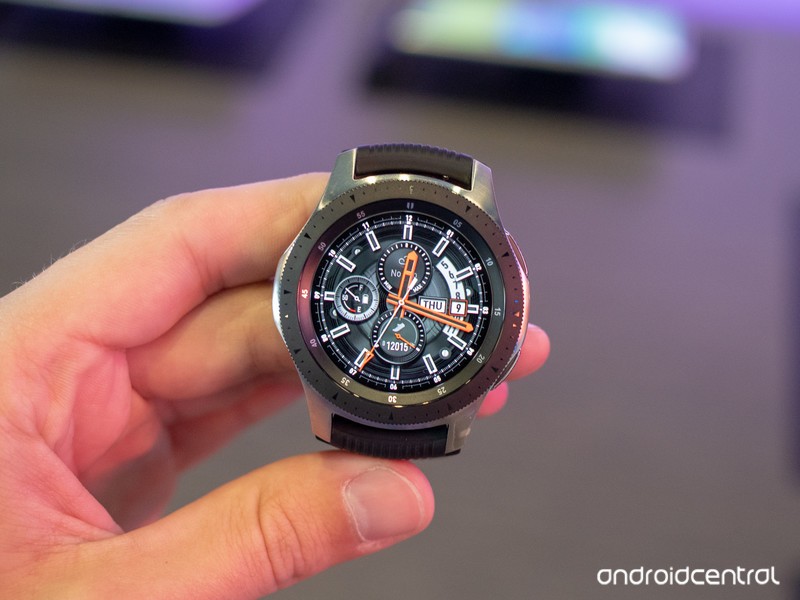
Following excellent wearables such as the Gear S3 and Gear Sport, Samsung’s coming back to the smartwatch market once more with the Galaxy Watch.
The Galaxy Watch ditches the Gear branding to be more in line with Samsung’s other mobile products, and while there’s nothing all that revolutionary here, the Galaxy Watch is shaping up to be one heck of a gadget if you’re in the market for a new wrist computer.
Here’s everything you need to know!
Latest Galaxy Watch news
Galaxy Watch LTE details revealed — coming in September for $50 premium
Samsung will make LTE versions of the Galaxy Watch available in September, and they’ll cost an extra $50 over the standard Bluetooth models. That means the 46mm watch will retail for $399, and the 42mm for $379. Samsung’s website shows both colors of the 42mm watch, black and rose gold, to be available with LTE.
At least, that’s for T-Mobile, which is the first carrier that has announced availability officially. At its Unpacked event (alongside the Galaxy Note 9), Samsung had said that all four major U.S. carriers would eventually carry the watches. Each carrier will have its own plans for the watches, which will simply be attached to your existing cellular plan as an add-on device in some way.
The T-Mobile variants of the Galaxy Watch are showing a shipment date of September 2, but Samsung has told Android Central that T-Mobile will be announcing the watch directly on August 24. Internationally, Samsung says that 30+ carriers in 15+ countries will be offering the Galaxy Watch throughout the second half of 2018. Samsung specifically listed Canada, Australia, New Zealand, China, Western Europe and the UK were among those in the early launch plans.
See at Samsung
It’s available in two sizes
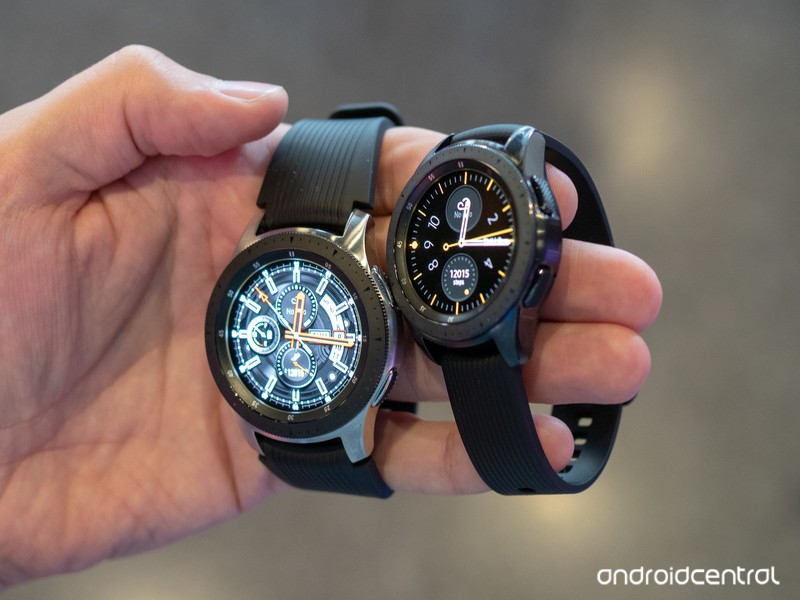
For the first time, Samsung’s selling the Galaxy Watch in two different sizes — including 42mm and 46mm. Seeing as how the Gear S3 was a comically large smartwatch and the Gear Sport was designed more for smaller wrists, it’s nice to see that Samsung’s catering to people of all wrist sizes with one product line.
No matter if you pick up the 42mm or 46mm option, you’ll still get the same design, features, etc., but the 46mm model will have a much larger 472mAh battery compared to the 42mm’s 270mAh unit. The screen sizes are of course different as well, at 1.3- and 1.2-inches, respectively — though they’re both the same resolution, 360×360, and have the same Gorilla Glass DX+ covering.
The Galaxy Watch is packed with fitness features
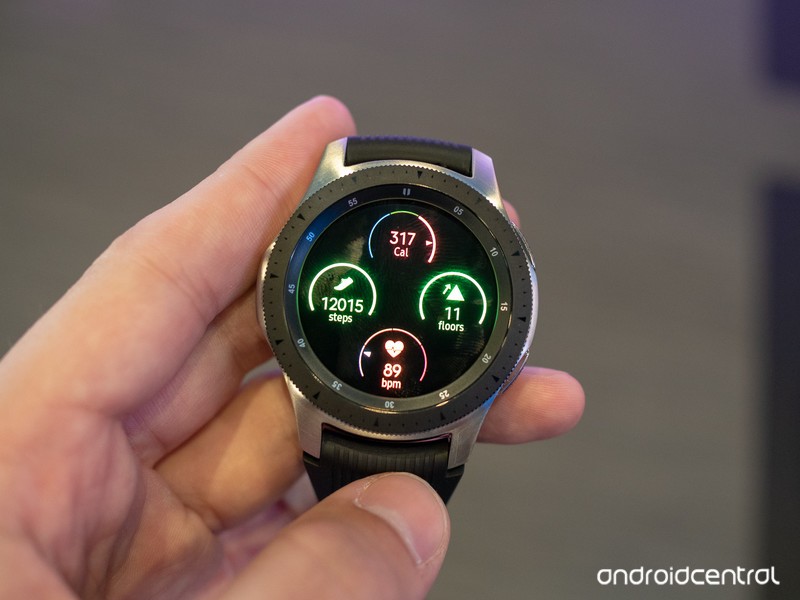
Samsung’s Gear products have often been focused on helping people live better lives, and although that Gear branding is no longer here, the Galaxy Watch continues that idea with a heap of fitness goodies.
You’ll find all of the regular suspects here, including calorie and step tracking, reminders to move throughout the day, guided meditation sessions, and heart-rate monitoring. The Samsung Health app on the Galaxy Watch can be used to track up 40 different workouts, can automatically detect six of the most common exercises, and has a built-in GPS to keep you connected while out on a run.
Rounding all of this off, Samsung’s also outfitted the Galaxy Watch with 5 ATM water resistance (including salt water), Corning Gorilla Glass DX+, and military-grade protection (specifically, MIL-STD-810G).
Tizen 4.0 is available out of the box
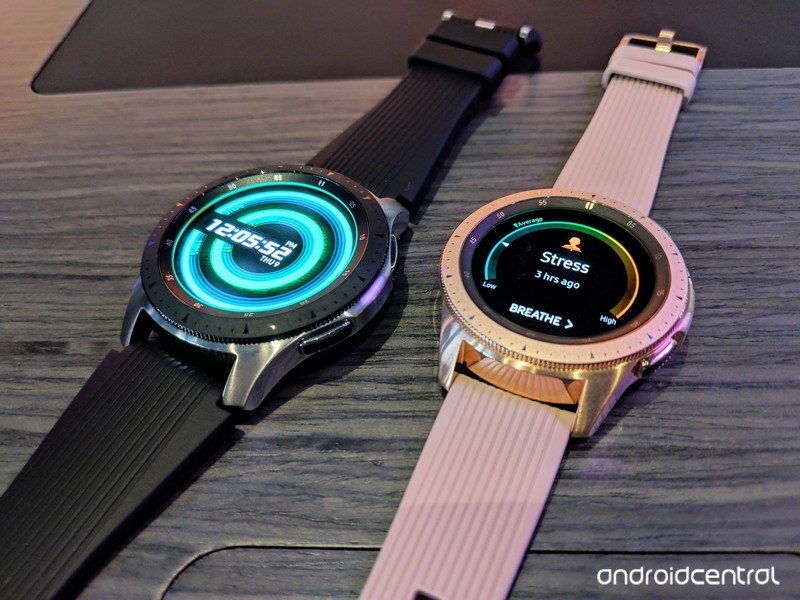
Despite all of the rumors claiming that the Galaxy Watch would run Wear OS, the Galaxy Watch is, in fact, powered by Samsung’s own Tizen wearable platform like previous Gears. The Galaxy Watch is running Tizen OS 4.0 which is an upgrade from Tizen 3.0 that shipped on the Gear Sport last year.
The software we’ve seen so far looks awfully similar compared to past Tizen versions, meaning that you can control the interface using the Galaxy Watch’s rotating bezel, download apps and watch faces from the Galaxy Apps Store, etc. The main difference is a slight upgrade in the fitness features, plus a few interface tweaks to make things a bit darker (saving battery) and simpler to read on a small screen.
Samsung Pay is here … for NFC payments only
The Gear S3 did a lot of things right, one of which was its inclusion of Samsung Pay for both NFC and MST payments. Samsung Pay is making a return to the Galaxy Watch, but similar to the Gear Sport, only supports NFC transactions.
That’s not uncommon for smartwatches that allow for mobile payments, but considering that MST has been such a big draw to Samsung Pay since its introduction in 2015, it is disappointing to see that it won’t be coming to the Galaxy Watch.
Also, if you use the Galaxy Watch with an iOS device (aka an iPhone), you won’t be able to use Samsung Pay at all.
You can get one with LTE
One feature the Galaxy Watch does keep from the Gear S3 is LTE support!
In order to get LTE on your Galaxy Watch you’ll pay roughly $50 more up front, but then you’ll also have to pay a monthly fee to your carrier of choice in order to keep the connection alive. Most carriers charge about $10-20 per month to add the new device, but that also includes neat features like forwarding text messages and phone calls to the watch.
You can bet that carriers will be offering discount son the watch up front in order to get you signed up for a data contract, too — so if you want to save money on the watch itself, wait a bit.
It works on Android and iOS
If you’re interested in picking up the Galaxy Watch, you’ll be able to use it with both Android and iOS.
As mentioned above, Samsung Pay will not work if you’re using the Galaxy Watch with an iPhone.
Pre-orders are open now!

Samsung has officially opened pre-orders for the Galaxy Watch! You’ll need to pay $329.99 for the 42mm variant (your choice of black or rose gold) and $349.99 for the 46mm one.
Following pre-orders, Korea will get the Galaxy Watch on August 24 and then followed by a worldwide release on September 14.
See at Samsung
Update August 22, 2018: Updated with new information on the LTE versions of the Galaxy Watch.
Oculus ‘Santa Cruz’ VR headset may arrive in the first quarter of 2019
Facebook and Oculus may formally introduce a mid-tier VR headset during the Oculus Connect 5 conference on September 26 and 27. This is an assumption based on a response regarding the “Santa Cruz” headset that sources now claim will arrive in the first quarter of 2019. An Oculus representative wouldn’t comment on the rumor, but instead said “OC5 will be really exciting.”
There’s really no big secret regarding the Santa Cruz headset, except for when it actually hits the market. Oculus confirmed with Digital Trends in March that the headset would serve as a mid-tier product nestled between the high-tier Oculus Rift and the low-tier Oculus Go. It won’t be tethered like the Oculus Rift nor will it be limited to head movements like the Oculus Go.
That said, the Santa Cruz headset will target the stand-alone VR market. It will include built-in cameras to track your physical environment, allowing you to move freely through open space without a tethered PC while remaining in the virtual environment. You also don’t need external sensors — like those used with the Oculus Rift and HTC Vive — to track your physical position in the play space.
Of course, without the wires and external sensors, you’d expect the real world to spoil your virtual fun by throwing walls, furniture and even kids into the mix. Oculus solves this problem with its “guardian” system that throws up a blue grid when you approach a scanned object or wall. Google’s WorldSense technology for its stand-alone Daydream headsets supposedly does something similar.
One of the sessions during the Oculus Connect conference next month will talk about porting Oculus Rift apps to the Santa Cruz headset.
“The introduction of stand-alone means the arrival of more approachable devices and, for developers, a broader range of consumers to target,” the listing states. “The good news is you’re already ready. We’ll start with an overview of the device and basic considerations and walk step by step through the process of reviewing and optimizing textures, scene geometry, and lighting.”
The Oculus Go, launched in May, merely tracks your head movement and incorporates input from a motion controller. The 32GB model costs $200 while the 64GB retails for a higher $250. It supports all VR applications provided through the Oculus Store for Samsung’s Gear VR platform. That said, most of what you purchase for Samsung’s smartphone-based headset will work on the Oculus Go, which doesn’t require a smartphone.
Meanwhile, the Oculus Rift costs $400 and includes the headset, motion controllers, external sensors and so on. It requires a tethered PC and pulls content from the Oculus Store and Steam. That said, we presume the upcoming Santa Cruz headset will have a starting price of $300 for it to fall between the two headsets currently on the market.
The mid-tier Santa Cruz unit is expected to arrive in March 2019 to celebrate the second anniversary of the Oculus Rift’s availability on the market. The original headset arrived on March 28, 2016.
Editors’ Recommendations
- Everything we know about Project Santa Cruz and the Oculus Rift 2
- Stand up or sit down? Many don’t take advantage of VR’s room-scale experience
- Oculus TV arrives, letting you watch a big screen TV without taking up any space
- Oculus Go vs. Lenovo Mirage Solo
- VR is in a tailspin, and the sales numbers prove it
Pocophone F1 by Xiaomi review
Research Center:
Pocophone F1 by Xiaomi
Rarely do smartphone reviews require much context ahead of talking about the device, but the Pocophone F1 is a phone that warrants a proper introduction. The name itself should be a giveaway as to why, because unless you’re plugged into the international smartphone world, this new brand may not sound familiar.
Pocophone’s partner in all this is Xiaomi, a name more will know. Xiaomi provides its manufacturing and software expertise, the benefits of scale — which includes buying power and industry connections — and years of experience. Pocophone isn’t Honor to Xiaomi’s Huawei, as it follows completely its own design and promotional path; but the F1 and presumably future Pocophone devices will be available almost everywhere Xiaomi phones are. That includes parts of Europe, and potentially, the U.K. and the U.S. in the future.
You’ll want the Pocophone to go on sale near you: It’s shockingly good, and all for an almost unbelievably low price. There are several companies out there that should be looking nervously back at Pocophone, and here’s why.
Thick, but comfortable
Xiaomi’s involvement isn’t a secret. The Pocophone’s box and case both say, “Pocophone by Xiaomi,” in case there was any confusion over the famous Chinese brand’s input. The phone will also be sold in India, where confusingly it’ll be known as Poco by Xiaomi. There will be a blue, black, and a red model sold, along with a special edition with a Kevlar rear cover, like the one you see in the pictures.
The phone’s body is made from polycarbonate, just like Nokia’s Windows Phone devices, and although it doesn’t feel very premium, it is hard wearing, protective, and low cost. This also means there are no visible antenna lines on the body. While the red color looks excellent, the Kevlar is a lot more attractive. It’s real Kevlar too, and the the weave shows through nicely. Two vertically-stacked camera lenses are set above a fingerprint sensor, and red flashes surround the lenses for some visual flair. Take a look at the top of the phone and you’ll see a 3.5mm headphone jack.
Pocophone’s partner in all this is Xiaomi.
This isn’t a slim phone at 8.8mm thick, but through some clever design tweaks — comfortably rounded sides, and the screen sitting slightly proud of the body — it doesn’t feel large in the hand. The IPS LCD screen measures 6.18-inches and it’s in a compact body, so it’s only slightly larger than the iPhone X.
The Pocophone F1 isn’t a stunner, but it’s far from being visually offensive. It’s mild-mannered, and definitely reminds us of early OnePlus efforts, such as the OnePlus 2. This won’t be the first time we bring up OnePlus either.
Large screen
The 6.18-inch LCD screen has a 2,246 x 1,080 pixel resolution, with a sizeable chin, small side bezels, and a notch at the top. We asked Pocophone’s head of product, Jai Mani, about this as the notch is quite large and noticeable. It’s a business decision, as it is the type of screen that’s easily available in the supply chain right now. In reality, it actually makes the phone look more modern, more so than it would with a standard aspect ratio and large bezels around the screen.
Andy Boxall/Digital Trends
Sadly, the notch isn’t that functional, as it’s not only very wide, but also quite deep, so any arguments that it gives “more screen real estate,” are rendered pointless. Dig into the software and the notch can be hidden, and we actually prefer the look of the Pocophone’s screen without it active.
Display performance is good, although some scenes when watching YouTube videos do have a bluish tint compared to other phones, and it does lack a little in detail when compared with phones from Honor, which also offer great performance for a reasonable price.
Fantastic performance
Expecting the Pocophone F1 to have a mid-range Qualcomm processor and a handful of RAM? Think again, this is a high performance smartphone with a Qualcomm Snapdragon 845 and 6GB of RAM. That’s the same chip and RAM configuration used in many flagship phones that cost between $500 and $1,000. The F1 does not cost that.
It’s still early days at Pocophone, which makes glitches more likely, but not less annoying.
The F1 is, well, F1-car fast. Fast for gaming — we played Reckless Racing 3 and Riptide GP2 with the graphics maxed out without issue — and fast for multitasking. Simply, if you want a phone with the fastest processor available now, and probably more RAM than many of the computers you’ve owned in the past, the Pocophone F1 will do the job.
We tried to run some benchmarks to see how it performs, but two of our usual three benchmarking apps — Geekbench 4 and 3DMark — refused to run on the F1.
- AnTuTu 3DBench: 265,421
This AnTuTu score is higher than the Samsung Galaxy S9 Plus, close to the OnePlus 6, and one step away from the 273,00 scored by the Galaxy Note 9. Don’t worry about performance on this phone.
The big chip is not the only thing the F1 shares with high-end phones including the new Galaxy Note 9. It’s also water-cooled, with a pipe running along the device’s spine to help keep the processor cool. By lowering the temperature, the device runs more efficiently, and the battery keeps going for longer too. The F1 did not get hot during benchmarking and gaming sessions.
Pocophone F1 by Xiaomi Compared To
Vivo Nex S
Moto Z3 Play
LG G7 ThinQ
Alcatel 1X
LG Fortune 2
Cat S61
HTC U12 Plus
Moto E5 Plus
Samsung Galaxy S9
Nokia 7 Plus
LG V35 ThinQ
Motorola Moto G6
Nuu G3
LG G Flex2
Samsung Galaxy Note 3
We have been impressed by the F1’s speed and smoothness, factors that are crucial to making the phone enjoyable to live with and use each day. However, there are some inconsistencies and slight disappointments between our test phone and the official spec sheet. Bluetooth AptX HD is listed as a feature, but this did not seem to activate, or appear as an option. Also, the infrared scanner in the notch isn’t active yet, with secure face unlocking coming later with a software update. It’s still early days at Pocophone, which makes glitches more likely, but not less annoying.
Camera
The camera is perhaps even more important than device performance, and one of the main reasons we choose one phone over another. The Pocophone F1 borrows the main camera from Xiaomi’s Mi 8 and the Mi Mix 2S, meaning it’s a 12-megapixel sensor with dual-pixel autofocus, and is paired here with a second 5-megapixel sensor.
The results are startling, thanks in part to an effective artificial intelligence mode. Shooting on a slightly overcast day in London, the F1 made great use of the available sunlight, and the AI applied sensible scene enhancements when needed. During the changing of the Guard in Whitehall, the F1 captured a great photo of the stone buildings, clouds, and London scenery. We also love the shine on the horse’s coats as the parade passed by.
The dual-lens setup enables portrait mode shots, and we were really impressed with some of the results. In St. James’s Park, we got close to the ducks and took several photos using portrait mode. These were taken quickly, often in positions where it was difficult to see the screen, yet the camera sorted everything out and returned some really great photos. All the camera technology is supplied by Xiaomi, including the app, and the experience shines through. Edges are picked out effectively, and the blur is subtle for a pleasing composition.
All the camera technology is supplied by Xiaomi, including the app, and the experience shines through.
A software-driven portrait mode is also included on the 20-megapixel front camera, along with a beauty mode. The blur effect is very strong, and like most software bokeh systems, it’s confused by glasses and lots of hair. We like the various live filters though, including black-and-white mode. The beauty mode can be turned off if you don’t like it too. The front camera also has a Super Pixel system that combines four pixels into one, for better low-light selfies. We haven’t seen this make much of a difference yet, but will continue testing.
F1 photos can look quite processed, which instantly makes them suitable for sharing online, without the need to add filters. If you do want to play with the results, the app has a comprehensive editing mode.
We’ve really enjoyed taking photos with the F1, and haven’t stopped even though that part of the review process is complete — high praise indeed.
Software and battery
A massive 4,000mAh battery lives inside the Pocophone F1, which has happily returned two days of general use — that’s photos, social media, gaming, and web browsing — before needing a recharge. When that time comes, although the device supports Quick Charge 3.0, the included charger will take the best part of three hours to take the battery from almost flat to full.
The F1 has Android 8.1 installed with Xiaomi’s MIUI Global version 9.6 user interface installed. That means Google Play and all the associated apps are all present, making it easy to use anywhere in the world. Xiaomi’s MIUI is a well-established Android-based operating system, and it’s one of the better versions available. There are millions of satisfied users, after all.
We like MIUI because of its clean design, but anyone used to Android on a Pixel will be frustrated by the amount of extras that come installed, ranging from Xiaomi’s own web browser, an optimization app, a system cleaner app, a QR code reader and business card scanner, and a screen recorder app too. That’s along with a file manager, a dialer, a download app, and a contacts app. Xiaomi’s own apps cannot be uninstalled.
The F1 is, well, F1-car fast.
Sadly, our F1 had one rather annoying issue that definitely ruined our experience, and not one we’ve seen with MIUI before. Notifications did not always appear on the lock screen, and icons did not appear at all in the notification bar on the home screen. Pull down the notification shade and they’re all there, but this doesn’t help much. We imagine this will be fixed in a software update, but none arrived during our time with the phone.
Despite this, MIUI is pleasingly fast, and if you don’t like the look, it’s ready to have any theme you want applied over the top. Pocophone needs to fix the notifications though.
Price, warranty, and availability
Available in India only from August 29, at least at the moment, the Pocophone F1 starts at about $300 for the 6GB/64GB model. The 6GB/128GB version costs about $340, and the 8GB/256GB version is approximately $400. The Armored Edition with the Kevlar back panel is $430. Next stop for the Pocophone F1 is Hong Kong, Indonesia, and France according to the company. The intention is to sell the F1 everywhere Xiaomi phones are currently available.
It’ll be possible to import the phone if you live outside one of those places, and provided you select the “global” version, it will come with Google Play, and MIUI will be in English. However, the modem bands may not operate with your chosen carrier, especially in the U.S.. In the U.K., where we tested the Pocophone F1, it happily connected to O2’s 4G LTE network.
Our Take
The Pocophone is impossible to ignore, due to a spec sheet that practically defies belief given the $400-or-less price; but it’s still early days for the company, which means putting up with a few glitches and features not working.
What are the alternatives?
Let’s list the sub-$400 smartphones with a Snapdragon 845 first. There, that didn’t take long, because there aren’t any. The Pocophone F1, for this reason alone, stands out as being astonishing value for money. To get an identical hardware specification, the minimum you’ll spend is $530 for the OnePlus 6. After that, the sky is the limit, all the way up to the $1,000 Galaxy Note 9.
What you’re abandoning is what we’d call premium design and materials. The Pocophone is plastic, not glass, and the design is simple. Neither of these things are bad, but they are one of the reasons we pay more for high-end phones. The camera performed well in our tests, but it’s not only up against the OnePlus 6, but phones like the 400 British pound Honor 10 too, both of which are excellent value for money.
The Motorola G6 and the Nokia 7 Plus would also be considerations when you’re spending this amount of money. The Pocophone F1 gives you more performance, more technology, and a bigger battery. It’s very hard to ignore these benefits.
How long will it last?
The Pocophone F1 is not a rugged phone, nor does it have water resistance; but the polycarbonate body will definitely be harder wearing than one made of glass. The weight makes it feel sturdy, and Xiaomi’s manufacturing expertise is immediately obvious in the great build quality. A simple silicone case is included in the box, which is a nice addition. Treat it sensibly by not getting it wet, and the phone should be a faithful companion.
Software is a little harder to judge. Xiaomi is good at delivering its own software updates on a relatively regular basis. It is also a Google partner, and Pocophone has said Android 9.0 Pie will arrive in the near future. What’s more, MIUI is highly flexible, and Xiaomi will update the software dependent on the phone and its capability, rather than ignoring older phones entirely.
No, it won’t have the same guarantee of the immediate software updates you’d get from buying a Google Pixel 2 XL, but it won’t be left to fend for itself over time either.
Should you buy one?
If you plan on using the Pocophone F1 in the U.S., then no, because it may not operate properly on your carrier’s 4G LTE network. If you live where the Pocophone is officially sold, then yes, even with the glitches we have experienced, it’s too much of a bargain to pass by.
Facebook Removing Onavo VPN From App Store After Apple Says It Violates Data Collection Policies
Facebook today removed VPN app Onavo Protect from the iOS App Store after Apple decided that it violates App Store data collection policies, reports The Wall Street Journal.
Apple earlier this month told Facebook officials that the Onavo app, which serves as a virtual private network, violates June App Store rules that prevent apps from harvesting data to build advertising profiles or contact databases.
Earlier this month, Apple officials informed Facebook that the app violated new rules outlined in June designed to limit data collection by app developers, the person familiar with the situation said. Apple informed Facebook that Onavo also violated a part of its developer agreement that prevents apps from using data in ways that go beyond what is directly relevant to the app or to provide advertising, the person added.
Facebook and Apple met last week to discuss the Onavo app, and last Thursday, Apple suggested that Facebook voluntarily remove the Onavo app, which Facebook agreed to do.
Onavo, a free VPN, promised to “keep you and your data safe when you browse and share information on the web,” but the app’s real purpose was tracking user activity across multiple different apps to learn insights about how Facebook customers use third-party apps.
Whenever a person using Onavo opens up an app or website, traffic is redirected to Facebook’s servers, which log the action in a database to allow Facebook to draw conclusions about app usage from aggregated data.
As of earlier this year, Onavo for iOS and Android had been installed on more than 33 million devices, giving Facebook a wealth of user data. Facebook was up front about the data collection in the app’s description, but the data that was being collected is now above and beyond what Apple allows.
To provide this layer of protection, Onavo uses a VPN to establish a secure connection to direct all of your network communications through Onavo’s servers. As part of this process, Onavo collects your mobile data traffic. This helps us improve and operate the Onavo service by analyzing your use of websites, apps and data. Because we’re part of Facebook, we also use this info to improve Facebook products and services, gain insights into the products and services people value, and build better experiences.
It appears that the Onavo app has indeed been removed from the App Store at this time. People who have previously downloaded the app will still be able to use it, but it will no longer be updated. Onavo for Android will continue to be available.
Customers who have installed Onavo but do not want to be tracked by Facebook should uninstall the app from their iOS or Android device.
Update: Apple provided the following statement on the removal of Onavo: We work hard to protect user privacy and data security throughout the Apple ecosystem. With the latest update to our guidelines, we made it explicitly clear that apps should not collect information about which other apps are installed on a user’s device for the purposes of analytics or advertising/marketing and must make it clear what user data will be collected and how it will be used.
Tags: App Store, Facebook, App Store Review Guidelines
Discuss this article in our forums
White Night review – minimalist and bare, yet highly unsettling


I don’t know about you but I am a big fan of film noir. These movies rely on the subtle interplay between light and shadows to create an eerie, oppressive atmosphere that for me remains unmatched by today’s mystery thrillers and horrors.
Well, the developers of this game I’ve been playing for the past week have tried to port this unique ambiance to Android. Called simply White Night, this is a classic survival horror with a pretty intriguing story attached to it.
It’s available for download from the Google Play Store for $4.99.
Impressions

As you enter the black-and-white universe of White Night, you can’t help being drawn in by this unique monochromatic aesthetic which lays the ground for an eerie adventure.
The opening sequence which displays the credits for minutes on end reminds me of Twin Peaks. I couldn’t help but feel like Dale Cooper on his way to a God-forsaken town where something horrible had happened. The beautiful yet sinister music makes the scene even more striking.
A bit about the story
White Night is set in the 1930s during the Great Depression and the narrative is part murder mystery and part supernatural ghost story.
You step into the shoes of a nameless man who while driving on a deserted road, tries to avoid a young woman standing in the middle of the road. He crashes his car and unable to find the body of the victim, limps towards a spooky mansion to look for help. The house appears to be deserted at first, but as the main character will quickly find out that’s not exactly the case.

You’ll soon start exploring the darkness that is engulfing you, and stumble upon locked doors with mysterious seals engraved on them, pieces of a journal and lots of memories. The story is indeed a treat for those who love to solve enigmas. Who lived here? Why is this house abandoned? Did something bad happen here? All these are questions you need to answer.
Gameplay
Osome Studios, the developer behind the game did a spectacular job at creating a unique atmosphere just by using simple yet contrasting black and white graphics. Yet they didn’t pay the same attention to gameplay.
First and foremost, the controls and camera angles are really frustrating. Playing a point and click adventure on a mobile device was never a rewarding experience for me and the same goes for White Night.
Movement in the game was a real pain. I often found my taps on the screen did not correlate with the hero’s moves. This was in part, due to the fact that it’s quite difficult to make out the obstacles blocking your path since most have to explore in the near-absence of light. But the controls themselves brought plenty of painful moments to the experience.
 See anything?
Once you’re inside the mansion, you can start collecting matchsticks, which are your only sources of light for most of the game. Yikes! But they burn out pretty quickly, so you’ll always have to keep an eye out for more. Because you don’t want to be caught in the dark for too long.
Darkness is the villain of this game
White Night isn’t the kind of game which has monsters jumping at you from behind. Instead, it uses darkness itself as the main villain. Fail to light a match quickly enough and you’ll be dead in an instant. Then you’ll start back from the last saving point.
The game’s fixed camera angles are another issue. While they do offer a cinematic Hitchcock-like experience, they don’t allow you to get a great sense of your surroundings and make some stuff hard to view or access. Basically, most of the time you can’t really see what you’re doing. Which is quite annoying in a game where you’re supposed to find and click on things to solve puzzles.

On the bright side, the ghostly apparitions in the game are very well executed. They are fuzzy, flickering creatures that seem to be in a state of agony that will bring chills up your spine.
Our character can catch a glimpse of them through the darkness, and man do they look frightening. Even on a mobile phone!
The puzzles in the game aren’t super complicated. And when you find yourself stuck, you can always turn for hints in the in-game newspaper, which is actually more of a journal. This has spared me a few times from roaming aimlessly throughout the house.
Conclusion
White Night excels at being an atmospheric mystery/horror game. It’s built on a good story, which at a time could have been a bit more original, but that’s just an idea. I’m deep in the horror genre, so perhaps I am a bit too familiar with its motifs and themes.
Sure, it’s not perfect and there’s a lot of room for improvement starting with the controls. The use of fixed camera angles could also be adapted to provide a more fluid exploration experience. But in my eyes, the black and white graphics, as well as the excellent soundtrack and voice acting redeem this game. I have to say: if you love horror games you shouldn’t miss White Night.
Don’t Miss
Google Home is awesome; here’s how to make it even better!
Check it out!
Honor Play review: Flagship specs on a budget
Huawei recently became the second largest smartphone manufacturer in the world. On top of that, it just made it into the top five smartphone manufacturers in India, carried by the success of its phones and that of its sub-brand, Honor.
Honor’s new phone, the Honor Play, is aimed at power users and gamers on a mid-range budget, packing in top-of-the-line specifications. It doesn’t have the high-refresh rate display or fancy liquid cooling system of other gaming phones, but it’s got the company’s new GPU Turbo technology, which promises an enhanced visual experience while gaming.
I’ve played (sorry, not sorry) with the Honor Play for a couple of weeks. For the specs it packs, its crazy this phone comes for less than $350. But is it really any good?
This is our full Honor Play review.
For the purpose of this review, I took the higher spec’d Indian variant of the Honor Play – the one with 6GB RAM and 64GB of internal storage – for a spin.Show More
Design
Honor Play is a gift for anyone still against manufacturers’ obsession with glass-backed phones. Personally, I think devices like the Honor 9 Lite and Honor 10 look very attractive, even if they attract a lot of fingerprints and smudges. I also like the Honor Play, even though the company played it safe here.
The unibody aluminum construction with a matte finish, makes for a premium looking smartphone. The antenna lines are etched right on the curves, giving the back a clean and seamless look. The vertical Honor branding we’ve seen on recent Huawei phones looks chic as well.
The Honor Play sports a large 6.3-inch display, but the 19.5:9 aspect ratio, curved edges, and rounded corners make for a very ergonomic phone. There’s a considerable chin at the bottom and it’s not completely without bezels though.
With its large battery, Honor did well keeping the thickness of the phone (7.5mm) in check. Of course, the vertically aligned dual camera at the back adds a slight bump.
Overall, the Honor Play has a very smooth and minimalist look. The build quality is solid and quite reassuring, though there’s nothing in the design to suggest it is a gaming phone.
Display

The Honor Play manages to cram in a large 6.3-inch Full HD+ IPS LCD display with a 19.5:9 aspect ratio and an 83 percent screen-to-body ratio. Yes, there’s a notch, but you can turn it off in display settings if you’ve still not warmed up to the increasingly ubiquitous trend.
The display is quite vibrant, though a tad oversaturated, and the colors look rich. If you’re not a fan of the vivid colors, you can dial them down to more natural tones in the display settings. You can also pull down the resolution to HD+ to conserve battery.
The viewing angles are decent enough, but a slight tint creeps in at wider tangents. Also, while the brightness is appropriate, the display is quite reflective and it’s hard to use in direct sunlight.
Performance

It’s remarkable the Honor Play packs in Huawei’s flagship Kirin 970 processor, with 6GB of RAM and 64GB of UFS 2.1 storage at its price.
The phone’s performance is top notch. Even with several apps running in the background, including Asphalt 9 Legends and several open tabs in Chrome, it holds up quite well. The company did well optimizing the hardware for EMUI — a benefit of owning all pieces of the puzzle. The overall smoothness and reliability in everyday usage is quite apparent. Throw anything at the Honor Play, and it won’t break a sweat. There’s also a 4GB variant (with the same internal storage) of the device, which should also be good enough for most people.
Editor’s Pick
Why the Kirin 970 NPU is faster than the Snapdragon 845
As artificially intelligence creeps its way into our smartphone experience, SoC vendors have been racing to improve neural network and machine learning performance in their chips. Everyone has a different take on how to power these …
The Honor Play is the company’s first smartphone to run GPU Turbo. It’s an integrated hardware-software graphics processing acceleration technology that reconstructs the traditional graphics processing framework at the lower layer system, greatly improving the efficiency of GPU graphics processing and user gaming experience.
According to Honor, the feature improves graphics processing efficiency by 60 percent and reduces energy consumption by 30 percent on the Play. It’s hard to test the company’s claims since I don’t have an Honor Play “without” GPU Turbo. However, without qualitative numbers to report, playing PUBG Mobile with the highest graphics settings was a breeze.
Right now, GPU Turbo only supports PUBG Mobile and Mobile Legends: Bang Bang. Honor will announce more titles in the future, but until then it’s a pretty limited feature. Honor is also apparently working on integrating this technology with EMUI, which could be very interesting.
The Honor Play packs in 3,750mAh battery, and even after heavy usage through the day, I ended up with 10-15 percent battery left at the end of the day. Most moderate users will likely be able to squeeze more than a day and a half out of the battery, which is pretty good. The phone also supports fast charging, with a bundled 18W charger. Considering all the Honor Play’s horsepower, battery life like this is pretty great.
Hardware

The Honor Play sports a mono speaker. It’s pretty loud and the audio performance is actually quite good, but the lack of stereo speakers is surprising, considering the gaming focus. Then again, you don’t reach this price by throwing in everything you can.
It packs in a hybrid tray, for either two nano-SIMs or a nano-SIM and a microSD card. Both the phone’s 4GB and 6GB RAM variants only come with 64GB of storage, so you might want to gauge your requirement if you plan to use two SIMs.
Camera

Like with other Huawei and Honor smartphones powered by the Kirin 970 processor, the camera on the Honor Play has a bunch of AI features using the SoC’s dedicated NPU, like real-time scene detection.
In most cases, AI tends to oversaturate the photos, so if you prefer more natural looking colors, you may want to toggle off the AI. Turning it off is easy and better for most shots, which is a shame. I think Honor missed a beat here with the execution of the Play’s AI capabilities.


The dual camera on the back is a mixed bag. It’s got a 16MP f/2.2 primary lens and a 2MP f/2.4 second sensor for capturing depth information. There’s also a single LED flash and phase-detection auto-focus.
In good lighting conditions, the photos are good enough. The camera captures a good amount of detail, the noise levels are low, and the color reproduction is pretty good. In less than ideal conditions it struggles because of the smaller aperture. Since there’s no optical image stabilization (OIS), you may need to use the AI mode, which enables artificial intelligence stabilization (AIS), Honor’s implementation of electronic image stabilization (EIS).

Despite the average camera performance, the phone has a very capable Portrait mode. The separation and edge detection is pretty good, and you can control the bokeh, even after taking the picture.
The front camera comes with a 16-megapixel resolution and a f/2.0 aperture that offers well-balanced selfies in good light conditions with good contrast and colors.
Honor Play doesn’t have an impressive camera but its results should work for social media. If the camera is your top priority, you should look elsewhere. That said, the camera app is quite snappy and it has a ton of features. If only the AI features worked well too.

Software
The Honor Play runs EMUI 8.2, the latest iteration of Huawei’s proprietary UI layer over Android 8.1 Oreo.
While custom skins are a matter of preference, EMUI is a feature-packed one offering nifty features like being able to toggle the app drawer and customize phone’s the home screen and animations. The universal search on swipe down is quite handy as well.
Related
Android 9 Pie review: Closing the gap
The Android 9 Pie release is the proof in the proverbial pudding that Android as an operating system has hit its stride. Lacking neither underlying features or surface polish, Android 9 Pie is the most …
The only bad thing about the Honor Play’s software is its bloatware. It comes with a bunch of random games we could frankly do without. PUBG Mobile isn’t even pre-installed, and it’s one of the few games showcasing the phone’s new technology.
The company did well tying its processor and software together, and EMUI runs very smoothly. It will be a delight for most users, except the vocal minority that prefers stock Android experience. In my experience with other Honor phones in the past, the EMUI doesn’t slow down after a few months, which is pretty impressive, though less talked about.
Specifications
| Display | 6.3-inch Full HD+ (2340 x 1080) IPS LCD 19.5:9 aspect ratio 2.5D curved glass display |
| Processor | Octa-Core Kirin 970 (4 x 2.4 GHz A73+ 4 x 1.8 GHz A53) 10nm Mali-G72 MP12 GPU NPU GPU Turbo |
| RAM | 4GB/6GB LPDDR4X |
| Storage | 64GB (UFS 2.1) Expandable up to 256GB with microSD |
| Cameras | Rear cameras: Primary: 16MP with LED flash, f/2.2 aperture, PDAF Secondary: 2MP secondary camera with f/2.4 aperture Electronic Image Stabilization (EIS) Front camera: 16MP, f/2.0 aperture |
| Battery | 3,750mAh |
| Software | Android 8.1 with EMUI 8.2 |
| Dimensions and weight | 157.91×74.27×7.84mm 176g |
Gallery

Pricing and final thoughts
At 23,999 rupees ($329) in India, Honor has broken the lower threshold of packing in flagship-grade internals for less than $350. However, the 4GB variant at only 19,999 rupees ($286) is an even better deal. The Honor Play’s price alone makes it one of the best mid-range options out there.
Buy now from Amazon India
Check it out on HiHonor.com
The pricing and the specifications sheet alone make Honor Play a top option on the table.
Of course, there’s more to a smartphone than just its spec sheet. This phone performs as good as any flagship phone out there and looks quite brilliant as well. However, the camera could’ve definitely been better.
The Honor Play is a solid phone for most users — not just gamers. If GPU Turbo catches game developers’ fancy and Huawei can manage to bring support for more titles, all the better.
Honor is offering a formidable mid-range smartphone at a great value. It’s got a little something for everybody, except the shutterbugs.
Next: Pocophone F1 review: Can’t argue with a Snapdragon 845 for $300
Want a future-proof degree? Head to Colorado for asteroid mining
Are you a high schooler wondering what career to pursue that won’t be gobbled up by robots in the next few years? Are you an engineering grad, economist, physicist, or policy analyst looking to become an expert in a new, but fast-developing discipline? If so, the Colorado School of Mines has the perfect answer for you: You should totally take up space mining.
No, we’re not kidding. While the idea of extracting water, minerals or even metals from an asteroid sounds like the stuff of far-future science-fiction, it’s likely to actually happen in the coming decades — and Colorado School of Mines’ newly launched “Space Resources” course will help you get in on the ground floor.
“Space Resources is an area that includes identifying the resources there are in space, and working out how to collect, extract and utilize them,” Dr. Angel Abbud-Madrid, director of the Center for Space Resources and Research Associate Professor in Mechanical Engineering at Colorado School of Mines, told Digital Trends.
Students on the course can earn post-baccalaureate certificates, master’s degrees, and doctoral degrees through the interdisciplinary program. It will cover the responsible exploration, extraction, and use of resources on the moon, Mars, asteroids, and even further afield locations. The courses will include guest speakers from a variety of mining and aerospace companies.
“I would compare this to aviation,” Abbud-Madrid continued. “The first academic programs started just a few years after the Wright brothers [pioneered the first airplanes]. People realized quickly that this was no longer just the field of daredevils and people looking for entertainment; it was going to become very important. The same thing happened with academic aerospace programs shortly after the launch of Sputnik. Even though going to the moon looked far away, there was a realization that this would happen. Universities have to be ahead of the curve so they can start preparing people to enter [new] fields.”
While the first year’s course officially kicked off this week, it’s never too early to start thinking about next year. Could 2019 be the year you start your new career as an asteroid mining student? The decision is in your hands.
Editors’ Recommendations
- Meet the gigantic machine that eats land mines for breakfast
- The browser-based Monero miner Coinhive generates around $250,000 each month
- Apple just banned apps from cryptocurrency mining on iOS devices
- Think your GPU rig is fast? This Asus motherboard can handle 20 at once
- Valve bans Steam game that was installing cryptocurrency mining malware
Everything you need to know about the Nvidia GeForce RTX 2000 series

After months of speculation, Nvidia finally revealed its next-generation graphics architecture at Gamescom, with CEO Jensen Huang hailing it as the greatest advancement in its GPU technologies since CUDA cores were introduced in the GTX 8 series in 2006. It adds new technologies that bring about lighting techniques thought to still be years away from being practically possible and overhauls Nvidia’s now-classic reference cooler design. But all of it does come at a price.
The new-generation graphics cards are an order of magnitude more expensive than their predecessors, even factoring in recent pricing problems faced by graphics card buyers all over the world. Are all of the new exciting features of the RTX 2000 series worth it?
The cards
Nvidia had three cards to show off and announce the details of at Gamescom: The RTX 2070, RTX 2080, and RTX 2080 Ti. That was somewhat of a surprise, as with generations past, Nvidia has staggered the showcase and release of these cards over a longer period of time. Where the 10-series saw the 1080 release first, followed by the 1070 a month later, and the 1080 Ti a year after that, the 2000 series will see the 2080 and 2080 Ti go on sale on (“or around”) September 20, while the 2070 has a rough release date of October.
These cards have a couple of different prices for each, with Huang claiming that third-party reference cards (that aren’t overclocked or given custom cooling solutions) would be cheaper and slightly lower-clocked than Founders Edition cards. The Nvidia FE GPUs will launch at $1,200 for the RTX 2080 Ti, $800 for the RTX 2080, and $600 for the RTX 2070. Reference designs will be noticeably cheaper at $1,000, $700, and $500 respectively, but that is still much more expensive than previous generation cards have been. Equivalent 10-series GPUs debuted at $200-$300 less.
Typically we would expect more mid-range cards at more reasonable prices to debut a couple of months after the flagship GPUs. A hypothetical RTX 2060 and RTX 2050 could show up before the end of the year, but Nvidia has yet to make any official announcement to such an effect.
The raw numbers aren’t as big as you might think

Although the majority of the Nvidia Gamescom conference was taken up by the discussion of new technologies supported by the new-generation graphics cards, arguably the information gamers and hardware enthusiasts are most interested in are the numbers. Nvidia followed up the presentation a few days later with a slide, showing that in actual gameplay performance, the RTX 2080 performs at around 1.5 times the speed of the GTX 1080. Nvidia used a multitude of last-gen games as examples, including Epic Infiltrator, Wolfenstein II, and Shadow of War.
Here are the specifications of what we’re looking at:
RTX 2080 Ti
RTX 2080
RTX 2070
GTX 1080 Ti
GTX 1080
GTX 1070
CUDA cores:
4,352
2,944
2,304
3,584
2,560
1,920
Base speed:
1,350MHz
1,515MHz
1,410MHz
1,480MHz
1,607MHz
1,506MHz
Boost speed:
1,545MHz
1,710MHz
1,620MHz
1,582MHz
1,733MHz
1,683MHz
Memory
11GB GDDR6
8GB GDDR6
8GB GDDR6
11GB GDDR5X
8GB GDDR5X
8GB GDDR5
Memory speed:
14Gbps
14Gbps
14Gbps
11Gbps
10Gbps
8Gbps
Memory interface:
352-bit
256-bit
256-bit
352-bit
256-bit
256-bit
Memory bandwidth:
616GB/s
448GB/s
448GB/s
484GB/s
352GB/s
256 GB/s
Power:
250 watts
215 watts
185 watts
250 watts
180 watts
150 watts
Note: Nvidia’s Founders Edition models will launch with slightly higher price tags, power requirements, and clock speeds than the reference models which will, in turn, be overclocked and tweaked by third-parties.
There are a number of interesting inter-generational changes at play here. The CUDA cores have increased by similar sort of numbers — although not percentages — as between the 9oo series and the 1000 series graphics cards, which should equate to a noticeable, if not significant increase in general performance. Clock speeds have actually come down, which isn’t wholly surprising, but when shown in conjunction with an increase in power draw is a little more so. It could be that those RT and Tensor cores require some juice of their own.
GDDR6 memory provides a solid bump in speed and bandwidth for the 2000-series, bringing both the 2080 and 2070 almost in line with the GTX 1080 Ti, though not quite.
The biggest takeaway from these numbers though is that for all of the talk of ray tracing advancements and clever AI processing capabilities, the RTX 2000 series looks much more like a typical graphics generational leap. We won’t know for sure what that equates to until we get our hands on the hardware in a few weeks time, but it could mean that we’re looking at a much more conservative overall performance increase, rather than the “10-times” numbers that Huang repeated ad nauseam during his presentation with an emphasis on ray tracing.
Ray tracing and AI
While the number of traditional CUDA cores in the new graphics cards have increased across the board, the more exciting achievement of this new-generation, we’re told, is the addition of dedicated hardware for ray tracing and AI. The Turing architecture includes RT cores which use clever tricks to accelerate ray tracing to make it possible to produce realistic lighting and reflections within games without much of an overhead.
Those RT cores will run alongside Turing’s Tensor cores, which utilize AI “trained by supercomputers” to fill in the blanks using a technique known as denoising — effectively a new form of advanced anti-aliasing. Huang also discussed the possibility of foveated rendering, which could help make virtual reality titles much less hardware-intensive by focusing the processing power where the gamer is looking and rendering everything in their peripherals at a lower detail level.
These new technologies at the heart of the 2000-series architecture mean that certain games will be able to leverage real-time reflections and advanced anti-aliasing techniques like never before. Demonstrations at Gamescom showed us explosions which would typically not be visible to the player, being rendered and reflected in materials like a car door or a character’s eyeball, which are visible.
It’s beautiful stuff. Ray tracing has often been considered by many as the end-goal of digital visuals, effectively rendering real light rays within a scene. Nvidia made it clear during its demonstration that its new cards are much better at handling that sort of rendering than any card that has come before it. The RTX 2070, was said to be faster than the Titan XP. At ray tracing.
But as with every generation of graphics cards that have come before it, that one metric is not the only one we measure graphics cards by.
Ports, noise and cooling
Previous
Next
1 of 4


While the hardware inside the 2000-series cards has changed, the exterior has received a major overhaul too. After decades of single fan, reference graphics cards, Nvidia has added a second to its design. It’s created a much more insular blower set up, no doubt to ensure that temperatures remain consistent with the higher-power requirements of the new RTX series graphics cards.
We’re assured by Huang though, that this also nets much quieter graphics cards too. Even when fully overclocked, we’re told that temperatures stay consistent and noise at a comfortable level. Proving such claims will require more than showing off an unpowered card on stage, but better cooling for reference cards will be a welcome addition for those who don’t want to wait for the third-party alternatives.
At the back end where you’ll connect up your display, the 2000-series offers a few port options. Alongside more typical DisplayPort 1.4 and HDMI 2.0b connectors, there’s also a VirtualLink, a USB-C-shaped port that is designed to provide power and video to virtual reality headsets. Although none of the major ones support that feature just yet, it could mean a cut down on cables and cable size for VR in the future.
Is the performance worth the price?
As exciting as all of the above features and specification improvements are, they must be taken in the context of cost. The RTX 2000 series cards are the most expensive new Nvidia GPUs have been at launch in a long time and by quite a margin. The RTX 2080 Ti will cost $1,200 for the Founders Edition and no less than $1,000 from third parties. The 2080 is priced at $800 and $700 respectively, while the 2070 will be $600 and $500.
That’s a lot of money, especially for what should be a mid-range card in the 2070. With its much closer specifications to the RTX 2080 though, Nvidia may be looking to price that card as more of a high-end offering, with more affordable GPUs, like a potential 2060 and 2050 coming later.
Ray tracing is unlikely to be adopted heavily by developers until there is a large enough number of RTX-capable cards out there and we still don’t really know how capable other GPUs like the 10-series or AMD Vega and RX cards will be at handling it themselves. It may be that those cards still compete with the 2000-series in games without ray tracing, which will be the majority for years to come.
Editors’ Recommendations
- Nvidia’s GeForce RTX 20 Series starts at $500 and features real-time ray tracing
- Nvidia’s Turing chip reinvents computer graphics (but not for gaming)
- Nvidia GeForce RTX GPUs are coming to Alienware and Predator gaming desktops
- ‘Tomb Raider’ devs respond to RTX 2080 Ti, ray tracing performance concerns
- What is ray tracing, and how will it change games?
This CO2-sucking rock takes eons to form naturally. Now we can grow it in weeks
Could lab-grown magnesite help fight back against climate change? That’s what a new research project carried out by investigators from Trent University, in Ontario, Canada and The University of British Columbia suggests. Magnesite, a.k.a. magnesium carbonate, is capable of sucking up carbon dioxide (CO2) at an impressive rate, with one metric ton of magnesite capturing half as much CO2. Unfortunately, it can take thousands of years to grow — reduced to just 72 days using the new process.
“Although many technologies for sequestering CO2 have been shown to work, the challenge is finding ways to do this economically and at a large scale,” Ian Power, an environmental geoscientist at Trent University, told Digital Trends. “Magnesite can form at high temperatures — say, in industrial reactors — but high temperatures means greater energy input, and that would likely mean higher cost. We demonstrated that it is possible to accelerate the formation of magnesite, at room temperature, from hundreds to thousands of years [down to just] tens of days.”
The reason it is so important to sequester CO2 is because, even with the amount of greenhouse gases which have been pumped into the environment, the climate will continue to get warmer — even if we were to stop all emissions immediately. As a result, what is needed is a way to get back some of the greenhouse gases already in the atmosphere.
The room temperature process pioneered by the researchers used microspheres made of polystyrene as a catalyst to trigger the reaction process, helping the magnesite to form. These microspheres weren’t changed by the production of magnesite, meaning that they could be reused.
Given that the world currently emits around 40 billion tonnes of CO2 per year, a whole lot of this material would be needed for this to have a noticeable impact — but being able to produce it more rapidly is definitely a good start. Next, the researchers want to work on ways to scale up the process.
“Our study was at the laboratory scale,” Power continued. “We demonstrated a very novel approach to forming magnesite. We [now] want to better understand the fundamental science even better, and possibly [also] explore how bacteria could be used to form magnesite. Bacteria can have similar cell walls as the polystyrene microspheres we used in our experiments, and have been shown to mediate carbonate formation.”
A paper describing the work was recently published in the journal Crystal Growth & Design. Powers’ co-authors on the project included Paul Kenward, Gregory Dipple, and Mati Raudsepp from the University of British Columbia.
Editors’ Recommendations
- No, terraforming Mars isn’t going to be possible in your lifetime
- These living solar cells make energy, even in bad weather
- Materials scientists have found a way to make graphene twice as tough
- Science says waste beer could help us live on Mars
- Genetically engineered bacteria paint microscopic masterpieces
 AIVAnet