


The Morning After: Elon Musk’s candy dreams
It’s a busy week coming up. Microsoft’s Build conference kicks off today, then, with no time for a break, it’s Google I/O. What to expect from Microsoft? This. What does Google have planned? Something like this. Oh, and then there’s all the things from the weekend.
To celebrate the MMO’s anniversary, a tale from its past.
‘Eve Online’ turned 15, and its history is epic

Yesterday was the 15th anniversary of the legendarily fascinating virtual world EVE Online, a massively multiplayer spaceship game that has become famous for the incredible stories that sometimes emerge from the community about heists and wars between thousands of players.
EVE is so interesting that it even has its own historian, Andrew Groen, a video game writer formerly of Wired who studies the politics and sociology at work in EVE’s virtual community over its 15-year run. Take a glimpse into its complicated, fascinating history.
Its effects can be felt on computers to this day.
Apple’s influential, iconic iMac turns 20

There are few individual computer models that have left a lasting mark on the industry, but you can definitely put the iMac on that list. Apple introduced its signature all-in-one desktop at a special event on May 6th, 1998, and while it makes me shudder to realize that was 20 years ago, the iMac (and personal computing as a whole) has come a very long way.
It’s the first state where the renewable energy is mandatory.
California to require solar panels on most new homes

Solar power is increasingly mainstream, but California is about to give it a giant boost. The state’s Energy Commission is expected to approve new energy standards that would require solar panels on the roofs of nearly all new homes, condos and apartment buildings from 2020 onward.
But why?
Elon Musk’s next project might be a candy company

The man behind Tesla and SpaceX might be going full Willy Wonka.
But wait, there’s more…
- BMW M550i review: Equal parts luxury and power
- MIT’s self-driving car can navigate unmapped country roads
- YouTube pulls hundreds of videos over essay cheating ads
- After Math: Robot revolutionaries
The Morning After is a new daily newsletter from Engadget designed to help you fight off FOMO. Who knows what you’ll miss if you don’t Subscribe.
Craving even more? Like us on Facebook or Follow us on Twitter.
Have a suggestion on how we can improve The Morning After? Send us a note.
A VR quest to make you care about endangered species
Most of us don’t think about rhinos on a daily basis. We’re too consumed with maintaining inbox-zero or making sure our cat is healthy. When the last male white northern rhino died in March, the impact on most of us was minimal because the now-extinct 2-ton mammal wasn’t lumbering around our living rooms. We’re gravely concerned the moment Mr. Whiskers starts acting funky, though. That’s because he’s a part of our everyday environment and, as such, we’re emotionally attached to him.
This theory is called environmental amnesia. Basically, it’s the belief that we don’t consider what’s going on outside of our immediate surroundings. We think that whatever is happening around us is normal. It’s something that Fountain Digital CEO Svetlana Dragayeva thinks virtual reality can help address by showing people how wondrous our planet’s creatures can be in an intimate setting — their homes.
“This is where technology can really help us shape new types of [emotional] relationships so that we actually become curious about what’s going on in the offline world, and become more involved in saving [it],” she said.
Dragayeva believes that by exposing people to wildlife on a regular basis and leveraging VR’s ability to put us in foreign situations, her BAFTA-winning Virry VR projects can, in a small way, help change the world. Typically, people’s only exposure to wild animals is in a zoo or, for the well-heeled, on a safari. Neither get you close to the animals, however.
Rather than experiencing the horrors of nuclear war or a Syrian air raid in first person, Virry’s interactive experiences let you go face-to-face with some of Earth’s most vulnerable creatures. The latest episode, “Wild Encounters,” was filmed at Lewa Wildlife Conservancy in Kenya. Fountain Digital placed 360-degree cameras around the park to get you close to the animals and put you in unique situations with them, with Dragaeva hoping the work will build an intimate relationship between you, baboons, rhinos and other creatures.
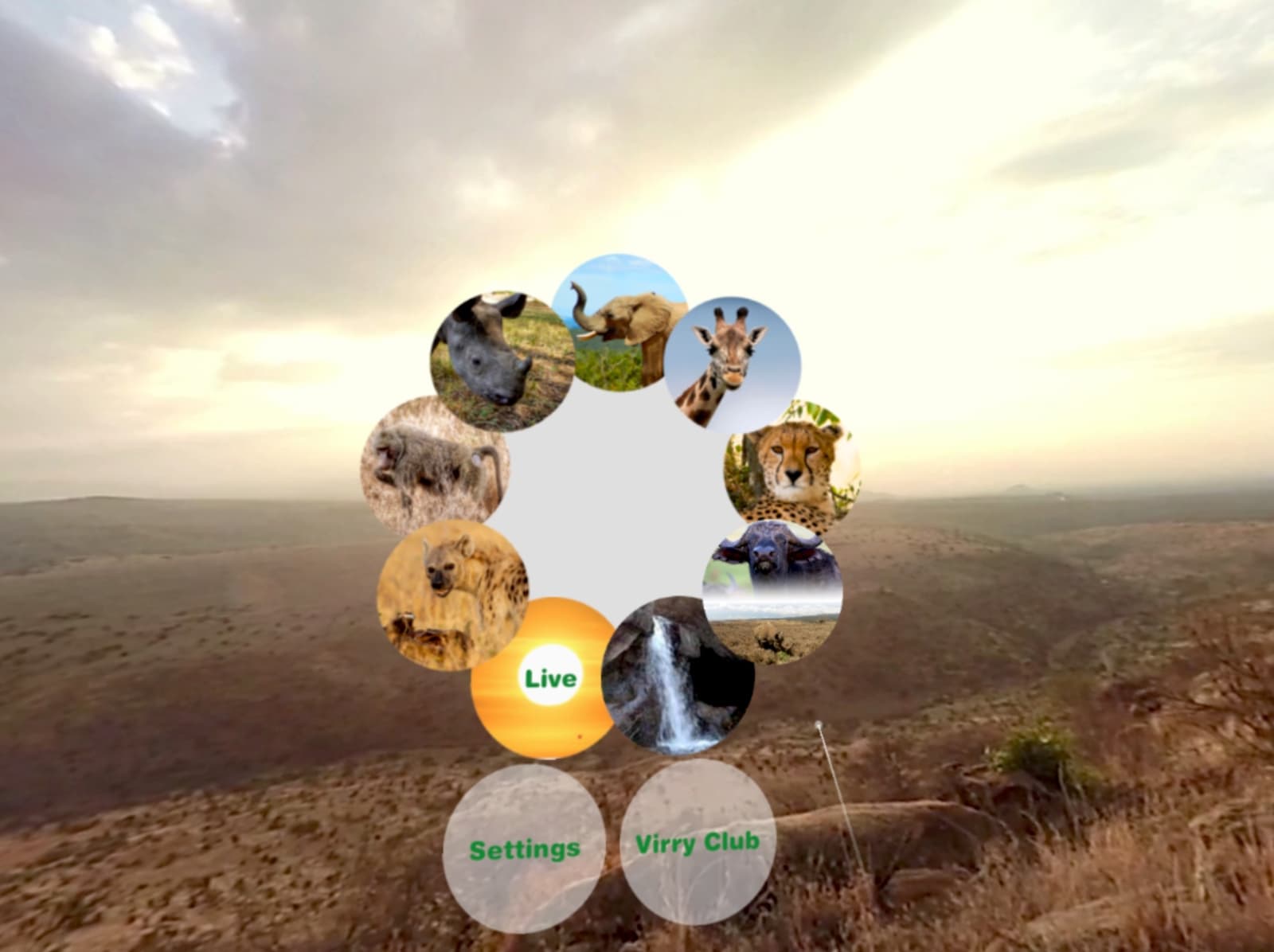
From the app’s main menu, you can choose from a handful of prerecorded environments including woodlands, a jungle river and savanna. Make a choice and you’re transported there. In the case of the savanna, you look out onto the horizon to pick from a trio of encounters. Gaze to the left and you’ll see an elephant icon. Front and center, you’ll spot one for lions, and to the right is another for hyenas. Each experience lasts five or six minutes.
Fountain Digital
Initially, Dragayeva’s team thought all it would need to do was drop food in front of its cameras and the animals would be drawn to them and more or less ham it up. Dragayeva and her team spent months in preproduction working on scripts for Virry only to discover that animals don’t follow any schedule but their own. “In our scripts, you could see what every animal was supposed to be doing as if they were actors,” she said. “On the first day [of shooting], we discovered that animals really don’t care what we think.”
When you shake the PS4’s controller and drop a bundle of acacia branches for the elephants to eat, an adorable juvenile cautiously trudges over to inspect the noise. It gets spooked and awkwardly runs back to its herd. Time shifts forward, and when the mother comes over, though, things are different. She’s hungry and starts grabbing the branches off the ground with her trunk.
“On the first day [of shooting], we discovered that animals really don’t care what we think.”
A soothing female voice with a British accent explains that acacia branches are an elephant’s favorite food and that the massive mammals use their tusks as a sort of helping hand while eating. Then she asks you to pick which tusk is used most, hinting that the length of each should be a clue. There isn’t a penalty for getting the questions wrong. Instead, the voiceover will nudge you in the right direction. When you finally answer correctly, the disembodied voice explains that the pachyderms may have evolved shorter tusks as a means of being less attractive to poachers. All the while, the gargantuan creature is chowing down, peeing and not even paying attention to the camera.
Predators like lions and hyenas aren’t so easy to fool, however, and mostly ignore it when you shake the controller to drop fresh meat. After filming was completed, Dragayeva had to alter the script to reflect what actually happened. Now, the voiceover explains that because the meat wasn’t a fresh kill, the big cat ignored it.
On the other hand, one of the baboons was so interested in the camera that it licked it, broke the mount, knocked it to the ground and batted it around. Dragayeva said the animal ran off with it, but that section was cut out to avoid giving people motion sickness. Before exiting the scene, you’re quizzed again, this time about the conservation status for olive baboons. The voice-over cheerfully explains that they’re very abundant.

An olive baboon.
Education Images via Getty Images
Dragayeva said it’s important to make people feel happy when they’re using Virry because otherwise it wouldn’t be nearly as effective. If you sit at the menu too long, a voice-over even cheesily suggests you “think about using Virry as an everyday tool to help relax and achieve a happier life.”
“I want you to have fun,” Dragayeva said “I want you to laugh, to smile. I want your mood to become better because I think that if your mood is better, you’ll want to share your happiness.” If you’re happier afterward, she suggested, maybe on the way home you’ll buy flowers for your significant other, and perhaps they’ll pick up a piece of litter off the ground. Admittedly this butterfly-effect conservation is a bit of a stretch. It relies on people being inherently good and the notion that your good deeds can inspire others to do the same.
In addition to the prerecorded vignettes, Virry also offers live-feeds from Lewa as a way to support the Conservancy via an in-app subscription. It’s a direct, actionable item that, like the interactivity of Virry itself, helps the app stand apart from traditional nature documentaries. For $2 each month (there’s a free trial as well) you’ll get access to live cameras at the nonprofit. There are a lot of empty fields, but if you’re patient enough, you might spot a zebra or giraffe.
Dragaveya has big plans for Virry. There’s another safari installment in the works, and she’s also planning two art-focused apps, including one for meditation. A version of Virry is also available for mobile devices, and the company has a close relationship with Oculus, which is helping fund development of the additional projects.
“Just because I watched a documentary on children dying in Africa, children will not stop dying.”
Dragayeva knows that even with Facebook’s money, her projects aren’t going to have the same impact as tougher laws against poachers or deforestation. At the end of the day, she’s making documentaries, not saving the northern white rhino from extinction.
“Just because I watched a documentary on children dying in Africa, children will not stop dying,” Dragayeva said. She realizes art can only do so much to make an impact and that her dreams of changing the world via VR are lofty. However, she won’t stop trying.
Latest WhatsApp Update Touts Instagram and Facebook Video Support
WhatsApp for iOS has been updated to support inline Instagram and Facebook video playback, according to the messaging platform’s latest release notes.
YouTube videos have been playable for some time in WhatsApp, which also offers a Picture-in-Picture mode for continuing to watch while switching between chat threads. However, clicking on an Instagram or Facebook video link kicks users out of the app and into the respective hosting platform.
The WhatsApp changelog for version 2.18.51 indicates support for Facebook and Instagram videos has now been greenlighted by the developers, although our tests suggest the feature is still being rolled out.
The group administrator functions have also been tweaked in the latest version of the app, so that group admins can now revoke admin rights from other participants. To remove an admin, select the user in “Group Info” and select “Dismiss As Admin”.
In addition, group admins can now choose who can change a group’s subject, icon, and description. These options can also be found in Group Info under the “Group Settings” section.
At the recent Facebook F8 developers conference, CEO Mark Zuckerberg revealed WhatsApp will soon support group video calling, although he offered no timeline for the feature’s introduction. The messaging platform is also set to support stickers “soon”, including third-party ones made by developers.
Tags: Facebook, Instagram, WhatsApp
Discuss this article in our forums
Sophisticated Android malware tracks all your phone activities
An advanced type of malware can spy on nearly every Android smartphone function and steal passwords, photos, video, screenshots and data from WhatsApp, Telegram and other apps. “ZooPark” targets subjects in the Middle East and was likely developed by a state actor, according to Kaspersky Lab, which first spotted and identified it.
ZooPark has evolved over four generations, having started as simple malware that could “only” steal device account details and address book contacts. The last generation, however, can monitor and exfiltrate keylogs, clipboard data, browser data including searching history, photos and video from the memory card, call records and audio, and data from secure apps like Telegram. It can also capture photos, video, audio and screenshots on its own, without the subject knowing. To get the data out, it can silently make calls, send texts and execute shell commands.
Kaspersky — a company with its own spotty security history that has been banned by the US government — said that it has seen less than 100 targets in the wild. “This and other clues indicates that the targets are specifically selected,” Kasperky Lab’s Alexey Firsh told ZDNet. It also implies that the campaign is backed by a nation state, though the security firm didn’t say which.

At the same time, Kaspersky suggested that the malware might not have been built in-house. “The latest version may have been bought from vendors of surveillance tools,” it wrote. “That wouldn’t be surprising, as the market for those espionage tools is growing, becoming popular among governments, with several known cases in the Middle East.”
As is now known, a lot of those tools came from the US government itself. A group called Shadow Brokers famously stole exploits from the NSA — some of the zero day, unpatched variety — and eventually released them to the public. In other words, a hacking group was able to obtain malware from what should be the most secure agency in the world. That’s one of the reasons that security experts and companies like Apple don’t trust the US government with device backdoors.
Via: ZDNet
Source: Kaspersky
British watchdog group orders Cambridge Analytica to hand over data
As the fallout of data firm Cambridge Analytica continues, a U.K. data privacy watchdog group has ordered that the company cede all of the personal information it collected from an American professor back to him, noting that even non-British citizens have the right to seek and obtain data held by a British firm. In doing so, the Information Commissioner’s Office (ICO) has set a precedent for how Cambridge Analytica and other firms would have to deal with illegally collected information, potentially allowing millions of other U.S. Facebook users to demand information on exactly what data companies have on them.
In a notice posted on Saturday, the ICO said that it had “served a legal notice on SCL Elections Ltd,” the parent company of Cambridge Analytica, “ordering it give an academic all the personal information the company holds about him.” In total, the company will have 30 days to comply with the subject access request, as submitted by Professor David Carroll. If Cambridge Analytica does not do so, it will be violating the Data Protection Act of 1998, and will be committing a criminal offense “punishable in the courts by an unlimited fine.”
Carroll first submitted a request to Cambridge Analytica for his data in January 2017, at which point SCL Group requested that he submit a 10 pound fee and proof of identity in order to obtain such information. In March, he received a spreadsheet that the company claimed contained all of his personal data to which he was legally entitled. But Carroll was not convinced that this was truly the extent of the damage, nor did he receive an “adequate explanation of where it had been obtained from or how it would be used.” As such, he complained to the ICO last September, and now eight months later, may finally be getting his way.
“[SCL Group] has consistently refused to co-operate with our investigation into this case and has refused to answer our specific enquiries in relation to the complainant’s personal data — what they had, where they got it from and on what legal basis they held it,” said Information Commissioner Elizabeth Denham in statement. “The right to request personal data that an organization holds about you is a cornerstone right in data protection law and it is important that Professor Carroll, and other members of the public, understand what personal data Cambridge Analytica held and how they analyzed it.”
The Commissioner concluded, “We are aware of recent media reports concerning Cambridge Analytica’s future but whether or not the people behind the company decide to fold their operation, a continued refusal to engage with the ICO will potentially breach an Enforcement Notice and that then becomes a criminal matter.”
Editors’ Recommendations
- Facebook was always too busy selling ads to care about your personal data
- 9 things to know about Facebook privacy and Cambridge Analytica
- Cambridge Analytica used more apps to steal data, former employee claims
- Cambridge Analytica designed cryptocurrency to sell back your personal data
- Localblox data breach is the latest nightmare for Facebook, LinkedIn
Nike wants to put treadmills in shoes to help you get them on
Nike is proving itself to be the master innovator when it comes to footwear once again, but this time it has nothing to do with 3D-printed soles or recycled materials for the upper. Instead, it’s all about the treadmill. You may no longer need to hit up the gym to get on the running machine — you’ll just need to put on your shoes. As per a new patent filed in early May, Nike is looking to place a “rotatable conveyor element” in the sole of your shoe. No, it’s not to help you work out. Rather, it’s to help you put on the shoe a bit more easily.
The concept contained within the patent includes an “insole, an upper configured to form a space between the upper and the insole,” which in turn is “configured to admit and secure a foot of a wearer.” And then, most importantly, there’s the conveyer belt portion, or for our purposes a mini treadmill. This little machine is “configured to rotatably engage a body part of the wearer as the foot enters the space and draw the foot into the space.” So no longer will you have to wrestle with your shoe to get it on. Instead, your foot will slide right in.
Also included in the patent is a controller mechanism. After all, you wouldn’t want your conveyer belt/mini-treadmill to be running all day long. As such, Nike has described a controller that is “coupled to an activation mechanism, such as a switch or mechanism to detect the presence of a foot.” Such mechanisms could be a magnetic field sensor that senses a change in the capacitance, indicating that a foot is nearby. It could also be a switch either inside or outside the shoe that you would need to activate in order for your foot to be conveyer-belted into the shoe.
We’ll give Nike some more time to figure that one out.
The conveyer belt mechanism could be used to help you take your shoe off at the end of the day, saving you precious seconds once you walk though the door. As is the common case with these cases, just because Nike has filed a patent for such an invention doesn’t necessarily mean it’ll come to fruition. But like many out-there patents, we wouldn’t mind seeing it happen.
Editors’ Recommendations
- How to create a route in MapMyRun
- The best running shoes
- Adidas AM4NYC runners are templates for shoe design in the future
- Once you put them on, you may never want to take Suavs shoes off
- Nike’s 3D-printed uppers take weight off your feet
Facebook opens A.I. research labs in Seattle and Pittsburgh
Facebook has announced that it is opening two new artificial intelligence research labs in Pittsburgh and Seattle. The labs will include professors hired from the University of Washington and Carnegie Mellon University. This has prompted some fears that Facebook is poaching the instructors needed to train the next generation of A.I. researchers.
“It is worrisome that they are eating the seed corn” Dan Weld, a computer science professor at the University of Washington told the New York Times. “If we lose all our faculty, it will be hard to keep preparing the next generation of researchers.”
Experts in the field of A.I. and machine learning can often command extremely high salaries, making it difficult for universities and other non-profit research centers to compete with the likes of Facebook and Google.
In a recent post, Facebook’s director of A.I. research, Yann LeCun, says that that company’s goals have been misinterpreted. Rather than poach qualified experts from universities, Facebook is hoping to create a model where both the public and private sectors can benefit.
“Professors gain a different type of experience in industry that can have a positive impact on their students and on their research,” LeCun said. “Additionally, their connection with industry helps produce new scientific advances that may be difficult to achieve in an academic environment, and helps turn those advances into practical technology. Universities are familiar with the concept of faculty with part-time appointments in industry. It is common in medicine, law, and business. ”
LeCun stressed that the company’s goal with its FAIR program was to create a healthy partnership between Facebook and the universities which contributed to its research labs.
“Unlike others, we work with universities to find suitable arrangements and do not hire away large numbers of faculty into full-time positions bottled up behind a wall of non-disclosure agreements,” he added. “We contribute to local ecosystem.”
Facebook itself has plenty of reasons to be investing in A.I. Many of the company’s latest initiatives, such as photo and video sorting ,are reliant on machine learning. The social network is also experimenting with A.I. that can read text in order to help filter out hate speech and extremist organizations.
Editors’ Recommendations
- Robot chefs are the focus of new Sony and Carnegie Mellon research
- LED-studded ‘electronic skin’ monitors your health, makes you look like a cyborg
- Thanks to A.I., there is finally a way to spot ‘deepfake’ face swaps online
- Poachers don’t stand a chance against these A.I.-powered camera drones
- Baidu’s pocket translator is a ‘Star Trek’ dream come to life
No map, no problem: MIT’s self-driving system takes on unpaved roads
If you find yourself on a country road in a self-driving car, chances are you’re both pretty lost. Today’s most advanced autonomous driving systems rely on maps that have been carefully detailed and characterized in advanced. That means the millions of miles of unpaved roads in the United States are effectively off-limits for autonomous vehicles.
But a team of computer scientists from the Massachusetts Institute of Technology’s (MIT) Computer Science and Artificial Intelligence Laboratory (CSAIL) have designed a self-driving system aimed at successfully navigating unpaved roads by using basic GPS data and sensors technology.
“We were realizing how limited today’s self-driving cars are in terms of where they can actually drive,” Teddy Ort, an MIT CSAIL graduate student who worked on the project, told Digital Trends. “Companies like Google only test in big cities where they’ve labeled the exact positions of things like lanes and stop signs. These same cars wouldn’t have success on roads that are unpaved, unlit, or unreliably marked. This is a problem. While urban areas already have multiple forms of transportation for non-drivers, this isn’t true for rural areas. If you live outside the city and can’t drive, you don’t have many options.
Ort and his colleagues think their system, which they’ve named MapLite, could change that.
Using simple GPS data that can be found on Google Maps and an array of sensors to scan the surroundings, MapLite navigates along unpaved roads, observing road conditions over 100 feet in advance.
“Existing systems still rely heavily on 3D maps, only using sensors and vision algorithms for specific aspects of navigation, like avoiding moving objects,” Ort said. “In contrast, MapLite uses sensors for all parts of navigation, using GPS data only to obtain a rough estimate of the car’s location in space. The system first sets both a final destination and what we refer to as a ‘local navigation goal,’ which has to be within the view of the car.”
But there are good reasons why other autonomous system use detailed maps. For one thing, when they work, they work well. Put an advanced autonomous car on a road that’s been previously mapped, and you’re pretty much guaranteed that it will be able to navigate just fine.
MapLite, on the other hand, doesn’t come equipped with this experience and, thus, lacks the guarantee.
Moving forward, the CSAIL researchers will attempt make MapLite more versatile, capable of navigating various road types. They have no plans to commercialize the system yet, though Ort said they’re working with Toyota to incorporate the system into future vehicles.
Editors’ Recommendations
- MIT’s new A.I. could help map the roads Google hasn’t gotten to yet
- Ambarella launches Silicon Valley autonomous car demo despite Uber crash
- How Nvidia is helping autonomous cars simulate their way to safety
- MIT drones navigate more effectively in crowded spaces by embracing uncertainty
- Autonomous cars with remote operators to hit California streets in April
No map, no problem: MIT’s self-driving system takes on unpaved roads
If you find yourself on a country road in a self-driving car, chances are you’re both pretty lost. Today’s most advanced autonomous driving systems rely on maps that have been carefully detailed and characterized in advanced. That means the millions of miles of unpaved roads in the United States are effectively off-limits for autonomous vehicles.
But a team of computer scientists from the Massachusetts Institute of Technology’s (MIT) Computer Science and Artificial Intelligence Laboratory (CSAIL) have designed a self-driving system aimed at successfully navigating unpaved roads by using basic GPS data and sensors technology.
“We were realizing how limited today’s self-driving cars are in terms of where they can actually drive,” Teddy Ort, an MIT CSAIL graduate student who worked on the project, told Digital Trends. “Companies like Google only test in big cities where they’ve labeled the exact positions of things like lanes and stop signs. These same cars wouldn’t have success on roads that are unpaved, unlit, or unreliably marked. This is a problem. While urban areas already have multiple forms of transportation for non-drivers, this isn’t true for rural areas. If you live outside the city and can’t drive, you don’t have many options.
Ort and his colleagues think their system, which they’ve named MapLite, could change that.
Using simple GPS data that can be found on Google Maps and an array of sensors to scan the surroundings, MapLite navigates along unpaved roads, observing road conditions over 100 feet in advance.
“Existing systems still rely heavily on 3D maps, only using sensors and vision algorithms for specific aspects of navigation, like avoiding moving objects,” Ort said. “In contrast, MapLite uses sensors for all parts of navigation, using GPS data only to obtain a rough estimate of the car’s location in space. The system first sets both a final destination and what we refer to as a ‘local navigation goal,’ which has to be within the view of the car.”
But there are good reasons why other autonomous system use detailed maps. For one thing, when they work, they work well. Put an advanced autonomous car on a road that’s been previously mapped, and you’re pretty much guaranteed that it will be able to navigate just fine.
MapLite, on the other hand, doesn’t come equipped with this experience and, thus, lacks the guarantee.
Moving forward, the CSAIL researchers will attempt make MapLite more versatile, capable of navigating various road types. They have no plans to commercialize the system yet, though Ort said they’re working with Toyota to incorporate the system into future vehicles.
Editors’ Recommendations
- MIT’s new A.I. could help map the roads Google hasn’t gotten to yet
- Ambarella launches Silicon Valley autonomous car demo despite Uber crash
- How Nvidia is helping autonomous cars simulate their way to safety
- MIT drones navigate more effectively in crowded spaces by embracing uncertainty
- Autonomous cars with remote operators to hit California streets in April
MIT’s self-driving car can navigate unmapped country roads
There’s a good reason why companies often test self-driving cars in big cities: they’d be lost most anywhere else. They typically need well-labeled 3D maps to identify curbs, lanes and signs, which isn’t much use on a backwoods road where those features might not even exist. MIT CSAIL may have a solution, though. Its researchers (with some help from Toyota) have developed a new framework, MapLite, that can find its way without any 3D maps.
The system gets a basic sense of the vehicle’s location using GPS, and uses that for both the final destination and a “local” objective within view of the car. The machine then uses its onboard sensors to generate a path to those local points, using LiDAR to estimate the edges of the road (which tends to be much flatter than the surrounding landscape). Generic, parameter-based models give the car a sense of what to do at intersections or specific roads.
MapLite still isn’t ready to handle everything. It doesn’t know how to cope with mountain roads and other sharp changes in elevation, for instance. However, the ultimate goal is clear: CSAIL wants autonomous cars that can safely navigate any road without hand-holding. While 3D maps may still be useful for dealing with the complexity of cities, this could be vital for rural trips, snowy landscapes and other situations where the car needs to improvise.
Source: MIT CSAIL (YouTube)
 AIVAnet