


Volvo aims for half of its sales to be fully electric by 2025
Last year, Volvo announced that starting in 2019, all models it unveils will have an electric motor, whether it by a hybrid, a plug-in hybrid or a fully electric EV. Today, Electrek reports, the automaker has added to its electric goals. At the Beijing Auto Show today, CEO Håkan Samuelsson said that by 2025, the company would like half of all sales to be for fully electric vehicles. “Last year we made a commitment to electrification in preparation for an era beyond the internal combustion engine,” said Samuelsson. “Today we reinforce and expand that commitment in the world’s leading market for electrified cars.”
In June, Volvo relaunched its Polestar performance brand as a standalone line focused on electric cars and the company also said last year that it would release five fully electric models between 2019 and 2021, three under the Volvo brand and two under Polestar.
Most automakers have set some sort of EV goals for the near future. Mercedes-Benz said last year that it plans to offer electric versions of all of its cars by 2022 while Aston Martin announced that all of its vehicles would be hybrids or EVs by the mid-2020s and a quarter of its sales would come from EVs by 2030. Volkswagen is aiming to offer electric versions of each of its existing models by 2030 and is shooting for 80 new EVs across its brands by 2025. And Jaguar said last year that all of its new cars will be a hybrid or an EV starting in 2020. Meanwhile, Honda announced in 2016 that it wants two-thirds of its vehicles to be electric by 2030.
Volvo doesn’t yet have a fully electric vehicle in its lineup, but one is expected out next year.
Via: Electrek
Sheryl Sandberg: Facebook has ‘thought about’ paid subscriptions
When Facebook CEO Mark Zuckerberg testified in front of a Senate commission earlier this month, he made a statement that hinted at the company exploring paid subscriptions down the line. He specifically said that they would always offer a free version of Facebook, leaving the door open for other paid versions as well. On today’s earnings call, COO Sheryl Sandberg got even more concrete, saying that “we’ve certainly thought about lots of other forms of monetization including subscriptions, and we’ll always continue to consider everything.”
The latter half of that statement is the expected executive speak about everything being on the table, but the fact that Sandberg specifically mentioned subscriptions so soon after Zuckerberg hinted at a paid version of Facebook is worth taking note. Neither executive has talked about what might differentiate a paid Facebook experience from what the site currently offers — but if it’s more privacy protections, a lot of people will probably at least investigate signing up. It wouldn’t take a lot of Facebook’s massive user base to turn this into a notable revenue generator.
Zuckerberg: It’s easier for AI to detect nipples than hate speech
Today, Facebook released its Q1 earnings, which showed the company can still make more money and attract more users year-on-year despite staggering controversy. During a Q&A session after with Mark Zuckerberg and other executives, the CEO fielded a question on artificial intelligence’s role in automatically detecting harmful content on the platform. Its AI isn’t so good at catching hate speech, but has done a great job intercepting terrorist content. Some things are just easier for robots to spot, Zuckerberg elaborated:
“It’s much easier to build an AI system to detect a nipple than it is to detect hate speech,” he said.
It shouldn’t be a surprise that Facebook’s AI can spot nipples given the platform’s history of banning, then begrudgingly allowing, breastfeeding and nudity in iconic photos. (Though it still doesn’t let folks #freethenipple on Instagram.) But Facebook has outlined practical reasons for why its AI should be combing the platform for nipples. Its adult and nudity policy lists all the content the platform removes by default — not just for users more sensitive to sexual imagery, but to prevent the sharing of content depicting non-consensual acts or underage people.
Ford will stop selling most of its cars in North America
If there was any doubt that the auto industry is rapidly changing, Ford just delivered proof. The industry pioneer is scaling back its North American small car lineup in North America to just two vehicles, the Mustang and the unrevealed Focus Active crossover, in the “next few years.” The rest of its range will be limited to SUVs, trucks and commercial vehicles. Ford isn’t shy about its reasons: “declining consumer demand and product profitability” make it impractical to develop other sedans. You’d better act quickly if you’ve been looking at a brand new Fusion or Taurus.
While the brand wasn’t too specific beyond that, it noted that it was adding hybrid powerplants to many of its vehicles, ranging from the Mustang to historical gas guzzlers like the Explorer and F-150. It reiterated that it’ll launch its first all-electric vehicle (the Mach 1 SUV) in 2020, and that it would have 16 EV models on the market by 2022. Some of the incentives for buying small cars, such as fuel economy, are going out the window — you don’t need to buy a compact car to get decent mileage. Combine that with North America’s fondness for SUVs and small cars faced a major challenge.
There’s also the matter of overall declining car ownership. Even if you discount changing tastes and economic situations, there just isn’t as much reason to own a car as there once was. You can order many products online instead of visiting the store, and ridesharing can frequently cover quick trips. That’s before self-driving cars arrive, too. Why pour so much money into sedans when many people might hop into robotic cars?
Other automakers haven’t cut most of their lines, and we wouldn’t count on when competitors like Honda and Toyota are still committed. Just don’t be surprised if Ford’s move is the start of a trend rather than an exception.
Via: TechCrunch, Autoblog
Source: Ford (PDF)
Sonos One, Playbase, and Play:5 Will Support AirPlay 2 Functionality
When Sonos introduced the new Sonos One back in October, the company confirmed it would add AirPlay 2 support to Sonos speakers later in 2018.
At the time, Sonos did not specify which of its devices would support the new protocol, but Sonos appears to have offered some clarification in the form of new details provided to Mac Observer.
Mac Observer says native AirPlay 2 support will be available on the Playbase, the newest version of the Play:5, and the Sonos One.
Older Sonos speakers will not support AirPlay 2 on their own, but they can be paired with the Playbase, the Play:5, or the Sonos One to enable AirPlay 2 functionality. A Sonos Play:1 grouped with a Sonos One, for example, will support AirPlay 2.
Since we all like things to be simple, here’s the easy test to remember: if your Sonos has touch controls, it natively supports AirPlay 2. If your Sonos is old enough to have buttons, it only supports AirPlay 2 in a group.
Apple thus far has not released AirPlay 2, despite the fact that it was first introduced as a feature of iOS 11 back in June of 2017. AirPlay 2 functionality was initially included in iOS 11.3 and tvOS 11.3 betas, but it was pulled ahead of the release of those updates.
AirPlay 2 functionality is now included in iOS 11.4 and tvOS 11.4, but it is not yet clear if the features will be included in the final version of the software.
Related Roundup: iOS 11Tags: AirPlay, Sonos
Discuss this article in our forums
ClutchPoints gives a new view to mainstream sports (review)

There are several sports apps on the market, and most of them try to be everything to everybody, covering pretty much every angle of every sport imaginable. While a noble effort, and appealing to the greatest number of potential fans, a lot of times this ends up making the app interface a confusing labyrinth; resulting in a convoluted mess.
While there are a number of ways to track your scores and highlights, a newer option out there has come into the limelight: ClutchPoints, a sports news and tracking app, much like the big boys out there….but with one main difference.
ClutchPoints focuses only on the mainstream pro sports; and in that just the “big 3”: MLB baseball, NBA basketball, and NFL football. That’s it. No beach volleyball, cricket, or other ancillary pro and amateur sports vying for your eyeballs.
Features
The idea seems to be, “Hey, let’s start with the popular sports apps, and pare it down to just the most mainstream sports. Then let’s freshen it up with intense colors, uber-modern layouts, and photos & videos everywhere!”. And for the most part, they hit the mark.
Opening ClutchPoints, you have a pretty modern interface, looking much like a very clean sports website (there is an established website that the app emulates). At the top you pick from your 3 sports leagues, MLB, NBA, and NFL. Within each you can also pick your favorite/primary teams to follow, to ensure these appear first and most often.
The NBA playoffs are amongst us; two months plus of non-stop pro basketball bliss for casual & hardcore fans alike. Let’s use these games as the focus for this review…
At the bottom of your screen you have several icons:
- A ball (games)
- A newspaper (news)
- A trophy (playoffs)
- A graph (team & player stats)
- A generic avatar (the social corner, using Facebook as your hub)
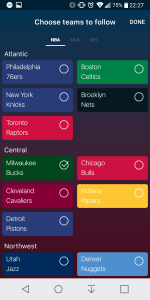
Pick your favorite team(s)

News, news, & more news!
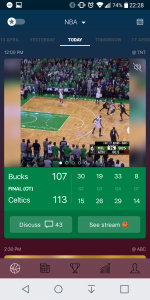
Game recaps
Starting out with games, you get what I’d call a “scrolling newspaper” effect. Each of today’s games (you can choose days by scrolling left-right-left from the top) is listed top-to-bottom in its own block. Each game shows the score (duh), plus several videos/photos/news overlays in a mini-slideshow right in the window. There’s also a button to allow you to vote on who will win, and also a comments section to talk (argue) about who’s going to win, and why.
Even More Features
Clicking on the game takes you to several more options:
- Stream (a live-blog with immediate highlights and small real-time news snippets)
- Box score (self-explanatory)
- Matchup (a mix of stats and graphs; similar to the game summary a network put on-screen coming out of halftime but updated in real-time).
- Play by Play (a time-stamped narrative of each score, rebound, timeout, etc.)
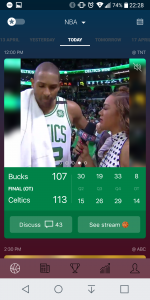 Get different views of the game
The color palette was very noticeable to me, in that in addition to a deep red-to-blue transition in the background, each block of game or news provides a contrasting color that is wonderfully organic yet contrast-y. I don’t know a better way to put it, but it’s one of the best overall uses of color I’ve ever experienced in any app, ever. ClutchPoints really nailed this aspect of their app build.
What Else?
The News section is impressively updated and comprehensive at the same time. In this
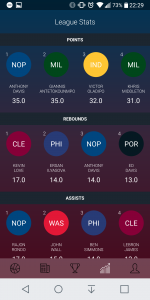 Feed your stats appetite!
section the sports are compiled by chronology, listing all the trending stories in the Big Three, with live links to tweets and other social media posts.
As a closet stat-head, the graphs tab may be my favorite. This is a scrolling list of statistical categories (scoring, assists, etc.). Under each category is the live list of that stats leaders, by team & player, scroll-able left-to-right.
Perhaps the best part about this page is the speed of this page. I could scroll up/down and left/right/left, at what almost felt simultaneous. The movement/animation is extremely smooth, and the presentation is very efficient. You get the category, team/player, and categorical stat, and that’s it. With this approach, you can plow through all kinds of categories and get your numbers fix in satisfyingly extreme speed…..sweet.
Overall
If you can’t tell by now, I’m truly & very impressed with ClutchPoints. If you’re into any combination of the Big Three pro sports leagues, you owe it to yourself to give this app a test ride. Chances are you’ll find ClutchPoint’s approach a fresh breath, and one you’ll want to hang to.
Download the ClutchPoints app from the Play Store
Pro gaming team signs 13-year-old ‘Fortnite’ player
Among the four members making up pro gaming organization Team Secret’s new European Fortnite squad, one stood out: 13-year-old Kyle “Mongraal” Jackson. Almost immediately after the team was introduced today, news outlets jumped on Jackson’s youth. Even if he may not hold the record (some say the then-12-year-old Jun “TY” Tae Yang was picked up to play StarCraft in 2006, noted Cybersport.com), the Fortnite ace is one of the youngest ever signed to pro team.
Perhaps in reference to his youth, Team Secret cheekily introduced Jackson as ‘pound for pound, UK’s best.’ Apparently, he had been playing with his other three teammates before, and the pro gaming organization picked up the squad intact and christened it their official Fortnite team, according to ESPN. Team Secret’s CEO John Yao didn’t actually know Jackson was that young when he signed him and his older (17-, 20- and 21-year-old) teammates.
“I actually had no idea he was 13 until the team told me,” Yao told ESPN. “Because when we looked at some of the videos and we looked at their game play, it was not apparent. What immediately stood out to me was how mature he was, and he sounded just like one of the other guys.”
To prove the foursome’s chops, Team Secret added a highlight reel. Doubters can see Jackson’s prowess at 1:19, where he demonstrates the fanatically fast construction-duelling that’s come to characterize Fortnite’s high-skill combat.
Yao admitted to ESPN that age restrictions might lock Jackson out of competition, but even if Epic Games establishes a minimum if (or when) it introduces a formal Fortnite league, tournaments probably won’t have a requirement. Still, competitive gaming is already grappling with its young playerbase. The Overwatch League has fired a pair of players for hate speech and alleged sexual harassment. Teams want to field late-teen and early-20s talent for their top-tier skills, but immaturity and unprofessionalism have stained pro competition.
Via: Cybersport.com
Source: Team Secret
Electronic locks in over 40,000 hotels worldwide compromised, says security firm
Security research firm F-Secure has discovered a critical vulnerability in electronic locks made by the world’s largest lock manufacturer, Assa Abloy. The vulnerability allowed F-Secure researchers to gain access to any locked room in hotels secured by one of Assa Abloy’s electronic lock systems — leaving roughly 40 thousand major hotels around the world potentially exposed.
“The researchers’ attack involves using any ordinary electronic key to the target facility – even one that’s long expired, discarded, or used to access spaces such as a garage or closet. Using information on the key, the researchers are able to create a master key with privileges to open any room in the building. The attack can be performed without being noticed,” F-Secure’s announcement reads.
With this exploit, F-Secure researchers were able to gain “master key” access to any hotel facility using Assa Abloy’s VingCard system — all they needed was a guest’s key card. Using off-the-shelf hardware, F-Secure’s researchers were able to read these key cards remotely — say, through your pocket — and using the same device, effectively circumvent the electronic key card system’s protections in just a matter of minutes, creating their own master keys out of thin air. To be clear though, this system is primarily used in the hospitality industry, and consumer Assa Abloy products are unaffected.
“You can imagine what a malicious person could do with the power to enter any hotel room, with a master key created basically out of thin air,” said Tomi Tuominen, practice leader at F-Secure.
Tomi said F-Secure doesn’t believe anyone is currently using this exact exploit in the wild, which should help all you frequent travelers breathe a sigh of relief. Still, that doesn’t mean there aren’t similar vulnerabilities in electronic key card systems. After all, F-Secure’s odyssey to discover this vulnerability was kicked off after one of its researchers experienced a similar exploit firsthand.
“The researchers’ interest in hacking hotel locks was sparked a decade ago when a colleague’s laptop was stolen from a hotel room during a security conference. When the researchers reported the theft, hotel staff dismissed their complaint, given that there was not a single sign of forced entry, and no evidence of unauthorized access in the room entry logs,” the announcement continues.
F-Secure has been working hand in hand with Assa Abloy to mitigate this particular vulnerability and develop software patches for all affected hotel properties.
“I would like to personally thank the Assa Abloy R&D team for their excellent cooperation in rectifying these issues,” said Tuominen. “Because of their diligence and willingness to address the problems identified by our research, the hospitality world is now a safer place. We urge any establishment using this software to apply the update as soon as possible.”
Editors’ Recommendations
- SimpliSafe and August Lock integrate smart locks with security systems
- Why Ring’s porch-protecting cameras made it a no-brainer acquisition for Amazon
- AMD is working on fixes for the reported Ryzenfall, MasterKey vulnerabilities
- August Home smart locks expand integration with Google Assistant
- Control front door security from your phone with the Nest x Yale Lock
Facebook acts as unwitting sales platform for identity thieves
On top of the other scandals surrounding Facebook at the moment, a new investigation has discovered that identity thieves regularly make use of the social network to spread and sell people’s personal information. The investigation turned up sales posts for credit card and social security numbers, alongside other personal information, some of which dates back years and is still live on the site.
Although the sale of personal information is often most associated with sites on the dark web, Facebook appears to be a popular avenue of sale, too. The activity isn’t even well hidden. Motherboard’s investigation turned up a plethora of public posts that offered a variety of personally identifiable information. Such data could be used to make fraudulent bank transfers, clear out Paypal accounts, take out loans in a person’s name, or steal their identity entirely.
Posters also listed contact details for potential buyers, alongside prices for the various pieces of personal information they had for sale.
As Motherboard highlighted though, what was most worrisome about these posts is that they have existed on Facebook for years without being taken down. In some cases, posts from 2014 were discovered and were only pulled by Facebook after being actively reported by the investigation.
Security professionals have exhibited surprise and concern that Facebook doesn’t have automated systems in place to block, or at least highlight such posts. They assert it should be easy for Facebook to do so, even with the sheer size of the organization and its now multiple billions of users.
Facebook later released a statement on the matter:
“We work hard to keep your account secure and safeguard your personal information. Posts containing information like Social Security numbers or credit card information are not allowed on Facebook, and we remove this material when we become aware of it. We are constantly working to improve these efforts, and we encourage our community to report anything they see that they don’t think should be in Facebook, so we can take swift action.”
This report follows a recent one by KrebsOnSecurity which highlighted how groups dedicated to sharing hacked information had hundreds of thousands of members, each leveraging Facebook to gain access to stolen information or new malware.
Editors’ Recommendations
- Mozilla’s Facebook Firefox tool helps keep your browsing habits more private
- Logging in with Facebook may let Javascript trackers steal personal data
- Facebook is on a fake-finding campaign before the next election
- Facebook investigating more security vulnerabilities with third-party logins
- Social Feed: Embeds might be iIllegal, Vimeo adds simultaneous live-streams
Buying on a budget? Here’s all the best tech you can snag for $25 or less
25 bucks might not sound like a whole lot, but you’d be surprised what you can get for such a small sum of money. We live in a world where you can get a cheeseburger for $1, a functioning computer for $5, and thousands of HD movies for $10 — so it stands to reason that you should be able to pick up some pretty sweet gear for $25. In this article, we’ve rounded up some of the best gear and gadgetry you can get your paws on for $25 or less. Enjoy!
Tile (2nd Gen) Item Finder ($25)
Originally, Tile was a little device that you could clip to your keys or stick in your bag. During your morning misplaced-my-keys routine, you could use your smartphone to track it down, as long as you were in 50 to 100 feet of the lost item. The Tile would play a little song to help you find the object. The problem was that its 0.5-inch thickness still made it a bit too bulky to stick on your phone. Now, Tile has announced its app update allows users to find a missing phone, even when it’s on silent or vibrate.
Amazon
Bondic Plastic Welder ($24)
Forget super glue. Instead of haphazardly squeezing some adhesive out of a tube, Bondic allows you to join two materials together with liquid plastic that hardens under UV light. You know those little UV glue guns that dentists use to fill minor cavities before they get too serious? It’s basically the exact same adhesive technology, just tweaked a little and redesigned for a different purpose. This is a must have if you’re prone to breaking sunglasses a lot!
Amazon
Ultralight camping hammock $20+
You know those ultralight camping hammocks that ENO sells for like $60-$90 a pop? Don’t get one. As it turns out, they’re just made from standard ripstop nylon parachute fabric, and cost very little to produce. You can actually get an off-brand hammock made out of the exact same material (and of the exact same quality) for less than $20 on Amazon, and it’ll hold your weight without breaking your wallet in the process.
Amazon
Sugru 8-pack ($21)
Sugru might be the greatest invention of the 21st century. When you take it out of the package, it’s soft and malleable like play-doh, allowing you to mold it into practically any shape you need. Over night, it solidifies into hard rubber — making it ideal for fixing broken things, sealing leaks, and building stuff. The potential applications are only limited by your imagination.
Amazon
Mpow 3-in-1 Clip-On Smartphone Camera Lens Kit ($12)
Smartphone cameras have come a long way in the past few years, but they’re not nearly as versatile as a camera with interchangeable lenses. If you want to take a wide angle or macro shot, you’re pretty much out of luck — unless you get yourself one of these sweet little clip-on lens kits. This one from Mpow is pretty generic, but it’s designed to clip onto just about any modern smartphone lens, which is pretty freakin cool.
Amazon
Joby Gorilla Pod ($15)
You know that old saying, “the best camera is the one you have with you”? Same thing applies to tripods. The best one is the one you have on hand, so instead of spending a small fortune on a 50-pound Manfrotto, you should drop 12 bucks on a Gorilla Pod. These things are brilliant. In addition to standing upright like a traditional tripod, their flexible legs allow them to grip onto tree branches, hand rails, and just about anything else you’ll ever need to mount a camera on.
Amazon
Anker PowerCore 5000 portable battery $15
Smartphones have come a long way in the past few years, but no matter how advanced they seem to get, they never seem to have enough battery power. Show me the most advanced smartphone we’ve got, and after 8-10 hours, i’ll show you a really expensive paperweight. But not to worry — that’s where Anker’s PowerCore 5000 comes in. Despite being small enough to fit in a pocket, purse, or backpack pouch; it can store enough juice to fully recharge most smartphones — twice.
Amazon
Generic Wi-Fi OBD2 Dongle ($23)
These things are awesome. Basically, they plug into your car’s On Board Diagnostics 2 port and provide details about what’s going on with your car. There are more expensive models that have their own proprietary smartphone apps, but you can do the same thing if you buy one of these cheap ones and use the Dash app. It’s a smart investment, too. Oftentimes these dongles help you catch problems before they get serious and require the attention of a mechanic.
Amazon
Arduino Uno ($20)
Arduino is an open-source prototyping platform based on easy-to-use hardware and software. Arduino boards are able to read inputs (light on a sensors, a finger on a button, or a Twitter message) and turn them into outputs ( activating a motor, turning on an LED, or publishing something online, for example). You can tell your board what to do by sending a set of instructions to the microcontroller on the board. You’ll need a bit of programming knowledge, but it’s fairly simple to learn, and there are a zillion tutorials online.
Amazon
WhizTags NFC Tags ($13)
NFC (near field communication) enabled phones allow users to do a variety of tasks with a simple scan of NFC tags. For instance, you can put one on your office desk and with a quick scan on the tap, your phone will set your phone to vibrate, disable GPS, and enable only work-related notifications. Scan it again and you’ll return to your normal non-work settings. The package comes with 11 NFC tags with a 3M adhesive tape on the back that allows you to stick the tags to just about anything. Though, you’ll have to download a good NFC reading app and brush up on how to configure NFC related prompts on your phone.
Amazon
Panasonic High Fidelity Ergo Fit Inner Ear Bud ($22)
Generally speaking, when you purchase ear buds for less than $25 you’ll sacrifice sound and quality. Budget earbuds may not have a secure in-ear-fit. They may cause general in-ear discomfort and an underwhelming flat sound. We all know how disappointing flat sound can be. Not the case with the Panasonic High Fidelity Ear Buds. These beasts come with 3 different earpad sizes, are made from soft silicone, and repel sweat and moisture at the gym or around town. For $22, they deliver a surprisingly clear sound.
Amazon
Nomad Charge Key $12
No longer are USB cables unruly in the pocket. The Nomad Charger Key charger is designed to live on keychain but made from a flexible material that will allow the charger to flex to accommodate awkward charging positions. It’s a great accessory for someone who’d rather not carry a USB charger around all the time. The Nomad Charge Key is lightweight and comes with a micro USB for Android devices and a lightning cable for iPhone.
Amazon
Loop Universal Power adapter $20
Know somebody who’s traveling to a foreign country sometime soon? Get them a Loop. It’s not just your average universal plug adapter — in addition to every kind of plug/socket you could ever need, it’s also equiped with smart power tech that automatically detects, recognizes, and then adapts to your device’s unique charging protocol. This allows Loop to find the optimal recharging speed for your device, which ultimately translates to shorter charging times.
Amazon
Editors’ Recommendations
- Totally tiny and cool: 18 portable tech gadgets you’ll want to use every day
- Cool camping gadgets for every outdoor adventure
- Share the power and juice up your phones with the best USB charging hubs
- A BBQ in a briefcase? 21 Amazon products you don’t need, but will probably want
- 100 awesome Android apps that will transform your tired tablet
 AIVAnet