


Google loses ‘right to be forgotten’ case over man’s past conviction
Google has usually been reluctant to honor European Union “right to be forgotten” requests when people are trying to hide past convictions, but it may have to change its stance going forward. A UK judge has ruled that Google must honor a request to erase search results for a man who had been convicted of conspiracy to intercept communications more than a decade ago. The unnamed plaintiff had shown remorse for his actions, the judge said, and the offense was relatively minor.
The court shot down an attempt by another man who had been convicted of false accounting and still seemed bent on misleading the public.
Google, unsurprisingly had objected to both requests. The EU policy wasn’t intended as a “right to rewrite history” or “tailor your past,” Google’s attorney argued — you may have rehabilitated, but that doesn’t mean you can pretend your conviction doesn’t exist.
The case highlights the challenges Google has had obeying requests under the EU rules, which some of complained are too nebulous. At the same time, it could also establish precedent for future cases. Google and other internet companies might not have the option of dismissing conviction-related requests out of hand — they may have to weigh the seriousness of crimes and the convict’s willingness to reform. And that could be tricky. At what point does a crime become too serious to wipe from search results? How does Google know a convict’s repentance is sincere? As much as this case might have done to explain Google’s responsibility, it may have introduced more confusion.
Source: Guardian
Formula One’s streaming service won’t launch until next month
We’re almost halfway through April, and Formula 1’s streaming service hasn’t launched as promised. The racing organization announced today that F1 TV will now be available next month ahead of the 2018 Gran Premio De Espana. Annual subscription rates are available for between $70 and $150, or $8 – $12 per month. “The service will be priced according to market,” the announcement reads.
The higher-pried “Pro” tier will offer live races and access to cameras on all 20 drivers’ cars in addition to what sounds like a picture-in-picture mode for viewing multiple feeds at once. As previously announced, all pre-race practices, qualifying races and pre-and-post race press conferences will be streamed as well. The FIA Formula 2 Championship, GP3 Series and Porsche Supercup will be added later in the season.
The lower-priced option translates to extended highlight reels and “unprecedented access” to F1’s deep archives of historic video. As far as live programming goes, however, you’ll be limited to race timing data and radio broadcasts, according to F1. That’ll launch on a “near-global” basis alongside Pro next month.
For now, there’s a small, closed beta that’ll run through the Heineken Chinese Grand Prix and Azerbaijan Grand Prix. To see if you’re in the coverage zone, hit the source link below.
Need something to fill in the gaps until F1 TV begins broadcasting? The F1 eSports league starts competition today, and you can all but guarantee that the proceedings will be streaming on Twitch.
Source: Formula One (1), (2)
Wireless Android Auto is available for Google phones
JVCKenwood was a tad premature in announcing head units with wireless Android Auto given that phones weren’t officially ready for it, but that support is finally here… more or less. Google has enabled cord-free Android Auto in vehicles that have an Android Auto Wireless-compatible infotainment system (built-in or aftermarket), but only if you have a relatively recent Google phone running Oreo — that means a Pixel, Pixel 2, Nexus 5X or Nexus 6P. Sorry, folks, your LG- or Samsung-branded phone will have to wait. You’ll also need a USB cable for the initial setup, so don’t leave the wire at home the first time around.
Wireless, smartphone-based in-car interfaces have been slow in coming regardless of which smartphone you use. Apple’s CarPlay has supported wireless connections for longer, but it’s still not nearly as common as its wired counterpart. Still, this is an important step. Car manufacturers and electronics companies may be more likely to add wireless support knowing that there’s a wider variety of compatible handsets.
Via: Android Police
Source: Android Auto Help, Android Auto User Community
Ming-Chi Kuo Says Apple Considering Lower-Priced HomePod After Potentially Lackluster Sales
HomePod shipments “could be far below market expectations” this year, according to reputable KGI Securities analyst Ming-Chi Kuo.
“Our understanding is that the market expects HomePod shipments to arrive at 5-10 million units in the 2018 fiscal year, versus our forecast of only 2.0-2.5 million units,” wrote Kuo, in a research note obtained by MacRumors.
Kuo believes the “major miss” in HomePod shipments could be attributable to the speaker’s design and pricing, among other factors.
For starters, at $349, he said the HomePod’s high price “could undermine demand despite excellent sound quality.” He added that Siri provides an “uninspiring user experience” compared to competitors, presumably including the Amazon Echo with Alexa and the Google Home with Google Assistant.
Kuo said the HomePod’s potentially lackluster sales highlights “underlying concerns” in Apple’s development of artificial intelligence.
It’s been six years since Apple introduced Siri to the market, which was way ahead of the firm’s major competitors. The massive population of iOS and macOS users is also conducive to the promotion of the voice assistant function. However, we note that for most users worldwide, Siri is not a must-have function, and Apple has not yet become a leading brand in the AI voice assistant market. We also note that HomePod has not added support for new languages in the device since launch, suggesting Apple is facing challenges in AI/voice assistant development spanning the globe; this will cap the shipments momentum of HomePod.
The oft-accurate analyst said Apple is “mulling” a “low-cost version” of the HomePod that may help short-term shipments. However, even if the product materializes, he predicts it will only provide a short-term boost to sales.
More importantly, Kuo believes Apple needs to improve Siri, support more languages, and make other improvements to the HomePod to stay competitive against Amazon and Google in the smart speaker market. Premium audio quality alone may not be enough for customers to justify dropping $349 on the speaker.
Kuo’s research on potentially lower-than-expected HomePod shipments echoes similar reports from Bloomberg News and the China Times earlier this week. Rumors about a lower-priced HomePod have also surfaced a few times in recent months, with one report suggesting a $150-$200 price in the United States.
Apple released the HomePod in early February in the United States, United Kingdom, and Australia, and it also confirmed availability in France and Germany later this spring. AirPlay 2 features such as stereo sound and multi-room audio won’t be available until later this year, according to Apple.
Related Roundup: HomePodTags: KGI Securities, Ming-Chi KuoBuyer’s Guide: HomePod (Buy Now)
Discuss this article in our forums
(PRODUCT)RED iPhone 8 and iPhone 8 Plus Now Available for In-Store Pickup at Apple Retail Stores
On Monday, Apple introduced new (PRODUCT)RED models of the iPhone 8 and iPhone 8 Plus, which went up for pre-order on Tuesday and are available to purchase in Apple Stores as of today. Since it’s an Apple product launch day, customers interested in the new iPhone 8 color can visit Apple.com to check stock at their local Apple stores and arrange for an in-store pickup on the smartphone.
Apple’s iPhone availability tool shows that the new (PRODUCT)RED iPhone 8 and iPhone 8 Plus devices should be easy to obtain today at most Apple stores across the United States and in other countries, in both 64GB and 256GB. Those who don’t feel like picking up at an Apple store, or who don’t live nearby one, can also choose to have the iPhone delivered via free next day shipping.
The unlocked/SIM-free prices of each new model can be found below:
- iPhone 8 / 64GB: $699
- iPhone 8 / 256GB: $849
- iPhone 8 Plus / 64GB: $799
- iPhone 8 Plus / 256GB: $949
The (PRODUCT)RED iPhone 8 has all of the same internals and hardware as the models that launched last September, including a glass body for wireless charging, A11 processor, True Tone display, and more. In the box, you’ll get EarPods with a Lightning Connector, Lightning to USB cable, 5W USB power adapter, and a Lightning to 3.5mm headphone jack adapter.
The new iPhone 8 models are available in stores as of today in the U.S., U.K., Australia, Canada, China, France, Germany, Hong Kong, Japan, New Zealand, and Singapore. Later this month, the devices will arrive in Brazil, Denmark, Ireland, Italy, Malaysia, Mexico, Netherlands, Norway, Russia, Saudi Arabia, South Korea, Spain, Sweden, Switzerland, Taiwan, Thailand, UAE, and other countries. Chile, Colombia, India, Israel, and Turkey will follow in May.

Alongside the new iPhone 8, Apple also launched a (PRODUCT)RED iPhone X Leather Folio at $99. As with every (PRODUCT)RED accessory and device, the iPhone 8 and iPhone X Leather Folio are part of Apple’s partnership with (RED), which helps raise money for The Global Fund in its fight against HIV/AIDS.
Related Roundup: iPhone 8Tag: (PRODUCT)REDBuyer’s Guide: iPhone 8 (Neutral)
Discuss this article in our forums
Apple Lost Lawsuit Against Independent iPhone Repair Shop in Norway Over Unauthorized Parts
Apple last year sued an aftermarket repair shop in Norway, accusing the owner, Henrik Huseby of infringing on Apple’s trademarks by using non-genuine aftermarket repair parts.
Details on the lawsuit were shared today by Motherboard, a site that has been covering “Right to Repair” efforts in the United States.
Apple started out by sending Huseby a letter demanding that he stop using aftermarket displays to repair broken devices after Norwegian customs officials seized iPhone 6 and 6s replacement screens that were addressed to him and discovered they were counterfeit.
Image via iFixit
Huseby had ordered the screens, which were “refurbished screens assembled by a third party” from Hong Kong. The displays were refurbished using genuine broken iPhone components.
Apple wanted Huseby to destroy the counterfeit displays, pay a fine of about $3566, and sign an agreement not to manufacture, import, sell, or otherwise “deal with any products that infringe Apple’s trademarks.” Huseby decided he would not sign Apple’s settlement, instead deciding to fight it, leading Apple to sue him.
According to Norwegian news sites, Apple had five lawyers working on the case against Huseby, but he ultimately won when the court sided with him. Apple appealed the decision and Huseby is waiting to hear whether or not a court will accept the appeal.
The court decided that Norwegian law “does not prohibit a Norwegian mobile repair person from importing mobile screens from Asian manufacturers that are 100 percent compatible and completely identical to Apple’s own iPhone screens, so long as Apple’s trademark is not applied to the product.” […]
“It is not obvious to the court what trademark function justifies Apple’s choice of imprinting the Apple logo on so many internal components,” the court wrote. “Huseby is largely dependent on being able to import screens with covered up Apple logos to be able to operate in the market as a non-authorized iPhone repair technician.”
“They threw all kinds of claims against me and told me the laws and acted so friendly and just wanted me to sign the letter so it would all be over,” Huseby told Motherboard. I had a good lawyer that completely understood the problem, did good research, and read the law correctly.”
As Motherboard points out, while the specifics of the legal case will only be relevant to Norway, the lawsuit should be of interest to other independent repair shops around the world who may face similar situations with Apple. In the U.S., for example, Apple has worked with ICE and the Department of Homeland Security to seize counterfeit parts and raid independent iPhone repair shops.
It’s no surprise that Apple does not want its iPhones and other devices repaired with counterfeit and inauthentic parts because it can lead to a whole slew of problems, and in fact, damage caused by such repairs can void a device’s warranty.
Some repair shops don’t want to pay Apple’s fees or submit to Apple’s restrictions to become an Apple Authorized Service Provider, however, which is the only way to receive genuine replacement parts. This dispute between Apple and independent repair shops is at the heart of the “Right to Repair” legislation that Apple is lobbying against in several states.
Apple may also be disabling certain iPhone features after repairs are done by aftermarket shops, even when using genuine parts. Earlier this week, a report suggested iPhone X, iPhone 8, and iPhone 8 Plus display repairs disable the ambient light sensor on the devices, preventing the device’s auto brightness features from working. It’s still not clear if this is a bug or intentional, as Apple has not commented.
Tag: Right to Repair
Discuss this article in our forums
HyperloopTT takes another step toward completing its test track in France
Full-Scale Hyperloop Tubes Arrive in HypleroopTT’s Toulouse R&D Center (PRNewsfoto/Hyperloop Transportation Techno)
Our dreams of being shuttled around in vacuum tubes are coming yet another step closer to fruition. Hyperloop Transportation Technologies (HyperloopTT) has received the first sets of tubes needed to build its test track in Toulouse, France. The tubes measure 4 meters (about 13 feet) in diameter, and the entire system is purported to be “optimized both for passenger capsules and shipping containers.” As part of the first phase of the test track, HyperloopTT will build a 320 meter (1,050 feet) system that is slated to begin operations sometime in 2018. Another full-scale system that is elevated to a height of about 5.8 meters (19 feet) should be completed by 2019.
Both of these systems are planned to be “fully upgradable,” and will be leveraged by HyperloopTT and its partner companies. The passenger capsule, which will be used to actually shuttle individuals from Point A to Point B, is “near completion” at a facility in Spain, and should be delivered for assembly and integration sometime this summer.
“Five years ago, we set out to solve transportation’s most pressing problems — efficiency, comfort and speed. Today, we take an important step forward to begin to achieve that goal,” said HyperloopTT CEO Dirk Ahlborn. “Hyperloop is more than just displays of rapid acceleration and more than just breaking speed records. The real opportunity is to create an efficient and safe system with an unparalleled passenger experience.”
HyperloopTT has been hard at work since 2013 on its goal of delivering one of these next-generation transportation systems. The Los Angeles-headquartered company maintains presences across the world, with its team of 800 individuals spread out across Abu Dhabi, Dubai, Slovakia, France, Brazil, and Spain. Thus far, the company has agreements to begin test tracks in the United States, Slovakia, Abu Dhabi, the Czech Republic, France, India, Indonesia, Brazil, and Korea.
“Building in full-scale means we’re committed to innovation in the long term,” said Bibop Gresta, HyperloopTT chairman. “We’ve pioneered the technology, proved feasible and insurable by the world’s largest reinsurance company, Munich RE. We have agreements in place in nine countries where we’re working on feasibility and regulations. We have a research center for freight and logistics in Brazil and a facility in Toulouse where we’ll deliver the first full-scale passenger capsule. Hyperloop is no longer a concept, it has become a commercial industry.”
Editors’ Recommendations
- Lunar lava tubes may provide access to vast polar ice reservoirs on the moon
- Hyperloop One joins HTT with its own hyperloop project in India
- Elon Musk teases plan for a record-breaking Hyperloop speed test
- Airbus’ odd-looking BelugaXL aircraft is one step closer to its maiden flight
- Elon Musk wants to whisk you from NYC to DC in 30 minutes with a new Hyperloop
Biologists have found an oil-hungry bacterium that’s ideal for oil spill cleanup
Although different types of sustainable energy are gaining momentum, we still rely to a large degree on oil. That’s not good news when it comes to the potential risks associated with oil spills, as was seen to devastating effect in 2010 with the BP spill in the Gulf of Mexico. Although that remains the largest oil spill on record, other hazardous spills are nonetheless an unfortunately regular occurrence. Cleaning up after them takes both time and resources — not to mention the enormous toll on the environment. Could hungry bacteria help?
Researchers from the University of Quebec’s National Institute of Scientific Research certainly think it could. For the past several years, a research team including Professor Satinder Kaur Brar, Dr. Tarek Rouissi, and others have been searching for the perfect strain of bacteria to munch up large quantities of oil. The results might be a simple, effective and eco-friendly approach to decontaminating the site of oil spills.
“[This is the] first time that enzyme based-technology is proposed for decontaminated of petroleum sites [for large areas],” Brar told Digital Trends. “It can decontaminate sites in only a few days to weeks of application. We have seen that it can be applied to both contaminated soil and water. We are developing this technology of fast bioremediation using low cost enzymes with a safe bacteria.”
The bacteria the team has experimented with is a non-pathogenic marine bacterium classified as a “hydrocarbonoclastic,” meaning a bacterium which uses hydrocarbons as a source of energy. This particular bacterium is already present in oceans, where it drifts with currents. When it comes into contact with large amounts of oil compounds, it multiplies. This explains the natural degradation which has been observed after some oil spills.
In tests on contaminated soil, the team demonstrated that enzymes from the bacterium can degrade up to 80 percent of the compounds which result from oil spills. These include benzene, toluene, and xylene. Delivered to the site of an oil spill, the bacteria could be a powerful way of cleaning up polluted land and marine environments.
“The next step is the formulation and fields tests in real conditions,” Brar explained.
Editors’ Recommendations
- One way to cool your massive bitcoin mining rig? Submerge it in oil
- Scientists mimic odd leaf structure for potential use in cleaning up oil spills
- Broccoli and reprogrammed gut bacteria team up to battle cancer
- One Way to Cool Your Massive Bitcoin Mining Rig? Submerge It In Oil
- Forget oil, Saudi Arabia to create world’s largest solar power project
Astronaut training app could earn you a real-life trip into space
Space Nation
Here in 2018, there are a bonkers number of different fitness apps. Some let you drill down to receive mind-boggling amounts of data about your fitness levels. Others boast a sarcastic A.I. leading you through your workout. Still others promise to scare you fit by plunging you into an immersive zombie apocalypse scenario. One of the latest boasts a new hook that we’ve never come across before: It’ll help you train like an astronaut.
Oh, and if you’re particularly good at it, its creators might even send you into space for real!
Created by Finnish startup Space Nation, the Space Nation Navigator app for Android (an iOS version is reportedly in the works) features a range of boot camp-style fitness training regimes, alongside quizzes and even a narrative adventure element. These are designed to test and train not just users’ physical abilities, but also their cognitive and social skills — such as problem-solving or managing a crisis.
Trainees collect points to reach increasingly difficult levels, with the potential of winning prizes at assorted milestones in the program. After three 12-week cycles, around 100 trainees from all over the world will be selected to participate in a real-life training camp. Of these 100, a dozen will then be invited to participate in a more intensive 10-week astronaut training camp in Iceland, which will be filmed and broadcast. The winning person gets an expenses-paid trip to the stars.
“Space Nation itself does not run any rockets or spaceships,” Mazdak Nassir, CCO and co-founder of Space Nation, told Digital Trends. “Instead, we collaborate with a number of space companies, several of which are expected to launch their first commercial space flight at the end of this year or in 2019. The selected candidate that will go as the first Space Nation Astronaut to space will travel with one of those spaceships. Which one the astronaut will travel with will be decided later as we see which companies actually deliver. The first flight in 2019 will be suborbital, with the aim to send the first Space Nation astronaut to the International Space Station in 2020.”
The app’s launch (no pun intended) coincides with the first human space flight on April 12, 1961, by Soviet cosmonaut Yuri Gagarin. If you’re interested in cementing your own space travel legacy, you can download the Space Nation Navigator app through the Google Play Store.
Samsung addresses battery issues with Exynos-powered Galaxy S9
Samsung’s equivalent to “you’re holding it wrong.”
Depending on where you live, you’ve got access to one of two variants of the Galaxy S9/S9+ – one that’s powered by Qualcomm’s Snapdragon 845 processor and another that uses Samsung’s own Exynos 9810 chipset. Reports came out earlier this month highlighting the Exynos version’s considerably worse battery performance compared to the Snapdragon one, and since then, users have been demanding answers from the company.
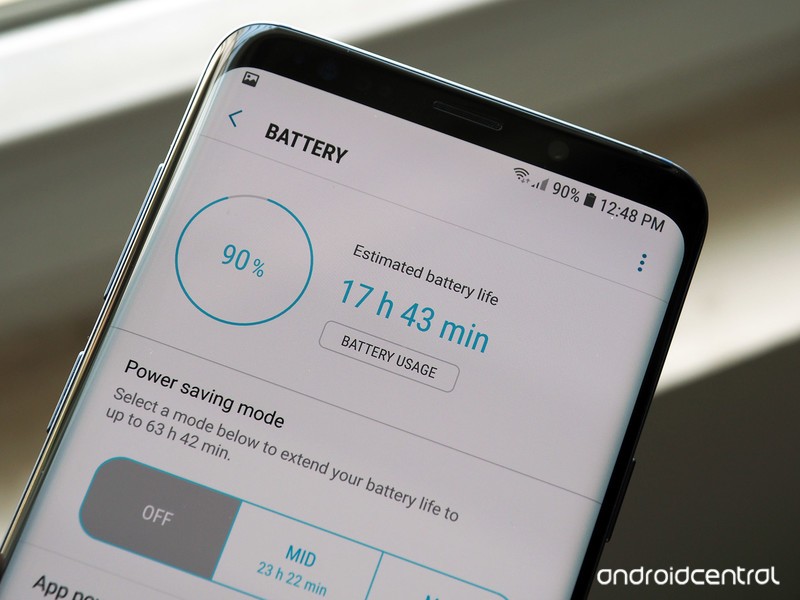
A little less than two weeks since a light was shed on the matter, a Samsung spokesperson commented on it, saying –
The Galaxy S9 is a reimagined smartphone designed to provide the best experience possible. Battery discharge time is dependent upon each user’s specific installed apps and settings, as well as other environmental factors. Both processors go through strict and rigorous testing considering real life usage scenarios, in order to provide the same top-of-the-line experience regardless of processor. Samsung is committed to delivering consistent battery performance over the lifecycle of the phone to provide users with an optimal experience.
In other words, Samsung’s saying that the Exynos Galaxy S9 is fine and that the shorter battery life is a non-issue.
Daniel recently wrote a great explainer highlighting why the Exynos chip is delivering consistently poor longevity, and it essentially boils down to the 9810 being incredibly fast but up to 50% less power efficient when compared to other mobile processors.
As noted in that piece:
The reason for Samsung’s poor showing isn’t because the Exynos 9810 is a bad chip, or even that it’s inherently power-hungry; it appears that Samsung merely programmed the core scheduler poorly, resulting in clock speeds and voltage settings that aren’t appropriate for the task at hand.
With all that said, it doesn’t sound like Samsung’s rushing to come up with a fix for the Exynos variant of its latest phone. People who live in regions where that’s the version sold are simply out of luck this time around, and those with the Snapdragon model can gloat about their longer endurance.
If you have an Exynos Galaxy S9/S9+, what do you think about Samsung’s stance here?
Samsung Galaxy S9 and S9+
- Galaxy S9 review: A great phone for the masses
- Galaxy S9 and S9+: Everything you need to know!
- Complete Galaxy S9 and S9+ specs
- Galaxy S9 vs. Google Pixel 2: Which should you buy?
- Galaxy S9 vs. Galaxy S8: Should you upgrade?
- Join our Galaxy S9 forums
Verizon
AT&T
T-Mobile
Sprint
 AIVAnet