


7 Best OBD2 Car Readers for Android

What’s the best OBD II reader for Android? Here’s a few to get you started!
Car repair can be costly (duh!) and that Check Engine light could mean myriad issues with your car. Or, it could be a simple fix that you could do yourself — so why take it to your dealer or mechanic without knowing the problem first? Some places will charge you $100 or more just for the scan.
Don’t get swindled again. Get yourself your very own Bluetooth OBD II reader/scanner and figure out what’s wrong with your car, right on your phone or tablet!
- BAFX Products 34t5
- Panlong Car Diagnostic scanner
- ScanTool OBDLink LX
- iSaddle Super Mini
- BlueDriver professional OBD2 scanner
- Automatic PRO AUT-350
- Carista OBD2 scanner
BAFX Products 34t5

The BAFX Products 34t5 claims to work on all vehicles in the U.S. from 1996 or later, so chances are that if you’re driving, this will work with your vehicle. All you need is a third-party app (which range from free to rather expensive paid apps), and you can connect the 34t5 to your Android phone or tablet to read out diagnostic information.
While reading out diagnostic codes, you can even clear them out at will, thus turning off your check engine light – even for manufacturer-specific codes!
Depending on the third-party app your choose, you can get real-time sensor information right on your phone, life speed, balance rates, RPM, O2 readings, and lots more.
If you feel the need for speed, this reader will even send you ⅛, ¼, ½, and 1 mile times.
Don’t spend $100 just for someone to scan your car; spend about $22, read it yourself, and maybe you’ll even be able to fix it on your own!
See at Amazon
Panlong Car Diagnostic scanner

Panlong’s small OBD II scanner is perfect for the do-it-yourselfer on a budget – you can find it on Amazon for around $11.
This reader will work on any car sold in the U.S. from 1996 or later – it just might not work with some hybrids. All you need is a third-party app, like Torque or DashCommand and you’ll be able to read and clear trouble codes, while receiving real-time data readings – and you’ll be able to turn off that damn Check Engine light!
If inexpensively is the way you like to maintain your vehicle (who doesn’t?), then opt for the Panlong scanner.
See at Amazon
ScanTool OBDLink LX

The ScanTool OBDLink LX is a professional-grade OBD II reader that features its own app, which allows you to scan, read, and clear trouble codes in all cars sold in the U.S. since 1996 (except hybrid or electric vehicles).
All you have to do is plug it in, pair it with your phone, open the app, and you’ll see real-time diagnostic data, as well as information about performance.
You can even use your Windows PC to access and compile your information without ever having to see a mechanic. Fix the stuff you can fix yourself and only take it in when absolutely necessary.
Being a professional tool, the OBDLink LX claims to service a wider range of vehicles, given more complex algorithms, and the Amazon reviews seem to agree.
It may be about $55, but if you love your car and worry that the cheaper readers might not actually do the trick, then check out the OBDLink LX. $55 is better than the $100 the dealers will charge you!
See at Amazon
iSaddle Super Mini

The iSaddle Super Mini supports all OBD II protocols and works on just about every car sold in the U.S. since 1996 (except hybrid and electric), allowing you to diagnose what ails your vehicle to help determine whether or not it really needs a trip to the shop.
For Android users, iSaddle works exclusively with the Torque app feeding you diagnostics and performance data via Bluetooth.
If you’re unsure about the DYI approach to car repair, the iSaddle’s only about $14, so you really have nothing to lose if you want to try it out yourself. If you can fix the problem yourself, go for it, but you still have the option of taking it to your dealer or mechanic if you’re out of your element.
See at Amazon
BlueDriver professional OBD2 scanner

For $100, you’d hope this scanner would be professional-grade, and it certainly makes the cut, as one that’s even used by mechanics. This one does a lot more than the average scanner, showing you recall information, dynamic data, and it even offers repair suggestions in its companion Android app. As Tom’s Guide puts it, “BlueDriver is as close to a repair-shop diagnostic scanner as you can get for under $100.”
See at Amazon
Automatic PRO AUT-350

If you’re looking for an OBD2 scanner that goes well beyond the others, then the Automatic PRO might be up your alley, since it also tracks your car in real time, is Alexa-, Nest-, and IFTTT-compatible, and uses a 3G connection. You get an unlimited, 5-year 3G subscription from Automatic, and this thing will even detect serious crashes and automatically alert emergency services. It’s basically a total car monitor (yeah, it also diagnoses your check engine light problems), and at $130, that ain’t a bad deal at all.
See at Amazon
Carista OBD2 scanner

Carista wins the award for prettiest scanner on this list (not that it matters at all), and it’s app is elegantly laid out and simple to use. The scanner does what you’d expect, but the OBD2 Pro app ($39.99 extra) is what really makes it shine, showing you airbag information, ABS data, and even showing you specialty codes for eight car makers.
The upgraded app also integrates with your key fob, allowing you to remotely control your power windows and other instruments. At roughly $40, the buy-in is about $80 for the full experience, but if you’re looking for more than a basic scanner, it’s worth it.
See at Amazon
What do you use?
Do you read your car or truck’s trouble codes with another scanner that we didn’t mention? Do you read your own codes or just take your car to the shop whenever the Check Engine light comes on?
Let us know in the comments below!
Updated April 2018: Updated pricing and added the BlueDriver, Automatic, and Carista scanners to the list.
Today’s best deals you won’t want to miss
Whether you’re looking for new tech gear or household items, we’ve got you covered.
Today you can get big discounts on iOttie’s super-popular car mounts, Arlo security cameras, TP-Link smart plugs, and more! Don’t pass these up.
View the rest of the deals
If you want to know about the deals as soon as they are happening, you’ll want to follow Thrifter on Twitter, and sign up for the newsletter, because missing out on a great deal stinks!
Marvel’s Spider-Man for PlayStation 4: Everything you need to know!
Forget everything you know about Spider-Man video games. This experience is on a whole new level.

Spider-Man is one of the most iconic fictional characters ever created. The web-head has starred in countless comics, movies, TV shows, and video games but not all of them have bee super high quality. While games like Spider-Man 2 are widely regarded as one of the best superhero games of all time, Spider-Man has also been subjected to some extremely bad video games that many of us try to block out of our memory.
With that said, Ratchet and Clank, Sunset Overdrive, and Resistance developer Insomniac Games is spearheading an exciting new vision for the wall-crawler. While we haven’t played the game yet, the studio has proven themselves time and time again and all the trailers we’ve seen look incredibly promising for PlayStation 4 fans this year.
See at Amazon
The Spidey classics, with a new twist

Insomniac has taken great care with Marvel’s golden boy by working closely with comic-book legends like Dan Slott and Christos Gage to craft an original story for Spider-Man. We all know how Peter Parker got his powers, how he struggles to find his footing as a superhero at first, and all that jazz so Insomniac is going to spare us the classic origin story and thrust into the prime of Spidey’s life. Peter Parker is 23, he has been Spider-Man for eight years and has pretty much gotten this whole superhero thing down to a tee.
In the game’s opening, Spider-Man will take down the infamous criminal mastermind, Wilson Fisk AKA Kingpin. Insomniac Games has noted Kingpin as Spider-Man’s greatest villain at this point in his career and it’s a massive achievement for him when he finally takes him down. Peter Parker’s apartment is also littered with various details regarding his past encounters with criminals like Shocker and Rhino meaning he has tackled some of his famous villains but the biggest baddies like Venom and Green Goblin may not have surfaced in New York yet.
On the opposite side of Peter’s life where he’s not wearing the mask, things are a bit more troublesome. His relationship with the red headed bombshell, Mary Jane Watson, is on the rocks, he’s on the verge of being evicted from his messy apartment, and Aunt May is put into danger when she becomes close with the charitable Martin Li. Li looks like a pretty swell guy on the surface but he holds a dark secret inside of him in the form of his super villain alter ego, Mister Negative. In fear that Li could hurt those closest to him, Peter begins his hunt for Li while tackling plenty of other criminals along the way such as Taskmaster.
More than an open outdoor world
As much as those in Peter’s life are important to a good Spider-Man story, one of the most vital characters is the city of New York City itself. As expected, there will be tons of side activities to tackle such as stopping robberies and other crimes. According to Game Informer, when they went hands-on with the game, there will actually be a good amount of interiors to go inside during these crimes so it’s not like other Spider-Man games where you have to chase after a speeding car or beat up some guys on the street.
To make the city feel more alive, Insomniac has built a Marvel universe within it. Players will be able to find the Avengers Tower, the Wakandan Embassy, and likely other major landmarks within the world to help take the worldbuilding to another level. There’s no word on if any other Marvel heroes will show up in the game but it’ll likely be kept to a minimum as they’re trying to make a Spider-Man game, not build an expansive Marvel games universe.
With a heavy focus on story and developing Peter Parker’s life and world, a lesser team could forget to develop a really solid set of gameplay systems, but Insomniac isn’t taking their eye off the ball.
Dynamic movements, killer combat
Many look to Spider-Man 2 as the best gameplay experience in a Spidey game due to the incredible attention to detail and physics based gameplay. The webs attached to walls, Spidey swung like a pendulum, and there was an incredible sense of momentum and speed building as you zipped through the city. With all of the advancements and innovations in games in the last decade and a half, Insomniac is on track to deliver the best Spider-Man game, perhaps superhero game, to date.
The most important aspect of the character is the way he moves through the world. Spider-Man will be as agile and fast as ever in this new game where he acts like a speeding train that has had the brakes ripped out. In Insomniac’s game, Spider-Man is equipped to adapt to his environment on the fly. He’ll never stop moving if you don’t want him to, the game is constantly making adjustments so you’re speeding through the world as the real experienced “masked menace” would.
It’s some of the more traditional Spider-Man combat with elements of the Batman Arkham series mixed in.
If you’re swinging but you’re about to smash right into a wall, Spider-Man will instead prepare to run along the wall in the direction you’re holding the stick. If you’re running along a rooftop with lots of vents and other objects, Spider-Man will parkour over them. If you’re running up a wall with a fire escape, he won’t awkwardly get stuck on it, he’ll bounce off each individual layer of the fire escape like stairs or propel himself through them if he’s coming at them from the side.
There’s an almost dynamic nature to the locomotion of Spidey in this game. His animations are diverse so it keeps this fun and fluid sense of rhythm, he’ll twirl, move his body in cool ways, and all sorts of other things you’d expect him to do when going from place to place. It’s safe to say that it will probably one of the most beautifully animated games to date when it drops.
As for combat, it’s some of the more traditional Spider-Man combat with elements of the Batman Arkham series mixed in. You’ll have your punching and kicking but you can also use some gadgets to help keep things fresh and make things easier on yourself. One gadget Spider-Man has is a web grenade, it detonates and then strings up any nearby enemies so you can swing in and deliver some cheap shots or pick them up and swing them around with a makeshift silk lasso.
If you’re feeling a bit playful, you can use the tripwire which is similar to the web grenade. It sits on a surface and when someone walks past it, it shoots a web out at them and slams them toward the wall. If you manage to latch the tripwire on to a person instead of a wall, it will smash two enemies together like Newton balls. If you also happen to knock an enemy off of a building, a tripwire will automatically be deployed and activated to prevent a foe from becoming a splatter on the sidewalk down below. The city is messy enough and Spider-Man doesn’t kill so the game will help you out there.
If you’re in the heat of the moment and you’re keen on doing that, players will be able to slow down time briefly and analyze the area for their next move. Is it singling out a guy? Choosing where to throw a gadget? Using an environmental object to defeat some evildoers? It’s up to you how strategic you want to be with it.
Missions, Trophies, and so many different suits

Of course, New York City is known as the city that never sleeps so there’s always something brewing on the streets whether it be petty crimes or full-blown robberies. Outside of story missions, our friendly neighborhood Spider-Man will get side activities to go clean up the streets. Crimes will play out differently each time so you’re not doing the same repetitive task over and over again so you can grind for that trophy or special in-game perk. According to Game Informer, robberies can evolve into car chases and so forth so it’s always shifting and keeping you on your toes.
If you’re a bit tired of beating people up (you’re a superhero, it’s your job, get over it), you can go and do some of the collectible missions like finding Peter Parker’s lost backpacks. As we saw in Spider-Man: Homecoming last year, Peter tends to just leave his school bag webbed up in alley ways when he has to spring into action. Of course, this can result in some bags being misplaced so you need to go and retrieve some key mementos of Peter’s. The items in the bags will serve as backstory for Peter Parker and fill in some of the blanks in the story as well as give you little trinkets such as the first pair of web-shooters he ever created.
There are other little side activities sprinkled in the world but Insomniac isn’t going to divulge all of them before launch so that there can be some surprises when you play it. Similarly, they were tight lipped on the suit customization.
While it is now officially confirmed there will be dozens of costumes for Spider-Man inspired by comics, other games, and the movies, they’re not revealing many of the suits yet. So far we know that there will be a more traditional suit that you start the game in, an upgraded one with the white spider which supposedly ties into the narrative, the Noir suit, and the Spider-Punk suit.
Each suit has a unique special ability tied to it, the Spider-Punk suit features the ability to pull out a guitar and strum it really hard to create an AOE attack. The other suits have their own benefits but Insomniac isn’t willing to talk too much about them yet.
Alright, when can I buy this?

If you’re as excited as we are for this game, you can pre-order the game for $59.99 at most retailers. If you want to go the extra mile, you can drop $149.99 on the Collector’s Edition which includes a nice looking statue, some digital items such as post-launch DLC missions, and a steelbook case.
Spider-Man will swing onto store shelves on September 7th, 2018 exclusively on PlayStation 4, this is NOT a timed exclusive. It will never be on anything else other than PlayStation.
See at Amazon
PlayStation 4

- PS4 vs. PS4 Slim vs. PS4 Pro: Which should you buy?
- PlayStation VR Review
- Playing PS4 games through your phone is awesome
Amazon
Chromebook Buyer’s Guide

You’ve decided on Chromebook. Now you just have to choose which one fits your needs best.
Plenty of people are buying Chromebooks for a variety of reasons, not the least of which being price and simplicity. Chrome enables you to have a simple yet powerful computer that can be handed to anyone and used right away, without all of the headaches of maintenance or management. The toughest part of using one is picking the right one to use!
Like everything else electronic, what you should buy depends on what you need to do with it. We can help.
Chrome OS

Chrome isn’t like Android on a phone — it’s the exact same on every Chromebook (or Chromebox). That makes things a lot easier when buying a new Chromebook because you won’t have to make any decisions about the software. The most inexpensive model can do everything its hardware supports in the very same way the most expensive model can. Hardware support can make a difference, though, because things like a 180-degree flippable screen or a specialized pen bring options along with them and if your Chromebook can’t flip over to be a tablet or doesn’t include a pen (bundled or as an optional purchase) you won’t see any special software to use one.
One other place that this software “sameness” matters is when you are buying a Chromebook. Chrome automatically updates and the new software comes directly through Google regardless of who made your Chromebook. With support lasting five years, you won’t have to buy the newest model to have the latest software. That can mean big savings, and we all love big savings.
Thankfully, Chromebooks come in a wide range of hardware configurations that support every budget. What you need to do before you buy is decide why you need a Chromebook and how you’re going to use it.
For the youngsters

There’s a good chance a young student will be issued a Chromebook from their school. Most companies make specially ruggedized Chromebooks for the education market, and that’s exactly what you want for a youngster’s first computer. Luckily, you can buy a similar model through normal retail channels and it won’t break the bank.
The Lenovo 100e is a great choice for a young child. It’s built like a tank and designed to survive bumps and bruises as well as being dropped for the height a child can reach. It even has a “waterproof” keyboard tray so a spilled drink won’t automatically equal a disaster.
It’s not pretty, but neither is a thin and light Chromebook that’s been destroyed by a fall off the desk or a glass of water. You can buy the 100e directly from Lenovo for around $200.
See at Lenovo
For older students

Many teens and older students use their phone to do everything. That’s awesome, but if you’re shopping for a student that’s out of that “will break everything” stage, you want a Chromebook that foregoes the rough and rugged build and focuses on being portable and speedy. ASUS has you covered.
Their Chromebook Flip line brings the all the portability a student needs along with a great display and speedy internals. And it’s called a Flip for a reason — it’s a great tablet replacement, too.
Android apps have changed the way we use Chromebooks and with the display flipped back a Chromebook really shines. Models in the Flip line come with a great touch screen for games or casual use, can stand as an easel for watching a video, and at the end of the day folds back into the ultra-portable laptop that a student can carry anywhere.
The Chromebook Flip 101 comes in under $300
See at Amazon
The Chromebook Flip 302 brings a bigger 12.5-inch display and uber-fast Intel core processor to the table, and costs around $450
See at Amazon
For all-around use at home or on the go

If you want a Chromebook to use for a little bit of everything, it’s hard not to recommend the Samsung Chromebook Plus.
It’s our recommendation as the best Chromebook you can buy based on the price and feature list, and it deserves its place at the top of that list. Built around an absolutely amazing 12.3-inch 2400×1600 pixel Samsung HD display, the Chromebook Plus does everything you want or need from a Chromebook and does it well. Android app support and a bundled stylus bring a lot to the table, and you’ll be able to surf the web or watch a movie or even balance your monthly budget while enjoying the simplicity and security Chromebooks have to offer.
The Chromebook Plus retails between $450 and $500 and is built with the same components as all Samsung’s high-end laptops use. This is the Chromebook for everyone!
See at Amazon
The perfect tablet

Many find a tablet to be the best way to do they things they want to do when relaxing at home or out on the go. 2018 brings the debut of Chrome tablets, and right out of the gate Acer’s Chromebook Tab 10 looks to be a winner.
It has the internal specs you would see on any Chromebook and a 9.7-inch QXGA touch display. There’s also a Wacom EMR stylus in its own on board slot if you want to draw or write on the screen instead of touch it. On the software front, it has the same Chrome operating system we see on every other Chrome device, including support for Android apps through Google Play. This really is a Chromebook without the keyboard, which is what a lot of people have been waiting for.
See at Tiger Direct
For the professional

Google’s Pixelbook is perfect for the professional who lives and breathes through their laptop. It comes with a high price tag (starting at $999) but the hardware, fit and finish, and slim portable design are worth it for anyone who spends a good part of every day at the keyboard keeping the wheels greased and gears turning.
The Pixelbook was the first Chromebook to come with Google Assistant and even includes a dedicated keyboard key and functionality through the Pixelbook Pen. Assistant can be a godsend for anyone with a full and busy calendar and is a great tool for asking the web just about anything. The Pen and Google Assistant work while the Pixelbook is in the traditional laptop mode or when it’s folded over to become an ultra-slim 12-inch tablet.
As mentioned, the Pixelbook isn’t cheap. But if you’re going to spend all day every day behind the keyboard, there is no such thing as excessive when it comes to the right product for the job. The Pixelbook is that right product for the working pro.
See at Best Buy
See at Google
For the road warrior

If your job has you on the go and you don’t know what plane you’ll be on or which hotel you’ll be sleeping in next week, you want a great laptop with a mid-sized display. Bbut you won’t want to spend a thousand dollars on something that will be banging around in an overhead compartment while you catch a few hours sleep. The Acer Chromebook R13 is perfect.
This 13-inch convertible has a roomy 1080p display, a full 1080p HDR webcam, a million + apps at Google Play, and a price tag around $350. If you want or need to be able to do it all and need a light and inexpensive tool that helps you, the Acer Chromebook R13 is our top pick and a crowd favorite.
See at Amazon
A Chromebox makes a great desktop computer

Chrome isn’t just for laptops, and if you’re in the market for a secure and inexpensive desktop computer you should have a look at a Chromebox.
These small computers do everything a Chromebook can do — connect you to friends and family, entertain you with videos or games, and of course surf the web like a rock star. Their also the most secure desktop computer you can buy thanks to the way Chrome sandboxes every app, every web page, and every process then verifies the operating system files for integrity every time you turn it on. Chrome is more than just a web browser, and as an operating system, it was built from the ground up with security as one of its main features.
Chromeboxes use the same peripherals as any other desktop computer. That means you can use any monitor or keyboard to tailor the experience just as you would with a more expensive computer that runs Windows. The best part about a Chromebox might be the price, as they come in a wide range of hardware to meet almost any budget.
For a family PC or a Home Theater PC, Chromeboxes are inexpensive, filled with features and priced right for just about anyone.
Read now: The best Chromebox
Updated April 2018: Switched the best Chromebook for kids to the Lenovo 100e and added the Chromebook Tab 10.
Chromebooks
- The best Chromebooks
- Should you buy a Chromebook?
- Google Play is coming to Chromebooks
- Acer Chromebook 14 review
- Join our Chromebook forums
What’s new on Amazon Video for May 2018
Mayday!!! Mayday!!! Great shows ahead!
It’s springtime. Maybe. If it’s not snowing where you are, it’s probably springtime. And that means we’ve got the latest lineup on Amazon Prime Video for May 2018.
More Bond? More Bond. Baywatch? Baywatch! Back to School and Bad News Bears? Booyah!
If you need me, I’ll be lounging by the pool with a tablet and a movie or two.
Amazon Prime Video has is one of the go-to destinations for on-demand content, thanks in no small part to devices like the $50 Amazon Fire Stick, the all-new $70 Amazon Fire TV, and even the $229 Amazon Echo Show.
But hardware is the easy part. Buy it once, and then use the heck out of it. What’s not quite so easy is keeping up with everything that’s new on Amazon Prime Video — because new shows are always coming and going.
Here’s what’s new on Amazon Prime Video in May 2018!
Don’t have Amazon Prime Video yet? Get a free 30-day trial!
Movies coming May 1
- 3 Ways to Get a Husband (2009)
- 40 Days and 40 Nights (2002)
- A Very Brady Sequel (1996)
- A.I. Artificial Intelligence (2001)
- An Inconvenient Truth (2006)
- Baby Boom (1987)
- Back to School (1986)
- Bad News Bears (1976)
- Barefoot (2014)
- Beyond Borders (2003)
- Blame (2017)
- Brother Nature (2016)
- Bull Durham (1988)
- Cool World (1992)
- Cyborg (1989)
- Diamonds Are Forever (1971)
- Dr. No (1962)
- Eight Men Out (1988)
- Elizabethtown (2005)
- Evolution (2001)
- Foxfire (1996)
- Frailty (2001)
- From Russia with Love (1964)
- Gator (1976)
- Ghost Town (2008)
- Goat (2016)
- Goldfinger (1964)
- Holy Air (2017)
- Hot Boyz (2000)
- Immigration Tango (2011)
- Insomnia (2002)
- Iron Eagle IV: On the Attack (1999)
- Kalifornia (1993)
- Live and Let Die (1973)
- Love Is A Gun (1994)
- Manhunter (1986)
- Men with Brooms (2002)
- Murder on the Orient Express (1974)
- Never Say Never Again (1983)
- New Rose Hotel (1999)
- Ninja Masters (2009)
- Octopussy (1983)
- Outcast (2014)
- Perfect Score (2004)
- Perfume: Story of a Murderer (2006)
- Psychopaths (2017)
- Race for Your Life, Charlie Brown (1977)
- Rocky (1976)
- Rocky II (1979)
- Rocky III (1982)
- Rocky IV (1985)
- Rocky V (1990)
- Sabrina (1995)
- Saturday Church (2017)
- School Ties (1992)
- Set Up (2011)
- Starting Out in the Evening (2007)
- Strategic Air Command (1955)
- The Benchwarmers (2006)
- The Benefactor (2015)
- The Box (2007)
- The Brady Bunch Movie (1995)
- The Counterfeit Traitor (1962)
- The Crow (1994)
- The Elephant Man (1980)
- The Golden Compass (2007)
- The Hangman (1959)
- The House I Live In (2013)
- The Hurt Locker (2008)
- The Last Castle (2001)
- The Legend of Bagger Vance (2000)
- The Man with the Golden Gun (1974)
- The Saint (1997)
- The Spy Who Loved Me (1977)
- Thief (1981)
- Thirst Street (2017)
- Thunderball (1965)
- Twisted (2004)
- Untamed Heart (1993)
- Wild Thornberrys (2002)
- Wish Upon a Star (1996)
- Wonder Boys (2000)
- You Only Live Twice (1967)
TV series coming May 1
- Aristocrats: Limited Series
- Banished: Limited Series
- Charles II – The Power and The Passion: Limited Series
- Daniel Deronda: Limited Series
- David Copperfield: Limited Series
- Desperate Romantics: Limited Series
- Ivanhoe: Limited Series
- Jane Eyre (1983): Limited Series
- Jane Erye (2006): Limited Series
- Life in Squares: Limited Series
- Little Dorrit: Limited Series
- Lorna Doone: Limited Series
- Love in A Cold Climate: Limited Series
- Mansfield Park: Limited Series
- Martin Chuzzlewit: Limited Series
- Middlemarch: Limited Series
- Oliver Twist (1985): Limited Series
- Oliver Twist (2007): Limited Series
- Our Mutual Friend: Limited Series
- Pride and Prejudice: Limited Series
- Sense and Sensibility (1981): Limited Series
- Sense and Sensibility (2008): Limited Series
- Sinbad: Limited Series
- Tess of the D’Urbervilles: Limited Series
- The Buccaneers: Limited Series
- The Hitchhiker’s Guide to the Galaxy: Limited Series
- The Lost World: Limited Series
- The Office: Limited Series
- The Pickwick Papers: Limited Series
- The Tenant of Wildfell Hall: Limited Series
- The Way We Live Now: Limited Series
- Tom Jones: Limited Series
- Vanity Fair (1998): Limited Series
Coming May 4
- Last Flag Flying (Amazon Original, 2017)
Coming May 5
- Diablo Guardian (Prime Original series), Season 1
- Warrior (2011)
Coming May 11
- Rocky & Bullwinkle (Prime Original series), Season 1
Coming May 12
- Baywatch (2017)
- Orphan Black, Season 5
- Still Mine (2012)
Coming May 15
- How to Be a Latin Lover (2017)
Coming May 18
- You Are Wanted (Prime Original series), Season 2
Coming May 18-20
- Live TV: Pro Beach Volleyball Tour (Austin Open)
Coming May 19
- Beatriz at Dinner (2017)
- Shooters (2003)
Coming May 22
- Dino Dana (Prime Original series), Season 2
Coming May 23
- Beast of Burden (2018)
Coming May 25
- Picnic at Hanging Rock (Prime Original series), Season 1
Coming May 27
- Just Getting Started (2017)
- The Wedding Plan (2016)
Coming May 29
- Howards End, Season 1
Previously, on Amazon video …
Here’s what was (or still is, depending on when you’re reading this) new on Amazon Video in April:
Coming April 1
- 30 Beats (2012)
- 52 Pick-Up (1986)
- A Simple Plan (1998)
- A Suitable Girl (2017)
- Basic Instinct (1992)
- Brooklyn’s Finest (2009)
- Carrie (1976)
- Danny Roane: First Time Director (2007)
- Desperately Seeking Susan (1985)
- Drugstore Cowboy (1989)
- Escape from New York (1981)
- Eye for An Eye (1996)
- Flashback (1990)
- For a Few Dollars More (1967)
- Fred 3: Camp Fred (2012)
- Fred: Night of the Living Fred (2011)
+ Fred: The Movie (2010) - Friday the 13th (1980)
- Funny About Love (1990)
- Gamer (2009)
- Hangman (2017)
- Hellbenders 3D (2012)
- Hitler’s Bodyguard (Season 1)
- Ice Mother (2017)
- Internal Affairs (1990)
- Kickboxer (1989)
- Ladybugs (1992)
- Life Stinks (1991)
- Man in the Moon (1991)
- Marathon Man (1976)
- Married to the Mob (1988)
- Meatballs (1979)
- Merlin (Seasons 1-5)
- Miami Blues (1990)
- My Art (2016)
- Mystery Team (2009)
- Mystic River (2003)
- Paranormal Activity (2007)
- Philadelphia (1993)
- Prancer (1989)
- Project Nim (2011)
- Quigley Down Under (1990)
- Red State (2012)
- Salsa (1988)
- Shanghai Surprise (1986)
- She’s Having a Baby (1988)
- Sleepers (1996)
- Small Soldiers (1998)
- Snake Eyes (1998)
- Spaceballs (1987)
- Stand Up Guys (2012)
- Standing in the Shadows of Motown (2002)
- Steel Magnolias (1989)
- Storage Wars Northern Treasures (Season 1)
- Superstar (1999)
- Tenderness (2009)
- Texas Chainsaw Massacre II (1986)
- The Big Wedding (2013)
- The Conspirator (2011)
- The Departure (2017)
- The Dogs of War (1981)
- The Foot Fist Way (2008)
- The Karate Kid (1984)
- The King of Comedy (1982)
- The Marc Pease Experience (2009)
- The Phantom (1996)
- The Rage: Carrie 2 (1999)
- The Replacements (2000)
- The Thomas Crown Affair (1999)
- The Winning Season (2010)
- Thirst Street (2017)
- Throw Momma from the Train (1987)
- Trading Mom (1994)
- Troy (2004)
- Up in Smoke (1978)
- Uptown Girls (2003)
- Warpath (1951)
- Wayne’s World 2 (1993)
- Wishmaster (1997)
- Wishmaster 2: Evil Never Dies (1999)
- Wishmaster 3: Beyond the Gates of Hell (2001)
- Wishmaster 4: The Prophecy Fulfilled (2002)
- World’s Craziest Foods (Season 1)
Coming April 2
- Chavela (2017)
- Psychopaths (2017)
- The Missing (Season 2)
Coming April 5
- The Killing of a Sacred Deer (2017)
Coming April 6
- Blame (2017)
- The Florida Project (2017)
Coming April 10
- Hours (2013)
Coming April 12
- I Can Do Bad All by Myself (2009)
- Saturday Church (2017)
Coming April 13
- Bosch (Prime Original, Season 4)
Coming April 15
- Fame (2009)
Coming April 18
- Aida’s Secrets (2016)
Coming April 23
- Red Rock (Season 3)
Coming April 24
- Vikings (Season 5)
Coming April 25
- The Vanishing of Sidney Hall (2017)
Coming April 27
- All or Nothing: Dallas Cowboys (Season 3)
- Little Big Awesome (Prime Original, Season 1A)
Updated April 17, 2018: May’s listings are here!
Windows 10 update will support more password-free logins
It’s not just web browsers that are moving beyond passwords. Microsoft has revealed that Windows 10’s next update will support the new FIDO 2.0 standard, promising password-free logins on any Windows 10 device managed by your company or office. You could previously use Windows Hello to avoid typing in a password, of course, but this promises to be more extensive — you could use a USB security key to sign into your Azure Active Directory.
FIDO 2.0’s centerpiece is Web Authentication, a standard that enables no-password sign-ins across a much wider spectrum of sites and services than before. Microsoft had already publicly committed to supporting the technology through its Edge browser, but this takes it to the operating system level. Don’t be surprised if other OS developers follow suit, especially for work-oriented platforms where passwords are all too common.
Source: Microsoft Secure
China’s relaxed rules on foreign car makers are good news for EVs
China is taking steps that could not only help ease trade tensions with the US, but help electric car manufacturers around the world. The country is phasing out rules that required foreign automakers to share factories and profits with local brands if they wanted to avoid a 25 percent tariff. EV companies will no longer have to find partnerships as of this year, while all other car manufacturers will be free of the requirement by 2022. There had been threats of instituting a similar sharing requirement in the US, so this may be a preemptive measure.
Whatever the motivations, it’s good news for at least some EV brands. It won’t make much of a difference for American brands that already have joint ventures, as backing out could be costly and hurt their access to the market. However, it could be a major victory for Tesla and other EV builders that want to establish Chinese factories, but don’t relish the thought of a forced alliance and the potential loss of trade secrets that comes with it. Elon Musk had floated the idea of equal trade rules for cars, but he might not need to argue for them now.
This isn’t likely a selfless gesture. China has a much stronger position in the automotive market than it did several years ago, and not just because of those existing, hard-to-untangle partnerships. Geely, for instance, is an international powerhouse — it owns Volvo, Polestar, Lotus and Lynk & Co, so it’s likely to weather new competition. Other companies have had the advantage of years of protection, too.
Even so, this could easily transform the vehicular landscape over the next several years. American and European EV producers might grow more quickly now that they can tap into the most populous country on the planet, and their Chinese counterparts may have to step up their game now that they’ll face more challenges.
Source: Wall Street Journal
The best to-do apps
Plenty of people still rely on pen and paper, but it’s inarguable that smartphones have become commonplace for keeping tabs on what needs to get done. And while Apple and Google both offer basic reminder apps, many people might crave something a little more robust. Fortunately, both app stores are teeming with task management apps, so much so that picking the right one can be overwhelming.
As a chronically disorganized human, I’ve found to-do apps are key to my productivity. As such, I periodically reevaluate what I use and check to see how the various big-name options have evolved. Eventually, in quest to find the best task management service for most people, I settled on five options: Todoist, Remember the Milk, Things, Wunderlist and Any.do.
There are a host of factors that go into evaluating these services, but they include pricing, design, ease of use, cross-platform support and “power” features. This last category encompasses things like natural language support, voice commands, attaching notes or files, sharing tasks or projects with co-workers or family members, and integration with other services, to name just a few examples.
Narrowing the field
While all the apps I tried would work well for most users, it didn’t take long for me to conclude that Remember the Milk and Any.do aren’t the absolute best options. Points in favor of RTM included solid platform support; it has apps for iOS, Android and the Apple Watch as well as a web interface for when you don’t want to use mobile. It also has detailed reminder integration, with options to ping you via email, text, Twitter or push notifications. You can connect RTM to many third-party services, too, including Gmail, Google Calendar, Siri, IFTTT, Alexa and more.
The main knock against RTM is its price. The “pro” subscription costs $39.99 a year and adds subtasks, unlimited task sharing with others, colored tags, Apple Watch access and mobile reminders. Ultimately, restricting important features like mobile reminders and subtasks to a pricey subscription makes it tough to recommend. It also doesn’t help that RTM’s web app feels both dated and a little arcane. The mobile app is lovely, though — if you’re a phone-first user who doesn’t care so much about reminders and subtasks, the free version of RTM is worth checking out.

Remember the Milk’s web interface.
Any.do stands out mostly for its unique take on task management. For better and worse, it doesn’t display tasks the way other apps do. Rather than using different lists as the main way to organize your life (“home,” “work” and so on), Any.do defaults to showing what you need to get done today, tomorrow, further out (the next week, say) and “someday.” Naturally, you can put items into different lists as well, but the main interface is designed around managing what you said you wanted to get done today, regardless of whether it’s a personal item or something from your work list.
To that end, Any.do works well alongside your calendar, to which you can allow access when you set up the app. It’ll then show your appointments and to-do items side by side. And for those of us who never manage to check everything off, there’s a feature called the “Any.do Moment” that gives you a rundown of your day and lets you re-assign tasks to different days depending on what you have the bandwidth for.

Any.do’s main app interface (left) and adding a task (right).
Another nice feature is its auto-completing suggestions that pop up when you make a new task. Items like “call,” “buy,” “clean,” “email” and more show up for you to tap on; when tapping “call” you can start to fill in a name and it’ll then suggest contacts from your list. Google does something similar when you create calendar entries on mobile, and it does make it easy to fill out many common chores.
If you’ve found that “standard” to-do apps don’t work well for you and you want to try a more proactive organizer, Any.do might fit the bill. The free version is fairly generous with features, though you’ll need to upgrade for location-based reminders, unlimited Any.do Moments (it’s not clear how it restricts them in the free version), customized recurring tasks and unlimited size attachments. Any.do’s plans range from $32 a year for a single device to $35 a year for unlimited devices. There’s also a low-risk $4 per month plan if you want to give it a shot before committing.
A great (but expensive) option for Apple users
Things is one of the best app I tried, but a few things immediately disqualify it from contention for the top spot. First, it’s for Apple devices only. There’s no web interface; instead, you can buy separate apps for the Mac, iPhone (with Apple Watch support) and iPad. It’s not cheap, either — the Mac app costs an eye-popping $50, while the iPhone and iPad apps are $10 and $20, respectively. Most people will probably need to shell out $60 to get fully up and running, and there’s no way to demo the iOS versions before putting down your money. (The Mac app offers a two-week demo, which should be enough time to know if Things is right for you.)
However, it’s worth noting that if you subscribe to the other apps on this list, you’re going to spend around $30 per year. Developer Cultured Code has been supporting Things for years, so while that up-front cost is significant, you hopefully won’t have to think about it again for a long time.
If you can get past these caveats, you’ll find an extremely powerful but streamlined task management app. From a pure design standpoint, Things is delightful. The typeface is large and easy to read without taking up too much space. Tasteful animations abound without distracting you from your tasks. Subtle visual clues let you see how far you’ve gotten through a larger project. The whole thing feels polished, and is just a lot of fun to use.

Things (the Mac version is above) offers a ton of organizational flexibility.
Despite Things’ simple design, there’s a lot of organization options under the hood. At a high level, your “areas” can hold basic to-do items, but you can also add sub-areas, called projects, which you can use to group to-dos under a single header. For example, I have a “work” area that has simple to-dos (like “finish expenses”) as well as bigger projects with multiple steps (like this to-do list review roundup, which had multiple items below it). Projects and to-do items can hold extensive notes, as well as have due dates and reminder dates. To-dos can also have sub-tasks assigned. If you’re the kind of person who prefers to break down tasks into small steps, Things is well-suited to the job.
Unfortunately, there are a handful of features missing here that you’d expect to see in an app this expensive. Adding due dates and reminders is easy enough through a little calendar interface, but you can’t use natural language. Typing “send weekly team email every Friday” or “order groceries tomorrow at 3pm” doesn’t do anything by default. On the Mac, you can click the calendar item and then type in “this Friday” or “the 20th” and it’ll add a due date, but you can’t do that on the iOS apps. Things also doesn’t support location-based reminders, file attachments or collaboration of any kind.
If you’re a heavy Apple user, can stomach the price and don’t mind the missing features (I personally can live without collaboration tools and location reminders), Things has much to offer. But given the price and exclusive focus on Apple devices, many people will do better elsewhere.
The final contenders
I wasn’t surprised that my search narrowed to Todoist and Wunderlist — they often show up on best-of lists like this. Both work on just about every device — in addition to the standard iOS and Android apps are Chrome extensions and apps, Windows 10 and Mac apps for Todoist, good Apple Watch support for both… the list goes on. There’s even a Todoist Safari extension! Neither app is quite as granular as Things, but you can still lay out projects with to-do items nested below; each of those items can have sub-tasks as well.
Before going too deep into each app, however, it’s important to note one big caveat for Wunderlist: It was bought by Microsoft in 2015, and the company has confirmed Wunderlist will eventually be replaced by a new app. That app, simply called To-Do, has been out in an open beta for a year now, so naturally I gave it a shot. It does much of what Wunderlist can do, but it lacks Wunderlist’s natural language input for adding due dates. There also aren’t any collaborative features, at least not yet.

Wunderlist on the left, To-Do on the right.
Due to the uncertainty surrounding Wunderlist and To-Do’s currently missing features, Todoist feels easier to recommend. At $28.99 for an annual subscription, it’s one of the more affordable options, and with that you get a raft of features. (The free version omits some tools, but it’s worth trying to see how it works before subscribing.) Its organizational system can be as simple or as complex as you want — projects hold to-do items, which can in turn have as many sub-tasks as you want to add. And you can make a folder of projects to add another layer to your organization system, if you’re so inclined.

Todoist’s task interface and comments section.
Todoist also has natural language support so you can have tasks pop up “every 11th” or “Friday at 2PM,” and it’s easy to collaborate on projects with other Todoist users. The app also includes location-based reminders. Unfortunately, it doesn’t know things like your home or work address by default, but it’s still easy to locate places and get reminded when you leave or arrive.
For the times when you can’t get everything done by a due date, Todoist features a “smart schedule” that looks at your upcoming tasks and figures out where to slot in things you’ve missed. Of course, you can just reschedule things yourself, but Smart Schedule makes it easy to clear out overdue items fast so you can get on with your day. Todoist also lets you attach files and add comments; those comments can work as a notes section as well as a way to get the attention of others shared on a particular task.
The bottom line is that every time I thought of a feature I might want in a to-do app, a little digging showed that it was available in Todoist. The app is reliable, receives frequent updates, is available on any platform you choose and is easy to use while still offering flexibility and power. It might not have the slickest design among to-do apps, but it is the most practical option for most people.
Roland’s TR-8S drum machine is ready to tackle the stage
If you know the history of drum machines, the first thing you want to do with the TR-8S, is load up the 808 kick drum. It’s a deep, satisfying boom that’s been an important part of everything from hip-hop to rock. But after you get done having fun with four-on-the-floor bass hits, it’s time to get to the real work — your own rhythms. For that, it’s tough to beat the latest digital percussion instrument from Roland for ease of use and features.
Based on the TR-8 (itself based on the legendary TR-808), the $699 TR-8S expands on the abilities of both of those drum machines, creating something that’s more than just a grab for some nostalgia-based cash. It’s a feature-filled addition that should be welcome in any percussion and production set up. With its extensive library of drum kits and sounds, a sampling feature and expanded programming controls the latest Roland Rhythm Performer is better than the sum of all its parts.
At first glance, it looks like its predecessors. But on the left and right side of the console are the new features that make the TR-8S shine. On the left, are the eight sequence buttons available per pattern (a sequence is typically a 16-note drum part). That’s six more than the machines that came before it and it opens up a whole new world of pattern programming.
While a sequence is playing, musicians can press any of the eight buttons (that are ordered A thru H) to make that selected part the next one in a pattern. This allows real-time selection of multiple beats in any order you want. Additionally, you can press multiple buttons at once and the instrument will play those sequences in alphabetical order.
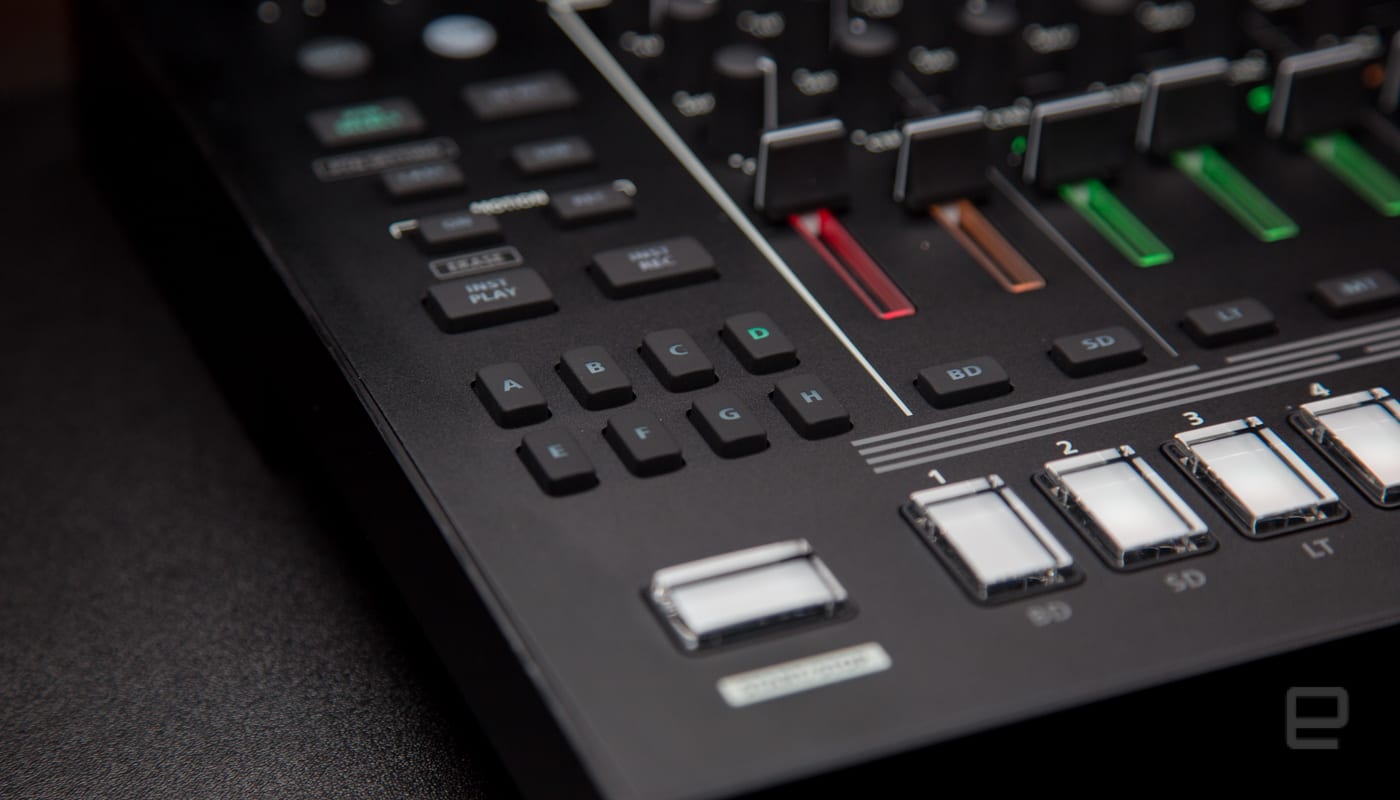
Building patterns on the TR line has always been easy and, with the addition of those the extra drum parts, I found playing live with the instrument to be more enjoyable. Typically I have a list of patterns that I can jump back and forth between different sections in a song. With the additional six parts available, I could just push a button to prime up another section of a composition. Plus, being able to press multiple buttons and have sequences play in order gave me the ability to easily create more complex patterns in a live setting.
Another feature the TR-8S introduces, that was missing from the TR-8, is that when you save a pattern it also saves the current sound and effect parameters. Something that would have saved me a bit of embarrassment at a show once when I jumped to a pattern on my TR-8 and was greeted with a complex mess of hand claps and low toms instead of what I had saved and expected from that pattern. The moral of that story, obviously, is check all your gear and settings before playing live.
In addition to keeping me from looking like I don’t know what I’m doing onstage. The TR-8S also makes its new features simple to find and implement when I’m onstage. So now, I’m not fumbling trying to remember how to do something. Nearly everything is a button push, followed by twisting the “Value” knob.

Under that Value control is where most of the new goodies are, including the shining star of the TR-8S: the Sample button. With it, I was able to quickly add my own samples to instruments and kits and add them to my patterns. Yes, I added a dog bark. Everyone loves a dog bark in their songs. But I could add voices, actual hits from my drums and really anything I could think of to sample via an SD card.
In order to get my random sounds out to the world, I can select from a huge library of sounds which now includes my personal samples via the INST (instrument) button. To change feel and sound of an entire pattern, the drum machine’s Kit button has access to 150, well, kits (a group of sounds packed together). Which again are also a breeze to change and set up for a pattern. Tap on the button and twist the knob until you get the percussion or sound you’re looking for. That’s it.
One thing I’m still not excited about is the Auto-Fill feature. It was introduced on the TR-8 as a way to mix up a pattern the way a drummer adds a fill while playing. You can adjust it to fill every 2, 4, 8, 16, or 32 measures. I’ve never found the fills to add much to my compositions. You may find them worthy of use and if you do, like everything else, it’s easy to implement.
That’s really the theme of the TR-8S. Everything is simple to find, use and implement. In my time with it both at home and while practicing with my bands, I found it to be one of the easiest to understand electronic instruments I’ve used. At practice, other band members quickly picked up how to create their own beats and patterns after only a cursory explanation of how the TR-8S worked.

Drums and guitars are easy to understand. Electronic instruments, on the other hand, can be mired in complex menus and archaic processes to produce the sounds a musician wants. The TR-8S bucks that with an instrument that old-school drum machine users and folks new to electric percussion can sit in front of and be able to create complex beats for a band, song or just for fun within a few minutes.
The TR-8S is solidly built (important for gigging), has a ton of features that Roland says its users have been asking for and because the company built it for live performances is robust enough for touring musicians and at-home producers. The $700 price tag seemed steep at first, but after spending a month with the TR-8S, it’s clearly worth every dime.
Source: Roland
IRS’ direct online payment system goes down on tax day
We hope you weren’t relying too heavily on internet payments to file your taxes on time. The Internal Revenue Service’s Direct Pay system failed (and is still unavailable as we write this) on April 17th — you know, the last day before the tax filing deadline. You can still pay online with a credit or debit card, but that entails a transaction fee. Otherwise, you’re looking at old-school checks.
It’s not certain what happened to Direct Pay or when it will be back. IRS Acting Commissioner told those at a hearing that it was “probably” an internal technical glitch rather than a cyberattack. Don’t panic too much at this point, then. The agency is trying a “hard reboot” to solve it. And in case you’re wondering: Kautter is promising that the IRS won’t punish people if the technical failures prevent them from filing on time. If you’re truly without options at this point, you’ll likely get a reprieve.
Whatever the cause, the failure underscores the challenges of offering such a vital government service online. The IRS’ Direct Pay system not only has to cope with tremendous demand from taxpayers (5 million people filed returns at the last moment in 2017), but protect against hacks and brute force denial-of-service attacks. That’s a daunting challenge for any organization — and when the IRS has a less than stellar track record on this front, it’s no exception to the rule.
Source: IRS

