


Sonos will sell red, yellow and green One speakers for a limited time
Sonos speakers, for the most part, have been limited to two shades, black and white, which is a result of the brand’s desire for its devices to blend in with the home rather than stand out. Well those looking for a little bit of color now have their opportunity as Sonos has just announced a partnership with Danish brand Hay, resulting in a speaker line with red, yellow and green options.
The Hay Sonos One Limited Edition Collection features hues in line with Hay’s 2018 palette. “Color is one of the most important tools in the design process, and it was very important we didn’t just create a color scale that looked beautiful,” Hay co-founder Mette Hay said in a statement. “Colors can hide completely and disappear or provide contrast.” In 2015, Sonos launched a blue speaker in partnership with Blue Note Records.
Though there’s a pink option in the image above, The Verge reports that it won’t actually be for sale. The Hay line of Sonos One speakers will be available in September and the speakers are priced at $229.
Source: Sonos
YouTube details how its updates help creators get paid
YouTube knows creators are worried about being demonetized without warning, and it’s experimenting with new methods to prevent those rude surprises. As part of a broader piece discussing efforts to improve relations with creators, company chief Susan Wojcicki said YouTube is piloting a video upload process that has you supplying “specific information” about your clip as it relates to “advertiser-friendly” guidelines. If you know your video will include a lot of risqué material, you can let YouTube know in advance so that you’re less likely to lose ads.
In a “sneak peek” posted earlier in the month, the service hinted at what that information could include. It would touch on not just the nature of the content, but the level of it. Is there a lot of sex, violence, drug use, firearm , hateful language or profanity? The process would also include more generalized questions about the age-appropriateness of the clip and its connection to “sensitive current events.” There’s no guarantees these questions made it into the pilot (or will make it to an official launch), but they indicate what YouTube is looking for.
Wojcicki stressed that this is far from the only method involved in reviewing videos, as algorithms and human reviewers will still play a part. It knows there will be dishonest types who understate the provocative nature of their uploads. For truthful creators, though, this could be a tremendous asset. It might reduce the chances of YouTube mistakenly demonetizing clips. YouTube itself could benefit, too, as it might see fewer advertisers pulling out over fears their commercials will run alongside offensive videos.
The larger piece, meanwhile, acknowledged that YouTube needed to open (and has been opening) a line of dialogue with creators that didn’t really exist before. It’s now replying to creators six times as often and running a Creator Insider channel for behind-the-scenes info. There’s a test for sponsorship deals that provides an alternative to ad revenue. The company is likewise taking more steps to enforce and tighten its policies, and sharpening the focus of its educational resources (such as helping to avoid “creator burnout”). In short: it knows it can’t just dictate changes and expect its community to accept them.
Source: YouTube Creator Blog, Creator Insider (YouTube)
Scientists think these meteorite diamonds formed on a long-lost planet
Scientists studying a meteorite fragment that fell to Earth in 2008 have found evidence that suggests it may have originated from a Mercury-sized planet that no longer exists. The makeup of a meteorite — the elements it contains, what ratios they’re in — can usually point us to where it came from, like say the moon or Mars. But there are a set of meteorites, including the one collected in 2008, that have no known origin, appearing to be from a planetary body that has since been destroyed and purged from our solar system. “These samples are coming from an era that we don’t have any access to,” Farhang Nabiei, a researcher on the project, told The Washington Post.
To get a better idea of this meteorite’s history, scientists used transmission electron microscopy to study its composition and they found deposits of chromite, phosphate and iron-nickel-sulfide trapped within diamonds contained in the meteorite. And those observations gave them some clues as to how the diamonds formed. Their work was published today in Nature Communications.
Diamonds are often found in this family of meteorites, but they’re usually pretty tiny. And researchers say there are three main ways they can form — during a major collision, through the deposit of chemical vapor or through sustained high pressure and temperature, like the way diamonds form here on Earth. The size of the diamonds in this meteorite, which were larger than others’, aren’t compatible with the first two methods, meaning they likely formed through high pressure within some sort of major astronomical body. And the metal deposits found within them would likely have formed in a young planet at least the size of Mercury and maybe as large as Mars, according to the researchers.
Models have predicted that a number of protoplanets existed during the early years of our solar system and that through accretions and collisions helped form the existing terrestrial planets and some of their moons. Though there’s no way to know what exactly happened to the “lost” planet that formed these diamonds, it was likely destroyed through collisions billions of years ago. But it’s history is part of our history. “This is part of the story of how we came to be,” said Nabiei.
Via: EPFL
Source: Nature Communications
EU may follow US push for easier data sharing across borders
Last month, US lawmakers passed legislation updating how law enforcement gets access to native companies’ data held overseas. The new CLOUD Act, as it’s called, had its supporters (big tech corporations like Apple, Google and Engadget’s parent company Oath) and detractors (privacy advocates like the EFF) and redefines how the US negotiates with other nations for corporate information — including text messages, emails and documents. Now the European Commission has proposed its own version of those rules to speed law enforcement access to data.
Ideally, this will smooth over a process that was so slow and unwieldy that it’s lead to conflict between US and EU authorities, as happened when American authorities unsuccessfully tried to wrest data from Microsoft that was located in Ireland. While the tech titan won that legal challenge, as it happens, the Supreme Court dropped the appeal-in-process earlier this week, as the CLOUD Act essentially ensured Microsoft and other companies won’t be able to enact the same defense next time. Per the new law, US authorities can request that information.
Under the EU proposal, online service providers would be required to respond to authorities’ requests within ten days — or, in emergencies, within six hours. Both are far quicker than the 120-day limit for the existing European Investigation Order used to ask for data. Authorities would also be able to command companies not to delete certain information while the request is being processed. Compliance is mandatory; The existing ‘voluntary cooperation’ model created too many challenges for companies and increased the uncertainty of law enforcement data requests.
The EU proposal only allows requests for ‘electronic evidence,’ which includes everything from communications to subscriber and traffic data, that is relevant to criminal investigations. Crucially, it only applies to stored information, not intercepting it in transit. Much like the US CLOUD Act, it establishes safeguards to protect user privacy. But according to the proposal’s FAQ, the judge allowing the request will likely have to make the final call about whether it violates laws and interests of the country hosting the data.
The European Parliament needs to vote on the proposal before it becomes law, and may amend it along the way.
Via: The Wall Street Journal
Source: The European Commission
Tesla will run its Model 3 production ’24/7′ to meet targets
Tesla is scrambling to increase Model 3 production however it can, and that now appear to include some drastic measures. Elon Musk has informed staff that Model 3 assembly at the company’s Fremont factory will step up to “24/7 operations,” with a new shift added to keep the plant humming. Combined with upgrades (including both an ongoing improvement and one due in late May), Tesla intends to “unlock” production levels of 6,000 per week by the end of June. The company’s publicly stated goal is 5,000 per week, but Musk doesn’t want a production volume with “no margin for error” across a vast supply chain.
A “steady” production level of 6,000 per week should arrive a few months after that, Musk wrote.
The company chief acknowledged that this will require a hefty recruiting effort — Fremont and the Gigafactory will add about 400 workers in the next several weeks. And yes, he was aware of concerns that higher production might come at the expense of build quality. Musk claimed that many of the Model 3’s design tolerances were “better than any other car in the world,” but he was striving for precision better than other manufacturers “by a factor of ten.” This could include cutting suppliers who don’t think they could achieve these goals, he said.
The exec also mentions looking to cut waste now that Tesla was producing cars at a large scale and had to focus on turning a profit. He put a hold on high-value expenses unless they receive his explicit approval and planned to cut contractors that weren’t pulling their weight.
Musk’s memo is an extension of what he has previously admitted in public: Tesla’s robot-heavy initial production strategy has been holding back Model 3 manufacturing, and the company needs to make up for lost time. It’s not just that there are hundreds of thousands of pre-order customers waiting for their EVs — it’s that features like all-wheel drive are contingent on Tesla making enough Model 3 units that it can afford to make a wider variety of configurations. Whatever Tesla spends on factory workers might pay dividends if it gets Model 3 output (and the company’s bottom line) back on track.
Source: Jalopnik, Electrek
‘Dark Souls’ on Switch delayed until summer
If you were all set to re-experience Dark Souls Remastered on Nintendo’s flagship console, you’ll have a bit longer to wait. Originally slated to come out on May 25th, the Switch port of the infamously difficult game — as well as its paired amiibo — have been delayed until later this summer. Lucky for everyone else, the remaster is coming out on-time for PC, PS4 and Xbox One owners.
Due to the nature of causality, we must announce that the Nintendo Switch version of #DarkSoulsRemastered will be pushed back to summer of 2018, and with it, the release of the Solaire of Astora amiibo.
PC/PS4/X1 versions will maintain their May 25th release date.
— Dark Souls (@DarkSoulsGame) April 17, 2018
Seems like the team needed more time to port the game to the Switch’s unique mobile-console experience. “The new release timing gives the development team the time needed to make sure Nintendo Switch players can fully appreciate the true ‘Dark Souls’ experience anytime and anywhere, thanks to the unique portable nature of the Nintendo Switch console,” Bandai Namco said in a press release, according to Variety. The company didn’t specify when it
It’s amazing that Nintendo welcomed the grim, violent game in the first place given its family-friendly branding. Dark Souls Remastered headlined January’s Nintendo Direct and almost took the spotlight away from the Mario Tennis announcement.
Via: Variety
Source: Dark Souls (Twitter)
LEGO DC Mighty Micros lacks depth and purpose (review)

Two of the most revered properties in the world (LEGO and DC) combine powers for a character-driven racing game for the kiddos and kids-at-heart. COUNT ME IN!
Oh, wait, you’re not really racing per se?
Ok, well, at least there are several awesome heroes and villains to unlock.
Uh, so, I’m just doing the same exact thing over and over regardless of who I’m controlling?
But, I mean, surely there are cool environments as I whip around the city?
Three of them? Ugh.
I can’t sugarcoat it. LEGO DC Mighty Micros is about as shallow as Bizarro himself. To be fair, the intended audience ranges from ages five to twelve. More on that later.

Set Up
Head on over to the Google Play Store, download and you are right in the action starting off as Batman w/ Batcopter. There are literally no settings to fiddle with.
Gameplay
Mighty Micros is described as a racing game. As I was brought to a cutscene showing my character and vehicle, then an opposing villain and their mode of transportation, I assumed I would need to outrun them to a finish line.
What unfolds is a constant chase where you never pass the villain, there is no finish line and the various speed ramps you encounter mean absolutely nothing. You steer and collect weapons and studs until the action slows down and you disable the villain’s vehicle by launching character-specific projectiles. Once you hit them three times, you have accomplished your mission.

Each time an enemy is thwarted, a cutscene focuses on the hero tossing a broom to the villain to … clean up the city? I dunno. If you accumulated enough studs you are then given an oversized gift to open which will either be a new character/vehicle or a horn sound effect (the horn is used for hovering a bit, nothing more).
Once you start grinding and unlocking more characters, you will have the option to assume the role of the baddy. With the roles reversed, there is only one difference in gameplay; you are positioned in front of the protagonist until it is time to launch your weapons.

Strength In License
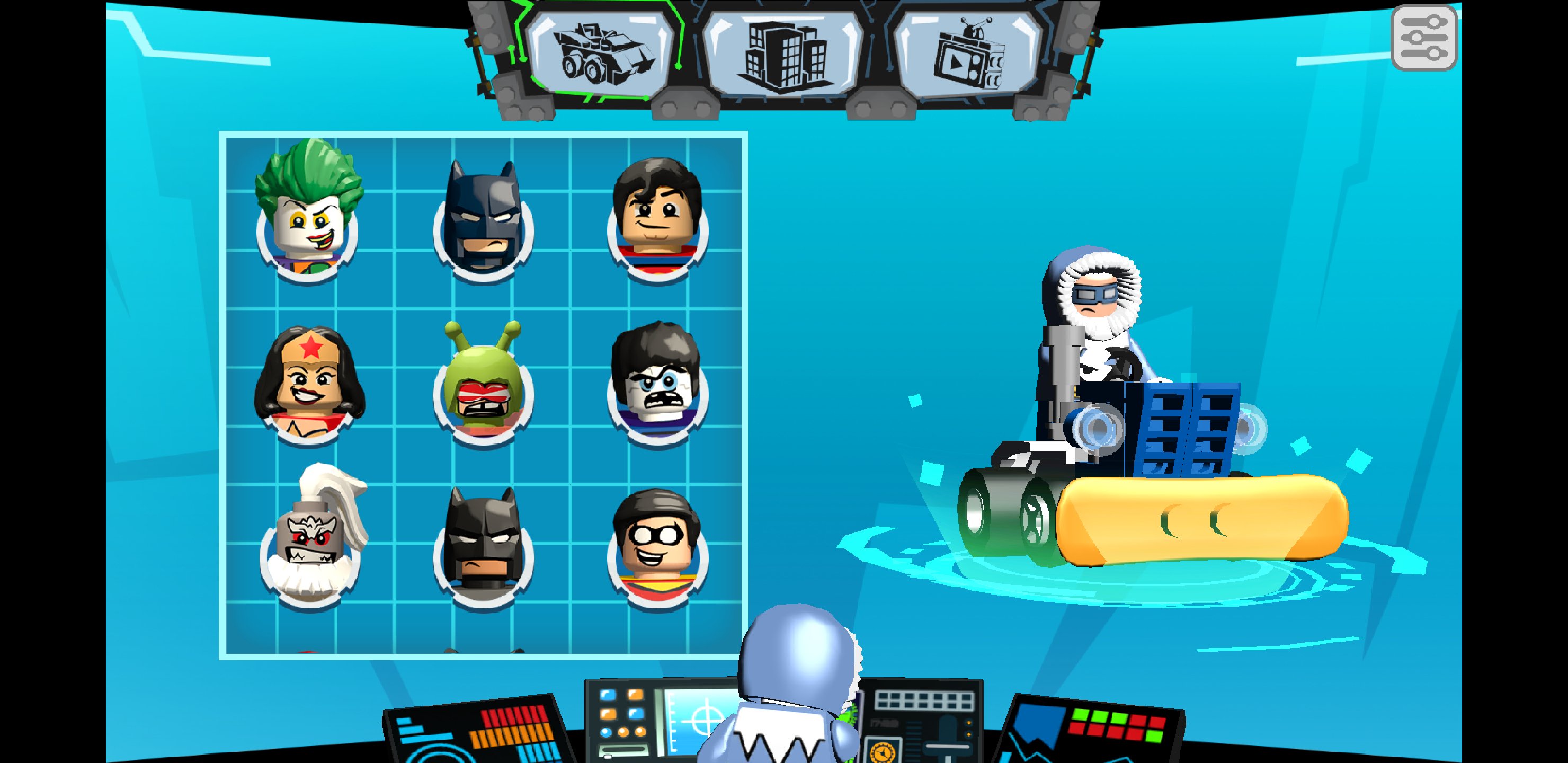
If there is one redeeming quality of Mighty Micros it certainly lies in the recognizability of LEGO DC characters. There is a bit of excitement when unlocking new heroes and villains with their respective vehicles:
- Batman (two versions)
- Superman
- Wonder Woman
- Robin
- The Flash
- Joker
- Bizarro
- Catwoman
- Bane
- Captain Cold
- Doomsday
- Killer Moth
It’s an impressive roster with rides and projectiles for each. But once all characters are unlocked there is almost no incentive to continue playing.
What Could Have Been
This game is targeting an age group of five to twelve. I myself have a seven-year-old gamer son, I am willing to say that the age span is a bit overzealous.
The assortment of characters, although plentiful, all basically operate the same. This is one more aspect where the devs could have scrutinized more with special abilities or separate sound effects. As it stands, the only differentiating features are the skins. Yes, they have different weapons, but they all do the same thing — as is also the case with the vehicles.
LEGO System A/S would have been better served with something more along the lines of the kid-friendly kart racer, Angry Birds Go! Unfortunately, Mighty Micros is not ambitious enough even for the youngest of fans.
Quick Wrap-Up

LEGO DC Mighty Micros seems to exist as just a showcase for the involved properties. The lack of depth or even fun is evident all throughout the game. Sure the graphics are top notch, the music and sound effects are great, but the overall package is a stale endeavor.
This kid-at-heart was expecting “Mighty,” but instead “Micro” describes the game very well; offering very little.
You can grab LEGO DC Mighty Micros at the Google Play Store
Meitu V6: The selfie phone you’ve never heard of
Another Chinese phone Josh saw
Xiaomi Mi Mix 2S hands-on: Iteration never looked so good
Xiaomi just announced its newest device, but as you can see in our Xiaomi Mi Mix 2S hands-on, it’s a familiar one. The Mi Mix 2S brings back a full-screen experience and tries to update …
Recently I was in Asia taking a look at a few of the phones you’ve seen covered here on Android Authority. Traveling out to a different market affords a unique opportunity to look at what’s hot in those markets — much of which will never make it to Western shores. I found one that not only looks unique, but can add unique looks to pretty much any photo it takes. It’s the selfie powerhouse phone many of you may never get your hands on: the Meitu V6.

This phone is only found in China and Taiwan, with the latter edition sporting Google Play Services.
Let’s start off by sharing the phone’s availability, which is very limited. Only China and Taiwan get this phone officially, though imports were found in Hong Kong and surely can be found in neighboring markets. I spent a day with the Taiwan edition, which is why Google Play Services and the Play Store were available.
Read: Best VPNs for China

At first glance, the phone is nestled in a luxurious case totally made of leather. This orange-like color might not be particularly attractive, but a few other colorways are available and they look pretty stunning. Once out of its case, the phone itself is not at all subtly designed, proudly sporting shiny bits on the back like actual 18K gold rivets on the bottom portion and proud metal lines up top. The back is made of leather reminiscent of the LG G4 from a few years back, and the shape of the phone adds some funky angles to the top and bottom edges.

It is not shy in its design — 18K gold, leather backing, and plenty of bezel are proudly displayed.
The front of the device shows some real departures from what we’ve come to expect in the West. This is far from a bezel-less phone. The dual cameras up top (yes, there are dual cameras on both sides) are accompanied by a front-facing flash and the very edges have grills on them. Normally this would signify a dual front facing speaker setup, but they are only for show, as only one of the grills actually houses a sound unit.
At the bottom of the front panel is a home button flanked by programmable capacitive keys. The concave button not only sports a fingerprint reader but also provides haptic feedback. Obviously, all of this means that the top and bottom bezels are sizable. The 5.5-inch screen also bucks the 18:9 aspect ratio trend, despite the body of the phone being far taller than your usual 16:9 phone thanks to those angular ends. It is a Full HD OLED display, meaning colors look pretty great.

The phone is plenty colorful on the inside, but performance purists might not feel so positive about its processing power. The V6 sports a Mediatek processor which is less than ideal compared to the Snapdragons of the world, but the phone makes up for it with 6GB of RAM and 128GB of storage. In the short time I played with the phone, these specifications did not seem to affect overall performance very much.

Editor’s Pick
Meitu: trade your privacy for cute anime selfies (Update: Meitu response)
Original post: While it’s been available in China for nearly a decade, the Meitu photo editing app has recently become very popular here in the US. You might not be so thrilled about your anime-themed selfies after …
The phone runs on MEIOS, which is powered by Android Nougat, and does not have an app drawer. A quick look through the settings shows a few bells and whistles — face unlock is available, on top of the fingerprint reader, and a themes engine can be used to change the look of the interface.
I can see this software not being everyone’s cup of tea in the West, where Asian software without app drawers (like Huawei’s EMUI) has had trouble gaining widespread acceptance. Much like Xiaomi, however, Meitu’s history dates back to software development, and plenty of extra applications have been installed to add to the experience. One of them, in particular, is the powerful MakeupPlus and it is a big reason why this phone is so popular in the East.

The MakeupPlus app is most of the reason why this phone is so popular in the East.
Before we get to that, let’s talk about those cameras. A dual lens setup of 12MP and a depth-sensing 5MP secondary unit can be found on both the front and the back, in the hopes of providing the same quality pictures no matter what side is being utilized.
Pictures from the rear camera are good, though I didn’t really pixel peep them very much. After all, the main story here is that front camera. The same dual lens setup includes a front-facing flash, which already sets the phone apart from most. Depth sensing is supposed to help with portrait modes, where subject cutouts are fairly consistent.


The camera app is pretty standard fare, with plenty of modes including panoramas and manual controls. Selfie shots can benefit from a built-in beauty mode, but MakeupPlus, which we’ll discuss further in a moment, is where the magic is hidden.
What I wanted to showcase in the official camera app is the Movie Mode. This is not a video recording mode, though it can be applied to footage. Instead, it is a setting that adds black bars to the top and bottom of the frame to give it a more cinematic 21:9 feel. This setting is pretty much available across all modes, which is a nice touch.

Okay, on to MakeupPlus. Beauty modes are a bit of anomaly in most in Western markets — we have dabbled with some of them in more widely available Chinese phones to mixed results. The skin softening is usually a little aggressive (like how it removes all of my freckles), while your eyes end up really large like an anime character and facial slimming can be so over the top it makes you see what you want and hate what you have right now. Put all those together and you can look almost completely different in the self-portrait than you do in real life. Self-confidence notwithstanding, that’s all fun and good and totally available in both the camera app and in MakeupPlus.

Where MaekupPlus takes things a step further is with makeup filters that use face tracking to accurately apply the effects to one’s face. The app is fortunately very user-friendly. You don’t even have to use the built-in camera to take the photo, rather, you can just import existing pictures like, for example, those taken with the Movie Mode applied. The sheer number of available filters, categorized based on parameters I may never understand, was surprising. The accuracy of the camera is also a bit staggering, as are the filters themselves. Putting aside the ridiculousness of having this amount of makeup on my own face, the camera and the app actually did a hell of a job.


This doesn’t even take into account the ability to change one’s hair color, which again showed how accurately the camera tracks faces. No pictures like the one above had issues with the color application applying anywhere it shouldn’t. The takeaway was this: if I didn’t know any better, I would think a person using MakeupPlus actually looked that way in real life.
This level of polish and accuracy is a far cry from many of the other beauty modes we have tested. Even within the last couple of years, the effects are so obviously digitized that it takes away from the final result — the best selfie possible. The best part: this app, along with other apps by Meitu like BeautyPlus, are available in the Play Store so anyone can check them out.
Try the app: MakeupPlus by MEITU in the Play Store

The point of this phone is not so much how it looks but how it makes you look.
Taken on its own, the Meitu V6 is a unique device inside and out, but what is so intriguing about this Asia-only phone is how most fans hone in on just the selfie experience. I heard on multiple occasions while out in China that the photos it takes are what mattered most, not Meitu’s styling or the 18K rivets or any of the typical specifications many of us now just take for granted.
In some regards, Meitu didn’t even set out to keep up with the rest of the pack, like how the phone does not even try to minimize its bezels. Instead, it wears every aspect of its design proudly, like a Vertu phone but without the pretentiousness. (Although, admittedly, it does carry a hefty price tag of almost $800 equivalent.)

The point of this phone is not so much how it looks but how it makes you look. That is important to a lot of users all across the world, but the perspective is naturally different in the East. The V6 highlights soft focus, even softer skin with as few blemishes as possible, and the ability to see makeup and hair color in surprising detail before you actually made any of those changes IRL. I can see why this phone has such a cult following. This unique opportunity to check out the Meitu V6 gave me a glimpse into what people in an entirely different smartphone market actually want.

What do you think of the Meitu V6? Would you like to see this phone (or at least aspects of this phone’s experience) make it into more markets? How important are beauty mode features to you? Let us know in the comments, on social media, and over at the video on our YouTube channel!
B&O’s Beoplay P6 speaker blasts your summer playlists in all directions
Danish luxury A/V company Bang & Olufsen has launched a number of more affordable speakers under its more approachable B&O Play brand, and today it added yet another option. The Beoplay P6 is the company’s latest wireless speaker, offering Bluetooth connectivity with your go-to music-playing device. Like the Beoplay A1 that came before it, the P6 has an aluminum exterior with a leather carry strap. B&O says the design is also dust and splash resistant, so you don’t need to worry about taking the device outdoors.
Speaking of the great outdoors, B&O says you can expect up to 16 hours of battery life on a charge with the P6. When it does come time to charge up, the Beoplay P6 does so with a USB-C cable — like a few other recent audio devices from B&O. Along the top, controls for power, Bluetooth pairing, volume and a multi-function button that can be used for a number of tasks. That so-called OneTouch button can be tasked with alerting Google Assistant or Siri on your phone, accepting phone calls or toggling through ToneTouch presets from the Beoplay companion app. While the ToneTouch interface does offer presets, it can also allow you to personalize the audio of Beoplay devices as you see fit inside the aforementioned app.
As is typically the case with B&O Play goods, you’ll have to be willing to dig a little deeper to procure the company’s mix of style and sound. The Beoplay P6 will cost $399 when it goes on sale April 23rd from the B&O Play website and the company’s own retail stores. And yes, you’ll also be able to find it third-party retailers. Wherever you decide to look for it, the P6 comes in both black and “natural” (silver) color options and the requisite charging cable will be included in the box.
Source: B&O Play
The amount users spent on iPhone apps in the U.S. rose 23 percent last year
Julian Chokkattu/Digital Trends
Wondering where all the money in your bank account is going? As per a new report from app store intelligence firm, Sensor Tower, the answer may be your iPhone apps. The company found that in 2017, U.S. iPhone owners spent nearly a quarter more money on in-app purchases than they did in 2016. The average user, in fact, spent $58 on in-app purchases — up 23 percent from $47 in 2016. Sure, that’s not a staggering amount, but it is about a dozen lattes in Starbucks currency.
This figure only represents the amount spent on purchases within an app using either Apple’s in-app purchase or subscription tools. This doesn’t include purchases made as a function of an app itself — for example, the $58 is not inclusive of the amount that you spend on Lyft or Uber rides, or your eBay bids. Rather, these are in-app purchases for say, Pokémon Go or other games.
Indeed, games represented the largest category of spending last year, making up over 60 percent of average spending. At $36 of the overall $58 spent per device, that’s a 13-percent jump when compared to last year’s $32 spent on gaming. That’s not particularly surprising given that gaming is generally the biggest revenue generator for the App Store as a whole.
Not only are iPhone users willing to pay to download these apps, but they’re also quite committed to continuously purchasing virtual goods, unlocking levels, buying in-app currencies, and other features. And given that most people play these games for extended periods of time, there’s plenty of opportunity for game developers to make a pretty penny.
More interesting, however, is the fact that entertainment apps have grown 57 percent year over year to represent $4.40 in spending per device, making it the largest category aside from games. These apps include streaming services like Netflix, Hulu, and HBO Now. And it’s not just visual entertainment — music also went up 8 percent between 2016 and 2017 to $4.10 in average spend. Most of this can be attributed to folks paying for premium subscriptions of, say, Pandora or Spotify. When music and entertainment are combined, it becomes clear that streaming services comprise a large proportion of in-app spending.
Also popular were dating apps, including Bumble and Tinder, which as a category grew 110 percent year over year and hit $2.10 in spending.
Curiously enough, while in-app spending on iPhone apps went up last year, it seems that Android spending on Google Play did not follow the same trend.
“We estimate that for each active Android device in the U.S. last year, approximately $38 was spent on Google Play – on and in apps – so about $20 less than iOS,” Sensor Tower’s head of mobile insights, Randy Nelson, told TechCrunch. “That tracks with the disparity in revenue generation we see between the stores outside the per-device level,” he added. “Android users generally spend less on or in apps, Google Play generated about 60 percent of the App Store’s revenue last year in the U.S.”
Also worth noting is that folks generally seemed more inclined not only to spend money on apps, but generally to install them. Sensor Tower found that iPhone app installs increased 10 percent — users installed around four more apps in 2017 when compared to 2016. And if you’re wondering how you stack up to the average iPhone owner when it comes to how cluttered your mobile device is, here’s some trivia for you. In total, the average iPhone user had 45 apps on their phone in 2017.
Editors’ Recommendations
- App downloads and revenues continue to grow on Android and iOS
- Apple acquires music-recognition app Shazam; competition review commences
- Buy a shirt, get a share. Bumped turns your purchases into investments
- 50 years in, Nike’s new digital studio defends its title as the king of kicks
- Google Play sees 19 billion apps downloaded in previous quarter
 AIVAnet