


Your Facebook data can be snatched by JavaScript trackers
Facebook is looking into a security report that reveals Facebook user data can be snatched by JavaScript trackers if they’re planted in websites that let users log in with their Facebook credentials. Not just their name and email address, either: The exploit catches age range, gender, locale and possibly a profile photo too, depending on how much access the user allowed said website. Once someone logs in, any third-party JavaScript can supposedly retrieve their info at will.
The report, by Princeton’s Center for Information Technology Policy website Freedom to Tinker, listed 431 of the top one million sites (by Alexa rank) that have the shady scripts embedded. The list included cloud database provider MongoDB until TechCrunch brought the issue to their attention, after which they allegedly shut down the abusive script.

“Scraping Facebook user data is in direct violation of our policies,” a Facebook spokesperson told Engadget. “While we are investigating this issue, we have taken immediate action by suspending the ability to link unique user IDs for specific applications to individual Facebook profile pages, and are working to institute additional authentication and rate limiting for Facebook Login profile picture requests.”
The report concluded that exposed user data wasn’t due to a bug in Facebook’s login feature — instead, it’s “due to the lack of security boundaries between the first-party and third-party scripts in today’s web.” To fix this loophole, the report’s authors recommend Facebook (and any other services that have social logins) audit their APIs to review who accesses login data. Cheekily, they also recommend finally making Anonymous Login with Facebook available after it had been announced four years ago.
Source: Freedom to Tinker
Theranos’ video game stars the reporter who exposed the company
Last week, Business Insider reported that employees of the troubled startup Theranos had created a Space Invaders-style video game featuring the Wall Street Journal’s John Carreyrou as a target. Carreyrou began reporting on the company in 2015 and revealed that Theranos was misleading investors about its technology. Theranos and CEO Elizabeth Holmes said the company could test just a small drop of blood for a number of diseases — claims the company was never able to back up and eventually led to massive financial troubles, employee layoffs and fraud charges from the SEC. Today, Business Insider shared a video of employees playing the video game at the company.
A number of people at the startup are said to blame Carreyrou for Theranos’ growing problems and Vanity Fair reported in 2016 that staff erupted in a chant of, “Fuck you, Carreyrou,” during a meeting. The video game was dubbed Haters’ Gonna Hate and the video obtained by Business Insider shows employees playing it inside the company’s manufacturing building. In it, players use miniLabs (the device Theranos claims can be used to analyze small samples of blood) to shoot Nanotainers (the tubes that hold the blood samples) at images of both Carreyrou and the Zika virus.
Last month, Holmes agreed to pay $500,000 to settle the charges brought against her by the SEC. She also agreed to return 18.9 million Theranos shares and to not serve as an officer or director of a public company for 10 years.
Space Invaders, Theranos Edition! pic.twitter.com/gOeUNqASBU
— John Carreyrou (@JohnCarreyrou) April 13, 2018
Via: Business Insider
NASA finally has a new administrator
The Trump administration nominated Oklahoma Republican Representative Jim Bridenstine for the top NASA job in September of last year. He’s been a vocal proponent of the privatization of space, which led to some criticism of the choice as injecting politics into an agency that should be about the pursuit of science. Now, some 16 months into Trump’s time in the White House, the Senate has finally confirmed Bridenstine for the position.
Today, the U.S. Senate voted to confirm Jim Bridenstine as our 13th administrator. Once sworn in, he will oversee our ongoing mission of exploration and discovery. Welcome to the NASA family! pic.twitter.com/r1Eiyb13PY
— NASA (@NASA) April 19, 2018
“It is an honor to be confirmed by the United States Senate to serve as NASA Administrator,” said Bridenstine, now the 13th administrator of the US space agency, in a statement. “I am humbled by this opportunity, and I once again thank President Donald Trump and Vice President Mike Pence for their confidence. I look forward to working with the outstanding team at NASA to achieve the President’s vision for American leadership in space.”
Acting NASA administrator Robert Lightfoot praised the confirmation in the statement, as well. “I’m very pleased to welcome Jim Bridenstine to NASA,” he said. “He joins our great agency at a time when we are poised to accomplish historic milestones across the full spectrum of our work. Jim now takes the reins of this agency and its talented and dedicated workforce. I’m looking forward to him building on our great momentum and sharing our many strengths to help us make the next giants leaps on behalf of humanity. I also want to express my heartfelt appreciation to the NASA team for all they accomplished during my time leading the agency.”
Source: NASA
The Honor 10 is as funky-looking as the Huawei P20, only cheaper
So you’re yearning after Huawei’s P20 phones, but you can’t quite justify the outlay to get that nearly-all-screen design and sports car finish. Are you stuck? Thankfully, no: the company has launched the Honor 10, which touts many of the same features in a potentially more affordable design. You get a notch-happy 5.84-inch 2,280 x 1,080 LCD and an optional color-shifting glass body on the outside, to start. And the inside isn’t much different. You get the same Kirin 970 chip (with 6GB of RAM), a 3,400mAh battery and an extensive camera array — there are 16-megapixel color and 24-megapixel monochrome cams on the back, and a 24-megapixel selife shooter on the front.
Notably, there’s even something new: the Honor 10 touts a stealthy ultrasonic fingerprint reader on the chin that should do a better job of recognizing wet fingers. This isn’t strictly new in the industry (Xiaomi’s Mi 5s has one), but it’s good to see the feature spread to Huawei’s brands.
The allure, as you might guess, is competitive pricing. The Honor 10 will launch April 27th for 2,599 yuan (about $414) with 64GB of built-in storage, and 2,999 yuan ($478) for 128GB. Prices are bound to change when the phone reaches other countries (likely including the US given Honor’s tendencies), but there’s a good chance it’ll still deliver a lot of handset for the money.
Oh, and there’s another treat: Honor is launching the MagicBook (below), a sibling to the Huawei MateBook X Pro. The 15-inch system doesn’t have the same dramatic nearly-no-bezel display as the MateBook (though this does mean the webcam isn’t hidden in the keyboard), but you’ll still find current-generation Core i5-8250U and Core i7-8550U processor options, 8GB of RAM, a 256GB solid-state drive and dedicated GeForce MX150 graphics. It should even last a while with a 12-hour claimed battery life. There’s even Dolby Atmos audio that should give some added impact from the built-in speakers.
The MagicBook is launching in China for 4,999 yuan (roughly $796) in its Core i5 edition, while springing for the Core i7 hikes the cost to 5,699 yuan ($908). There’s no word on whether or not the MagicBook is destined for other countries, but we wouldn’t count on a US debut when Honor’s local sales have so far focused on phones and accessories.

Source: Engadget Chinese (translated)
Apple Shares 2018 Environmental Report With Details on Daisy Recycling Robot, Progress on Closed-Loop Supply Chain
Apple today shared its 2018 environmental report [PDF], outlining all of the improvements and changes that were implemented throughout 2017 and early 2018 to lessen the company’s overall environmental impact.
As was announced earlier this month, Apple recently hit a major milestone and longtime environmental goal, with 100 percent of its operations around the world powered by renewable energy. Apple has also convinced 23 of its suppliers to commit to using 100 percent renewable energy so far.
A map of Apple’s renewable energy projects
These efforts allowed Apple to cut down on its total carbon footprint in 2017. During the year, Apple was responsible for 27.5 million metric tons of greenhouse gases, down from 29.5 million metric tons in 2016.
 A breakdown of Apple’s carbon footprint
Through its unwavering commitment to renewable energy, improvements to energy efficiency, and a reduction in emissions from aluminum manufacturing, Apple has reduced emissions by 54 percent worldwide since 2011, and as of 2018, 66 percent of the renewable energy Apple procures comes from Apple’s own projects.
Over the course of 2017, Apple worked to implement energy efficiency improvements to its facilities around the world, including Apple retail stores. Upgrades were made to LED lighting, heating, ventilation, and air-conditioning systems, resulting in an overall electricity savings of 3.7 million kilowatt-hours per year.

Apple’s overall energy footprint was reduced by 14.7 million kWh and 225,000 therms in fiscal 2017, and combined with other efficiency measures implemented since 2011, Apple cumulatively saves 70 million kWh of electricity and 2.4 million therms of natural gas per year. The company has also worked directly with its suppliers to audit facilities and find opportunities for better energy efficiency, with the program saving an annualized 320,000 metric tons of C02e from entering the atmosphere in 2017.
Today’s environmental report highlights Apple’s newest recycling robot, Daisy. Daisy can disassemble 200 iPhones per hour, removing and sorting components more efficiently than Apple’s previous recycling robot, Liam. Daisy removes and sorts components from the iPhone, allowing Apple to collect more materials than it would get from traditional recycling methods.
Daisy has a smaller footprint than Liam and can disassemble multiple models of iPhone with higher variation compared to the earlier robot. Using Daisy, Apple was able to make progress towards its goal of creating products without mining materials from the earth, aka the closed loop supply chain that it announced as a goal in 2017.
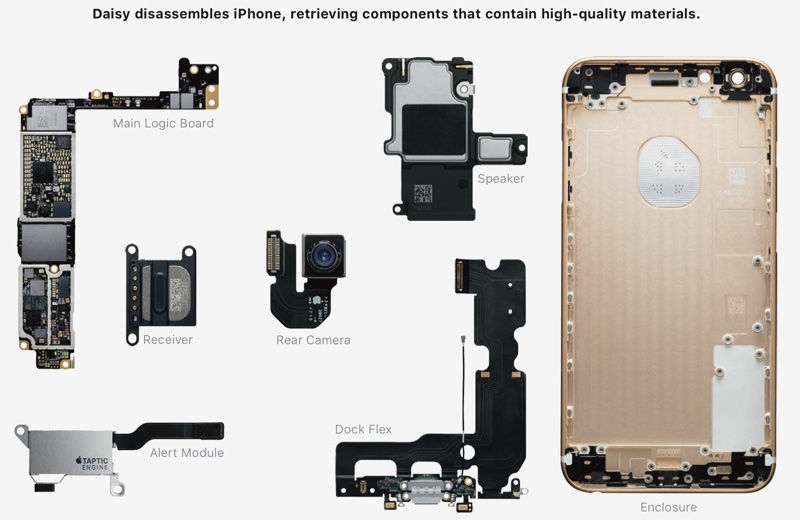
Apple says that in 2017, it invited “key stakeholders” to small “closed-door roundtables” in Europe, the U.S., and China to get targeted feedback on its closed-loop supply chain ambitions. Apple spoke with academics, NGOs, industry leaders, and other companies.
The company has also been investing in research to figure out the barriers to implementing a closed-loop system, and it has been launching pilot programs to determine possible solutions. Apple outlines several materials and programs it’s currently focusing on, including aluminum (sourced from old iPhones), cobalt (battery scrap is now shipped to a recycler), copper (reducing copper usage on PCBs), glass (new reuse and reprocess methods), paper (sustainable forests), plastics (aiming to eliminate plastics), rare earth elements (exploring new recycling technologies), steel (increasing recycled content), and tungsten (recovered from the Taptic Engine and sent to specialty recycler).
Apple’s main accomplishment in 2017 was the use of 100 percent recycled tin for the solder on the main logic board in the iPhone 6s. Recycled tin is now being used for the iPhone 7, iPhone 7 Plus, iPhone 8, and iPhone 8 Plus.
For those interested, Apple’s full environmental report [PDF] goes into much greater detail on landfill usage, water usage, dangerous materials, recycling, product efficiency, and more, and it’s well worth reading if you want to brush up on Apple’s environmental protection efforts.
Tags: Environmental Responsibility, Apple environment
Discuss this article in our forums
Greenpeace Criticizes Apple’s ‘Daisy’ Recycling Robot, Says Focus Should be on ‘Repairable and Upgradeable Product Design’
As part of its 2018 environmental report, Apple today unveiled the latest iteration of its recycling robot, named Daisy. Daisy is an upgraded version of Liam, the recycling robot Apple debuted in 2016. Daisy is smaller, faster, and more efficient than Liam, able to disassemble 200 iPhones per hour and obtain their component parts for recycling.
In response to Apple’s environmental report and details about the new robot, Greenpeace has released a statement suggesting Apple’s focus should be on product longevity rather than recycling robots.
Daisy, Apple’s newest recycling robot.
In a statement, Greenpeace Senior analyst Gary Cook said Apple needs to work on product designs that better accommodate upgrades and repairs, allowing for devices to be used for a longer period of time. Cook says customers clearly want to keep their devices for longer, citing demand for battery replacements under Apple’s discounted battery program.
“Rather than another recycling robot, what is most needed from Apple is an indication that the company is embracing one of its greatest opportunities to reduce its environmental impact: repairable and upgradeable product design. This would keep its devices in use far longer, delaying the day when they’d need to be disassembled by Daisy.
Customers want to keep their devices longer, as evidenced by a 3 to 4 week wait for a battery replacement at Apple retail stores earlier this year, when Apple was compelled to dramatically reduce the replacement cost.
Greenpeace often champions device repairability and longevity, especially in regard to Apple products. Last summer, for example, Greenpeace teamed up with iFixit to rate the repairability of Apple devices, accusing Apple of shortening device lifespan with difficult, proprietary repair processes and components, ultimately leading to more electronic waste.
For its part, Apple in its environmental report says that device durability and longevity is one of its goals, citing its efforts to provide parts and repairs for five years after a product is no longer manufactured. “When products can be used longer, fewer resources need to be extracted from the earth to make new ones,” reads the report.
While Greenpeace criticized Apple’s lack of focus on repairability, it did laud Apple’s efforts to cut down on greenhouse gas emissions in comparison to Apple competitors. Samsung, for example, operates on 1 percent renewable energy, a sharp contrast to Apple’s operations that now run on 100 percent renewable energy.
“Apple’s latest environment report highlights the company’s continued leadership in aggressively deploying renewable energy to tackle the greenhouse gas footprint of not only its own operations, but also its suppliers who are responsible for the vast majority of its emissions. Apple’s leadership on climate change contrasts sharply with its main competitor, Samsung Electronics, who currently operates on only 1% renewable energy.
Greenpeace regularly gives Apple high marks for the company’s dedication to environmental improvements, which is close to unparalleled in the tech world. Apple received a B- in Greenpeace’s latest Guide to Greener Electronics, beating out Google, Amazon, Microsoft, Sony, Samsung, Lenovo, Huawei, HP, LG, and more.
Note: Due to the political nature of the discussion regarding this topic, the discussion thread is located in our Politics, Religion, Social Issues forum. All forum members and site visitors are welcome to read and follow the thread, but posting is limited to forum members with at least 100 posts.
Discuss this article in our forums
Honor 10 announced with the P20’s design and a much lower price
The phone will be available in China for around $414 USD.
Huawei wowed us in late March with the unveiling of its P20 series, and now the company’s bringing many of the features that make those phones great, cutting the price, and slapping its Honor sub-brand logo on it. Ladies and gentlemen, meet the Honor 10.

The Honor 10 has much more striking design compared to last year’s Honor 9, featuring a 5.84-inch 1080p LCD display with a small notch at the top, incredibly slim bezels, and a front-facing fingerprint sensor. Flip the Honor 10 over, and you’ll find a glass back that shifts colors depending on how the light hits it. This design proved to be absolutely stunning on the P20 and P20 Pro, and it looks like it’ll be just as impressive on the Honor 10.
Rounding out the phone is dual 16MP and 24MP cameras on the back, 24MP selfie camera, Huawei’s own Kirin 970 processor (the same one found on the P20 and Mate 10 Pro), a USB-C port for charging, and the endangered 3.5mm headphone jack even makes an appearance.


Sales for the Honor 10 will begin on April 27 in China and pricing is set at ¥2599 (around $414 USD) for 6GB RAM and 64GB of storage. If you want to step up to the model with 128GB storage, you’ll pay ¥2999 (or $478).
Honor hasn’t announced any plans for availability outside of China just yet, but we’ll keep you posted if anything changes on this front.
Honor 7X vs. Huawei Mate SE: What’s the difference?
Fitbit Versa and fitness: Everything you need to know
You can’t spell ‘versatile’ without Versa.

While the Fitbit Ionic is the flagship, the new Fitbit Versa is likely a better fit for the masses. At $200, it is a wearable that everyone should consider as a way to understand all of the details of your daily life while also motivating you to make healthy choices.
It lacks GPS, but still has a number of fitness features that will help you track your activity, understand the details of your resting and active heart rate, record data during specific exercise sessions, learn about and practice breathing to reduce stress, study the details of your evening sleep stages, and challenge friends and family to move more.
The Fitbit Versa will also be one of the best devices for women when the female health features launch soon.
See at Fitbit
Daily activity

At its core, the Fitbit Versa is an activity tracker that will use its 3-axis accelerometer, 3-axis gyroscope, and altimeter to count your steps, calculate the distance you covered, estimate the number of calories you burned, categorize your active as active minutes, and compute how many flights of stairs you have climbed (sorry, going down the stairs does not help you reach your goal).
For each of these metrics, you can set custom goals in the smartphone app or on the dashboard of the Fitbit website. There is also an option to have an hourly activity goal of 250 steps that can be selected to remind you to walk for periods from five to 14 consecutive hours. This hourly goal is great for those working in an office that need a reminder to step away from the desk and walk around a bit.
Heart rate tracking

Another element of your daily activity tracking, also very relevant to the state of your fitness, is heart rate tracking. The Fitbit Versa has Fitbit’s latest PurePulse heart rate tracking technology that is used for continuous heart rate monitoring to improve calorie burn estimates, provide you with valuable resting heart rate information, optimize your exercise routines, and guide you best through breathing exercises.
Many exercises do not involve steps so it is important to measure your changing heart rate during these exercises, spinning for example, in order to calculate a more accurate calories burned metric.


Heart rate measurement during exercise makes sure you maintain the right intensity during those workouts to help you achieve your goals while also preventing you from overtraining. Maintaining your heart rate in the cardio zone is great for fitness, but if you are training to burn fat then training at the cardio level is not going to help you reach your weight goal. It is important to understand how heart rate affects your fitness and goals so thankfully the Fitbit Versa is built to provide this data measurement in an accurate manner.
Your resting heart rate is best calculated when you wear your Fitbit Versa 24/7. Wearing it at night when you are asleep, and your heart rate is lowest, will help Fitbit’s algorithms estimate a true resting heart rate. Your resting heart rate is not usually your lowest heart rate, but a measure of a typical calm, comfortable, awake condition. A measure of 60-80 is generally a good measure, but it can also vary quite a bit. My own resting heart rate varies between 44 to 48 beats per minute, but I have always had a rather slow rate and am in the middle of training for another half marathon.
In order to establish heart rate training zones, Fitbit calculates a maximum heart rate with the common formula of 220 minus your age. You can also setup a custom max heart rate if you are targeting a specific training zone.
Exercise tracking

You can select up to seven exercise shortcuts to appear on your Fitbit Versa from a list of These exercises include run, bike, hike, golf, elliptical, workout, martial arts, kickboxing, pilates, yoga, stairclimber, treadmill, walk, weights, tennis, boot camp, spinning, interval workout, swim, and circuit training.
Within each of the exercise modes, you can toggle on GPS (remember, the Versa does not have integrated GPS so this data will need to come from a connected smartphone) and also customize the stats for the three rows that appear on the display after you select Go to start your exercise session. Available stats are dependent on the exercise mode and may include elapsed time, heart rate, calories burned, time of day, lap time, distance, pace, average pace, steps, speed, average speed, and more.
Some exercise modes have an auto pause option (useful if you run in the city and have to cross a lot of streets with stop lights) while others have auto tracking. Fitbit employs its SmartTrak technology to track select exercises like running, biking, and walking after a customized period of time performing that activity passes, even if you do not manually start that activity on the watch. Since I walk about a mile to and from my commuter train, I turned this off for walking since I don’t need these walks appearing as workouts on my Fitbit Dashboard.


The Fitbit Versa is water resistant to 50 meters, which means you can use it to track swimming. The options for swim mode include setting the pool length so you can track laps and pace while swimming.
Every fitness tracker needs a great 7-minute workout, and this is one of the best implementations.
The Fitbit Versa also comes preloaded with Fitbit Coach and three free bodyweight exercise options. Short videos on your phone, or animations on your Versa, will show you the proper form of each exercise. These free exercises include the 7-minute workout, 10-minute Abs, and Treasure Chest.
The 7-minute workout is one of my favorites and includes 30 seconds each of jumping jacks, wall squat hold, pushups, crunches, step ups, squats, bench dips, forearm plank, high knees, lunges, side plank pushups, and forearm side planks on both sides. It is a great short session of 12 exercises with short breaks between each exercise that I like to perform after a four to six mile run.
The 10-minute Abs workout also has 12 exercises with a mix of time and reps. Each is focused on your lower core and is also a great workout to include with other exercise sessions.
For an upper body focused workout, choose the free Treasure Chest option. This exercise is setup to be completed in 20 minutes and includes 22 parts of exercise and rest. It has similar exercises to the 7-minute workout with the addition of spidermans, typewriter pushups, burpees, scorpion pushups, and more.
Stay tuned for another article taking an in-depth look at all of the options when you subscribe to Fitbit Coach premium
Guided breathing

My wife is now serving as the caregiver for her aunt who has pancreatic cancer and over the past week has been quite anxious thinking about the future of her aunt. I had her put on the Fitbit Versa and try out the guided breathing utility. She immediately showed signs of calming down and I could see the anxiousness leave her face.
Guided breathing was launched on Fitbit devices in 2016 and is present as an app, called Relax, on the Fitbit Versa. It is something that you may just ignore or even remove as an app, but I would like to encourage you to give it an honest test for a week or so. As I mentioned earlier, it is powered by the PurePulse heart rate technology too.
You can choose to perform a session for two or five minutes with two minutes serving as the default. Vibration can be toggle on or off to help you through the inhale and exhale routine without having to watch the expanding and contracting circle.
Sleep tracking


I enjoy running and cycling, but over the years I discovered that one of the most important elements of a healthy lifestyle and the potential to improve your fitness is sleeping. This is one area that Apple has not yet explored with the Apple Watch and one area where Fitbit beats all other wearables with its advanced sleep tracking algorithms.
Fitbit’s new sleep stages track the time you spend awake, in light sleep, in deep sleep, and in the REM (rapid eye movement) stages of sleep. The PurePulse heart rate technology and motion detectors help define these four stages of your sleep and I am personally fascinated by waking up and viewing these stages.
I find that such detailed tracking and attractive presentation actually motivates me to go to sleep earlier and thus reach my sleep goals. My sleep time has definitely increased thanks to Fitbit’s reminders and my understanding that sleep is a vital part of overall fitness.
The great thing about the Fitbit Versa is that it is very lightweight and you can hardly tell you are wearing it. This, combined with the fact that sleep tracking is performed automatically, makes it an excellent accessory to wear every night. You can also set a silent alarm so that your partner isn’t blasted out of bed when your phone loudly blares your annoying alarm.
Sleep results and insights show your stage time for the day, compared to the last 30 days, and benchmarks for men or women of your age.
Fitbit Community and challenges


Fitbit has been rather successful over the years in large part due to the ecosystem of users. There is a vast Fitbit community and within the Fitbit app you can join groups that interest you, view your friends’ weekly activity and see where you fall on the leaderboard, and even view a feed full of Fitbit users that has a similar look and feel to an Instagram feed.

In addition to the community, there are adventure races, friends and family challenges, and solo adventures that you can compete in to help motivate you to move. Most of these challenge events are focused on daily step counts, but if you are looking for ways to motivate you to get out and move then you may want to challenge your family to a daily showdown.
Female health
As a father of three daughters who has been married to my lovely wife for 25 years, I am quite familiar with the importance of tracking female health stats. Fitbit will soon be launching support for tracking menstrual cycles and comparing this health data against all the rest of the metrics that the Versa is tracking. My oldest daughter is a Fitbit user and I look forward to hearing more about the performance of this unique aspect of the Fitbit ecosystem.
What’s your favorite fitness feature on your Fitbit?
Do you use all the fitness features on your Versa? Which ones do you love (or hate)? Let us know in the comments below!
See at Fitbit
The Best Indie Games for PlayStation 4

If you are on the lookout for some great independent games for your PS4 then check these out.
There’s no denying that the PlayStation 4 has made a comfortable home for blockbuster games and their developers. Every year there is a seemingly endless stream of huge titles. But what about the little guys? Independent developers are just as capable of creating amazing and engaging games as the big guys. Here are just a few of the very best independent titles that PS4 has to offer.
- What Remains of Edith Finch
- Rocket League
- Hellblade: Senua’s Sacrifice
- Hotline Miami 1 & 2
- Rogue Legacy
- Fez
- Rime
- Stardew Valley
- Celeste
What Remains of Edith Finch
If you’re looking for a fantastic storytelling experience bolstered by gorgeous visuals then developer Giant Sparrow has you covered. What Remains of Edith Finch may not be for every gamer but if you are enticed at the idea of having your heartstrings tugged and you enjoy a meditative gaming experience then it’s certainly worth your time and money.
See at PlayStation
Rocket League
A titan on the level of Rocket League hardly seems worth mentioning considering how massively popular it is. With 40 million Rocket League players developer Psyonix must have done something right. If you like soccer and cars and have always wanted a game which married the two with fast-paced gameplay then this is the game for you. If you happened to get good enough at Rocket League then perhaps someday you could be a professional eSports player. Try explaining that to your grandparents.
See at Amazon
Hellblade: Senua’s Sacrifice
You know that argument that you always get into? The one where you try to explain to someone that video games are just as valid and valuable an art form as film is. There’s always that one person who hasn’t played a video game since Frogger and they continue to insist that games are just kid stuff. Well, show them Hellblade: Senua’s Sacrifice. Ninja Theory developed one heck of a game and there is a reason that it garnered a veritable boatload of nominations at the 2017 Game Awards.
See at Amazon
Hotline Miami 1 & 2
Thank you, Sir. May I have another? Dennaton Games are video game design sadists and they made Hotline Miami for gaming masochists who love a game that relentlessly abuses them. Aside from being fun and insanely hard, Hotline Miami has a beautiful retro visual style and one of my favorite game soundtracks of recent years.
See at PlayStation
Rogue Legacy
Rogue Legacy is a killer Rouge “Lite” game developed by Cellar Door games. As you progress through the game there is no doubt that you will die. You will actually die quite a bit. The upside to death in Rogue Legacy is that when your character dies you will get to replace them with an heir. That heir will often be cursed by one of many genetic deficiencies. For instance, if your character carries the gene for color blindness then your play through with that character will be in black and white. It’s goofy and fun and overall it’s a terrific game.
See at PlayStation
Fez
Fez arrived pretty early in the life cycle of the PS4 and it arrived with a bunch of ancillary noise thanks to its vocal developer. Despite any sort of social kerfuffle it’s an outstanding game. Fez starts as a 2D game that rapidly evolves into a cube based 3D world. The mechanics are actually quite clever and add an interesting element to the gameplay. It also has a stellar soundtrack.
See at PlayStation
Rime
Stunning and gorgeous are completely apt adjectives to use when discussing Rime. Developed by Tequilla works, it’s a third person puzzle adventure game wherein you control a boy who has been stranded on a deserted island. Imagine the spirit of games like Ico and Myst and you will have a decent idea of what’s in store for you. If you like just a tinge of sadness with your visually masterful games, then you should certainly give Rime a second look. You can experience it yourself for $30.
See at PlayStation
Stardew Valley
If you were a fan of the Harvest Moon games and you haven’t played Stardew Valley, then drop everything and buy this game right away. Developed with palpable care by a single person, Stardew Valley is certainly a perfect spiritual successor to the Harvest Moon games. One would think that a farming sim shouldn’t be this much fun but it most decidedly is. If you’re looking for an insanely fun and charming time sink, then Stardew Valley is a no-brainer. You can pick it up on Amazon for $15
See at Amazon
Celeste
Celeste came to the PlayStation 4 in the very beginning of 2018 and boy is it ever good. It will take a place amongst similarly difficult titles as Meatboy and Hotline Miami. However, it also just so happens to be beautiful and thoughtful as well. If you’re looking to make a list of the best platforming experiences of the past decade, then you should certainly put Celeste in the running. It’s hard to believe that a game this good is only $20 dollars, but it is. And it’s well worth your money and time.
See at PlayStation
One of the truly great things about the PlayStation 4 is the sheer volume of top-tier independent titles. What are some of your favorites?
Why are we talking about PlayStation 4 games on Android Central? Let us explain.
Update, April 2018: We’ve updated this article to include more great indie titles for your PS4!
PlayStation 4

- PS4 vs. PS4 Slim vs. PS4 Pro: Which should you buy?
- PlayStation VR Review
- Playing PS4 games through your phone is awesome
Amazon
Verizon revamps its parental control tools with ‘Verizon Smart Family’
Pricing starts at $4.99/month.
There are a number of parental control platforms for monitoring your family’s device usage, and the latest company to throw its hat in the ring is Verizon. The carrier’s offered a suite of controls through its FamilyBase service, but it’s now being completely overhauled as Verizon Smart Family.

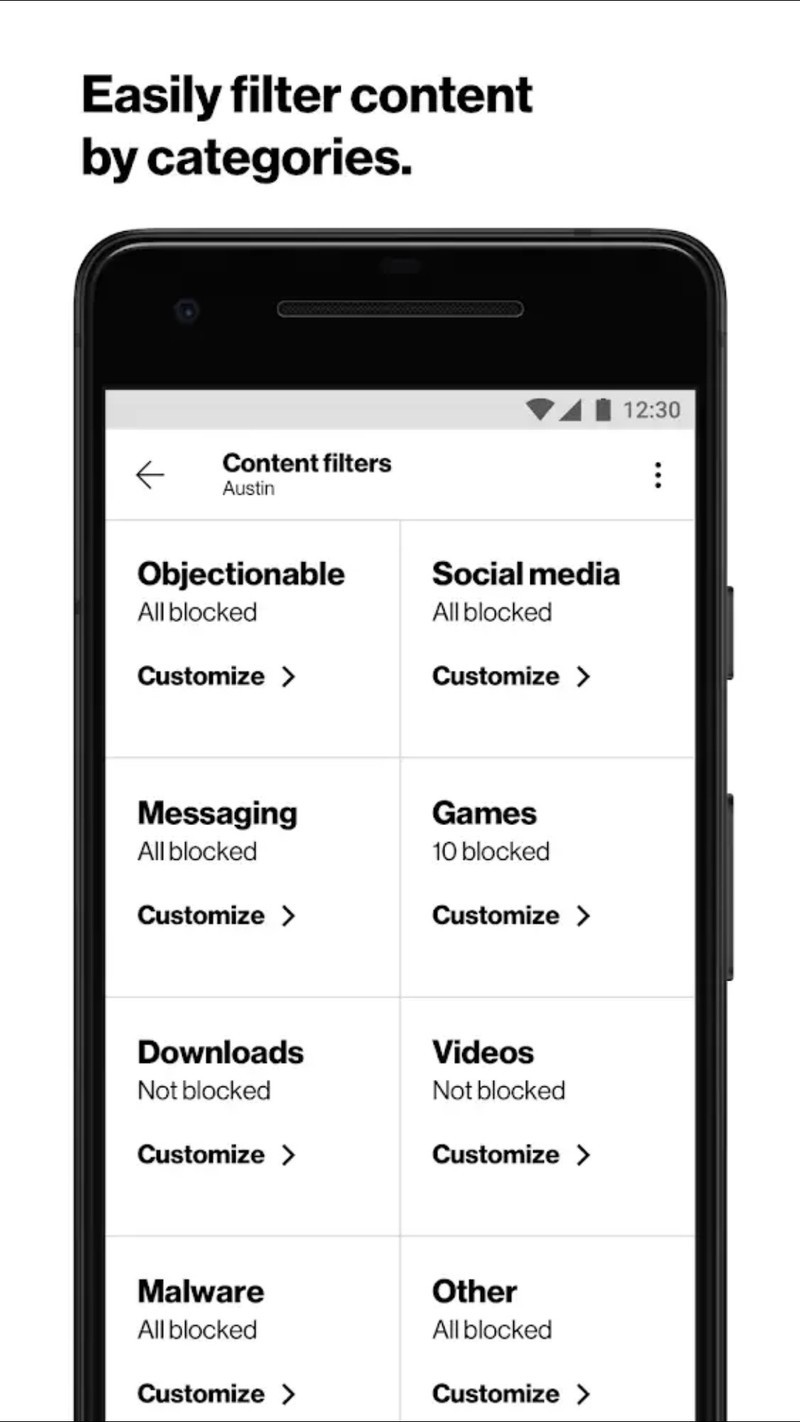
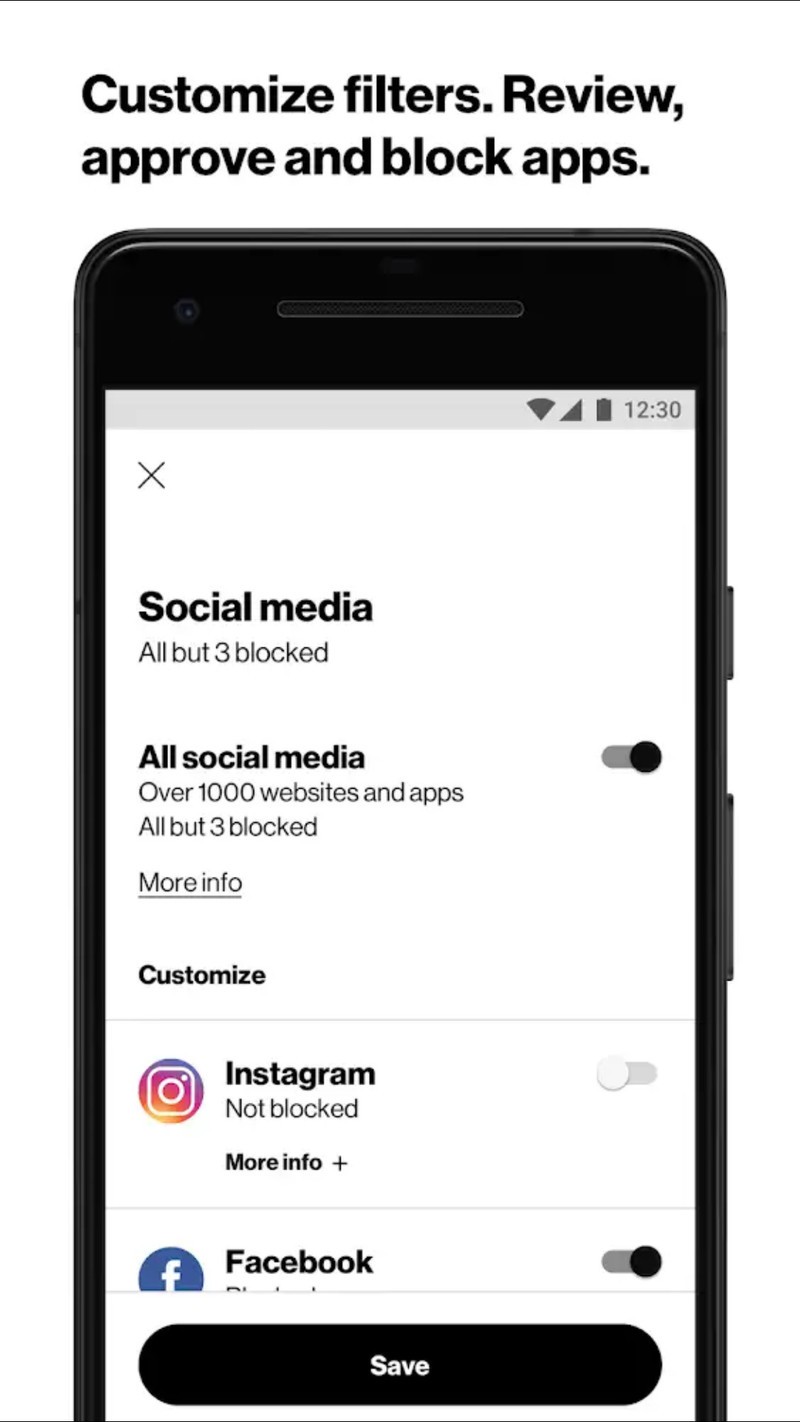
Using the Smart Family mobile app, you can view real-time location tracking for your family, enable screen-on time limits for specific days/times, and turn on content filters for social media, videos, text messaging, etc. You can also remote pause internet access for your kids, in addition to seeing how they’re using their phones throughout the day.
Verizon Smart Family is replacing the old FamilyBase app, and with this, introduces an updated design that should make using it much simpler.

Commenting on the rebrand, Verizon’s Senior Product Manager, Susie Fernandes, said –
Being a parent in today’s digital world can be daunting, but it doesn’t have to be. We created Verizon Smart Family to give parents the tools they need to help them raise tech savvy kids with a healthy and responsible approach to screen time and content viewing.
If you want to start using Verizon Smart Family, you’ll need to cough up $4.99/month. In order to access the location tracking features, that’ll cost a higher $9.99/month fee.
Download: Verizon Smart Family (free)
 AIVAnet