


It’s no crypto-utopia. Blockchain has real problems to solve.
Blockchains have an energy problem — the technology relies on expensive hardware and draws an enormous amount of electricity to process complex algorithms and transactions. Lars Hagberg/Getty Images
Amidst the continued fervor for cryptocurrencies and blockchain technology, evangelists have claimed it can help replace everything from money itself, to the foundation of many of our digital tools. But with Bitcoin fees skyrocketing off of its expanded use last year, and bugged Ethereum smart contracts leading to users losing millions of dollars, is this really a technology that’s ready for mainstream adoption?
There’s not even a concrete definition of what a blockchain is. If, however, we assume it to be a distributed ledger system, there are key areas which many of those at the forefront of blockchain’s development believe are lacking. We sat down with blockchain developers to find out more about the technology’s flaws.
Working for everyone
This article is part of our series “Blockchain beyond Bitcoin“. Bitcoin is the beginning, but it’s far from the end. To help you wrap your head around why, we’re taking a deep dive into the world of blockchain. In this series, we’ll go beyond cryptocurrency and hone in on blockchain applications that could reshape medical records, voting machines, video games, and more.
“The biggest issue I see right now is the scalability problem,” Justas Pikelis, co-founder of blockchain Ecommerce platform, Monetha, told Digital Trends. “Right now, Ethereum can process 17 transactions per second. Facebook can handle 175,000 requests per second. Visa, 44,000 transactions per second. So, if we really want to use cryptocurrencies as currencies, it would not be possible as of this moment.”
The best example of blockchain’s scaling problem is the escalation of Bitcoin transaction fees and confirmation times that occurred during the currency’s explosive value rise at the end of last year. Fees rose from a dollar or two to as much as $50.
Other cryptocurrencies and blockchain platforms don’t suffer as severely from this issue, and there are technologies being implemented in Bitcoin to mitigate it, but it’s not an easy fix even with them in place.
“When you store the data on the blockchain, it’s quite expensive,” explained Alexander Demidko, CRO of blockchain database company Fluence. “That’s why all of those solutions are trying to store the data off chain and send it periodically to the blockchain. But it’s still hard to search through the data stored there. That’s why we [think] ideally there should be a way to upload the data to the decentralized environment, then search the data I need there. That’s what we’re trying to solve with a decentralized database, as it’s not currently supported by the blockchain.”
Justas Pikelis, co-founder of Monetha, a blockchain Ecommerce platform. Justas Pikelis/Facebook
Blockchains like the one used by Bitcoin, which leverage a ‘proof of work’ system, require enormous amounts of computing power – that’s expensive in hardware and electricity. Although alternatives exist, blockchains are still computationally intense when compared with traditional databasing solutions. Storage is also a potential problem.
Bitcoin’s blockchain of simple transactions is upwards of 150GB. Any business institution using blockchain technology for a traditional database can expect every node to require much more space than that. That problem would be compounded if, as a company, you were to operate a private blockchain – controlling every node yourself.
Edgar Bers, head of public relations at HashCoins, believes blockchain technology, as it exists now, wouldn’t be useful or scalable for a large database.
“Most blockchains we have today are not good for businesses that rely on massive amounts of data […] Most businesses rely on terabytes of information and centralized server architecture […] Multi-terabyte blockchains are inefficient,” he said. “When your business requires ultra-heavy communications you really have to throw all the tech you can on the blockchain to survive the load. If you design a blockchain for a certain maximum of transactions per second, increasing your business operations could be staggering due to required blockchain upgrades – which you may not even have to hand.”
That’s less of a problem if you operate a public ledger blockchain because you can decentralize your blockchain over nodes that are found across the world. That’s certainly a viable solution, and one used by governments like Estonia. Yet that runs into another issue entirely. The problem of privacy.
For your eyes only
Most people imagine blockchain technology as the publicly distributed system that Bitcoin is built on. The nodes (miners) are located all over the world, and the entire blockchain is publicly downloadable, viewable, and verifiable. That total transparency creates all sorts of problems for organizations handling even the slightest confidential data.
“Full decentralization is almost utopian, where it can only be used in a very primitive function, like Bitcoin,” Pikelis explained. “When you’re talking about more complicated things, a little more information stored on the blockchain, it’s really hard to reach that full decentralization. Still people have to believe that companies are running these decentralized applications for them to be able to on board and really store the things and hash the things that are private [like] public information.”
Even the developers at Fluence, who are working on developing blockchain database technology that could, in theory, handle potentially sensitive information, don’t believe it’s quite ready to yet. “As with every technology that has yet to mature, you don’t want to store overly sensitive data there. Once it becomes more mature, you can trust it more,” Demidko told Digital Trends.
That’s not to say they aren’t working on a solution. The first and most predictable, considering the blockchain’s reliance on cryptography, is encryption.
“In the example of a driving license database, I am a user, I have my driver license and I want to put it into a decentralized database,” Demidko explained. “I can encrypt it with my personal key and not tell this key to anyone, but authorities who need that. If I put my driver’s license into the decentralized database, it’s encrypted there, so no other person can read it without my permission. The nodes where the data is being stored have access to the data, but they can’t read it because they don’t have any keys.”
However, encryption alone is not the final solution to privacy concerns. Private keys could be accidentally revealed by a third-party, and the development of quantum computing could lead to easy brute forcing of private keys that would threaten the sanctity of data stored on a truly decentralized blockchain. There’s no easy fix to these problems yet, so privacy will remain a serious obstacle for many promising projects.
The layman problem
Although blockchain technology is becoming easier to leverage and understand all the time, it’s still not an easy topic to get your head around. Blockchain services and tools demand more technical know-how from the users than many contemporary digital platforms, and that could prove problematic for adoption, especially if security scares and lost funds become associated with blockchain’s public image.
Data security is failing and there has to be a better system. Blockchain creates a secure, unalterable public record and is poised to dramatically improve the world around you, from voting systems to rental contracts.
“Blockchain and Bitcoin [is] really hard for those who are not related to technology or software developers to use,” Fluence’s CEO, Evgeny Ponomarev told Digital Trends. “Just sending a transaction is pretty hard. The next year we all as a community need to build tools to make it easier, because it’s the only way to better adoption.”
Such tools will have to involve easier user security. Although blockchain technology is often more secure than traditional passwords, losing a private key can create all sorts of headaches. A decentralized system often lacks an arbitration process for recovery.
While blockchain is often more secure than regular passwords, losing a private key can create all sorts of headaches.
“There is some cryptography research that has been done with key recovery,” Ponomorev suggested, as a potential solution to this issue. “Splitting the key into many pieces, giving them to many people. They can help you recover it from pieces if you lose it. Some companies are trying to use a custodian system, where you can get your keys and place them somewhere or with someone safe, to protect you from losing keys.”
His company’s CRO quickly pointed out, however, that these techniques are imperfect, potentially opening new avenues for attack from outside actors. Security and ease of use don’t always go hand in hand, he said.
The wild west
Many early proponents of blockchain technology lauded its ability to operate outside of the usual restrictions and regulations of centralized governments and financial institutions. Although that lack of oversight is still welcome by many, a growing number of developers believe that some form of standardization and control is necessary to make blockchain a mainstream technology.
“I think [regulation is] certainly possible,” Monetha’s co-founder, Pikelis said. “There is so much uncertainty […] people still don’t agree on one kind of consensus on what they should do about cryptocurrencies and initial coin offerings (ICO). I think we’re going to see a lot happen in the regulation space for ICOs, cryptocurrencies and the blockchain quite differently in different parts of the world.”
Part of that will be financial regulation, he said, suggesting that bodies like the U.S. Securities and Exchange Commission will create guidelines for what is allowed. That will particularly affect companies looking to sell their own tokens.
Although regulating certain cryptocurrencies would be difficult, it’s not hard to look at the glut of new cryptocurrencies and blockchain marketing schemes and see the benefits of limitations. The expansion of blockchain into new areas also invites new regulations or running afoul of existing law. If it were used to track medical records, for example, it’d immediately become bound by existing laws in many countries across the globe.
“The whole attention to blockchain technology is a little bit premature, and the size of it brings a lot of pressure, and that’s why some things are starting to crack and some things might not seem rational,” Pikelis told us. “It will take some time for people who don’t have the tech savvyness and technical knowledge to be able to fully trust smart contracts and blockchain technology.”
It’s not hard to look at the glut of cryptocurrencies and blockchain marketing schemes and see the benefits of limitations.
We are starting to see the early signs of that, and as HashFlare told Digital Trends recently, the first steps will likely be know your customer (KYC) rules designed to prevent money laundering.
That’s unlikely to please those who have enjoyed operating on the fringes of society with anonymous cryptocurrency wallets and relative impunity from governing and regulatory bodies.
However, as with any new and exciting frontier technology, if blockchain wants to see more mainstream adoption, simplification of interaction and some form of remediation may be necessary – and that means governance.
That won’t solve everything though. Blockchain technology, by its very, distributed nature. That’s a strength in some cases, but also it hard to blockchain to handle some problems centralized systems have been designed from the ground up to achieve.
It seems likely that much, like the early days of the internet, some of the largest and most impactful blockchain platforms will one day become mainstays in everyday society. If that analogy if followed to its conclusion, though, it also means hoards of others will fall by the wayside to leave only the most useful and versatile standing. Blockchain is not a miracle cure for every technological ill and, as recent history has shown, powerful innovations come with unintended consequences.
The tech behind cryptocurrency could save lives by fixing medical records
This article is part of our series “Blockchain beyond Bitcoin“. Bitcoin is the beginning, but it’s far from the end. To help you wrap your head around why, we’re taking a deep dive into the world of blockchain. In this series, we’ll go beyond cryptocurrency and hone in on blockchain applications that could reshape medical records, voting machines, video games, and more.
Your medical record grows longer with each visit to your doctor. Your weight, blood pressure, symptoms, and other data gradually builds up in your electronic medical records, or EMRs. It’s a neat, tidy term, but EMRs are messy. Every hospital and every doctor’s office has a different way of storing them, which means it’s not always easy for healthcare providers to obtain your medical history.
This situation, coupled with a medical emergency, can have potentially disastrous consequences. Luckily, there’s a research group at MIT that aims to bring order to the chaotic world of EMRs, with a little help from the blockchain.
Before the blockchain
Before we talk about the potential solution, let’s talk about the problem. Electronic medical records (EMRs) — also known as electronic health records (EHRs) — are the backbone of every modern healthcare system. They’re the reason your doctor is always seated in front of a computer during a general checkup. They’re filling out information about the visit, their recommendations, your condition, and adding notes. Entering data in your records during visits has, as recently deposed Secretary of Health and Human Services Tom Price stated, turned medical professionals into data entry clerks.
“A prescription refill used to take five seconds of the doctor’s time. Today, it can take 20 to 200 seconds of clicking through boxes, reviewing chart notes and entering orders, depending on the workflow and any questions that arise,” writes Dr. Paul Dechant. “Doctors and nurses spend less time talking to each other these days. Rather than calling a colleague regarding a consult, we enter the referral order. Rather than discuss the patient with the nurse, we type in our orders.”
That problem, according to a Mayo Clinic study, is a factor contributing to professional burnout. Managing records is time-intensive, and not only during patient visits. Healthcare professionals need to catalogue personal notes, procedures ordered, procedures performed, and prescriptions. Every tiny detail that exists in your medical record was put there by a healthcare professional — and not always for your benefit.
Changing doctors, providers, and facilities can all complicate your medical records.
These systems aren’t designed to streamline medical record storage and access for healthcare providers and patients. They’re primarily designed for billing. Overworked healthcare professionals end up spending hours at home or during the weekend, catching up on data entry not for your health, but for your insurance company. It’s an inefficient system. The Canadian Medical Association Journal speculates it could be less effective than old paper-based systems.
“The systems are also designed to make billing easier, not to make clinical care more efficient, so tasks such as refilling prescriptions actually take longer than before EHRs,” the CMAJ reports.
And remember, these meticulously maintained records aren’t interchangeable. Changing doctors, providers, or facilities can complicate your medical records. The city of Boston, Massachusetts has at least 26 different medical record systems currently in use. As MIT reports, of those systems has its own language for sharing, representing, and sorting data. Moving your medical records from one facility to another is complicated. They must be translated into the new system, and that can mean added strain on already overstressed medical professionals.
Added, and unnecessary. It could all be as simple as sending an email.
Dr. Blockchain, MD
Here’s where the blockchain comes in. If you’re unfamiliar, blockchain forms the literal backbone of cryptocurrencies like bitcoin, Litecoin, and Ethereum. They work by keeping track of transactions in a distributed ledger, a log where hundreds, thousands, even millions of computers all hold a piece of and validate with one another. When one computer (a node) adds a piece of data (a block) to the ledger (the chain), other nearby nodes start talking to each other, distributing the updated ledger. Each block can contain different kinds of data — financial transactions, a CryptoKitty, anything, that’s why the blockchain is an intriguing option for imposing order on the chaotic world of EMRs.
Privacy is an important concern, however. As they work today, anyone can look at the bitcoin or Ethereum ledger at any time. Addresses and transactions on the ledger have no personally identifiable information in them, they don’t say your name or phone number. But they do contain the cryptocurrency “addresses” of both involved parties — the person sending the cryptocurrency, and the person receiving it. These addresses are rendered a long strings of incomprehensible letters and numbers. But if you happened to know who those addresses belonged to, you’d know who they were sending money to and when.
That’s not ideal for medical records. If someone knew how to identify your records on the blockchain, they’d know everything about your medical history. That’s why MedRec, an MIT research project, aims to use the blockchain in a slightly different way.
Instead of storing specific data in the blockchain, like every single procedure you’ve undergone, MedRec keeps stores “pointers” in the blockchain. Think of these like the hyperlinks in this article. “The raw medical record content is never stored on the blockchain, but rather kept securely in providers’ existing data storage infrastructure,” the MedRec research paper reads.
Let’s say you go in for a check-up. Your doctor enters data in his or her medical records app, and a small, anonymized piece of info goes up on the blockchain under your unique identifier. It’d be no more than a link to the internal records managed by your doctor. If you change providers, your new doctor just needs to look up your identifier in the blockchain and data, which is stored as a “pointer.” Think of it as a hyperlink to an entry in your old provider’s files. Your new doctor would enter her secure access key, and then have access to your personal ledger of medical records.
In this way, MedRec is more of an index, a high-tech, high-security card catalog your medical providers can use to look up your medical history. Since every entry is stored as a block on a chain, it’s easy for your providers to see what care you received most recently, when you took certain medications, and what medications you’re currently taking. Even if you went to an urgent care clinic in another city, state, or country, the care you received would be added to your personal MedRec ledger.
Complications
If you’re familiar with how blockchain and cryptocurrencies usually work, you know there’s something we haven’t talked about just yet — mining. Miners play a vital role in the crypto market. They not only chip away at complex code to discover new coins, they validate transactions, and serve as a check against tampering.
Miners are literally the beating heart of the blockchain, and without them transactions would take a lot longer to validate. If there weren’t people “mining” the medical records blockchain, your records could take longer to update every time you visit a healthcare provider. If there weren’t enough computers working to keep things going, the MedRec system could become just as slow as the system it was designed to replace.
The MedRec team has an innovative solution — use researchers to mine the healthcare blockchain. In return for using the computing power to keep the blockchain going, researchers would be rewarded with access to anonymized medical data, would be a potential goldmine to life sciences and medical researchers.
Take your name off a lifetime’s worth of medical records, and there’s probably still enough to identify you.
However, even anonymized data is personal medical data. There may still be enough data to identify you. That’s why MedRec engages patients and providers to decide how much metadata they want to release. It’s a work in progress, but the MedRec team is confident enough people will be willing to share their anonymized metadata to make the system work on a large scale.
“We note a growing interest among patients, care providers and regulatory bodies to responsibly share more data, and thus enable better care for others,” the MedRec research reads. “[With MedRec] researchers can now obtain greater clarity in their investigations by earning census level, anonymized metadata in return for contributing the computational resources that sustain the network.
The future of EMRs
MedRec offers a novel approach to a widespread problem, and it’s an innovative use of blockchain technology. MedRec is just one potential solution, but it lays out a roadmap that gives us a look at what the future of medical records management could be. That’s not exactly the most exciting use of blockchain, but this is an issue that involves literally everyone.
EMRs and EMR management systems present a growing problem for healthcare providers and patients alike. Not only does an increase in clerical work contribute to physician burnout, but hospitals which participated in a similar interoperability program saw a ten percent downtick in overall risk-adjusted mortality.
When healthcare providers can’t get access to a clear, up-to-date picture of your medical records, mistakes can happen. If blockchain can help solve this problem, it might be worth forking over some anonymous healthcare data. Maybe.
The creator of Javascript is using blockchain to save the internet from ads
This article is part of our series “Blockchain beyond Bitcoin“. Bitcoin is the beginning, but it’s far from the end. To help you wrap your head around why, we’re taking a deep dive into the world of blockchain. In this series, we’ll go beyond cryptocurrency and hone in on blockchain applications that could reshape medical records, voting machines, video games, and more.
Online ads are a special kind of terrible. They’re invasive, they’re distracting, and worst of all — they’re necessary.
Despite the fact they’re almost universally hated, ads are what make the World Wide Web go round. They’re a vital part of the internet ecosystem, and without them, many of the blogs, websites, and Youtube channels that you enjoy wouldn’t generate enough revenue to stay afloat. In fact, if not for ads, you wouldn’t be reading this article right now.
That’s a problem. Our current online advertising system — a pillar of the internet as we know it — is rotting from the inside out. It’s ruining the internet, and it desperately needs to be fixed.
The Problem(s) with Ads
In the internet’s early days, web users only had to deal with the occasional banner every now and then. Today, ads are everywhere, all the time. We have banner ads, wallpaper ads, search ads, interstitial ads, video ads, pop-up ads, email ads, newsfeed ads — and much, much more. To make matters worse, advertisements are no longer confined to our web browsers. They appear on most internet-connected mobile games and applications as well.
In addition to being inundated with ads everywhere we go, we’re also being tracked. Most websites use third-party trackers to monitor your activity in a wide variety of ways and use that data to build up a unique “fingerprint” that can be used to identify you regardless of where you go on the web, and regardless of what device you browse on. Right now, as you read this article, there’s likely around 40 different trackers watching what you do and harvesting data about your activity. This isn’t unusual, either. In fact, it’s the norm.
Worst of all? You’re paying for this to happen. Every targeted advertisement you see on your smartphone is likely bounced through a variety of ad exchange networks, buy- and sell-side servers, placement verification services, and data management platforms, before reaching your device. These data transfers do more than make pages load slower. They also eat into your data plan and drain your battery. It costs you a fraction of a cent per ad, but those fractions add up.
A report from the New York Times found that 50 percent of mobile data transferred during visits to popular news websites was a result of ads. Depending on the cost of your mobile data plan, that means you could be paying up to $23 per month just to see ads you never asked for.
Blockchain to the rescue
If there’s anyone who can help fix this problem, it’s Brendan Eich, the founder of Mozilla and creator of JavaScript. Eich has spent the last three years developing an alternative to our fraud-ridden, inefficient, and user-hostile online ad system. He and his team describe it as a “decentralized, transparent digital ad exchange based on blockchain.”
Don’t worry — it’s not as nebulous or confusing as it sounds.
Broadly speaking, Eich’s solution is an attempt to wipe the slate clean and put a better system in place, one where you aren’t assaulted with ads, and where the lion’s share of the money spent by advertisers doesn’t fall into the hands of middlemen.
The system is made up of two main parts, the first of which is a new browser called Brave. In Eich’s own words, Brave is “a privacy focused browser that puts users first and blocks third-party ads and trackers by default.” That means you receive not just a clean, ad-free, and fast browsing experience, but also that your privacy isn’t compromised by an onslaught of tracking bugs and cookies.
It’s true that you could achieve a similar result in Chrome or Firefox by installing a handful of extensions, but Brave does both ad blocking and tracker blocking simultaneously — and at all times — from the moment you fire it up. It also keeps nifty stats on the number of ads you’ve blocked over time, and how much time you’ve saved because of faster, tracker-free page loads.
How is anyone paid if ads are blocked by default? Glad you asked. That’s where the second component of Eich’s system comes in.
The Brave browser is powered by a blockchain-based unit of account called the Basic Attention Token (BAT). In the words of its creators, BAT is “a new token that can be exchanged between publishers, advertisers, and users. It all happens on the Ethereum blockchain. The token can be used to obtain a variety of advertising and attention-based services on the Brave platform. The utility of the token is based on user attention, which simply means a person’s focused mental engagement.”
BAT isn’t a currency. It can be exchanged between two parties just like currency, but it’s more than a store of value. BAT can be used as a unit of account between advertisers, publishers, and users on the BAT platform, and can be utilized to directly measure, exchange, and verify attention. As Eich explains “a cryptocurrency like Bitcoin would not enable this kind of distinct, in-platform problem solving.”
Put simply, BAT not only allows you to literally pay attention to websites, but also get paid for your attention. Or at least it will, in the not-so-distant future.
Growing pains
Eich’s blockchain-based ad exchange system is still under construction. He and his team are rolling it out in phases. Right now, they’re in phase two of three. Phase one was the Brave browser, phase two was Basic Attention Token, and phase three involves reintroducing ads that users are paid to view — but we’ll get into that last part in a moment.
Right now, in its not-quite-completed state, Brave works like a weird version of Netflix that runs on the honor system. You don’t have to pay to use it. You can fire it up and watch all the movies you want completely for free, without ever being interrupted by a commercial. But if you do decide to pay for the service, your money doesn’t go to Netflix — at least not all of it. Instead, 70 percent of your donation is divvied up and passed out to the producers of the movies and shows you watch the most over the next 30 days. You aren’t required to pay anything to use the browser, but if you do, your money is converted to BAT and doled out to all the publisher websites you visit in the form of automatic micropayments.
Eich believes this an alternative to existing subscriptions, like those offered by the New York Times, NewScientist, and others. “Asking people to turn over their credit card to every site that you might read a few articles from is not reasonable,” he argues. “A lot of times, the paywalls want $250 a year or something. That’s not reasonable. […] This way, if you have funds in your Brave user wallet you will be monitoring (over 30 minutes of personal uptime, privately on your device, without sending information to anybody, not even Brave) what sites you go to, and then rewarding them automatically.”
BAT not only allows you to literally pay attention to websites, but also get paid for your attention.
Brave’s creators know that only a small percentage of users will opt in to this voluntary payment system. “We don’t expect most people to do this,” Eich admitted. To supplement the system, Brave also introduced a stimulus package in 2017 to incentivize early adoption and coax new users onto the platform. After Basic Attention Token’s explosive ICO (which raised over $35 million in 30 seconds), Brave set 500 million BAT aside for the “user growth pool.”
“We created 500 million BAT,” Eich continues, “that we can then use to give to users to put change in their pocket from the get-go, which they can use to reward creators who refer new users to us. If those new users browse for 30 days with us, then that automatically causes the U.S. equivalent of five dollars in Basic Attention Tokens to go to the creator who referred them.”
The plan seems to be working. Brave now boasts about 1.4 million active daily users, and it’s getting bigger every day. But to truly disrupt the current ad-based internet model and supplant it with a newer, fairer, blockchain-based ad exchange, Brave needs to roll out the rest of the platform.
Reintroducing ads: the last piece of the puzzle
The next piece of the puzzle is reintroducing ads in a more controlled, efficient, and private manner than what currently exists on the internet.
Brave will soon let you opt in to seeing a small number of advertisements, which will appear in either a private tab, or an in-browser notification. Brave plans to allow some ads on publisher pages, but the first rollout will be user-private ads. It’s important to note, though, that these ads will not be “targeted” in the same way that current online ads are.
“Instead of sending out tracking signals to allow advertisers to buy access to your attention, we bring an objective catalogue — one per region and natural language that you live in — to your machine,” Eich explains. “It doesn’t fingerprint you to download the catalogue. […] When you opt-in to this — it’s consent-based, and not on by default — you will get one private ad per day, in a tab, at the right time and place.”
Any ads that you choose to allow in Brave will be relevant to you. They just won’t rely on fingerprinting and tracking services to stalk you and figure out what you might be interested in buying. It’s a completely different system. The best part? Thanks to Brave and BAT, you’ll get paid for the ads you pay attention to. In the case of user-private ads loaded in a separate browser tab, you’d get 70 percent of what the advertiser spent to serve that ad to you, while Brave takes the remaining 30.
BAT has the potential to fundamentally change how you use the internet.
Eventually, Brave will let publishers sell ad space. “If publishers want to do ads in their space that we block,” Eich explains, “with their consent, and with the user’s consent, we will give 15 percent to the user, we’ll take 15 percent, and we’ll give 70 percent to the publisher. We’ll always give 70 to the owner of the ad space — be that the user or the publisher — if they’re willing to do a deal with us.”
Later, when the platform is finished, Brave will let you “cash out” and convert BAT into dollars, bitcoins, or any other currency. By default, though, the Brave Payments system is built to take a user-specified amount from your wallet and redistribute it to the websites you visit most over the next 30 days — thus completing the cycle from advertiser to user to publisher, and helping the system go, as Eich puts it, “steady state.”
Once Brave is complete, it will provide an alternative path through which you can explore the internet. One where you can wander freely, without being tracked, without being bombarded with ads, and without screwing over publishers by blocking the ads that bring them revenue.
A Brave New World
Will this new system disrupt the current digital advertising model and replace it with a blockchain-based online utopia? Will Google Chrome become the new Internet Explorer and be banished to the sideline as everyone jumps headfirst onto the Brave bandwagon?
Probably not any time soon. In fact, that’s not even Eich’s main goal. As the co-creator of Firefox and a decorated veteran of the browser wars, he isn’t interested in unseating Google Chrome to become king of Browser Mountain.
Brendan Eich
“I don’t want to corner the browser market,” he explains. “I think Brave will have a good growth curve and lots of market share among elite users who are very economically valuable, but BAT is the big play. I want the Basic Attention Token to be used widely, which means we will bring it to other browsers and other attention apps — things like podcast players, or games that have ads in them.”
Eich’s grand plan is to eventually release an open-source SDK for Basic Attention Token, which will allow developers to not only build new applications that run on attention, but also integrate BAT into existing apps.
Think of it like an exotic new engine technology. If it runs, this engine could revolutionize more than just automobiles. It could power boats, motorcycles, and supersonic jets as well. No matter what your preferred mode of transportation may be, BAT has the potential to fundamentally change how you cruise down the information superhighway we call the internet. It just needs a bit of a kickstart first.
“Nobody knows what the future holds,” says Eich, “but if we prove this model, it should lead to future web standards. And I think that in the future you should be in charge of your data.”
Editors’ Recommendations
- Is your browser mining bitcoin? ‘Malvertisements’ are hijacking Google Ads
- Cryptojacking turns your PC into a Bitcoin mine, but you won’t see a cent
- It’s no crypto-utopia. Blockchain has real problems to solve.
- Salon will mine digital currency on your PC if you opt to disable ads
- You can now mute more annoying ads with Google’s new ad controls
Blockchain is coming to an election near you, but don’t expect it to be perfect
Joe Raedle/Getty Images
Two major election scandals have plagued the United States over the past twenty years. In 2000, there were widespread reports of a miscount. In 2016, it was alleged that various individuals had committed voter fraud by casting ballots in more than one state.
This article is part of our series “Blockchain beyond Bitcoin“. Bitcoin is the beginning, but it’s far from the end. To help you wrap your head around why, we’re taking a deep dive into the world of blockchain. In this series, we’ll go beyond cryptocurrency and hone in on blockchain applications that could reshape medical records, voting machines, video games, and more.
Running parallel to these incidents is an effort to use technology to uphold the electoral process. The rise of blockchain in the collective consciousness has led some to argue that it might provide a solution, but others maintain that it’s not the silver bullet it’s being made out to be.
Blockchain can underpin a tamper-proof ledger of information that the public could access without security concerns. Its combination of anonymous use and decentralized data storage has encouraged a bevy of start-ups to examine blockchain as a way to make voting fair, accountable, and secure.
Could blockchain help tackle these problems? We asked experts working in the field.
Block Party
Joe Kiniry, the CEO of Free And Fair, has spent his life focusing on computer systems that need to be impeccably secure; the technology that makes sure planes don’t fall from the sky, pacemakers don’t fail, and elections aren’t compromised.
“I got interested in elections per se because I grew up in Florida,” said Kiniry when he spoke to Digital Trends last month. “The 2000 election, Bush v. Gore in Florida, was a debacle. I thought, ‘hey, computers could help there,’ and then I realized how hard and interesting the problem was.”
In October 2008, while Kiniry was teaching in Denmark, the original bitcoin white paper was published. He read it, and soon began to experiment with blockchain alongside some of his post-doc students. More recently, he’s been tasked with analyzing specific implementations of the technology as part of his work at the computer science consulting firm Galois.
“Every industry […] has somehow found a way
to think blockchain is applicable to its problems.”
“Various clients are interested in their use, and want to have objective assessment about their utility; how secure are they, are they correct, can I build a business around this technology?” he explained. “It’s people doing due diligence, and that would include the federal government, and the Department of Defense.” Given Kiniry’s experience with voting systems and blockchains, does he think that the technology could be a gamechanger? Not necessarily.
“Every industry that I work in has somehow found a way to think blockchain is applicable to their problems,” he said. “I think most of that enthusiasm is misplaced, and guided more by shiny visions of wealth than actual utility.” Blockchain isn’t a miracle cure that will fix democracy in the US, said Kiniry, but it’s not entirely useless, either.
ID, Please
The 2016 presidential election was preceded, and followed, by numerous accusations of widespread voter fraud. Subsequent investigations found little illegal activity, but that hasn’t quelled suspicions on both sides of the political fence.
A voting machine used in California for the 2016 US Presidential Election. Getty Images
The US lags many countries in its ability to track who can vote. Voters must register ahead of time, while in other parts of the world, registration is automatic – voters instead must present their government-issued ID to confirm their identity, and therefore their right to vote.
“There’s new, novel work using blockchain as a means by which to authenticate people,” said Kiniry. Blockchain is typically used to record and store information, and this implementation ensures anyone trying to cast a vote has that right and hasn’t already exercised it across state lines. The technology has been used to great effect by cryptocurrency companies because transaction verification easy. Its usefulness in that instance mirrors why it could help track voting.
Combatting voter fraud using blockchain would work, but implementing
the complex process may be far more trouble than it’s worth.
On the surface, it seems this idea would eliminate any specter of the doubts circulating during the 2016 election. However, Kiniry has a good reason why the U.S. might not it. There are other, much simpler ways to yield the same effect.
“It’s all kind of an awkward fit, of using something that’s currently popular to solve a problem that you could probably solve – or do currently solve – in a simpler fashion,” he said.
Blockchain isn’t intended for this kind of use. It would work, but implementing it could become a complex process that’s far more trouble than it’s worth. It’s an attempt to force a square peg into a round hole.
Count ‘Em Up
While the 2016 election was surrounded by controversy, the election of George Bush over Al Gore remains the most serious and example of voting problems in modern history. A major study commissioned in 2001 concluded a statewide recount of disputed ballots likely would’ve found Al Gore to be the winner. Even if that’d occurred, however, it would’ve been ripe with its own controversy. Re-counting paper ballots isn’t easy, and every day that passes between a disputed result and a re-count will bring with it more skepticism of the ultimate result’s validity.
“On our side of it, we’re more about using blockchains as ledgers,” said Herb Stephens, president of the Democracy.Earth Foundation, speaking to Digital Trends last month. The organization wants to use the technology to offer a transparent way to monitor the results of an election. In theory, voting by blockchain would be more transparent and tamper-free, but it’d also require a serious re-think of how we approach democracy.
Democracy.Earth’s focus is on what’s called ‘liquid democracy,’ which is quite different from the system of representational democracy that we use today. Instead of voting for an elected official that will weigh in on issues on behalf of their constituents, liquid democracy allows voters to have a say for themselves, or delegate their voice to someone with expertise on the subject. If you didn’t feel that you had enough knowledge about global economics to make an informed decision, but you trusted a well-known economist, you could cede your vote to them.
Liquid democracy sounds good in theory, but it relies on an entirely new technical infrastructure, as noted by IOTA Foundation co-founder Dominik Schiener in an essay published in November 2015. Democracy.Earth wants to use blockchain to make it practical, dispensing tokens to voters that they can use to cast their ballot, or pass on to the expert they want to vote on their behalf.
“The value of your opinion is not only recorded in a place and time [like traditional voting] but because it’s stored in blockchain, it can be moved – it’s liquid, if you will,” said Stephens.
But Democracy.Earth’s plans for liquid democracy would require an overhaul of our current electoral system. This isn’t something that we could tack onto current methods of voting. It might be possible to make a less dramatic change, using blockchain only as a ledger without dramatic changes to voting otherwise, but Kiniry doesn’t see much utility in that.
“The core idea is attractive, that of using it as a reliable mechanism for, basically, a ballot box. But to build any digital voting system requires an enormous number of other pieces. The core thing, of the ballot box, is actually kind of an easy thing that people have been doing for many years, in a reliable fashion.”
Kiniry notes that the very nature of a governmental election is centralized. A decentralized ledger doesn’t seem to add any unique benefit, but it does introduce further complications. It’s advantageous for bitcoin to be decentralized because the lack of government control is a feature for many of its fans, but an election must be tied to a governing body. A single point of control might be easier to keep secure in an era when digital manipulation of election results seems to be a grim reality.
Shouldn’t we select
the most applicable technology to voting rather than retrofit blockchain?
Any technology introduced to the electoral process has to undergo stringent vetting before it’s accepted, and will be subject to resistance from those who would prefer to maintain the status quo. If we are to overhaul the system, there’s an argument that we should select the most applicable technology rather than attempting to retrofit blockchains to this particular use case.
In some ways, Kiniry and Stephens find themselves holding two very different positions when it comes to blockchains and voting, but they’re united on one issue. Both think, for better or worse, the technology will be implemented — and it won’t take long at all.
Foregone Conclusion
A vote counter examines a ballot from the controversial 2000 US Presidential Election during a recount of thousands of votes at the Emergency Operations Center in West Palm Beach, Florida. Roberto Schmidt/Getty Images
“We are going to see the deployment in America of a blockchain-based voting system, in some jurisdiction or another,” said Kiniry. “I would guess in experimental fashion maybe in 2018, but more likely 2020.” Stephens agreed, also predicting that “we’re going to see blockchains used in voting within the year.”
Kiniry’s apprehension about the eagerness to use blockchains is due to his prior experience. “The core issue in 2000 actually came down to poorly designed paper ballots,” he explained. “Rather than solve the problem by designing the ballots better, they solved the problem by throwing computing at the problem.” He suggested that many legislators look to technology as “a shiny thing that solves problems.”
Eagerness to adopt blockchain may be enhanced by the age of existing voting hardware in the US. Kiniry said that most of it was installed in the late 1990s. Stephens recalled working on a project in the technologically savvy city of San Francisco, where the technology was already fifteen years old. Blockchain’s popularity has occurred just as the country is re-examining how voting happens, making its adoption more likely.
“I think we’re going to see a new wave of deployment of prettier, fancier technology that makes people comfortable with the idea of computers in elections, and there will still be paper ballot records around,” said Kiniry “But once again, we don’t have federal standards ensuring that these systems operate correctly and have security. Standards haven’t evolved.”
Further Afield
Although it seems inescapable, there are lingering questions about whether blockchains can have a positive effect on American democracy. In the United States, the sheer heft of the election process means that it’s difficult, or at least very time-consuming, to enact new technology. The existing process works just well enough, even with its faults, to make leaders reticent to address persistent issues.
“[Within a year or two] we are going to see … a blockchain-based voting system, in some jurisdiction or another.”
That’s not the case in countries where corruption and injustice run rampant.
“When you look at other parts of the world, for example Venezuela, where the government itself isn’t trusted and it’s broken down, the currency is worthless,” said Stephens. “There, citizens are looking for the solutions, so you don’t have to go in and sell it to the government. We’re really providing the solution for the people.”
Democracy.Earth is designing its platform to be open-source, which helps with grassroots attempts to make voting fair. However, it’s also essential when it comes to accountability and security.
“You can’t have trust in the system, unless you can understand it completely, and it’s completely public,” said Kiniry. “So, every crypto system in the world that’s widely deployed is open-source. The point of it being secure is not about keeping it secret, that’s a complete red herring. It’s about having disclosure, and having a security case that is completely independent of the fact that everyone can understand what’s in front of them.”
When it comes to voting, it’s important we don’t buy into the blockchain hype at our own expense. The electoral process could benefit from the access to technology that we have today, making sure that everyone can exercise their right to vote, and producing a result that’s reflective of the country at large. But if we throw blockchain at the problem without looking at the issues at hand, we’re not going to make any progress.
Editors’ Recommendations
- Pennsylvania wants a paper trail on all voting machines, but money is an issue
- A New York city becomes first in the U.S. to temporarily ban Bitcoin mining
- It’s no crypto-utopia. Blockchain has real problems to solve.
- Global supply chains are often murky, but blockchain may bring them into the light
- Bitcoin’s blockchain contains links to child pornography, possible illegal image
Nokia 6 (2018) now available in the U.S. for $270
On sale at Amazon and Walmart.
At the beginning of the year, Nokia announced a new and improved version of its Nokia 6 mid-range phone. The device was initially limited to the Chinese markets, but now just a few months later, it’s already available in the United States.

The new Nokia 6 offers a lot of improvements over its predecessor, but its biggest change has to do with the processor it’s touting. Where last year’s model used the underpowered Snapdragon 430, the 2018 variant steps up to a much more capable Snapdragon 630.
In addition to the new processing tech, the Nokia 6 (2018) also offers an aluminum unibody design, rear-mounted fingerprint sensor, a 5.5-inch screen with a 1920 x 1080 resolution, and a 3,000 mAh battery.
You can buy the Nokia 6 (2018) for $269.99 in the U.S., and it’s already available on Amazon and Walmart for that price.
The phone was also recently made available in the United Kingdom through Carphone Warehouse, and while it starts out at £229 if you buy it SIM-free, there are a number of bundles available that help to cut costs if you buy it through one of the available contract deals.
See at Amazon
These super-popular iOttie car mounts are heavily discounted at Amazon
Keep it out of your hands.

Amazon currently has a bunch of the insanely-popular iOttie car mounts on sale for as low as $9.99. The iOttie Easy View 2 is down $5, making it just $9.99 in black only. It can hold phones from 2.5 to 3.5 inches in width. Next up is the One Touch XL, which is only $10.99 thanks to this sale. It releases your phone with just the press of a button, making it extremely easy to not only put your phone into but also get it out of.
The Easy One Touch 2 offers similar ease of use, except it adds a telescoping arm for easier reach in your car. You can grab it for $12.73 today, which is within a few cents of its all-time low. Lastly, the most compact option in this sale is the Easy Flex 3 for $12.74. It can only hold phones up to 3.1 inches wide, but if you cherish the space on your dashboard, this is the way to go.
Price drops on iOttie mounts don’t ever seem to stick around for long, so be sure to grab one before they disappear.
The 3rd-gen Nest Learning Smart Thermostat is down to just $200
Adjust the temp without getting up.
The Nest Thermostat 3rd generation is down to $199.99 on Amazon. Outside of eBay’s last site-wide sale, this is one of the Nest’s lowest prices. It regularly sells for as much as $250, and right now the other colors are selling around $230.

The Nest Learning Thermostat is full of Smart features to help make your home more energy efficient. It can learn your habits and save you money by automatically adjusting the temperature. You can even pair it with other products, like the Nest Protect to have it automatically turn off your gas furnace if carbon monoxide is present. Connect the Nest to an Echo Dot or Google Home Mini and control it with your voice.
See on Amazon
It sure looks like Google is about to kill Inbox
The age of AI-powered Google is causing its email clients to merge.

It has been almost exactly three years since Google made its new email client available to the whole world.
Inbox by Gmail was sold as a “completely different type of inbox, designed to focus on what really matters,” and while I think this mission was a huge success, the client never really caught on the way Gmail itself did. Fast forward to today, Inbox has become stagnant and Gmail is being regularly updated to compete with modern email clients. In fact, with the recent revelation of an upcoming new Gmail design, including several features straight from Inbox, it’s not difficult to imagine this once futuristic-feeling email client being sunset before too long.
The big thing that sets Inbox apart from other email clients is automation. Inbox automatically sorts your email into themed piles, so you can sift through them as you see fit or archive whole stacks with a swipe. You can snooze emails, too, so they disappear from your main feed and arrive, magically, when and where you want them. That feature, which largely sets Inbox apart from Gmail, is now coming to Google’s primary email client. And that’s good because it’s incredibly useful worth having everywhere. But seeing it come to Gmail caused me to look at what else sets Inbox apart, and that list is quite slim these days.

Google has been working on things like smart replies and several other features for Inbox and Gmail at the same time, but if you look at the Gmail blog, the last time Inbox got a solo update was way back in August, 2016. There’s been little momentum since then, something iPhone users have found especially frustrating as the iOS Inbox app is one of the few remaining Google apps without iPhone X support. Any way you look at it, the Inbox experience has been largely unchanged for quite some time now.
The biggest reason this frustrates me as an Inbox user is how it aligns with Google’s overall trend of focusing on automation products. The AI-powered revolution, the “Personal Google” experience powered by machine learning, is the kind of thing I expected would make Inbox even more capable over time. In reality, Inbox doesn’t feel any smarter to me now than it did two years ago. That’s not necessarily a bad thing, since I already enjoy it for what it is, but it seemed likely that Google would sink some resources into making its predictive, intelligent email system a big part of its machine learning future. Instead, it feels more like successful parts of Inbox are being woven into Gmail.

Its possible Google will never fully “sunset” Inbox, as it is mostly just a different front-end for the existing Gmail platform. Google did not immediately respond to requests for comment on the future of Inbox.
Soon enough, no doubt at Google I/O in less than a month, we’ll likely all have access to this new Gmail and everyone will be able to enjoy most of the things that make Inbox cool. But for now, I’m not quite ready to give up on an email system that pre-sorts my messages so I never have to look at a giant list of emails ever again.
Boost your Gmail productivity with these tips and tricks
Razer Phone now being updated to Android 8.1 Oreo
All units should be updated over the next few weeks.
The Razer Phone, the ultimate phone for gamers, is now getting better across the board thanks to Android Oreo. Razer announced at the end of March that this month would see Android 8.1 Oreo make its way to the device, and now that day has come.

Although Razer’s initiating the update today, it may be a few more days before it actually arrives on your unit. Razer says that 8.1 will be available on all Razer Phones “over the coming weeks”, so be sure to keep tapping that “Check for update” button every now and then.
When Oreo does arrive on your handset, you’ll have a lot to check out. Per Razer –
The latest update has a cleaner visual design, under-the-hood improvements for a better overall experience, Dolby Atmos app improvements and support for the Netflix widget. The update is rounded off by major security patches and bug fixes.
If you’ve got the Razer Phone, have you been graced with the Oreo update yet?
Razer Phone review, 4 months later: Gamers’ delight
Android Oreo
- Android Oreo review!
- Everything new in Android Oreo
- How to get Android Oreo on your Pixel or Nexus
- Oreo will make you love notifications again
- Will my phone get Android Oreo?
- Join the Discussion
Fitbit Versa and Android: Top 10 things you need to know
Fitbit’s got a winner on its hands.
I’m a big fan of 2017’s Fitbit Ionic, but as it turns out, a lot of people aren’t. Not pleased at all with the Ionic’s sales performance, Fitbit went back to the drawing board to create something that’d appeal to a larger audience. Five months later, we have the Fitbit Versa.
Where the Ionic is a smartwatch that’s really meant for sports and fitness enthusiasts, the Versa is supposed to be Fitbit’s truly mass appeal option. There’s a lot the Versa has going for it, and if you’ve been thinking about picking one up for yourself, these are the top 10 things you need to know before doing so.
See at Fitbit
It’s incredibly small and lightweight
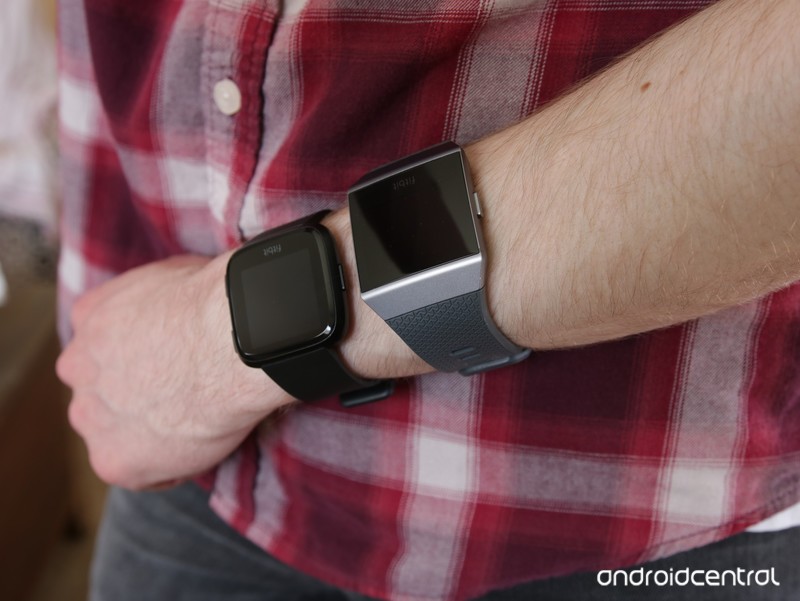
Fitbit Versa (left) and Fitbit Ionic (right)
The Fitbit Versa looks like the love-child of a Pebble Time and Apple Watch, and that honestly works towards its benefit. The watch feels great on my wrist, and when Fitbit says it’s the “lightest metal smartwatch you can buy in the U.S. today”, it’s not joking around. The Versa practically disappears once you strap it on, and this makes wearing it for hours on end a joy.
Practicality isn’t the only thing the Versa gets right, however. Not only does the Versa feel good, it also looks good. Fitbit went with a squircle design for Versa’s body, and it’s available in Black, Graphite, Silver, and Rose Gold colors with a variety of different bands.
Versa looks right at home when worn at the gym with a sports band, but throwing on something leather or metal dresses it up nicely for a night out on the town. This flexibility with its design is really what wins me over, and it’s something I think Fitbit knocked out of the park.
Proprietary bands

Speaking of watch bands, it’s worth mentioning that Fitbit decided to go with proprietary ones. The watch bands here are different than the Ionic’s, and you can swap them out by moving a small metal nub that’s on each one. They’re not as easy to take on and off compared to the Ionic’s bands, but they often feel more secure thanks to the new mechanism.
Fitbit sells a number of bands in different colors and materials directly on its website, but you can also find a good selection of third-party ones on Amazon that cost considerably less.
Battery life is great
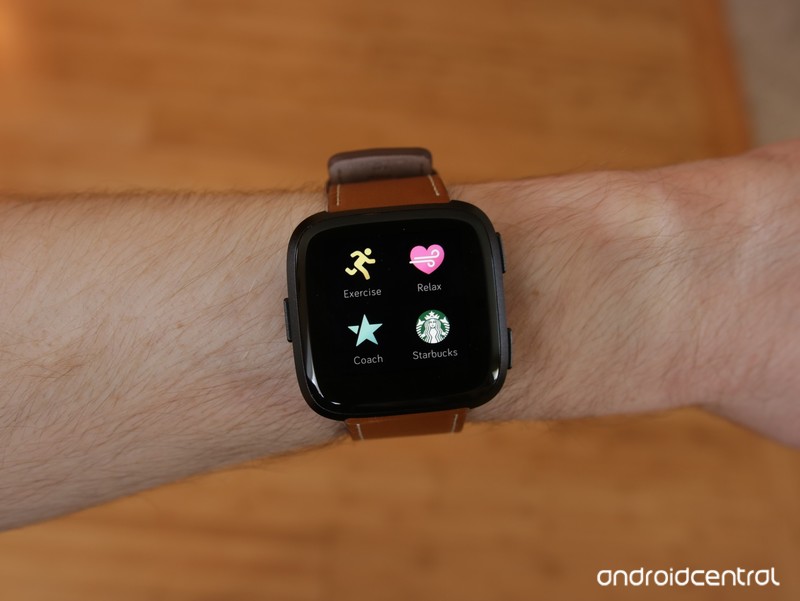
Battery life on the Fitbit Ionic is easily one of its best features, and despite the smaller size of the Versa, Fitbit’s touting that it can still get 4+ days of use on a single charge.
With the first review unit of the Versa I received, I was only seeing around 1-2 days of use before being forced to place it back on the charger. After contacting Fitbit and getting it swapped out for a fresh model, I was pleased to see that my shorter endurance was nothing more than a fluke.
The Versa that I have now consistently sees 4 days of continuous use before needing to sit on the charger, and if used sparingly, it’s possible to even pull 5 days out of it.
There’s no GPS
Although the Versa has most of the same features that the Ionic does, one thing you won’t find is built-in GPS. As such, if you want to go for a run/walk and see a path of where you go, you’ll need to bring your phone with you.
The lack of GPS is not a big deal.
I personally prefer to have GPS on my smartwatches, but that’s also because I’m a huge running nut. This likely won’t be a huge deal for most people, and anyone that needs built-in GPS that badly likely won’t blink an eye before picking up the Ionic.
NFC is only available with the Special Edition
Fitbit introduced Fitbit Pay with the Ionic last October, and this allows you to use the watch to pay for things at grocery stores, vending machines, and other places that accept NFC as a form of payment. Fitbit Pay makes a return to the Versa, but only for certain models.
In the U.S., only the Special Edition Versa comes with NFC to support Fitbit Pay. The Special Edition also comes with an exclusive fabric band in two color options, and this will set you back $30 more compared to the standard variant. However, if you live in Asia or Europe, NFC/Fitbit Pay will be available on all models.
The Versa is an excellent fitness-tracker
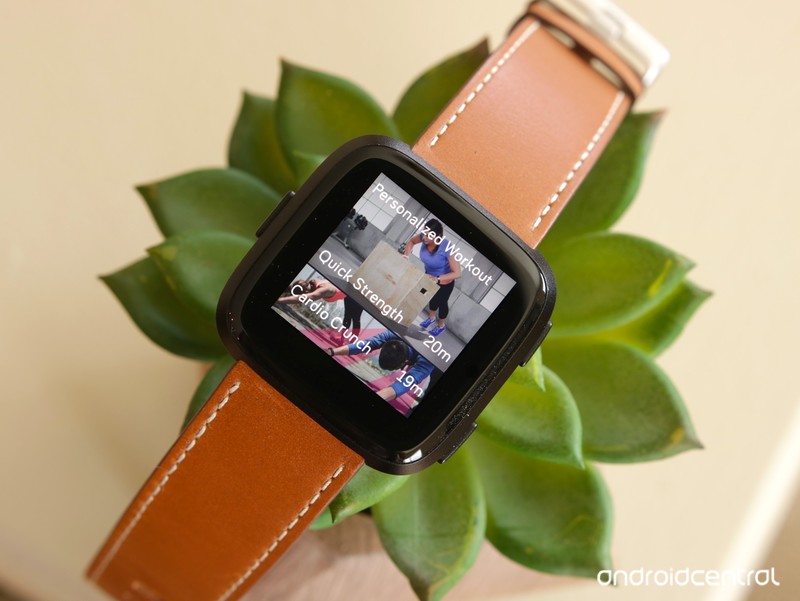
This should go without saying, but the Fitbit Versa is a superb fitness-tracker. It can do basic things like track your steps, calories burned, distance, stairs, and active minutes, but the Versa also goes far beyond that. Wearing the watch to bed will track how long you sleep and the quality of your rest, and Fitbit’s PurePulse heart-rate tracking keeps tabs on how fast or slow your heart is pumping 24/7.
The Exercise app can record a variety of workouts, such as Run, Walk, Treadmill, Weights, and more, and you can even use Versa to log your swims thanks to 50M water-resistance. If you want to take things a step further, there’s also the Fitbit Coach app.
Fitbit Coach offers guided workout routines directly on Versa’s screen, and there are three included out of the box. If you decide to pay $39.99/year for Fitbit Coach, however, you’ll get up to six that often change based on your performance and fitness level.
Fitbit OS 2.0 is polished and fast
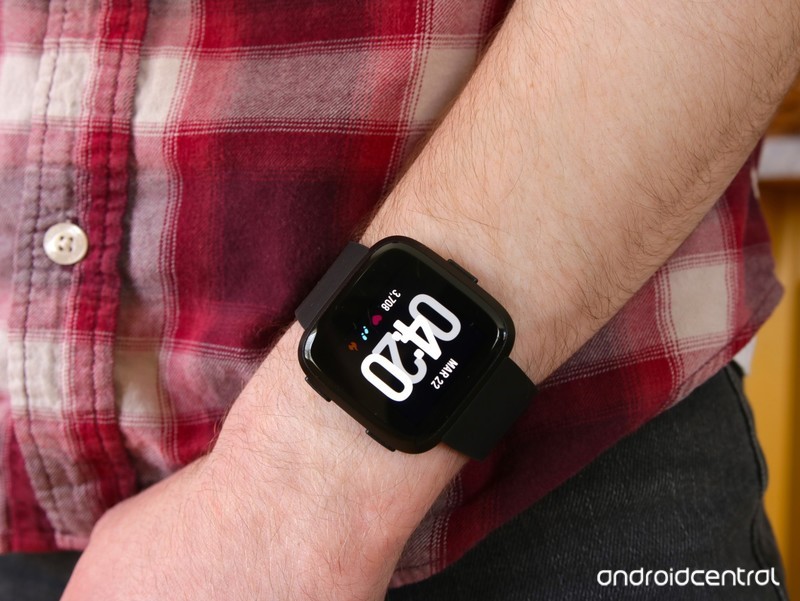
Fitbit OS powers the Versa, and this is the same operating system that shipped with the Ionic. Fitbit has since updated the platform to v2.0, and it offers a lot of welcome improvements.
The Fitbit Today app now shows more information than ever, including your three most recent workouts, a 7-day graph for your primary goal (such as steps, calories, etc.), and your resting heart-rate for the past week. Apps open faster, animations are considerably smoother, and you can now use Deezer to store music right on the Versa (in addition to Pandora and any local music you already own).
Quick Replies are coming in May (Android only)
When paired with your phone, the Versa will notify you of any incoming calls, text messages, calendar appointments, and notifications from any other apps you’ve granted permission to. Being alerted of these things is great, but as it stands, there’s no way to interact with these things. Thankfully, this will soon be changing.
You’ll be able to use five customizable responses.
This coming May, Fitbit will add Quick Replies to the Versa and Ionic, allowing you to reply to texts, WhatsApp messages, and more right from your wrist. There will be five pre-loaded responses that you can send, and you’ll be able to customize what these say in the Fitbit app (up to 60 characters per response).
Quick Replies are currently an Android-only feature, meaning that they won’t work if you pair the Versa with an iPhone or (shudder) Windows Phone.
Pricing starts at just $199
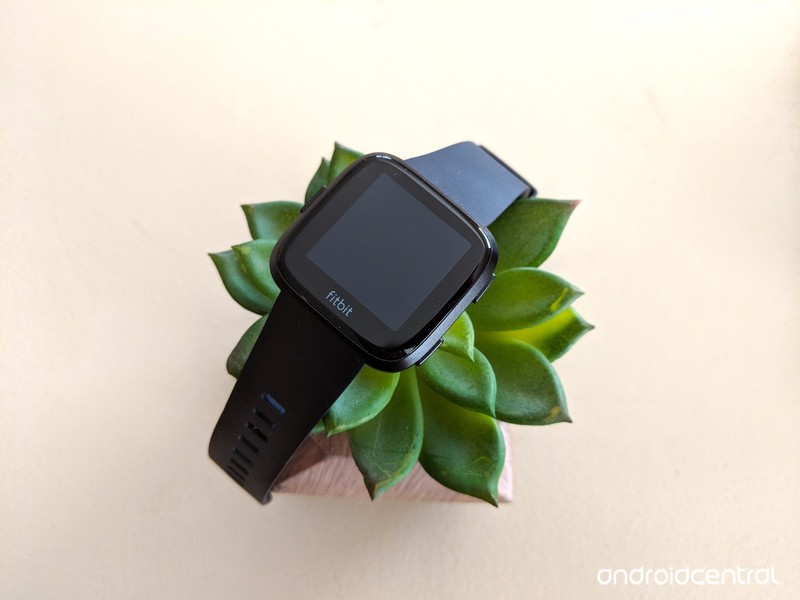
If you’re interested in buying the Versa, it’ll cost you $199.95 for the standard version and $229.95 for the Special Edition. The standard option comes in Black, Rose Gold, and Silver colors for the body, each being accompanied by a matching silicon band.
The Special Edition offers a woven fabric band in addition to the regular silicon one, and it’s available with a Graphite and Rose Gold body.
You can buy it right now!
If you want to buy the Fitbit Versa for yourself, you can pick it up at Fitbit’s website or at “major retailers worldwide.’
As mentioned above, the regular model costs $199.95 and the Special Edition will set you back slightly more at $229.95.
See at Fitbit
Updated 4/16/18 – Updated sections about battery life and availability.
 AIVAnet