


GTA IV will lose some of its in-game music over licensing issues
Grand Theft Auto IV, the game that keeps on giving for Rockstar Games, hits its tenth anniversary this month. That’s quite a feat, but as Kotaku UK reported, it also means that it’s losing the rights for a bunch of in-game songs. The developer told the site that “due to music licensing restrictions, we are required to remove certain songs from the in-game soundtrack … in particular, a large portion of the Russian pop station, Vladivostok FM.”
The last time this happened, Rockstar didn’t tell players, who unknowingly downloaded a patch that deleted a Michael Jackson song. This time, at least, players will be in the know. There are currently nearly 30 songs, mostly Russian pop, on Vladivostok FM. They add some flavor to sections of the game when you’re driving or at the Bahama Mamas Club in Episodes From Liberty City.
Rockstar didn’t say whether it would delete all the songs or just some of them. The music is supposed to be cut on April 26th, according to Kotaku’s sources, but there is a silver lining. “We are replacing some of those songs with a new set of songs on that station,” said Rockstar. “We will update our customer support website with new information as soon as it is available.”
iMovie gets some attention with an iPhone X-ready update
After a few months without updates, Apple has shown some attention to the mobile version of its free iMovie video editor with a new update. It’s now fully compatible with the iPhone X’s Super Retina Display (and that notch), and according to the notes, finally takes advantage of the Metal API for direct access to your iPhone GPU. Unfortunately, judging by a few early reports, that doesn’t seem to do much for video rendering time, but maybe there are benefits that just haven’t been uncovered yet.
Source: iTunes
How to Specify Your Activity Type in the Apple Watch Workout App
When you open the Apple Watch Workout app, the main screen by default offers you 10 quick-start workout types that you can use to track your exercise. These include Walking, Running, Cycling, Elliptical, Rower, Stair stepper, HIIT, Swimming, and Wheelchair.
If you want to track a more specialized activity that isn’t covered by these types, then you’ll want to note the tenth option on the main screen, called Other. Selecting Other allows you to label your activity more accurately by choosing from over 60 pre-defined workout categories – you can find Apple’s full list at the end of this article.
The neat thing about using the Other option is that once you’ve recorded a workout and given it a custom label, that workout type will subsequently appear in the main Workout screen as a quick-start option for the next time you need it.
How to Categorize an Activity in the Workout App
Launch the stock Workout app on your Apple Watch.
Using your watch’s Crown, scroll down the list of activity types and tap the Other option to begin your workout, or tap the three circled dots at the upper right of the option’s icon if you want to define a specific time or calorie goal before the workout starts.
When you’ve completed the activity you want to track, swipe right on the metrics readout and tap End.
Tap the grey Name Workout button near the top of the workout summary.
Scroll through the alphabetical list and tap the category that best describes your workout. (Apple includes a convenient list of popular categories at the top.)
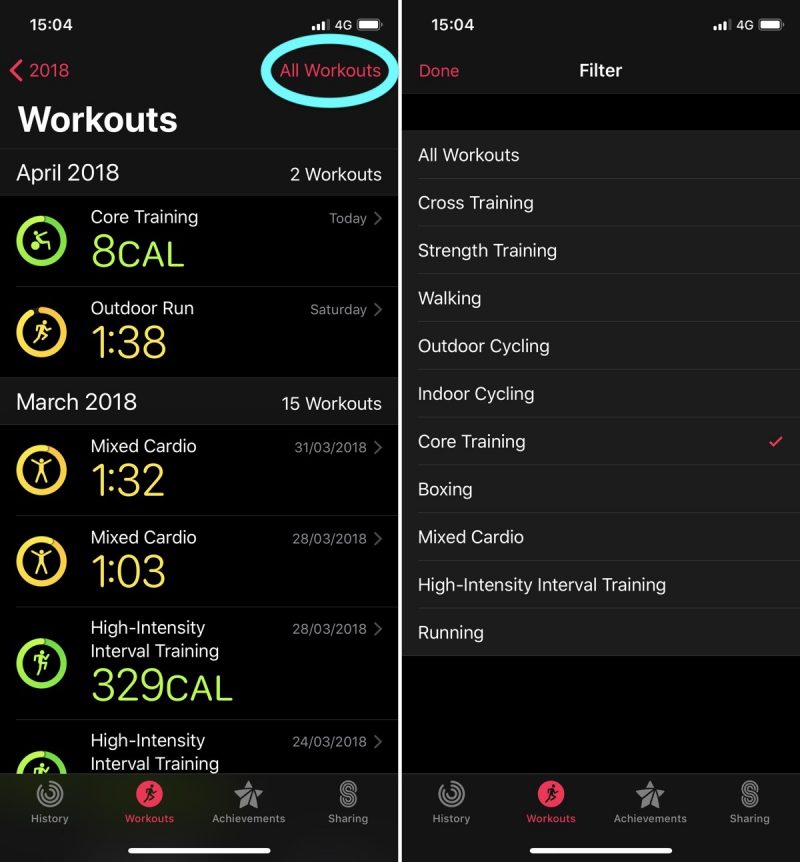
With your activity now labeled, scroll down to the bottom of the workout summary screen and tap Done. It’s unclear whether using these additional categories affects the way Apple Watch’s biometric sensors work (although we do know that using Other earns you the calorie or kilojoule equivalent of a brisk walk whenever sensor readings are unavailable). Either way, using specific labels ensures the Activity iOS app offers you a more informative exercise log, which makes it easier to filter to display specific workouts.
To learn how you can customize the Workout metrics for your chosen activity on Apple Watch, check out our how-to guide.
Full List of Apple Watch Workout Categories
- American Football
- Archery
- Athletics
- Australian Football
- Badminton
- Barre
- Baseball
- Basketball
- Bowling
- Boxing
- Climbing
- Core Training
- Cricket
- Cross-Country Skiing
- Cross Training
- Curling
- Dance
- Downhill Skiing
- Equestrian Sports
- Fencing
- Fishing
- Flexibility
- Functional Training
- Golf
- Gymnastics
- Hand Cycling
- Handball
- HIIT (stands for High Intensity Interval Training)
- Hiking
- Hockey
- Hunting
- Jump Rope
- Kickboxing
- Lacrosse
- Martial Arts
- Mind & Body
- Mixed Cardio
- Paddling
- Pilates
- Play
- Racquetball
- Rolling
- Rugby
- Sailing
- Skating
- Snow Sports
- Snowboarding
- Soccer
- Softball
- Squash
- Stairs
- Step Training
- Strength Training
- Surfing
- Table Tennis
- Tai Chi
- Tennis
- Track & Field
- USA Football
- Volleyball
- Water Fitness
- Water Polo
- Water Sports
- Wrestling
- Yoga
Related Roundups: Apple Watch, watchOS 4Tag: WatchOS 4Buyer’s Guide: Apple Watch (Neutral)
Discuss this article in our forums
RAW photo editor Luminar is now up to 12 times faster with Jupiter upgrade
Skylum
Photo editing platform Luminar just got faster. On Thursday, April 12, Skylum launched Luminar 2018 Jupiter, a speed-focused upgrade for the company’s photo editor and RAW processor. The company boasts speed improvements of up to five times on Windows and up to 12 times on Mac and claims improved RAW conversion with the update as well.
Mac users will see the biggest speed improvements when using the Details Enhancer tool on large files, like the 12-times speed improvement on the tool when working with a 72 Mb file from the Canon EOS 5D Mark IV. Working with a similar file size, RAW develop speed sees a 9.8-times improvement. Filters like the golden hour filter, polarizer, and dehaze see a six- to seven-times boost. RAW imports are about 4.6 times faster. Speed will also vary based on hardware — Skylum used a MacBook with an Intel Core i7 processor, 1536 GB GPU to generate those numbers.
Luminar’s move over into the Windows space is a bit more recent (and with some features missing), but users on a Windows platform will also see a speed boost. Compared to the previous version, Jupiter is up to 2.4 times faster in RAW develop, with filters, details enhancer, LUT mapping and color adjustments in the HSL panel between three to five times faster.
Along with the speed boost, the editing software also sees an improved conversion on those RAW files. Skylum says that the conversion is more accurate at calculating exposure. Gradients are also cleaner, the company says. The update also sees fewer artifacts like halos and chromatic aberration, along with expanding support to new cameras.
Automatic lens corrections, like the enhanced RAW engine, are available on both Mac and PC.
The Windows version, which just launched last year, is also beginning to catch up with the older Mac version with a handful of features, including batch processing and remote sharing. Skylum also enhanced the clone and masking tools and expanded workflow options through plugins.
“Our loyal community of users continues to offer ideas for additional features that would benefit their respective workflows, and we continued to listen, learn, and improve,” Alex Tsepko, CEO of Skylum, said in a press release. “Our goal is to produce a fast, easy, and feature-rich imaging software that can offer both single-click solutions as well as custom functions for those [that] want absolute control.”
The Jupiter update is still part of Luminar 2018 — which means that current users of the 2018 version can upgrade for free. Owners of Luminar 2017 can upgrade for $49 and new users can download the software for $69.
Luminar launched less than two years ago and has since seen several changes. The company rebranded from Macphun when adding Windows compatibility last year. Luminar is also expected to gain file management features during 2018.
Editors’ Recommendations
- 5G is coming — here’s what to expect, and when to expect it on your carrier
- Adobe focuses on speed — but just how fast is the new Lightroom 7.2?
- If you’re a Northeast Xfinity customer, your internet will soon be faster
- Elon Musk teases plan for a record-breaking Hyperloop speed test
- Adobe enables faster workflow with updates to XD, InDesign, and Illustrator
Thanks to A.I., there is finally a way to spot ‘deepfake’ face swaps online
The ability to use deep learning artificial intelligence to realistically superimpose one person’s face onto another person’s body sounds like good, wholesome fun. Unfortunately, it’s got a sinister side, too, as evidenced by phenomenon like the popularity of “deepfake” pornography starring assorted celebrities. It’s part of a wider concern about fake news and the ease with which cutting- edge tech can be used to fraudulent effect.
Researchers from Germany’s Technical University of Munich want to help, however — and they are turning to some of the same A.I. tools to help them in their fight. What they have developed is an algorithm called XceptionNet that quickly spots faked videos posted online. It could be used to identify misleading videos on the internet so that they could be removed when necessary. Or, at the very least, reveal to users when they have been manipulated in some way.
“Ideally, the goal would be to integrate our A.I. algorithms into a browser or social media plugin,” Matthias Niessner, a professor in the university’s Visual Computing Group, told Digital Trends. “Essentially, the algorithm [will run] in the background, and if it identifies an image or video as manipulated it would give the user a warning.”
The team started by training a deep-learning neural network with a dataset of more than 1,000 videos and 500,000 images. By showing the computer both the doctored and undoctored images, the machine learning tool was able to figure out the differences between the two — even in cases where this would be difficult to spot for a human.
“For compressed videos, our user study participants could not tell fakes apart from real data,” Niessner continued. On the other hand, the A.I. is able to easily distinguish between the two. Where humans were right 50 percent of the time, making it the equivalent of random guesses, the convolution neural network could get compressed videos right anywhere from 87 percent to 98 percent of the time. This is particularly impressive since compressed images and video are harder to distinguish than uncompressed pictures.
Compared to other fraudulent image-spotting algorithms, XceptionNet is way ahead of the curve. It’s another amazing illustration of the power of artificial intelligence and, in this case, of how it can be used for good.
A paper describing the work titled, “FaceForensics: A Large-scale Video Data Set for Forgery Detection in Human Faces,” is available to read online.
Editors’ Recommendations
- A.I. perfectly predicted last year’s Super Bowl score. What happens to betting?
- Deep learning vs. machine learning: what’s the difference between the two?
- Poachers don’t stand a chance against these A.I.-powered camera drones
- Horizon Robotics’ smart security camera uses A.I. for serious facial recognition
- Social (Net)Work: What can A.I. catch — and where does it fail miserably?
Get your pickaxe ready: The next MineCon Earth show streams in September
Minecraft fans will be pleased to learn that the second annual MineCon Earth event will take place on September 29. The 90-minute interactive live-stream will cram all the “best bits” from previous conventions into one show for the entire world to watch for free. The event will feature pre- and post-show segments, along with several community panels.
“The Minecraft community is still growing, and there’s only a certain number of players we can host while keeping the friendly, intimate community atmosphere that’s made previous MineCons so special,” developer Mojang said last year. “With that in mind, we’re pleased to announce MineCon Earth — an interactive show.”
With more than five months to go before the second MineCon Earth event, fans have enough time to submit ideas for panels that could be prerecorded and played during the live show. They can even create a Minecraft-themed costume and submit the design. Select designers will be flown out to Mojang and highlighted during the broadcast. Winners will receive a “fantastic prize.”
MineCon Earth isn’t just an in-studio show — it’s broadcast on stage in front of a live audience. Hosted by actor Will Arnett and Mojang’s Lydia Winters, last year’s show introduced the Update Aquatic slated for spring 2018, which will add coral, kelp, additional fish, explorable shipwrecks, new water physics, and more to Minecraft. The show also saw the addition of free content on the marketplace and the launch of a new Minecraft server: The Hive.
MineCon Earth also revealed that Minecraft for Nintendo Switch will support cross-platform multiplayer in 2018. That means Switch owners will finally be able to play with gamers on the Xbox One, Windows 10, Gear VR, and mobile devices (nope, still no PlayStation 4). When that will actually happen is unknown for now, but Minecraft boss Helen Chiang recently said the update is coming soon.
“When I think about what’s next for us — well, my job is really not to change the plan that we’re on, but to focus on a number of different things,” she said at the end of February. “The first one is bringing over more people to Bedrock through Nintendo, and that’s coming out pretty soon.”
The first gathering to honor Minecraft took place in Bellevue, Washington, in 2010. The first MineCon-branded convention was held in Las Vegas in 2011, followed by Paris Disneyland; Orlando, Florida; London; and Anaheim, California, in successive years. Microsoft and Mojang then went all-digital in 2017 with the first annual MineCon Earth 90-minute show.
The 2018 edition will showcase live gameplay and discussions featuring Lydia Winters and community co-hosts to be revealed at a later date. You’ll also find out what’s coming to the popular block-building game by streaming on the MineCon Earth website, YouTube, and other streaming sites.
Editors’ Recommendations
- Bleacher Report steps into the live TV arena with sports streamer B/R Live
- How Intel will plunk you into South Korean snow by streaming the Olympics in VR
- These apps will help you make the most out of your Apple TV
- DirecTV wants to make 4K HDR sports par for the course. Here’s how it’ll work
- Cutting the cord? Let us help you find the best service for live-streaming TV
European Commission may slap Google with a serious fine over Android
Over the past several years, Google has faced three antitrust cases by the European Commission regarding Google Shopping, AdSense, and Android’s dominance in the smartphone market. The Commission’s ruling regarding Android will likely arrive in the next several months, slapping Google with a possible multi-billion dollar fine. But rivals and market watchers believe fines and regulations won’t make a significant difference.
Outside Apple’s iPhone, Google’s Android is the dominant operating system in the smartphone market. It’s typically unaltered packing first-party apps such as Google Maps, Gmail, Google Search and so on, peppered with apps developed internally by smartphone makers. Typically, any “customization” involved relies on visual tweaks to the overall interface and special “launchers” that change the appearance of the home screen and app drawer.
Device makers have attempted to offer smartphones with altered, “forked” versions on Android. Amazon made such an attempt with its failed Fire Phone in 2014: A 3D-enabled phone powered by a modified version of Android the company calls Fire OS. It’s the same platform Amazon uses for its Kindle Fire-branded tablets, Fire TV, Echo, Echo Dot, and more. Meanwhile, Samsung’s use of Tizen initially seemed the end of Android on its smartphones, but the company still uses Google’s operating system on its Galaxy devices.
That said, there is no real alternative to Android. Even more, Google commands 90 percent of the European search market and provides revenue sharing payments to smartphone makers who pre-install Google Search. Individuals siding with the European Commission claim the company provides strong incentives, too, leaving smartphone makers unable to promote alternatives to Google’s apps. Anything distributed outside Google Play could be considered as untrustworthy by users.
That’s because Android’s app-related problem spans years. In the early days, smartphone makers were altering Android to distinguish their products against competitors. Meanwhile, third-party app stores not governed by Google or device manufacturers lured in device owners. The resulting malware epidemic seemingly pushed customers to prefer “pure” Android builds and Google Play apps. The only exception is Amazon’s Android apps store, which still must be side-loaded on Android devices.
Seemingly to keep the “pure” theme intact, Google pushes smartphone makers to install the Chrome browser and other first-party apps if Google Play is present. But smartphone makers still have an option to install their own stores and apps, such as Samsung’s Galaxy Apps store on Galaxy-class smartphones. Obviously, Google isn’t completely banning third-party apps from Android, but the European Commission still seems to think that some type of regulation is in order.
But European Commission sources claim that it can’t simply order Google to change its Android business under European law. If anything, the Commission can slap Google with a fine and make suggestions: Stop enforcing first-party app installation and stop paying device makers for installing Google Search. Will that make a difference in the overall Android picture? Probably not.
“Android is utterly dominant,” CCS Insight’s Geoff Blaber told Reuters. “Whatever the ruling, manufacturers are heavily reliant [on Android] so nothing is going to change dramatically.”
Editors’ Recommendations
- Google Home Mini vs. Amazon Echo Dot: Which is better?
- How to sideload an APK or install an Android app from outside the Play Store
- Amazon, Google trade punches over Nest smart home product sales
- Got a new Amazon Echo? Here’s how to set it up
- The best tablets you can buy
What is an ASIC miner?
A BitMain AntMiner S9 ASIC miner BitMain
As much as cryptocurrency mining was originally designed to be something everyone could do with their home computer, those days are long gone. Today, whether you’re mining Bitcoin, Litecoin, DASH, or a host of other cryptocurrencies — the most effective way to do so is with a piece of hardware known as an ASIC miner.
It’s not a desktop PC or a dedicated graphics card mining rig — it’s something else. Application specific integrated circuits, or ASICs, are chips that are designed with a singular purpose, ranging from audio processing to managing a cellphone call. In the case of cryptocurrency mining though, these chips are built into specifically-designed motherboards and power supplies, constructed into a single unit. It’s not just a purpose built machine though, it’s purposely designed and developed hardware right down to the chip level.
What an ASIC miner actually does
In a nutshell, mining is the process of running complicated calculations in the search for a specific number. Mining hardware, whether it’s an ASIC miner or a GPU mining rig, has to run through many calculations before finding that number. In proof of work systems like Bitcoin, the first one to find that number gets a reward — at the time of writing, 12.5 Bitcoins. That’s worth around $110,00.
There are so many people and powerful computing systems trying to mine Bitcoin though, that almost everyone bands together with a group of miners to try and find that number. That said, miners tend to earn more if they have faster hardware. That’s why people who can afford it opt for ASIC miners because it gives them the greatest chance of earning cryptocurrency in exchange for their investment.
Each cryptocurrency has its own cryptographic hash algorithm and ASIC miners are designed to mine using that specific algorithm. Bitcoin ASIC miners are actually designed to calculate the SHA-256 hash algorithm. In the case of Litecoin, Scrypt. That means technically they could mine any other coin that’s based on the same algorithm, though typically people who buy ASIC hardware designed with one particular coin in mind, mine that coin.
For a more in-depth look at what mining actually is, here’s our detailed guide.
What makes an ASIC miner better?
ASIC miners differ from a graphics card or CPU mining system in that those more general pieces of hardware are designed to do more than one thing. They also just happen to do it better than anything with a more general purpose focus.
When it comes to mining cryptocurrencies, all that really matters is that the cryptocurrency you mine is worth more than what you spend on hardware and electricity. Those margins can be closer than you might think, because mining cryptocurrency can be expensive. Hardware can be costly to buy up front, and some of it can cost thousands of dollars a year in electricity to run.
So when it comes to the mining hardware you choose, having more efficient systems is incredibly important. That’s where ASIC miners come in. Since they are designed from the ground up to perform the calculations required by a specific cryptographic hash algorithm used by an individual, or handful of, cryptocurrencies, they are incredibly efficient at doing so. They’re powerful — offering a high “hashrate” — and energy efficient, using far less power than a more general piece of hardware might do for the same task.
This combination of performance and low-power usage makes them much more economical to run than more general purpose hardware. That’s why in the case of Bitcoin and Litecoin, ASIC mining is just about the only way anyone mines those cryptocurrencies any more. If the new Ethereum ASIC miner turns out to be just as successful, that could soon be the case for that popular cryptocurrency too.
Editors’ Recommendations
- What is Bitcoin mining?
- Bitmain’s $800 Ethereum ASIC miner could help bring GPU prices down
- How to mine Bitcoin
- What is Litecoin? Here’s everything you need to know
- Samsung confirms it’s working on chips for cryptocurrency mining
Xiaomi Mi 6X set for unveil on April 25, could launch globally as the Mi A2
This could be Xiaomi’s Android One phone for 2018.

Xiaomi caught the smartphone industry by surprise when it announced that it was teaming up with Google over an Android One phone. The Mi A1 turned out to be a fantastic phone in the budget segment, offering a great design, powerful specs, and pure Android. The phone itself was a rebranded variant of the Mi 5X with Android One instead of Xiaomi’s MIUI.
The Chinese manufacturer has now sent out invites to the Chinese media (Via FoneArena) for an event on April 25, where it is set to unveil the Mi 6X. The phone made its way through TENAA last month, giving us a look at the specs on offer.

The Mi 6X will feature a 5.99-inch FHD+ 18:9 panel, Snapdragon 626, 4GB of RAM, 64GB of storage, microSD slot, hybrid SIM card slot, 20MP + 8MP dual cameras at the back, 20MP front shooter, and a 2910mAh battery. The battery may not be as massive as that of the Redmi Note 5 Pro, but as I saw on the Mi A1 last year, Xiaomi still knows a thing or two about optimization to eke out the most out of the battery.
As this particular variant is aimed at a Chinese audience, it will be running an Oreo-based build of MIUI. Right now, there’s no information regarding an Android One model that will go on sale in global markets, but the Mi A1 saw a decent amount of sales in India last year, and Xiaomi will be looking to offer an alternative to MIUI in the budget segment.
India’s ACT Fibernet is giving away a free Google Home Mini — here’s how you can get one
India’s largest ISP is giving away a free Google Home Mini to select subscribers.

With over 1.3 million customers, ACT Fibernet is India’s largest fiber-focused wired broadband ISP (think of it as Comcast, but with much better service). ACT Fibernet serves just 12 cities across India — including Hyderabad, Bangalore, Chennai, and Delhi — and the service provider’s ability to offer high bandwidth at affordable rates allowed it to carve out a niche among enthusiast users. The service is headquartered in Hyderabad, where it rolled out a Gigabit plan last year, being the first ISP in the country to do so.
With the launch of the Google Home and Home Mini in India, ACT Fibernet has announced that it is Google’s “fiber broadband partner” (whatever that means). What is interesting though is the fact that the ISP is offering promos where it is bundling a Google Home Mini with most subscription plans.
Essentially, all customers subscribing to its Gigabit plan in Hyderabad and Bangalore will receive a complimentary Google Home Mini, and users in Chennai and Delhi that pay for yearly plans will also receive a Home Mini for free. For subscribers in Delhi, ACT is introducing a Platinum Promo plan that delivers 150Mbps bandwidth for just ₹999 ($15) a month.
Here’s the breakdown of the offer, as detailed by ACT Fibernet:

I talked to ACT Fibernet’s head of marketing Ravi Karthik regarding the details of the offer, and was able to ascertain that the promotion is valid for both current as well as new subscribers. If you’re a new subscriber, you’ll have to select one of the Google Home Mini plans outlined above, and you’ll receive the speaker at your registered address within a week of activation.
Existing subscribers paying a yearly plan will have to call ACT’s customer care number and request the Google Home Mini. Provided the details check out, the speaker will be sent out after three to four days. Given that the promotion is starting to roll out just now, it is possible that not all service desk agents are aware of the offer, so you’ll have to exercise some amount of patience.
The promotion itself is valid in four cities — Hyderabad, Bangalore, Chennai, and Delhi — and isn’t likely to be rolled out to new markets. But if you’re using ACT Fibernet’s service in these markets, there’s an added incentive to make the switch to a yearly plan.
 AIVAnet