


‘Eve: War of Ascension’ reimagines the venerable space MMO for mobile
Complex space sim Eve Online will be 15 years old this year, surviving in a less MMO-friendly market with various spin-offs like Dust 514 and Valkyrie, as well as a free-to-play version. Developer CCP teased a new mobile Eve title last October, and now EVE: War of Ascension is set to launch on iOS and Android sometime later this year.
Originally titled Project Aurora, the company promises that this will be a massively multiplayer mobile game set in the Eve universe. CCP co-developed the new title with Finnish developer PlayRaven and will be published by Kongregate. The companies say that War of Ascension (not to be confused with the past Eve expansion of the same name). The team hopes that the new title will appeal to both fans of the original franchise as well as more casual players, which could mean either a solid game to play or a crufty F2P experience. Here’s hoping it will lean more towards the former, though translating the immense galactic community in a mobile title is likely a challenge.
Similar to the PC game, you’ll get to explore different sectors of space, create your own stories and either work cooperatively with other players or fight them for resources. You’ll also hunt for relics that unlock unexplored areas of space and engage in weekly and limited time “events.”
“Eve Online has always been an incredible online world, but as one of the most complex and interesting MMO games on PC, it wasn’t always accessible to a broad audience,” said Kongregate’s Emily Greer in a statement. “Bringing the community, intrigue, and universe of Eve to millions of mobile players later this year is a banner moment for our publishing program.”
HP’s latest Pavilion PCs are built for gamers on a budget
Many conspicuously gaming-oriented PCs are aimed at high-end buyers, the sort who won’t flinch at splurging on top-end parts and extravagant RGB lighting. But that’s not really how the gaming market works — there are many, many people only ask for just enough performance to run their favorite games at a decent clip. And HP is most definitely aware of this. It’s refreshing its Pavilion PC lineup for the spring, and the focus this time is on a new Pavilion Gaming line that offers some of the trappings of gaming PCs without venturing into the higher prices of the Omen and Omen X lineups.
Both the Pavilion Gaming tower and Pavilion Gaming Laptop ranges all have angular black designs, colorful lighting (green, purple or white on the Laptop) and practical gaming-oriented features. The 690 and 790 desktops have swing-out hard drive trays, while the portable touts dual fans and an “improved cooling solution” to keep the system running at full bore. Of course, the performance is really what you’re here for — while neither lineup will replace a custom gaming rig, they handle a surprisingly large swath of enthusiasts.
The desktops start at $549 with an entry-level 3.5GHz Ryzen 3 processor, Radeon RX550 graphics, 8GB of RAM and a 1TB hard drive, but they scale all the way up to a $1,699 configuration of the 790 with a 3.2GHz Core i7, GTX 1070 video, 32GB of RAM, a 256GB solid-state drive and a 2TB spinning disk. There are options for RX580 and GTX 1080 graphics, too, as well as up to 3TB of space and more RAM (16GB on the 690, 64GB on the 790).
The Pavilion Gaming Laptop, meanwhile, will start in the US at $799 with a 2.3GHz quad Core i5, Radeon RX560X video, a 1080p display, 8GB of RAM, a 1TB disk and 16GB of Optane storage. Go all-out and you can get a $1,019 model with a six-core 2.2GHz Core i7, GTX 1060 graphics and a 144Hz 1080p display. Options can bump it up to a 4K screen and a storage combo that includes a 128GB SSD and 2TB hard drive.
Both Pavilion Gaming PC rosters should arrive throughout May and June, and they should be accompanied by a Pavilion Gaming 32 HDR Display that promises gaming-friendly AMD FreeSync (no G-Sync, alas) as well as DisplayHDR 600-rated high dynamic range, a DCI-P3 color gamut and a 1440p resolution. It arrives on May 11th for a not-too-unreasonable $449.
Oh, and there Pavilion PCs for non-gamers. A new version of the 14-inch Pavilion x360 convertible (starting at $500) sports a refreshed design with thinner bezel, a lighter weight (down to 3.5lbs), a side-mounted fingerprint reader and a rear-facing camera when you’re in tablet mode. The 14- and 15-inch standard Pavilion laptops ($629 and $740) are thinner and sport a new “geometric” design, while the Pavilion Desktop ($400 and up) promises a more compact design with slicker faceted looks. All of these should also arrive in the May-to-June time frame.
Source: HP
BMW’s new research center is dedicated to autonomous driving
The world of autonomous cars is coming. Maybe it’s a utopian future where all the vehicles drive themselves, while traffic jams and road rage are made a thing of the past. Or maybe it’s just a bunch of fancy robo-taxis (and hopefully buses) that ensure city commuting is less of a pain. No matter how it plays out, it’s coming and BMW wants to be prepare, establishing its own autonomous driving campus.
In Unterschleißheim (near Munich, Germany) the automaker opened the facility that it says will help with the “systematic development of highly- and fully-automated driving at the BMW Group.”
At the event, Klaus Fröhlich of BMW AG’s board of management, responsible for development, said that: “It is important because autonomous driving will change the automotive industry.” The goal is to build pilot projects at the facility and that BMW is building a cornerstone of artificial development here. The campus in Germany joins the automaker’s research office in Mountain View, California, working on BMW’s place in the autonomous driving world. Both facilities will have cars on the road and in simulators — BMW has three test cars in the United States already.
Those vehicles gather data while driving and help the automaker work on edge-case scenarios and this is all set to expand hugely. By the end of 2018, BMW expects to have 40 additional automobiles in the US and 80 worldwide, driving around countries including China, Israel and Germany.
In addition to real-world testing, the company will use simulations to train their autonomous program. Thomas Bachman, autonomous driving head of test validation and integration said that the core of the system was built by BMW with several technologies sourced from other companies. Bachman referred to them as bricks of a house that is still unmistakably BMW’s.
The actual house of autonomous driving for BMW is a no-brainer. It’s located near the automaker’s global headquarters in Munich and the company’s data center is also a little over a mile away — which is helpful considering the immense amount of information being handled. Autonomous cars can generate around 16 to 40 terabytes of data per day, according to BMW.
The campus is still under construction, but the main building and workshop are already complete. A small track is also incoming, but it will mostly be used for calibrating test vehicles according to Bachman. BMW reiterated that its first level 3 autonomous production vehicle, the iNext is coming to public roads in 2021 but clearly, the automaker is in it for the long haul.
Fröhlich said, “We know it’s a marathon. It’s a huge challenge.” In other words, it’s going to be a while before we’re all in autonomous cars. But right now, automakers need to go all in on our driverless future.
‘Fortnite’ update adds instant fort-building grenades
As Fortnite continues to pick up new players across various platforms, Epic Games has consistently deployed new updates to keep the game fresh and free from game-breaking bugs. Earlier this week, we saw the team introduce new space-themed skins, complete with NASA-like space shuttle gliders, but we’ve had to wait until today to see some of the new in-game items. The most notable inclusion is the Port-A-Fort, a new epic drop that will instantly deploy a three-story fort made from metal.
Epic Games says that insta-forts feature a 1×1 bottom floor with an entry door. Tires are also found inside, allowing for easy access to the roof. Players have already identified that if the item is thrown at someone’s feet, that person will immediately be transported to the top of the fortification. Useful if you need to quickly evade a full squad or want the high-ground advantage in a one-on-one.
If you’re looking for new ways to show off your skills, the new update also delivers on that front. On PC and console, there is now a powerful replay system that allows you to save each individual match and view it from various perspectives. Controls allow you to speed up or slow down the replay and focus on the action that is most important to you. Unlike other multiplayer games, Fortnite doesn’t yet feature instant kill replays — which let you see exactly how you died — so this will go some way towards filling that gap.
It also helps that 50 vs 50 matchmaking is back, letting you take part in (and watch back) epic deathmatches.
As expected, Epic Games has made some weapon balance changes, making the guided missile slower and harder to turn. Fast-switching between powerful weapons like shotguns, rocket launchers, hand cannons, sniper and hunting rifles has also been nerfed, meaning you’ll find it harder to quickly deal high-value damage during fights. Ammo drops are now more plentiful and rewarding, as is resource farming, which has been given a 75 percent boost.
With all these new features included, the new update is a pretty big one. It clocks in at over 8GB on console. If you’re planning to land in Tilted Towers with your squad later, it’s definitely worth getting the v3.5 patch ready ahead of time.
Source: Epic Games
Even genuine replacement Apple displays can mess with iPhones
Following the news that the latest iOS update can break phones with non-official replacement screens, repairers are encountering a different, more subtle problem: If you put a genuine Apple replacement display into an iPhone 8, 8 Plus or X, it’ll no longer be able to adjust its brightness automatically. If Apple or one of its authorized partners were to put the same display in the same phone, though? No problem.
The aftermarket repair community has verified the behavior in phones from the US all the way to Australia. It’s confirmed to be an issue with phones running iOS 11.1, 11.2 and 11.3, which led sources to suggest it’s been a problem since the launch of the latest batch of iPhones last fall. I was able to confirm that even swapping the displays of two brand-new iPhones causes the ambient light sensor to stop working, despite it not being altered or touched in any way. Experiments have shown that the sensor is disabled by iOS during the boot process.
There’s some debate over whether this is a bug or a feature. Apple first tied hardware and software together with the launch of Touch ID on the iPhone 5S. Third-party repairers quickly found out that replacing a broken fingerprint sensor with a working unit would disable Touch ID. This was the root cause of the infamous “Error 53,” which broke phones without a valid fingerprint sensor on restore. Apple said the security test that caused Error 53 was only supposed to be performed at the assembly factory, and fixed the bug by disabling the test during the restore process.
Apple’s reasoning for locking down the fingerprint sensor in this way was security, and it used the same rationale with the iPhone X and the introduction of the Face ID camera array. Some of the repairers we spoke with, who asked to remain anonymous for fear of repercussions, don’t believe this is the case. Instead, they think it represented Apple’s first tentative steps towards controlling the entire repair process.
“I’ve been waiting for this for five years to be honest.”
When Apple replaces a Touch ID or Face ID sensor, it uses a machine dubbed Horizon, which tells the phone all its parts belong with one another. Apple recently started shipping these machines (around 400 last year) to some of the 4,800 authorized service providers around the world. But that leaves a large number of authorized service providers in the dark, as well as aftermarket repair shops, which greatly outnumber those officially approved by Apple. And that’s not to mention individuals who feel confident enough to fix their own devices.
But why would merely swapping the displays of two identical, working iPhones disable a seemingly unrelated sensor? “I’ve been waiting for this for five years to be honest, since the 5S,” one repairer said. “It’s a scary looking future for me.” They expressed concern that Apple is using the ambient light sensor “as a test-case to see how it works, to see if they can link hardware with logic boards so if they were repaired outside of the Apple network it loses functionality.”
The same source said that the ambient light sensor issue could “open us to a lot of returns and a world of trouble,” but added that they were willing to talk about it in the hope of forcing Apple to address it. After all, it was public outcry that pushed Apple to fix Error 53. They also believe that the recent iOS 11.3 problem is an attempt by Apple to damage public trust in aftermarket repairs.
Considering that screen cracks and smashes are among the most common types of damage seen by repairers, it’s likely that tens of thousands of phones are currently affected. One source, on discovering the behavior, was shaken. They said that they had personally replaced over 100 displays. “We try to offer a cheap alternative [to Apple], and we only use genuine parts. I’m worried that customers are going to come back to me and demand that I fix it. What can I do if Apple is the one disabling the sensor?” Another source said that they repaired between 20 and 50 iPhone 8 screens per month.
The “right to repair” is a hot issue. Just yesterday, the FTC warned companies about preventing third-parties from repairing products. Separately, several states (most recently California) are seeking to introduce legislation that would coerce companies into making customer repairs easier. Historically, Apple has been against right to repair bills, telling lawmakers in Nebraska that a proposed law would turn the state into a “Mecca” for hackers.
Locking down Touch ID and Face ID was easy for Apple to explain. Likewise, disabling untested third-party components can be presented as a quality control measure. But it’s tough to see why the company would need to lock customers and aftermarket repairers out from replacing parts like-for-like. I spoke with Apple about the problem, but after initially replying to ask some follow-up questions, the spokesperson failed to provide a response in time for publication.
Russian cosmonauts are really into ‘World of Tanks’
You’d be forgiven for thinking Fortnite and PUBG were the only games in existence at the moment, given the amount of noise surrounding them. But an upcoming gaming event, launched from actual space, shows that long-established games are still making their mark. Today, in one of the wildest endorsements ever, World of Tanks unveiled a Stellar Bonus event from the International Space Station (ISS), in celebration of the International Day of Human Space Flight.
Why space, you rightly ask? Tanks don’t do so well in zero gravity, after all. One word: Russia. World of Tanks is massive in the country. According to unofficial figures from wot-news, there are around 37.2 million players on the game’s Russian servers, compared to 21 million in Europe and 8.9 million in North America. So it makes sense that Russia would take the lead in this launch. And you don’t get more grandiose an announcement than one made from the heavens, hence cosmonauts Oleg Artemyev and Anton Shkaplerov officially unveiling the bonus event from the ISS (yes, they’re even wearing World of Tanks T-shirts).
To take part in the event, you just need to log in to your World of Tanks account and play one battle between April 12 at 1pm (ET) and April 13 at 1pm (ET) and you’ll get a bunch of in-game boosters, including: +100 percent combat XP personal reserve, +300 percent crew XP personal reserve, +300 percent free XP personal reserve and +50 percent credits personal reserve. Each booster lasts an hour. Watch Oleg and Anton’s out-of-this-world message here:
Watch Mark Zuckerberg’s second day of congressional testimony at 10AM ET
After Facebook CEO Mark Zuckerberg spent several hours answering questions from dozens of senators yesterday, he’ll face the House Energy and Commerce Committee this morning. Zuckerberg is scheduled to testify at 10AM ET and you can watch the proceedings live via the committee’s website right here. As was the case yesterday, Bloomberg’s TicToc will be livestreaming the hearing on Twitter and several other outlets will have YouTube and Facebook feeds. We’ve embedded the YouTube broadcast from PBS News Hour down below for easy access.
In the meantime, catch up on what you missed yesterday and read up on what else we may hear from the Facebook CEO today.
Source: House Energy and Commerce Committee
Qualcomm designed new chipsets just for IoT gadgets
Instead of continuing to repurpose existing processors for smart home devices, Qualcomm has unveiled two new chipsets built specifically for IoT gadgets. The QCS605 and QCS603 are 10nm system-on-chips (SoCs) that will power things like 360-degree cameras, robot vacuums and smart displays from companies like Ricoh Theta and Kedacom. Qualcomm also launched a Vision Intelligence Platform today that provides frameworks like the company’s AI Engine, and the Snapdragon Neural Processing Engine (NPE) to enhance on-device machine learning. It’ll also offer SDKs for camera processing and computer vision so that companies who buy these processors can more easily create applications for their products.
The QCS605 and QCS603 feature ARM-based multicore CPUs, an Adreno GPU, the company’s Spectra image signal processor and a Hexo vector processor. Some of the uses that the Vision Intelligence Platform will support include object detection, tracking, obstacle avoidance and facial recognition.
These SoCs focus on three applications in particular: artificial intelligence, camera processing and power efficiency. In addition to tapping Qualcomm’s own engines for AI and neural processing, manufacturers can also use frameworks like Tensorflow, Caffe and Caffe2, as well as the Open Neural Network Exchange format.
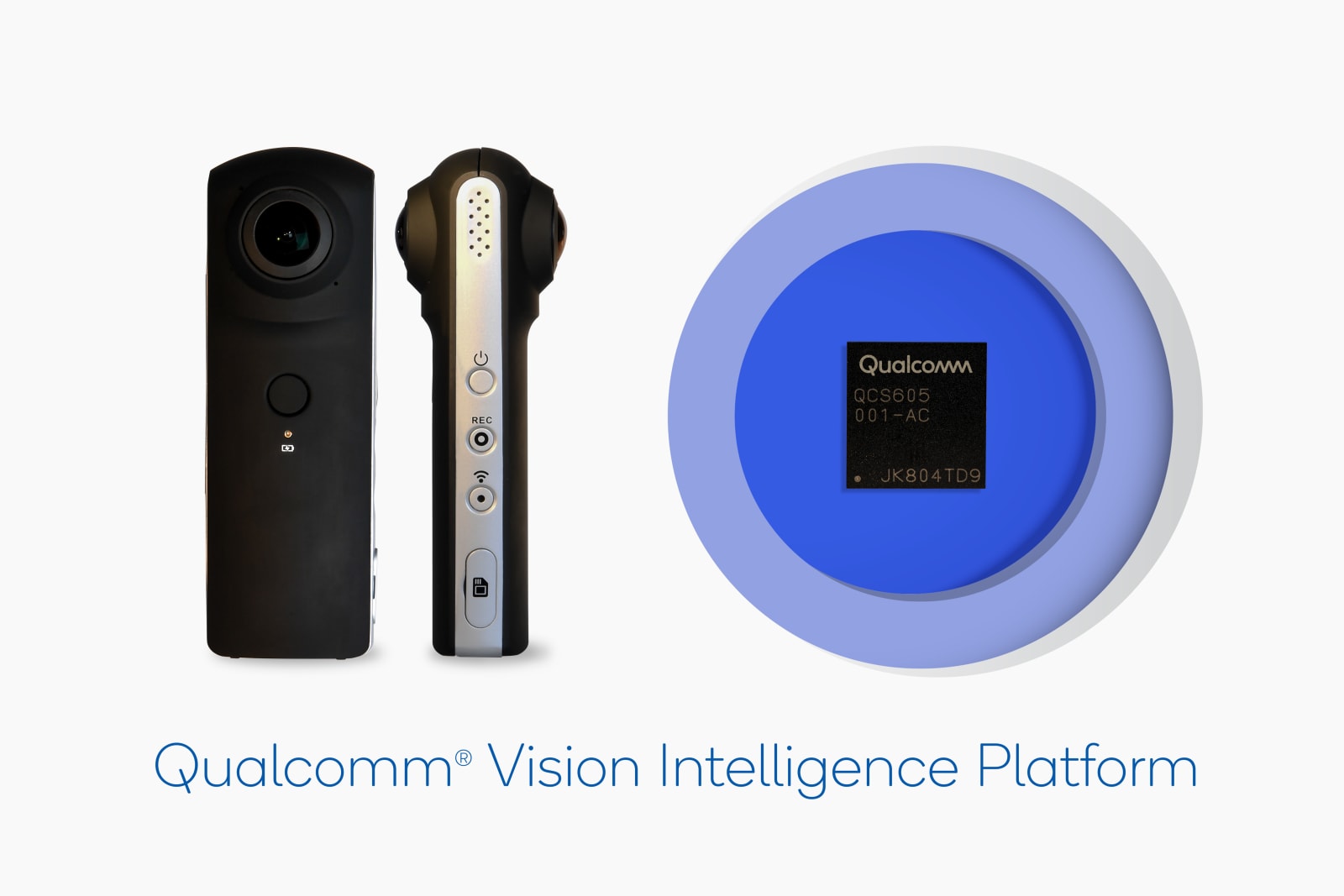
Qualcomm said the new chipsets also enable “superb image quality” thanks to the Spectra 270 ISP, which can support dual 16-megapixel sensors. It can run dual streams of 4K video at 60 fps, 5.7K at 30 fps or even more concurrent streams at lower resolutions. For things like VR headsets or security cameras, that could mean higher quality experiences.
Seshu Madhavapeddy, Qualcomm’s vice president of IoT product management, told Engadget that thanks to the company’s experience with smartphone cameras, it was able to apply what it learned to improve low light performance in IoT devices. Security cameras, for example, benefit from that since the Vision Intelligence Platform’s algorithms can process temporal noise reduction in low light, or even pitch dark environments. Which is important, because, like Madhavapeddy said, “Bad people like dark places.” Other image processing tricks the platform offers include staggered HDR “to prevent the ‘ghost’ effect in HDR video, advanced electronic image stabilization, dewarp, de-noise (and) chromatic aberration correction.”
Add to that support for 2×2 802.11ac WiFi, Bluetooth 5.1 and a host of Qualcomm’s audio technologies, and the QCS605 and QCS603 look like potentially powerful brains for future IoT devices. The 605 looks like the higher-end version of the pair, as it has eight CPU cores (two at 2.5GHz, six at 1.5GHz) while the 603 is just quad-core (two at 1.6GHz and two at 1.7GHz). Both use the Adreno 615 GPU.
Madhavapeddy said the company has been sampling the platform and chips since late last year, and there are already ongoing engagements, so you should expect commercial products to be available in the second half of the year.
How to Use Tags to Organize Files and Folders in macOS
In macOS, tags provide you with an alternative way to organize your files and folders, and can make items in Finder easier to locate. To tag a file in Finder, simply right-click (or Ctrl-click) it and select one of the colored tags in the dropdown menu.
Alternatively, click on Tags… in the same dropdown menu, type in a custom name for a tag, press Enter, and a new tag will be created automatically, ready to be applied again from the dropdown.
How to Customize Tags and Search for Tagged Items
You can customize which tags appear in the dropdown menu by clicking Preferences… in the Finder menu bar, selecting the Tags tab, and dragging your favorite tags to the area at the bottom of the pane.

You can also create new tags and remove unused ones using the + and – buttons, right-click tags to rename them or change their color, and tick the checkboxes next to them to select which ones appear in the Finder sidebar, because that’s where tags show their true worth.

For instance, click a tag in the Finder sidebar, and all the files and folders assigned with that tag will appear in the Finder window, regardless of where they’re located on your Mac. You can also search for a tag by entering the tag color or name in Finder’s search field, then selecting a tag from the suggestions.
How to Tag Open Files You’re Working On
Don’t forget, in many macOS applications you can tag the open file you’re actively working on. Simply click the arrow next to the document name in the title bar, click in the Tags field and enter a new tag, or select one from the dropdown list.

Similarly, you can also tag new files when you save them. Just select File -> Save from the application’s menu bar, and in the Save dialog, click inside the Tags field and enter a new tag, or select one from the list.

Finally, if you don’t have a Finder window open, you might find it more convenient to consult Siri to locate all the files that you’ve assigned a particular tag.

Click the Siri icon in your Mac’s menu bar or press Command-Space, then say something like: “Find files with a purple tag.” Siri should deliver your results including an option at the bottom to open the tagged files in a Finder window.
Related Roundup: macOS High Sierra
Discuss this article in our forums
PRODUCT(RED) iPhone 8 Plus Gets First Unboxing and Hands-on Video
Yesterday, Apple began taking pre-orders for new PRODUCT(RED) versions of the iPhone 8 and iPhone 8 Plus ahead of the smartphones’ official launch this Friday.
Like it did with last year’s (RED) iPhone 7, Apple has given YouTube tech reviewer Marques Brownlee (MKBHD) exclusive access to one of the phones ahead of launch to bring viewers the first obligatory unboxing and hands-on video of a 256GB iPhone 8 Plus.
As expected, the handset comes in a familiar box containing Lightning cable, wired headphones, and standard wall plug, with the only addition being a small card detailing the (RED) brand’s aim of raising funds for HIV/AIDS programs – for each (RED) product sold, Apple makes a contribution to The Global Fund, raising over $160 million to date.
As for the handset itself, there are differences in the look of the (RED) iPhone 8 compared to the (RED) iPhone 7, most notably the glossy glass back to support wireless charging, which gives the phone a “Ferrari-like” candy red finish, as opposed to the matte look of the iPhone 7’s brushed aluminum.
The other big change is the fact that Apple has gone with smart-looking black bezels on the front of the device. That should please users who skipped the (RED) iPhone 7 because they disliked the white bezels that gave the handset a candy cane-style color combination.
According to Brownlee, Apple wouldn’t let on when asked whether it had a PRODUCT(RED) iPhone X planned, but the continued absence of one going into the summer months could hint at the company’s plans for its smartphone lineup – Apple is expected to discontinue the first-generation iPhone X when the second-generation model launches this year, which could mean a red iPhone X variant might not arrive until spring 2019.
PRODUCT(RED) editions of iPhone 8 are available with 64GB or 256GB storage for the same $699-$849 and $799-$949 prices as the equivalent iPhone 8 and iPhone 8 Plus models in space gray, silver, and gold.
Related Roundups: iPhone 8, iPhone XTags: (PRODUCT)RED, MKBHDBuyer’s Guide: iPhone 8 (Neutral), iPhone X (Neutral)
Discuss this article in our forums
 AIVAnet