


DHS may have found unauthorized Stingray devices in Washington DC
The Associated Press reports today that the Department of Homeland Security (DHS) has confirmed that it found what appear to be unauthorized cell-site simulators, also known as Stingrays, in Washington DC last year. The agency told Senator Ron Wyden in a letter that it had found “anomalous activity” consistent with these sorts of devices in the Washington area and a DHS official told the AP that the findings were obtained through a 90-day trial that began in January of last year. Senator Wyden sent the DHS a letter last November requesting information on the use of cell-site simulators by foreign intelligence services.
Cell-site simulators work by tricking mobile devices into pinging a signal off of them instead of a cell tower. The device then holds onto that signal and gives users access to where that phone is located. A number of US agencies and law enforcement groups including the FBI, IRS, ICE and police forces are known to use Stingrays and their use has been challenged in court multiple times.
Though the DHS acknowledged that cell-site simulators are suspected to be in use in Washington, the agency provided little else in the way of information about who might be using them or why. The agency didn’t say exactly what type of devices were found to be in use or how many were detected. Christopher Krebs, who leads the DHS’ National Protection and Programs Directorate, said in the letter to Wyden that the agency doesn’t have the resources to continuously detect these devices but that it did share its findings with “federal partners.”
In 2014, security-focused firms performed public sweeps in Washington, with the aim of spotting cell-site simulators near government buildings like the White House, the Pentagon and the Supreme Court. Aaron Turner, president of consulting company Integricell, was a part of those sweeps and told the AP that every embassy “worth their salt” has this type of device.
Source: Associated Press
Apple iPad review (2018): A little better, a little less competition
The tablet business has been tough in recent years, but last year Apple found a hit in its low-cost iPad. Its admirable performance and battery life made up for its lack of frills, and that $329 price tag certainly didn’t hurt either. Apple saw its iPad sales grow year-over-year for the first time in ages after its release, all but ensuring we’d get a sequel — and here we are.
Apple spent most of its time at a launch event in Chicago lauding this year’s $329 iPad ($299 with that education discount) as a great machine for kids in classrooms. I won’t dig into that too much in this review — there are people far more qualified than me to explore the relative merits of iOS versus Chrome OS in schools. While the iPad’s announcement explored its use almost exclusively as a classroom tool, it’s a lot more than that. In fact, just like the iPad we got this time last year, Apple’s latest is the best budget tablet you can buy right now.

Hardware
No, I swear I’m not reusing photos — the 2018 iPad looks identical to last year’s model, which in turn looks like 2013’s iPad Air with a Touch ID sensor. For those who haven’t been keeping track, that means we’re working with an aluminum body that’s 7.5mm thick and weighs just a hair over one pound. It would’ve been nice if Apple could’ve shaved a few fractions of a millimeter off the iPad’s waistline to match its slimmer Pro-series tablets, but that’s a pretty minor complaint. It’s not as if the 2018 model is uncomfortable to hold for prolonged periods of time. The volume keys, headphone jack and nanoSIM slot (on the LTE model) are all exactly where they’ve been for years, and they all work exactly the way they’re intended to.
This design is arguably a classic, but a few more modern flourishes couldn’t have hurt. The 8-megapixel camera around back is adequate for the occasional snapshot, but considering how strongly Apple played up the importance of “creating” during its education-focused launch event, a camera pulled from a more modern iPhone would’ve been nice. Having a Smart Connector (like the one that graces the left side of every iPad Pro) here would also have been really helpful. Students and adults alike would’ve benefitted from the ability to magnetically attach accessories like keyboards to their inexpensive tablets, but hey — the company has to keep its Pro line special somehow.
And my biggest quibble with the 2017 iPad is back: the noticeable gap between the 9.7-inch Retina display and the glass that covers it. Apple’s Pro line eliminates that gap by bonding those two elements together, which makes for a slimmer design and eliminates the hollow, plasticky feeling you’ll notice when poking at the screen. If you’re coming to this iPad from a much older model, though, this might not seem like a big deal. After all, the Retina display still renders text and images crisply and gives colors a pleasant amount of verve, even under the warm Spring sun.
As usual, though, the most valuable changes are hidden inside the iPad itself. This year, the iPad uses one of Apple’s A10 Fusion chipsets — you know, the ones that powered the iPhone 7 and 7 Plus a year and change ago. Also hidden between the Retina Display’s glass is a new touch sensor that allows the 2018 iPad to play nice with Apple’s $99 Pencil accessory. (More on that later.)
Could this iPad have been made better with a few slightly different design choices? Certainly. Pencil support aside, this is about as by-the-book as Apple hardware updates get. For the price, though, it’s hard to complain about the minor issues and omissions here.
Chris Velazco/Engadget
Software and performance
As I mentioned before, the iPad runs with an A10 Fusion chipset that pairs two high-performance CPU cores with two energy efficient cores for less strenuous tasks. These chipsets were plenty impressive in the iPhone 7 and 7 Plus and they continue to do great work here, too. In fact, with the A10 Fusion in place, this cheap tablet has more computing power on offer than the first two iPad Pros. If Apple’s presentation in Chicago was any clue, it wants kids to use that horsepower to dissect virtual frogs and learn about the world around them using augmented reality. That all worked well enough, both in Apple’s demo areas and in my own testing. Kids will have a blast using the 2018 iPad… assuming they attend a school well-heeled enough to afford them.
Of course, the benefits of a more powerful chipset in a tablet like this are clear to everyone, not just those toiling away in school. I’ve spent a little more time than I care to admit whipping through matches in PUBG Mobile with the graphics cranked up too high, and the iPad kept up without a single hiccup. (Pro tip: Don’t try to use the Apple Pencil to aim.) Ditto for Drake’s jam Fortnite, which similarly runs like a charm. When it came time to actually get work done, I found I could seamlessly jump between multiple apps and run them side-by-side without so much as a stutter.

Chris Velazco/Engadget
More importantly, the 2018 iPad is an excellent vessel for iOS 11.3 and its multitude of tablet-specific features. When I tested the iPad last year, iOS 11 hadn’t arrived yet, so this is the first opportunity I’ve had to try Apple’s relatively new interface on a low-cost tablet. In short, it feels great. The company has said the iPad represents its vision for the future of personal computing, and with iOS 11 on-board, even a budget machine like this could feasibly fill the role served by a traditional PC for some.
Apple’s iPad Pros may wring much more power out of their chipsets, but to my surprise, this $329 tablet often felt just as fast at most tasks. Not bad at all for a budget machine. You won’t need to worry too much about battery life too much, either. As always, Apple claims you’ll be able to get “10 hours of battery life on a single charge”, and always, the company is low-balling it. In our video playback tests (looping an HD movie with screen brightness set to 50 percent), the iPad routinely lasted 1.5 to 2 hours more than Apple’s estimate.

Chris Velazco/Engadget
Life with the Pencil
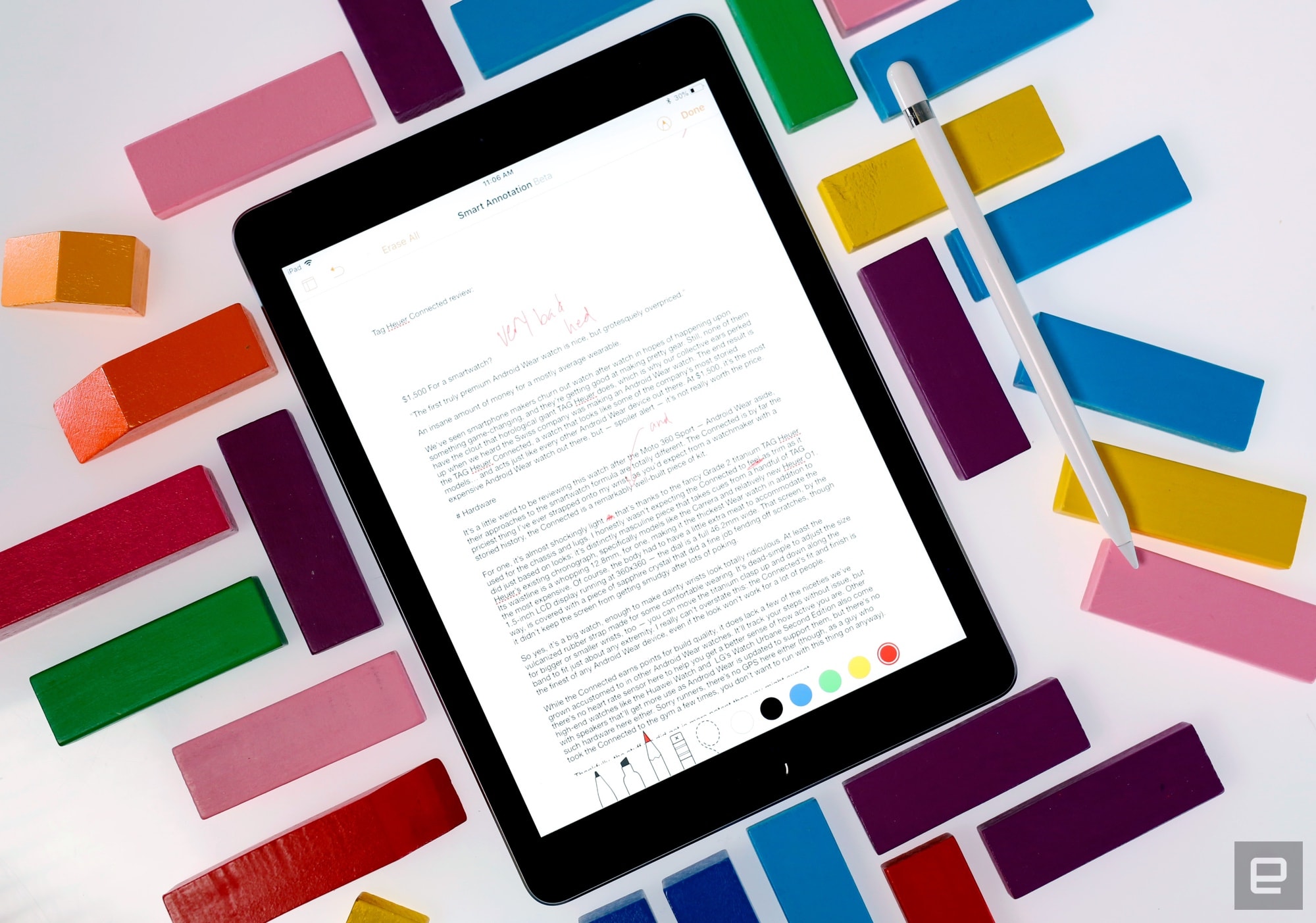
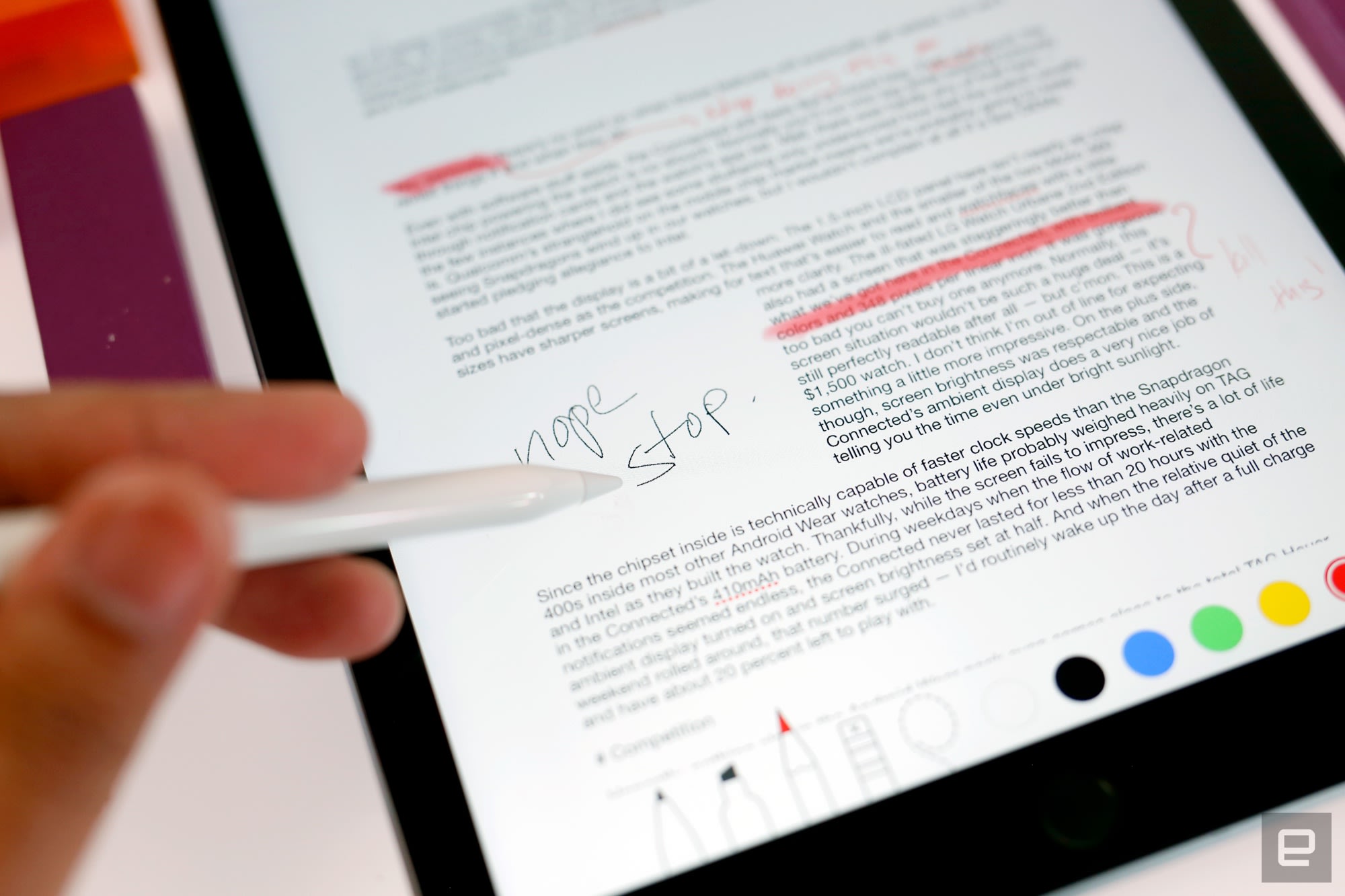
Apple’s Pencil has been around for over two years now, it has changed very little since the day it launched. For the most part, that’s a good thing: its pressure sensitivity and tilt detection make it an elegant, capable companion for artists and ardent note-takers. But does it work as well here as on an iPad that costs twice as much? Unless you’re a professional digital artist, the answer is “yes.” I’ve never had much of an eye for art, but our video producer Brian Oh — an Apple Pencil neophyte, mind you — found doodling on the 2018 iPad surprisingly pleasant. Ditto for the handful of children I yielded the iPad to over Easter weekend, though their work was largely lacking in, err, artistic integrity. Meanwhile, I spent most of my time with the Pencil jotting down quick notes marking up documents with Pages’ new smart annotations and found nothing amiss.
The only real difference between using the Pencil on a $650 iPad Pro 10.5 and on a tablet that costs half that is the way it feels. The gap between the Retina display and the glass covering it means the pencil makes a more pronounced plunking sound than an iPad Pro when you tap the screen with it. Otherwise, it works as well as the first batch of Pros Apple released — you know, the ones before Apple started including 120Hz ProMotion displays.
To be clear though, most people won’t need to splurge on an Apple Pencil. I’ve loved my time with it, and it’s undeniably useful, but I can’t say its blend of utility and price is worth $99 for most people. (Sadly, the $50 Logitech Crayon unveiled in Chicago will be sold exclusively to educators). If nothing else, the Pencil’s journey down-market may offer a bit of insight into the future of the iPad Pro. After all, the Pencil was one of the Pro line’s marquee features; now that anyone who buys a new iPad can use one, it stands to reason that other factors will soon differentiate the Pro from Apple’s basic tablet. All of a sudden, rumors of iPad Pros with notches and even larger screens don’t just sound plausible — they seem probable.
The competition

There’s still some relatively lively competition in the premium tablet space, but down here in the budget zone, truly good options are harder to come by. If you’re not sold on the 2018 iPad, you may want to consider something like Samsung’s Galaxy Tab S3. Sure, it came out last year, but it packs an absolutely gorgeous 9.7-inch Super AMOLED display and a thinner frame than the iPad. At $449 it’s more expensive than the standard iPad, but it also comes with one of Samsung’s S Pens right in the box for note-taking and sketching. Some will also welcome the ability to magnetically attach a keyboard, though in our experience, Samsung’s keyboard is pretty lousy.
If kicking back with a movie on a tablet is more your speed, the iPad might be overkill. Something like Amazon’s surprisingly decent Fire 10 HD tablet may fit the bill better. It lacks access to Google’s services, but it’s quicker than we anticipated and its 1080p screen was nicer than we’re used to from Amazon. And the best part? It’s really cheap — just $150 for the base, 32GB model. Meanwhile, Acer was the first company to unveil a tablet powered by Google’s Chrome OS. The timing of Acer’s announcement was seemingly chosen to take some of the wind out of Apple’s sales, and it’s mostly a play for classrooms, but Chrome OS is plenty capable if you have modest needs. Alas, it’ll still be a few weeks before we get to take the $329 Chromebook Tab 10 out for a spin.

Chris Velazco/Engadget
Wrap-up
It’s too early to tell what sort of impact the 2018 iPad will have in schools — while it might have the edge in education apps, the iPad is still more expensive than most of the Chromebooks you’ll find floating around school corridors. Outside of those hallowed halls, though, the 2018 iPad’s appeal is much clearer. Sure, you could easily spend less money on a tablet if you wanted to, and you couldn’t exactly call this iPad “exciting.” Even so, its potent combination of price, polish and power make this iPad the best value tablet money can buy.
In ‘Ready Player One,’ the real world doesn’t matter
When Steven Spielberg introduced Ready Player One at SXSW this year, he made a surprising statement: “This is not a film that we’ve made, this is — I promise you — a movie.” And really, there’s no better way to put it. It’s a pop culture-driven, nostalgia-inducing blockbuster that works best as a ride, but it falls apart the moment you think critically about it. It’s not something that’ll be taking any deep stances on VR, and it certainly doesn’t have time for much social commentary (aside from some heavy-handed moralizing at the end).
Spoilers ahead for Ready Player One.
While Spielberg’s film is an improvement on Ernest Cline’s novel in almost every way, with slightly stronger characters and a scope beyond 80’s pop culture references, it’s also a missed opportunity. It does little to show us the world and people outside of those VR headsets, which makes it more difficult to care about the stakes of our heroes’ virtual adventure. It’s surprising to say, given how much I loathed the source material, but that’s one area where the book did a better job.
The film starts out similarly, describing a future where the world is semi-collapsed and people live in city slums. Their only escape is the Oasis, a VR world where practically anything is possible. But while the film briefly shows people gaming in the Oasis and doing a few odd jobs (we see a brief shot of a woman pole dancing), we don’t really see how society functions if everyone is wearing headsets. Cline’s book at least gives us a glimpse at how the world could be shaped around VR. In the novel, our hero Wade Watts (AKA Parzival online) goes to a public school on planet Ludus inside Oasis. Partially, it’s because he was bullied in a real world school, but it’s also easy to see the advantages of a VR-driven education, where teachers can make lessons completely interactive.

Spielberg’s adaptation of Ready Player One, based on a script by Zak Penn and Cline, skips the Ludus entirely, and along with it much of the world building. All we know is that the world is in a shambles, but it’s unclear what it actually looks like outside of a brief glimpse at the stacks of trailers Wade calls home. The main thrust of the film is the same as the novel: Wade and his friends are racing to find the hidden keys left by the Oasis’s creator, James Halliday, following his death. Whoever finds all of the keys gets full control of the virtual world. And, as you’d expect, there’s a rival group on the same mission: Innovative Online Industries (IOI), a well-funded tech corporation that’s eager to own the Oasis and monetize the hell out of it.
While the book spans years, the film boils down much of its action to a few weeks. And consequently, Wade’s journey doesn’t seem nearly as compelling. That sped up narrative also gives us little chance to see how the world reacts to his accomplishments. He’s the first person to find one of Halliday’s keys, but the only glimpse of celebrity is him being briefly mobbed by a few fans in the Oasis. There’s never a sense of how people in the real world respond. Never mind that it’s a remarkable achievement — something that thousands (perhaps millions) of people failed to do over the five years since Halliday’s death.
I wasn’t really expecting much from the film to begin with. But I grew increasingly annoyed at how much Spielberg, an artist who’s no stranger to grounding fantastical narratives with human emotion, ignored the actual people who live most of their lives in VR. Instead, he’s more focused on showing us how much fun the Oasis can be. The first key challenge is an insane, action-packed race filled with dozens of pop culture references. And it’s great to see the return of some cult heroes, like the Iron Giant, in the huge final battle. But again, that’s all spectacle with very little heart.

Warner Bros.
There’s something inherently sad about a world where everyone is strapped into VR most of the time. But in the brief looks we get at crowds of actual humans, it’s all played for laughs. We see both kids and adults strapped to headsets outside during the day, who are more concerned with what’s happening with their virtual characters than their physical bodies. I get it, VR looks silly, especially once haptic suits and omnidirectional treadmills are in play. But how does a society work if everyone’s just walking around wearing VR headsets? Throw me a bone Spielberg, I’d like to see how they can even cross the street.
At least the film does a decent job of telling us why it’d be a bad thing for the world if IOI got its hands on the Oasis. In one of the more memorable scenes, the company’s head of operations, Nolan Sorrento, proudly proclaims they’ll be able to fill around 80 percent of a player’s view with ads before there’s a risk for seizure. That’s obviously a bit extreme, but it resonates today, now that we’ve seen how far companies will push their technology, even if there’s a risk for societal harm. Just look at Facebook’s latest controversy around Cambridge Analytica, a company that didn’t actually hack anything, they just absorbed as much personal data as the social network made available. And then there’s Facebook’s mishandling of fake news and nefarious ads, which likely had an impact on the 2016 election.
Ready Player One adds slightly more depth to Art3mis, the badass female player that Wade inevitably falls for. In the film, she’s also a member of a resistance group that’s fighting against IOI. Aside from that setup though, the movie doesn’t tell us much about Art3mis’s group. Does it only exist in one city? Is it a worldwide resistance? And it’s not as if they’re fighting for the freedom of an open platform like the World Wide Web. In the end, the Oasis is still a product of one company, albeit a seemingly benevolent one.

Warner Bros.
The most disappointing element of the film is the way it ends. (Spoilers ahead, naturally.) Upon finding the final key and gaining control of the Oasis, Wade and his clan institute a new rule: the VR world will be shut down on Tuesdays and Thursdays. While the intent might be helpful — people should really take off those headsets once in a while — it’s a bit of a Luddite solution. What about people who depend on the Oasis for a living? And is it actually noble to cut off access to a resource that everyone relies on for education? Shutting down the Oasis for a few days would be as helpful as disconnecting the Internet for a few days, or locking people out of their smartphones to cure tech addiction.
Spielberg’s Ready Player One is a curious adaptation. For the most part it succeeds, especially if you’re just looking for a fun ride through pop culture in VR. But like Jurassic Park and Minority Report before it, it could have been so much more if Spielberg paid attention to the real world.
Police are responding to an active shooter at YouTube headquarters
Multiple social media reports, including from YouTube employees, have indicated there is an active shooter at the company’s northern California headquarters. The San Bruno Police have confirmed an active shooter at the address for the campus.
Active shooter at YouTube HQ. Heard shots and saw people running while at my desk. Now barricaded inside a room with coworkers.
— Vadim Lavrusik (@Lavrusik) April 3, 2018
San Bruno city manager Connie Jackson told BuzzFeed News that the city received multiple emergency 911 calls about shots fired both inside the YouTube headquarters offices and from the surrounding area. The campus typically houses over 1,100 employees. CBS has live footage of the campus, and so does the news organization Circa (below):
BREAKING: Reports of active shooter at YouTube headquarters in San Bruno, CA https://t.co/gPeLJT2ELB
— Circa (@Circa) April 3, 2018
Both the footage and at least one tweet showed employees evacuating the YouTube offices. A Zuckerberg San Francisco General Hospital spokesperson confirmed to NBC that it had taken in patients related to the shooting. Stanford Health Care told ABC that it is treating four to five patients.
Google’s official communication Twitter account posted that they are coordinating with authorities, but had nothing to announce yet.
Re: YouTube situation, we are coordinating with authorities and will provide official information here from Google and YouTube as it becomes available.
— Google Communications (@Google_Comms) April 3, 2018
Developing…
‘Shadow of War’ will drop its in-game currency system on May 8th
The backlash against heavy-handed in-game purchasing systems is starting to spread to those games that weren’t directly caught up in the firestorm. Monolith is phasing out Middle-earth: Shadow of War’s Gold currency over the next few months — you’ll lose the option of buying Gold on May 8th, while any existing Gold, the Market and War Chests will cease to exist on July 17th. If you still have leftover Gold on that last date, it’ll be converted to in-game items. As Monolith describes it, the virtual currency was souring the experience of the game itself.
The option to buy Orcs in the Market may have given you a quick fix, Monolith said, but it perpetually “risked undermining the heart” of Shadow of War’s Nemesis system, which has you building up rivalries with villains. It not only compromised the stories the studio wanted to tell, it risked you missing out on your own stories. Just having that choice broke immersion, the company added.
At the same time, Monolith is promising to upgrade the defend-your-fort Shadow Wars section with new story elements and a “more cohesive” experience, while the Nemesis System, skill tree and progression systems will all get updates.
These changes aren’t going to have as much impact now as they would have in the fall of 2017, when the game was fresh. That they’re happening at all is notable, though. The teams behind Star Wars: Battlefront II and Destiny 2 may have suspended or scaled back the dependence on their in-game economies, but they’ve always intended to keep real-world purchases in place. Monolith, however, is dropping them entirely — it’s convinced the potential for extra profit hasn’t been worth the compromises to gameplay. You could argue that this is a cynical attempt to rekindle buzz for a game that fell off the radar, but it still suggests that opposition to loot boxes and pay-to-win systems is now considered a selling point.
Via: NeoGAF
Source: WB Games Community
California bill would force Twitter and Facebook to identify bots
Facebook and Twitter are plenty aware that Russian-backed actors have been using troll accounts to manipulate online discourse. Despite introducing transparency tools and purging lists of bots, California lawmakers don’t think the companies are doing enough to safeguard consumers. Legislators proposed a bill that would force social media platforms to identify automated accounts and deal with them within three days.
The bill would make it illegal for anyone to use an automated account to mislead California denizens or interact with them without disclosing that they’re a bot. If one is reported, the social platform should deal with the auto-account within 72 hours. Finally, the companies would be required to submit a bimonthly report to the state’s Attorney General detailing bot activity and corrective actions taken.
The legislation is slated to run through a pair of California committees later in April, according to Bloomberg. This follows a bill introduced by state assemblymember Marc Levine in January that aggressively sought to require bots on social platforms be linked to human accounts.
Via: Bloomberg
Source: California SB-1001 Bots: disclosure.
Apple Report Reveals Men Are Paid 5% More on Average Than Women in UK
Male employees who work for Apple in the United Kingdom earn five percent more on average than women, according to a UK Gender Pay Gap report released today by Apple [PDF]. The median hourly pay gap was two percent in favor of women, however.
According to Apple, the average pay gap is due to more men holding senior positions at the company, and when factoring in “similar roles, markets, and performance” it has achieved pay equity. Apple has more than 6,000 employees in the UK.
Apple believes strongly that equal work deserves equal pay. Every year, we examine the compensation employees receive and make adjustments where necessary to ensure we maintain pay equity. And we have achieved this in every country — women at our company earn the same as men when you factor in similar roles, markets and performance.
As part of our commitment to eliminating pay disparities from the first day at Apple, later this year we’ll also stop asking candidates about their salary history.
Apple says that 30 percent of its UK employees are women, and 36 percent of new employees last year were women. 40 percent of the companies “leaders under the age of 30” are also women.
92 percent of men received a bonus including vested stock, while 88 percent of women received the same bonus. Additional detail on the wage gap in the UK is available in Apple’s full report.
Apple published this information because of a new UK law that requires companies with more than 250 employees to publish the average total pay received by men relative to that received by women.
Note: Due to the political nature of the discussion regarding this topic, the discussion thread is located in our Politics, Religion, Social Issues forum. All forum members and site visitors are welcome to read and follow the thread, but posting is limited to forum members with at least 100 posts.
Discuss this article in our forums
Drone pilot gets hefty fine after flying his machine over an Ed Sheeran concert
As Ed Sheeran launched into one of his many hit singles during an outdoor concert in Brisbane, Australia last month, a camera-toting drone flew overhead to catch a glimpse of the British singer-songwriter.
But the police were having none of it, and quickly tracked down the pilot outside the Suncorp Stadium where Sheeran was performing, the Brisbane Times reported.
In recent days, the unnamed perpetrator was hit with a fine of 1,050 Australian dollars ($805) for the reckless drone flight. A ticket to the show would have been a lot cheaper in comparison, at around $165 Australian dollars ($125), though admittedly the stadium seats wouldn’t have offered the elevated view that he was presumably going after with his drone camera.
Australia’s Civil Aviation Safety Authority said the drone, likely a popular consumer quadcopter, was flown at night and within 30 meters of an area packed with people, in breach of local safety regulations. In addition, the unnamed pilot flew the drone beyond the line of sight, as he was outside the stadium when he sent his remotely controlled copter skyward. As in the U.S., drone pilots have to be able to see their flying machine at all times when it’s in the air.
It’s not known if Sheeran noticed the drone as he played in front of more than 50,000 fans, but he doesn’t appear to have been in any danger during the prohibited flyover.
The last time we heard about a performer coming too close to a drone was in 2015 when Spanish singer Enrique Iglesias reached out to grab a quadcopter during a show in Tijuana, Mexico. In that case, the drone had permission to be there, with the event’s organizers using it to capture crowd shots. When it flew by the stage, Iglesias somewhat foolishly reached out to grab it, slicing several of his fingers on the propellers in the process. Yes, there was blood, though Iglesias, ever the pro, plowed on with his set.
In the U.S., we don’t hear too many stories of drones flying over stadiums, though it certainly happens from time to time. A baseball game between the Arizona Diamondbacks and the San Diego Padres at Petco Park last year, for example, saw an out-of-control quadcopter crash into an empty seat inside the stadium, narrowly missing spectators sitting close by.
Meanwhile, in an effort to demonstrate it’s not messing about when it comes to keeping the skies safe over major sporting events, the Federal Aviation Administration warned in 2016 that it would shoot down any rogue drones spotted inside the no-fly zone set up around Levi’s Stadium in Santa Clara, California for the Super Bowl.
Editors’ Recommendations
- Watch a drone lose control and crash onto Apple Park’s solar roof
- A consumer drone crashed and burned, and then caused a wildfire
- Drone-catching drones to bolster security at this week’s Winter Olympics
- Indoor fireworks? Intel broke records with 100-drone light show at CES
- A drone and helicopter reportedly tangled in South Carolina. The helicopter lost.
Origin PC’s latest notebook packs Intel’s Core i7-8750H CPU, Nvidia Max-Q GPU
On Tuesday, April 3, Origin PC unveiled its new EVO15-S laptop for gamers sporting Intel’s just-announced eighth-generation Core i7-8750H “Coffee Lake-H” processor for notebooks. The launch also introduces a new Matte Display option featuring a screen with a 1,920 x 1,080 resolution and a 144Hz refresh rate. The EVO15-S laptop joins the company’s new-but-similar NT-15 model targeting professionals.
Here are the shared hardware specifications:
Screen size:
15.6 inches
Resolution:
3,840 x 2,160
1,920 x 1,080 @ 144Hz (Matte Display)
1,920 x 1,080 (IPS display)
Processor:
Intel Core i7-8750H
Graphics:
Up to GTX 1070 Max-Q
Memory:
Up to 32GB DDR4 @ 2,666MHz (2x 16GB)
Storage:
Up to 1x 2TB M.2 PCIe SSD
Up to 1x 4TB HDD or SSD (2.5-inch)
Sound:
Sound BlasterX Pro-Gaming 360
Connectivity:
Wireless AC (2×2, MU-MIMO)
Bluetooth 5.0
Ports:
2x USB-C 3.1 Gen1
3x USB-A 3.1 Gen1
1x USB-A 2.0
1x SD card reader
Battery:
55WHr
Dimensions:
0.73 inches thick
Weight:
4.3 pounds
Starting price:
$1,733
If you’re not familiar with Intel’s Core i7-8750H chip, it’s the newest addition to the company’s eighth-generation lineup and its first six-core, 12-thread chip for laptops. We saw this processor in early March sporting a base speed at 2.2GHz and a maximum speed at 4.1GHz. Leaked benchmarks showed the six-core chip scoring between the current four-core i7-8650U chip for laptops, and the six-core i7-8700 CPU for desktops.
Also listed in the specifications is the term “Max-Q” regarding Nvidia’s GTX 1070 discrete graphics processor. Typically, high-performance discrete GPUs reside in bulky laptops sporting dual-fan designs. But last year Nvidia introduced low-power variants of its GTX 10 Series GPUs for the best performance in laptops measuring just 0.70 inches thin without the need for bulky blowers, hence the Max-Q label.
Meanwhile, Nvidia’s “normal” high-performance GPUs for mobile are still installed in larger laptops. These chips typically outperform its Max-Q siblings because they are allowed to consume more power, hence the higher heat and bulky fan requirement. The Max-Q variants are supposedly only 10 percent slower in performance although some tests have shown up to 14 percent. Still, with Nvidia’s Max-Q design, you’re getting gaming-grade performance in a form factor measuring just under three-fourths of an inch thick.
“It’s simply incredible that the thin and light EVO15-S laptop is less than one inch thick with a six-Core Intel Core i7-8750H processor inside of it!” Kevin Wasielewski, Origin PC CEO and co-founder, said in a statement. “Combined with Nvidia’s GeForce GTX 1070 Max-Q desktop-class graphics, our latest thin and light custom notebooks take gaming, content creation and streaming higher than ever before.”
As the specifications show, the laptops can support up to two storage devices: One stick-shaped SSD and one 2.5-inch drive. The ideal configuration would be to have the primary SSD play host to the operating system and games that require every ounce of hardware performance. The secondary drive would serve as your local storage for movies, music, and other files along with your less-demanding games.
Finally, the laptops ship with free lifetime 24/7 technical support and free lifetime labor for any future upgrades or service. You can configure the laptops now for a starting price of $1,733.
Editors’ Recommendations
- Lenovo’s updated ThinkPads include T480s with Nvidia MX150, affordable X-Series
- Dell rebrands Inspiron gaming laptops to G Series, serves up four new models
- Dell’s refreshed Latitude laptops get to work with 8th-gen Intel Core, 4G LTE
- Dell’s latest Inspiron notebook packs in AMD’s Ryzen APU with Vega graphics
- Intel’s Radeon-backed ‘Hades Canyon’ mini PC runs games at 1080p, Ultra graphics
The Vive Pro proves that HTC and Oculus need each other for VR to succeed
The Vive Pro has a lot riding on its tiny shoulders. Or strap, or whichever part of it is the shoulders. Anyway, it’s important for a couple reasons, not least of which because it’s the first second-generation virtual reality headset to hit the market. If the original Vive and the Oculus Rift were the proof of concept for modern VR, then the Vive Pro and upcoming Oculus headsets will be the foundation for the future. The thing is, with each passing month, Oculus and HTC have less and less become direct competitors. To make the VR revolution a reality and not just a passing fad, they need each other.
First, let’s talk about the Vive Pro. As we mentioned in our review, it’s a unique product for a unique market. It’s not really for most people, and that’s by design. It’s a high-end gadget that fills the same kind of niche that those giant TVs at Best Buy fill. You know the ones, the massive 4K HDR TVs that take up a whole wall with price tags north of a couple thousand bucks?
Think of the Vive Pro like that. It’s expensive, it requires a very powerful gaming PC (and a whole room set aside for VR) but it’s currently the best VR headset on the market. HTC, with its expensive accessories and hardware caters to the VR audience by promising unbelievable detail and high-fidelity graphics. Oculus is doing something entirely different, but no less important.
The Oculus Go and Santa Cruz headsets are not going to be competing with the Vive Pro. They’re not built for delivering the sharpest, richest, most detailed, high-def VR experience money can buy. They’re built to put VR into as many hands as possible, and not just OK VR like the Samsung Gear VR.
The Oculus Go, for instance, is a stand-alone device not unlike the Google Daydream or Gear VR, but by all accounts, it delivers a surprisingly robust VR experience. Using clever software tricks to dynamically change the resolution and detail so only objects you’re looking at are fully rendered, it can offer high-quality visuals without requiring any external graphical horsepower. It doesn’t require you tuck a phone into it, or plug it into a powerful gaming PC, it just works on its own, and it will hit the market at about $200. That us the important part.
The Oculus lineup will serve as the entry point to VR that the market needs. These technologies are hard to fully describe without the benefit of first-hand knowledge, and the Oculus Go will provide that. So, if that’s true, where does the Vive Pro come in? Right where it is, at the top-end. The Oculus Go is the entry point, it’s a game console. The Vive Pro on the other hand, it’s the big powerful — finicky and not always elegant — LED-bedazzled gaming PC.
In the long run, that’s a very good thing because if VR is going to survive and thrive, it’s going to need both.
Editors’ Recommendations
- Displaylink is ready to make wireless virtual reality setups, well, a reality
- HTC Vive Pro hands-on review
- Oculus Rift re-enters virtual space after bad software caused a global blackout
- Is the HTC Vive Pro too expensive, or the right price for the right hardware?
- Oculus Go and Santa Cruz will have a 72Hz mode for smoother mobile VR

