


Quick Takes: (PRODUCT)RED iPhone 8, iPhone 8 Plus, or iPhone X?
In addition to our standalone articles covering the latest Apple news and rumors at MacRumors, this Quick Takes column provides a bite-sized recap of other headlines about Apple and its competitors on weekdays.
Friday, March 23
1. (PRODUCT)RED edition iPhone 8, iPhone 8 Plus, and/or iPhone X very soon? Steve Hemmerstoffer, who runs the OnLeaks account on Twitter, says at least one red-colored iPhone might be released soon. However, he says his source is unverified, so treat this rumor with a dose of skepticism.
(PRODUCT)RED edition iPhone 7 and iPhone 7 Plus
Take this with a pinch of salt because I got it from a new and therefore still “unverified” source but I heard that new red colored iPhone(s) might be on his way… pic.twitter.com/LKkGB99ylK
— Steve H. (@OnLeaks) March 23, 2018
Rosenblatt Securities analyst Jun Zhang also said Apple may release a (PRODUCT)RED edition of the iPhone 8, iPhone 8 Plus, and/or iPhone X. A year ago this week, Apple unveiled a special (PRODUCT)RED edition of the iPhone 7 and iPhone 7 Plus, so there’s certainly some precedence to suggest this rumor may be true.
2. Apple edits iPhone X ad that captured an animation glitch: A week ago, 9to5Mac’s Benjamin Mayo noticed the ad captured a minor bug causing some text to briefly appear outside of notification bubbles on the lock screen. The bug can be seen in the tweet below or in GIF form over at The Verge.
OMG Apple’s latest iPhone X ad includes a shot of the bugged notification bubbles (see thread for explanation)
Yes, I did file a radar on this months ago. I think it got closed as dupe. I’m way more concerned that this was signed off for the commercial. pic.twitter.com/4VnuplkQTf
— Benjamin Mayo (@bzamayo) March 16, 2018
As it turns out, Apple has quietly edited the video to remove any evidence of the glitch, somehow without re-uploading it to its YouTube channel. The irony is that Apple hasn’t fixed the bug in the latest iOS 11.3 beta, but given the attention it has now received, expect that to change soon.
Apple’s edited iPhone X ad “Unlock”
For more Apple news and rumors coverage, visit our Front Page, Mac Blog, and iOS Blog. Also visit our forums to join in the discussion.
Tags: (PRODUCT)RED, Quick Takes
Discuss this article in our forums
Apple is reportedly working on a ‘foldable’ iPhone for 2020
Apple changes its iPhone designs slowly and reluctantly, so folks were pretty surprised to see the famous notch in the iPhone X. That might be nothing compared to what it has planned for 2020, though, if you’re willing to buy into a new rumor. A Merrill Lynch analyst told clients that “our checks suggest that Apple is working with suppliers on a foldable phone (that potentially could double up as a tablet) for launch in 2020,” reports CNBC.
There are a lot of reasons to doubt such a rumor, as financial analysts are normally self-interested and supplier reports are near the bottom rung of news reliability. If you put your skepticism aside for a second, though, the idea does have some merit.
For one thing, Apple is reportedly working with LG, one of the few companies that has demonstrated and could manufacture a bendable screen. And late last year, Apple filed a patent application for “an electronic device [that] may have a flexible portion that allows [it] to be folded.”
Lastly, Apple showed that it’s willing to be at least a bit experimental with the iPhone X, and may be hoping to rekindle earlier days when it used to lead, and not follow in the smartphone market. A bendable phone would certainly do that — on top of looking radically different, you might be able to unfold it and double the screen size, making it serve double-duty as a tablet. Flexing such a device could also offer new ways to interact with a phone, as this tech demo shows.
We’ve reached out to Apple for more information, but we’re not holding our breath. In the meantime, take this as a fun, very unlikely rumor and liberally sprinkle it with maximum salt.
Source: CNBC
Spotify says 2 million users suppressed ads on its free service
Earlier this month, Spotify revealed that it had begun cracking down on people using hacked versions of apps. These apps allowed users with free accounts to suppress advertising and take advantage of paid features. Now, Spotify has disclosed just how many people have been taking advantage of this hack: around 2 million users.
That’s not an insignificant number, and it’s understandable why Spotify is cracking down on them. As the company explains in an amended F1 filing with the SEC this week, these users forced the company to adjust its metrics and key performance indicators. The disclosure notes, “Unauthorized access to our Service may cause us to misstate key performance indicators, which once discovered, corrected, and disclosed, could undermine investor confidence in the integrity of our key performance indicators and could cause our stock price to drop significantly.”
As a result, Spotify has adjusted its monthly active users from 159 million at the end of 2017 to 157 million. Considering the company has filed for a direct listing to go public, these numbers matter more than ever. In an email at the beginning of March, Spotify notified users of hacked apps that they were at risk of having their accounts suspended or terminated if they didn’t cease using them immediately. Now, these numbers tell us why the company is concerned.
Via: Variety
Source: SEC
The best blood pressure monitor for home use
By Stacey Higginbotham
This post was done in partnership with Wirecutter. When readers choose to buy Wirecutter’s independently chosen editorial picks, it may earn affiliate commissions that support its work. Read the full article here.
After spending 20 hours researching more than 50 blood pressure monitors, interviewing medical professionals, and testing 10 finalists with a group of nursing professors and students at the University of Texas Nursing School, we can say the best blood pressure monitor for most people to use at home is the Omron Series 10 with Bluetooth. Not everyone needs a blood pressure monitor, but those with high blood pressure (a third of Americans) or concerns about it will find a blood pressure monitor is a relatively inexpensive investment in one’s health.
How we picked and tested

We took 10 blood pressure monitors to the University of Texas Nursing School to test and find the most accurate, comfortable, and easy-to-use model. Photo: Stacey Higginbotham
The most important element of a blood pressure monitor is its accuracy. This is determined by the blood pressure machine itself and by the size of the cuff. The conditions under which you measure your blood pressure—from time of day to body position—matter as well. The medical experts we consulted recommend using a monitor that does not deviate more than 10 mmHg of pressure from your doctor’s reading.
In addition to accurate readings, we looked for devices that can store data, so you can compare trends over time. We also appreciated monitors that could store readings for multiple people, average three blood pressure measurements over a short period (for greater accuracy), and send data to Apple’s HealthKit or other another fitness tracking service.
Based on these criteria, we found 10 promising blood pressure monitors and brought them to the University of Texas School of Nursing, where nine volunteers tried on all of the cuffs after getting a baseline reading on the school’s equipment. The goal was to get a variety of user impressions and to test the accuracy of the monitors against a professionally taken blood pressure on equipment you might find in a doctor’s office or hospital setting.
To read more about our testing process and how we settled on just 10 models, please see our full guide to blood pressure monitors.
Our pick

The Omron 10 Series with Bluetooth has the most comfortable cuff of all the monitors we tried, and because of its stiffer construction, it’s also the easiest to put on one-handed. Photo: Stacey Higginbotham
The Omron Series 10 with Bluetooth measured the most accurately in our tests, has the most comfortable cuff, and was the only monitor we tested with a backlit display. It offers the best balance of necessary and nice-to-have features that ensure accuracy of measurement and help users track trends in their health.
In our tests, the Omron 10 provided seven out of the nine testers with results that fell within the 10 mmHg variation from the school’s testing equipment that doctors recommend for home monitors, and brought all nine within 15 mmHg. The cuff was comfortable and easy to put on, it has a feature that can detect irregular heart rates, and the process of taking blood pressure was quiet and fairly quick. We like that it can either send data to a smartphone app via Bluetooth or store up to 200 results on the monitor itself.
An inexpensive option

Walmart’s ReliOn-branded monitor has a more basic set of features and is simple to use. Our testers found the cuff isn’t as comfortable or easy to put on as that of the Omron 10. Photo: Stacey Higginbotham
The ReliOn BP200 is a more basic blood pressure monitor than the Omron 10, lacking some features and leaving out Bluetooth, but it’s affordable and simple enough for most people to use. It was not as accurate as our main pick for the testing group as a whole, but it did measure within the recommended 10 mmHg for two testers. It also has an irregular-heart-rate detection feature and has a screen that is easy to read (though it’s not backlit).
Instead of having a stiff plastic ring to place your arm through, the ReliOn’s cuff is entirely flexible, which can make it tricky to tighten using one hand. And unlike our top pick, this monitor doesn’t have a feature that automatically takes three readings in a row to average them. However, you can take three readings on your own within a 10-minute time frame, and it will then average them.
If you need to track blood pressure for more than two people

The only model we found that will track up to four users, the A&D 767F monitor is inexpensive and provided us accurate readings in our testing. Photo: Stacey Higginbotham
The A&D 767F is the only monitor we found with the ability to track four users, so if you have multiple people in the home who need to monitor their blood pressure, it’s a good option. It can store up to 240 measurements, but its comfort and ease of use was polarizing among the testers. But for less than $40, it is accurate and comes with a nice case and easy-to-read display.
Some testers, including myself, found the cuff to be tight and the inflation process extremely loud for day-to-day use. Others complained about the cuff overinflating or inflating too quickly and hurting their arm. However, how long the cuff takes to inflate and deflate depends in part on your blood pressure.
Smart blood pressure monitors

The Nokia BPM forgoes the traditional monitor unit and sends data straight from the cuff to a smartphone or tablet. These kind of “smart” cuffs tend to be less accurate than hospital-grade blood pressure monitors. Photo: Stacey Higginbotham
There is an emerging class of devices that bypass the traditional monitor and use your smartphone instead. Based on our research and testing, we found these options to be overly expensive and not worth the cost. The only one that made it to our final round of testing was Nokia’s BPM. This device consists of a metal bar, meant to be placed on the inner side of your arm, and an attached cuff. It’s slightly awkward to wear, and will be a problem for anyone with low dexterity as the on-off button is tiny and tough to press. It’s also inaccurate compared with our top pick: Only three out of the nine testers were in the recommend 10 mmHg range.
This guide may have been updated by Wirecutter. To see the current recommendation, please go here.
Note from Wirecutter: When readers choose to buy our independently chosen editorial picks, we may earn affiliate commissions that support our work.
Bank of America Analyst Says Apple Plans to Launch Foldable iPhone in 2020
Apple plans to launch a foldable iPhone two years from now, according to Wamsi Mohan, an analyst at Bank of America Merrill Lynch.
A fan-made foldable iPhone concept
Mohan shared his prediction in a research note obtained by CNBC after spending a week in Asia meeting with companies in Apple’s supply chain. He expects the foldable iPhone will launch in 2020 and said it could potentially “double up as a tablet,” suggesting the device could expand to have an iPad-like form factor.
This isn’t the first time we’ve heard this rumor. Back in December 2016, a Korean report said LG Display was developing and mass-producing foldable displays for smartphones. And, as of October 2017, it appears that LG Display has reached an agreement to supply Apple with its foldable displays for future iPhones.
LG has shown off various futuristic-looking curved and foldable display prototypes over the past three years, including one with a book-like design and another that can be rolled up like a newspaper. Both designs take advantage of the flexible property of OLED displays, compared to rigid LCD screens.
For that reason, the iPhone X is a good start on the path towards a foldable iPhone, should one ever materialize.
While not visible, the iPhone X actually has a flexible OLED display that curves behind itself on the inside of the device. The curved portion houses the display controller chip, and this clever engineering feat allows the iPhone X to have a slimmer bottom bezel, which is normally where the chip is located.
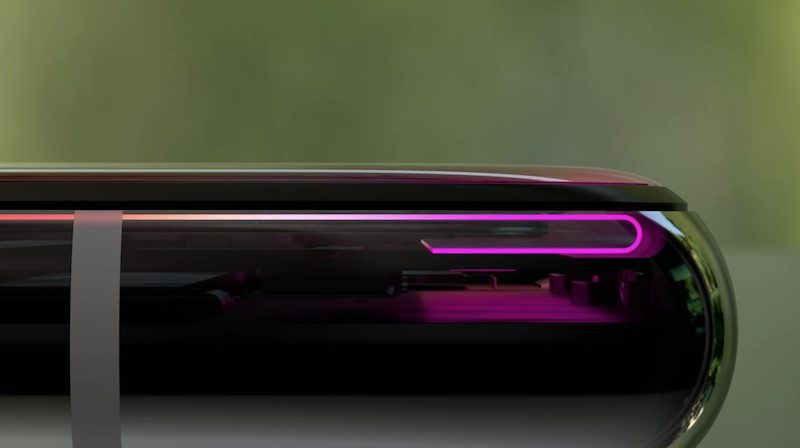 iPhone X’s flexible OLED display
A foldable iPhone would require further innovation. If the device can be rolled up like a newspaper, then components like the logic board and battery would need to be flexible enough to bend rather than buckle. But if it only folds in half, then components could still be rigid and connected with flex cables.
Apple applied for a foldable display patent last year and is likely researching ways to create a foldable iPhone, but that doesn’t guarantee we’ll ever see a consumer-facing product. 2020 might be an overly ambitious timeframe, too, but technology can change a lot in two years, so we’ll have to wait and see.
Tags: Bank of America, Wamsi Mohan
Discuss this article in our forums
Smart wine bottle company Kuvee is going out of business
Back in early 2016, Engadget Senior Editor Andrew Tarantola spent some time with the Kuvée, a sort-of Keurig for wine, and was impressed with its features but wary about its prospects. “Do you want to be the schmuck who blows two Benjamins on this thing only to have the company fold, thereby rendering the entire system useless? I sure don’t,” he wrote. Well, it turns out Andrew was right. According to Business Insider, the company is now shutting down.
The system consisted of a “bottle” with a WiFi enabled touch screen. The bottle was hollow; it took proprietary wine cartridges you could only buy from Kuvée. These cost anywhere from $15 to $50 (the initial bottle sleeve, along with four cartridges, cost $178). The system would keep the wine fresh for up to a month, and you could order new bottles (Kuvée promised around 50 varieties at launch) straight from the touch screen.
The system did well enough when it launched. Preorders sold out in a matter of hours, and it had raised $6 million from various investors. The problem, according to an email that Kuvée CEO Vijay Manwani sent out, was that they weren’t able to acquire enough capital or customers, and that the company needed more of both for awareness. Manwani blamed the fires in Napa Valley for the company’s difficulties, according to the email published by Business Insider.
If you have a Kuvée, you’d better act quickly. The company is selling its existing stock of wines for 50 percent off until Monday, March 26th, after which your device will be pretty much useless. Manwani did say that they are still looking for a partner to leverage the technology, so you may not want to throw your Kuvée out yet, but the prospects don’t look great.
Via: The Verge
Source: Business Insider
Apple’s Sales Have Grown So Much That It’s Running Out of 10-Digit Invoice Numbers
Currently, when Apple sends an invoice to its customers and business partners, the recipient gets an invoice number that is entirely numeric and spans 10 digits.
According to a post on Reddit citing a letter from Apple called “Change in Invoice number format,” the company has drafted so many invoices that it’s close to going through all possible permutations for these 10-digit numeric codes, necessitating a switch to an alphanumeric system.
This means that instead of a basic 10-digit number, Apple’s system will now include two alphabet characters followed by eight numbers, for example: “AB12345678.” These changes will begin applying to all invoices issued “approximately after the third week of February 2019.”
 Image via jwildman16 on Reddit
As explained in the Reddit thread on the topic, there are a total of 10 billion possible invoice numbers available to Apple through its current 10-digit all-numeric system, suggesting Apple is nearing 10 billion invoices sent worldwide for as long as it’s used this system. Apple sends an invoice every time an order is made on the Apple Store app, website, or in-store, with each order receiving a unique invoice code.
When adding in two letters to the beginning, Apple’s invoice code possibilities increase to around 67.6 billion. Redditor nalexander50 explained the math in greater detail:
Wow, that’s a lot of orders! If I am remembering my college combinatorics course properly, a 10 digit numeric only code would cover 10 Billion orders. Each position in the number has 10 possible values (0-9) and there are 10 values total. Multiplying it out, 1010 = 10 Billion.
Changing the first two positions to letters vastly increases the possibilities. For the first two positions, there are 26 possible choices (a-z), and the remaining 8 positions have the same 10 (0-9) choices. Multiplying it out, 262 * 108 = 67.6 Billion invoices. Since it has taken this long to creep up on 10 Billion, I figure that an additional 67 Billion will last a while.
With yesterday’s update to the Apple Store iOS app, the company also made it possible to get to your order invoices from within the app. To do so follow these instructions: open the app, tap the circular profile symbol at the top right of the Discover tab, scroll down to My Orders, tap on one, tap Print Invoice, then sign in to your Apple ID. On the invoice, the invoice number is located in the Additional Information section at the very bottom of the page.
Tag: Apple Store
Discuss this article in our forums
How to break your smartphone Addiction
How to break your smartphone Addiction
Smartphone addiction is causing waste of productive time and causing serious health issues. Here, people are going frenzy behind social apps, gaming apps and other apps where they spend hours daily for no good reason. In fact, people while being disconnected to social life are trying to find pleasure in digital world. In fact, cheap data plans and smartphone devices have only fueled the market for smartphone apps. You can find number of apps for any given subject (purpose) on Google Play Store easily. It has only increased the time users spend on their smartphones. Knowing that issue exists, it becomes necessary to deal with it in an effective manner.
Use Social Fever: You believe it or not, we are talking about an app that helps you break your smartphone addiction. Social Fever is a futuristic solution to help you analyze your smartphone usage and helps you manage it further. Here, it offers you detailed smartphone usage report to help you understand the time you are wasting on unnecessary apps. Further, you can reduce your smartphone usage based on this report to invest this time in more important things in life.

Highlights of the App
- It works as a advanced solution to help you deal with smartphone addiction.
- It displays detailed app usage to help you avoid over usage of unnecessary apps.
- It is useful tool to keep your eye and ear health intact.
- It offers real-time app usage tracking to curb unnecessary usage.
Features of the App
Track Goals: App allows you to set goals for yourself by setting the maximum time limit to use any app. Here, it allow you to add different apps to the tracking module to avoid over usage of the unnecessary apps. It will help you save lot of time effortlessly.

App Usage: Under App Usage, you can find the time you have spent on individual apps on your device. It will display apps that are added to tracking module.
History: Under History, it display a complied report of time you have spent on various apps in last 7 days. You can find report in graphical format for easy understanding.

Interests: Under Interests feature, you can set your interests from given options. Under this feature, app will update you when you manage to save some time for your hobby or interest.

Ear Health: Here, the app will send you alerts when you continuously using headphone/earphones for a longer duration. This feature is designed to keep your ear health intact.
Eye Health: This is another useful feature to keep tab on your health. Under this feature, the app will notify you when you are using your smartphone for longer duration while watching movie, playing game or doing other activities. Here, you can take break to relax your mind and body.
Other Features

- To view app usage in real-time, you can set time tracker by clicking on “Show App Tracking” feature.
- App sends you daily app usage report on 22:00 hours daily by report. You can tweak the time settings to your desired time.
- “Show daily report” feature allows you to keep a tab on daily goals you have set for yourself.
- “Clear History” feature allows you to clean all app tracking history.
- To change interests, you have set for yourself go to “Show Interest” feature.
The Verdict of the App: Social Fever is a futuristic solution that works on smart algorithms and advanced techniques to offer you effective results. Here, it helps you track app usage in real-time to avoid unnecessary usage of unwanted apps. Using this app, you can set goals and interests for you to save some valuable time for your favorite activities. We suggest you this app to get rid of smartphone addiction effectively.

Atlanta government computers hit by ransomware
The last victim affected by ransomware is the city government of Atlanta, GA. The ninth-largest metro area in the US isn’t able to do things like process payments or provide access to courthouse information because some systems are locked down. During a press conference, mayor Keisha Bottoms and newly-appointed COO Richard Cox said that they’re working with the FBI, DHS, Microsoft and Cisco to find out what data has been potentially been compromised.The local NBC affiliate reports a ransom note included with the SamSam ransomware is demanding about $51,000 in bitcoin to restore the systems.
If it is SamSam, it’s part of a family of malware has been active against many government and healthcare systems since late 2015. In January, Talos noted that its makers had already netted over $325,000 in ransom sent to one bitcoin wallet. This particular attack isn’t spreading on the level of 2017’s NotPetya/WannaCry, but its apparent ability to target critical systems where the owners are likely to pay makes it even more troublesome, spreading first through vulnerable servers and then onto Windows desktops. The Atlanta government said it will be open for business in the morning, and that infrastructure like public safety, water and the airport are unaffected.
The City of Atlanta is currently experiencing outages on various customer facing applications, including some the customers may use to pay bills or access court related information. We will post any updates as we receive them. pic.twitter.com/cezLBFsINt
— ATL Municipal Court (@ATLCourt) March 22, 2018
Source: City of Atlanta (Twitter), 11 Alive, Bleeping Computer, CNN
Red Bull built an underground eSports bar in London
London’s Red Bull Gaming Sphere has everything you would expect from an eSports venue: neon-strewn PCs, large TVs, chunky headsets and the latest Nintendo, Sony and Microsoft consoles. But this isn’t a stadium designed to compete with the Gfinity Arena or ESL’s Studio 1 in Leicester. There are no seats, for instance, beyond a few cube-shaped blocks scattered in front of a 190-inch wall-mounted TV. It’s something else, a strange hybrid of eSports arcade and Twitch-friendly streaming studio. The hardware inside is undoubtedly impressive, but on opening night few are sure what it’s actually for.
The Sphere is based less than 200 meters from Shoreditch train station and the Fnatic concept store that was run temporarily on Redchurch Street. Descend the stairs and you’ll find a swanky bunker with a bar and various gaming stations that can be reconfigured depending on the event. There’s a mixture of sofas and gaming chairs, catering to both serious and and casual play, as well as VR headsets and a couple of racing rigs complete with wheels, pedals, and wrap-around displays. The centerpiece, though, is a clearly defined “red” and “blue” area for team-based games such as Overwatch and Rocket League.
It feels more like a gaming hangout than a stage where the next Dota champion could be crowned. Which would seem like a problem given how the eSports industry currently operates. Typically, players will practice at home until they reach an in-game ranking that grabs the attention of a professional team. They’ll then be whisked away to a team house, or kept on the roster for a squad that plays at the highest level. Those two extremes — playing at home, or professionally on a large stage — have negated the need for smaller venues.
Still, it’s a concept that retailer Game has already experimented with through its ‘Belong’ in-store arenas. These spaces make sense, though, as a way to bring players and potentially business through its doors. Red Bull sponsors multiple players and teams, but it’s not clear if they’ll be using the Sphere for practice or competition. “I think Red Bull thought, ‘Well what’s the best way for us to give back to that community,’” James Dean, UK managing director for eSports company ESL said. “And this is like a big present, really.” We would have asked Red Bull, but the company declined to comment during the event.

James Dean, managing director of ESL UK.
Riot Games, the developer behind eSports phenomenon League of Legends, has some ideas of how to make use of the space. The company is currently reworking its tournament structure in the UK and held a “workshop” with eight professional teams at the Sphere yesterday. The squads were able to provide feedback on previous tournaments, or “splits”, and ask questions about the new Forge of Champions competition launching this summer. “Maybe we’ll always use the Red Bull Gaming Sphere as a kick-off event for each quarter,” Mo Fadl, head of UK eSports for Riot Games hinted.
He thinks the venue could be used for community-centric events such as player meet and greets and interactive ‘ask me anything’ streams. “Suddenly we have a space here where we invite maybe the biggest streamer in Europe, the biggest teams in Europe, pro players coming down, and then normal community guys have a chance to meet them,” he said. To build a better relationship with the fans, it could hold smaller exhibition games between a professional team and rookie squads. As Forge of Champions grows, it could also host early match-ups in large, anyone-can-enter tournament brackets.
“For that, we need locations,” Fadl said. “This is a perfect location where we can say ‘Guys, three times this week we’ll have tournaments happening in the Red Bull Gaming Sphere in London. Come here and play.’”
Red Bull has some events of its own lined up. The Sphere won’t be open 24/7 like a gaming bar, but there will be a “Friday Night Brawl” every week from 5 to 10pm. The game will change with each brawl and the winner, at least on March 23rd, will walk away with a £100 (roughly $141) cash prize. Attendance will be limited to 32 players, however, who have pre-registered online. The beverage brand will also be hosting casual “practice quarters” every other Thursday, starting with some Street Fighter V sessions in April, and workshops with Dota 2 analyst Purge.
It’s an experimental, scattershot lineup. But Dean says that’s a good thing — the Sphere has everything an eSports fan might want, and now it’s down to the community to decide what it should be used for. “[Red Bull] has obviously spent a decent amount of resources and money making this amazing facility,” he said. “It’s got the computers, it’s got the consoles, it’s got the streaming facilities, it’s got the internet, and it’s in a cool location. Now it’s up to the community to decide how it engages with this space.”
“It’s up to the community to decide how it engages with this space.”
It’s an expensive gamble, but one that Red Bull has taken before. Last month, the company set up a Gaming Sphere in Tokyo that can host up to 150 people. Both are a footnote in a ridiculous marketing budget that includes soccer and Formula One teams, recording artists, and a skydive from the Earth’s stratosphere. Even if the venues are an abject failure, they probably won’t hurt Red Bull’s bottom line. That’s why the Spheres have been able to open with such a vague business model. eSports is a booming industry and the company seems confident that with enough time, they will figure out a way to provide value to the community.
Jamie Rigg contributed to this report.
 AIVAnet