


Facebook to Delay Smart Speaker Unveiling Amid User Data Scandal
Facebook has chosen not to unveil its latest smart connected devices at the company’s F8 developer conference in May, in part because of the ongoing data-privacy scandal that has engulfed the social network, according to people familiar with the matter.
Bloomberg reports that Facebook’s new home products, which include a video-capable smart speaker featuring the company’s own digital assistant, are now being held back from public view, pending a deeper review into the devices’ processing of user data. Although the hardware wasn’t expected to launch until the fall, Facebook had planned to preview the devices at its annual developer summit, according to the paper’s sources.
The devices are part of Facebook’s plan to become more intimately involved with users’ everyday social lives, using artificial intelligence — following a path forged by Amazon.com Inc. and its Echo in-home smart speakers. As concerns escalate about Facebook’s collection and use of personal data, now may be the wrong time to ask consumers to trust it with even more information by placing a connected device in their homes. A Facebook spokeswoman declined to comment.
In the last few weeks, Facebook has come under increasing scrutiny over its user data practices, after reports emerged that political advertising firm Cambridge Analytica procured information on 50 million social network users without seeking permission.
Facebook CEO Mark Zuckerberg is set to testify in front of Congress on privacy in the coming weeks, but the chief executive has so far refused a British request to appear before a parliamentary committee and answer questions about the social network’s involvement in data misuse.
Tag: Facebook
Discuss this article in our forums
Porsche Design Huawei Mate RS: Everything you want at triple the price
You might think that the Huawei P20 Pro is the nicest phone that Huawei announced, but you may change your mind after taking a look at the Porsche Design Huawei Mate RS. With its sleek looks, forward-thinking features, and massive price tag, the Porsche Design Huawei Mate RS is certain to turn a lot of heads.
The big to-do of the P20 Pro is the fact that it has three cameras. Well, guess what? The Mate RS has three cameras, too; the exact same setup in fact. It also has an under-glass fingerprint sensor, the option for 512GB of storage (the first of its kind), and wireless charging — three features that the P20 Pro doesn’t have. In fact, the Mate RS is essentially a P20 Pro, but better.
That sleek Porsche feel


First, let’s talk about the Porsche Design moniker of the device. The Porsche branding is all over the phone, just like on the previous Huawei-Porsche collaboration, the Porsche Design Huawei Mate 10.
The Porsche Design logo adorns the back, and the words “Porsche Design” are printed not-too-subtly on the front. But hey, just like with fancy cars, you want everyone to know what brand your flaunting, right?
The phone comes in a pretty cherry red and also a more traditional black, both of which were chosen by Porsche’s fussy design team.

The Porsche Design Huawei Mate 10 got some scathing reviews (including here at Android Authority) mostly because it was simply a Huawei Mate 10 Pro with a little more storage, a new coat of paint, and a crazy-high price tag. Huawei must have taken those reviews to heart, because the Porsche Design Huawei Mate RS (which stands for “racing sport,” for whatever reason) is not just a fancy sibling to the Huawei P20 Plus. There are features in this phone that even that new flagship device doesn’t have.
Related Articles
Huawei P20 and P20 Pro hands-on: Holding nothing back
Editor’s note: We’ll update our Huawei P20 and P20 Pro hands-on and related coverage with more details in the coming hours, so stay tuned!
They say the best revenge is massive success, and Huawei seems poised …
The Porsche Design Huawei Mate 10 is a comical cash grab
The appearance of any limited edition version of a smartphone usually implies one of three things; it’s geared towards those with more taste— and money— than the mainstream consumer; there’s more to the company’s creative …
That being said, the devices are incredibly similar. The specs are listed in a table below, but the display, processor, camera setup, and battery size are all the same. However, you will notice that the Mate RS doesn’t have the P20 Pro’s notch. And there are some other differences, too.
Better than the P20 Pro?

First up is the under-glass fingerprint sensor, probably the most talked-about new feature appearing in modern smartphones. Up until this device, Vivo was the only company with an under-glass fingerprint sensor phone for sale. But now, this Mate RS joins the fold by giving you the option to use the hardware sensor on the back or the under-glass sensor on the front. You can navigate to the device’s settings to choose which you’d like to use. But keep in mind: a fingerprint that’s set up with the back sensor can’t be used on the front, and vice versa.
Next up, we have the option for a whopping 512GB of built-in storage. The Porsche Design Huawei Mate RS is now the first phone to hit the market with that much storage as an option. You’ll pay a hefty premium for that much storage (more on that in a minute), but the fact that that’s even an option is incredible.
Finally, the phone also features wireless charging. However, we haven’t had a chance to test it out yet, so we’re not sure how effective it is or what kind of charging docks are supported.
Porsche Design Huawei Mate RS specs
| Display | 6-inch curved OLED display 18:9 aspect ratio 2,880 x 1,440 resolution |
| Processor | Huawei Kirin 970 |
| RAM | 6GB |
| Storage | 256GB or 512GB |
| Cameras | Rear: 40MP main camera 20MP monochrome lens 8MP telephoto lens Front: |
| Battery | 4,000mAh Non-removable Wireless charging |
| Software | Android 8.1 Oreo Porsche Design skin |
| Colors | Red, Black |
| Price | 256GB version: €1,695 (~$2,103) 512GB version: €2,095 (~$2,599) |
| Availability | April 12 – China, Hong Kong, and Macau Sometime later – France, Germany, Italy, Spain, the U.K., and Switzerland |
Hopefully you’ve been saving up

Now, the bad news: this phone is really, really expensive. Sure, it may not be as much as a new Porsche, but it’s up there. The version with 256GB of storage (the lowest amount the device offers) will set you back €1,695 (~$2,103), and the version with 512GB of storage goes for a whopping €2,095 (~$2,599). That’s a lot of cash to have the most advanced smartphone available today.
If you are like us and can’t afford to blow two months’ rent on a new smartphone, you’re probably pretty sad right now. But hey, today’s superphone is tomorrow’s normal phone. The very fact that a phone exists on the market with three cameras, an under-glass fingerprint sensor, 512GB of storage, and wireless charging, all in one, means that those features are coming soon to a more affordable device.
Want to learn more about the not-so-expensive Huawei P20? Find out more below:
- Huawei P20 Pro hands on: Holding nothing back
- Exclusive: An afternoon with the Huawei P20 Pro camera
- Huawei P20 Pro: World’s first triple camera explained
- Huawei P20 and P20 Pro: Price, availability, and release date
- Huawei P20, P20 Pro, and Porsche Design Mate RS specs: Triple cameras and notched displays
- Huawei P20 color comparison: Buy the twilight one
Nvidia hits the brakes on public autonomous tests after fatal Uber crash
Nvidia is now halting all tests regarding autonomous vehicle driving on public roads. The company formerly tested its driver-free technology in California, New Jersey, Japan, and Germany. But the fatal crash in Arizona involving one of Uber’s self-driving cars pushed Nvidia into re-thinking its strategy. Just one error can be devastating.
“The accident was tragic. It’s a reminder of how difficult self-driving car technology is and that it needs to be approached with extreme caution and the best safety technologies,” a Nvidia spokesperson said. “This tragedy is exactly why we’ve committed ourselves to perfecting this life-saving technology.”
A driver-free Uber vehicle struck a pedestrian late Sunday night in Tempe, Arizona. Elaine Herzberg, 49, was walking outside of the crosswalk when she was struck by the vehicle. She was rushed off to a hospital but died later from the injuries. Uber has since halted all autonomous vehicle testing on public roads.
A big chunk of Nvidia’s keynote during its GPU Technology Conference opening focused on autonomous vehicles. Nvidia founder Jen-Hsun Huang admitted that safety is the hardest computing problem. Because so much is at stake, it needs to be addressed “step by step” to prevent future accidents similar to what happened in Tempe and Uber’s vehicle.
“This is the ultimate deep-learning, A.I. problem,” he said. “We have to manage faults even when we detect them. The bar for functional safety is really, really high. We’ve dedicated our last five to seven years to understanding this system. We are trying to understand this from end to end.”
He believes that autonomous vehicles will drive better than humans. They will be the staple of society as humans move away from cites due to overcrowding. Humans are also becoming more dependent on Amazon-like services where products are shipped to their doorsteps rather than customers venturing out to the store. Another 1 billion vehicles will come into society over the next 12 years, he predicted.
For now, until Nvidia understands why the Uber vehicle struck a pedestrian, the company will depend on simulations and private lots to train its autonomous vehicle technology. As for its “fleet” of manually driven data collection vehicles, they will continue to roll across America’s highways.
One topic discussed during Tuesday’s keynote focused on perception: The ability for the car to understand its surroundings. That includes the perception of space, distance, objects of any shape, scenes, paths, the weather and more totaling 10 “networks.” Nvidia plans to assign ten high-powered DGX-2 systems to each network.
Huang also introduced the company’s next-generation supercomputer for self-driving cars called Drive Orin. The successor to the current Drive Pegasus model, it combines multiple Pegasus computers into one Orin package, providing more computing power in the same physical space. The company set out to require less power from the battery too, increasing the vehicle’s overall mileage.
Also during the keynote, Nvidia showcased means for remotely taking control of a real-world autonomous vehicle using a virtual reality headset.
Editors’ Recommendations
- Video of deadly Uber autonomous car crash raises more questions than it answers
- Google’s Waymo vs. Uber: Everything you need to know
- Toyota halts autonomous car tests on public roads following Uber crash
- Volkswagen enlists Nvidia’s powerful Xavier chip for autonomous cars
- Selfless move? Uber may be selling its self-driving technology to Toyota
Nvidia’s GTC keynote was big on business, but ignored gamers and miners
This morning was the opening keynote of the annual GPU Technology Conference (GTC), Nvidia’s big annual show. CEO Jansen Huang took to the stage and made a number of interesting announcements, including the unveiling of the world’s largest GPU — the GDX-2 — and some impressive deep learning demos powered by Nvidia’s move into AI.
However, two important groups of people were left virtually unmentioned by Huang. Gamers, and cryptocurrency miners.
Both groups have been eagerly awaiting the release of the next generation of graphics cards, specifically the announcement of a GPU made solely for mining cryptocurrency. Miners want more hashing power, while gamers want the skyrocketing prices of GPUs to get back to normal levels. A new generation of GPUs would accomplish both of those tasks.
The future for #GPU #cryptocurrency miners will be laid out this morning at #GTC18. Here’s how to watch the keynote. https://t.co/u13Y2trJFY #bitcoin
— Jake Rossman (@ptownjake) March 27, 2018
Outside of the possibility of interest in the GDX-2 as a powerhouse mining rig, gamers and miners are as in the dark as they were yesterday.
This “GPU crisis,” as it’s been referred to, has been left nearly unaddressed by the company. Of course, for Nvidia, it’s hardly a crisis. It’s given lip-service to the problem, but has no doubt enjoyed the profits of the new use case for its products. The lack of any mention of it at the keynote is a hard pill to swallow.
GTC isn’t a gaming-focused event — I get that. But it also would have been a great time to give even just a hint or tease at what’s to come. There’s lots of rumors and conspiracies floating around the internet, all of which could have been squelched with a mention by Huang from the stage. It also would have shown that they’re aware of how gamers feel, and given them a light at the end of the tunnel. Instead, I’m left to wonder if and when Nvidia will fix the issue.
“The more you buy, the more you save,” Huang repeated over and over throughout the keynote.
For the people Nvidia ignored, that couldn’t be further from the truth. Buy? Buy what? For many, affordable GPUs aren’t even available.
Amazon’s Kindle Lite app offers the same great reading experience at a fraction of the size
The Kindle Lite app weighs just 2MB, and is designed to work on 2G connections in emerging markets.

Amazon launched Kindle Lite in beta at the end of last year, and the app is now formally making its debut in India. The app is tailored for entry-level phones with limited storage (such as Android Go devices), and takes up just 2MB and uses less resources than the full-fledged client.
Kindle Lite offers a similar set of features as the Kindle app, including the ability to sync your progress across devices with Whispersync, personalised recommendations, night mode, navigating through the table of contents, and changing font sizes. I’ve been using the app for a few weeks, and the experience is similar to that of the full-fledged app.
Amazon is also touting a feature where you can start reading the book before it finishes downloading. Personally, I haven’t run into any issues downloading ebooks (as they’re routinely under 5MB in size), but the feature is likely designed for those on 2G connections. From Kindle’s country manager for India Rajiv Mehta:
As part of our continued focus on India, we are always working to improve the reading experience for our customers. Apps constantly compete for space on a mobile phone and Kindle Lite solves this problem for our readers. Kindle Lite is less than 2MB and built to provide a great reading experience even on 2G/3G networks.
Kindle Lite also lets you purchase books from the Kindle store, and you’ll be able to read books in five regional languages — Hindi, Tamil, Marathi, Gujarati, and Malayalam — aside from English. To further incentivize the usage of Kindle Lite, Amazon is offering an 80% cashback to those picking up their first ebook from within the app, provided you pay using Amazon Pay.
Overall, Kindle Lite is a nifty app that works great on low-powered hardware. With Android Go devices starting to make their way into the market, it’s likely we’ll see more lightweight versions of popular apps.
Download Kindle Lite from the Play Store
Study: Most YouTube influencers still don’t disclose sponsored deals
It’s been almost a year since the FTC warned social media influencers that they should “clearly and conspicuously [disclose]” if they’re being paid for a post or video. But according to a new Princeton University research, most YouTube and Pinterest influencers still don’t add proper disclaimers to the content they produce. The researchers analyzed over 500,000 YouTube videos and over 2.1 million unique Pinterest pins from August to September 2017 for the study. They found that 3,472 videos and 18,237 pins in the bunch had affiliate links, but only 10 and seven percent, respectively, contained written disclosures.
Those that did have disclosures didn’t even follow the FTC’s guidelines, which recommend lengthier explanations than “hey, these are affiliate links.” The FTC wants influencers to be very clear in their wording: for instance, as Wired said, they can write “I make a small commission every time you purchase through these links.”
According to lead author Arunesh Mathur, his study doesn’t even represent all types of undisclosed affiliate partnerships, since they didn’t take coupon codes and other linkless deals into account. That said, the researchers also didn’t take into account any disclosure YouTubers mention in the video and those written in languages other than English. Mathur, however, is “fairly confident that only a tiny fraction of content creators disclose affiliate links at places other than the description.”
Advertising on social media without the proper disclosure has become a huge issue in recent years. Just take a look at celebrities’ accounts, and you’ll see them promoting products without saying whether they’re getting paid for the post. It’s not the advertisements themselves that are the problem, it’s that without the proper label, people won’t know whether influencers are simply recommending a product they like or if they’re getting paid to praise it.
Instagram, YouTube and Facebook have labels influencers can use to indicate sponsorship, but they’re a bit too subtle for the FTC. Things might change as more and more social media superstars pop up. Mathur and his team, for one, believe the answer lies in browsers: they plan to develop an extension that can automatically detect and highlight affiliate marketing campaigns.
Via: Wired
Source: Princeton University
Logitech’s G Pro headset is built for eSports
With the new G Pro headset, Logitech set out to make something that gamers could wear for hours on end, without getting fatigued. It’s a fairly straightforward pair of headphones: It only offers stereo sound (no fancy surround option), and it relies on an analog audio connections. Instead of the sports mesh headphone material found on Logitech’s other gaming headsets, though, the $90 G Pro sports soft leatherette. The company claims it offers 50 percent more sound isolation than before, but more importantly, the new material simply feels better. (The previous covering made my ears feel a bit itchy after a few Overwatch matches.)
The headphones feature Logitech’s Pro-G drivers with a slightly more aggressive sound profile than last year’s headsets. While I found the G433 and G533 to sound a bit flat, the G Pro accentuate bass, which makes plenty of gaming moments feel more satisfying. Some music fans prefer a neutral sound profile, but when it comes to games, that tends to sound dull. The G Pro comes with a removable microphone, which features noise-canceling and better sensitivity than past Logitech offerings. You’ll need a separate microphone jack to take advantage of that feature, which could be a problem for some gaming laptops.
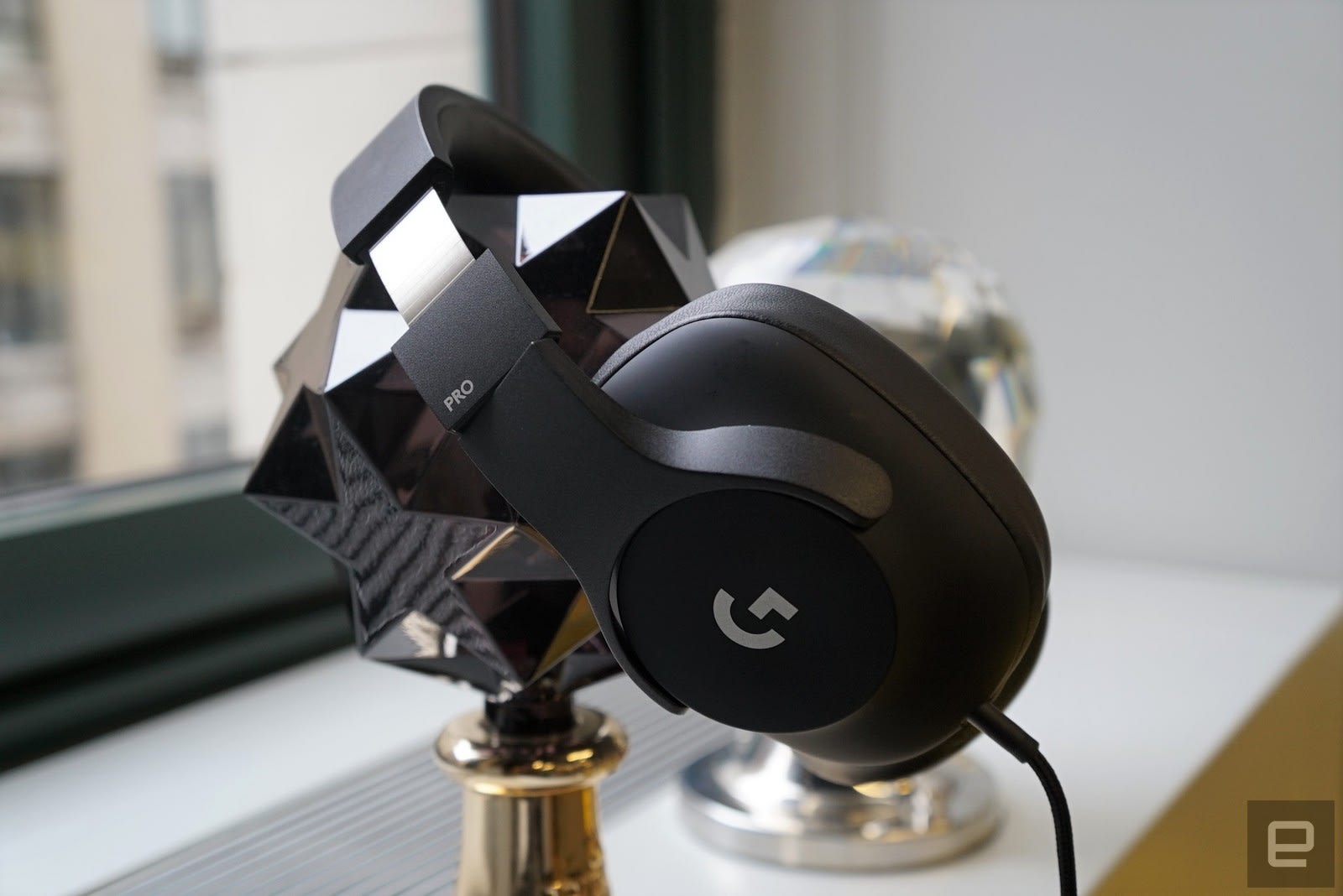
Logitech says it developed the G Pro based on feedback from eSports players, and it shows. In addition to the leatherette ear coverings, you’ve also got microsuede replacements in the box. While I missed the useful noise separation from Logitech’s surround sound headphones, the G Pro still sounded excellent. I could easily make out the careful footsteps of other players looting gear in Playerunknown’s Battlegrounds, or enemies creeping up behind me in Overwatch. I also found myself paying more attention to games than with Logitech’s previous headsets, thanks to the improved sound isolation.
At $90, the G Pro sits in the middle of Logitech’s gaming headphone lineup, but they’re a solid pick if you’re looking for a high-quality wired option. You’ll be able to snag one of your own in April.
Facebook sued for collecting call logs and text histories
After news broke that Facebook Messenger and Lite scraped call logs and text history from Android devices, the social network stressed that it didn’t do so in secret and with an ulterior motive. It got access to those data due to Android’s wonky permission system, and it only inadvertently collected info from users who agreed to give the app access to their contacts list. That explanation, however, wasn’t enough for the three users who filed a lawsuit against the social network, accusing it of violating their privacy by collecting their call and text history.
According to Reuters, the lawsuit filed in the Northern District of California federal court is seeking class action status on behalf of all affected users and is asking for unspecified damages. Of course, a judge still has to decide whether enough people were affected by the issue before the case can move forward as a class action. In Facebook’s explanation, it said it didn’t sell all the call and text data it got from Android phones and that it never had access to people’s texts. Whether the company’s assurance is good enough for most people or whether enough users will come forward to back the case remains to be seen.
Source: Reuters
Massachusetts halts five ICOs for defying financial rules
It’s not just the feds concerned about sketchy cryptocurrency fundraising. Massachusetts Secretary of the Commonwealth William Galvin has ordered a halt to the sale of five initial coin offerings (18 Moons, Across Platforms, Mattervest, Pink Ribbon and Sparkco) for offering “unregistered securities.” All five listed the state as their place of business, but hadn’t registered with the state to sell their wares. That should be a “red flag” to any potential investors, Galvin said.
The companies in question haven’t responded to requests for comment so far.
You might have seen this coming. SEC head Jay Clayton has been calling for cryptocurrencies to be regulated like regular securities, and it was likely that at least some state officials would agree. As it is, there’s little doubt that the ICO world is full of bandwagoners who either don’t understand much about financial regulation or are running scams. Moves like this can only do so much when there still aren’t many rules surrounding ICOs, but they might lead some companies to think twice before rushing in.
Source: Reuters
Alphabet’s X lab explores using AI to improve food production
Add Alphabet to the growing number of companies hoping that AI will solve food production problems. The Google parent brand’s X lab has revealed that it’s exploring ways machine learning could improve farming. While X hasn’t focused on any specific solutions, lab leader Astro Teller told MIT Technology Review that AI could be combined with drones and other robotics. It could help determine when to harvest crops, or adapt farms in areas where climate change makes forecasting difficult.
You shouldn’t expect any tangible results in the near future, although X has typically focused on projects where practical applications are at least on the horizon — think Project Loon.
Yes, this is yet another instance of a tech giant hoping that AI will cure the world’s ills, and there’s no certainty that X’s idealism will lead to meaningful solutions. With that said, agriculture is one of those categories where AI could be helpful, or even vital. Crop waste is a major issue (20 to 40 percent is lost every year to disease and pests, according to the UN), and even the more productive farms may struggle with low yields or poor quality. AI could not only reduce losses, but improve the volume and quantity. That, in turn, could reduce malnutrition and boost the quality of life for a large swath of the human population.
Source: MIT Technology Review
 AIVAnet