


Google joins forces with band OK Go to create classroom activities
Rock band OK Go is known for their complex, nerdy music videos. They danced in microgravity inside a parabolic plane in one, set a Rube Goldberg machine in motion in another and used the sounds they could create inside a car in yet another one. Since teachers love to use their videos as a teaching aid — say, to challenge students to identify the science behind them or to recreate the way they used various tools to make sounds — the band has decided to create teaching materials for K-12 educators.
OK Go brainstormed for ideas with Dr. AnnMarie Thomas, head of the Playful Learning Lab at the University of St. Thomas in Minnesota. After that, they teamed up with Google’s Science Journal team to “develop tools that allow students to explore the world around them through music.” The result is “OK Go Sandbox,” a collection of classroom activities, including ones challenging students to recreate the things the band did in their videos, along with the tools they can use to accomplish them.
For instance, Google’s Science Journal team created a a pitch detection feature for their app that makes it possible to create sounds with glasses of water, like what OK Go did in a couple of music videos. They also made another feature that plays data values as pitches, allowing students to compose songs by feeding data to the app. You can watch a couple of Sandbox videos below, but you can learn more about the project (either because you’re curious or you want to do the classroom activities even though you’ve been out of school for years) on its website.
Source: OK Go Sandbox, Google
A ‘Narcos’ video game is on the way for PC and consoles
A video game version of Pablo Escobar could grace your monitors, asking a poor guy whether he prefers “plata o plomo” (silver or lead), as soon as next year. Narcos producer Gaumont has forged a deal with British game publisher Curve Digital to develop a video game adaptation of the hit Netflix series. Curve’s sister company Kuju — some of its better-known titles include Art Academy and Marvel: Ultimate Alliance — will be doing the actual development, but it’s still unclear what kind of game the adaptation would be.
Kuju studio chief Brynley Gibson only said that his team is “looking forward to creating a game that matches the fantastic storyline and gritty action of the Netflix series.” Tim Stephen, Head of Legal and Business Affairs at Gaumont, also said that it trusts the developers to create a game that will thrill the series’ fans and allow “them to engage with the storylines and characters they have come to know over the past three seasons.”
The first two season of Narcos revolved around the infamous Colombian drug kingpin Pablo Escobar, his family, cohorts and massive cocaine empire. Season three’s focus shifted to Escobar’s rivals, the Cali Cartel, so you at least have an idea of which characters will be in the game. We’ll definitely know more about it before it drops: Curve and Kuju plan to release the game in 2019 for the PS4, Nintendo Switch, Xbox One and PC. If that release date’s too vague and far away, don’t worry: Narcos season 4, which will focus on Mexico’s Guadalajara cartel, might arrive on Netflix by the end of the year.
Source: IGN, Comicbook
Apple is holding an education-focused event on March 27th
Well, can’t say we saw this one coming. We were expecting Apple to take some time this month to talk about a sequel to its popular, low-cost iPad, and maybe even share some more information about its long-awaited wireless charging mat. Instead, Apple just sent out invites to an education-focused press event on March 27 where the company will discuss “creative new ideas for teachers and students” at a high school in Chicago.
The drastic change in locale is a clear signal that this event is far from Apple’s business as usual, but it would still make sense for Apple to talk about the future of its cheap iPads. Remember, inexpensive, easy-to-manage machines like Chromebooks have become widely used for schools looking to make sure classrooms are more connected and students are more digitally literate. This might be Apple’s next attempt at claiming a larger chunk of that market for itself, but for now, we’ll just have to wait 11 days and see for ourselves.
ThinkPad X1 Yoga review (2018): Flexibility comes at a cost
Lenovo’s ThinkPad X1 Carbon is the ideal business laptop. But it’s also strictly a traditional notebook. If you’re looking for something a bit more flexible, the X1 Yoga might be a better option. Just like Lenovo’s other Yoga machines, it has a hinge that lets you twist the screen a full 360 degrees, letting you use it as a giant tablet or in a tent formation. And of course, it also offers most of the features we loved on the X1 Carbon.
The two laptops look pretty similar — that is, until you put them side by side. They share the same sleek black carbon-fiber aesthetic and sturdy build quality, but the Yoga is noticeably larger. It’s also significantly heavier, weighing in at 3.1 pounds compared to the X1 Carbon’s 2.5 pounds. The Yoga is more of a throwback to ultraportables from a few years ago whereas the X1 Carbon looks and feels more modern.
And while both laptops feature 14-inch screens, the Yoga’s display has significantly larger bezels around the top and sides. You can choose from 1080p and 1440p options, and you can also opt for that higher resolution with Dolby Vision HDR. That feature will make black levels and bright highlights look better on supported videos from services like Netflix.
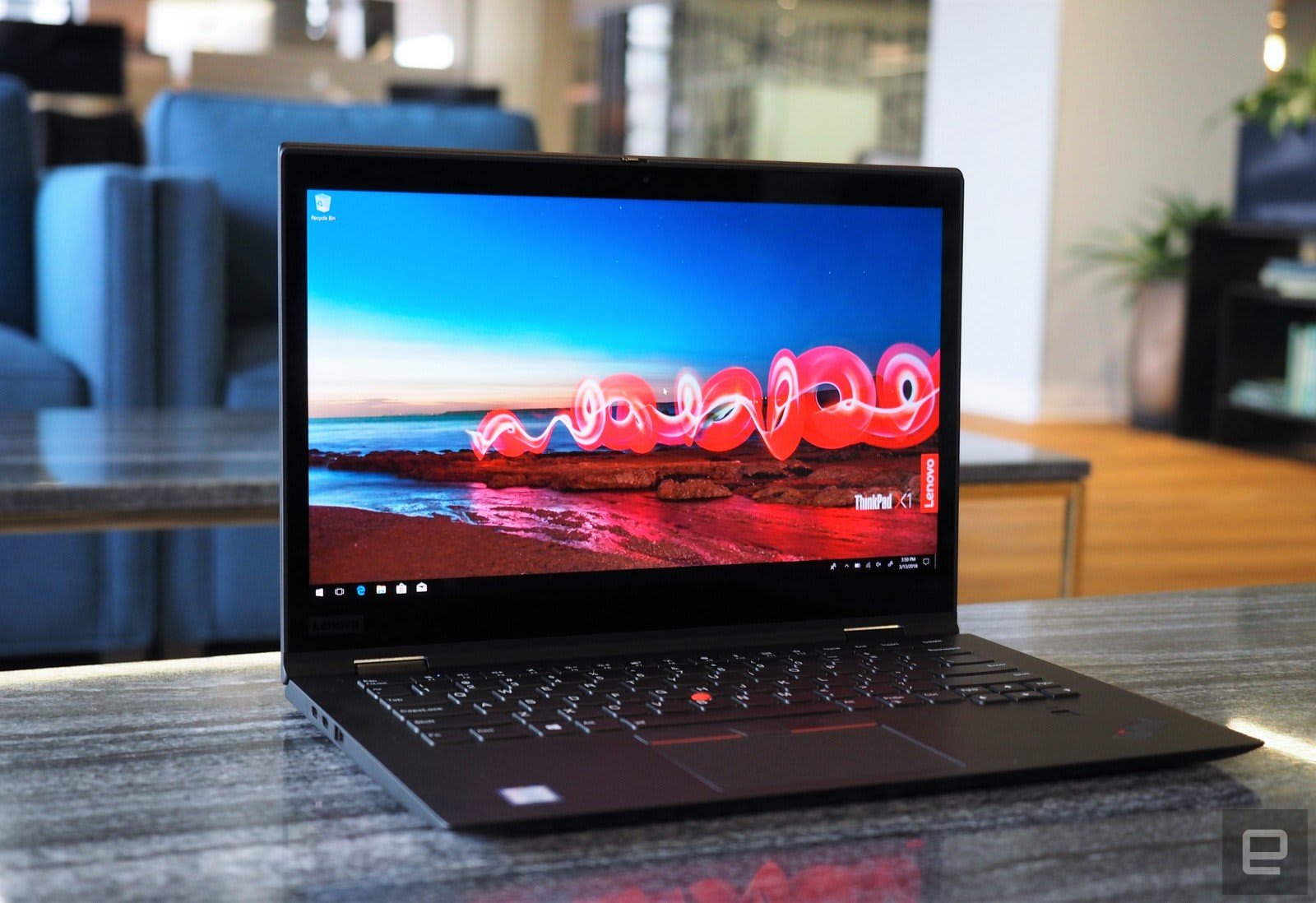
Another difference? The X1 Yoga’s Wave keyboard isn’t as deep as the Carbon’s, as it’s built to pull the keys into the case when you fold over the display. Still, it’s ultimately better than what you’ll find on most thin laptops. The keyboard feels on par with Dell’s XPS 13, and it’s far better than Apple’s flat MacBook keyboards. The trackpad is just as smooth and accurate as the Carbon’s, and ThinkPad purists will appreciate the return of the red TrackPoint nub.
As for other components, the X1 Yoga has a physical-privacy shutter to block its 720p webcam (which is far easier to switch than the Carbon’s). When it comes to ports, there are two USB-C Thunderbolt 3.0 sockets, two traditional USB 3.0 connections, a full-sized HDMI port, a headphone/mic jack and microSD and Micro SIM slots around the back.

Devindra Hardawar/Engadget
We’re keeping this review short because the X1 Yoga and Carbon are basically the same machine under the hood. They both feature eighth-generation Intel Core processors and UHD 620 graphics. They’re fast performers when it comes to most productivity tasks, but you won’t be using them to play many games. Mostly, we were interested in seeing if the convertible functionality of the Yoga made a huge difference. After several days of testing, the answer is a bit complicated.

Devindra Hardawar/Engadget
As you’d expect, the X1 Yoga is a much more flexible machine to use. When I wanted to focus on a long article or dive into digital comics, I appreciated being able to turn it into a huge tablet. Given its size, it’s not a machine I would use in that orientation for very long, but it’s still genuinely useful. And as is typical for 2-in-1s, the tent mode was helpful for watching Netflix in bed. It also made the Yoga a useful companion to my desktop setup; I was able to keep an eye on TweetDeck while diving into Overwatch matches. As for battery life, it was almost exactly the same as the Carbon, lasting 15 and a half hours in our video-looping test.
The X1 Yoga also comes with Lenovo’s ThinkPad Pen Pro stylus, which sits in a slot near the fingerprint reader. That makes it a particularly useful machine for anyone who’s grown used to jotting down notes or marking up images and presentations with Windows Ink. The stylus is very responsive on the X1 Yoga’s touchscreen, but it’s still a bit too thin to hold comfortably for long. There’s a reason Microsoft’s Surface Pen is as thick as a normal ballpoint: It simply feels better in your hands.

Devindra Hardawar/Engadget
The X1 Yoga’s size and weight are a trade-off compared to the X1 Carbon though. That machine practically disappeared in my bag as I walked around town, whereas I always noticed the Yoga’s extra heft. If you’re choosing between those machines, you’ll have to decide if the added flexibility is worth having a heavier machine. The X1 Yoga is also slightly more expensive than the Carbon, starting at $1,649 compared to $1,519. If you’re looking for something lighter and cheaper, Dell’s XPS 13 two-in-one is pretty compelling. Microsoft’s Surface Book 2, on the other hand, is a more powerful option that’ll cost you a bit more.
There’s no doubt that the X1 Carbon is the star of IBM’s ThinkPad lineup. But the Yoga still seems like a compelling option for people who want the reliability of the ThinkPad name but want to use their laptop in different ways.
A New York town just placed a moratorium on crypto mining
As cryptocurrency becomes a more important force in the world market, more companies are cropping up to mine it. And that, in turn, is becoming a problem for places where these miners are setting up. The town of Plattsburgh, New York, has become the first in the US to place a moratorium on cryptocurrency mining. It’s not an outright ban, at least not yet — it doesn’t affect miners currently operating in the city, just new ones looking to set up shop, and it’s only in place for 18 months.
Why Plattsburgh, New York? It’s simple: the small town has the “cheapest electricity in the world,” as Mayor Colin Read told Motherboard. Mining involves using high powered computers to solve complex problems, and thus be rewarded with cryptocurrency. It generates a lot of heat and uses an inordinate amount of electricity. It makes sense that these mining enterprises would look for places with inexpensive electricity. The problem is that it’s resulted in higher electric bills for everyone else in the town.
This doesn’t mean Plattsburgh is hostile to cryptocurrency miners, though. The town is interested in various proposals, including charging the miners for overages in the city’s power budget. The city currently has a budget of 104 megawatt-hours per month; if it exceeds that, Plattsburgh is forced to buy electricity on the open market. This is expensive, and the cost is distributed equally among the town’s residents. In the future, it could be covered by cryptocurrency miners.
Plattsburgh isn’t the only place that is facing problems with cryptocurrency miners. China is trying to ban the practice because of pollution, among other concerns. These processes are having a real impact on the environment and energy resources, and it’s important to figure out how to manage them effectively.
Via: Motherboard
Source: City of Plattsburgh
Apple to Host March 27 Event in Chicago: ‘Creative New Ideas for Teachers and Students’
Apple today invited the media to an event on Tuesday, March 27 at Lane Tech College Prep High School in Chicago. The keynote will commence at 10:00 a.m. Central Time and will be focused on “creative new ideas for teachers and students.”
Apple’s invite for March 27 event via The Verge’s Nilay Patel
Apple’s tagline suggests the event will be focused on education, and there are several rumored products in the pipeline that could fit within those plans. Here’s a recap of everything that could be announced at the March 27 event:
- 9.7-inch iPad for $259: Taiwanese websites DigiTimes and the Economic Daily News reported that Apple is considering releasing a cheaper 9.7-inch iPad for $259—perhaps this will be education pricing. The current 9.7-inch iPad was released in March 2017 for $329.
- MacBook Air for $799 to $899: KGI Securities analyst Ming-Chi Kuo said Apple will launch a more affordable MacBook Air in the second quarter of 2018. The estimated $799-$899 price range comes from WitsView researcher Yubin Qiu. The current MacBook Air starts at $999.
- AirPower charging mat: A trio of reports claim Apple will launch AirPower in March. The mat can inductively charge multiple Apple devices at once, including the iPhone 8, iPhone 8 Plus, iPhone X, and Apple Watch Series 3. It will also be able to charge AirPods placed in an optional charging case.
- iOS 11.3 availability with ClassKit and Classwork
- Wild card — a second-generation iPhone SE: Rumors have been swirling about an iPhone SE refresh, with speculated features ranging from a larger 4.2-inch display to an iPhone X-like design, but KGI Securities analyst Ming-Chi Kuo recently cast doubt on the device launching in the first half of 2018.
More details to follow…
Tag: Apple event
Discuss this article in our forums
Best Sleeves for Google Pixelbook

Need a great case or sleeve for your Google Pixelbook? We can help.
The Google Pixelbook is a very expensive Chromebook with an amazing display. That means you’ll definitely want to protect your investment by slipping it into some kind of case or sleeve. Here are the ones we like.
- Bellroy Sleeve for Google Pixelbook
- Google’s Pixelbook Sleeve
- Mama Mouth PU Leather Folio
- Kroo Neoprene Protective Sleeve
- Tomtoc UltraSlim Sleeve
- CAISON Laptop Sleeve Case
Bellroy Sleeve for Google Pixelbook

Bellroy’s Pixelbook sleeve is one of Google’s recommended choices, and it’s hard to argue that it’s not one of the best.
Made from water-resistant fabric with genuine leather accents, to keep your Pixelbook safe and look good while doing it the Bellroy sleeve is custom built for the Pixelbook.
There’s a loop for the Pixelbook Pen, and when your Pixelbook isn’t inside it you can use it as a tablet stand by pushing in the top flap. the Bellroy case is a tight fit at first because it’s designed to hold everything snugly, but like many other things, it gets better with a little age.
There’s also a three-year warranty in case something rips or tears, which is great to see on any laptop sleeve that costs over $80.
See at Google
Official Google Pixelbook Sleeve

Google’s “official” Pixelbook sleeve is $100. We need to mention that right up front because that’s a lot of money for a microfiber sleeve. But you have to admit it’s one of the nicest microfiber sleeves you’ll ever see.
What makes it great for the Pixelbook is the custom fit. On the surface, a Pixelbook is just a 12-inch laptop and will fit into most any sleeve or case made for a mid-sized laptop. But the Pixelbook is also incredibly slim and incredible square. This sleeve is form fit to hold it in place and even has room for the Pixelbook pen. If a microfiber sleeve can be worth $100, this one is it.
See at Google
Mama Mouth PU Leather Folio

The Mama Mouth PU Leather Folio case is another that’s specially designed for the Pixelbook and is a great way to keep things protected. It also comes in eight different patterns and colors.
Designed to protect from dust, dirt and bumps and bruises, this folio case is made of synthetic leather on the outside and plush microfiber on the inside. It’s easy to take off if you want to go into tablet mode and the back and bottom serve as a stable platform for viewing anything on the screen.
it’s also really affordable at a price under $20!
See at Amazon
Kroo Neoprene Protective Sleeve

The Kroo Neoprene Sleeve offers complete protection and is spill resistant.
It’s a generic 13″ laptop sleeve, but one sized right to fit the Pixelbook’s 3:2 display. Featuring a padded interior as well as an external pocket for things like the Pixelbook Pen, the nylon zippers will keep your Pixelbook safe and sound inside its own padded cell.
The Kroo neoprene case comes in six color combinations and costs about $15.
See at Amazon
Tomtoc UltraSlim Sleeve

The Tomtoc UltraSlim sleeve is designed to fit 13-inch MacBooks, Surface laptops, and the Pixelbook and has room for a second device like your phone or an Amazon Kindle.
The external felt is hardened and durable while the interior felt is soft and gentle, and genuine leather accents make this one quite the looker.
The magnetic flap keeps everything closed up until you need to get to your Pixelbook, and there’s a cutout on the side to top up the battery without removing it from the case.
The Tomotc UltraSlim Sleeve lives up to its name and will keep your Pixelbook safe. It costs about $20.
See at Amazon
CAISON Laptop Sleeve Case

If you’re looking for good basic protection without any frills or fuss, the CAISON Laptop Sleeve is perfect.
Made of water-resistant nylon, it’s also fully padded with a fleece interior and is designed to hold most any 13-inch laptop, including the Pixelbook. The zipper is also padded and there is a roomy external pocket to hold your phone or other small accessories.
The CAISON Laptop Sleeve comes in black, blue, grey or military green and costs about $15.
See at Amazon
Update March 2018: This post has been updated to make sure the best choices when it comes to a Pixelbook sleeve are here.
Chromebooks
- The best Chromebooks
- Should you buy a Chromebook?
- Google Play is coming to Chromebooks
- Acer Chromebook 14 review
- Join our Chromebook forums
Is your Galaxy Note 8 showing any signs of slow down?
Nothing to see here.
The Galaxy S9 may be the hottest new flagship around, but that doesn’t necessarily mean it’s the absolute best Samsung has to offer. The Galaxy Note 8 continues to be one of the most powerful Android phones you can buy, and even with it being a few months old and no longer being Samsung’s latest, current owners are still plenty happy with the phone.

Samsung devices have become infamous over the years for slowing down and showing signs of lag after a few months of regular use, and when you spend nearly $1000 on a smartphone, that’s not something you want to encounter.
A few Galaxy Note 8 owners recently got together to talk about whether or not they’ve experienced any slowness on the phone so far, and this is what they had to say.
Lepa79
03-15-2018 04:50 PM“
Got it on day one. Absolutely a work horse and smooth like butter. I reboot phone about every 2 weeks.
I also have Pixel 2 XL and it’s going on sale this weekend. Love Note 8 10x more.
Only phone replacing note 8 is note 9.
Reply
cwbcpa
03-15-2018 11:39 AM“
I have had zero issues with mine and I’ve had it almost 5 months. I use Nova, but only because I like to use a few of the options. I could be using stock Samsung experience and it would still fly. I typically don’t have issues with my phone’s lagging too much but the Note 8 has been absolutely amazing. It will be interesting to see what the Note 9 brings and if I think it’s actually worth the…
Reply
amyf27
03-15-2018 04:24 AM“
I’ve had mine since Sept and it’s been fantastic. I haven’t really noticed any slow downs. I’ve got a warranty replacement phone that I got a few months ago due to a freezing / error moisture code (wasn’t moist) . Overall though this and the original have been fantastic.
I went to try the s9 plus for a couple days and went back to my note 8.
Reply
Climb14er
03-15-2018 08:41 AM“
No slow down in speeds what-so-ever. Someone mentioned their S9+ 845 chipset is much faster than the Note 8 835 chipset. I said to myself… really? Frankly… I highly doubt it because the Note 8 flys across the screen with no hesitation or lag. It’s a very fast phone and stable too.
Reply
Now, we want to hear from you – If you’ve got a Galaxy Note 8, is the phone still just as fast as the first day you got it?
Join the conversation in the forums!
Samsung Galaxy Note 8
- Galaxy Note 8 review
- Galaxy Note 8 vs. Galaxy S8+
- Which Note 8 color is best?
- Complete Galaxy Note 8 specs
- Join our Galaxy Note 8 forums
Verizon
AT&T
T-Mobile
Sprint
Best Buy
Will my phone get Android P?

A new version of Android means it’s once again time to peer into my crystal ball.
Did you hear? Android P is a thing now. We have no idea what the P will stand for (no, it won’t be Peanut Butter and Jelly, unfortunately) and we have very little insight into the changes it will bring because we just got the very first developer pre-beta beta preview. One thing we do know though is that everyone will want it and want it as soon as possible. That’s how it works and that’s how we are wired. We want updates, we want them to be spectacular and we want them right now.
The reality of the situation is a bit different. Most phones made in the last 18 months will see Android P, but some of them will only get an update to P when we see the first developer preview for Android Q (Quince Jelly or gtfo, Google!) come along. It’s a lot easier for manufacturers to update their phones to a newer version, but it’s still not any better. That’s another article for another time, though. This one is where I guess which phones will get updated sometime in the next 12 months.
Predicting anything Android-related is 10% science and 90% interpretation.
It’s not as easy as you think and many sudsy cold beverages worth of thought goes into my guesses each and every year. About one-third of them are no-brainers, but some of the others are basically the same odds as a coin flip. It seems like manufacturers only care about a few models that get a lot of press time. But I do have to toot my own hat (or something) and say I have a pretty good track record. Luck or skill? You decide. (It’s totally skill.)
Let’s break it down by the major manufacturers of the phones we love and make a few predictions. Remeber, these are just predictions and not any official word on anything from any company. We’ll also circle back around once Android P is officially released and see how close I got.
Still waiting for Oreo? Check to see whether your phone will be upgraded!

I always start with Google because it’s easy and I’ll get it right every time. That’s what I want at the top of the page. I say it’s easy because Google has already told us which phones get updated and which won’t.
- The Pixel 2 and Pixel 2 XL will be updated to Android P.
- The Pixel and Pixel XL will be updated to Android P.
- While not actually from Google, any Android One phones manufactured since October 2017 will also be updated.
And that’s it. Prior to the Pixel, Google promised two years of full support and three years of security updates for phones they sell under their own brand. Come September or so when we expect to see Android P go gold, the Nexus 6P and Nexus 5X will be just about three years old.
More: It’s time to say goodbye to the Nexus program for good
Samsung

Samsung makes more models of a single flagship line like the Galaxy S each year than Google has made in total, but it’s also pretty easy to know which phones Samsung will update because they’re predictable. Samsung offers four “premium” models each year. like 2018’s Galaxy S9, Galaxy S9+, the Galaxy S9 Active that we all know is coming, and the Galaxy Note 9. Even when Samsung sold 15 different models of the Galaxy S6, they were all treated the same when it came to expecting an update.
When to expect it is just as predictable, and it will happen about a year from the date this was first published (March 2018). Some models in Europe will see it first, about a month later it will show up somewhere else, and once Samsung is satisfied it’s not going to totally wreck about a gazillion phones they will give it the green light. Add in whatever time your carrier needs and the final result is just about a year from its initial release.
- The Galaxy S9 and S9+ (and any S9 Active that comes in the future) will be updated to Android P.
- The Galaxy Note 9 will be updated to Android P.
- The Galaxy S8 and S8+, and the Galaxy S8 Active, will be updated to Android P.
- The Galaxy Note 8 will be updated to Android P.
Here’s where it gets interesting. there are a handful of other Galaxy phones that have a huge regional fanbase. In India, for example, the Galaxy J models are huge hits because they offer most of the same experience you find in a Galaxy S at a lower price. Samsung will give them the same treatment the Galaxy S and Note lines receive. That’s not the most interesting part, though.
There’s a chance Samsung will try to update the Galaxy S7 and S7 edge to Android P. Adding the third year of life to the Galaxy S line would be an important move in a world where only Apple supports more than the last two yearly remakes. And Apple is Samsung’s only competition is the mobile space so Samsung would love to erase the stigma of Android phones being disposable. I don’t know if Samsung will succeed and get Android P on a Galaxy S7, but I do know they will be trying. They almost have to.
LG

LG has always been a wild card when I write this post every year. Like Samsung, there are a few “important” models that get all the press coverage and plenty of other more inexpensive models that most of us aren’t talking about.
LG also mentioned some streamlining in the release cycle, which means the LG G8 won’t arrive before most people were able to buy a G6. Hopefully, it also gives the development teams time to get an update out the door and have it be a good update.
- The LG V30 (including the V30S or whatever models we have seen or will see) will be updated to Android P.
- The LG V20 will be updated to Android P.
- The LG G6 will see Android P.
Older models like the G5 and V10 are done seeing any attention and won’t see any updates. LG makes a handful of phones that aren’t quite flagship material, and we know it is willing to spend the time and money on updating some of them even if your carrier isn’t and you never see it.
I also think LG consolidating things and releasing phones when they think it’s time for a new model rather than by looking at a calendar will make a difference here and lead to longer support.
Huawei

Huawei is tough to read. It hasn’t abandoned the Asian way of doing smartphones like LG and Samsung have for their U.S. divisions and sometimes that means the things the company does can be puzzling to those of us used to the Western way of thinking. Just when I think I have figured out exactly which phones are the company’s flagship models that will get the lion’s share of time and money spent, they change it all up. That’s a good thing.
Something made Huawei change the way it redistributes and maintains phones running the EMUI operating system (Huawei’s version of Android) in 2017 and I think that’s going to be reflected when it comes to Android P updates.
- The Huawei P10 will be updated to Android P.
- The Huawei Mate 10 will be updated to Android P.
- The Honor 9 and Honor View 10 series will be updated to Android P. I’m hoping, but less confident about the Honor 7X.
- The Huawei Mate 9 will probably be updated to Android P, but we’ll see.
This includes the various Plus, Pro, and Porsche models (I want a Porsche phone) as well, and because EMUI is so different than every other smartphone software available users will have no idea which version of Android they are running unless they look.
Besides, if the things a handful of little birds are saying happen to be true, EMUI 9 isn’t going to be able to run on any hardware older than what comes in these phones.
Motorola

Motorola had a weird 2017. That’s putting it mildly. They released like 100 phones in the Americas and Western Europe (Editor’s note: it was actually 9) and they ranged from the surprisingly great $100 Moto E4 to the Moto X4, the first of hopefully many non-Google phones you can use on Project Fi, and all the Z and Force you can handle in between.. And they did it without compromising the G series which has been a company staple for years from the smartphone division.
Moto phones under Lenovo are slowly becoming like the Thinkpad — quietly chugging along in the background doing their thing. And doing it well.
So far in 2018, we’ve heard the company is going to release more phones than ever this year and that they were scaling back and had to lay off employees (in the same week, no less) so we’re not sure just what to expect. in the coming months. One thing I am pretty sure of is that every one of those 2017 phones, as well as any we see in 2018, will be updated to Android P.
That’s right, no bullet point list of the highlight models. Every Moto phone manufactured in 2017 or later will see Android P.
Lenovo has taken a lot of the fanfare surrounding Android version updates away and quietly builds them in the background. Maybe the update horrorshow that happened when the company first absorbed Moto branding made them decide the limelight is a better place to be. Or maybe when you build like 100 different models, an update day feels more like a Tuesday than something special.
Must mentions

These may be the companies we’re most familiar with in the west that sell Android phones, but they aren’t the only companies doing it. Out of the literally hundreds of models available, a few stand out and need mentioning.
- OnePlus will update the 5 and 5T.
- Sony’s high-end Xperia like the Zs and Xs from 2017 and 2018 will be updated, but other models probably won’t be.
- Essential will have learned from mistakes with Oreo and the EP1 will be fast-tracked for Android P.
- I’m not sure how changes in the company will affect HTC, but thinking all their phones as far back as the U11 and UBolt will see an update.
- The BlackBerry KEYone probably won’t be upgraded to Android P, but we like surprises!
- Now that Nokia has committed to Android One across all of its devices, there’s a good chance many of the more expensive models, like the Nokia 7 and Nokia 8 Sirocco, will be updated to Android P.
- Someone at XDA will update their Nexus One to Android P and I am going to do my best to get Google to send that person a brand new Pixel 3 NotchXL.
Like mentioned earlier, these are just educated guesses at this point. but one thing I know for certain is that no matter what the phone, any updates will feel like they took too long to make it into our hands. That’s just how we’re wired.
Android Oreo beta rolling out to Honor 7X with Project Treble support
Available in the U.S., India, France, Germany, Italy, and Spain.
The Honor 7X is one of the best choices around if you’re in the market for a smartphone under $200 USD, and today, it’s getting a big software update with the beginning of the Android Oreo / EMUI 8.0 beta.

If you signed up to join Honor’s Oreo beta earlier this month, you should receive a message any time now in Honor’s Friendly User Test app with details about how to download the first official version of the beta. Honor says that it’ll be “a staged rollout” and that all of its beta testers should be able to download and install it by the end of the week.
As with any Oreo update, some of the new features include picture-in-picture, Google’s Autofill API, more restrictions on what apps can do in the background, etc. Honor’s also included a couple of its own additions, such as better notifications and a floating dock for your Android navigation buttons.
For those still unimpressed with what’s included, it’s been confirmed that Honor is supporting Project Treble with Oreo on the 7X. This is Google’s new update process that’ll theoretically make it easier for OEMs to push new versions of Android to their phones, and while the effectiveness of Treble still remains to be seen, I know a lot of you will still be pleased to see it make an appearance here.
The Oreo / EMUI 8.0 beta is available for testers in the United States, France, India, Italy, Germany, and Spain, and Honor previously mentioned that this software would be ready for a public launch by Q2 of this year.
Android Oreo
- Android Oreo review!
- Everything new in Android Oreo
- How to get Android Oreo on your Pixel or Nexus
- Oreo will make you love notifications again
- Will my phone get Android Oreo?
- Join the Discussion
 AIVAnet