


Amazon’s Kindle Lite app offers the same great reading experience at a fraction of the size
The Kindle Lite app weighs just 2MB, and is designed to work on 2G connections in emerging markets.

Amazon launched Kindle Lite in beta at the end of last year, and the app is now formally making its debut in India. The app is tailored for entry-level phones with limited storage (such as Android Go devices), and takes up just 2MB and uses less resources than the full-fledged client.
Kindle Lite offers a similar set of features as the Kindle app, including the ability to sync your progress across devices with Whispersync, personalised recommendations, night mode, navigating through the table of contents, and changing font sizes. I’ve been using the app for a few weeks, and the experience is similar to that of the full-fledged app.
Amazon is also touting a feature where you can start reading the book before it finishes downloading. Personally, I haven’t run into any issues downloading ebooks (as they’re routinely under 5MB in size), but the feature is likely designed for those on 2G connections. From Kindle’s country manager for India Rajiv Mehta:
As part of our continued focus on India, we are always working to improve the reading experience for our customers. Apps constantly compete for space on a mobile phone and Kindle Lite solves this problem for our readers. Kindle Lite is less than 2MB and built to provide a great reading experience even on 2G/3G networks.
Kindle Lite also lets you purchase books from the Kindle store, and you’ll be able to read books in five regional languages — Hindi, Tamil, Marathi, Gujarati, and Malayalam — aside from English. To further incentivize the usage of Kindle Lite, Amazon is offering an 80% cashback to those picking up their first ebook from within the app, provided you pay using Amazon Pay.
Overall, Kindle Lite is a nifty app that works great on low-powered hardware. With Android Go devices starting to make their way into the market, it’s likely we’ll see more lightweight versions of popular apps.
Download Kindle Lite from the Play Store
Study: Most YouTube influencers still don’t disclose sponsored deals
It’s been almost a year since the FTC warned social media influencers that they should “clearly and conspicuously [disclose]” if they’re being paid for a post or video. But according to a new Princeton University research, most YouTube and Pinterest influencers still don’t add proper disclaimers to the content they produce. The researchers analyzed over 500,000 YouTube videos and over 2.1 million unique Pinterest pins from August to September 2017 for the study. They found that 3,472 videos and 18,237 pins in the bunch had affiliate links, but only 10 and seven percent, respectively, contained written disclosures.
Those that did have disclosures didn’t even follow the FTC’s guidelines, which recommend lengthier explanations than “hey, these are affiliate links.” The FTC wants influencers to be very clear in their wording: for instance, as Wired said, they can write “I make a small commission every time you purchase through these links.”
According to lead author Arunesh Mathur, his study doesn’t even represent all types of undisclosed affiliate partnerships, since they didn’t take coupon codes and other linkless deals into account. That said, the researchers also didn’t take into account any disclosure YouTubers mention in the video and those written in languages other than English. Mathur, however, is “fairly confident that only a tiny fraction of content creators disclose affiliate links at places other than the description.”
Advertising on social media without the proper disclosure has become a huge issue in recent years. Just take a look at celebrities’ accounts, and you’ll see them promoting products without saying whether they’re getting paid for the post. It’s not the advertisements themselves that are the problem, it’s that without the proper label, people won’t know whether influencers are simply recommending a product they like or if they’re getting paid to praise it.
Instagram, YouTube and Facebook have labels influencers can use to indicate sponsorship, but they’re a bit too subtle for the FTC. Things might change as more and more social media superstars pop up. Mathur and his team, for one, believe the answer lies in browsers: they plan to develop an extension that can automatically detect and highlight affiliate marketing campaigns.
Via: Wired
Source: Princeton University
Logitech’s G Pro headset is built for eSports
With the new G Pro headset, Logitech set out to make something that gamers could wear for hours on end, without getting fatigued. It’s a fairly straightforward pair of headphones: It only offers stereo sound (no fancy surround option), and it relies on an analog audio connections. Instead of the sports mesh headphone material found on Logitech’s other gaming headsets, though, the $90 G Pro sports soft leatherette. The company claims it offers 50 percent more sound isolation than before, but more importantly, the new material simply feels better. (The previous covering made my ears feel a bit itchy after a few Overwatch matches.)
The headphones feature Logitech’s Pro-G drivers with a slightly more aggressive sound profile than last year’s headsets. While I found the G433 and G533 to sound a bit flat, the G Pro accentuate bass, which makes plenty of gaming moments feel more satisfying. Some music fans prefer a neutral sound profile, but when it comes to games, that tends to sound dull. The G Pro comes with a removable microphone, which features noise-canceling and better sensitivity than past Logitech offerings. You’ll need a separate microphone jack to take advantage of that feature, which could be a problem for some gaming laptops.
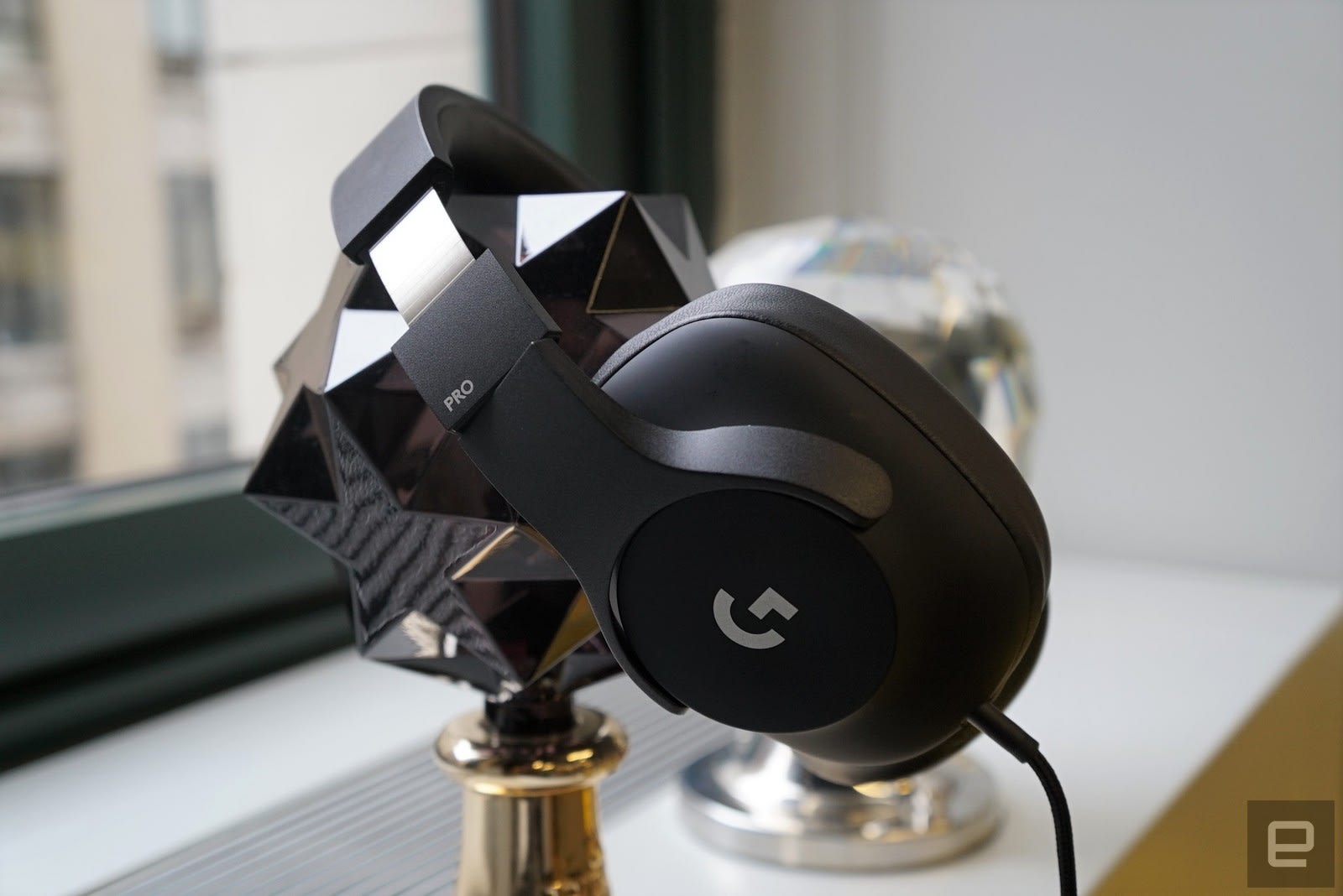
Logitech says it developed the G Pro based on feedback from eSports players, and it shows. In addition to the leatherette ear coverings, you’ve also got microsuede replacements in the box. While I missed the useful noise separation from Logitech’s surround sound headphones, the G Pro still sounded excellent. I could easily make out the careful footsteps of other players looting gear in Playerunknown’s Battlegrounds, or enemies creeping up behind me in Overwatch. I also found myself paying more attention to games than with Logitech’s previous headsets, thanks to the improved sound isolation.
At $90, the G Pro sits in the middle of Logitech’s gaming headphone lineup, but they’re a solid pick if you’re looking for a high-quality wired option. You’ll be able to snag one of your own in April.
Facebook sued for collecting call logs and text histories
After news broke that Facebook Messenger and Lite scraped call logs and text history from Android devices, the social network stressed that it didn’t do so in secret and with an ulterior motive. It got access to those data due to Android’s wonky permission system, and it only inadvertently collected info from users who agreed to give the app access to their contacts list. That explanation, however, wasn’t enough for the three users who filed a lawsuit against the social network, accusing it of violating their privacy by collecting their call and text history.
According to Reuters, the lawsuit filed in the Northern District of California federal court is seeking class action status on behalf of all affected users and is asking for unspecified damages. Of course, a judge still has to decide whether enough people were affected by the issue before the case can move forward as a class action. In Facebook’s explanation, it said it didn’t sell all the call and text data it got from Android phones and that it never had access to people’s texts. Whether the company’s assurance is good enough for most people or whether enough users will come forward to back the case remains to be seen.
Source: Reuters
Massachusetts halts five ICOs for defying financial rules
It’s not just the feds concerned about sketchy cryptocurrency fundraising. Massachusetts Secretary of the Commonwealth William Galvin has ordered a halt to the sale of five initial coin offerings (18 Moons, Across Platforms, Mattervest, Pink Ribbon and Sparkco) for offering “unregistered securities.” All five listed the state as their place of business, but hadn’t registered with the state to sell their wares. That should be a “red flag” to any potential investors, Galvin said.
The companies in question haven’t responded to requests for comment so far.
You might have seen this coming. SEC head Jay Clayton has been calling for cryptocurrencies to be regulated like regular securities, and it was likely that at least some state officials would agree. As it is, there’s little doubt that the ICO world is full of bandwagoners who either don’t understand much about financial regulation or are running scams. Moves like this can only do so much when there still aren’t many rules surrounding ICOs, but they might lead some companies to think twice before rushing in.
Source: Reuters
Alphabet’s X lab explores using AI to improve food production
Add Alphabet to the growing number of companies hoping that AI will solve food production problems. The Google parent brand’s X lab has revealed that it’s exploring ways machine learning could improve farming. While X hasn’t focused on any specific solutions, lab leader Astro Teller told MIT Technology Review that AI could be combined with drones and other robotics. It could help determine when to harvest crops, or adapt farms in areas where climate change makes forecasting difficult.
You shouldn’t expect any tangible results in the near future, although X has typically focused on projects where practical applications are at least on the horizon — think Project Loon.
Yes, this is yet another instance of a tech giant hoping that AI will cure the world’s ills, and there’s no certainty that X’s idealism will lead to meaningful solutions. With that said, agriculture is one of those categories where AI could be helpful, or even vital. Crop waste is a major issue (20 to 40 percent is lost every year to disease and pests, according to the UN), and even the more productive farms may struggle with low yields or poor quality. AI could not only reduce losses, but improve the volume and quantity. That, in turn, could reduce malnutrition and boost the quality of life for a large swath of the human population.
Source: MIT Technology Review
Facebook reportedly pauses smart speaker plans for obvious reasons
Even though it seems like everyone is selling some sort of smart speaker, Bloomberg reports that Facebook will not be the next company joining in and has scuttled plans for a reveal at its F8 developer event. Despite earlier rumors of a device that would compete with the likes of Echo, Home, and HomePod, it seems that the company has considered its current privacy debacle and decided this isn’t the right time to try and sell customers (and, likely regulators) on an always-listening assistant/video chat device with built-in facial recognition.
Of course, the market hasn’t exactly been receptive to Facebook’s previous hardware efforts either — remember the HTC First with Facebook Home? — so the potential of anything beyond Oculus Go remains hazy. Consensual or not, there are already rumors-that-won’t die about Facebook and Instagram listening in on your conversations, and we’d expect some solid answers on privacy before there’s any movement in that direction.
Source: Bloomberg
Amazon may spend $1 billion to adapt hit Chinese sci-fi novels
Amazon’s bid to create worldwide blockbuster shows may extend well beyond very familiar Western stories like Lord of the Rings. Investors speaking to the Financial Times claimed that Amazon is in talks that would let it spend up to $1 billion for the rights to Liu Cixin’s massively successful sci-fi novel trilogy Remembrance of Earth’s Past, also known as The Three-Body Problem. The internet giant is reportedly hoping to acquire rights from Chinese game developer Youzu Interactive’s Lin Qi and turn it into a three-season Prime Video series.
Whether or not Amazon does get the rights is in the air. YooZoo Pictures (part of Youzu) told Caixin and other media outlets that it had sole rights, and that its partnership with Liu Cixin was “ongoing.” The author himself, meanwhile, explained to Mtime that he hadn’t been aware of Amazon’s reported bid, and wasn’t sure if he would be involved. These don’t completely rule out an Amazon adaptation (companies tend not to acknowledge deals unless they’re completed), but it’s worth taking the rumor with a grain of salt.
A deal like this wouldn’t be out of line for Amazon. The company has been pushing for shows that could be international hits, and it wouldn’t get much bigger than one of the most popular sci-fi trilogies in Chinese history. The production would have a strong allure in its home market (where a movie adaptation has been stuck in purgatory), and might expose the story to a much wider audience.
It’s not as if Amazon has been reluctant to spend gobs of cash, either. Reports had Amazon paying $1 billion for Lord of the Rings, so shelling out that much for three seasons of a probable hit isn’t that much of a stretch. Whatever Amazon would spend up front might be more than worthwhile if it gave the company the sort of must-watch show that could give it an edge over Netflix.
Via: io9
Source: Financial Times, Mtime (translated), Caixin
Apple needs more than apps to win over educators
Earlier today, Apple announced a brand new iPad. It’s has a 9.7-inch screen, an 8-megapixel rear camera, 10 hours of battery life, a front-facing FaceTime HD cam, an upgraded A10 Fusion chip plus support for Apple’s Pencil. But the main talking point of today’s iPad unveiling is the fact that it was done in a high school, in an education-themed event that was clearly focused on the classroom. The pitch: Schools should invest in iPads.
At $299 (and $50 to $99 more if you want to get a compatible stylus), schools might not have the budget to get both a tablet and a traditional laptop for students. With the financial constraints of most public schools, they probably have to pick one of the two. And while Apple’s case for the iPad as an educational tool is a strong one, laptops remain a more sensible option for most students. Which begs the question: Why hasn’t Apple made a low-cost Macbook for education instead?
Apple is likely making a push into schools in an attempt to recapture some of its glory days in the education sector. Apple famously made a deal in 1978 with the Minnesota Education Computing Consortium (MECC) to supply 500 computers to schools, and by 1982, MECC was the largest seller of Apple computers in the country. Steve Jobs told Computerworld in a 1985 interview that “one of the things that built the Apple II was schools buying Apple IIs.”
It used to be that Apple computers were commonplace in learning institutions, with Macintoshes and eMacs present in schools and universities across the country throughout the 1980s and early 2000s. Much of that was due to efforts such as large-scale computer donations, deals with top colleges, and making eMacs (and other models) a little less capable and more affordable, than the rest of Apple’s consumer lineup.

In the mid-2000s, Apple did make a low-cost Macbook for schools… sort of. It was the basic polycarbonate Macbook, and while it was initially intended for consumer audiences, it was still marketed and sold in schools as a low-cost alternative. When they were taken off the retail shelf in 2011, Apple still sold them exclusively to educational institutions for around $900 per machine.
In recent years, however, things have changed. According to a recent survey by FutureSource Consulting, Apple has fallen to a distant third behind Google Chromebooks and Windows PCs in the education market. That’s because Chromebooks and PCs are more affordable. In an effort to make its products sleeker and faster, Apple’s done away with most of its entry-level products. The cheapest Macbook right now, for example, is $1,300, which is definitely not a budget laptop by any stretch of the imagination.
So why can’t Apple make a cheap laptop? “Theoretically Apple could do this, although the first step they would have to take is to reduce their profit margin,” said analyst Rhoda Alexander from IHS Markit. “However, that profit margin is a key component of Apple’s success, allowing Apple to constantly reinvest in the brand, driving innovation and R&D across hardware, software and content development.”

Apple could also make cheaper laptops with plastic cases and cheaper CPUs, but making mass quantities of cheap hardware doesn’t seem to be part of Apple’s current strategy. “There are other compromises they could make at the design and component level to reduce their cost, if their end goal was to drive unit volume,” continued Alexander, stating that Apple likely wants to maintain a “premiere standard across the entire brand line.”
Which seems to be why Apple seems to be so keen on iPads as part of its education strategy. Not only are the tablets portable, lightweight and easy to use, they’re also part of Apple’s “post-PC” narrative, where most tasks only need a touchscreen and an accessory or two.
In a way, it makes sense. When Engadget tried replacing a laptop with an iPad Pro for a week, we found it to be surprisingly effective, letting us do most tasks with ease. No, it didn’t quite replace a laptop for us — batch-resize images was a struggle, for example — but it was close. And for kids, that might be good enough.
The fact that so many parents already use iPads with their kids should not be underestimated. After all, this is a device that many children are already familiar with, and moving from what you have at home and bringing the experience to school makes sense. While laptops and keyboards are what we as adults are familiar with, children who grow up with hand-me-down tablets will be more adept with touchscreens. Combined with just how many educational apps there are available on the iPad, it’s no surprise that Apple sees the iPad as key to getting back into classrooms.

Yet, the cost is a barrier. Given the choice between a $300 iPad and Chromebooks that start at $150, it’ll be hard for schools to pick the former over the latter. Sure, one has sleek and powerful apps, but the other has a keyboard, with all the important functionality, for a cheaper price.
Apple could make a student-only iPad or Macbook just for the educational market, perhaps constructed out of a durable polycarbonate. As long as there was enough performance and power to properly run any and all educational apps as well as Apple’s own productivity tools without hiccups. It might not be as shiny and glossy as the iPad announced today or the current Macbook line, but it wouldn’t need to be.
But the reality is, we probably won’t see anything like that anytime soon. At the end of the day, Apple has stuck to its guns as a purveyor of high-end electronics. It would be very unlike Apple to suddenly produce cheaper, budget versions of its hardware just to keep up with its rivals (the iPhone 5c didn’t last long, remember). Which is unfortunate, because that might be what it needs to do in order to convince more schools to switch to iPad.
Catch up on all of the news from Apple’s education event right here!
This amazing robot intestine barfs out perfectly mixed rocket fuel
It’s not every day that the prospect of space exploration makes us feel a little bit nauseous. But that’s certainly the case with a new excreting robot designed to mimic the function of the human intestines. It was created by researchers from the Japan Aerospace Exploration Agency and Japan’s Chuo University.
While it kind of looks like something that might appear on the robot version of Jackass, in fact it’s a tool intended to replicate the involuntary wavelike contractions of the digestive tract for the purpose of properly mixing rocket fuel. The idea is that turning the solid rocket fuel manufacturing process into a continuous pumping process is more efficient and safer than producing it in batches.
The gooey mixture that’s squeezed out of the robo-intestine (which sort of resembles the white android blood in the Alien movies) is a combination of ammonium perchlorate powder, aluminum powder, and an elastomer binder that’s composed of hydroxyl-terminated polybutadiene (HTPB). For those keeping track at home, those are the ingredients in rocket fuel. The tube-like system is closed off at both ends, and the materials is added in the middle, alongside pressurized air. As the tubing contracts and expands, the mixing process is carried out, with the end result being the expelling of rocket fuel. After it is expelled in this form, the gooey rocket fuel can then be cured to turn it into a rubbery solid.
A paper describing the innovative concept was previously published under the title The Continuous Mixing Process of Composite Solid Propellant Slurry by an Artificial Muscle Actuator. For safety purposes, the material manufactured in the above demonstration was a simulated propellant. However, the researchers behind the project have had a go at mixing real propellant to make sure that their proof of concept experiment works. They even took the liberty of firing off a bench-top rocket to prove the system’s efficacy.
So, a gross-looking bio-inspired robot that craps or vomits out real working rocket fuel? There is literally nothing about that concept that we don’t love. Now we just have to cross our fingers and hope that one of the groups leading today’s next-gen space race incorporates this into their setup.
Editors’ Recommendations
- Spirit animals: 9 revolutionary robots inspired by real-world creatures
- 14 major milestones along the brief history of 3D printing
- SpaceX nailed the Falcon Heavy launch, but didn’t quite stick the landing
- Icon and New Story are pairing cheap 3D-printed homes with people in need
- This tiny, self-folding robot could one day be part of a large ant-like swarm
 AIVAnet