


Xiaomi’s Mi Mix 2S is a more powerful take on an already beautiful phone
By now, you probably know exactly what to expect from a smartphone sequel with an S in its name: it’ll be faster than its predecessor but its design won’t change very much. That’s not necessarily a bad thing for Xiaomi’s newly announced Mi Mix 2S, though. Even if it isn’t dramatically different from last year’s Mi Mix 2, it still blends excellent performance with sleek ceramic body and impeccable attention to detail. It’s just too bad it’ll remain a China exclusive for a while.
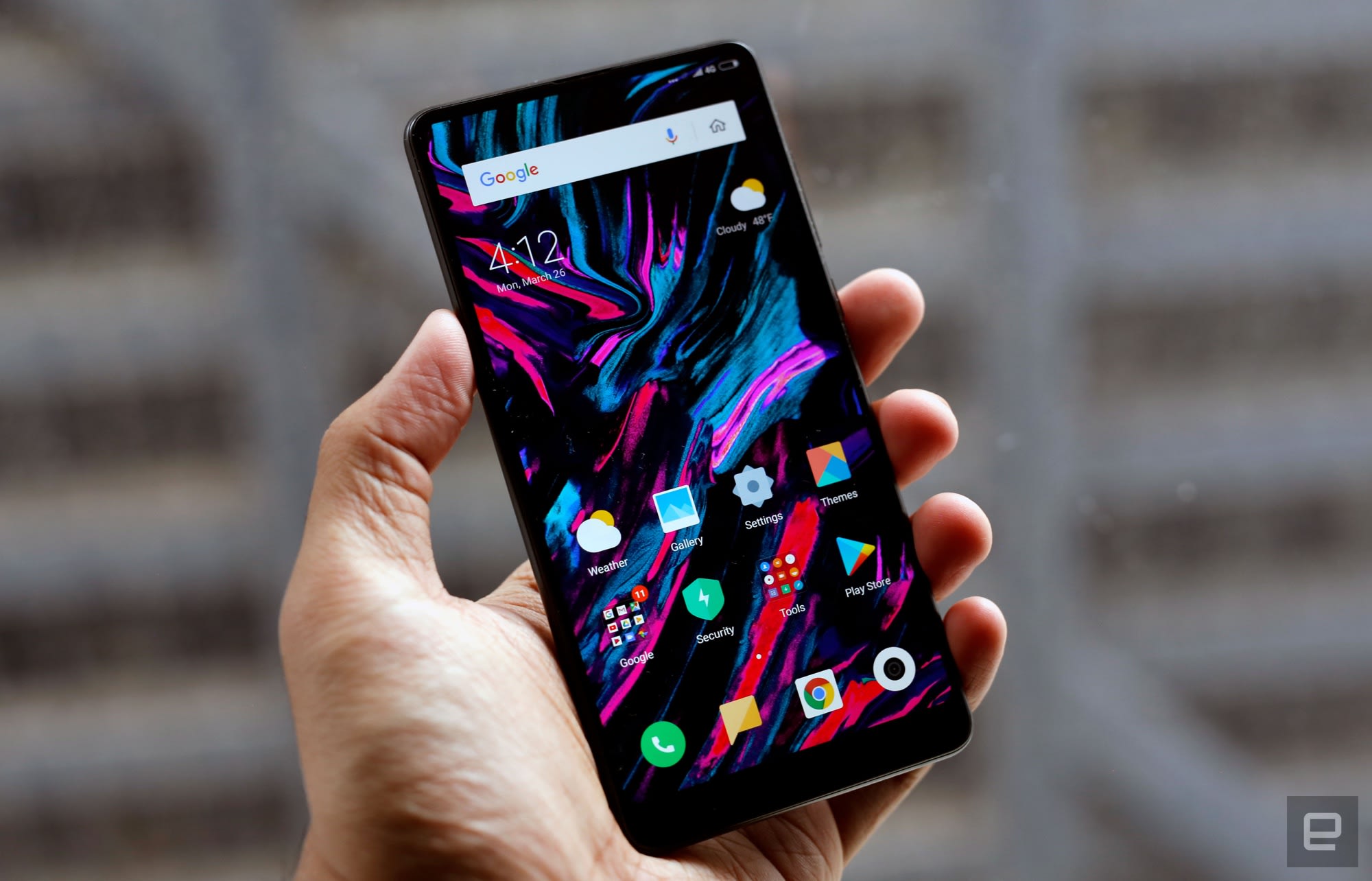
My photos probably aren’t doing this phone justice — the Mi Mix 2S is a fabulous-looking device. A quick recap: like the phone that came before it, the Mi Mix 2S has a slightly curved ceramic back flanked by a metal frame to add durability. (In case you hadn’t heard, it was pretty easy to foul something up on the original, all-ceramic Mi Mix.) If that’s not enough ceramic for you, there are also black and white premium editions that use that hard-to-process material to form the entire back shell. A fingerprint sensor sits midway down the phone’s back, and while Xiaomi traded theMi Mix 2’s single camera for a dual setup, there’s still a dash of gold trim around the housing.
The phone’s hyper-slick body does present some issues, though. For one, it doesn’t take more than a few minutes to mar the glossy jade-like finish with greasy fingerprints. And because of the Mi Mix’s smooth rounded back, it tends to slide around desks (and in my case, out of pockets) more easily than I’d like. But none of these really feel like dealbreakers to me.
The phone’s main draw remains the near-bezel-less screen. Xiaomi kept the same 5.99-inch IPS LCD screen from last year and it’s plenty bright, even if it lacks the visual punchiness of AMOLED screens. In a likely concession to cost, the screen only runs at Full HD+, which in Xiaomi’s case works out to 2160×1080. The edge of the Mi Mix 2S’s screen stretches right up to the top and side edges with no notch in sight too, a pleasant change compared to the iPhone X-esque designs we’ve seen several Android phone makers embrace recently. That expansive look is only possible because of a love-it-or-hate-it choice, though: the front-facing camera is nestled into a corner below the screen, which makes for pretty lousy selfies unless you take the phone’s advice and flip it upside down.
Chris Velazco/Engadget
Such quirks are easier to overlook in light of how powerful this device is. It’s one of the few phones we’ve tested this year with a Qualcomm Snapdragon 845 chipset, and it breezed through every task I threw at it. The rare hiccups that did pop up all seemed like pre-production issues with some of the MIUI 9 features Xiaomi layered on top of Android Oreo. Overall though, the Mi Mix 2S left with me few complaints on the performance front — it certainly doesn’t hurt that our test model sits at the top of the range with 8GB of RAM.
That premium version also comes with 256GB of storage and support for 43 global radio bands, so it’ll hop onto just about every wireless network in the world. At time of writing Xiaomi hasn’t confirmed how this model actually costs; ditto for the lower-spec models with 6GB of RAM and either 64 or 128GB of storage. No matter which version you splurge on, you’ll at least get Qi wireless charging — a first for the Mix line.
There’s another first for the Mi Mixes here, too: a dual camera. There are two 12-megapixel cameras around back — one wide angle and one telephoto — and Xiaomi’s decision to use Sony’s IMX363 sensor with an f/1.8 aperture and 1.4-micron pixels as the primary camera means the Mi Mix 2S does surprisingly well in low-light. And like almost every flagship smartphone we’ve seen in 2018 so far, Xiaomi tried to imbue the Mi Mix 2S’s camera with some level of artificial intelligence. In theory, you can point the 2S at a landscape or a person’s face and the phone will tune the resulting image appropriately. In fact, the 2S is supposed to be especially good at beautifying faces: engineers “taught” the camera to divide faces into separate areas that get processed and tweaked differently. In theory, anyway.

Chris Velazco/Engadget
The reason I’m couching all of this is because the early software on our test unit didn’t have all of these new camera features enabled. Retail-ready units — like the ones going on sale in China shortly — will be feature-complete. As such, I can’t really comment on the quality of the sample photos I’ve taken over the last few days either. We’ll revisit this phone and its camera if and when it gets some final software updates.
It’s only been a few days, but I’ve grown surprisingly fond of the Mi Mix 2S, quirks and all. The phone will launch first in its native China, but Xiaomi spokespeople have confirmed that it’ll eventually go on sale in some of the company’s international markets, too. If I were you, I wouldn’t hold my breath for a US release, though.
Sure, Xiaomi CEO Lei Jun has been candid about his desire to sell his company’s phones in the United States, either by the end of the year or early 2019. As a flagship device, though, the Mi Mix 2S might not be the best choice to bring to the US because of the serious competition it would face from the industry’s incumbents. The US is a notoriously tough market to crack, too — just look at Huawei’s long, strange journey. None of this means the 2S will never come to the States — it’s just that there probably more lucrative slices of the market to focus on first. Cheap, powerful mid-range phones, maybe. Xiaomi has no shortage of those, after all.
As always, I’d love to be proven wrong. Based off what I’ve experienced with the 2S so far, I really hope I am.
Watch Xiaomi unveil the Mi Mix 2S right here!
Xiaomi is all set to unveil the Mi Mix 2S in China, and you can follow all the action from the livestream.

Xiaomi is set to unveil the Mi Mix 2S in Shanghai, China. The phone is powered by the Snapdragon 845, and Xiaomi is touting AI capabilities for the camera. The latest leaks have hinted at a model with 256GB of storage, and Oreo out of the box, along with a new design that sees a cutout at the top for the front camera module.
If you’re interested in seeing all the action live, you can tune in to the livestream from right here. The event is being broadcast live from Shanghai, China, and there’s an English transliteration as well.
What are you looking forward to seeing from the Mi Mix 2S? Share your thoughts in the comments below.
Xiaomi’s Mi Gaming Laptop packs NVIDIA GTX 1060 graphics
Xiaomi already offers laptops (the Mi Notebook Pro and Mi Notebook Air), but it’s now getting into PC gaming with a new model for the Chinese market. The literally-named Mi Gaming Laptop offers decent performance for the price, with a 15.6-inch wide-gamut color screen, NVIDIA GeForce GTX 1060 GPU, 7th-gen Intel Core i7 CPU and gaming keyboard, all for RMB 8,999 (around $1,440). Xiaomi didn’t specify the size, but given the narrow screen bezels and brushed aluminum chassis, it should be compact and light for a 15.6-inch laptop.
Other specs include 16GB of RAM, a 256GB NVMe SSD, and a 1TB hard disk. If the price is too steep for the high-end model, Xiaomi is also offering a variant with NVIDIA GTX 1050 Ti graphics, 8GB of RAM and a 128GB/1TB SSD/HDD. The keyboard lights up with 16 million colors, and you get four USB 3.0 ports, two USB-C ports, HDMI and an audio jack.

Xiaomi also unveiled the Mi AI Speaker mini, a new version of the Amazon Echo- or Google Assistant-like smart speaker that it unveiled last year. As before, it’s powered by Mi’s in-house AI, letting you stream music, get the weather, program your calendar, and do other personal assistant-type chores. However, the new model is more compact, and cheaper, with a price of just RMB 169 ($27) instead of $45.
Xiaomi unveiled the devices at its Mi Mix 2S event, where it also launched a high-end smartphone of that name. There’s no word on whether the laptop or smart speaker will arrive outside of China (that seems unlikely), but the phone itself is coming to global markets later this year.
Source: Xiaomi
Xiaomi’s first-gen Mi Robot vacuum is once again down to $315

Xiaomi’s Mi Robot picks up an attractive discount, along with other products in the lifestyle range.
Gearbest is hosting its fourth anniversary sale, and the retailer is offering enticing discounts on a lot of Xiaomi’s Mi Ecosystem products. The Mi Robot is up for grabs for just $315, with the second-generation model available for $499. The second-gen variant comes with a more powerful motor and has a wet clean option built in, making it a decent upgrade over the Mi Robot.
The standout feature with the Mi Robot vacuum cleaner is the ability to pair it to the Mi Home app, which lets you access the vacuum’s controls, including the option to set schedules, view the robot’s movements in real-time, and so much more.
See at Gearbest
Xiaomi’s Amazfit Smartwatch 2 is also on sale for $198 with coupon code AMA2HK. The smartwatch is made by ecosystem partner Huami, and offers a range of features that include activity tracking, heart rate monitor, sleep tracking, built-in GPS, and call and notification alerts.
The smartwatch usually retails for $275, but you can pick it up for $198 during the anniversary sale by keying in AMA2HK at checkout.
See at Gearbest
Looking for more deals? Hit up Gearbest from the link below for all the discounts live on the platform.
See at Gearbest
Netflix renews ‘Queer Eye’ and four other unscripted shows
Netflix won’t leave you longing for more Queer Eye make-betters forever, because the Fab Five is returning for a second season. The streaming giant has renewed the critically acclaimed reboot, along with four other unscripted shows: Dope, Drug Lords, Nailed It! and The Toys That Made Us. Out of the five, only Dope, which is a docu-series that features dealers, users and cops, has a Season 2 premiere date set on April 20th, but at least you now know if your fave show has more episodes on the way.
Bela Bajaria, VP of content at Netflix, said:
“These series are indicative of what we’re trying to accomplish for Netflix unscripted: working with world-class producers to create the best unscripted shows on television. These series elevate the genre with innovative takes on familiar formats. They deliver immersive and nuanced stories. They elicit so many emotions from viewers, from tears of laughter to tears of joy — and that’s just Queer Eye.”
Queer Eye sets itself apart from the original series by venturing outside of New York and into Red State America, blessing straight men and their houses with makeovers. Drug Lords tackles the biographies of the most notorious drug kingpins, while The Toys That Made Us is a documentary on the most prominent and recognizable toy lines. Finally, Nailed It! is a baking show for home bakers who tend to mangle their creations as they compete for a $10,000 cash prize.
Source: Variety
Twitch app for PS4 gets a much-needed interface makeover
It’d be an understatement to say the Twitch app for PS4 needed some tweaking. Apart from looking more than a little like the Xbox One version, it just wasn’t great for quickly hopping into a favorite channel or seeing what’s popular among your favorite games. No more: a new version of the Twitch app gives it an overhauled interface that makes it easier to see who’s live, browse followed games and explore completed videos from individual channels.
The refresh also puts search and settings more conspicuously within view, and is more consistent with the desktop experience when you’re watching a channel and chatting with fellow viewers. Simply speaking, it looks more like an actual live service à la PlayStation Vue (really, how it should be) than yet another video-on-demand offering.
The PS4 Twitch app gets a big update today, featuring improved content discoverability and a redesigned UI. Start watching now: https://t.co/KV9piepSsc pic.twitter.com/QZV1rPiY5K
— PlayStation (@PlayStation) March 26, 2018
Via: PlayStation (Twitter)
Source: PlayStation Store
‘Fortnite’ hot streak grows with a record-breaking YouTube stream
Fortnite’s Battle Royale mode continues to be a cultural phenomenon, and YouTube just provided some stats to back that up. To begin with, the company’s Ryan Wyatt has revealed that a Battle Royale event set a record for the largest single live game stream, with 1.1 million simultaneous viewers watching ElrubiusOMG in action. Drake and Ninja have some catching up to do. That same event racked up 42 million unique views across the 100 creators involved.
YouTube told Engadget that Fortnite broke a handful of other not-quite-so-impressive records. As of February, it holds the record for the most monthly video uploads related to a game. It was also the second most-viewed game on YouTube (it’s not clear what number 1 may be).
It’s no secret as to why YouTube might bring out these stats. They illustrate the sheer influence of Fortnite, but they also serve as a shot across Twitch’s bow. YouTube hasn’t been shy about wanting to take on its Amazon-owned rival in game streaming, and this demonstrates that it can compete — at least, in the right circumstances.
How big is @FortniteGame on YouTube? Fortnite holds the record for the most videos related to a video game uploaded in a single month EVER. Yesterday, the Battle Royale tournament had over 42M live views, and set a record for biggest single live gaming stream @ 1.1M concurrent.
— Ryan Wyatt (@Fwiz) March 26, 2018
Source: Ryan Wyatt (Twitter)
500,000 people downloaded QR code apps with embedded malware from Google Play
Android malware seems to be everywhere. Every few weeks, we hear of a new set of apps on the Google Play Store that have some kind of malware embedded in them, and this time around it seems like a series of QR code readers may be targeting unknowing users.
The news comes in a report from SophosLabs, and it notes that as many as seven QR code readers on the Google Play Store may have been infected with malware. In addition to the QR code apps, one smart compass may have also been infected.
The malware itself is called Andr/HiddnAd-AJ, and as the name suggests, it basically plays ads on your phone — after lying low for a while to “lull you into a false sense of security.” The malware waits six hours before it springs into action and starts serving up full-screen ads and opening ads on webpages. The malware also sends users notifications with links to ads.
According to Sophos, the malicious apps were downloaded as many as 500,000 times before Google removed them from the Google Play Store, and they were able to make it through Google’s scanning by essentially hiding the hostile code in what looked to be regular Android app code. At least on the surface, the apps did what they advertised they could do. The QR code readers could still read QR codes, and if you downloaded the apps for one use, only to delete them afterwards, you likely never would have run into the ads that the apps serve up. That, plus the fact that the malicious code didn’t kick into gear until 6 hours after installation, helped the apps avoid detection.
Of course, it’s likely the incident will help Google refine its malware scanning process — so it’s entirely possible that we won’t see apps similar to this again. It’s also still recommended that you continue using Google Play, if possible. While incidents like this do happen every now and again, the fact is that downloading apps from Google is far safer than downloading them from third-party marketplaces.
“Many off-market Android app repositories have no checks at all – they’re open to anyone, which can be handy if you’re looking for unusual or highly specialized apps that wouldn’t make it onto Google Play (or trying to publish unconventional content),” said Sophos in its blog post.
Editors’ Recommendations
- How to remove Android malware from your phone or tablet
- Report shows Machine learning is helping make Google Play a whole lot safer
- Google Play sees 19 billion apps downloaded in previous quarter
- Got time to kill? Do it on the go with the best Reddit apps for Android and iOS
- The best Android Wear apps
Arizona governor suspends Uber’s self-driving car tests
As the investigation into last week’s fatal crash where an autonomous Uber SUV struck and killed a pedestrian in Tempe, AZ, the state’s governor has suspended Uber’s permission to test its cars there. While the company had already halted testing nationwide after the test, this is a turnaround after Gov. Doug Ducey (R) had welcomed self-driving testing from many companies with open arms in a relationship that stretches back a few years. Just a few weeks ago Ducey updated his autonomous vehicle executive order to allow testing without a safety driver.
In this crash, there was a test driver behind the wheel, but neither they nor the car reacted in time to avoid a woman who crossed in front of the car. In a letter to Uber, the Wall Street Journal reports Ducey said “my expectation is that public safety is also the top priority for all who operate this technology in the state of Arizona..The incident that took place on March 18 is an unquestionable failure to comply with this expectation.”
In a statement to Engadget, an Uberspokerson said “We proactively suspended self-driving operations in all cities immediately following the tragic incident last week. We continue to help investigators in any way we can, and we’ll keep a dialogue open with the Governor’s office going forward.”
Source: Wall Street Journal, Fox 31
FedEx reserves 20 Tesla electric Semi trucks
FedEx is the latest company to invest in Tesla’s Semi electric trucks. It recently ordered 20 of the vehicles to be deployed in its FedEx Freight department. Still, that doesn’t compare to UPS, which reserved 125 of them, making it the largest Tesla Semi truck order to-date.
Other companies have reserved the Tesla trucks too. PepsiCo ordered 100, Anheuser-Busch ordered 40, Walmart ordered 15, DHL ordered 10 and Loblaws, a Canadian grocery chain, has ordered 15. Those represent only a very small percentage of the companies’ overall fleet, but it shows that they’re at least willing to try them out.
“FedEx has a long history of innovation and incorporating sustainability efforts throughout its global network,” said FedEx Freight president and CEO Mike Ducker in a statement. “Our investment in these trucks is part of our commitment to improving road safety while also reducing our environmental impact.”
According to Tesla, the new big rig will be safer and produce significantly less carbon footprint than their non-EV counterparts. It even has onboard sensors and cameras to help avoid traffic accidents, and there’s also the option for Enhanced Autopilot, which promises features such as automatic emergency braking, automatic lane keeping and lane departure warning.
The Semi has a recharge rate of 400 miles in 30 minutes via Tesla’s new Megachargers, and will be able to travel up to 500 miles between stops. As for where the Megachargers will be built, right now that depends on customers like Pepsi and UPS to build them out themselves. At least to start, it seems like these trucks will be mostly kept to routes that keep them somewhat close to home. The trucks are set to deploy in the year 2019.
Via: TechCrunch
Source: FedEx
 AIVAnet