


How to get started with Apple Music on Android

Are you ready to cross the Android and Apple streams? Let’s get the music started.
Apple doesn’t often offer its services on Android, but for Apple Music, they make an exception. After all, it’s hard to be a music service without being available on the most widely-used mobile platform in the world. Whether you’re an Apple fan who stepped away from the iPhone or an Android enthusiast who wants to see if Apple Music can compete, Apple Music for Android is here and relatively easy to set up.
Before we get started
There are a few things to remember when getting started with Apple Music. First and foremost, there is no free tier of Apple Music. Unlike Google Play Music and Spotify, Apple Music has only paid tiers: Student at $4.99/month, Individual at $9.99/month, and Family at $14.99/month for up to 6 people. If you want to test out Apple Music, you can sign up for a 3-month trial, but you have to give your payment information up front and you will be charged if you don’t cancel before that trial expires.
It is also worth noting before you decide to take the plunge on an Apple Music trial that Apple Music does not have a web client, so in order to listen to it on a computer, you will have to download iTunes. On a Chromebook, you will have to download the Apple Music app, provided your Chromebook is Google Play equipped. Apple Music is also incompatible with Google Cast and Google Assistant. This means you cannot listen to Apple Music on a Google Home or Google Chromecast without mirroring your phone’s screen/audio. If you primarily use Apple devices like a MacBook or a HomePod, then you have no worries here.
Sign up
Once you’ve downloaded the Apple Music Android app, it’s time to sign up and get your music on.
Open Apple Music.
Tap Try it free.
Select the plan that’s right for you.
Tap Start Trial.


If you already have an Apple account, tap Use Existing Apple ID and skip to step 10.
If you do not already have an Apple account, tap Create New Apple ID.
Enter the email and password for your new Apple ID.
Tap Agree to the Terms and Conditions.
Tap Next.


Enter your Apple ID and password.
Tap Sign In.
Tap Continue to verify your payment info.
Choose your Payment method, PayPal or Credit/Debit Card.


a. If you select PayPal, tap Log In To PayPal.
b. Agree to the subscription.
c. If you select Credit/Debit, input your card information and billing address.
d. Tap Done.


Agree to the terms of the subscription.
Tap the Genres you like.
Press and hold the Genres you don’t like until they disappear.
Tap Next.


Tap the Artists you would like to follow.
Tap Next.
Decide if you want to Send to Apple your crash reports and diagnostics or Don’t Send.


You are now free to go about your music. You can see if any of your friends are on Apple Music by giving them access to your contacts, or you can start searching for music to listen to right off the bat.
A helpful feature if you were an iTunes user once upon a time is that Apple Music can sync many of your iTunes music purchases to your new Apple Music library. This includes a Purchased Music playlist in your library that features every song you bought in iTunes that’s available in the Apple Music library. Even if you haven’t touched iTunes in years, this can provide a nostalgic trip down memory lane.
Are you going to give it a try?
Apple Music and Spotify are two of the most popular streaming music services on earth, and they each have their advantages. With a three-month trial, though, it’s worth seeing whether Apple Music is good enough for your money. And if not, there’s always Google Play Music.
Spotify vs. Google Play Music: Which should you subscribe to?
Xiaomi Mi A2 revealed with 5.99-inch display and dual cameras
There’s also a 2,910 mAh battery.
Last September, Xiaomi took its Mi 5X, loaded it with stock Android One, and sold it globally as the Xiaomi Mi A1. It quickly proved itself to be one of the best mid-range smartphones of the year, and now we have our first look at its successor.


A device recently passed through the TENAA in China with the model number M1804D2SE, and for all intents and purposes, it’s expected that the phone in question is the Xiaomi Mi 6X / Mi A2. The TENAA listing reveals that the Mi A2 will feature a very similar design compared to last year’s Mi A1, and at least one of its color options will be this striking red variant that I absolutely love.
The Mi A2 will boast a 5.99-inch display with an 18:9 aspect ratio, and when you combine this with considerably slimmer bezels, we should end up with a much more modern-looking phone compared to the Mi A1. It’s also noted that the phone will ship with a 2,910 mAh battery (slightly smaller than the Mi A1’s 3,080 mAh unit) and feature dimensions of 158.88×75.54×7.3mm.
There’s currently no word on pricing or availability for the Mi A2 / Mi 6X, but if it’s anything like the Mi A1, we’ll be treated with yet another strong force in the mid-range smartphone space.
Xiaomi Mi A1 review: Best of both worlds
The revolutionary Minimoog Model D synth is now available as an iOS app
From Kraftwek and Michael Jackson to Nine Inch Nails and Dr. Dre, the Minimoog has spanned musical genres and decades. Released in 1970, it was one of the first synthesizers to include a keyboard. It gave musicians the ability to step up to the instrument and start composing instead of figuring out the complex world of modular synths. Sadly, Moog (rhymes with vogue) ended production of the Minimoog Model D in 1981.
But then in 2016, Moog released a limited edition reissue of the Model D and while it’s available for $3,749.00, as soon as the company runs out of parts, it’ll stop shipping the keyboard. Of course with the price for a new one over three grand and the used price hovering around $2,500 the Minimoog Model D is bit out the range of hobbyists and a lot of musicians.
Fortunately, Moog has released the Minimoog Model D app for iOS for the rest of us. Sure you won’t get the wood panels and metal front, but you will get a very impressive digital recreation of all the sounds that come out of the influential synthesizer.

The $4.99 (for a limited time) iOS app faithfully recreates the physical version of the Minimoog down to the wood beam that separates the knobs and the keys. Controls are straightforward. Knobs are twisted by tapping and sliding your finger up or down. Accessing additional effects like the arpeggio, delay and looper only require a tap of the FX button with those options sliding down from the top of the screen. As for actually playing, the 44-key keyboard can be slid up and down to reach the correct octave without too much trouble.
If you have a MIDI keyboard though, you can hook it up via an adapter or Bluetooth for better keyboard control of the app. With that in mind, you could very well use the app to play the quadraphonic digital version of the Minimoog live.
No matter how to play the app, it does lower the barrier to playing the instrument thanks to the sound presets Moog added. For example, the high keyboard part that permeates Dr. Dre’s Chronic album has its own setting called G-Thang. There are also presets for Kraftwerk (Kraft Bass) and Parliament Funkadelic (Funky B).
So instead of twisting knobs for hours trying to recreate the sounds of the favorite songs, Moog as added them to the app with others available for purchase. These presets not only make it easy to jam to your favorite songs, but also offer up the ability to understand how oscillators, mixer, filters and other features can be manipulated to create sound.
If you can see what’s been done to create a sound, you can build upon that to create your own unique tone without just randomly twisting knobs and pressing buttons.

My one issue with the app is that it’s tough to read the control options on a smaller iPhone. After a weekend of playing with it on my iPhone 6s (because headphone jack), I’d recommend using a Plus-sized iPhone or iPad. Still, even on the small screen, it’s tough to put it down.
Moog doesn’t see the app as something that will get people to run out and buy the Minimoog Model D. But it does expect those that do use the app and encounter a Model D in the wild to be able to step right up and use it. So while a $3,000-plus synth might not be in your future, for $5 you’ll have the confidence to know that if you do step up to a physical Minimoog you’ll be able to play the bassline to Thriller.
‘Pokémon Go’ fetch quests could bring you closer to Mew
Well over a year later, Niantic is adding more traditional gameplay to Pokémon Go. Soon, you’ll be able to tackle “Research Tasks.” Essentially, they’re fetch-quests like you’d find in a typical RPG. The carrot on the string? Finding out if the “series of mysterious happenings” in the game are related to Mew, the illusive psychic, Mythical Pokémon. You’ll pick up normal research tasks (finding and catching predetermined pocket monsters, battling) from Pokéstops, while “Special Research” objectives from Professor Willow are rather ambiguous.
The rewards break down as such: completing one Field Research Task will earn you one Stamp, and if you collect seven of those you’ll snag a Research Breakthrough, with the tease that you could encounter a Legendary pocket monster.
The update starts rolling out this week, just in time for spring and the ensuing warmer weather. Will it be enough to draw people to parks and public places to start catching again? Or, were they all turned off by the disastrous Chicago meet-up last year? We’ll have to wait and see.
Source: Niantic
FTC confirms Facebook data security investigation
Last week, reports surfaced that the FTC was opening an investigation into Facebook regarding Cambridge Analytica’s use of its data. The agency has now confirmed that it is indeed investigating the social media giant. “The FTC takes very seriously recent press reports raising substantial concerns about the privacy practices of Facebook,” the FTC said in a statement. “Today, the FTC is confirming that it has an open non-public investigation into these practices.”
Just over a week ago, a number of reports detailed how Cambridge Analytica obtained Facebook profile information on over 50 million Facebook users through a researcher that collected the data with an app. Since then, the company has faced hard inquiries from a number of groups including Congress and the UK Parliament. Shareholders, Facebook users, and states have also filed a handful of class action lawsuits against the company while state attorneys general have opened their own probes as well.
Developing…
Via: Bloomberg
Source: FTC
Fitbit Versa Reviews: Solid Smartwatch Option at $200 Unlikely to Lure Away Apple Watch Owners
Nearly two weeks after Fitbit first announced the Fitbit Versa, reviews for the new smartwatch have now emerged online today. Many of the reviewers agreed on the following points: the Versa is a step above last year’s Fitbit Ionic, trading off GPS and NFC is worth it for the $200 price tag, and Fitbit still hasn’t launched a device that could properly challenge the Apple Watch’s dominance.
The Verge started off by pointing out that text message notifications on the Versa are clunky for iOS users, especially because “there’s no way to respond to them” from the watch. Android users will have a “quick replies” feature updated in May, and because of this and other factors The Verge ultimately explained that the Fitbit Versa could appeal to “everyone other than those hardcore Apple users.”
Image by Vjeran Pavic via The Verge
So it all comes down to how much you want to pay, how tied into the Apple ecosystem you are, and how much you care about battery life. Fitbit may have a hard time luring away hardcore Apple fans, especially since the Versa is coming to market years after the original Apple Watch. On the flip side, it may be appealing to Android users, as Google’s Wear OS smartwatch platform has stagnated at this point.
Engadget said that while the Versa looks like a “slightly wider Apple Watch,” it’s also the “best-looking Fitbit yet.” To get the Versa to its $200 price point, Fitbit removed some features from the standard version of the smartwatch, like GPS and NFC, but Engadget said that this price drop is what could help the company “reach a bigger audience” in the future.
Ultimately, the things that stand out about the Fitbit Versa are its sub-$200 price and attractive design — this is a Fitbit that finally looks more like a smartwatch than a fitness tracker. With the addition of female health tracking in May, the Versa could be even more helpful to women. It’s disappointing that GPS isn’t built in and NFC is missing, but those tradeoffs may help Fitbit reach a bigger audience.
In its review, Ars Technica called Fitbit’s fitness app the “best health and fitness program for any wearable,” thanks to its flexibility to adapt to both workout novices and experts. The site liked how the $39.99/year Fitbit Coach service integrated with Versa, although the wearable experience is still lacking in comparison to the mobile app.
 Image by Valentina Palladino via Ars Technica
However, Fitbit has the opportunity to make its wearable operating system just as killer as its mobile application and overall ecosystem—if it can do that, its devices will be strong contenders in the smartwatch world. It may not have made a splash as Fitbit’s first smartwatch, but if any device can entice users to take a chance on Fitbit as their smartwatch provider, it’s the $200 Versa.
As a quick tidbit, most of today’s reviews mentioned that the process of swapping out bands on the Fitbit Versa is far more difficult when compared to Apple Watch. A few also commented that the Versa’s bezels are sometimes noticeable in certain lighting situations, with The Verge further pointing out that Fitbit “had enough space to cram the word “fitbit” onto the watchface, a questionable design choice.”
More opinions on the Fitbit Versa can be found online at the following websites: TechCrunch, CNET, Tom’s Guide, Gizmodo, and PCMag.
Tags: Fitbit, Fitbit Versa
Discuss this article in our forums
Apple’s big push into original TV could start next March
Apple’s original TV programming has been lackluster so far, to say the least. Planet of the Apps? Don’t bother. Carpool Karaoke? Not much better. But the company isn’t giving up and, according to The New York Times, has a major expansion in the works. Since October, Apple’s top brass has bought 12 projects — nine of which have been green-lit for a full series — with a budget that will soon exceed $1 billion. The new slate of shows will reportedly launch somewhere between March and summer 2019, which is aggressive considering that most premium shows take a year to shoot.
Apple is playing catch-up with Netflix and Amazon’s already enormous spending. To coax viewers from rival streaming services, it’s revived Steven Spielberg’s anthology series Amazing Stories and ordered a space drama from Battlestar Galactica creator Ronald D. Moore. The company has also bought a psychological thriller by M. Night Shyamalan (who is good again, right?) a drama series from La La Land director Damien Chazellae and an untitled series about a network morning show starring Reese Witherspoon and Jennifer Aniston. According to The New York Times, Apple is also working on projects with Octavia Spencer and Kristen Wiig.
These are big names, however they’re no guarantee of streaming success. Apple has shown that it’s prepared to outbid some of its biggest rivals — now it needs to deliver on programming that is actually worth watching.
Via: 9to5Mac
Source: The New York Times
Fitbit Versa review: A stylish smartwatch at the right price
When Fitbit launched its first true smartwatch last year, it had something to prove. The company had just bought beloved smartwatch pioneer Pebble, and up till then had struggled to produce a wearable with a proper operating system. So it’s no surprise that the Ionic was stuffed full of features. It not only tracks a comprehensive range of fitness metrics and provides onscreen workout tutorials, but also stores your music, streams to Bluetooth headphones, runs third-party apps and makes contactless payments. It even has a blood-oxygen sensor just waiting for the company to turn it on (but right now is completely useless).
It’s also not a surprise, then, that the Ionic wasn’t cheap. While $300 isn’t much compared to the Apple Watch and Samsung’s Gear Sport, it might put off people who are fitness novices looking for a simpler device. The Ionic also didn’t look like a regular watch, thanks to its hexagonal design that screams “Fitbit.”
The company addresses all that with its second smartwatch, the Versa. For starters, it will cost just $200, and comes with a simplified operating system that reduces the swipes you need to see your daily info. Most important, the Versa is the best-looking Fitbit yet.
Hardware
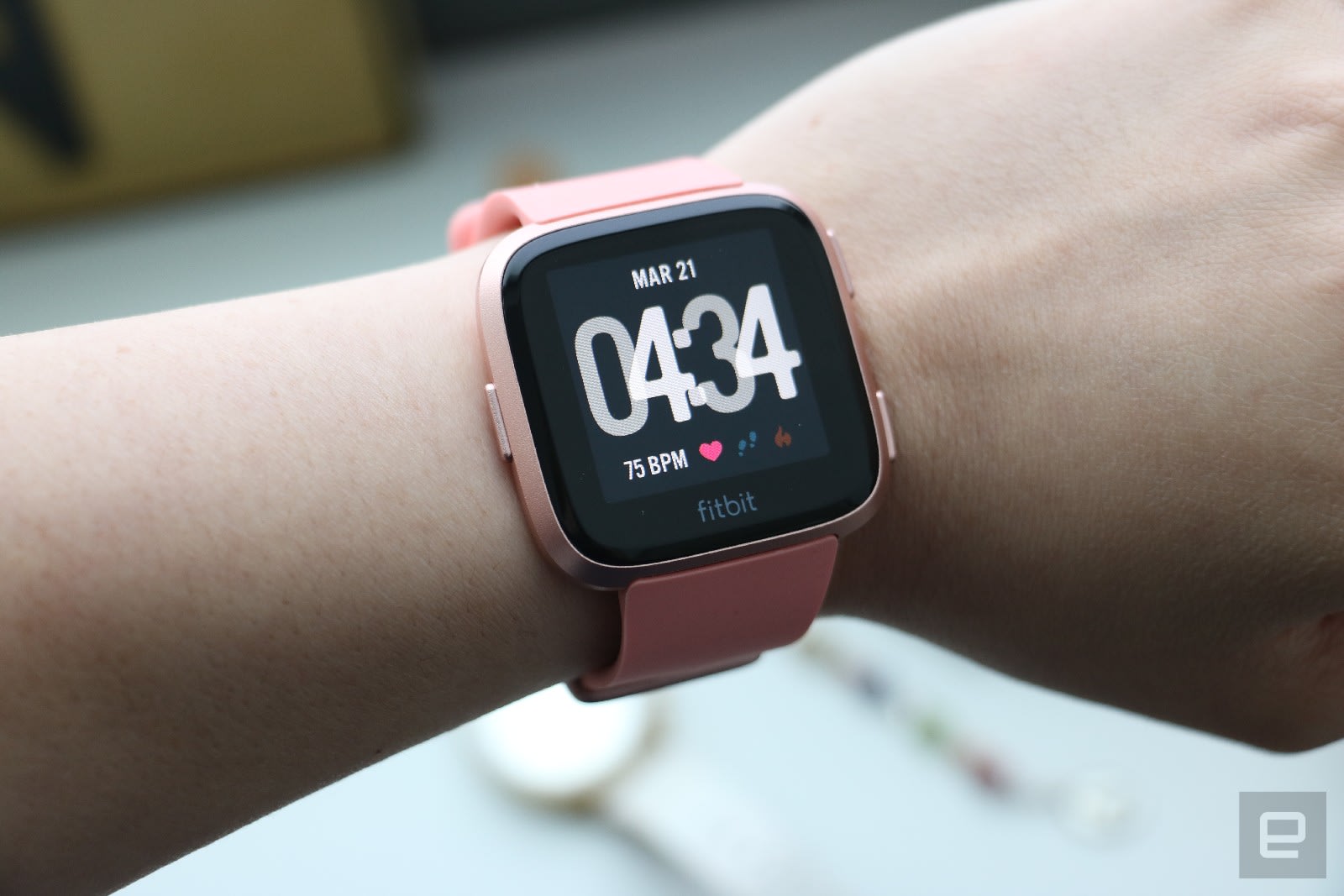
Yes, the Versa looks like a slightly wider Apple Watch, rounded square face and all. But compared to the awkwardly geometric Fitbits of the past, the Versa blends in nicely. People have gotten used to the way an Apple Watch looks, so the Versa’s resemblance to that is an asset. In fact, with the right band-and-case combination, like, say, the rose-gold face with a blue leather strap, you may even find the Fitbit prettier than the Apple Watch.
Aesthetics aside, much of the hardware here is similar to the Ionic’s. The Versa’s 1:1 screen aspect ratio is slightly wider, but both displays are crisp and bright. The images in the background of the Coach app still look vibrant and clear on the Versa’s 1.34-inch face. With the new display dimensions, apps that worked on the Ionic will need to be tweaked to fit on the Versa, but we’ll get to that later.
Meanwhile, the Versa has the same heart-rate sensor and water resistance rating (up to 50 meters) as the Ionic, making it a great device for tracking your swims. It even has the same inactive blood-oxygen sensor onboard, just sitting around waiting for Fitbit to do something with it.
Cherlynn Low / Engadget
But there are a few key differences. The Versa doesn’t have GPS built in — you’ll have to use your phone if you want to track your running route. Also, in the US, the basic version of the Versa is missing NFC for Fitbit Pay. You’ll have to shell out an extra $30 for the special edition to get that function.
These are the tradeoffs you’ll have to accept for the $100 drop in price. If you think you’ll want to run outside without bringing your phone, you should probably pick the Ionic.
In use
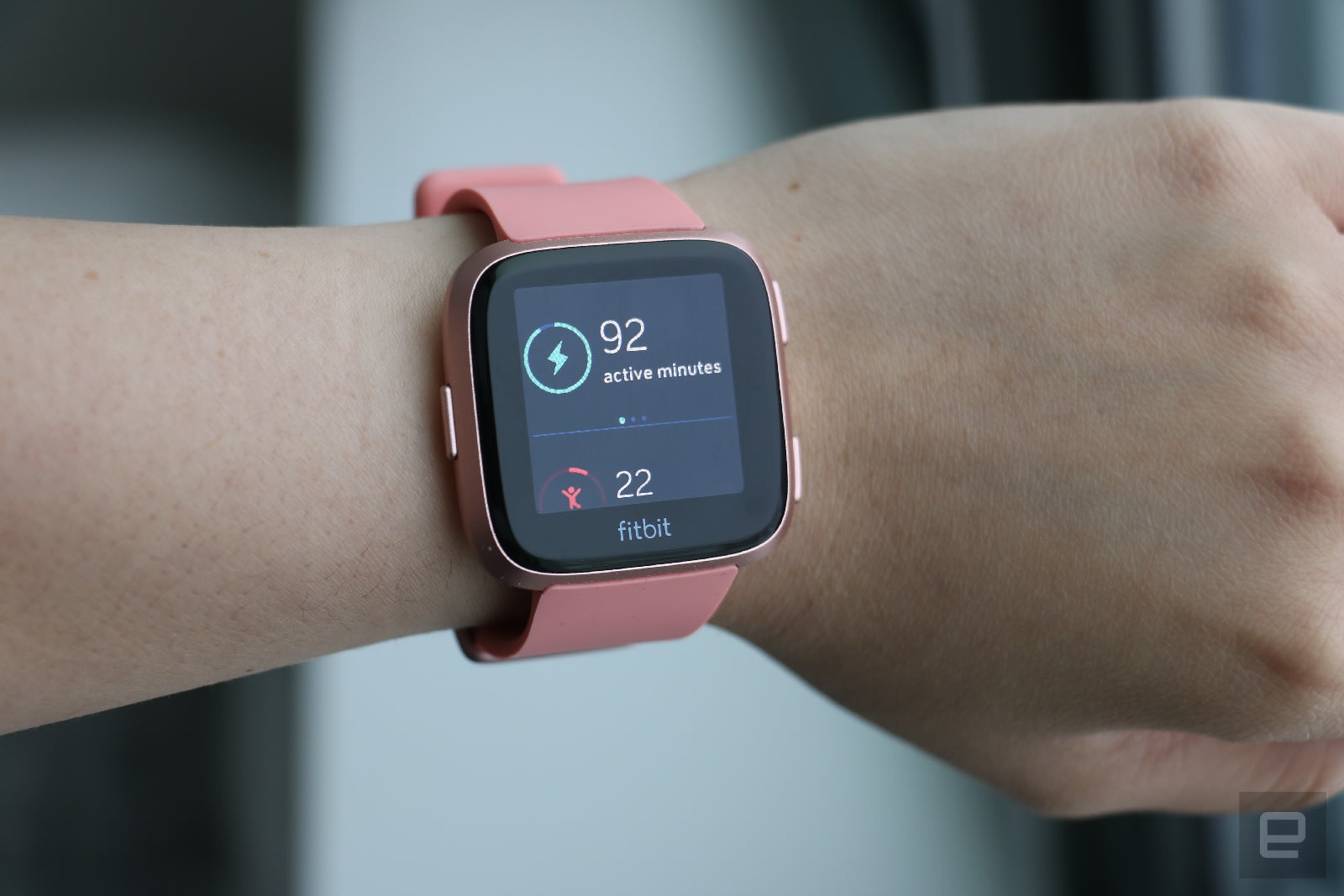
As for the Versa’s actual performance — again, there are no surprises here. The watch does a good job of noticing when I’ve started any activity, as long as I’ve been at it for about 10 minutes. I wore it to a boxing class, and the Versa accurately recognized, thanks to my elevated heart rate, that I worked out for about 45 minutes. If I wanted to capture more information from that session, like calories burned and cardio performance, I could also launch Workout mode from the watch’s Exercise app. Otherwise, it just logs those 45 minutes as “active time.”
When I went out for a run, it took the Versa about 10 seconds to connect to my phone so I could use the GPS. On the Ionic, you won’t have to wait as long before you can start running, but it still needs a moment to find your location.
One of the main differences between the Versa and the Ionic is the updated operating system. The Versa will ship with Fitbit OS 2.0, which the Ionic will get later this year. The new software places a dashboard under the Home screen, so you can see your day’s stats just by swiping up. To do that on the Ionic you had to swipe to the left to pull up your apps, then launch the Today app. OS 2.0 just reduces the steps to one. This actually encouraged me to check my daily progress more often, and motivated me to stay on target.
Notifications also got an overhaul. You can swipe down from the home screen or long press the top right physical button to pull down a list of your notifications. When an alert comes in, it peeks down from the top, and you can flick it away. But if you’re paired to an Android, you’ll be able to reply to messages from your wrist with one of five customizable templates. Too bad quick replies isn’t live yet and won’t roll out until May.
Another feature that won’t arrive till May is “female health tracking” — as in, tracking your menstrual cycle so you can look out for symptoms or when you’re ovulating. You can already download apps on your phone that do this, but it’ll be nice to see this on your wrist and integrated with the rest of the information Fitbit already has.
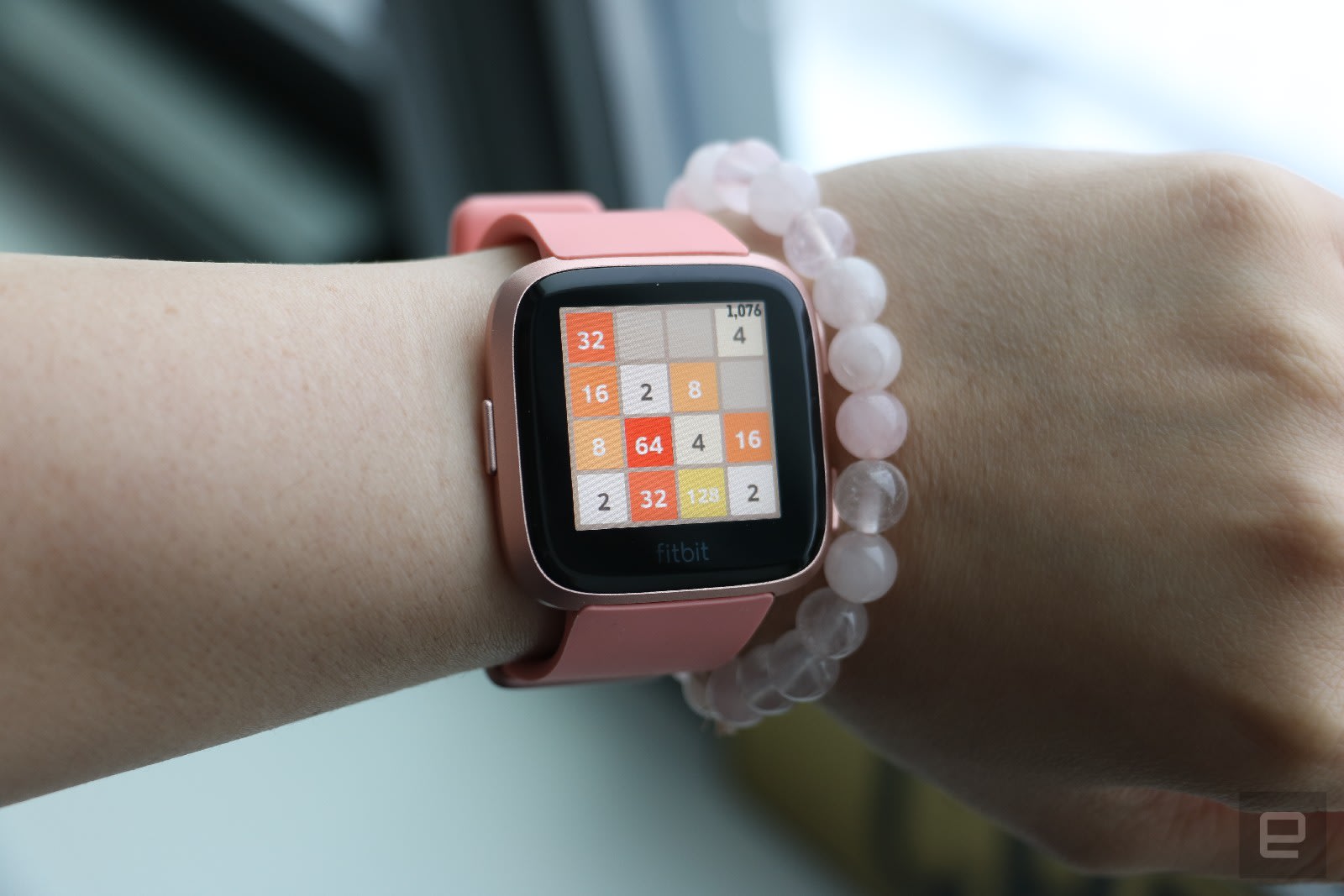
In addition to the built-in fitness-tracking features, you can also make the Versa more useful by installing third-party apps. Since the Ionic launched, Fitbit has grown its app store, although it’s not clear how many of these have been tweaked to fit the Versa’s wider face. You’ll find nifty options like Yelp, Nest, Philips Hue for smart light control and The New York Times for news updates. I particularly enjoyed playing 2048, even on the Versa’s teeny screen.
I also appreciate the Versa’s relatively long battery life. Fitbit promises you’ll get “four-plus” days out of it, and indeed the watch conked out after close to five days of use, during which I tracked at least two workouts and four nights of sleep. The Ionic lasts slightly longer, but the difference is not significant.
Competition

For the price, the Versa’s primary competition are the Samsung Gear Fit 2 Pro and the Apple Watch Series 1 (which costs $250). While both offer similarly robust fitness-tracking tools, the Versa has the edge on battery life — it’s the longest-lasting of the lot.
Those who must have built-in GPS should consider the Gear Fit 2 Pro. It looks nothing like a watch, but has almost all the features the Versa does with a bigger, brilliant display. You can play Spotify tracks offline, monitor your swims and map your runs phone-free. We haven’t reviewed it yet, so we can’t vouch for the battery life, but Samsung promises it will last three to four days.
Owners of iPhones may prefer an Apple Watch, although the Series is getting old. It lags behind the Fitbit in battery life and probably won’t be available for that much longer. If you’re after an Apple Watch and its superior compatibility with iOS, you’re better off shelling out the $80 extra it’ll cost to get a Series 3 model with GPS.
Wrap-up

Cherlynn Low / Engadget
Ultimately, the things that stand out about the Fitbit Versa are its sub-$200 price and attractive design — this is a Fitbit that finally looks more like a smartwatch than a fitness tracker. With the addition of female health tracking in May, the Versa could be even more helpful to women. It’s disappointing that GPS isn’t built in and NFC is missing, but those tradeoffs may help Fitbit reach a bigger audience.
Honda unveils the 2019 Insight, its new upscale hybrid sedan
Honda has debuted the 2019 Insight, an all-new hybrid sedan positioned in price between the Civic and Accord hybrids. Unlike the Clarity EV and plug-in hybrid, it’s a so-called “series hybrid,” with the 1.5 liter Atkinson-cycle gas motor acting as a generator to produce power for the propulsion motor and 60-cell lithium-ion battery pack. At higher speeds, a lock-up clutch engages the gas engine for more efficient highway and freeway driving.
The new insight has very little to do with the funky original Insight (1999-2006) and a later model produced between 2009 and 2014, other than they’re all hybrids. It’s a sedan rather than a hatchback, for one, and looks much more, er, conventional than the others. It uses the Civic platform, but has a longer wheelbase and battery positioning that allows for more passenger legroom and a bigger trunk. With 151 total horsepower and a lightweight structure, it offers the best power-to-weight ratio in its class, Honda says, along with a 55 mpg city mileage rating.
The Insight offers other driver perks you’d expect on a Honda, like a fully-independent suspension, variable-ratio dual-pinion electric power steering, and mechanical/regenerative breaking “for ultimate stopping performance.”
Honda notes that the Insight is the fifth electrified vehicle it has released in the last year, following the hybrid Accord and full EV and plug-in hybrid versions of the Clarity. Much like Toyota, however, Honda should be much further ahead in vehicle electrification, having beaten other automakers to the punch by miles with the original Insight and Clarity.
Facebook’s focus on local news goes global
Back in January, Facebook announced that it was prioritizing local news sources in the US. Today, in a blog post, the company’s Head of News Product, Alex Hardiman, and Head of News Partnerships, Campbell Brown, announced that these changes are being applied internationally, in all languages. Soon, Facebook users around the world will see more news from local sources in their news feeds.
The timing of this announcement probably isn’t a coincidence. The social network is currently mired in a scandal involving Cambridge Analytica, which is a data company that mined the Facebook profiles of over 50 million people without consent. It’s understandable that the company would want to release some good news to take some of the pressure off.
This move to highlight more local news is part of Facebook’s update to promote “high quality, trusted” sources and combat the rampant fake news problem on the social network. The question is whether relying more on local news outlets will help with that. After all, exposing people to the news they already see on a daily basis, rather than injecting more national news into their feed, might reinforce existing biases.
Via: TechCrunch
Source: Facebook
 AIVAnet