


ESA plans to measure ocean plastic data from space
Scientists at the European Space Agency (ESA) are working on a technology that would allow them to identify from space just how much plastic there is floating around in oceans. Until now, researchers have used satellite maps to simulate the accumulation of marine trash, but the new project would use direct optical measurements to provide actual data on the scale of the issue.
“We’re not talking about actually spotting floating litter items,” explains ESA’s Paolo Corradi, who is overseeing the project, “but instead to identify a distinct spectral signature of plastic picked up from orbit.” The technology would work in the same way as the processing software used in recycling plants, which identifies plastic based on its specific infrared “fingerprints”.
At this stage, the teams from France and the UK are assessing how feasible their objective is using current technology from the top of the atmosphere, but Corradi says they may have to operate from the middle of the atmosphere using aircraft or drones, or improve the technology altogether.
He adds that while current simulations estimating the amount of marine plastic “are all well and good”, an image based on actual measurements would have greater impact on policymakers. “Monitoring is not a goal in itself, but a means to show the scale of the problem, and start to try and solve it.”
Via: Parabolic Arc
Source: ESA
Telegram loses appeal over encryption keys in Russia
The dispute between Russia and Telegram has become something of a saga, but today Telegram was dealt a blow. The messaging service wanted to prevent the Federal Security Service (FSB, the successor to the KGB) from accessing user data on its platform. Now, according to Bloomberg, Telegram has lost the case before the Russian Supreme Court.
Last year, the FSB demanded that Telegram hand over encryption keys that would allow the agency to view messages sent on the service. Russia claimed that the app was used to plan terrorist attacks and that the request was in the name of national security. Pavel Durov, Telegram’s founder has repeatedly refused to hand over any data that could compromise users’ security, though he did register the app with the Russian government.
The FSB argued in court that holding encryption keys doesn’t actually constitute a breach of users’ privacy. That’s because, in order to actually collect data on any Telegram users, the organization claims it would have still have to obtain a court order.
Telegram once again plans to appeal the Supreme Court’s decision, so this case isn’t over. If the service loses, then it risks a hefty fine and a possible ban from Russia.
Source: Bloomberg
UK wants answers from Zuckerberg regarding Cambridge Analytica
Following reports by The New York Times, The Guardian and The Observer detailing how Cambridge Analytica obtained data on some 50 million Facebook users and used it for targeted social media messaging, the UK Parliament is now looking for some answers. And they want them from Facebook CEO Mark Zuckerberg himself. As CNBC reports, Damian Collins, chair of the Digital, Culture, Media and Sport Committee, sent Zuckerberg a letter today requesting that he appear before the committee to discuss Cambridge Analytica and Facebook’s role in its data acquisition.
You can read more about the situation here. But to sum it up, a Cambridge University researcher developed a Facebook app that contained a personality test and though 270,000 took the test, Facebook’s policies allowed the app to also collect data on many of those test-takers’ Facebook friends as well. In all, the app collected Facebook profile information on around 50 million users and the researcher then handed that data over to Cambridge Analytica — a political data analytics firm funded by the likes of billionaire Robert Mercer that aimed to use such data to better target ads and content to specific individuals. The company has been accused of using its methods during the US presidential election and the Brexit campaign.
In his letter, Collins says that Facebook’s representatives have repeatedly understated the risks that go along with the way companies can acquire and hold on to Facebook user data. “It is now time to hear from a senior Facebook executive with the sufficient authority to give an accurate account of this catastrophic failure of process,” writes Collins. “There is a strong public interest test regarding user protection. Accordingly we are sure you will understand the need for a representative from right at the top of the organisation to address concerns. Given your commitment at the start of the New Year to ‘fixing’ Facebook, I hope that this representative will be you.”
US Senator Ron Wyden also sent Zuckerberg a letter asking for more information about the situation. And the FTC is now investigating Facebook’s use of personal data.
Collins has asked for a response from Zuckerberg — who has been rather quiet as these reports have been published — by March 26th.
Via: CNBC
Source: UK Parliament
Nikon goes after video pros with the D850 Filmmaker’s Kit
Until recently, Nikon had been wasting an opportunity to make its cameras more appealing to filmmakers. It doesn’t have a pro video camera lineup to cannibalize, unlike Canon and others, so by adding 4K and other video features to DSLRs, it could have made taken sales away from rivals. Thankfully it started to catch up with the D850, which features 4K with no cropping and 1080p,120fps slow motion. Now, Nikon has made its clearest pitch for videographers yet with the Filmmaker’s Kit.
For $5,500, you get the D850, AF-S Nikkor 20mm f/1.8, 35mm f/1.8 and 85mm f/1.8 lenses, an extra battery, the ME-1 stereo microphone, the ME-W1 wireless Bluetooth microphone, an Atomos Ninja Flame 4K external recorder/display.
That kit should make up for some of the D850’s weaknesses, namely the lack of focus peaking in 4K and poor contrast-detect autofocus for video. The Ninja Flame recorder supports focus peaking, and Nikon’s FX lenses offer excellent manual focusing with an automatic AF override when you grab the focus ring.
The kit should thus tempt videographers that might have been considering the Canon 5D Mark IV. The latter significantly crops 4K video, while the D850 doesn’t, using intelligent line skipping to minimize moire. On the other hand, the Canon 5D Mark IV has excellent video autofocus, and despite the D850’s excellent phase-detect photography AF, its contrast-detect video AF system is pretty bad.
In comparison to Sony’s A7R III, however, the D850 doesn’t hold up as well, as the A7R III has both a no-crop 4K option and decent autofocus system. Still, the D850 is currently the world’s best DSLR, and for photographers that also shoot a lot of video, the Filmmaker’s Kit is a solid option that saves you around $700 if you buy the parts separately.
Source: Nikon
FTC is reportedly investigating Facebook’s use of personal data
Former officials have been worried that Facebook’s data sharing with Cambridge Analytica may have violated the FTC consent decree, and it looks like existing officials share their concern. Bloomberg sources have claimed that the FTC is probing Facebook to determine whether the social network broke the decree by letting Cambridge Analytica obtain users’ data without their express permission. If it did, the FTC could call for fines up to $40,000 per person, although that’s unlikely when there are roughly 50 million affected users.
The FTC hasn’t commented on the apparent leak, although any probe would likely take a significant amount of time for the agency to reach a definitive conclusion.
If the trade regulator does get involved, it’ll join a slew of state-level, UK and European Union investigations. Members of Congress want answers, too. Facebook is scrambling to deal with the scandal on its own terms, but it may be too late for the company to avoid serious legal repercussions — especially when it reportedly knew about the data sharing in 2015.
Source: Bloomberg
You won’t beat ‘A Way Out’ without help from a friend
A Way Out from Hazelight games is a dinosaur of a game and I mean that as a compliment. Set in the 1970s, A Way Out follows a pair of convicts — Vincent, who is serving time for embezzlement and Leo, a hardened jewel thief — as they escape from a fictional California prison, go on the lamb and attempt to rebuild their lives. But the disco era isn’t the game’s only throwback, the gameplay itself demands a decidedly old-school method of play: in-person co-op.
The game is exclusively two-player, relying on a split screen to show both halves of the action (or a remote connection if one of you is on a console and the other on a PC). The two players must not only coordinate their in-game actions, such as working together to subdue guards or traverse difficult terrain, you and your partner must also reach unanimous decisions in how to proceed during crucial parts of the game.
For example, during the demo that Edgar Alvarez and I played, we had to decide whether to steal a cop car and crash through the police barricade or sneak across the underbelly of the bridge the barricade was set upon. Each of these decisions has the potential to change the course of the entire story narrative, so choose wisely. We went with running through the barricade and wound up barreling the vehicle off the side of a mountain before totaling our ride and being subsequently chased through a forest by police dogs.
The gameplay changes throughout the course of the game, which runs between 7 and 14 hours depending on how many side missions you and your partner are willing to complete. In some chapters, Vincent and Leo will be required to use stealth and guile to accomplish their tasks, such as sneaking through a forest at night, avoiding and eliminating prison guards. In another, we had to fight our way through hospital halls, wielding fists and a lamp base (Oh Dae-su-style) against a half-dozen security guards and cops.

The game’s developers describe it as a “narrative adventure” and it certainly feels akin to other titles like The Last of Us. Its gameplay is linear, so you’re not going to be running through a massive open world simulation, but does offer a good degree of flexibility and plenty of opportunity to explore.
A Way Out will hit store shelves this Friday and will retail for $30 — a surprisingly low price given the level of polish and engaging storyline we saw during the demo. What’s more, Hazelight is offering a “friend pass” so that if you buy the game, your buddy can download a trial copy to play along through the full story. It will be available for Xbox One, PS4 and PC.
Click here to catch up on the latest news from GDC 2018!
T-Mobile Gifting Customers Free Year of MLB.TV Premium Ahead of 2018 Season
T-Mobile today announced the return of its Major League Baseball-themed offer, gifting customers a free year’s subscription to MLB.TV and the MLB At Bat app’s premium features, worth $115.99 in total.
Available for T-Mobile customers only, the MLB.TV deal will be available in the T-Mobile Tuesdays app [Direct Link] beginning March 27, 2018 and run through April 2, 2018 at 11:59 p.m. ET. If customers sign up for MLB.TV during this period on T-Mobile’s network, they’ll get their free 2018 MLB Regular Season subscription on the service and an At Bat Premium season subscription at no additional cost.
“Going to bat for customers is what we do, and our customers LOVE baseball…so we’re bringing them home a win next T-Mobile Tuesday,” said John Legere, president and CEO of T-Mobile. “Last year, Un-carrier customers streamed more than 1.3 million hours of baseball with MLB.TV thanks to the nation’s most loved wireless company, so we’re doing what do, giving them more of what they want…that’s how it should be, and we won’t stop!”
The deal’s fine print points out that this is for new 2018 subscribers of MLB.TV only, and current subscribers must cancel by 8:00 p.m. ET on March 23 to be eligible ahead of the March 27 launch on T-Mobile Tuesdays.
MLB.TV is a streaming service available as an app on most platforms, including Apple TV, PS4, Roku, Fire TV, and more. The service lets baseball fans watch every out-of-market regular season game live or on demand in HD, while the At Bat Premium features include 60fps video, radio broadcasts, and more.
Baseball fans can watch games on their favorite supported devices and enjoy live game DVR controls so they can pause and rewind live action. And, the MLB.TV subscription includes all the premium features of the MLB At Bat app (a $19.99 value), including enhanced pitch tracking, home and away radio broadcasts, and more.
T-Mobile’s deal will debut two days before Opening Day of the 2018 Major League Baseball season on Thursday, March 29. This year will be the fifth consecutive year that T-Mobile has offered a free year of MLB.TV to its customers.
Tag: T-Mobile
Discuss this article in our forums
Facebook plans all-staff meeting on Cambridge Analytica scandal
Facebook is holding an open meeting for all of its employees today, in the fall out of the unfolding Cambridge Analytica data privacy scandal. Taking place at 10am PT, the meeting will be led by Facebook’s deputy general counsel Paul Grewal, and will give employees the opportunity to ask questions about the ongoing case, which involves the data harvesting of more than 50 million people.
According to an internal calendar invitation seen by The Verge, the meeting is slated to last just 30 minutes, with one source suggesting the move is merely a “stopgap” measure designed to buy time before the all-hands meeting on Friday, which will allegedly be led by CEO Mark Zuckerberg.
Zuckerberg has come under fire for remaining silent on the matter so far, but it’s clear the company has significant concerns about what the revelations mean for it going forward. Today’s meeting, which is also being live-streamed for remote staff, will be the first time a large group of Facebook employees have had the opportunity to question the company’s leadership in person. If Facebook is as culpable as reports suggest it is, its staff are not going to be happy being viewed as complicit in the matter.
Source: The Verge
48 hours with an always on, always online laptop
“So you’re the type of woman who takes your work everywhere with you?” my cab driver asked Sunday when I pulled out the ASUS NovaGo and started writing this very intro. Usually, I don’t. But in the past few weeks, I’ve had to work nonstop, and the only hope I had at securing a good night’s rest is chipping away at stuff while I’m out and about. That’s made a portable, constantly connected and long-lasting laptop absolutely necessary. Microsoft promises just that with its ‘always-connected PCs’ — notebooks that offer long-lasting batteries, are constantly connected to the internet and wake up as quickly as a smartphone.
And there I was, writing this from the back of a cab on the NovaGo, which is the first Snapdragon-powered “always-connected PC” available. Honestly, I marveled at the fact that I could edit the same document I was working on at home awhile ago without first having to painstakingly set up my phone as a hotspot. Plus, I didn’t have to sap my phone’s battery to keep editing my Google Doc while monitoring my usual slew of tabs and apps like Twitter, Facebook, WhatsApp, Slack and Telegram.
Later, I moved locations to the lobby of my building, after snapping the laptop shut and getting out of the car. I opened up the notebook again, and the lock screen appeared slightly more quickly than on my usual on-the-go workhorses (the 12-inch MacBook or the Huawei MateBook X). Signing in and loading up my open apps was swift, too. That’s one of the promises of these Snapdragon-equipped PCs — they’re “always on” so you don’t have to wait around for the device to wake up before getting to work. While this did seem to work during my time with the NovaGo, I have to say it isn’t dramatically different from a regular laptop — it’s about half a second faster than my MacBook and around a second faster than my MateBook.
So far this has been working out as I’d anticipated, although I’d like a shorter time for the device to wake from sleep. But I’m OK waiting a second for the immense benefit of already being connected. My review unit has a T-Mobile SIM in it, and I got decent coverage almost everywhere I’ve been, even holding three to four bars in the Holland Tunnel as I wrote this sentence.
Chris Velazco/Engadget
I’m going to thank both T-Mobile and Qualcomm for this. The latter because it supplies the Snapdragon 835 chipset that powers the NovaGo, along with most of the first gigabit LTE phones. That CPU contains the X16 LTE radio that allows these reliable, fast transfer speeds of 75 Mbps down (as detected by Speedtest). It took a little longer to load Engadget’s YouTube page than I’m used to on my WiFi connection, but the videos I picked started playing in hardly any time at all (a second or less). Pictures my friend sent over WhatsApp Web also loaded as quickly as they normally do on my phone or over my home WiFi, and the grainy selfies I took with the laptop’s webcam sent almost immediately.
Just as important, the Snapdragon 835 has held up pretty well, performance-wise. Running Windows on an ARM-based chipset seems potentially problematic, but so far I’ve had no issue installing and running most of my favorite apps. This is a Windows 10 experience that’s almost identical to my other PCs, save a couple minuscule differences. To be fair, I haven’t pushed the NovaGo very hard — I’ve been mostly using this for my usual on-the-go workflow, which consists of two windows full of tabs like Gmail, Docs, Calendar, Slack, and WhatsApp. If I were using this like my desktop-replacement laptop, there’d be a lot more Netflixing and shopping going on.
The NovaGo occasionally stuttered, especially when the Slack app is running, but I have similar issues with my Intel Core i5/7-powered PCs too. That’s probably because Slack is awful. I was also able to multitask smoothly while talking on a group video Hangout with my editor and colleagues. I still don’t know if this laptop will be able to manage Photoshop or other intensive apps — that’ll have to wait till I can test it more comprehensively for a full review.
You could get a somewhat similar experience with any old notebook and a cellular dongle. Of course, those setups require extra moving parts and didn’t offer speeds as fast as this promises. The software appears better integrated here, too. Going from WiFi to a cellular connection brought up an alert saying, “This PC is on a metered network,” warning me to pause background syncs to save data. When I switched over to a WiFi network in my office, the laptop struggled a little with the shift in connection. Some of my tabs went offline for a few seconds before coming back on again. That’s a minor hiccup, though. For the most part, changing between WiFi and LTE is seamless.
By now, I’ve spent close to 48 hours with the NovaGo (and have taken way more cab rides than I should, really). In that time, the battery has been chugging along just fine. It’s supposed to last up to 20 hours, which is a potential life-changer for my painfully long journeys to Asia. I haven’t used the NovaGo nonstop for that duration just yet, and in all honesty, I keep plugging it in because I want to run a battery test soon.
After about three hours of using it since the last full charge, the battery indicator said we’re at 72 percent, and that there was about eight hours of juice left on this thing. But I don’t think that estimate is accurate, since a little bit before that it was reporting five hours left.

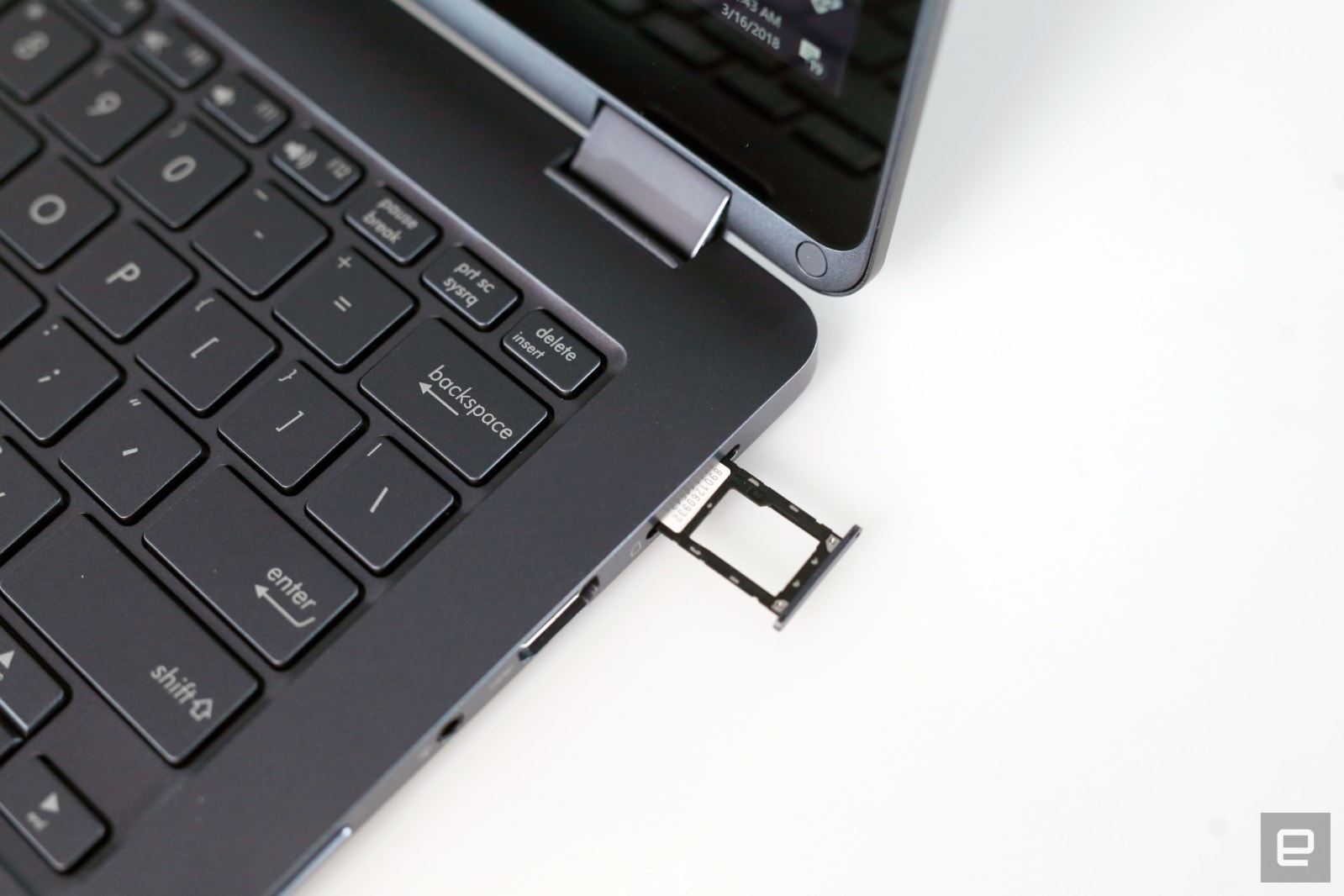
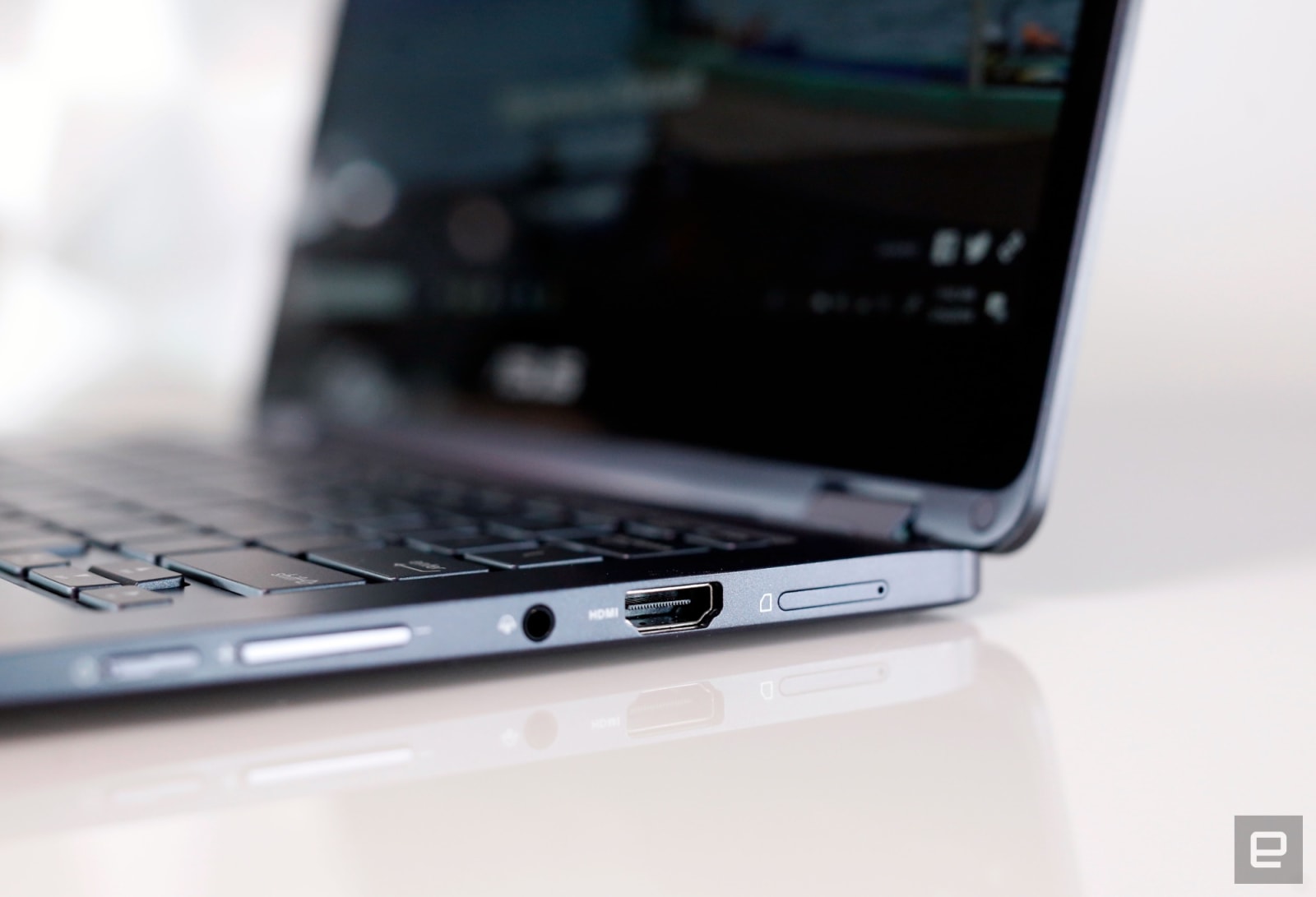
A few quick final observations: Compared to the MacBook and MateBook I use at shows, the NovaGo’s keyboard is a dream. It offers ample travel and a spongy feedback that my fingers appreciate. Another advantage the ASUS laptop has over the Apple and Huawei is ports. As in, it has plenty of them. Instead of just one or two USB-C sockets, the NovaGo has HDMI, two USB As, a microSD card slot and a headphone jack.
The major downside so far is that it doesn’t offer USB-C. For a system that promises to be like a smartphone, this is a big letdown. I still have to lug around the ASUS-branded proprietary charger if I want to bring this laptop on a weekend trip, in addition to the USB C cables I’ll be taking for my phones. If I pick the MacBook or MateBook, I can bring just the one charger for all my devices. Finally, the NovaGo’s display could stand to be a bit brighter. In direct sunlight, it was hard to see what I was writing — all I saw was the reflection of my puffy winter coat.

Chris Velazco/Engadget
There are still a few more things I’d like to try on the NovaGo before giving it a score, like run a full battery test and benchmarks. So stay tuned for the review.
For now, I’m satisfied with its ability to handle all the basic tasks I need and connect to LTE wherever I go. It could be lighter, and USB-C is a glaring omission. But there are several Snapdragon-powered PCs from brands like HP and Lenovo coming out that could address those complaints.
HP’s tiny laser printers are the length of a pencil
Today, HP revealed the LaserJet Pro M15 and M28 series, which are the smallest laser printers in their class. These tiny printers are about the length of a No. 2 pencil, yet still are able to print 18–19 pages per minute. These printers are also mobile-optimized; thanks to the HP Smart App, users can control the printer entirely from their smartphones. The printer supports Apple AirPrint, Google Cloud Print, WiFi Direct and is Mopria certified.
The printer’s small size doesn’t translate to a giant price tag. According to HP, these printers are also the company’s lowest priced, though we don’t have details on exactly how much the M15s and M28s will cost. These printers will be available worldwide starting in April 2018.
 AIVAnet