


Apple’s Fleet of Self-Driving Vehicles Has Almost Doubled Since January
Apple’s fleet of self-driving vehicles has almost doubled over the past two months, according to the Financial Times, as the iPhone maker continues to accelerate its research and development of autonomous technologies.
The report claims Apple now has permits for 45 autonomous vehicles, up from 27 in January, based on figures provided by the California Department of Motor Vehicles. Apple has been expanding its fleet rapidly since receiving permits to test just three autonomous vehicles in California last April.
$AAPL scooplet: Apple now has 45 cars testing autonomous systems in California, up from 27 in Jan & 3 last April, @CA_DMV figures show. That’s more than Waymo, Uber or Tesla in CA, as their testing moves to AZ https://t.co/Eohql6Qq70 pic.twitter.com/5ZdDIIAtxT
— Tim Bradshaw (@tim) March 20, 2018
Apple’s testing fleet is now the second largest in California, behind only General Motors subsidiary Cruise Automation and its 110 cars, according to the report. Google-owned Waymo is testing 24 cars in the state, down from more than 100 last June, while Tesla has 39 permits, the report adds.
As noted by Financial Times reporter Tim Bradshaw, Waymo and other companies appear to be shifting their testing to Arizona and other states, so Apple’s larger-sized fleet in California doesn’t necessarily make it the de facto leader.
Uber has permits to test 29 driverless vehicles in California, but the company has suspended all of its self-driving tests after a pedestrian was struck and killed by one of its autonomous vehicles, with a human safety driver behind the wheel, on Sunday. It was the first pedestrian fatality caused by an autonomous vehicle.
While the incident could result in more regulations for all companies testing autonomous vehicles, including Apple, Tempe police chief Sylvia Moir told the San Francisco Chronicle that “it would have been difficult to avoid this collision in any kind of mode based on how she came from the shadows right into the roadway.”
California has required companies testing autonomous vehicles to have a human in the driver’s seat to take over in the event of an emergency, but the state will be lifting that rule starting April 2, 2018.
Apple is one of more than 50 companies testing self-driving vehicle technologies in the San Francisco Bay Area. For nearly a year now, the company has been deploying its autonomous software in a series of 2015 Lexus RX450h SUVs, which can often be seen on streets surrounding its Cupertino headquarters.
“We’re focusing on autonomous systems,” said Apple CEO Tim Cook, in a June 2017 interview with Bloomberg Television. “It’s a core technology that we view as very important. We sort of see it as the mother of all AI projects. It’s probably one of the most difficult AI projects actually to work on.”
Related Roundup: Apple Car
Discuss this article in our forums
Apple Partners With UK’s John Lewis for HomeKit Showcase In New Department Store
High-end department store chain John Lewis today opened up a new 230,000 square foot location in White City Westfield, London, and one of the store’s new “experiences” includes deep integration with Apple’s HomeKit platform. Called the “Apple Smart Home” section, Apple and John Lewis partnered in an effort to show London residents how HomeKit products can enhance their homes, showing off features like Siri voice control, connected lighting and heating, music playback, and more.
Speaking with HouseBeautiful, John Lewis senior PR manager Siân Grieve explained the reason for the company’s partnership with Apple, instead of integrating with similar products from Amazon or Google.
But why have John Lewis decided to partner with Apple, and not Amazon, for example? ‘A lot of John Lewis customers love and use Apple iOS, they have an iPad or an iPhone. Our stats revealed 77 per cent of searches onto JohnLewis.com are from iOS devices,’ explains Siân Grieve from John Lewis. ‘We know Amazon are going after this space, we know Google are going after it in a big way – this is our chance to bring that to life in an iOS setting.’
In a video shared by Campaign yesterday, you can catch a glimpse into the Apple Smart Home section at John Lewis around the 1:30 mark. The space appears to include a variety of popular HomeKit devices — like a few Philips Hue lamps — and numerous iPads are dotted around the showroom floor for customers to interact with. A few demo stations include explanations on how to use HomeKit actions like “Hey Siri” for turning on and off Hue scenes.
Outside of the HomeKit experience, John Lewis’s new store aims to be an in-depth and unique shopping destination, with a dedicated Experience Desk where customers can find information on taking part in craft classes, marbling workshops, calligraphy lessons, beauty bar appointments, yoga classes, and meet with in-store fashion stylists.
John Lewis is also planning to launch an iPhone app so that customers can keep track of all these appointments, starting with a focus on staying in touch with personal stylists, “who will be able to provide notifications when, for example, a new collection of a favorite brand comes into stock.” Eventually, the company wants to expand the app to cover other services offered by the Experience Desk, including home design consultations.
Apple has been known to partner with companies in an attempt to boost HomeKit adoption, back in 2016 working with various building companies to integrate HomeKit directly into homes from the get-go, ensuring that new buyers are more likely to stick within its ecosystem. One such home in San Jose, California included devices sold by Kwikset, Ecobee, and Lutron, with HomeKit integration estimated to cost $2,500 per house.
Tag: HomeKit
Discuss this article in our forums
eBay’s New Springtime Coupon Lets You Get 15% Off Nearly Everything Sitewide Today
A few weeks ago eBay launched a popular pre-daylights saving coupon, which allowed customers the ability to save 20 percent off everything on eBay, with a few select exclusions. Today the site has debuted a similar — albeit slightly less valuable — coupon code that lets customers take 15 percent off everything across eBay.
The 15 percent off coupon is running for one day only and ends tonight, March 20, at 7:00 p.m. PT. To use it, you’ll need to make a purchase on eBay worth $25 or more, pay for the item or items by the coupon’s expiration time tonight, and enter the coupon code PSPRINGTIME in the redemption code field.
Note: MacRumors is an affiliate partner with eBay. When you click a link and make a purchase, we may receive a small payment, which helps us keep the site running.
The discount will apply to the purchase price, which excludes shipping, handling, and taxes, and caps at a maximum discount value of $50. You won’t be able to buy items from the following categories on eBay with the code: Coins & Paper Money, Gift Cards & Coupons, and Real Estate. The code is available only to eBay users registered with an address in the United States, Canada, Latin America, or the Caribbean.
As a point of emphasis, if you’re going to use the code remember that it’s one-time-only, so if you want to gain its maximum potential you’ll need to fill your cart up with either one expensive item or a collection of smaller items that add up to about $330 and above. After that point, the code’s $50 max discount will be capped off.
Just like the last coupon, the new Springtime discount code is available across all of eBay, so even if you can’t find Apple products you’re interested in, there should be plenty of other items on the site that could be made a bit cheaper with the 15 percent off sale.
For more information on the code visit eBay’s landing page, and head over to eBay’s Daily Deals tech section to get started on shopping for ideas before the sale ends tonight. Our full Deals Roundup has more details on this week’s latest sales as well.
Related Roundup: Apple DealsTag: eBay
Discuss this article in our forums
Apple Seeds Sixth Beta of tvOS 11.3 to Developers
Apple today seeded the sixth beta of an upcoming tvOS 11.3 update to developers for testing purposes, a little over one week after seeding the fifth beta and one month after releasing the tvOS 11.2.6 update.
Designed for the fourth and fifth-generation Apple TV models, the tvOS 11.3 developer beta can be downloaded onto the Apple TV via a profile that’s installed using Xcode and Apple Configurator.
Early tvOS 11.3 updates introduced support for AirPlay 2, allowing the Apple TV to be added to the Home app as part of a HomeKit setup and enabling multiple Apple TVs in separate rooms to play the same song, but that functionality was removed in tvOS 11.3 beta 3.
It is not yet clear if Apple plans to re-add AirPlay 2 features ahead of the release of tvOS 11.3, but it’s a possibility because there are still several betas to go.
Other new features in tvOS 11.3 include enhancements to Match Content support, automatic frame rate switching on the fourth-generation Apple TV (a feature that was added to Apple TV 4K in a past tvOS update), and automatic mode switching for AirPlay video sessions.
Related Roundup: Apple TVBuyer’s Guide: Apple TV (Buy Now)
Discuss this article in our forums
Landlord of Apple’s New Flagship Chicago Store Puts it Up for Sale
The Chicago landlord that owns the building where Apple’s new flagship Michigan Avenue Store is located has put it up for sale, according to The Wall Street Journal.
Walton Street Capital purchased the 20,000-square-foot Apple Store, a 35-story office building, and a retail building next door for $370 million in 2017, and is now planning to sell the store and 10,000 square feet of retail space for $175 million while holding on to the office building.
Demand for retail space is declining due to the decreasing value of malls and shopping centers as consumers turn to online shopping, but according to The Wall Street Journal, Apple Stores are the “gold standard in the retail world” because of the high foot traffic they attract to nearby locations.
A report by Green Street Advisors in 2016 found that average sales for 220 malls with Apple Stores came to $710 per square foot, compared with $630 per square foot for malls without Apple Stores. The study was based on a database that covered about 1,400 properties.
When the Apple Store sells to a new buyer, Apple doesn’t have to worry about rent. Apple is well aware that its stores attract a high number of customers and it uses that as leverage to get lower rent rates. Apple is paying rent that’s “well below” the average $400 to $500 charged per square foot for nearby Michigan Avenue retail space.
Apple’s Michigan Avenue store is located right alongside the Chicago River, and its construction was an ambitious project for the company. It includes 32-foot glass facades and an enormous 111-by-98 foot carbon fiber roof. Like most of Apple’s modern stores, it includes indoor trees, a dedicated seating area for Today at Apple sessions, a Genius Grove for getting help with products, and an area where customers can view and try Apple devices and related accesories.
Designed by longtime partner Foster + Partners, the store is meant to pay homage to Chicago’s iconic Prairie Style homes designed by architect Frank Lloyd Wright.
Related Roundup: Apple StoresTag: Chicago
Discuss this article in our forums
Galaxy Note 8 Oreo: What’s new in Android 8.0 for the Note
Long-suffering Galaxy Note 8 owners, your Android Oreo update is about to arrive! If you bought Samsung’s most expensive phone or 2017, you could be forgiven for feeling left out as the Galaxy S9 launches, and last year’s S8 gets its own Oreo update in many countries.
But very soon the Note is going to be right up to date with the latest Samsung Experience 9 — the same software experience that ships on Samsung’s 2018 flagships.
The look and feel of Samsung’s software hasn’t changed a whole lot from Android 7.1, but there’s still plenty to get stuck into in the Note 8’s first major software update. Check out our hands-on video above, and be sure to subscribe to Android Centra on YouTube for more Note and Galaxy S9 coverage in future.
- Samsung Galaxy S9/S9+ video review
- Android Central on YouTube
- Samsung Galaxy S9 review
- Samsung Galaxy S9: Everything you need to know
- MrMobile reviews the Galaxy S9+
How are you liking Android Oreo on the Galaxy S8?
The waiting game is finally over.
Following months of anxious waiting, Android 8.0 Oreo is finally making its way to the Samsung Galaxy S8 in the U.S. Verizon was the first carrier in the country to start updating the phone, and it was soon followed by T-Mobile and Sprint.

Android Oreo brings a lot to the Galaxy S8, including picture-in-picture, Google’s Autofill API, smoother performance, a new security patch, and plenty more.
We decided to check in with some of our forum users to see if they’ve gotten Oreo on their S8 yet, and this is what they had to say.
lgossin
03-16-2018 07:15 AM“
Got my Verizon this morning, I had to check for a software update and there it was. so far so good
Reply
CraftyMe2323
03-16-2018 02:50 PM“
I like it so far. Definitely more responsive, and I’m already noticing a difference with battery life, though time will tell.
However, I do not like the persistent notification I’m getting while running swipe navigation. Any ideas how to turn this notification off without turning off the ability for this to be active over other apps? I never had this issue on nougat. Any help would be…
Reply
pbike908
03-15-2018 11:03 PM“
I am on Verizon and it is available to me. I live on CO.
Reply
03-16-2018 12:55 PM“
Installed just fine on S8+. Faster response overall after.
Reply
Now, we’d like to hear from you – How are you liking Android Oreo on the Galaxy S8?
Join the conversation in the forums!
Samsung Galaxy S8 and S8+
- Galaxy S8 and S8+ review!
- Galaxy S8 and S8+ specs
- Everything you need to know about the Galaxy S8’s cameras
- Get to know Samsung Bixby
- Join our Galaxy S8 forums
Verizon
AT&T
T-Mobile
Sprint
Unlocked
The Galaxy S9+ is a much better phone with a case on it
It’s a great device either way.

I don’t know about you, but I don’t love dropping my phone. It’s about as enjoyable as burning your tongue on hot coffee or stubbing your toe on the edge of a table. Not only can the phone crack or stop working completely, but the fear of dropping it can mar the experience of using it in the first place.
After spending almost two months using the Pixel 2, a relatively small phone with flat edges and a textured metal back, it was disconcerting to switch cold turkey to the slippery, curved Galaxy S9+. It was like handling a fish. The phone is big and smooth and begs to be dropped, and in the brisk wintry days of Canadian March, is an accident waiting to happen.
In my first days with the GS9+, I held it gingerly, relearning how to drive after years of riding the subway. Familiarly came quickly, but comfort never arrived; it never quite felt like my phone — and given that I pick it up dozens, if not hundreds, of times a day, it needs to feel like it’s mine.

The commodification of phones has privileged us into being picky about our phone choices. If you’re not into this one, get that one; not into this size, get that one. But Samsung operates on a different plane to the rest of the companies developing Android phones, and the fact that all of its flagships now share the same coldly beautiful aesthetic opens it up to the kind of scrutiny reserved for royalty.
When I set the Galaxy S9+ down on a table, it looks more object than tool, and unlike the aforementioned Pixel 2, it does not invite me to use it but merely to stare. My experience with the phone remained this way for half a week — though, mercifully, I didn’t drop nor scrape it — until my first case shipment came in. And then everything changed.


It’s barely important which case I used, though I’ll say I’ve been enjoying RhinoShield’s SolidSuit series.
Last year, we forgave the Galaxy S8’s usability problems because its design was so striking.
It merely matters that all notions of precariousness disappeared when I installed it. I found my sea legs, confident in my ability to remove it from my pocket, place it in my hand, use it, and replace it once again without fumbling. Such a small thing, but so important: it opened up the phone to me. (And it’s a great phone — more on that in another article.)
This isn’t a new problem, but I think last year I was, as were many of my peers, so taken with Samsung’s industrial achievements, I forgot to critique how the phone actually, you know, felt. I also spent most of my time with the smaller Galaxy S8, which despite being made of the same stuff, could be wholly gripped in one hand and therefore never felt quite as insecure. With the Galaxy S9+ truly differentiating itself from its smaller counterpart this year, it’s become the de facto flagship, which has forced me to reckon with its ungainly size.

A case also alleviates my other major problem with the Galaxy S9+: the fact that the curved glass is more trouble than it’s worth. So many apps still rely on a left slide-in menu, but without the benefit of a lip, it’s almost impossible for most apps to register that horizontal gesture — it’s ignored because Samsung actively tries to prevent false touches.
The stunning symmetry of the Galaxy S9’s curved glass in no way improves my experience, and I’ve never found features like edge lighting and edge display useful enough to justify the trouble.

Almost every Huawei or Honor phone you buy today comes with a case in the box. Given that the Galaxy S9+ costs $840, it should probably come with one, too. Until then, we have a list of great options for you, so do yourself a favor.
Or you can toss care into the wind and get naked — it’s your phone.
See at Amazon
Samsung Galaxy S9 and S9+
- Galaxy S9 review: A great phone for the masses
- Galaxy S9 and S9+: Everything you need to know!
- Complete Galaxy S9 and S9+ specs
- Galaxy S9 vs. Google Pixel 2: Which should you buy?
- Galaxy S9 vs. Galaxy S8: Should you upgrade?
- Join our Galaxy S9 forums
Verizon
AT&T
T-Mobile
Sprint
HTC Desire 12 and 12+ launch with 18:9 screens and glass designs
There’s also a 3.5mm headphone jack 🙏
Before HTC launches its big flagship phone for the year – the U12+ – the company is first announcing two new handsets that are targeted to consumers who are on a budget. The new phones are the Desire 12 and 12+, and at first glance, they’re the best-looking entries in the Desire series to date.
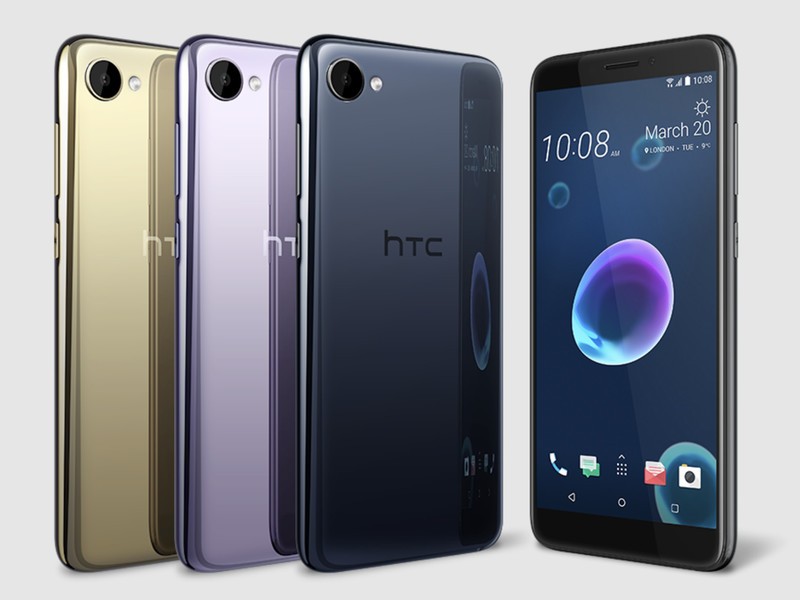
HTC Desire 12
Instead of going with a plastic design like we usually see with the Desire line, HTC’s adopted a glass construction similar to what’s found on the U11. You’ll find the same “liquid surface” that gives the U11 and U Ultra their shiny aesthetic, and both the Desire 12 and 12+ are being offered in gold, violet, and navy colors.
Looking first at the regular Desire 12, you’re getting a phone with a 5.5-inch screen with an 18:9 aspect ratio and 1440 x 720 resolution. The MediaTek MT6739 powers the phone, and this is equipped with either 2 or 3GB of RAM depending on which model you get. Similarly, the Desire 12 can have either 16 or 32GB of storage – both of which can be expanded up to 2TB.
There’s a single 13MP camera on the back, 5MP front-facing camera, 2,730 mAh battery, an unknown version of Android with HTC Sense layered on top of it.
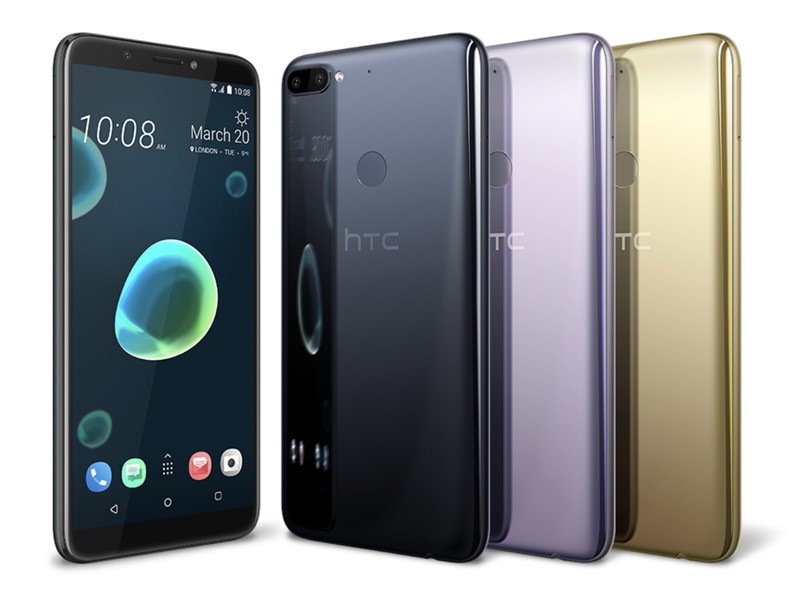
HTC Desire 12+
Moving over to the Desire 12+, there’s a 6-inch display with the same aspect ratio and resolution a the Desire 12. The MediaTek processor is swapped out for the Qualcomm Snapdragon 450, and 3GB of RAM with 32GB of storage is the only memory configuration that’s available. There’s also a 13MP camera on the back, but it’s joined by a secondary 2MP one that’ll allow for portrait shots. The front-facing camera is also upgraded to an 8MP sensor.
The Desire 12+ offers a larger 2,965 mAh battery, and it’s confirmed that Android 8.0 Oreo will be present on the phone out of the box. Plus, no matter if you choose the Desire 12 or 12+, both phones retain the endangered 3.5mm headphone jack.
Unfortunately, HTC’s yet to announce any details regarding pricing or availability. The company says to “stay tuned to the regional HTC social channels nearest you” for this info, but that’s all we’ve got right now.
Based on what we know so far, are you at all interested in the Desire 12 or 12+?
HTC U11
- HTC U11 review
- HTC U11 specs
- Manufacturing the U11: Behind the scenes
- Join our U11 forums
- HTC U11 vs Galaxy S8
- HTC U11 vs LG G6
Amazon
Sprint
HTC
Take our Affordable Phone Survey and you could win a $350 gift card!
Share what excites you about this year’s new phones.

The year is just getting started, but we’ve already been overwhelmed by the number of great phones announced. It’s easy to be distracted by the most expensive options, but we can all agree it’s impressive to see how much phone you can get for much less than the flagships. Just take a look at the trio of inexpensive options announced by Alcatel, the wave of Android Go phones, or even the latest from Nokia for examples of how capable the “budget” phone world is looking these days.
It got us thinking about how people think about what makes their next phone the one they fall in love with, and the best way to find those answers is to just ask you! We’ve assembled a brief survey so you can tell us what you think about your next phone, and what features are the most important to you. And since your time is valuable, we’re going to give away a $350 gift card to one lucky participant. Who knows, maybe that card will cover your next phone, maybe even with some left over!
Take the Mobile Nations Affordable Phone Survey!
 AIVAnet