


Two major eSports players associations are in the works
There are two players associations being put together for professional competitors who play Overwatch and Counter-Strike: Global Offensive, Sports Business Journal reports. The latter will include players in the ESL Pro League and the FACEIT ECS league and is being helmed by eSports broadcaster Scott “SirScoots” Smith and attorney Michael Doi. Smith told Sports Business Journal that the Counter-Strike Professional Players Association (CSPPA) won’t be seeking to become a US union since Counter-Strike players span the globe but it is looking to sign the over 225 players that participate professionally. “Every day I sign another guy,” he said. “I would say 70 or so have signed an official membership document that they are for the players association, are behind the players association, they want to be in the players association.”
Those behind the Overwatch players association haven’t shared as much information about their efforts, but they plan to release formal details in around four months. The push is being led by Overwatch coach and former player Thomas “Morte” Kerbusch and sports labor attorney Ellen Zavian. Sports Business Journal says that the Overwatch association will likely be modeled after other US unions like the NFL Players Association. “I don’t see this [players association] as any different than any other PA just because it’s eSports,” Zavian said. “So this isn’t something that will be a lighthearted step. This will be a big step.” Kerbusch and Zavian haven’t said if they’re collecting authorization cards — required for forming a union by US law.
If successful, these two efforts will join the players association formed last year by Riot Games for League of Legends players. Hal Biagas, who was elected to run that association, hasn’t said if it will make a move to unionize, but did say that it was looking to standardize team contracts and make sure they support players. The CSPPA hasn’t yet set an official agenda but is already being contacted by tournament organizers, according to Smith. For the Overwatch association, Zavian says she sees it dealing with the standard issues that concern all professional players — wages, insurance, continuing education and arbitration of grievances.
While these associations are still in the early stages of development they are the logical next step as the world of eSports begins to more closely resemble that of traditional professional sports.
Via: Sports Business Journal
Shocking the brain with electricity can prompt people to remember old dreams
kjpargeter / 123RF Stock Photo
It’s a weird observation that people with epilepsy can occasionally remember old dreams during seizures. Scientists at France’s Toulouse University Hospital have now discovered that this same effect can be recreated by stimulating a particular part of the brain using electricity.
“Sudden and unexpected reminiscences of memories have been described after some direct electrical brain stimulations in epileptic patients since neurosurgeon Wilder Penfield’s [pioneering work] between the 1930s and 60s,” Jonathan Curot, a PhD student studying neuroscience at Toulouse University Hospital, told Digital Trends.
Over the past several decades, Curot said that different types of electrical brain stimulations, such as deep intracranial stimulation or electrocorticography, have sometimes been shown to recreate this effect in epileptic patients. However, because there was no way to reproduce these in a deterministic manner, very little has been known about the phenomenon — which is referred to as déjà-rêvé.
A bit like déjà-vu’s lesser-seen brother, déjà-rêvé involves recalling an experience which a person had while they were sleeping. This difference is summarized in their names: while déjà vu is French for “already seen,” déjà rêvé means “already dreamed.” The researchers in this new study found that this effect can be consistently recreated by stimulating the temporal lobe, a part of the brain associated with long-term memory, dreaming, and forming memories during sleep.
“We have demonstrated [this effect] in six epileptic patients,” Curot continued. “We have trapped EEG signals during déjà-rêvé and we were able to record patients during it and interview them just after these phenomena.”
According to Curot, the discovery is interesting because being able to explore the sudden unexpected reminiscences of dreams without environmental cues can help us better understand the brain. It could also have potential therapeutic application when treating people with neurological diseases involving memory disorders.
“We are [now] studying neuronal activity changes after electrical brain stimulations,” he said. “We use new intracranial microelectrodes to explore the effect of electrical stimulation to better understand how they modulate neuronal activity.”
A paper describing the work, titled “Déjà-rêvé: Prior dreams induced by direct electrical brain stimulation,” was recently published in the journal Brain Stimulation.
Editors’ Recommendations
- Listening to their own brain waves could help PTSD sufferers battle affliction
- Bad habits? This tech predicts impulsive behavior, zaps your brain to stop it
- Neuroscientists use electrical pulses to brain to curb Tourette syndrome tics
- Blasting your brain with sound, pulses can help quiet the din of tinnitus
- Graphene-based wearable could help save babies from ‘crib death’
This adorable robo-tortoise teaches kids that beating up robots isn’t okay
Kids can be pretty mean — and that goes for their treatment of robots just as much as it does siblings and classmates. But an unusual new robotics project may be able to help. “Shelly” is a robotic tortoise developed by engineers from South Korea’s Naver Labs and Seoul National University. The difference between Shelly and other kinds of bots some of you may have had in the classroom is that this one shows emotional feedback based on how it’s treated.
Stroke the robotic reptile’s embedded LED surface, which is equipped with vibration sensors that can detect touch, and Shelly will wiggle her head and limbs. Her shell also lights up with different colors. Hit, kick, or drop Shelly, however, and her head will retract inside her body as if she’s frightened. This will also temporarily disable her lights. She’ll remain in this state for 14 seconds before she’ll once again respond to the children around her.
In some ways, this is reminiscent of Paro, the therapeutic robot seal, which also modifies its emotional state depending on how it is touched. In the case of Shelly, though, the purpose is explicitly to teach children that they should not abuse robots.
Naver Labs
With that in mind, the researchers explored the optimal length of time for her “disabled” state to continue. When it was halved from 14 to 7 seconds, the researchers found that kids were more likely to abuse Shelly, since the duration of the non-playable phase was not long enough to act as a deterrent. When increased to 28 seconds, the kids lost interest in the game.
It’s an intriguing project, and one which will be even more applicable to today’s generation of kids — who will grow up interacting with once-unimaginable numbers of robots in the home, classroom and, eventually, the workplace. Imbuing the proper treatment of robots (something that even some adults don’t practice) is therefore essential.
Hey, when Skynet takes over, nobody wants to be singled out as the kid who lay a beating on its robot vacuum cleaner cousin!
Editors’ Recommendations
- Pepper is everywhere in Japan, and nobody cares. Should we feel bad for robots?
- Oh, yeah! Robot joins Olympic torch relay, bashes through a wall on the way
- Spirit animals: 9 revolutionary robots inspired by real-world creatures
- Hanson Robotics CEO talks A.I. and Sophia, his latest humanoid robot, at CES
- Rise of the machines: Here are the best robots we saw at CES 2018
Prolonged time in space literally changes the structure of astronauts’ eyes
ER Productions/Getty Images
Going into space as an astronaut may be great for your résumé, but it could do absolutely no favors whatsoever for your eyesight. That is the conclusion reached by a University of Houston optometrist, who has analyzed the pre- and post-flight data from astronauts who spent time on the International Space Station, and discovered that the experience results in a physical change in the structure of their eyes. While all 15 astronauts had good vision before their trip into space, they all exhibited the same physical deformation once back on Earth.
This so-called “space flight-associated neuro-ocular syndrome” is something that NASA has previously observed, but the University of Houston’s research paper quantified these changes using smart algorithms and a technique known as optical coherence tomography imaging. This noninvasive clinical test provides optometrists with detailed cross-sectional images of the retina. University of Houston assistant professor Nimesh Patel then created custom algorithms which allowed him to delve into the data to see the changes that had taken place.
In individuals who have been exposed to long periods in microgravity, these changes include an alteration in the position of the Bruch membrane opening, an increase in retinal thickness closer to the optic nerve head rim, and an increase in the proportion of eyes with choroidal folds.
It’s not clear exactly why these changes are prompted by microgravity conditions, but one theory is that it relates to microgravity-induced shifts in the body’s cranial fluids. It’s also not immediately apparent what the long-term impact to a person’s eyesight are, although Patel suggests that the anatomical changes could well hang around for the long-term.
The research may well have application for the rest of us non-astronauts, however. Because of the precision of the algorithms used for analyzing the retinal scans, there is a possibility that they could be one day incorporated into patient care to help detect incredibly small changes in more earthbound retina scans.
As for the astronauts, we doubt that too many people will be put off space travel because of possible marginal risks to their eyesight — although it’s a factor worth considering. Still, telling people you wear glasses because of space flight-associated neuro-ocular syndrome is a lot cooler than admitting it’s because you sit too close to the TV when you play Call of Duty.
Editors’ Recommendations
- How to delete and reinstall games on your PS4
- Here’s the ‘last pic’ of Starman as he motors off into outer space
- MIT drones navigate more effectively in crowded spaces by embracing uncertainty
- This three-year time-lapse of Seattle is like a real-life Sim City game
- After a monthlong stay at the space station, Dragon capsule returns to Earth
PUBG Mobile is coming to North America, available first in Canada
Only the Android version has been released so far.
Battle Royale games have exploded in popularity over the last few months, and one of the top dogs is Player Unknown’s: Battlegrounds – more commonly referred to as PUBG. Along with successful launches on PC and Xbox, an official mobile version of the game was released in China late last year. Now, the game’s coming to North America.

Seemingly out of nowhere, PUBG Mobile appeared on the Google Play Store in Canada. There are plenty of copy-cats out there, but this is the officially-licensed one developed by Tencent Games (the studio responsible for the port in China).
PUBG Mobile is currently being run as an open beta in Canada, meaning anyone can download and play so long as they’re willing to put up with the occasional bug here and there. The game’s not available in the U.S. quite yet, but you if you’re dead-set on playing it right now, you can make use of a VPN to trick the Play Store into thinking you’re from the great white north.
Only the Android version of the game has been spotted in North America so far, but it’s expected that its iOS counterpart will be available soon, too.
I’m personally more of a Fortnite guy, but seeing as how we’re still a few months away from its Android release, this might be my new go-to when I want to get my battle royale fix on the go.
Download: PUBG Mobile (free)
Facebook Lite is now available in the United States
Also coming to the UK, Canada, and more.
No matter how active of a user you are, it shouldn’t come as a surprise that the Facebook app has become incredibly bloated over the last couple years. If you aren’t a fan of the million extra features it has and simply want to focus on the basics, you should probably check out Facebook Lite.

Facebook Lite has been around since 2015 as a stripped down version of the main Facebook app, but it’s just now being released in the United States.
The app was originally designed for developing countries where smartphones aren’t as powerful, but Facebook says it’s now expanding to developed markets to help people stay connected even when they have poor data speeds.
In addition to the U.S., Facebook Lite is also coming to Canada, the United Kingdom, Australia, France, Germany, New Zealand, and Ireland.
Facebook Lite is rolling out to these countries now, and you can download it from the Play Store by tapping the button below.
Download: Facebook Lite (free)
LG V30 and V30S: Everything you need to know!

What do I need to know about the LG V30?
Sometime around late 2016, LG decided to stop trying to win smartphone market share with gimmickry, instead concentrating on just making good products. The LG G6 was the first product of this new approach from the Korean company, winning praise from critics, but not really moving the needle against local rival Samsung’s Galaxy S8. For late 2017, LG has its new V30 phone. It’s technically a successor to the video-focused V10 and V20 — but there’s a clean break in terms of design language, as LG ditches the removable battery and instead goes all-in on metal and glass. And in February 2018, LG announced a sort-of sequel, the V30S, with an AI boost and slightly updated specs.
This is our guide to everything you need to know about LG’s best phones to date.
Check out our LG V30 review
We’ve been using the LG V30 for the past couple months, in multiple countries and with multiple networks. Check out our LG V30 review for extended thoughts on the phone’s build quality, software, camera and battery life. And you’ll also want to take a look at our video review below, which packages all that info into a concise 13-minute presentation.
It hits the sweet spot for a ‘big’ phone
With a 6-inch display, you might expect the LG V30 to feel enormous in the hand. However, like its little brother the G6, the V30 uses a taller 18:9 aspect ratio, which (because geometry) has a smaller screen area than a 16:9 phone with the same diagonal measurement. In short: It’s big, but not unmanageable. In the hand, the LG V30 feels about the same size as a 5.5-inch, 16:9 phone like the HTC U11.
Needless to say, if you’re used to lugging around a V10 or V20, the V30 is going to feel significantly more portable than your old handset.
It’s also slimmer and lighter, on account of the metal and glass construction used throughout. In fact, the V30 weighs even less than the G6, despite its larger screen size and identical battery capacity.
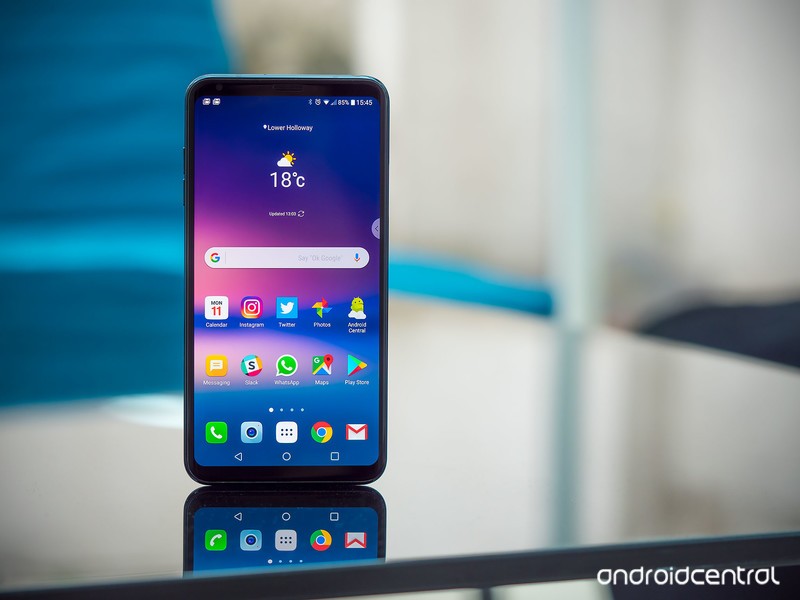
Same specs everywhere
The LG G6 irked customers in some countries by leaving out wireless charging or the legendary Quad DAC in some regions. Not so this time around: All V30s are made equal.
Regardless of where you buy the V30, you’ll get both wireless charging built-in, and high-performance wired audio thanks to LG’s Hi-Fi Quad DAC.
The only outlier is internal storage space. There’s an “LG V30+” sold in some countries (like the United States, where it’s available on Sprint and US Cellular), but this is just the same old LG V30 with a roomier 128GB of space. In addition, all V30s come with a standard high-end spec loadout: Qualcomm’s latest Snapdragon 835, 4GB of RAM and Android 7.1.2 Nougat. There’s also an absurdly priced LG V30 Signature Edition with 6GB of RAM, 256GB of internal storage, and a ceramic back instead of glass. The Signature Edition V30 is only available in South Korea and can be had for a cool $1800 USD.
Confusing things further, LG announced the V30S ThinQ. This phone includes the same Snapdragon 835, ups the storage to 128GB or 256GB, increases RAM to 6GB, and comes with Android 8.0 Oreo out of the box.
More: LG V30 specs
More: LG V30S specs: More of the same, plus A.I.
In addition to raw hardware specs, you’ll have (up to) four colors to choose from: Aurora Black, Cloud Silver, Moroccan Blue, and Lavender Violet. Naturally, not all hues will be available on all carriers, or all regions. (In the United States, black and silver are the dominant colors.)
New and improved dual cameras
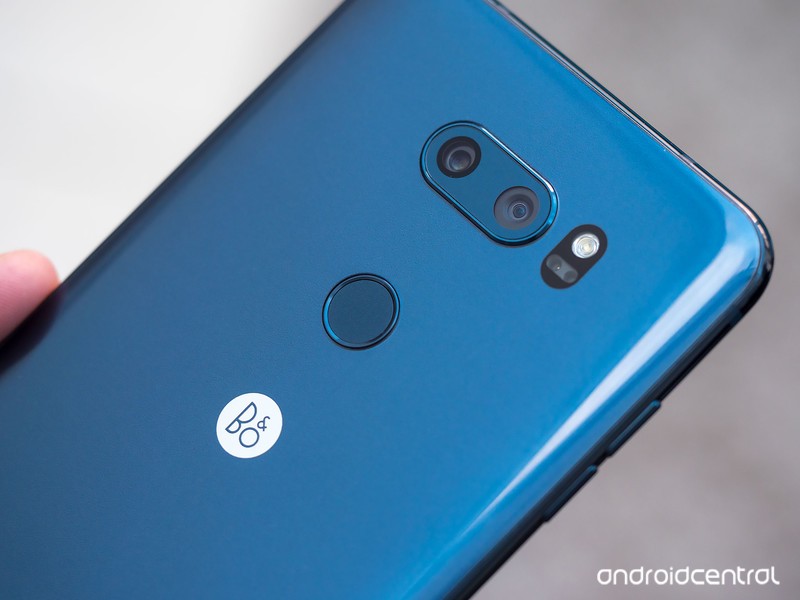
LG is no stranger to dual cameras on smartphones, having included the feature on the back since the G5 (and on the front since the V10). The LG V30 is LG’s best dual camera setup yet, with a 16-megapixel main shooter behind an f/1.6 lens, and a new, brighter wide-angle camera with less distortion, and an f/1.9 lens. The main camera is a solid step up from the G6 in all conditions. But the biggest improvement comes in wide-angle photography, where the brighter lens and improved post-processing allow for clearer wide-angle pics in the dark.
Besides photography, LG has built out some impressive new video capabilities. The V30 includes LG Cine Log mode, which captures photos with flatter colors, so that more dynamic range can be brought out in post-production. It’s similar to the techniques used by professional filmmakers, and worth a look if you plan on editing footage from the V30 in an app like Adobe Premiere Pro or Final Cut. And if you just want to give your footage a specific look without exporting to a PC, there are several color presets you can use. You could make your footage look like a dark, gritty thriller, or a light romantic comedy, all with a single tap.
The second screen is no more
The secondary ticker display has been a stable V-series feature since the beginning, but as LG moves towards OLED and slimmer, lighter phones, second screen has been retired. In its place, there’s a new “floating bar” feature, bascially a little arrow icon that you can drag around the screen, and tap to conjure up a list of app or settings shortcuts.
The feature works similarly to Samsung’s Edge Screen on its Galaxy phones, though with less disruption to apps you’re currently using in the background. In any case, if you decide the floating bar isn’t for you, it’s easy to disable it by dragging it up to the “Remove” icon at the top of the display.
It compares really well with the Pixel 2 XL
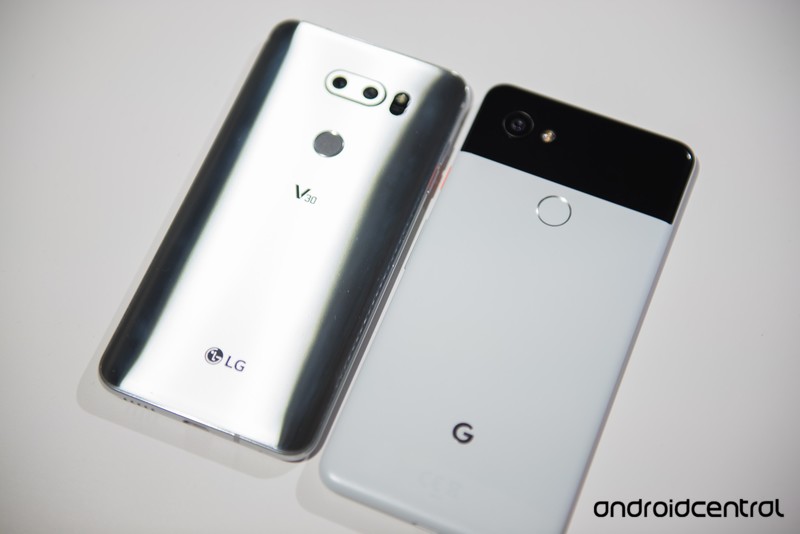
Google collaborated closely with LG to produde the Pixel 2 XL, and it shows. The phones have the same display panel, roughly the same size, and mostly similar internal hardware. There are key differences however: the Pixel 2 XL ditched the headphone jack this year, while LG doubled down and included an excellent Quad DAC for every version of the V30. The V30 also includes a glass back, allowing for Qi wireless charging, while the Pixel’s metal backing prevents that. Finally, the V30 includes LG’s now-famous dual camera setup, with the secondary lense used for wide-angle shots. The Pixel sticks with a single camera, though does use some wild algorithms to produce portrait shots.
Another key difference is software, and in this light the V30 comes a little worse off. The phone launched with Android 7.1.2 Nougat, while the Pixel line launched with Android 8.0 Oreo. The Pixel line will also be the first to receieve new feature and security updates, while the V30 may lag behind in that regard depending on region and carrier. The Pixel 2 XL is only $50 more than the V30, so it really comes down to whether you value software features — fast updates and minimal bloat — over hardware features — the dual camera, wireless charging and Quad DAC.
It’s the first phone to support T-Mobile’s 600Mhz network

Need better T-Mobile coverage in rural areas across the U.S.? The V30 is your phone.
The LG V30 is the first device to support T-Mobile’s burgeoning 600Mhz network, which offers much better coverage across greater distances than the rest of T-Mo’s network.
It’s still rolling out — only a few areas across the country are currently covered — but it should be fairly ubiquitous by this time next year.
The LG V30 is the first phone to run on T-Mobile’s new 600Mhz network
Oreo is here

The V30 launched with Nougat, but LG has started rolling out the update to Android 8.0 Oreo to the device. The update started in South Korea, but is now rolling out in other regions.
More: Stable Oreo update now rolling out to the LG V30 in South Korea
More: Android 8.0 Oreo is rolling out to the LG V30 on Verizon
There’s a gorgeous pink variant

The V30 launched in standard smartphone colors — black, silver, blue and violet. At CES 2018, the company showed off the new “Raspberry Rose” version, and it looks striking to say the least. The deep pink will definitely stand out in the crowd, and customers in South Korea, Europe and Asia can pick this version up.
More: LG V30 is getting a stunning Raspberry Rose color
There’s a refreshed ‘S’ model

For MWC 2018, LG was expected to announce the G7, but instead announced the V30S ThinQ: mostly the same V30 we know and love, but with some extra AI bits baked in. Other minor improvements include Oreo out of the box, increased storage and more color options.
| Operating System | Android 7.1.2 | Android 8.0 Oreo |
| Display | 6-inch OLED, curved edges2880x1440 resolution Gorilla Glass 5 | 6-inch OLED, curved edges2880x1440 resolution Gorilla Glass 5 |
| Processor | Qualcomm Snapdragon 835 | Qualcomm Snapdragon 835 |
| RAM | 4GB (6GB in some markets) | 6GB |
| Storage | 64GB (U.S.) 128GB (Korea, some other markets) microSD card slot | 128GB (V30S), 256GB (V30S+) microSD card slot |
| Battery | 3300mAhNon-removableWireless chargingQuick Charge 3.0 | 3300mAhNon-removableWireless chargingQuick Charge 3.0 |
| Rear cameras | 16MP f/1.6, OIS, 71° FOV13MP f/1.9, 120° FOV | 16MP f/1.6, OIS, 71° FOV13MP f/1.9, 120° FOV |
| Front camera | 5MP f2.2, 90° FOV | 5MP f2.2, 90° FOV |
| Audio | 32-bit Quad DC, high-sensitivity microphones | 32-bit Quad DC, high-sensitivity microphones |
| Water resistance | Yes, IP68 water resistant dustproof MIL-STD 810G certified | Yes, IP68 water resistant dustproof MIL-STD 810G certified |
| Dimensions | 151.7 x 75.4 x 7.4 mm | 151.7 x 75.4 x 7.4 mm |
| Weight | 158 grams | 158 grams |
| Colors | Silver, Black, Blue, Violet, Raspberry Rose | New Platinum Gray, New Moroccan Blue |
Expensive, but not Note expensive
The proximity of the V30’s release to that of Samsung’s Galaxy Note 8 — as well as the local rivalry between Samsung and LG — invites comparisons between the two phones. But aside from the size difference (the Note is much taller), LG is targeting a slightly lower price point.
More: Where to buy the LG V30
That said, the V30 is not a cheap phone. Outright prices on the U.S. carriers start at $800, and in the UK an unlocked LG V30 will set you back an eye-watering £799. LG phones tend to pick up heavy discounts not long after launch, so it’s probable you’ll be able to pick one up for $750 or less by the end of the year.
Still, the V30’s launch pricing is a far cry from the $900+ folks have been paying for the Note 8.
More questions? Check out the forums!
The Android Central LG V30 forums are a great place to chat with other V30 owners (and soon-to-be owners), and get answers to more of your burning questions.
LG V30 + V30S ThinQ
- LG V30S hands-on: A 2017 phone with 2018’s buzzwords
- LG V30S specs
- LG V30 review: The no-BS flagship
- Top LG V30 camera features
- Full LG V30 specs
- Join our LG V30 forums
Amazon
Best Buy
Verizon
AT&T
Google Maps has added wheelchair-accessible transit routes, and it’s life-changing

Sometimes the little things can make the biggest differences.
A feature that’s been in the works for a while debuts today in Google Maps as wheelchair accessible routes are added to public transit navigation. It’s going to be life-changing for a good many people. I know, because I’m one of them.
Starting today in London, New York, Tokyo, Mexico City, Boston, and Sydney (though I see the feature for the greater Washington, D.C. area, too) when searching for directions that use public transportation a filter for wheelchair accessible routes is available. With this enabled, you’re shown routes that thousands of participants in Map’s Local Guides program as well as municipal transit agencies have marked as friendly for those with mobility issues. Google is working with other cities to add more places in the coming months.
Sometimes feeling normal can be the best feeling and tools that make it happen are important.
This isn’t a complicated bit of news to understand, but how it can touch the lives of millions around the world might be. I can’t speak for everyone in a wheelchair, but I know how different the world can be when you’re stuck in one.
I’ve been confined to a wheelchair on and off for 15 years and full-time for the past five. So many of the things I used to take for granted are now problematic, sometimes to the point where I lost any desire to do them. Grabbing a train or bus to head downtown is one of them because getting “stuck” is heartbreaking and embarrassing. And it happens a lot more than you may think; any outing that’s new brings apprehension and worry that it may be cut short because there is no way to wheel myself from point A to point B. Something like flying out to Google I/O is fun and exciting for most everyone making the trip but for me, it means anxiety from the moment I say goodbye to my wife until the moment I say hello to a familiar face at the other end.
Accessibility goes beyond those of us in a chair, too. Anyone who has a tougher time getting around may need a ramp or an elevator, as do people with strollers or any type of cart. It’s just as easy to get stuck trying to push the kids or a bunch of tools from one place to another and just as frustrating when it happens. Hopefully, we see the feature in more places soon.
For most people, this news won’t be as fun as Mario Kart in Maps is. And it shouldn’t be – most people you see with trouble getting around don’t want or expect special treatment. But helping life be more normal in tiny ways like knowing you can get from a train station to an airport terminal is important to me and a lot of others. Thanks, Google.
SwiftKey 7.0 adds stickers, location sharing, new languages, and more
Available now for Android and iOS.
Microsoft purchased the ultra-popular keyboard app SwiftKey in April of 2016, and since then — well — let’s just say the keyboard’s had better days. In an attempt to better compete with the likes of Gboard and other competitors, SwiftKey is getting its biggest update since the Microsoft acquisition.

There’s a lot going on in SwiftKey 7.0, but perhaps the biggest change lies with the new Toolbar. The Toolbar is represented as a small “+” icon near the top left of the keyboard, and tapping it reveals a new menu for finding all of your favorite features, including emoji, GIFs, themes, and your clipboard. However, if you’re on Android, you’ll find even more goodies tucked away here.
The first Android-exclusive new feature is stickers. Similar to many other keyboard apps, SwiftKey now lets you send a variety of different stickers to whoever you’re messaging. You can send these stickers as they are, or edit them to get the perfect look.
Coming soon, SwiftKey will also add location sharing so you can quickly send your current location or a saved address, as well as a calendar feature that lets you insert any upcoming appointments in your default calendar app. Last but not least, SwiftKey 7.0 adds eight new “lish” languages — which SwiftKey describes as “a hybrid language that lets people shift seamlessly between languages, in this case English and Indic languages.”
SwiftKey 7.0 is rolling out for both Android and iOS right now.
Download: SwiftKey (free)
The UK’s spaceport ambitions inch closer to reality
The UK government’s goal to play host to the first spaceport in Europe is taking a baby step closer to fruition today. After being introduced just over a year ago as the Draft Spaceflight Bill, the rebranded Space Industry Bill is receiving royal assent to become part of UK law. While it sounds fancy, the nuts and bolts of it are kinda boring. The legislation covers necessities like spaceflight licensing, insurance requirements and safety commitments. Not a particularly exciting read then, but it does lay the regulatory groundwork that’ll be essential for an operational spaceport. The government hasn’t provided any update on when it hopes one will open, but previously it’s said 2020 sounds doable.
According to the government, a quarter of all telecoms satellites are “substantially built” in the UK. It hopes that with local launch capabilities, Britain can become a “one-stop shop” at the forefront of the burgeoning private space industry; not to mention the opportunities it could grant researchers and the public sector (“using satellite data and machine learning technology to support the roll out of charging points for electric vehicles,” for example). There are several potential spaceport locations still under consideration, and the government has earmarked £10 million in funding that’ll go towards breaking ground and complementary projects.
Should a UK spaceport become a reality in the next few years, it would be the first in Europe. The European Space Agency (ESA) does have one of its own, but that’s situated in the South American country of French Guiana. In addition to the proposed spaceport, the UK is also set to become home to the world’s first commercial astronaut training ground. Construction is expected to start on the facility later this year.
While the Space Industry Act is a good start, it might not be quite comprehensive enough. For example, the law doesn’t include any mention of a €60 million liability cap, introduced in 2015, that limits an operator’s financial risk. What that basically means is if a company launches a satellite, everything goes wrong and it causes a ton of damage, it’s only liable to hand over a maximum of €60 million to contribute to the clean-up. These kind of caps are essential for securing investment and insurance, so follow-up legislation will likely be required to fill this and other shortcomings of the act that might crop up.
The government is hopeful the work it’s doing will help the UK space industry grow, but there are signs it’s currently shrinking. British companies are apparently being increasingly excluded from bidding for work on projects with the ESA. While Britain’s membership of the ESA isn’t under threat, many of its programs are funded by the EU, and the fact the UK is Brexiting is beginning to muddy that relationship.
Source: UK government
 AIVAnet