


Google’s bringing its Maps APIs to augmented reality game development
Available to use right within the Unity game engine.
Pokémon Go is one of the biggest mobile games to ever be released, and later this year, we’ll see similar AR games that get people moving in the real world while interacting with the lore of Harry Potter, Ghostbusters, and more. To help make the development of these titles as easy as possible, Google’s launching new Maps APIs for the Unity game engine.

According to Google:
To make it easy to get started, we’ve brought the richness of Google Maps to the Unity game engine. We turn buildings, roads, and parks into GameObjects in Unity, where developers can then add texture, style, and customization to match the look and feel of your game. This means that they can focus on building rich, immersive gameplay without the overhead of scaffolding a global-scale game world.
The API grants developers access to more than 100 million 3D models of roads, buildings, and landmarks across 200+ countries, and this will enable AR games to work in virtually any nook and cranny of the globe.
Commenting on this announcement, Next Games CEO Teemu Huuhtanen said:
When new buildings or roads are built, we’ll have access to them in our game. Google Maps’ unrivaled location data, covering world-famous landmarks, businesses and buildings, like the Statue of Liberty, Eiffel Tower, London Eye, Burj Khalifa, and India Gate, makes exploring your surroundings a breathtaking experience.
Google will have a demo of this technology at the Game Developer Conference in San Francisco next week if you want to get an early look at what’s to come, and you can contact Maps’ sales department now to get more info on integrating the APIs into future titles of yours.
Google made the Pixel 2’s portrait mode tech open source
Today’s best deals you won’t want to miss
Whether you’re looking for new tech gear or household items, we’ve got you covered.
We’ve got great discounts on PlayStation VR bundles, iPhone cases, the Moto G5 Plus, and more! Don’t pass these up.
View the rest of the deals
If you want to know about the deals as soon as they are happening, you’ll want to follow Thrifter on Twitter, and sign up for the newsletter, because missing out on a great deal stinks!
‘GFE’ follows a high-end escort through San Francisco
Much of the virtual reality film GFE takes place in luxury San Francisco hotel rooms — softly lit, cozy spaces — while soothing music lingers in the background. There’s only one main character: a young woman who narrates her experience as a high-end escort, providing a “girlfriend experience” of dates, conversation and intimacy. She walks through Union Square in purple boots and a short skirt, sits across from the viewer at a cafe, applies lipstick in a hotel mirror. At times, the camera’s point of view places you as a neutral observer; at other moments you’re the implied client, locking eyes with the woman.
The closeness you feel to subjects in virtual reality is heightened here, for better or worse. Your level of potential discomfort is “a bit of a Rorschach test” for how one feels about sex work, said director Michael Jacobs. “I wanted to try to find a story or a character or an idea that would really push the viewer to confront something.”
Premiering at SXSW, the film is described as a fictional “documentary fantasy” by Jacobs. The premise is to take you, in just under five minutes, through what it’s like to have a liaison with the woman, who regularly works as an escort in real life and is anonymous in the film. She narrates her own experiences unscripted, but the scenes were all staged; there were no real clients involved.
About two-thirds of the way in, she appears in lingerie, with the viewer assuming a first-person point of view. She looks directly at the camera and removes her bra. The film cuts to the woman kneeling on the bed, naked. You have to physically look downward to see a following scene of her lying down while languidly stroking her right thigh.
The nude scenes last less than a minute and aren’t more explicit than what may appear in an R-rated movie. Yet the same levels of intimacy that have fueled porn as a major early application of consumer VR may instead unsettle viewers here. Viewers demoing the film at SXSW’s virtual cinema were visibly uncomfortable, shifting their weight from foot to foot and wrapping their arms tight around their chest. It’s a fine line to walk: Sex workers are a frequent source of fascination in the media, but depicting them on camera — especially with VR’s sense of presence — invites a prurient and exploitative male gaze.
“I think that can be provocative … what those emotions do to you and how you examine that. Do you find it compelling? Are you disgusted? Is it a version of an erotic fantasy? Does it reaffirm everything you believe about escort work? Or does it bump up against that?” said Jacobs, who described the piece as sex positive. “I love the idea of demystifying escort work and bringing a sense of empowerment to escorts, to women who do this work, and men.”
The production process came with strict conditions. There were two men on set — Jacobs and the director of photography — with four women forming the rest of the crew. It took two months of negotiation with the escort before the shoot last summer in which Jacobs went through the same vetting process as any of the woman’s clients, including providing his wife’s contact information as a reference. They met only once, at the shoot, and have never spoken on the phone. “I don’t know her name. I don’t know where she lives. I don’t know where she’s from,” Jacobs said.
This anonymity — even to the filming crew — adds another level of intrigue: How do we know that this is an authentic experience, and that the escort’s stories are true? Jacobs says the mystery is itself part of an authentic girlfriend experience. The woman who stars in this film is skilled at performing a certain persona while keeping her true identity unknowable, he told me. She allows clients to project their fantasies onto her. In GFE, the question remains, does virtual reality invite the viewer to do the same?
Twitter is reportedly working on a Snapchat-style video feature
Earlier this year, rumors surfaced that Twitter was working on a way to make sharing videos on its platform easier. Now, three sources have told CNBC that a camera-centric feature is in the works and may function in a way that’s similar to how Snapchat’s location-based snap collections are gathered and shared on its Discover tab. According to CNBC’s sources, Twitter’s function would collect location-based photos and videos and combine them with Twitter Moments, creating a broader collection of information surrounding notable events.
Importantly, Twitter could allow advertisers to place sponsored content among the user-tweeted photos and videos it collects for the expanded Moments feature. On Snapchat, one way advertisers can reach users is through short videos that are tacked onto the end of Stories and scattered throughout Discover content. Launching a similar video feature could let Twitter attract more advertising for itself.
Whether the feature will actually be rolled out and when is up in the air as of now and CNBC’s sources who’ve seen demonstrations of it said that it appeared to be early in its development process.
Twitter has had an ever-greater focus on video over the past year. The platform has hosted more and more live sports content as well as shows and local news.
Via: CNBC
Reddit’s iOS App to Feature Native Promoted Posts Beginning March 19
Starting next week, the official Reddit app for iOS will begin displaying native in-app promoted posts to Reddit users, according to an email Reddit sent out to advertisers on Wednesday and shared by Marketing Land.
Promoted posts in the Reddit app will look similar to standard Reddit posts, with upvotes, downvotes, and comment threads. Comments were not possible with Reddit’s previous mobile ad offerings for advertisers, and will provide users with a way to give feedback on ads.
The promoted posts will have a “Promoted” tag at the top of the post in the main Reddit news feed, but will otherwise look like regular Reddit posts.
Advertisers will be able to target Reddit users by interests, subreddit, location, device, and time of day.
According to Reddit, its mobile apps for iOS and Android are the most popular way Reddit users access Reddit content on their mobile devices. The Reddit apps account for 41 percent of time spent on Reddit across all platforms.
Native promoted posts will begin rolling out on iOS on Monday, March 19, and will expand to Android in the coming weeks.
Tag: Reddit
Discuss this article in our forums
PlayTable combines blockchain and board games for peak nerdery
Whether they’re taking over a section of your local Target or dominating the list of Kickstarter’s highest grossing projects, board games are booming right now. And, while traditional board games still have their place, plenty of companies are trying their hands at augmenting tabletop play with websites and apps, or building products that incorporate physical pieces into video games. Blok.Party’s PlayTable takes all of that a step further by building a giant tablet to serve as the game board and letting users create their own RFID-enabled pieces that incorporate blockchain tech for a truly personalized gaming experience.
The PlayTable itself is essentially a giant 24-inch full HD touchscreen running its own “PlayTable OS.” The demo units the company has been showing for the past two years were run on Windows, but the Blok.Party team is working on porting it to Android, and that’s what the final production units will use. Because it’s meant to live in your living room or den, the PlayTable isn’t designed to be portable — it’s 12 pounds, needs to be plugged in and largely depends on a WiFi network to function. That might be a bit of a bummer to any tabletop gamers who were hoping to lug the device to their local shop or a gaming convention but, if they do try it anyway, at least the size and weight aren’t much worse than carrying around a bag of board games or backpack of RPG manuals.
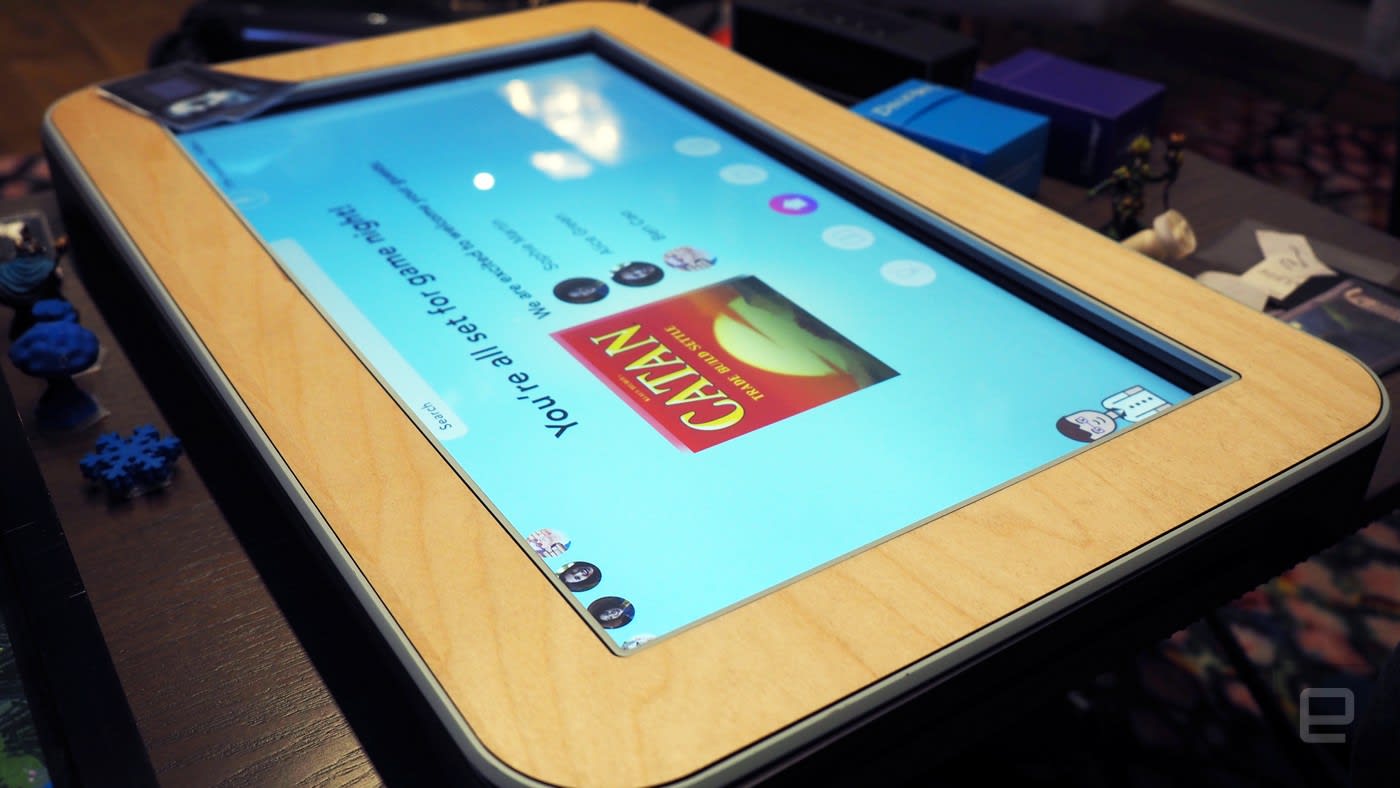
The PlayTable has a few nice touches to make it family room-friendly: There are four USB ports for charging phones and other devices, and the device itself is designed with an interchangeable faux-wood finish so it doesn’t clash with your decor. Blok.Party also plans on accessories like a cover for the screen when the device isn’t in use. Most importantly, the entire thing is incredibly tough, with industrial-strength glass and an IP54 rating for water resistance — you could even rest your drinks on it, something most players would never dream of doing to a cardboard game board. Heck, your beer glasses can even be the game pieces if you like, thanks to the system’s RFID-based game piece system.
Although some of the games will have physical components for sale, what Blok.Party is really hoping for is for people to buy RFID stickers instead. There are obvious business-related reasons for this: Toys are a pain to manufacture and distribute, something that Nintendo learned the hard way when it first started selling Amiibo more than three years ago. But the company is also embracing a DIY ethos with the PlayTable, one where it envisions users 3D printing its own figurines or even using favorite toys as game pieces. To ensure these components are truly unique but still work across various games, the company is embracing blockchain.

When you hear the term “blockchain” you tend to think of Bitcoin and other cryptocurrencies, which ideally represent a secure, decentralized form of payment but lately have been reduced to a buzzword for individuals and companies aiming for easy money. Blok.Party isn’t looking to mine anything — for starters, the PlayTable’s Rockchip CPU and 2GB of RAM aren’t exactly up to the challenge. Instead, the usage of blockchain is all about authenticating the pieces, without the company needing to build a central server or keep additional records beyond basic account info.
The components will have data associated with them, like what games they’ve played in and the stats they’ve earned. But, unlike Amiibo, that data will not be stored on the piece itself, which makes it more immutable: If a piece is lost or stolen, it’ll easy to recreate it on a new RFID chip and invalidate the old version. And you’ll never have to worry about fakes when trading with other people. It’s an authenticated digital collectible like CryptoKitties, except that it serves a slightly more practical purpose. You don’t just have it for the sake of having it, but also for the purpose of playing games with it.
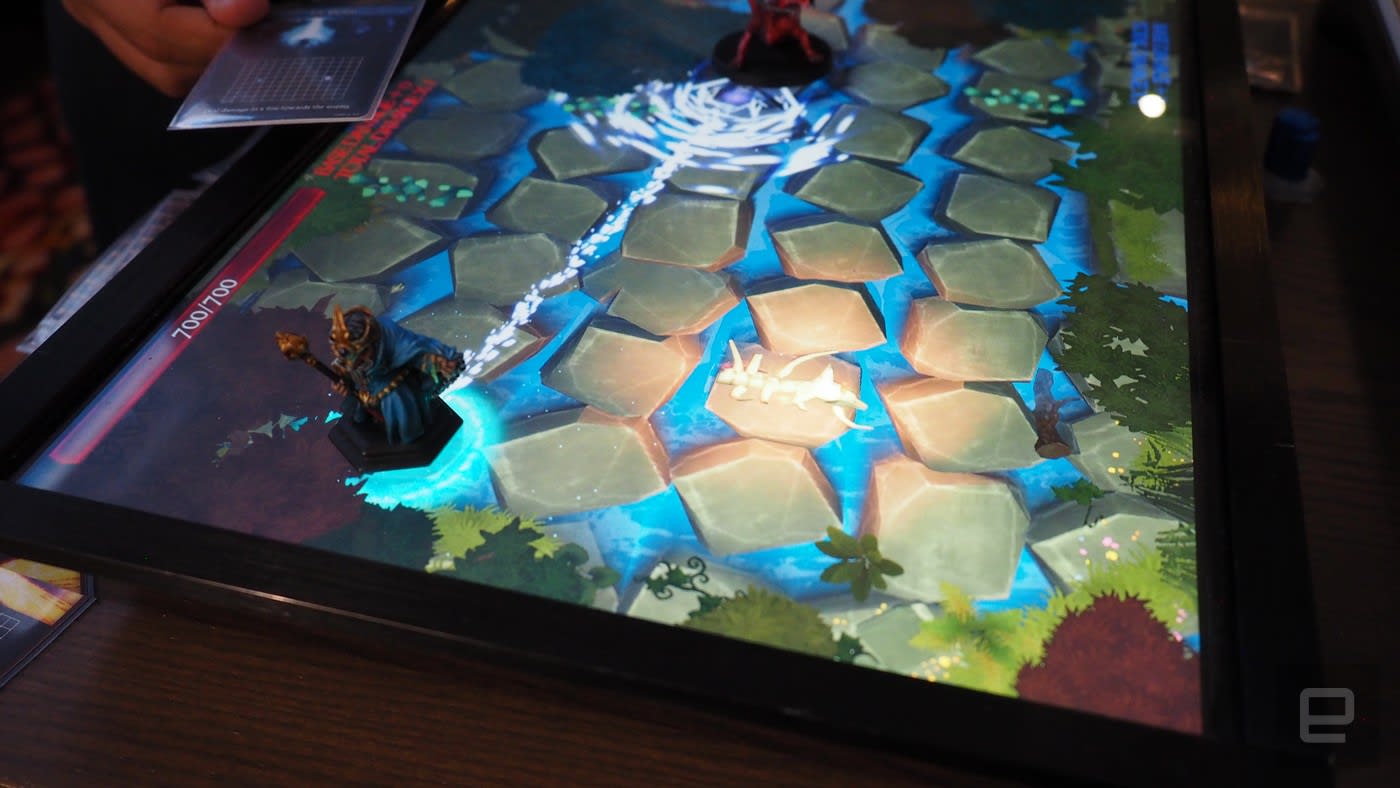
At launch, the PlayTable will have about 25 games available, including classic and popular titles like Catan, Ticket to Ride and Codenames, as well as originals like Battlegrid. Battlegrid is a hybrid miniature and card strategy game, with players controlling figurines like a dragon or a wizard on a grid with special RFID-enabled cards. The cards represent basic actions like movement and attacks, from ice beams to teleportation. There are also special physical pieces that add environmental effects on the board, like trees to create cover or a snowflake that will blanket the field with blizzard. There’s even a bomb that shuts the game down entirely!
These non-player pieces show that not every PlayTable piece has to be complex or uber-exclusive. Chances are the majority of PlayTable components will be fairly generic, like a set of chess pieces or checkers. This goes nicely with the fact that most of the players probably will not be hardcore tabletop gamers; Blok.Party CEO Jimmy Chen says that half the people who signed up for the mailing list were parents looking for a way to spend time with their kids.
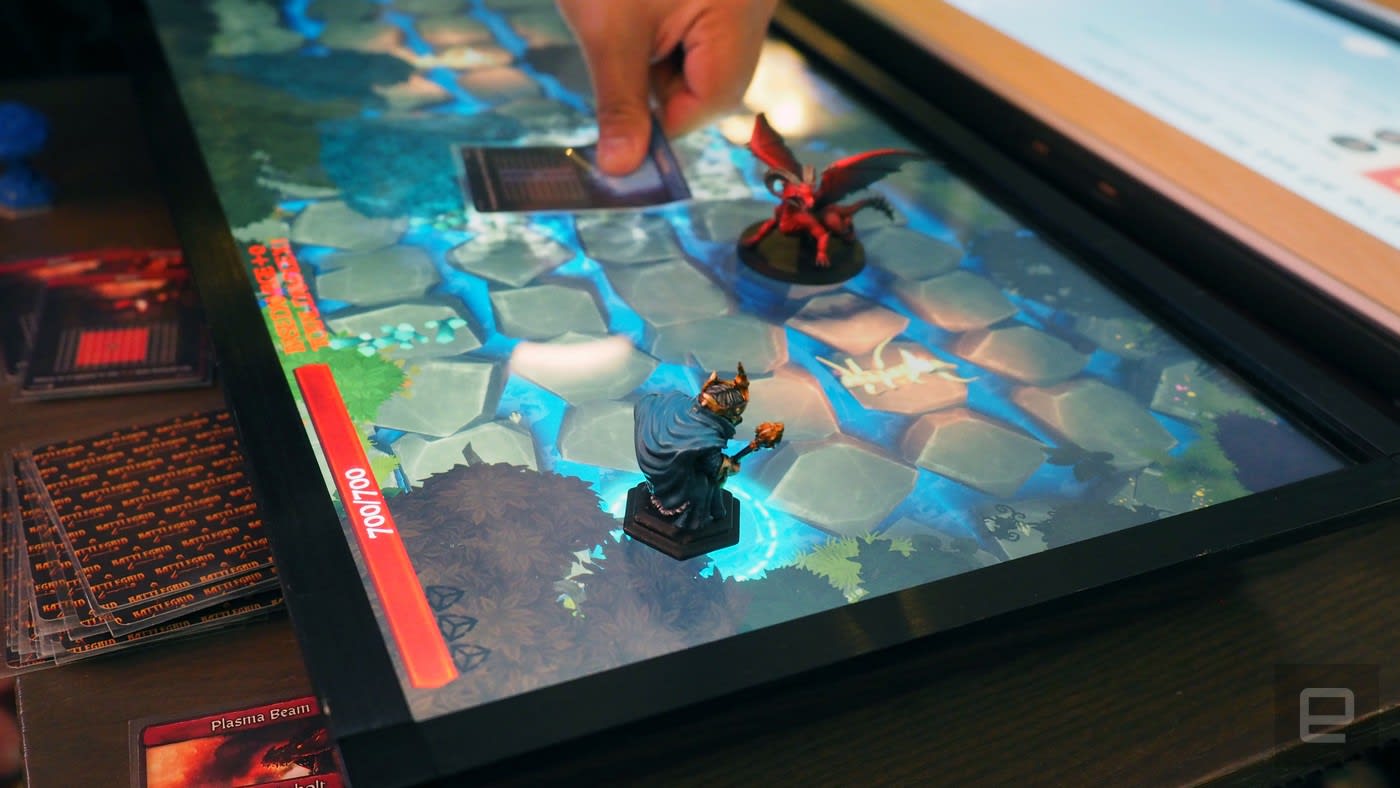
The PlayTable is expected to come out this fall, with an introductory price of $349, down from its intended MSRP of $599. It’ll come packaged with a few games like Battlegrid, while other titles will be available through the PlayTable store ranging from a few bucks to as high as $35. For some titles, that higher price includes the components, putting it on even ground with many regular cardboard and plastic games. But others might be standalone experiences, which means they’re more comparable to buying a console video game. Either way, tabletop gamers will appreciate the ability to build a board game collection that won’t take up much room, and not having to worry about losing irreplaceable pieces like their favorite fire mage again.
Source: Blok.Party
California will send residents election information through Nextdoor
Five California counties have adopted a voting act that will allow them to switch up how they handle elections. Within those counties, voters will have more choices in how they cast their ballots — the can mail them in, vote early or vote at any polling station in the county. And now California’s Secretary of State has announced that residents of those counties will also start to get election information through Nextdoor, the social network for neighborhoods.
The counties participating are Madera, Napa, Nevada, Sacramento and San Mateo and voters in those regions will be able to receive messages through Nextdoor regarding election deadline reminders, the location of voting centers in their county and changes about upcoming elections. “Nextdoor’s online social network provides a powerful platform to directly communicate with voters,” Secretary of State Alex Padilla said in a statement. “There are a lot of exciting changes coming to voters in the five counties adopting the Voter’s Choice Act in 2018. Through Nextdoor we can share nonpartisan election information that helps inform voters and allows them to take advantage of these new improvements. This is an exciting public-private partnership that shows how government and tech can work together to empower citizens to participate in our democracy.”
The Secretary of State’s office reports that Nextdoor reaches 92 percent of the neighborhoods in these five counties. In a statement about the partnership, Nextdoor CEO Nirav Tolia said, “Voting is a critical part of the citizen engagement required to build strong communities, and Nextdoor is increasingly the forum for neighbors across the nation to engage with each other regarding pressing local policy issues and to connect with their local officials. As California’s election process evolves to meet the needs of the voters, we look forward to partnering with the Secretary of State’s office to help educate the public about the process of democracy.”
Source: Secretary of State Padilla
Sushi robots, AI pianos and jump jetpacks on SXSW’s show floor
The SXSW show floor hosts a treasure trove of strange, innovative and ridiculous experiences from around the world. A vast array of industries are represented in the heart of the Austin Convention Center, including virtual reality, 3D audio, medical technology, sustainability, interplanetary rockets and rovers, and even bespoke, branded socks. This year, some of the most eye-catching installations are all about robotics and artificial intelligence.
Japanese companies showed up at SXSW with a handful of concepts for the future, including Lunavity, a jetpack designed to help the wearer jump higher and farther. It simulates jumping in a low-gravity space — hence the lunar namesake — and opens up new sports possibilities. One developer specifically mentioned quidditch, for instance.
And then there’s the sushi robot from Japanese manufacturing company Denso and its partners. The project itself is called Open Meals, and the goal is to digitize different foods and then have robots recreate those recipes anywhere in the world (or in space, as the marketing video demonstrates). The food itself will be constructed out of a gel that can take on a variety of textures. In the concept phase, sushi created by the Open Meals robot resembles something out of a 16-bit video game, but hopefully with investment and additional development time, it’ll eventually look like the real thing.
Yamaha showed up at SXSW, too, with a demonstration of its Yoo artificial intelligence technology. Yoo is an AI system that listens to the music someone is playing — in the case of this demo, “Twinkle Twinkle Little Star” on the piano — and responds in real-time with an accompaniment. Yoo has already made its debut in Japan, where it’s been used in professional concerts. In one case, the AI system joined a quartet — while the strings sung, a pianist-less piano played along.
There’s also the AI-powered Gochan mascot created by Nextremer, a team that builds natural language processing systems (chatbots, essentially). Gochan is the face of TV Asahi, a Japanese television network, and at SXSW, she came alive, asked me questions and then wrote a rap about my life. It was adorable, if not exactly practical.
That’s the beauty of the SXSW show floor — some of these products are far-fetched concepts, some are practical solutions to everyday problems, and and still more are simply a lot of fun.
Catch up on the latest news from SXSW 2018 right here.
SEC charges Theranos and CEO Elizabeth Holmes with ‘massive fraud’
The SEC has charged Theranos, Elizabeth Holmes and Ramesh “Sunny” Balwani with fraud relating to the startup’s fundraising activities. The company, as well as CEO Holmes and former president Balwani are said to have raised more than $700 million from investors through “an elaborate, years-long fraud.” This involved making “false statements about the company’s technology, business and financial performance.”
In a statement, the commission said that the company, and its two executives, misled investors about the capability of its blood testing technology. Theranos’ big selling point was that its hardware could scan for a number of diseases with just a small drop of blood. Unfortunately, the company was never able to demonstrate that its system worked as well as its creators claimed.
Theranos also apparently claimed that its hardware was used by the US Department of Defense and was deployed in combat zones. Investors were told that this deal, and others, would help the company pull in $100 million in revenue in 2014. Unfortunately, the DOD never used the equipment in combat zones and only generated $100,000 in revenue during that year.
The company and Elizabeth Holmes have already agreed to settle the charges leveled against them by the SEC. Holmes will have to pay a $500,000 fine and return 18.9 million shares in Theranos that she owned, as well as downgrading her super-majority equity into common stock. The CEO is now barred from serving as the officer or director of a public company for 10 years. In addition, if Theranos is liquidated or acquired, Holmes cannot profit from her remaining shareholding unless $750 million is handed back to defrauded investors.
Balwani, on the other hand, is facing a federal court case in the Northern District of California where the SEC will litigate its claims against him. It’s important to note that the deals between Holmes and Theranos are still subject to approval by the court, and neither party has admitted any wrongdoing.
The company has had its fair share of ups and downs, and raised hundreds of millions of dollars on the promise of revolutionizing medicine. By 2016, the company was facing a fight with Walgreens, its key partner, and whistleblowers claiming that internal standards were concerning. Then there was the lawsuit from investment fund PFM, which claimed that it had been misled into handing over $100 million.
Since our long and in-depth profile on Theranos’ troubled time, the company has conducted employee layoffs and had its financial woes exposed for all to see. Settlements with PFM and Walgreens forced the company close to bankruptcy, which was only avoided thanks to a last-minute, $100 million loan.
Not to mention that Anchorman and The Big Short director Adam McKay is still making a Holmes movie, which is expected to star Jennifer Lawrence. The film is based on the work of John Carreyrou — the Pulitzer-prize winning journalist who has done the most work to reveal the truth about Holmes. So, you know, it’s gonna be a really flattering film.
Source: SEC
Yuri Suzuki mimics ‘The Sound of the Waves’ with surf data
Yuri Suzuki was hunched over a MacBook Air with a “Fuck Brexit” sticker on the lid. He opened Magicseaweed, an ocean-monitoring website for surfers, and searched for a few spots along Spain’s northern coast. “It’s quite amazing to see the super-precise data we can get,” he muttered, turning the screen toward me. I nodded as the sound artist, designer and musician scrolled past endless tables listing hourly wave height and speed, wind and temperature conditions. These numbers, he explained, weren’t holiday research but the secret behind his latest and most ambitious art installation, The Sound of the Waves.
You can find the project inside London’s Stanley Picker Gallery, a few hundred yards from the Kingston School of Art. In a white, high-ceilinged room, 11 motorized rain sticks stand on camera tripods, rotating at a seemingly random rhythm. Sometimes, they move as a group, but usually one or two shift while the others stand still. When they tilt, a collection of beads cascade through their cylindrical innards, mimicking the sound of the ocean lapping against the shore. It’s a calming experience that encourages you to close your eyes and visualize the White Cliffs of Dover, or the glassy waters surrounding the Great Barrier Reef in Australia.
Every rain stick is connected to a gray box with a Particle Photon kit inside. The so-called Internet of Things hardware can access crowdsourced data directories — in this case, Magicseaweed — over WiFi and relay that information to the stepper motors behind each rain stick. Suzuki uses wave height to dictate how far the instruments rotate and “swell period,” the number of seconds between each wave, to decide when they should start moving. The whole experience is on a 10-minute timer: The first half, or “phase,” connects all 11 rain sticks to a single, randomly selected beach, while the second half gives them different locations to simulate.
The Sound of the Waves (2018) is a kinetic sound installation constructed from African rain sticks mounted on tripods. Using crowd data that measures wave oscillation from beaches around the world, the information is transmitted live to a computer controlling the tripods. pic.twitter.com/d4PzQOcSAv
— Yuri Suzuki (@yurisuzuki) February 24, 2018
Credit: Yuri Suzuki
Suzuki grew up in Tokyo, the antithesis of quiet Japanese seaside towns like Kamakura and Enoshima. He studied industrial design at Nihon University before joining Japanese art group Maywa Denki, best known for the wonderfully wacky Otamatone instrument. “I never grew up with a seaside city or anything,” Suzuki explained, “but at the same time, I’ve always been really obsessed with soothing sounds.” He moved to London in 2005 to study product design at the Royal College of Art under Israeli architect Ron Arad. By 2013, he had taken up a teaching position and created his own studio focused on audio-based research and consultancy.
A year later, the skinny designer created the Ototo synthesizer and musical invention kit. The hand-sized board, crowdfunded on Kickstarter, featured 12 touch-sensitive keys that could be connected to everyday objects with crocodile clips. That meant you could play charming tunes by tapping on fruit, plants and aluminium foil. The machine also had a built-in speaker and four sensors for controlling pitch, volume and the sound’s “texture.” Suzuki enjoyed the experience but decided he was “more of a designer than a manufacturer.” A hardware startup, after all, required a different structure with rigorous retail and marketing strategies. “But it was nice to run [the Kickstarter campaign],” he said. “It was really, really nice.”

At his office near London Fields, Suzuki explained his long-standing interest in ambient noise and whether it’s possible to improve or “redesign” the man-made sounds we encounter every day. Most cities, for instance, are filled with noisy cars and construction sites. People drown them out with noise-cancelling headphones and meditative white noise machines, but these rely on artificial, compressed tracks. It’s possible, of course, to improve sound quality with high-end gear and lossless audio formats, but ultimately it’s digital imitation. A recording of the rain isn’t the same as listening to a thunderstorm against your bedroom window.
Suzuki was inspired by Fallingwater, a house built by famed architect Frank Lloyd Wright in rural Pennsylvania. It sits over a small waterfall that provides a nonstop supply of natural, ambient noise for visitors. At first the sound is hard to ignore, but soon enough it fades into the background like an old piece of furniture. “You totally forget about it,” Suzuki said, “and just feel a nice, comfortable environment in there.” Of course, in a city like London, it’s nearly impossible to build a waterfall in your backyard. And if you want to hear the sea — well, by definition you can’t be inland.
Still, Suzuki wanted to build The Sound of the Waves in a domestic setting. He researched the idea and concluded that it was “not really possible” to simulate the intricacies of the ocean with modern algorithms on a computer. Thankfully, he stumbled on Magicseaweed and its extensive database of live and long-range surf reports. The Devon-based company — acquired by rival surf monitoring website Surfline last October — was happy to help with Suzuki’s unusual art project. It meant the Japanese designer could track and replicate real-life waves without fully understanding the moon, weather and oceanic currents that control them.

Building The Sound of the Waves wasn’t easy, however. In the beginning, Suzuki wanted 12 rain sticks in a clock-like formation. “But we had a bit of a problem with the installation,” he admitted, and had to sacrifice one. It was also tricky to find 11 matching rain sticks. Most are hand carved and therefore unique in length, weight and tribal decoration. Suzuki needed a clean, uniform design and searched tirelessly for the right supplier. “Because if each motor had a different weight on it, it would have been a nightmare to control the mechanical design sound [in the room],” he said.
Suzuki plans to increase the number of rain sticks in the future. Ideally, he would like enough instruments to mimic a beach in every country. “I’m really interested in browsing sound from around the world, but in a single place,” he explained. It’s a concept that Suzuki has explored in previous projects. In 2012, he built a vinyl globe that played eclectic music as the needle passed over different countries. Four years later, he teamed up with Moog on a map-shaped musical synthesizer. Each module, or “country,” contained unique sounds that could be blended together with red wires.
Redesigning our society with calmness in mind could help us lead healthier and happier lives.
This concept is secondary, though, to Suzuki’s ideas on noise pollution. He’s not suggesting that everyone should have The Sound of the Waves in their living rooms. And he’s aware that ambient music is an evolving concept; coffee shops, for instance, are a popular workspace that didn’t exist 1,000 years ago. Suzuki does, however, want people to think about sound and what they find relaxing. Redesigning our society with calmness in mind — everything from buildings to household appliances — could help us lead healthier and happier lives. It’s an abstract idea, but one worth balancing with our insatiable desire for better, more powerful technology.
 AIVAnet