


Google Debuts ‘Android P’ With Support for iPhone X-Style Notches
Google today announced a new Android update, Android P, which introduces support for display notches built into Android devices that mimic the design of the iPhone X.
According to Google, Android P offers support for “the latest edge-to-edge screens with display cutout for camera and speaker,” with a new “DisplayCutout” class for outlining the size and shape of a notch on an Android device.
Several new Android devices feature an edge-to-edge display with an included notch much like the iPhone X. The Leagoo S9, for example, is a $150 iPhone X clone that features slim side bezels and a front notch, with a design that looks very similar to the iPhone X.
 Leagoo S9
The recently announced Asus ZenFone 5 also adopts a design that uses a notch, and when it was unveiled, Asus bragged that its notch is 26 percent smaller than the notch on the iPhone X.
 Asus ZenFone 5
Other clone devices have surfaced from Chinese vendors, such as the Boway “Notch Series,” and with official Android support for notch-style designs, we’ll likely see more Android smartphones that aim to emulate the iPhone X. Even more well-known Android smartphone vendors are embracing the notch, with LG’s upcoming G7 said to include a notched design.
 Renders of the upcoming LG G7 via Techno Buffalo
Apple implemented a notched design in the iPhone X in an effort to maximize the available display area. The notch houses the TrueDepth camera system, which includes several components necessary for Face ID. Android companies copying Apple’s design aren’t using the notch in the same way, with currently available models offering fingerprint scanners rather than facial recognition.
In addition to notch support, Android P includes several other notable new features, such as indoor positioning APIs, enhanced notifications, multi-camera support, HEIF image support, design tweaks and changes, restricted access to the mic, camera, and other hardware, and more.
Android P is available for developers starting today, with a public release to come in the future following beta testing. Google is warning that Android P is in the early stages of development and should not be installed on a primary device.
Related Roundup: iPhone XTag: AndroidBuyer’s Guide: iPhone X (Buy Now)
Discuss this article in our forums
Samsung spills some details on its 2018 QLED TV lineup
Sure, Samsung showed off its MicroLED wall and 8K consumer TV at CES this year, but what about TVs for the rest of us? Those details were scant in Las Vegas, but now the company is ready to talk about its QLED lineup. There are some similarities across the entire range, like Ambient Mode where the display will mimic the wall color or pattern behind it (like a chameleon) so the TV blends into your living room rather than looking like a black mirror when there’s no programming running to it.
There’s also HDR10+ (with variants based on the model you’re buying) and a smart TV platform powered by Samsung’s Bixby digital assistant. While pricing and availability isn’t known at the time, we can relay what sizes each model will be available in. The entry level Q6F comes in 49″, 55″, 65″, 75″ and 82″ flavors, while the Q7F and Q8F are available in 55″, 65″ and 75″ models. You’ll be able to get the flagship Q9F with either a 65″ or 75″ display. The Q8F and Q9F models share what Samsung is calling a Direct Full Array backlight, which means you can expect better black levels. Oh, and each display is flat as a board.

The 65-inch Q6F model will run you $2,200, while you’ll have to shell out $3,800 for the comparable Q9F. Samsung says these sets will be available in stores later this month. If you’d rather not wait, LG revealed cost and availability for its 2018 OLED lineup yesterday morning. Decisions, decisions.
Netflix is taking a wait-and-see approach to virtual reality
Netflix was one of the first video-streaming services to adopt VR in 2015, when it introduced a 360-degree app that let users step into a virtual room to watch movies or TV shows on a Gear VR. Then, a year later, it launched a version of that application for Google’s Daydream headset, but the company has been relatively quiet in the VR space ever since. The reason for that, simply put, is that Netflix doesn’t see the technology as a priority — at least not right now. Speaking at a media event inside the company’s Hollywood headquarters, Chief Production Officer Greg Peters said that Netflix is only focused on seeing how VR systems evolve at the moment.
He said that’s because he sees it as more of a medium intended for gaming, rather than one where subscribers can have a lean-back experience to enjoy any of the content Netflix has to offer. Peters added that he believes virtual reality is still in its early days, hence Netflix choosing to sit back and take a wait-and-see approach to it. Netflix may have the right idea, too, because as we saw with NBC Sports’ VR streams of the 2018 Winter Olympics, the technology can be pretty tedious for viewers — even if most of that blame lies on the hardware limitations, not the content being produced.
Netflix rival Hulu, on the other hand, continues to be committed to VR. Just a few months ago, the streaming service brought its virtual reality content to Windows Mixed Reality headsets, including two new shows: The Driver and A Curious Mind. The arrival of headsets that are both more powerful and accessible in the near future, like the Oculus Go, could make Netflix change its mind. But for now, the company seems to be okay with letting VR platforms grow first, before taking any major chances on any of them.
Leave video voicemail for your unanswered Google Duo calls
Google’s Duo app is making it possible to leave more than just a voice mail when it isn’t enough. The big G’s app now allows you to record 30-second video messages when the person you’re calling isn’t picking up or declines your call for some reason. Simply tap the “Leave video message” icon when it pops up, record your video and then send that clip of your dog doing silly things or fun get-togethers to your relatives and friends.
Of course, you can’t leave video messages when calling contacts who don’t have the Duo app. The videos can only be accessed within the application — the recipient only needs to tap your icon and then tap “Call now” to call you back. Google says those messages are end-to-end encrypted and will disappear 24 hours after being watched, but adding them to “favorites” downloads and saves them locally. You can start blasting video messages to friends very, very soon: the feature is rolling out on iOS and Android today and will be on everyone’s phones (well, everyone who uses it anyway) in the next few days.
Source: Google
Our first look at Samsung’s 2018 QLED TVs
Samsung practically stole the show at CES with its massive 146-inch MicroLED TV, The Wall. But that’s not something most people will be able to afford. That’s where the company’s mainstay QLED 4K lineup comes in. At a media event in New York City today, Samsung unveiled its next generation of QLED TVs, which not only look better, but feature some genuinely useful improvements. They’re an even better option for consumers who want to get rid of the typical cable clutter around their home theater, as well as those looking for smarter sets.
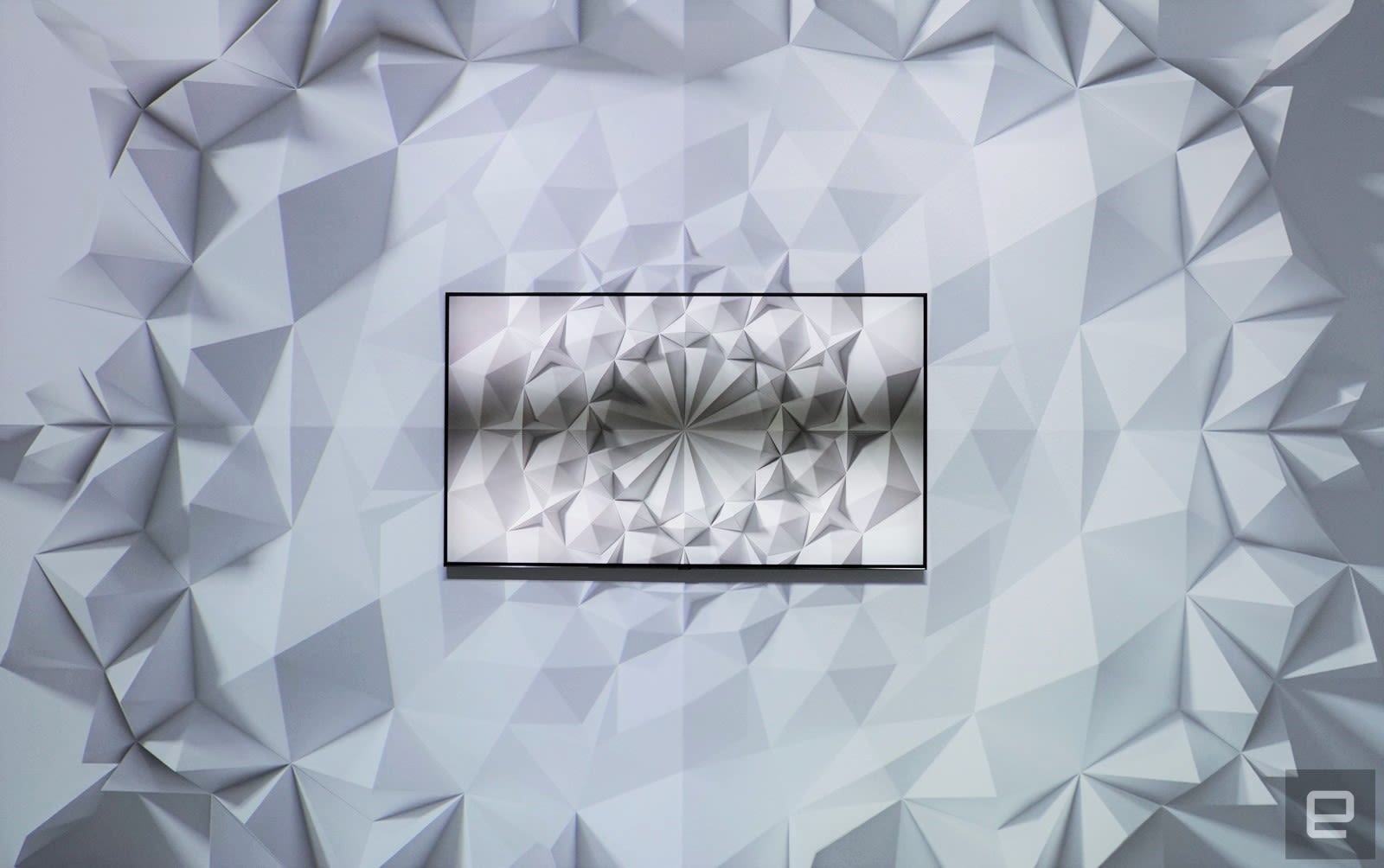
The biggest addition to the QLED lineup is Ambient Mode, a new feature that lets them blend into the background when they’re off. If you’ve got a brick wall, for example, the TV will display the same pattern. It might seem superfluous, but it’s a smart way to keep your set from just being a giant black mirror when it’s off. You can also overlay information on top of the background, like the news and weather, as well as display artwork or family photos.
Ambient Mode relies on the SmartThings phone app to work. To set it up, you just have to take a photo of your QLED TV and the surrounding wall. After that, the set determines the best pattern to display, a process that takes around five seconds. Based on a few demos at the event, the feature is definitely intriguing, especially for people who wall-mount their sets. It’s probably not enough to tempt shoppers away who care more about image quality, but it’s useful for style conscious buyers.
Devindra Hardawar/Engadget
Samsung also improved its single cable solution on its Q7F and Q9F models. Just like last year, it’s a single optical fiber wire that connects to a separate box that houses all of your typical inputs. This time, though, that cable also carries power. Samsung had to make it a bit thicker to make that happen, but it seems like a worthy trade-off. Having to run power separately kind of defeated the purpose of the company’s single-cable vision. The TVs come with a 5 meter cable, but you can also order a 15 meter version separately.

Devindra Hardawar/Engadget
As you’d expect, Samsung is also making the QLED TVs smarter with Bixby integration. It replaces S-Voice, the company’s middling voice interface, and lets you search for content across TV and streaming services (no Netflix yet, though). Bixby isn’t as advanced as its mobile sibling, but it’s a first step towards unifying the company’s platforms. With SmartThings support, you’ll also be able to control compatible smart devices right from your TV. That’s especially useful for things like smart cameras, since they can show up on your screen.
And of course, there are plenty of image improvements in the new QLED TVs. Most notably, Samsung added Direct Full Array backlighting to the Q8F and Q9F. That’ll let the TVs handle contrast and black levels better than the company’s edge-lit displays. Vizio has offerrd full-array backlighting in its TVs for years, which notably cost much less than Samsung’s. It’s about time the Korean electronics giant caught up.
From what I could tell, the QLED sets all looked better than last year’s models. The improved backlighting was easily noticeable on the higher-end models, though I wish Samsung was able to deploy it across the entire lineup. The Q6F and Q7F still rely on edge backlighting. As a tradeoff, those sets are a bit slimmer.
It’s strange to think that Samsung’s most exciting new feature shows up when their TVs are off. That’s not exactly a put-down, though, since background blending isn’t something anyone else is offering yet. Beyond that, it looks like Samsung has an interesting year in home entertainment ahead. The Wall will be available sometime in August, and these QLED sets will start rolling out later this month.
Samsung’s massive ‘The Wall’ TV will be available in August
At a Samsung TV event this morning, the company announced that their massive 146-inch 4K TV made of MicroLED panels, aptly named ‘The Wall,’ will be available for consumers to buy this August. While the electronics titan didn’t release a price, it’ll likely be significant, so start saving now.
When we first got a look at The Wall during CES 2018, two things were clear: The huge TV is a scaled-down version of their previous 34-foot 4K screen aimed at the home market, and that its rich, bright colors still came off looking like other OLED sets. Which is surprising given that Samsung chose to skip that tech for MicroLED to avoid OLED’s downsides like burn-in and shorter lifespans. Stay tuned for future announcements about The Walls price and availability.
Giugiaro’s supercar concept EV gives back to the power grid
The Giugiaro Sybilla is a bonkers concept EV with a fighter jet-like sliding canopy, gull-wing doors and screens everywhere, including the doors. But the vehicle from GFG Style, penned by auto design legend Giorgetto Giugiaro, is actually meant as a showcase for sustainable grid technology, believe it or not. It was built for Chinese windmill manufacturer Envision Group to illustrate how electric cars can connect intelligently to homes, businesses and charging stations so they don’t overwhelm future electrical grid systems.
The car itself — a one-off that will never be built — is one of the quirkier concepts at the Geneva Motor Show, and that’s saying a lot. While it certainly fits the supercar mold, it has items like the electric bubble canopy that you don’t see every day. In keeping with the green motif, it also has modest performance specs: a 400-kW motor, 450 kilometers of range from a 100-kWh battery, speeds around 120 mpg, and a 0-to-60-mph time of 4.5 seconds.
The always-animated Giugiaro, responsible for the design of mythical gas-powered vehicles like the Aston Martin DB4 GT, DeLorean DMC-12, and Ferrari 250 GT SWB Bertone, said that EVs provide one huge benefit to designers. “The big difference with electric vehicles is that there is more space for the passengers,” he told Engadget. “You can see that in the prototype, and in other electric cars.”
The Sibylla, though, is really meant to highlight the infrastructure part of EV ownership. “The grid is the real elephant in the room when it comes to electric cars,” Envision designer Jianfeng Yan said. “Let’s say 10 percent of the cars in France become electrified, that’s three million cars. If all of them charged at the same time, with a fast charge, that would create a load of 300 gigawatts. Historically, the peak load in France is 100 gigawatts. So there’s a huge infrastructure challenge.”
The answer is to make sure that cars only charge when power is cheap and plentiful, and that they can kick energy back to the grid when it’s overwhelmed. So beneath the Sybilla’s lovely exterior is technology that lets the the Sybilla connect to systems in your home, office and in public to only charge at the optimal times — and give back power when needed.

The Giugiaro Sibylla is a grid-connected supercar.
Steve Dent/ Engadget
At the same time, the vehicle would assuage the owner’s conscience by only pulling power from green sources. “An electric vehicle is only as green as the energy it runs on,” said Yan. “China is still 70 percent coal-fired, so you can’t really say it’s green energy at all. Our technology lets customers access 100 percent sustainable energy at a low cost, by connecting to 100 gigawatts of renewable assets and millions of smart devices.”
We’ve heard of similar ideas from companies like Tesla and, most recently, Renault, with its “smart island” that uses grid tech to let cars share their battery power. However, Envision is already using the tech in China, and said that, unlike companies like Tesla, is agnostic about the type of vehicles, chargers, devices and grids. “It’s not about the devices, it’s how you connect and synchronize them,” Yan said.
The Sibylla is a one-off concept, but it’s built on a standard platform and it wouldn’t be hard for the right company to turn it into a slightly less exotic production car. “Apart from the sliding canopy, the wheelbase is the same as an existing car from, and the suspension is from a real car. So the question is, who has the money to get this kind of car into production?” asked Giugiaro. “Take a brand like Audi, for example. If they said ‘I want to do this type of car,’ in two years, you would see it on the road.”
BlackBerry’s post-phone future includes IoT security
BlackBerry hasn’t been shy about shifting its focus away from hardware and toward technologies you can find inside others’ devices, such as self-driving cars and secure comms. If you need any further proof, though, you just got it: BlackBerry has struck a deal with Swiss electronics maker Punkt to secure an upcoming range of Internet of Things devices. In theory, the embedded security tech will ensure they can connect to your home or office network without creating glaring vulnerabilities. Details of the devices themselves weren’t mentioned, but it’s safe to presume they’ll be more advanced than the power accessories and cordless phones that represent Punkt’s current lineup.
In many ways, this represents the future for BlackBerry. It’s still technically involved in the smartphone business, but only on the software and licensing side — and while the sales are relatively healthy, they’re a far cry from the days when BlackBerry was a dominant force. As long as that’s the case, the real money will reside in services and security deals like this. Don’t be shocked if deals like this Punkt agreement become a regular occurrence.
Source: BlackBerry
Oculus Rift headsets are offline following a software error
This morning, people around the world couldn’t use their Oculus Rift VR headsets. System software couldn’t “reach Oculus Runtime Service” according to error messages posted to the Oculus forums, spotted by Polygon. One possible explanation is that an Oculus security certificate expired today. The company took to the bulletin board to offer a bit of an update.
“We are aware of and actively investigating an issue impacting ability to access Rift software,” the post says. “Our teams apologize for any inconvenience this may be causing you and appreciate your patience while we work on a resolution. We’ll share more updates here as we have them. Thanks.”
Rebooting the Oculus software, or the PC it’s running on doesn’t seem to be working at the time. So, if you had plans to spend your day jacked into the matrix, it sounds like you’ll need to readjust until a fix is available. We’ve reached out to Oculus for more information and will update this post should it arrive.
Via: Polygon
Source: Oculus forums
First Android P beta adds full support for notched displays
It’s March, and that means it’s time for Google to release its first look at the next version of Android. As of today, developers can download the first version of Android P to last year’s Pixel and Pixel XL as well as the newer Pixel 2 and Pixel 2 XL. Since it’s a developer preview, we’re not getting a ton of information about consumer-facing features, there is a lot of detail on what new features and technologies developers will be able to take advantage of in their apps when the next version of Android arrives later this year.

Right now, the feature that’ll be most interesting to users is improved messaging notifications — Google made revamped notifications a priority last year, and Android P will bring more of your conversations into the notification shade. As some screenshots show, messaging apps can include multiple lines from a conversation along with Google’s smart replies in the notification shade, making responses quicker while also including more conversational context.

Given how the smartphone “notch” isn’t going away, Google is including support for cutout displays in Android P — it’ll make it easier for developers to manage how a screen cutout affects an apps content. The OS will also now support HDR VP9 video, so that HDR-enabled video on YouTube and Play Movies will work on compatible devices. The HEIF image encoding option will also be supported in Android P, as well.
Multiple cameras is becoming more and more common these days, so Google added a new multi-camera API to Android P — it lets developer access “multiple streams” from two (or more) camera lenses. How exactly that’ll be used is up to developers, but Google says that apps will be able to pull in image data simultaneously from both dual-front or dual-rear setups.
Google is also addressing the difficulties with location tracking that occurs when a phone and its user are indoors by supporting the WiFi RTT protocol. RTT stands for “round-trip time,” and it lets your phone measure distances between WiFi access points without actually connecting to them. Once your phone knows the distance between three or more access points, Google says your position can be determined with an accuracy of one to two meters. This should help apps do better indoor mapping, something that Google’s been working on in Maps for years now. Additionally, Google says it’ll help support “disambiguated” voice control; that would let users say something like “turn on this light” and have the Google Assistant understand where you are and what light you’re talking about.

Finally, Google is continuing to improve Android’s foundations, including power-saving tools like Doze (which arrived in Android Oreo), App Standby and Background Limits. Android P will also help push developer and users both to run more current apps — it’ll show a dialog box when you try and install an app that targets versions of Android earlier than 4.2. Apps currently in development can now target Android P, so it really shouldn’t be hard to find apps that are ready to take advantage of the next Android version.
If you’re a developer ready to take the plunge, Google has published the initial release of Android P, but it can only be installed with a direct download and flash of your device (you can find instructions here). Naturally, Google has explicitly said that Android P is not for daily or consumer use, so don’t put this on a phone you rely on. We’re just two months out from Google I/O, where we’ll certainly get more details on what to expect from the latest version of Android. But for now, this will have to do.
 AIVAnet