


Everything you need to know about Chrome’s flags

WARNING: EXPERIMENTAL FEATURES AHEAD!
One of the cool things about Chrome is that we’re able to play with experimental features. That means we can install beta or even alpha versions, but we can also try some of the truly experimental things that haven’t been included on even the most alpha of alpha builds through what are called “flags.”
Let’s have a look at what they are and how to get started breaking things.
What are Chrome Flags?
Flags are experimental features as well as features most users will not need that are buried in a place where they won’t be accidentally enabled.
Some are features Google is working on implementing, some are just things being tested to know if it even should work on making a stable feature, and some are there because some obscure use case means there needs to be a way to do a thing.
Experimental things are cool when they are cool, but not so much when they aren’t.
Flags can improve your experience using Chrome or make it worse — that’s how things go with anything still in its experimental phase. They can also let you have access to content that you wouldn’t normally be able to see or use, like VR websites or features in other Google products like YouTube that aren’t quite yet ready for the general public.
They can also change the way Chrome itself runs by changing settings for hardware acceleration or memory management which can lead to problems. These problems can be simple and solved by reverting a setting or significantly worse. I’ve never heard of someone ruining a computer by changing a Flag, but there’s a first time for everything so you need to be careful.
Most people probably aren’t interested in changing any Chrome Flags and that’s probably for the best. But if you’re the type who can’t leave well enough alone, Chrome has you covered.
How to access Chrome’s Flags

To change any Flags, you need to know where they are. They aren’t exactly out in the open, but thankfully they also aren’t hard to uncover. Whether you are using a Chromebook or Chrome on another computer or even Chrome on your phone, you get to them the same way.
- In the Omnibox (Chrome’s address bar) on a blank tab, type the following: chrome://flags/
You’ll be greeted with a message warning you that these can experimental settings, and that things can go horribly wrong. And it’s true — you can make Chrome unusable if you change the wrong thing, and you can do worse things, too. This is more than Google covering themselves in case you break something, and it’s a warning you should pay attention to.
At the top of the page, you’ll see a search box where you can look for a specific Flag that someone or a website might have told you about. Google is pretty good at search.
You’ll also see a list of the Flags themselves. Each entry has a short description of what the setting changes, a button to enable or disable the Flag and a hyperlink so that you can get to that flag through the Omnibox without searching, such as chrome://flags/#WebRtcUseEchoCanceller3 which takes you to the Flag that attempts to cut back on microphone echo during web real-time chat instances. This is a good example of a Flag that won’t harm anything if you want to try it.
There’s always a way to go back unless you change a Flag that takes the reset button away!
To change a Flag, click or tap the button in its listing. you’ll see three choices: Default, Enable and Disable. Enable and Disable are simple enough to understand, but Default may throw you. it simply means that you want the setting to go back to whatever it was before you started changing things. it’s handy because it means you don’t have to remember if you enabled it or disabled it.
The most important button is at the very top of the page next to the search box: Reset all to default. That’s your get out of jail free card and as long as you can still start Chrome and get to it, you’ll be able to go back to where you were before you broke anything.
Should you change any Flags?
Ahh. That’s the meat of it all, isn’t it? These experimental things are right there and we get to try them as we please, knowing the risks involved. And as long as you understand those risks — you could lose browser data or compromise your security or privacy — there’s nothing wrong with trying things.
You’ll see tips about changing Flags online whenever someone finds a good one, but you probably shouldn’t just start jamming on buttons just because you can. An example of a Flag you might have heard about was the QUIC Flag — chrome://flags/#enable-quic. QUIC is Google’s experimental protocol, and it stands for Quick UDP Internet Connection. Its goal is to provide secure web browsing faster than the existing TLS/SSL protocols and in some ways, it’s pretty good. One way that it isn’t so good is that most Mitmproxy servers are unable to filter websites that serve you pages using QUIC. If you need to use a mitmproxy (you would know if you did) you can disable the QUIC Flag so it’s never used and every site serves you using TSL/SSL.
Never change a Flag for something you don’t understand. Trust me because I push buttons before I read them.
Another Flag that you can safely play with is the Fast Tab Unloader, chrome://flags/#enable-fast-unload. It’s Disabled by default on Chrome stable and what it does is allow the browser to run the process that checks, saves any data if needed, then closes the tab in its own thread outside of the user interface. The tab “closes” right away even though it’s still being handled in the background.
Of course, there are a lot of other Flags that can make everything worse, which are the ones you need to look out for. I’m not going to start talking about the ones I’ve tried and made everything worse other than to say Web Assembly Flags will break your browser and NaCI plugin Flags are things you should know what they are before you just press buttons. Trust a person who just pushed buttons and was sorry.
March security patches now available for Pixels and Nexus phones; expect your OTA soon

Security updates and fixes for “functionality issues” are cleared for landing and inbound.
Factory images with the March 2018 patch for the Pixel and Pixel 2 family, the Nexus 6P, and Nexus 5X are available at the Google Developer site and can be manually installed today, and OTA updates are expected to begin shortly.
These are part of the March Security Bulletin and besides patches for the critical vulnerabilities found in Android and hardware partner’s code, some bug fixes and software improvements are inbound for Google’s family of devices. Don;t get excited, though, there’s nothing fun in there.
- Improve screen wake performance with fingerprint unlock (Pixel 2, Pixel 2 XL)
- Improve audio performance when recording video (Pixel 2 XL)
- Improve crash reporting (Pixel 2, Pixel 2 XL)
I guess better crash reporting could be fun for some of us, though. And if you’ve been unlucky and have been bit by the “fingerprint unlocking slow-down bug” you are probably happy to see some more fine tuning being done.
The usual applies: you can grab the factory images and flash things yourself, or hang tight as Google says to expect an over-the-air update soon, which it encourages you to accept. Fast updates are one of the reasons to buy a phone from Google, but faster updates through a USB cable are an even better reason. Here’s what you need.
- Find the factory images here
- How to manually update your Pixel or Nexus
Google Pixel 2 and Pixel 2 XL
- Pixel 2 FAQ: Everything you need to know!
- Google Pixel 2 and 2 XL review: The new standard
- Google Pixel 2 specs
- Google Pixel 2 vs. Pixel 2 XL: What’s the difference?
- Join our Pixel 2 forums
Best Buy
Verizon
Google Store
Project Fi
MoviePass tracks your location before and after you go to the movies
Is your data worth a good deal on movies?
Unless you’ve been living under a rock, chances are you’ve heard of MoviePass by now. Being able to pay just $9.95/month to watch as many as one movie per day in theaters is an enticing proposition, but to not much surprise, some people are apprehensive of its too good to be true offer.

During the recent Entertainment Finance Forum, MoviePass CEO Mitch Lowe might have given some users a reason to cancel their subscription.
The topic of Lowe’s talk was Data is the New Oil: How will MoviePass Monetize It, and during this, he confirmed that MoviePass collects user data — specifically location info — before and after you go to the movies.
At one point, Lowe said:
We get an enormous amount of information. We watch how you drive from home to the movies. We watch where you go afterwards.
Later on in his talk, he made the reassuring comment of “we know all about you.”
There are a lot of apps that track location data, but what Lowe’s saying doesn’t exactly line up with MoviePass’s privacy policy of claiming to make a “single request” for your location when selecting the theater you want to watch a movie at. That’s drastically different from tracking your location before going to the movies and even for a point once the credits have finished rolling, so it’ll be interesting to see how MoviePass responds to these discrepancies.
I was thinking about signing up for MoviePass this summer, and while Lowe’s comments don’t personally deter me from the service, I completely understand current and potential customers being weary of it now.
Best of MWC 2018: What Android Central loved at this year’s show
Facebook expands breaking news label to more publishers
Facebook began testing a “breaking news” label for developing stories back in November, and now the social network is expanding the option to more publishers. Starting this week, the company says 50 more outlets in North America, Latin America, Europe and Australia will be privy to the tag. That’s in addition to the “small group of local and national publishers” that are already using it. If all goes well, Facebook said it may offer the option to even more publishers in the future.
As the image above illustrates, the tag adds a red “breaking” label beside the time and source as an attempt to make those posts more visible in the News Feed. The feature can be applied to Instant Articles, links and Facebook Live videos. Publishers included in the test can use the tool once a day and set a time limit for how long the story is breaking news — up to six hours.
There’s also an option for readers to report if they don’t think a story deserves the tag, feedback Facebook says will help it improve the tool. As you might expect, publishers will also get specific stats on how well the “breaking news” tagged posts perform in the News Feed. So far though, Facebook says the tag is proving effective. The company says clicks, Likes, comments and shares are all up on posts that have been included in the test thus far.
Source: Facebook
Uber considers Waymo partnership following lawsuit
Now that Waymo’s long-running lawsuit against Uber is finally settled, the two companies are free to cozy up to a possible partnership. According to a report at The Information, Uber executives, led by new CEO Dara Khosrowshahi, have been looking for a way to get Uber riders into Waymo’s autonomous cars.
Even though Waymo is already collaborating with Lyft, a working relationship with Uber would likely help the Google-owned autonomous car division get more of its self-driving cars on the road. Uber would be able to stay competitive with its largest rival, too, without falling too far behind in the public consciousness. There’s no indication, says The Information, that Waymo is ready to make a deal, however. Still, CEO Khosrowshahi is aware that Waymo’s self-driving systems are more advanced than Uber’s own, the site’s sources note, and would benefit from working with the Alphabet company.
Source: The Information
MWC 2018 teased a 5G-powered world that’s so close to being real
Before packing my bags for Spain, I took stock of my inbox for MWC meeting requests. A quick search showed I had more than 100 emails about 5G. “Solutions for cloud-based 5G infrastructures,” one read. “5G is happening,” another proclaimed. “Meet with XX 5G exec?” “XX invites you to experience the new 5G era.” From demos of super fast phones and connected street lights, to obscure infrastructure projects that will actually form the backbone of 5G, the thirst was real.
Cut to the first official day of the show, and it was almost impossible to avoid the in-your-face signs attempting to lure you to “5G open innovation” demos. Everywhere we turned, we were confronted with yet another banner. This isn’t surprising of course, 5G is very much a mobile communications standard and we were in Barcelona for Mobile World Congress, after all.
This isn’t the first time 5G news has permeated MWC — in years past, we saw companies show off “the first 5G phone,” even before the spec was approved. But at MWC 2018, we were seeing not just a few obvious proofs of concept, but a broad creative range of connected devices.
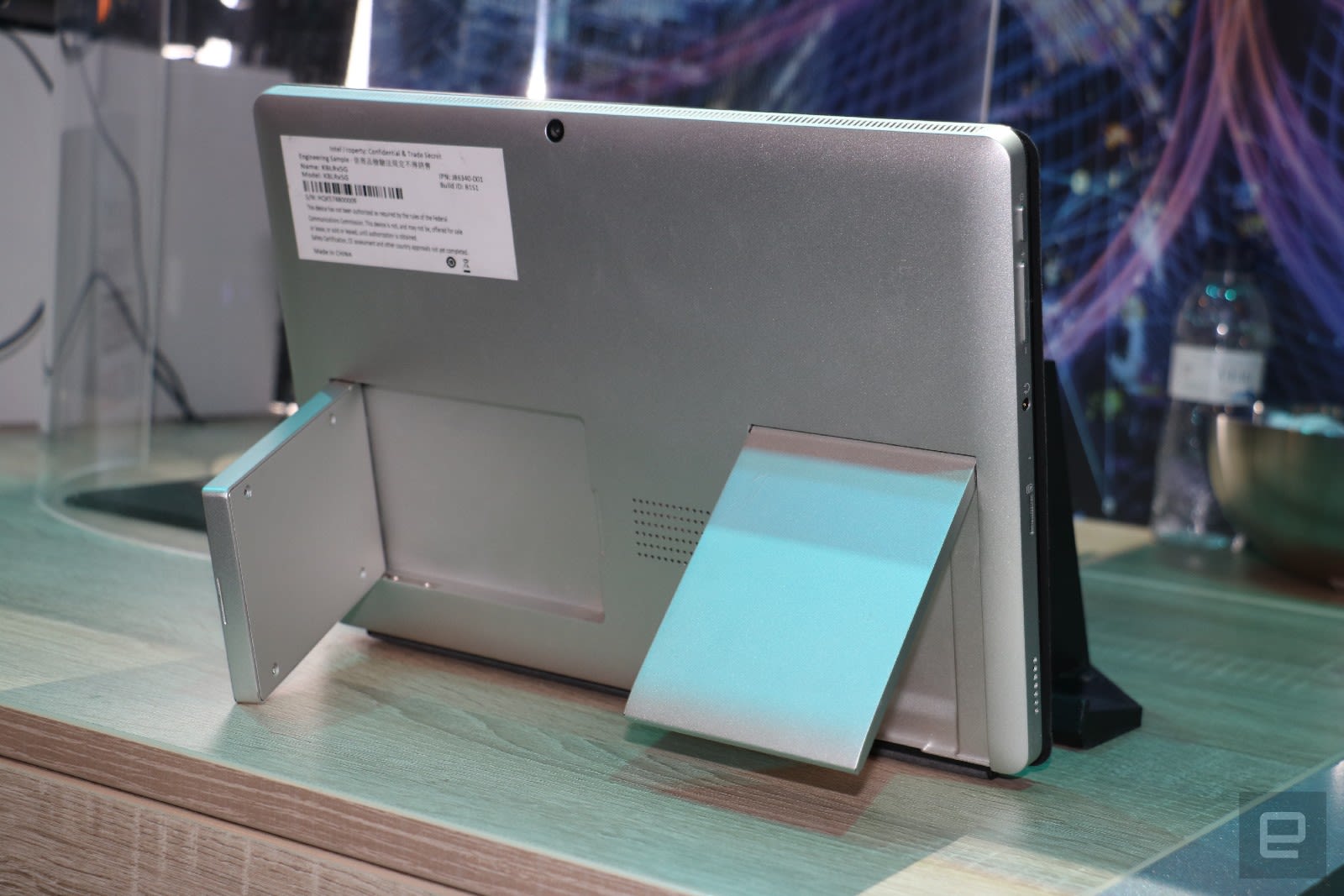
Intel, for example, had one of the most comprehensive sets of 5G applications on display. It showed off a 5G-capable PC concept, but it also showcased a 5G-connected car, as well as simulations of virtual cities. In those scenarios, devices like cars, traffic lights, drones and base stations communicate with each other to create a world that can basically think for itself. For example, cars packing 5G radios can allow passengers to conduct conference calls or watch Netflix at impressively high speeds while on the move. But a world with 5G everywhere could have gas pumps to automatically select the right type and amount of fuel for you and process the payment without having to leave the driver’s seat.
Self-driving cars can warn each other of upcoming turns and slowdowns, as well as allow for a traffic management to pre-emptively re-route autonomous vehicles to avoid congestion. Of course, we didn’t get to see that whole system in action just yet — what was on display was a cute setup with toys carrying transmitters to simulate that futuristic world.
Intel also shared a virtual map of a theoretical city that’s deeply integrated 5G into all sorts of devices. These ran the gamut from drones and weather sensors, to Bosch air quality monitors and General Electric’s CityIQ street lamps that track pedestrian traffic and listen for gunshots. Many of these are actually already live in various cities, but for the sake of MWC, Intel plotted their data onto a map of Barcelona. The company showed how, in theory, this information could all be collected and used not just for easing congestion, but also to deliver things like Amber alerts through digital billboards.
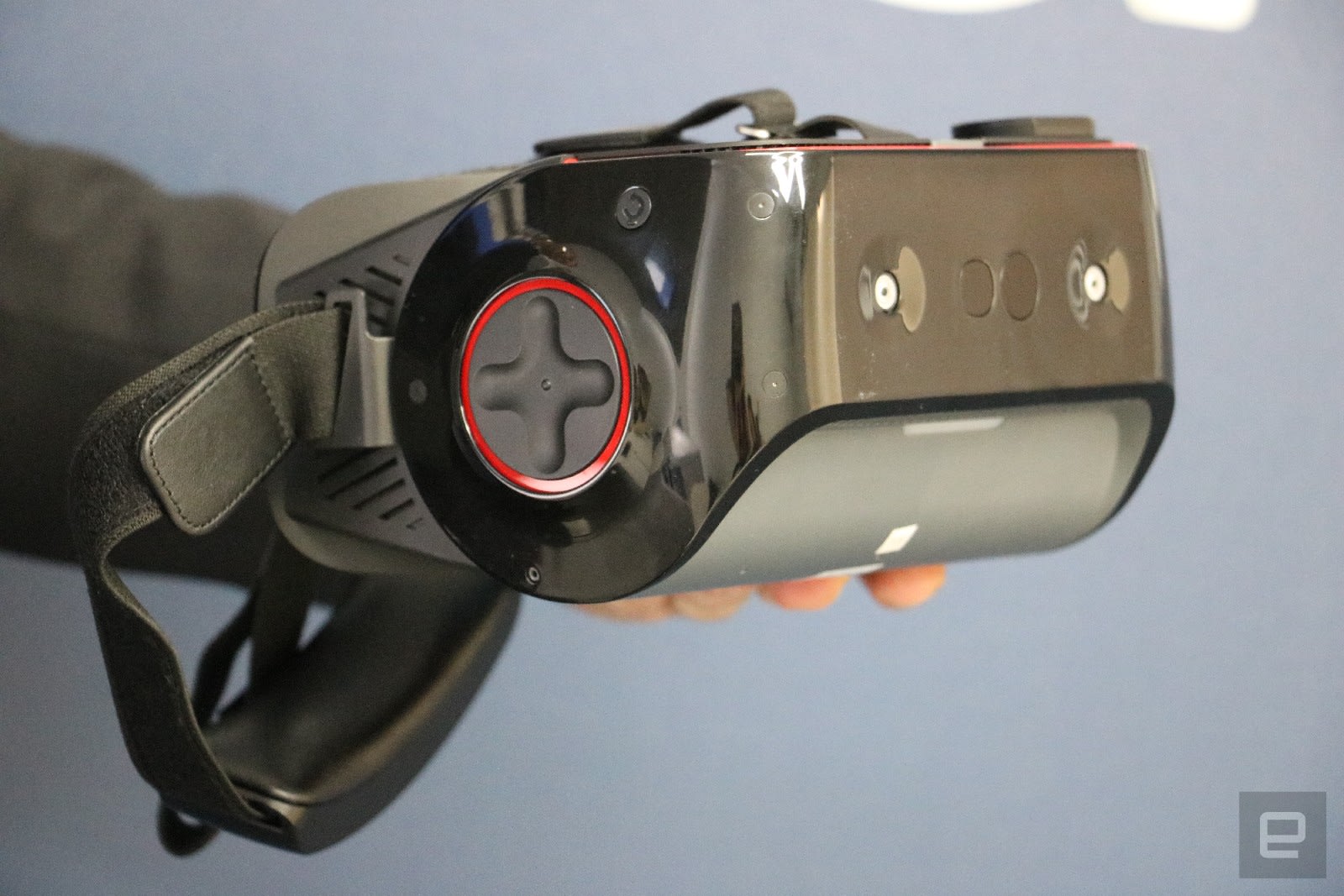
Above: Qualcomm’s Snapdragon 845 reference design headset (not the 5G version).
Meanwhile, in a meeting room above its booth, Qualcomm secretly showed off a virtual reality headset that uses a blend of on-device and cloud-based graphics processing to push an impressively high-res immersive experience. The characters I saw, and the details on their costumes and surroundings, were extremely clear, to the point where I could see small stains on a person’s jacket.
But more importantly, I was able to explore this detailed world without any noticeable delay caused by the cloud-based graphics processing, thanks to the 5G connection. During my demo with Qualcomm, I was also able to turn my head around freely. Even when the receiver on top of the headset was obstructed from view of the base station in the top right corner of the room, I was still receiving high-quality VR graphics with barely a flicker in the experience. This is noteworthy as millimeter waves, which are a key part of the new 5G spec, are notorious for being susceptible to signal interference.
This is just a demo, of course, but since it uses components that are already compliant with the new spec, it’s a good indicator of what’s possible when 5G rolls out.
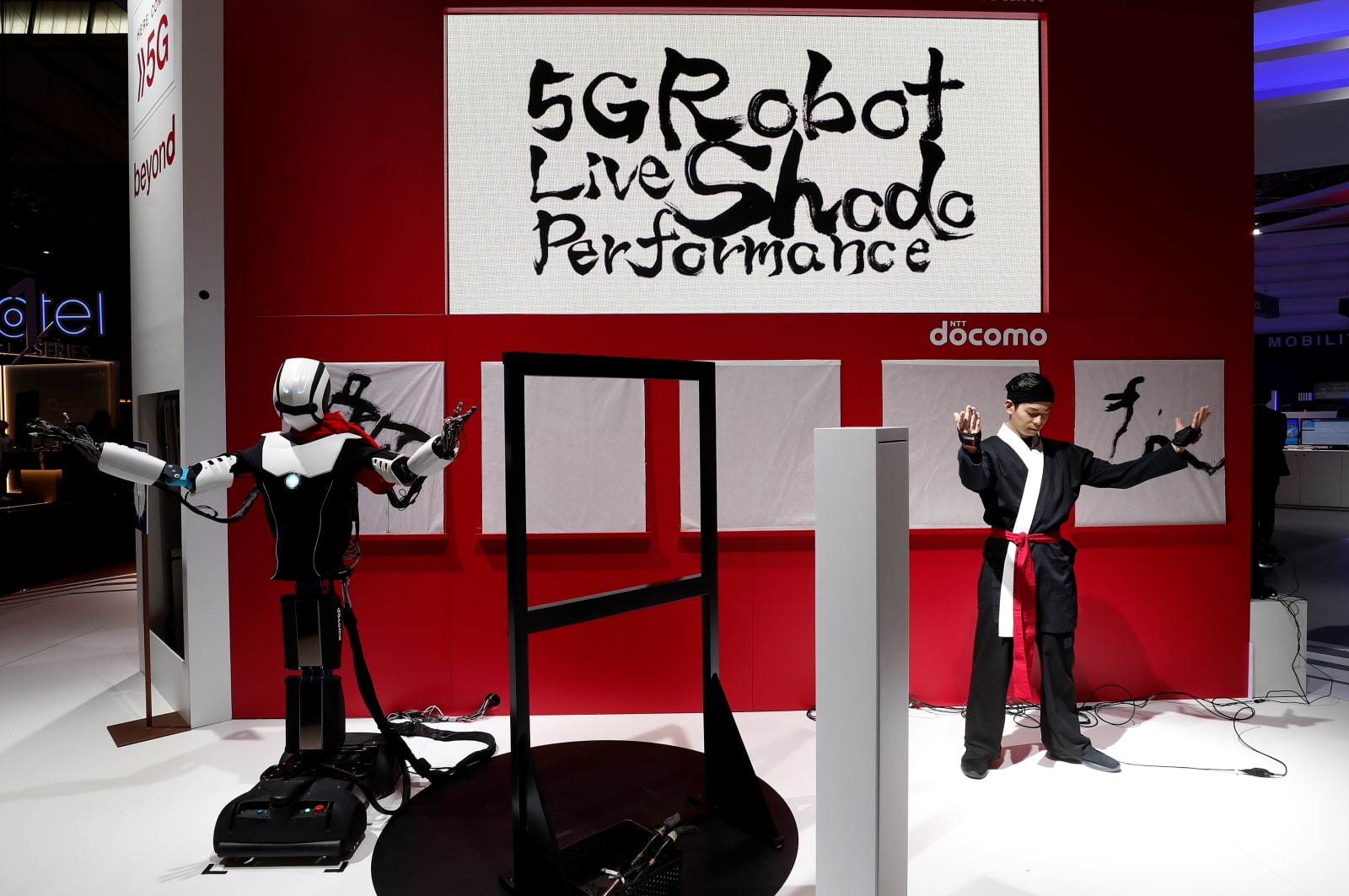
Now that there is an industry standard, companies also rushed to show off products that would help network operators get connected. For example, Huawei unveiled a 5G customer-premises equipment (CPE) terminal — like a signal repeater you can buy to access your service provider’s 5G network in areas with spotty coverage.
Carriers like T-Mobile, Telefonica and Deutsche Telekom also announced plans to bring 5G to their customers, while somewhere in far-flung Hall 7, people were invited to control 5G-connected robot football players that were in a whole other part of the convention center.
We are inching ever closer towards 5G becoming a reality, and nowhere was the excitement about this development as palpable as it was at MWC 2018. Although the event was altogether a strangely quiet show, it’s obvious 5G fever hasn’t broken. I’m sure we’ll hear more about how 5G can change our lives soon enough, but meanwhile I still have to wait 30 minutes to download all the podcasts I need for my 9-hour flight home. Thanks a lot, 4G.
Catch up on the latest news from MWC 2018 right here.
Tencent lets parents reward kids’ good grades with game time
If you grew up with video games as a kid, you probably struck a deal with your parents: pass a school test with flying colors and you can play more. Tencent wants to formalize those arrangements. Chief executive Ma Huateng has proposed digital contracts that offer game time to kids (for Tencent games, of course) in return for either reaching certain academic criteria or performing chores around the home. He wasn’t specific about when these agreements would be available, but he noted that children could have their friends witness the signing of a contract.
This isn’t an altruistic gesture. Tencent’s Honor of Kings (Arena of Valor in the US) has been so popular and addictive in its native China that the mobile multiplayer title now has time limits to prevent kids from playing too long. Between that and a degree of Chinese government pressure (games like HoK have been likened to “opium” by one delegate), Tencent has an incentive to implement its own limits before officials impose them.
Not that it’s the only company facing scrutiny. The World Health Organization has considered formally recognizing video game addictions, and mobile OS developers like Apple have promised more parental controls that restrict overall phone use. In that light, Tencent isn’t so much leading the way as it is responding to an emerging trend.
Source: Wall Street Journal
Volkswagen’s I.D. Vizzion EV is all about a customized ride
Volkswagen’s I.D. platform just got its flagship product, the Vizzion. The electric vehicle will have a range of about 370 miles (600 kilometers) via a 111kWh battery pack, two motors for all-wheel-drive capabilities and will be ready for autonomous driving.
The vehicle was unveiled at the Geneva Motor Show and is part of Volkswagen’s electrification roadmap of 50 new electric vehicles on the road by 2025. Like the rest of the I.D. vehicles, it’s built using the MEB platform which the automaker says will make its cars less expensive and can offer up long EV ranges.
During the presentation, the automaker called the Vizzion, “it’s most emotional and customized Volkswagen.” The idea is that when people are not driving, they want an environment that suits their needs.

Volkswagen noted that we would learn about the vehicle during its press conference tomorrow at the Geneva Motor show. But what we know now is that it’ll have 300 horsepower, a top speed of 112 miles-per-hour and a zero to 60 of 6.3 seconds.
During the event, the automaker also showed off the Kuka robotics-built arm that the company believes will help charge vehicles in parking lots. According to both companies, the arm and its charger would be available to all vehicles.
Click here to catch up on the latest news from the 2018 Geneva Motor Show.
Waze Carpool users can now choose who they ride with
Waze just updated its Carpool app, giving drivers and riders more control over who they’ll be sharing a ride with. If you’re not familiar with the app, Waze Carpool sets up drivers and riders who are headed in the same direction and those behind the wheel get a bit of cash from the individuals they’re transporting. The fees are low, since they’re meant to just cover driving costs, not be a source of income, and the app is meant to encourage ride-sharing in the name of reduced traffic and benefits to the environment.
With yesterday’s update, Carpool users will no longer be blindly matched. Instead, using star ratings, profile information and connections to your job or friends, you can choose who you’ll be riding with. Those with routes most similar to yours will appear at the top of list. Additionally, users can now filter riders by gender or choose to ride with their coworkers only and can send multiple ride or drive requests in order to up their chances of finding a Carpool match.
The updated up is available now and Waze says that it will be releasing more customization options soon. The app is currently available in California, Texas and Israel.
Via: Android Police
Source: Waze
Walmart is making its own meal kits in some stores
Walmart isn’t content to sell third-party meal kits in its bid to take on Amazon and Blue Apron. It’s launching its own line of kits that will give you a meal for two without hunting down and preparing ingredients. The kits cost between $8 and $15, and range from one-step-and-you’re-done offerings like a pot roast (above) to more flexible pre-portioned kits like steak Dijon.
The kits are available right now in 250 stores. They’ll be available in over 2,000 stores by the end of 2018, and you’ll have the option of grabbing them through the company’s Online Grocery Pickup service.
These aren’t quite the same as the kits you tend to get through the likes of Blue Apron, which tend to involve more preparation and more original creations. However, there’s no question about Walmart’s intentions: it’s hoping you’ll grab its kits on the way home rather than subscribe to an internet delivery service. You might have to go out of your way, but you also don’t have to base your meal plans around a fixed schedule.
Via: TechCrunch
Source: Walmart
 AIVAnet