


Best Buy will close all of its 250 Mobile stores in the U.S. by May 31
Canada’s Mobile stores will remain intact.
Best Buy is one of the United State’s largest electronics retailers, but effective May 31, 2018, all of its Mobile stores will be shut down.

This news broke after Reuters obtained an internal memo that’d been sent out to Best Buy employees, and with this decision, 250 locations will be no more.
Best Buy Mobile outlets are much smaller compared to the main Best Buy stores, with their average size coming in at 130 square meters as opposed to 3,716 square meters. Best Buy first launched its Mobile storefronts shortly before the launch of the iPhone in 2007 as a place dedicated to selling smartphones, but according to Best Buy executive Hubert Joly, “the cost of operations in our mobile standalone stores is higher than in our big box stores.”
Any employees working at Best Buy Mobile locations will receive help from Best Buy in finding other jobs within the company, and those that choose to leave after May 31 will be given severance packages.
Despite this shakeup in the U.S., the 52 Best Buy Mobile stores in Canada will remain fully operational.
IT’S HERE
Samsung Galaxy S9 and S9+ hands-on preview: The biggest gets better
Deal: Google Store offering $100 credit with Pixel 2 XL
Available between March 1st and the 17th.
Google’s Pixel 2 XL is a truly excellent smartphone, but it’s also incredibly expensive. The starting price of $849 isn’t the easiest thing to swallow, and stepping up to 128GB of storage will set you back a whopping $949. To help offset some of that cost, the Google Store is offering a free $100 credit with the purchase of the phone.

After buying any color/storage variant of the Pixel 2 XL, you’ll get a $100 credit applied to your account within 6-8 weeks for any future purchases on the Google Store. Google’s offering these credits “while supplies last”, and you won’t receive the credit should you choose to return the Pixel 2 XL.
This current offer is valid between March 1st and the 17th, and it can also be combined with the Google Store’s trade-in program that offers up to $400 back when turning in your current phone.
To take advantage of this deal, click/tap the button below.
See at Google Store
Google Pixel 2 and Pixel 2 XL
- Pixel 2 FAQ: Everything you need to know!
- Google Pixel 2 and 2 XL review: The new standard
- Google Pixel 2 specs
- Google Pixel 2 vs. Pixel 2 XL: What’s the difference?
- Join our Pixel 2 forums
Best Buy
Verizon
Google Store
Project Fi
Why the Gear VR wasn’t a big part of Samsung’s Galaxy S9 event
The most commonly owned VR headset in the world didn’t make an appearance at Samsung’s big event, but you shouldn’t worry too much about it.

While Samsung’s Galaxy S9 event took plenty of time to talk about Augmented Reality and all of the ways this new phone is taking advantage of that tech, Virtual Reality took a bit of a backseat. In fact, it wasn’t mentioned at all during the launch of the Galaxy S9 event in Barcelona. That’s a fairly substantial difference from the year before, when Samsung had the entire audience put on a Gear VR while Mark Zuckerberg snuck by and took to the stage, so there are a few people understandably concerned about the lack of news.
Is Virtual Reality on the way out? Has Samsung abandoned this tech to keep up with Apple and Google? It’s actually not that serious, but there are a few things you should know.
The history of the Gear VR

Every big launch event from Samsung over the last couple of years has come with some sort of Gear VR to go with it. But none of those events have ever made the Gear VR a major part of the attraction. With a single recent exception, each of the Gear VR updates we’ve had since the launch of the Galaxy S6 have been incredibly minor. The Gear VR itself has been largely unchanged over the last couple of years, with revisions being released to make room for the larger sizes of the phones Samsung has been making instead of adding new features or tracking capabilities.
The last major update to the Gear VR to add functionality was with the launch of the Galaxy S8, which added the Gear VR Controller. Because the Controller works independent of that specific Gear VR, it was sold separately so you could easily connect it to any version of the Gear VR. Outside of this update, Samsung has released a Gear VR to make sure the Note 8 and Galaxy S8+ could fit in the headset.
Aside from these minor updates, the only other reason the Gear VR was a big deal with the launch of a phone launch from Samsung is the headset would be given away as a pre-order bonus with the phone. Samsung has given away a Gear VR with each major release for several years now, making it the most widely available VR headset in the world by a wide margin.
Why this year is different

Put simply, Samsung isn’t giving away a Gear VR this year because it doesn’t need to. The people who pre-order phones largely already have a Gear VR, and because the Galaxy S9 and Galaxy S9+ hasn’t changed physically this year there’s no need to create a new version. The only real reason to update the Gear VR beyond what it is right now is to add new technology, which at the moment isn’t possible.
Take a look at what Oculus, the creator of the Gear VR tech, is doing with its first Standalone headset. Oculus Go is functionally not particularly different from the Gear VR. It’s got the same 3 Degrees of Freedom (3DoF) setup as the Gear VR, complete with nearly identical controller. Oculus is even making it easy for Gear VR developers to port existing Gear VR games to the Oculus Go, because the headsets are so functionally similar.
Read more: Oculus Go vs Samsung Gear VR
There have been rumors of an updated Gear VR headset with capabilities similar to the upcoming Daydream Standalone headsets due out later this year, but it’s unlikely we’re going to see that from Samsung or Oculus in 2018. For the immediate future, this is as good as it gets for smartphone-based VR headsets. Add that with the volume of Gear VR headsets already in circulation, and there really isn’t a huge reason to offer anything other than what is available now.
Nowhere near the end for the Gear VR

Back in December, Samsung celebrated the “second anniversary” of the Gear VR as a full consumer product instead of a developer kit. Despite having been around since the Note 4, Samsung has only been aggressively marketing the headset for the last couple of years. This includes dozens of theme park attractions, fully immersive experiences with total body rotation, and of course a massive library of games for people to play at home. Samsung has invested a tremendous amount of resources into the Gear VR as a platform, and there’s no signs of slowing down from the larger team working on the Gear VR.
If you’re a big fan of the Gear VR as it exists right now, and had concerns the Galaxy S9 was a sign of the end for that platform, relax. Samsung may be using the stage to focus on the shiny new things coming to the Gear VR, but developers continue to make incredible experiences for mobile VR fans. The S9 and S9+ are going to improve on an already great experience from Samsung and Oculus. For those eager to see something new from the Gear VR, maybe additional features or some more advanced head tracking, we’re all going to be waiting just a little while longer.
Samsung Gear VR

- Gear VR review
- The Best games for Samsung Gear VR
- Inside Samsung’s Gear VR web browser
- Gear VR vs. Google Cardboard
Amazon
DIY Security Cameras: Comparing Cloud Storage Costs

Oh, you thought the hardware was all you had to pay for?
So you got yourself one of those off-the-shelf home security cameras. Good for you. Because there are a lot of great ones out there that make it simple (and relatively affordable) to keep an eye on your abode.
But the hardware is just one part of the purchase. Pretty much every single company that’s selling you this magical peace of mind is also pushing some sort of subscription plan. (And, again, we’re talking plug-and-play cameras here — not the more hardcore IP cameras.)
While the basic principle is the same for all of these cameras and all of these companies — you’ll pay a premium for cloud storage of videos, and possibly smarter monitoring — it’s the pricing that can differ.
Here we’ll break down the pricing from the more popular providers, and give a little analysis on each.
Nest Aware
You get a free 7-day Nest Aware trial with any Nest camera, which is nice. Nest will record everything and save it for either 5, 10 or 30 days. Along with that you’ll get more intelligent alerts and notifications if a Nest Cam spots a person (versus, say, a pet), or if the Nest Hello doorbell or Nest Cam IQ sees a familiar face (that you’ve trained it to recognize.
Here’s the breakdown:
- 5 days of recording: $5 a month or $50 a year
- 10 days of recording: $10 a month or $100 a year
- 30 day of recording: $30 a month or, $300 a year
Those prices are for the first camera, and Nest doesn’t have an all-you-can-eat option. However, adding you do get a discount when adding Nest Aware to additional cameras. Additional 5-day subscriptions are $30 a year, 10-day subscriptions are $50 a year, and 30-day subscriptions run $250 a year.
Nest’s subscription plans are not inexpensive. But nothing about the Nest ecosystem comes cheap. It is, however, really good.
Nest Security Camera

The simplest of the Nest cameras starts at $199 (though it’s often on sale at Amazon) and is also one of the more discrete cameras Nest offers.
See at Amazon
Ring Protect
(Note: Amazon has agreed to purchase Ring, and it’s unclear whether that’ll affect the following prices. We’ll update if so.)
Ring made its name with video doorbells and since expanded with a number of camera options. They all take advantage of the Ring Protect subscription service.
Ring Protect Basic is $3 a month, or $30 a year. That’s a per-camera price. With that you get video recording for up to 60 days. You can review that video at any time, and you can download and share videos. You get a free 30-day trial as soon as you activate your Ring camera.
Ring Protect Plus is $10 a month, or $100 a year. You get the same video recoding and sharing features, but for an unlimited number of cameras. You’ll also get a 10 percent discount on additional Ring devices, and an extended warranty for as long as you have Ring Protect Plus.
If you’re going to have three or more Ring devices, you’ll want Ring Protect Plus. It’s a no-brainer at that point. At the very least, though, you’ll need a Basic plan to get good use out of a Ring product.
Ring Spotlight Cam

Ring has a number of camera options in addition to its excellent video doorbells. The Ring Spotlight Cam (pictured here) runs $199 and lets you hear and talk to folks on the other end, as well as sound an alarm.
See at Amazon
Amazon Cloud Cam Plan
Amazon has what’s generally considered to be the least expensive option for DIY cameras, and its subscription plans follow along the same path. (Full details are here.)
The Basic service runs $6.99 a month, or $69.99 a year. You’ll get 7 days of video recording for up to three cameras.
The Extended service is $9.99 a month, or $99.99 a year — and you can get a free 30-day trial to see if you like it. With it you get 14 days of monitoring for up to five cameras.
The Pro plan is $19.99 a month, or $199 a year. With it you get 30 days of recording for up to 10 cameras.
It pays to be in the cloud storage business, I guess. Those prices aren’t bad at all.
Amazon Cloud Cam

Amazon Cloud Cam is competitively priced at $199, and the sort of basic camera system that a lot of folks should enjoy.
See at Amazon
Arlo
Arlo’s camera system lacks a sexy subscription name. And maybe that’s a good thing, because it’s also among the most affordable, with three tiers from which to choose. (Get more details here.)
The Basic plan is free. With it you get seven days of recording for up to five cameras, with limited support for three months. Nobody else comes close to offering that.
The Premiere tier is $9.99 a month, or $99 a year. You get 30 days of recording for up to 10 cameras, and unlimited support.
The Elite tier is $14.99 a month, or $149 a year. With it you’ll get 60 days of cloud recordings for up to 15 cameras.
Those are some seriously compelling options.
Arlo Pro 2
An Arlo system with two cameras and the required base station runs about $479 on Amazon.
See at Amazon
Logitech Circle Safe
Logitech (yes, the company that makes mice and keyboards) also has an excellent stable of DIY cameras, and some decent plans to go along with them. (You can check them all out here.)
The bottom two tiers have the same features. Circle Free is, as the name suggests, free. You’ll get a single day of recording (but unlimited streaming, downloads, events, alerts and a time lapsed “daily brief.”)
Upgrading to the Circle Safe Basic plan ($3.99 a month, per camera) gives you all that, but with 14 days of recording.
The Circle Safe Premium plan is $9.99 a month, or $99.99 per year, per camera. It adds on custom daily brief time lapses, person detection, motion zones, and advanced event and alert features.
For casual monitoring that mid-tier plan should do a lot of folks quite nicely.
Logitech Circle 2

The Logitech Circle 2 is one of the top-rated do-it-yourself home security camera systems. You can find it for about $175 on Amazon.
See at Amazon
Uber Health can help you get to doctor’s appointments
While ridesharing services like Uber and Lyft certainly have some controversy surrounding them, it’s hard to deny that they have brought tangible benefits to the lives of many. Today, Uber introduced Uber Health, which is an official partnership with healthcare organizations. It allows healthcare providers, caregivers and staff to order rides for patients to and from appointments, and marks a positive development for the embattled ridesharing company.
Uber Health allows patients to take control of their rides to and from a provider’s office; or, if the patient is unable to (or unwilling to) schedule their own rides, a provider, member of the provider’s staff or a caregiver can do it for them up to 30 days in advance. The entire process is conducted via text message, so there is no need to have a smartphone advanced enough to run the Uber app. It allows for the organizations to easily keep track of their patients’ rides and billing. And because privacy is a huge concern when it comes to healthcare, Uber is partnering with Clearwater Compliance, a leading HIPAA company, to ensure it has enough safeguards in place.
It’s a good idea in theory, and it may work very well in practice. The problem here is that Uber does not have a history of respecting the privacy of its users. Now, the HIPAA safeguards should help with that, but what if Uber’s data is breached again like it was back in 2016? There’s a risk here of trusting potentially sensitive medical information to a third-party provider with a bad track record.
Still, the move is a step in the right direction for the company as it seeks to move past its myriad legal troubles. Over 100 healthcare companies have signed on to to work with Uber Health. Clearly this is a big market, as Lyft embarked on a similar venture with Hitch Health. We’ll see what comes out of all this, but all in all, this is probably a good thing.
Source: Uber
Booking a reservation through Seated will give you Lyft credits
Most ride-hailing and restaurant partnerships like UberEATS were designed to deliver you food, but Lyft’s new collaboration is the other way around. The ride-hailing firm is now a reward option for Seated, a restaurant discovery app for iOS and Android that pays you for dining out. Whenever you make a reservation with Seated, you can get between $10 and $50 in Lyft credits, depending on the size of your party and your dining time.
Based on a Morgan Stanley report last year, 43 percent of people who order food for delivery see it as a replacement for restaurant meals. You’d think the increasing number of people ordering food for delivery is a good thing, but that might not be the case: third-party platforms and carriers could be taking between 20 and 40 percent of the delivery revenue. This partnership aims to entice more people to dine out and to create more loyal customers. The hope is likely to create a cycle of booking meals with restaurants in the Seated app and using Lyft rewards to go there.
Seated chief Brice Gumpel said in a statement:
“This partnership simplifies the dining out experience by removing its biggest roadblock – just getting there. People can now use their Lyft credits to cover any future rides, including those to and from the new restaurants they try on Seated.”
The partners are giving away $1 million in rewards where Seated is available: Atlanta, Austin, Boston, Chicago, Washington DC, Denver, Los Angeles, Miami, New York (including Brooklyn), Philadelphia and San Francisco. New Seated customers can also get $10 in Lyft credits by making their first reservation and using the promo code LYFTxSEATED.
The best cameras under $1,000
Enthusiast cameras like Sony’s A7R III, the Nikon D850 and Fujifilm’s X-H1 get a lot of attention. The good news is that nowadays, you can spend under $1,000 for a camera body and get almost as much as you would with a model with three times the price. Cameras like Nikon’s D5600, the Sony A6300 and Fujifilm’s X-T20 handle both photos and video superbly. As you’d, expect, though, each model has a different combination of strengths and weaknesses. This guide is meant to help you figure out which best fits your needs.
The basics
Buying a camera revolves around three decisions: Do you want a fixed or interchangeable lens camera? If it’s the latter, would you rather have a mirrorless or DSLR? And finally, what size sensor do you want, full-frame, APS-C, Micro Four Thirds or smaller?
If you want the lightest camera possible for travel or street photography, consider a compact, fixed-lens model. Many, including the Panasonic Lumix ZS200 and Sony’s RX100 V, are highly pocketable but provide excellent quality. And just because you’re getting a fixed lens, doesn’t mean you have to settle for a small sensor. Panasonic’s excellent LX100 comes with a Micro Four Thirds chip and costs under $1,000.
A DSLR offers a direct, optical viewfinder and generally focuses quicker than mirrorless models. That makes them ideal for sports and wildlife photography, but many folks might find them too heavy to take on vacation. Unfortunately, Canon, Nikon and Sony don’t sell any sub-$1,000 DSLRs with 4K.

Those looking for the best video quality will thus need a mirrorless camera. Luckily, there are great mid-range models from Panasonic, Olympus, Sony and (finally) Canon. Mirrorless cameras are better than DSLRs if you’re looking to travel light, as many models are highly compact when equipped with small “pancake” lenses.
If portraits, videos and art photography are your passion, you’ll probably want the largest sensor possible. That makes it easier to separate your subject by blurring out the background, creating a bokeh effect. Full frame sensors are best for that, but there’s only one model under a grand, Sony’s original A7. APS-C is the next-best choice, and creates more bokeh than Micro Four Thirds.
Best mid-range mirrorless cameras
The mirrorless mid-range category can be confusing, because there are so many excellent models. Unlike with DSLRs, it’s easy to find 4K and in-body stabilization, and models from Sony, Olympus, Panasonic and Fujifilm are now crammed with innovative features.
For instance, mirrorless cameras are closing the speed gap with DSLRs in terms of autofocus, thanks to a new generation of phase-detect sensor models from Sony, Fujifilm and other companies. Electronic viewfinders (EVFs) are better than ever, and arguably superior to optical viewfinders because you can see the final result. Basically, then, ost camera innovation is happening in the mirrorless category, making it the most worthy of your consideration, in my opinion. Here are the best of the best:
Fujifilm X-T20

Olympus’s O-MD EM-10 Mark III is a stellar camera, but Fujifilm’s $900 X-T20 wins on several counts. First off, it has a larger APS-C 24.3-megapixel X-Trans III sensor that instantly buys you better bokeh and low-light performance. It offers a 2.3-million dot OLED EVF and touchscreen, which its pricier X-T2 sibling doesn’t have, giving you tap to focus and shoot plus swiping and zooming to review images. It can focus in just .06 second, and shoot in burst mode at 5 fps.
There’s also 4K video at 30 fps, a microphone input and various creative filters for the amateur crowd. And don’t forget Fujifilm’s impressive, and reasonably priced lens collection. Most importantly for many of its fans, the X-T20 has classic, retro good looks and is easy to operate, thanks to no fewer than five dials for mode, exposure compensation, aperture, ISO and shutter speed. On the downside, the X-T20 lacks in-body stabilization.
Olympus OM-D E-M10 Mark III
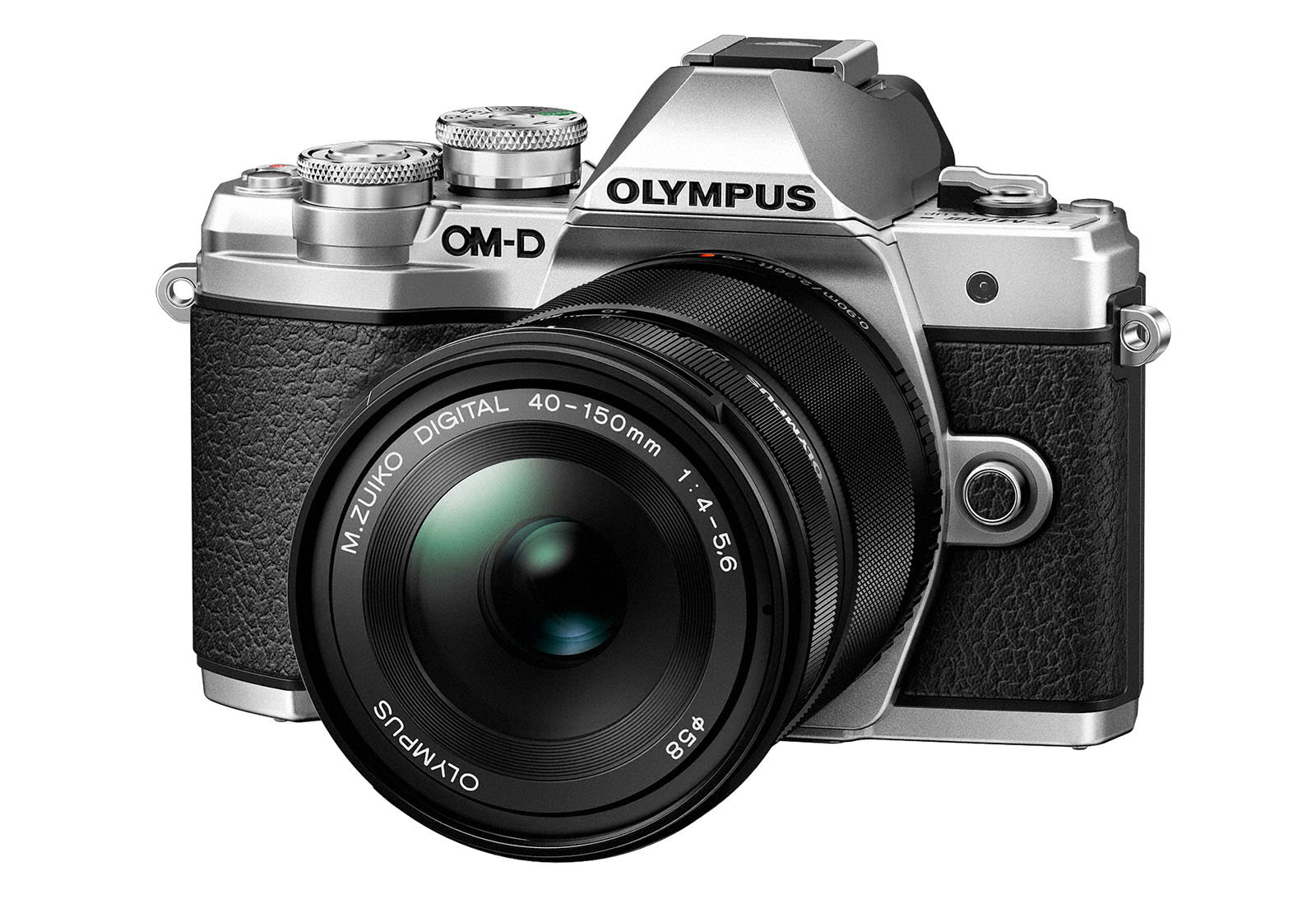
Speaking of beautiful, easy-to-use and impressively specced cameras, let’s talk about the $650 Olympus OM-D E-M10 Mark III. It beats the X-T20 in one key area: Namely, it has 5-axis in-body stabilization, something sadly lacking in all Fujifilm models except the new X-H1. The OM-D E-M10 Mark III also has some drawbacks like the smaller 16.1-megapixel, Micro Four Thirds sensor and lack of a microphone port.
It equals the X-T20 with 4K video, and features a 2.36-million-dot viewfinder and the same image processor as the one on Olympus’ super-quick OM-D E-M1 Mark II. It’s also small and light, and Olympus has a wide, and impressive, selection of Micro Four Thirds lenses, including the new F/1.2 prime lens lineup with enough bokeh to help you forget about that smallish sensor. As with the X-T20, the E-M10 mark III is lovely and packs manual dials, saving you from plunging into menus.
Sony Alpha A6300

Sony’s top-of-the-line APS-C camera is the $1,300 A6500, but the older $800 A6300 (above) isn’t that far behind. The 24.2-megapixel model was ahead of its time, packing 4K video with full sensor readout at 30 fps, uncanny fast .05-second phase-detect autofocus with 425 pixels, 11 fps burst speeds, and a maximum 51,200 ISO range.
The drawbacks are a clumsy menu system, lack of mechanical dials, and poor battery life. All told, though, shooters who do both video and audio will be better off with the A6300 than many of the pricier models out there.
Honorable mention: Sony A7

Sony’s original A7 is still available for $800 (body only), and under $1,000 with the 28-70mm f/3.5-5.6 kit lens. So why would you buy a circa-2013 camera? Well, it has a 24.3-megapixel sensor, and offers 1080/60p/24p HD video with both microphone and headphone jacks crucial for videographers. Most importantly, it’s a full-frame camera, giving you maximum bokeh and support for a growing number of full-frame lenses from Sony and others.

Getty Images/iStockphoto
Our top DSLR picks
DSLRs are the weak point of the mid-range camera category, as they lack features like 4K and in-body stabilization that can be found in mirrorless and even compact models. Nikon finally released an APS-C model with 4K, the $1,300 D7500, so let’s hope that trend continues in 2018. If you’re looking to get a current mid-range model under $1,000, however, you’ll need to forget about those things and decide which cameras handle best, shoot the fastest and have the best quality images for your needs. Here are our top three picks:
Canon EOS 77D

Canon’s $800 EOS 77D and the Nikon D5600 are the best mid-range DSLRs released recently and are close in specs, but the 77D gets the nod as our top pick. Released last year, it inherited some nice features from Canon’s higher-end models. That includes a fast, accurate 45-point phase-detection system, and Canon’s Dual Pixel AF — the best in the business for live view and video modes. Max burst shooting is 6 fps, and ISO tops out at 51,200 (extended), though shots beyond ISO 12,800 are extremely noisy.
If you can live without 4K and settle for 1080p at 60fps, the 77D actually has a lot to offer for video. You get surprisingly good electronic stabilization that works in concert with the optical lens IS; a flip-out screen for easier self-shooting and vlogging; and fast, accurate Dual Pixel autofocus. It also has WiFi, Bluetooth and NFC, so it’s easy to remotely control the 77D and download photos.
Nikon D5600

Engadget and plenty of other sites have given Nikon grief for its lack of innovation compared to rivals like Sony. The $650 D5600 is a solid case in point, being merely a minor refresh over its predecessor, the D5500, and lacking features like 4K and in-body stabilization. But that’s where the DSLR world is right now, and the D5600 still has enough to recommend it.
Namely, you get excellent dynamic range and detail from the 24-megapixel APS-C sensor that, don’t forget, is a touch larger than those on Canon cameras. The 34-point autofocus system for regular photo shooting is excellent, though Nikon is lagging well behind Canon’s Dual Pixel autofocus for video and live view shooting.
Most importantly, perhaps, the D5600 is about as light as a DSLR gets, so it’s feasible to lug it along on your vacation. It also has a nice touchscreen that flips around, making selfies and vlogging manageable. Finally, Nikon offers decent wireless connectivity for the D5600 via its Snapbridge option.
Hopefully, 2018 will be a better year for Nikon. The D850 was a promising start, and the company needs to put features like 4K and five-axis stabilization into lower-end models to match Olympus, Sony and other rivals.
Canon EOS Rebel T7i

Trying to find the third-best DSLR shows the problems with this category. A few cameras, like Nikon’s D7200 and the Canon 80D are worth considering, but they were released in 2015 and 2016, respectively. In a market where things change so fast, we chose Canon’s $750 EOS Rebel T7i.
While it doesn’t ooze excitement, the T7i does key things well. It’s nearly identical to the EOS 77D, with 6fps shooting speeds, WiFi, NFC and Bluetooth connections, a top ISO of 51,200 and a flippable screen. It focuses quickly and accurately whether in regular or live view/video mode thanks to the phase-detect and Dual Pixel autofocus systems. And yet, it’s much smaller and lighter, making it a good travel camera for folks who must have a DSLR.
Compact cameras
Anyone who’s wielded a Sony RX100 or Leica Q can understand why photographers are passionate about fixed-lens, compact cameras. Being able to whip out a camera and instantly, yet discreetly, snap great photos is a godsend for travelers and creative photographers.
Manufacturers keep upping the ante in this category in order to sway photographers away from smartphones. As a result, there are some astonishingly great models under $1,000 (and many that cost more like Fujifilm’s X100F and the Canon G1X Mark III, but we’ll save those for our forthcoming enthusiast guide).
Sony RX100 V

As with the mirrorless category, it’s tough to choose a winner here. But the $980 Sony RX100 V’s pure technical competence and tiny size make up for its operational minuses, which is why it’s often used as a second camera by professional photographers.
Where to start? The 20.1-megapixel, 1-inch sensor RX100 V can shoot an astonishing 24 RAW photos per second and handle 4K, 30fps video with a full sensor readout. Low-light capability is great for a compact, aided by the f/1.8-2.5 24-70mm lens, and it uses Sony’s latest BSI sensor tech with 315-point phase-detect AF.
That said, the RX100 V is pricey, and meanwhile the handling is clumsy compared to models from Panasonic and others. Sony needs to redesign its menu system, in my opinion, but seems to have resisted doing much with it so far because sales have been so good.
Panasonic Lumix ZS200

We picked Panasonic’s Lumix ZS100 as one of the top compact cameras for our recent camera buying guide. Since then, then the company has released the ZS200, which succeeds and improves on it in most ways. You still get a 1-inch, 20.1-megapixel sensor, 5-axis in-body stabilization, a 2,330K-dot EVF and 4K video at 30fps.
What the new model brings is a new “L.Monochrome” black and white shooting mode and a 15x, 24-360x zoom (35mm equivalent), a big jump from the last model’s 25-250x lens. In exchange, unfortunately, you lose a stop of speed, jumping from f/2.8-5.9 to f/3.3-6.4. Nevertheless, the wider zoom range will probably be more useful for the ZS200’s intended tourist market, helping them snap distant wildlife or beach action.
Panasonic Lumix LX100

Panasonic’s aging LX100 gets on this list because it’s the only sub-$1,000 model with a sensor larger than 1-inch. It packs a Micro Four Thirds, 12.8-megapixel chip and f/1.7-2.8 24-75mm equivalent lens, letting you easily separate subjects from backgrounds with plenty of bokeh.
Despite hitting the market in 2015, the LX100 also offers 4K video, embarrassing more recent models from the likes of Canon. It also looks great and has physical dials and buttons for easier handling. The LX100 is a bit large and the zoom range is limited, however, so it may not be the best option for travelers. On the other hand, it’s a perfect street and people photography camera.
Wrap-up
$500 to $1000 is a sweet price spot for camera buyers right now, and you can’t go wrong with any of our picks. That said, unless there’s a particular reason you need a DSLR, I would avoid that category and stick with mirrorless models instead. The latter are more technically competent, especially for video, and are lighter and easier to carry, to boot.
Meanwhile, there’s no longer a need to look down on fixed lens compacts. The models mentioned here are not a hassle at all to take on holidays, but are capable of putting smartphone photos to shame.
Image: Getty Images/iStockphoto (film roll)
Even hula hoops are getting the ‘smart’ treatment
It’s been roughly 20 years since I picked up a hula hoop and wiggled my waist with the elegance of, well, a technology journalist with zero coordination. But here I am, in the middle of Mobile World Congress, shaking my booty while a dozen or so attendees look on with a mixture of amusement and befuddlement. I’m trying out the Vhoop, a chunky ring with an embedded motion sensor that tracks your workouts in real-time. They’re sent via Bluetooth to a companion app that lists your clockwise and counter-clockwise revolutions, calories burned and workout duration.

I used the hula hoop for a good few minutes and everything worked as promised. The final version of the app will include leaderboards — if you fancy racing your friends in the park, or competing with the world from the comfort of your living room — a detailed history section, trophies and push notification reminders. The hoop itself is a sturdy contraption, comprising of a polypropylene outer shell and rubbery elastomer inner. I didn’t feel any discomfort while hooping, though that might be because I could only manage 20 or so revolutions before the ring fell dramatically to the floor.
The Vhoop weighs three and a half pounds and lasts 15 hours on a single charge. It’s also waterproof, and can be broken down into eight pieces for easy storage and transportation. If you’re looking for a challenge, the hoop comes with coin-like weights that slip inside the various segments. I can see the appeal, though $120 seems a little steep for a casual fitness tracker. The data is undeniably useful — like a pedometer, it’s an easy way to monitor your progress and set new goals — but ultimately, you can do the same thing by watching the hoop and keeping count the traditional way.

The Vhoop was pitched on Kickstarter last July and raised $14,290 from 141 backers. A few months later, the team launched an open-ended pre-order campaign on Indiegogo — at the time of writing it’s made $15,176. I was told by a company spokesperson that the first units will ship in April, but of course that doesn’t guarantee the Vhoop will ever see the light of day. The version I tried seemed ready for store shelves, but as with all Kickstarter projects — it’s best to be a little skeptical. Now excuse me while I try to crack my all-time hula hooping high of 25 clockwise revolutions…
Catch up on the latest news from MWC 2018 right here.
Source: Vhoop
Microsoft’s navigation tech for the blind is now an app
Microsoft has been working on its 3D soundscape technology for years. In 2014 it developed a bone-conducting headset to help visually impaired people navigate around cities using audio cues, and now that technology is available in app form, allowing users to pinpoint their location and identify areas of interest using only their phones and a stereo headset.
The app, Soundscape, calls out roads and landmarks as they’re passed, and lets users set audio beacons at familiar destinations. If at any time you’re unsure of where you are, or which direction to head in, you can simply hold the phone flat in your hand and use the buttons on the bottom of the screen to locate nearby roads and familiar destinations.
It’s not designed to simply get users from A to B safely, but to help visually-impaired people explore the world around them and enrich their perception of their surroundings as they move through cities. As Erin Lauridsen, access technology director at LightHouse for the Blind, says, “Obstacle avoidance is not the problem, we have a dog, a cane and our blindness skills for that. The gap is knowing where things are and being able to decide what’s of interest.” The app is available for free on iOS and iPhone in the US and UK now.
Source: Microsoft
Galaxy S9+ Tops iPhone X as Best Smartphone Camera Ever in DxO’s Controversial Rankings
DxO today said Samsung’s new Galaxy S9 Plus has the best smartphone camera it has ever tested. The device earned the highest-ever DxOMark score of 99, topping both the Google Pixel 2 and iPhone X, which scored 98 and 97 respectively.
In its review, DxO said the Galaxy S9 Plus camera lacks any “obvious weaknesses” and “performs very well across all photo and video test categories,” which will make it a compelling choice for photography-minded smartphone users.
The Samsung Galaxy S9 Plus is a smartphone without any real weaknesses in the camera department. In both still and video modes, it performs well across the board, delivering consistently good photo and video image quality in all light and shooting situations, thus earning itself our highest DxOMark Mobile score to date. Add one of the best smartphone zooms and a capable bokeh simulation mode to the mix, and the Galaxy S9 Plus is difficult to ignore for any photo-minded smartphone user. With the Galaxy S9 Plus, Samsung is setting the pace for 2018. We’ll see if the competition can follow suit.
While the Galaxy S9 Plus has a 12-megapixel dual-lens rear camera like the iPhone X, a key new feature is variable aperture, which means the lenses can adapt to various lighting conditions just as the human eye would, and automatically let in more light when it’s dark and less when it’s too bright.
In dim conditions, the rear camera uses a very fast f/1.5 aperture to maximize light capture, according to DxO. In brighter light, it switches to a slower f/2.4 aperture for optimized detail and sharpness.
DxO found the Galaxy S9 Plus produces “excellent results” in bright light and sunny conditions, with vivid colors, good exposures, and a very wide dynamic range. The autofocus wasn’t the very fastest DxO has ever tested, but they said it’s more than fast enough not to be an issue for any user.
 Galaxy S9+
 iPhone X
While the review crowned the Galaxy S9 Plus as an “excellent bright-light performer,” DxO still experienced some “fairly minor issues” in those conditions. Some of its photos had “purple fringing on high-contrast edges” and “pretty noticeable” ringing halos, while others had “slight blue or pink color casts.”
DxO said the Galaxy S9 Plus’s performance in dimmer conditions is “equally impressive,” yielding photos with “nice exposures with vivid color, accurate white balance, low noise, and good texture in low-light conditions.”
The rear camera earned top marks in several other areas, including autofocus, zoom, flash, and bokeh, exposure, contrast, and color accuracy, so be sure to read the full-length review for more detailed analysis.
To determine scoring in its smartphone camera reviews, DxOMark said its engineers capture and evaluate over 1,500 test images and more than two hours of video, both in controlled lab environments and in natural indoor and outdoor scenes, using the camera’s default settings. This article explains more about the methodology.
DxO’s smartphone camera reviews are well known, but they’ve also attracted some criticism, since the overall quality of a camera is subjective. When comparing dynamic range on the Galaxy S9 Plus, Google Pixel 2, and iPhone X, for example, DxO itself said the results are “pretty much a question of personal preference.”
For those interested, here is DxO’s review of the iPhone X camera. But reviews from professional photographers like Austin Mann may be more valuable. Together, they provide good technical and real-world insight.
Galaxy S9 and Galaxy S9+ can be pre-ordered starting today for $720 and $840 respectively. The smartphones launch March 16.
Tags: DxOMark, Galaxy S9
Discuss this article in our forums
 AIVAnet