


Jaguar releases more info on its electric SUV, still no price
After what seems like an eternity, Jaguar finally has pre-order information for its I-PACE crossover SUV, which looks to take on Elon Musk’s Model X. The truck will be available to purchase starting today in a handful of trim options, but a delivery date wasn’t available at press time. In the UK, the I-PACE starts at €63,495 or, roughly, $87,216. For context, the Model X we reviewed was priced at $132,000.
The luxury automaker boasts the truck will charge from 0 – 80 percent in 85 minutes on public 50kW DC chargers, and that if you’re in a hurry a half-hour charge will give you around 80 miles of range, with a total range of 480 kilometers (just over 298 miles). Speaking of charging, there’s an eight-year/100,000-mile battery warranty limited to 70 percent battery health. As for the rest of the car, there’s a three-year unlimited mileage warranty.
The I-PACE will also work with Amazon’s Alexa voice platform. You won’t be able to summon the SUV with your voice, but you will be able to ask if the doors are locked or if you have enough charge to get home from work. I-PACE also uses AI to tailor the driving experience to your personal style. And, like a Tesla, the I-PACE will constantly update itself over the air.
With Model 3 reviews popping up this week it seems like automakers with EVs are keen to take shots at Tesla. Just yesterday Porsche bragged that its Mission E sports car can hit top speed for “long periods,” sidestepping the Ludicrous Mode limitations of Musk’s rides. Competition breeds innovation though, so if anyone stands to benefit from the EV performance wars, it’s consumers.
The Finns who refuse to give up on Sailfish OS
Wander the halls of Mobile World Congress and you’ll notice a theme on almost every phone manufacturer’s stall: Android. Google’s operating system has slowly suffocated every “alternative” adversary including Firefox OS, Ubuntu Touch and Windows Phone. But in the middle of hall five you’ll find an unlikely holdout — Sailfish, a quirky mobile platform by Helsinki-based developer Jolla. Walk by the company’s stall and you’ll find a small group of Finnish employees eagerly showing off the few phones that run their swipe-based software. They’re grinning like children, which is no surprise given the hell they’ve been through to get here.
Most people know Jolla for its quirky ‘other half’ phone. It was the first hardware to run Sailfish OS — a continuation of the MeeGo platform that Nokia abandoned for Windows Phone — and boasted swappable backs that could add new hardware features and themed software. Jolla hoped brands would build backs for their most devout fans — a Real Madrid cover, for instance, might come with custom wallpaper, ringtones and an app for watching matches — but few embraced the idea. Still, the hardware was intriguing because of the operating system it shipped with. In a sea of Android conformity, Jolla stood out.
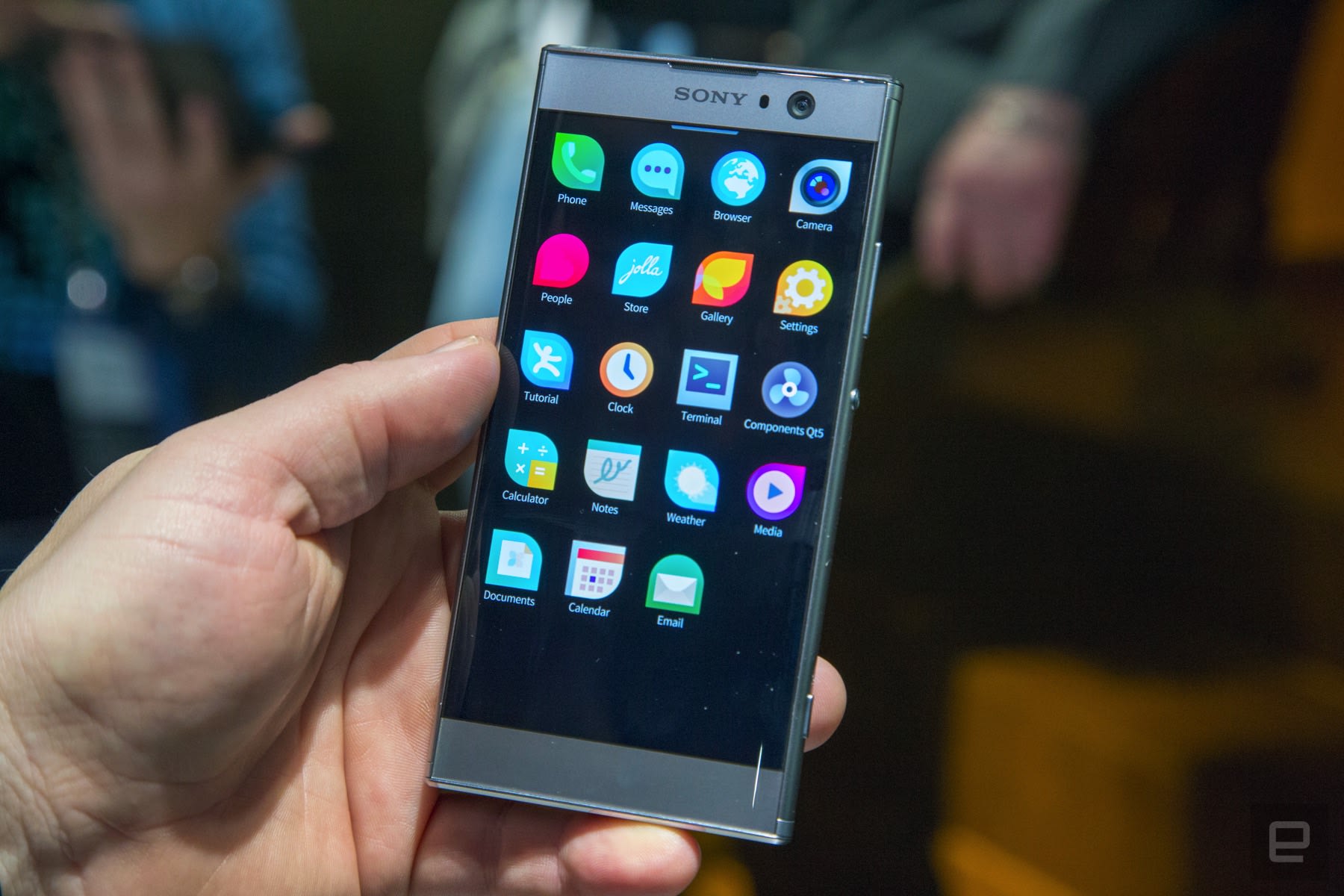
The combination of custom hardware and software is reminiscent of Apple. But in truth, Jolla was seeking a platform play similar to Google and Android. It wanted to license its operating system but couldn’t get anyone to take its pitch seriously. The industry was, unsurprisingly, skeptical of a startup with a completely unproven platform. To win them over, Jolla needed to make a smartphone of its own first. “We realised that we had to develop our own phone in order to bring life to the Sailfish operating system,” Sami Pienimäki, CEO and cofounder of Jolla said.
Many of Jolla’s employees were former Nokia staff, so the company had some experience shipping phones. The first Sailfish device, however, was a completely different challenge. The phone needed a suite of stock applications and a custom app store with robust submission and moderation processes. The team also required distribution partners — or at minimum, a reliable online storefront — and a customer service team that could deal with basic troubleshooting, device repairs and over-the-air software updates. “All of that kind of stuff, we just had to build it,” Pienimäki explains, “like a real go-to-market project does.”
In February 2013, Jolla attended MWC with a prototype version of the phone. Three weeks after the show, ST-Ericsson, the team’s chipset provider, called Pienimäki to announce it was exiting the mobile business. Jolla had just promised its investors that the phone would ship by the end of the year. “We had a really, really, really, shitty situation,” Pienimäki recalls. The team reworked the system architecture so it could support Qualcomm, MediaTek and other third-party processors. While stressful, it meant the company could support more hardware and coax a wider range of device manufacturers.
The Jolla phone came out in November 2013. It shipped with a Qualcomm Snapdragon 400 processor, 1GB of RAM and a 16GB of internal storage. The company was praised for trying something different with its software, which centered on swipes from the edges of the display. But many, including Engadget, found the interface to be needlessly complicated and confusing. Although the phone never sold in large, meaningful quantities, Jolla had its fans, and the launch showed that the company was serious about its dream of an alternative operating system.
Most phone manufacturers would follow up their first device with a new, slightly improved handset. But the Finnish startup wanted to prove that Sailfish OS could scale to different screen sizes, so it tried to build a tablet. Looking for cash and a little marketing buzz, it turned to the crowdfunding site Indiegogo. The company set a target of $380,000 and smashed that figure in a few hours, racking up roughly $2.5 million and 21,633 backers by December 10th, 2014. It was a huge moment for the company and an early indication that Sailfish OS could reach mainstream appeal.
Four months later, the company signed its first licensing deal with Intex Technologies, a phone manufacturer in India. At last, it had persuaded someone to ship a device with Sailfish OS, rather than Android. The partnership was overshadowed, however, by a supply issue with with the tablet. A week before the slate’s release date, a supplier told Jolla that the memory chipset and display it had chosen were no longer available. “For a software vendor, it’s always like ‘Aaargh!,’” Pienimäki shouted, “‘Like hey, we’re about to ship this next week, and now you’re telling me that you don’t have the display?! What the fuck?!’”
Jolla’s finances were already tight. It desperately needed another licensing deal to pay for the manufacturing setbacks. “It was like cat and mouse all the time with the supply chain,” Pienimäki said, “and the ODMs that we were working on.” By November, however, the situation had become untenable and Jolla went bankrupt. Management had been working on a new round of investor funding, however, and this materialized in December. “We simply raised more money to overcome the situation,” Pienimäki said. “It meant we were able to save the company and of course, save the team. The team is the most important.”
For some, quitting was never an option. “I guess it’s inevitable that at some point you think about it,” Pekka Vuorela, a software developer at Jolla said. “But still, I wanted to do this, because it’s really interesting to do an operating system and handle absolutely everything. It’s a huge project and it intrigues me.”

Pekka Vuorela, a software developer at Jolla.
In February 2016, Intex unveiled the Aqua Fish phone running Sailfish OS 2.0. In addition, Jolla revealed that the team behind Fairphone — a handset with sustainably sourced materials — was considering its platform. The company knew, though, that it needed to make some drastic changes to survive. So it laid off its hardware division and cancelled the tablet, promising refunds once its financial situation improved. It was a difficult, but necessary decision to avoid the fate of so many other alternative operating systems. Competing with Google and Android head-on, the team realized, was business suicide.
Instead, Jolla doubled-down on its licensing strategy. This time, though, it focused on enterprise customers that require secure, reliable hardware for their employees. The work wouldn’t be glamorous, but it would bring in the revenue required to pay the team and development of Sailfish OS.
“We want to see our platform alive,” Marko Saukko, chief engineer at Jolla said. “That keeps us going, and that got us through those ups and down we had. When we had the low moment, and the team size was reduced a little bit, we still kept on going. We still had energy left and we were able to push from the bottom back up.”
“We want to see our platform alive.”
Jolla’s pitch was simple: If you license Sailfish, you get full access to the source code. Pienimäki claims that none of its rivals offer this level of transparency. Even the Android Open Source Project (AOSP) comes with “proprietary stuff” that privacy-focused companies — and governments with a distaste or distrust of America — would prefer to avoid. “That really sets us apart from everybody else,” Pienimäki said. Sailfish OS, the company hoped, would become synonymous with security.
“It’s that, combined with the fact that we are doing this in open source with the global Sailfish community,” Pienimäki added. “The base platform that we create will always be open, and that’s the foundation of trustworthy operation.”
Later that year, Jolla’s platform achieved “official status” with Russia. In a press release, the Finnish company declared it was the “only mobile operating system” that had been “officially accepted to be used in governmental and government-controlled corporations.” Jolla sees the country as a huge opportunity. There is a “very sizeable” bubble of kremlin-controlled companies, according to Pienimäki, which Jolla hopes to win over. “Those are big companies, and that’s definitely a target in Russia.”
Since then, Jolla has inked deals in China — a country that, like Russia, has a difficult relationship with Google — and Latin America. In practice, it works a little something like this: Jolla will issue its source code to local partners who liaise with enterprise customers and provide the final hardware. Clients will request services, or features, that Jolla then solves with tools, or “enablers,” in Sailfish OS. It could be a mobile device management framework, or an open VPN solution — mundane features to the average consumer, but critical for secure business communications.
“A good example is security algorithms,” Pienimäki said. “We don’t do security algorithms for our clients, because typically they want to use their local partners to harden some communication systems. So something like that, in the platform, we’ll only do enablers and tell them that, ‘Okay here is an API and here you can put your local security algorithm.’”

Jolla chief engineer Marko Saukko.
Sailfish OS is still a consumer product. These days, though, you have to download a community port or buy a version of the operating system called Sailfish X. The latter is compatible with a single device — Sony’s Xperia X — although the company has plans to support the Xperia XA2, the upcoming Gemini PDA by Planet Computers, and a couple of Russian Inoi tablets later this year. Still, it’s a tiny number of devices. And for now, it’s nearly impossible to buy a Sailfish X license in the US.
“We have a 50-person team,” Pienimäki stressed. “We cannot cover the whole world in one day, even though people expect us to do it. We just have to face the realities of having a business operation.” Jolla has been surprised, however, by the uptake in licenses since Sailfish X launched. It’s a small money-maker, but that doesn’t mean it’s unimportant to the business. Jolla needs Sailfish X to keep the community on its side and facilitate ideas, feedback and code. Without these diehard users, it would be impossible for the company to support so many different chipsets and devices, including the original Jolla Phone.
Jolla has spent the last year working with a couple of partners on Sailfish-powered feature phones. At MWC, however, it wanted to make a formal announcement so the larger industry is aware of the compatibility. Pienimäki won’t say which companies it’s working with, but pointed to the enduring popularity of flip phones in Japan. (When asked point blank if a Sailfish flip phone is coming, he smiled and simply said “maybe.”)
“We cannot cover the whole world in one day, even though people expect us to do it.”
Jolla had some profitable months last year and started issuing refunds to people who backed its tablet on Indiegogo. The company won’t say how many are left, however. “It’s not that many,” Pienimäki claims. “Some of them are a bit noisy, but it’s not really that many anymore.” Jolla has promised to issue more refunds every time it has a profitable month. These, Pienimäki hopes, will happen at a “steady pace” by the end of the year. The company, however, is not profitable on a fiscal year basis, and continues to burn through investor cash.
Still, the company has survived. The corporate sector isn’t glamorous, but it’s allowed the Helsinki team to continue its dream of a MeeGo-inspired operating system. That, for now, is enough. “I’m a founder of the company,” Pienimäki said. “I must believe in this. And I do, with all my heart. Maybe I’ll be the last man standing if this all goes down some day. But that’s my role and responsibility as captain of the ship.”
Catch up on the latest news from MWC 2018 right here.
Equifax finds another 2.4 million people affected by its data breach
Last month, reports surfaced that more information than previously thought may have been exposed in Equifax’s massive data breach and today, Reuters reports, the has company confirmed it. Along with the 145.5 million individuals already reported to have been affected by the breach, Equifax says another 2.4 million were as well. However, their exposed data was limited to names and partial driver’s license information. The company said that in most cases, home addresses as well as driver’s license states, issue dates and expiration dates weren’t included in the stolen data.
“This is not about newly discovered stolen data,” Paulino do Rego Barros, Jr., Equifax’s Interim CEO, said in a statement. “It’s about sifting through the previously identified stolen data, analyzing other information in our databases that was not taken by the attackers and making connections that enabled us to identify additional individuals.” Equifax said that because the attackers appeared to be focused on obtaining social security numbers, that’s what their investigation centered on during its initial phases. These additional 2.4 million individuals didn’t have their social security numbers stolen and were therefore not spotted earlier in the investigation.
Equifax says that the newly identified victims of the breach will be notified and will have free access to identity theft protection and credit monitoring services.
Via: Reuters
Source: Equifax
Archos’ ‘Hello’ smart displays are powered by Google Assistant
As Google Assistant continues to get smarter every day, more and more companies are making hardware that’s compatible with the platform. The latest one is Archos, which has introduced a couple of Google Assistant-powered smart displays at MWC 2018, adequately dubbed “Hello.” Like with other similar products, you can use the Hello display to ask Google for a variety of things, such as the weather, recipes or news. The benefit here of course, compared to something like the Home Mini, is that you can actually view your search results on a screen, as opposed to just hearing what the Assistant has to say.
Naturally, the Hello displays also double as speakers, letting you jam out to some music while you’re cooking or walking around your home or office. They should blend in nicely with your furniture, since they have a minimalist, wooden finish that makes them easy on the eye. In terms of specs, there’s 2GB of RAM, 16GB of storage, a 1080p, IPS display, 4,000mAh battery and a 5-megapixel camera for video calls. Archos will be launching them later this summer in 7 and -8.4-inch versions, and the company told us pricing should be between $130 and $150 for the smaller device and $170 and $200 for the larger one.
Catch up on the latest news from MWC 2018 right here.
Twitter asks for help fixing its toxicity problem
Twitter has definitely come under a lot of fire in recent years for issues ranging from not doing enough to stop harassment on its platform to allowing foreign actors to sow political discord. In the past, the company has tweaked its tools, giving individuals more options when it comes to controlling what they’re exposed to online, as well as updated its guidelines a handful of times. But today, Twitter announced it’s trying out another route — asking people outside of the company to propose ways that it can promote healthy, open and civil conversations online.
While working to fix it, we’ve been accused of apathy, censorship, political bias, and optimizing for our business and share price instead of the concerns of society. This is not who we are, or who we ever want to be.
— jack (@jack) March 1, 2018
Twitter CEO Jack Dorsey tweeted today that the company isn’t proud of how some have taken advantage of its service, specifically calling out troll armies, misinformation campaigns and bots. And he added that Twitter has been accused of apathy, censorship and political bias as it has attempted to fix its problems. “This is not who we are, or who we ever want to be,” he said. He adds that the company doesn’t yet know the best way to measure conversational health on its platform and so it’s asking outside experts to chime in. “Twitter’s health will be built and measured by how we help encourage more healthy debate, conversations and critical thinking; conversely, abuse, spam and manipulation will detract from it,” the company said today. “We are looking to partner with outside experts to help us identify how we measure the health of Twitter, keep us accountable to share our progress with the world and establish a way forward for the long-term.”
What we know is we must commit to a rigorous and independently vetted set of metrics to measure the health of public conversation on Twitter. And we must commit to sharing our results publicly to benefit all who serve the public conversation.
— jack (@jack) March 1, 2018
Those who want to propose ways to do this can submit their ideas through this form starting today. The form asks you to describe your proposed health metrics, how you’ll measure, evaluate and report them and how long you’ll need to develop your methods. It also asks for what sorts of resources you might need and requests you provide any peer-reviewed articles you’ve published that are relevant to your proposal. Those who are chosen to collaborate with Twitter will get funding to do so and are expected to produce open-access, peer-reviewed research articles about their work. Those interested must submit their proposals by April 13th and Twitter will ask those it wants to hear more from to share further details throughout May and June. Final selections will be announced in July.
Source: Twitter, Jack Dorsey
Europe asks social networks to remove terrorist content within an hour
The European Commission published new guidelines for social networks today and among them is a request for these sites to remove reported terrorist content within one hour. In 2016, the Commission called for Facebook, Twitter, YouTube and Microsoft to put a more concerted effort into removing hate speech from their platforms and since then, it has been fairly pleased with the companies’ improvements. Last June, the four companies together were able to review 51 percent of hate speech reports within 24 hours and in January, the Commission reported that their rate had bumped up to 81 percent. But the Commission is concerned about terrorist content in particular and is now asking these companies for an even quicker turnaround when reviewing this type of material.
“Online platforms are becoming people’s main gateway to information, so they have a responsibility to provide a secure environment for their users,” Andrus Ansip, VP for the Digital Single Market, said in a statement. “What is illegal offline is also illegal online. While several platforms have been removing more illegal content than ever before — showing that self-regulation can work — we still need to react faster against terrorist propaganda and other illegal content which is a serious threat to our citizens’ security, safety and fundamental rights.”
In the newly published guidelines, the Commission requests that terrorist content be reviewed and removed within one hour of it being reported because it “is the most harmful in the first hours of its appearance online.” The Commission also asks social networks to implement better automated detection so that it doesn’t have to rely on reports as much. Additionally, for terrorism and other illegal content — including incitement of hatred and violence, child sexual abuse material, counterfeit products and copyright infringement — the Commission requests that more efficient tools be developed for its detection, that those tools be shared throughout the industry and that all platforms work more closely with law enforcement.
The Commission says that it will continue to review social networks’ performances regarding these new guidelines and will determine later on if additional steps, such as legislation, will be needed.
Via: Financial Times
Source: European Commission
Brewie is back with version 2.0 of its automated homebrew machine
Over the last few years, we’ve seen a number of automated homebrew machines promise easy beer making for homebrewers of all skill levels. Some of them offer the freedom of using loose grains and hops, while others rely on pre-packaged ingredients straight from the company. Brewie falls into the former category and the company is back with a follow-up to the machine it first debuted back in 2014. The new device, dubbed the Brewie+, has been retooled to make the unit faster and the brewing process more efficient.
The company says it upgraded the parts inside the Brewie+ (things like replacing pumps and heating elements, for example), a change that shaved almost an hour off of the machine’s total brew time. There are also new sensors that should make calibration less of a headache. Brewie says that before now, the machine was quite sensitive to what surface it was sitting on — an issue that could be frustrating when trying to setup the unit. The Brewie+ also has double the RAM of the previous model to boost the performance of the on-board interface that controls the whole process and allows you to select recipes or input your own.
Of course, the real hook here is that you can use whatever grains and hops you like with this machine. PicoBrew, for example, offers the same, but that company also has two models that rely entirely on its PicoPaks for brewing. And those ingredient packs have to be purchased almost exclusively online and shipped. Brewie also offers pre-packed ingredients (Brewie Pads), but you don’t have to use those in order to make beer with its brewing appliances. Brewie is also working on an app that will allow you to monitor and control its devices remotely, including the previous model (the B20). That software will also let you keep tabs on multiple Brewie units — should you splurge for more than one.
Speaking of splurging, buying a Brewie requires just that. The new Brewie+ is discounted to $1,799 only on launch (today), but you can expect to pay $2,399 when the introductory period runs out. After today, the price will be set at $1,899 for a limited time. For comparison, PicoBrew’s new Z Series starts at $2,500 (currently discounted to $1,499 during pre-orders), but the smallest model there brews 2.5 gallons of beer. The Brewie+ can handle 5-gallon batches (20 liters) at a time. Still, no matter which one you pick, you need to be serious about your homebrew habit before making such a large investment.
Live-action ‘Far Cry 5’ short film heads to Amazon Prime
Far Cry 5 is shaping up to be the most intriguing entry in the long-running series. It’s the first Far Cry game to be set in America, and it’s also a timely look at religious extremism. You’ll be able to get an early glimpse at its world with Inside Eden’s Gate, a live-action short film that’s headed to Amazon Prime video on March 5. It’ll follow a group of vloggers as they investigate the doomsday cult, The Project at Eden’s Gate, in Montana. The short will star Kyle Gallner (American Sniper) and Greg Bryk (A History of Violence), who also plays the head of Eden’s Gate in Far Cry 5.
We’re still awaiting more details on this short film, but at first glance it seems like an intriguing way to get players ready for Far Cry 5. Of course, video game films haven’t exactly been successful (just look at the horrific 2008 Far Cry movie). But a streaming short film is a much lower risk than a traditional theatrical release.
Dropbox will soon work with Google Docs and Gmail
Dropbox has been positioning itself as a competitor to Google Docs and Drive for a while now — the company arguably brought cloud-synced storage to the masses, and recent partnerships with Microsoft Office have given it robust document-creation and collaboration features. So it’s a bit surprising to see Dropbox announce a major partnership with Google today: the service will soon be able to connect with Google’s G Suite. What’s most important to know there is that users will be able to create Google Docs, Sheets and Slides files directly within Dropbox.
We haven’t seen exactly how this will work yet, but it’s probably not dissimilar to what Dropbox did with its Microsoft partnership. Dropbox’s iOS and Android apps are tightly integrated with Word, Excel and Powerpoint, letting you create new files in Dropbox and then jumping right into Office to take care of the details. Similarly, your Dropbox storage can be linked to an Office online account. If we had to guess, Google’s document types will simply be added to the Dropbox interfaces when you ask it to create new files, presuming you’ve linked your Google and Dropbox accounts.
Those files will be stored in Dropbox storage, and users will be able to open and edit them straight through Dropbox’s interface. Finally, for businesses taking advantage of this, Google Docs files stored in Dropbox will be managed the same as anything else; administrators will be able to revoke access or otherwise keep an eye on those files the same as anything else stored in a company Dropbox account.
Dropbox is integrating with Google’s tools in a few other ways, as well. First, a Dropbox for Gmail add-on will let users generate links to Dropbox files right in the Gmail interface. And a tool for the just-announced Hangouts Chat will bring Dropbox files right into the new messaging program — users can search, share and preview files without leaving the Hangouts Chat UI.
Despite the fact that Dropbox and Google compete in very similar areas, the partnership makes sense on some levels. Increasing numbers of companies are using G Suite for their business work, which means more and more Google documents are floating around out there. At the same time, lots of business are using Dropbox to manage their files as well as for team collaboration. Making those two worlds play better together will benefit users of both platforms, and Dropbox has long said it wants to work with all the tools people use to get things done. Adding Google to its list of partners should go a long way towards making that happen. These integrations are currently expected to go live in the second half of 2018.
SEC intensifies its cryptocurrency fundraising investigation
In January, the SEC warned that it was “looking closely” at companies that are involved in cryptocurrency (and using associated terms to boost stock). But now, it appears that the regulatory organization is doing more than just keeping an eye on things. According to The Wall Street Journal, the SEC has issued dozens of subpoenas and requests for information about cryptocurrency activities to both tech companies and their advisers.
The concern here is that ICOs (initial coin offerings), or token sales, may actually be in violation of securities laws. The SEC is specifically looking into the sale structure of these offerings, which aren’t necessarily subject to the rules surrounding IPOs. It’s because of this that there’s a history of fraud with token sales — they often are offered to support startups that have no real products or proven tech.
ICOs have already raised $1.6 billion in 2018. That kind of money is bound to bring scrutiny along with it. The SEC is specifically focused on agreements that allow rich investors to buy tokens ahead of a public sale. These rights can, in turn, be traded or sold for profit before the ICO even occurs. The SEC’s issue here is that these rights are being traded and sold like securities without being subject to any kind of rules.
It will be interesting to see how much the SEC steps in to regulate cryptocurrency and where this probe leads. After all, anything that is treated like a security, even if it’s named something different, is within the purview of the SEC.
Via: TechCrunch
Source: The Wall Street Journal
 AIVAnet