


Airbnb wants to use VR to let you tour your accommodations before you arrive
In the future, you and your friend may be able to walk through your next Airbnb rental before you even arrive. The home-sharing service recently detailed its interest in adding virtual reality (VR) and augmented reality (AR) to its listings and destinations.
Airbnb envisions using VR for trip preparation and AR for enriching the experience. With VR, Airbnb sees the technology allowing people to look around a home, and/or a city to get a better lay of the land rather than simply scrolling through a series of pictures. The post also notes guests would be able to “share a virtual world together, perusing and touring destinations and home options while interacting in a more natural manner.” This suggests Airbnb may see a future where multiple people are viewing a rental and communicating about it in VR.
For AR, context is key. Airbnb wants to leverage the technology to give people more information about the home and city they are in by just holding up their mobile device’s camera. Instantly translating foreign languages on home appliances, and directions to the kitchen are a few of the ways Airbnb envisions AR could help make travel easier for people. Airbnb doesn’t see AR only adding context to the home, and mentions the technology helping give valuable information about the city where hosts are staying. Presumably, this AR feature would be similar to apps such as Wikitude, which allow people to see information about places around cities provided by other people and sites such as Wikipedia.
Airbnb hosts have been asked for the option to give virtual tours of their homes in the past.Airbnb’s blog post conspicuously omits any mention of plans to release any VR or AR functionality in the Airbnb app. Airbnb stressed that any new functionality added to the app will require “experimentation, iteration, and technological evolution,” and most importantly, time.
Airbnb would not be the first to offer the option of touring a destination in VR. Companies such as LookAround and 3DVista are already helping people create VR tours of properties. Hotels have also got in on the VR fun, including Best Western Hotel and Resorts, which has offered VR tours of nearly 2,000 of its hotels since 2016.
Editors’ Recommendations
- Logitech Bridge lets you use your keyboard inside a VR experience
- The NBA has an AR app that lets you test your jump shot anywhere
- What is Windows Mixed Reality? It’s simpler than you think
- Nonprofit’s cruelty-free, therapeutic VR experience lets you swim with dolphins
- Like a real-life mech, MIT engineers use VR to put you in the head of a robot
The Best Deals On T-Mobile Right Now

If you’re currently subscribed to T-Mobile or looking to switch to the Un-carrier, these are the deals to watch out for.
T-Mobile’s been disrupting the wireless industry in the United States for years now, and a result of this has been big savings for the Un-carrier’s subscribers. T-Mobile often runs all sorts of deals and promotions at any given time, and these are the absolute best ones that you should keep your eye on.
Buy one Galaxy phone, get another for free
Samsung makes some of the best Android phones each year, but they often come at a high price. One of T-Mobile’s best deals that we recommend lets you to get two of Samsung’s latest Galaxy phones for the price of one, and taking advantage of it is pretty simple.

All you need to do is purchase two Samsung Galaxy phones on an equipment installment plan, add a new line of service, and then enter promo code Q4MAGSAM17 on T-Mobile’s online form. Once accepted, you’ll receive a MasterCard prepaid gift card within six to eight weeks for the full value of one of the phones you ordered.
Devices eligible for this promo include the Galaxy Note 8, S8, S8+, and S8 Active. So, if you purchase two Galaxy Note 8s, your MasterCard gift card will be preloaded with $820 for you to spend as you wish. Not bad at all.
See at T-Mobile
Get two LG V30s for the price of one and get a free tablet
If you’re more of an LG person, T-Mobile has a nearly identical offer for all of the company’s latest flagships. Eligible devices here include the LG V30, V30+, G6, and V20, but we’d recommend only opting for this promo if you plan on getting either the V30 or V30+ since the G6 can be purchased for just $400 unlocked and the V20’s over a year old.

Just like the Samsung deal, you’ll buy both phones at the same time, submit promo code Q4MAGLG17 through the online form, and then wait six to eight weeks to get your prepaid gift card for the total value of one of the phones. Buying two V30s will score you a gift card of $800, but opting for the V30+ instead will increase that up to $850.
As if that wasn’t good enough, you can also combine this with T-Mobile’s offer of buying any one of the above LG phones to get a free LG G PadX2 8.0 Plus through the form of 24 monthly bill credits. You’ll need to add a new line of service for the free phone, but not for the tablet.
See at T-Mobile
Moto Z2 Force for just $375 with free projector Moto Mod

The Moto Z2 Force is Motorola’s flagship phone for 2017, and while it’s not necessarily bad, it sure does leave a lot to be desired at its normal price of $720. We wouldn’t recommend buying the phone at its full cost, but T-Mobile’s current listing of the Z2 Force for $375 is a different story.
For that price, you’re getting a 5.5-inch 1440p Super AMOLED display that’s completely shatter-proof, Snapdragon 835 processor, 4GB of RAM, 64GB of storage, two 12MP rear cameras, and a 2,730 mAh battery. The Z2 Force is compatible with all of Motorola’s Moto Mods, and when buying the phone through T-Mobile, you can get a free Insta-Share Projector Mod that normally sells for $300.
See at T-Mobile
15,000 mAh battery pack for $30

For those times where you need to top up your phone but aren’t anywhere near an outlet, battery packs are godsends. There are more than a few of these things to choose from nowadays, but one of the best deals you can currently get is through T-Mobile.
The mophie Powerstation 8X usually costs $130, but you can pick it up through the Un-carrier right now for just $30. You’ve got 15,000 mAh worth of battery packed into a relatively compact body, two full-sized USB ports for charging two devices at once, and a microUSB port for refueling the Powerstation 8X when it finally runs out of juice.
See at T-Mobile
More than $200 off Nest Secure and Nest Cam Indoor

In November, T-Mobile announced that it would be partnering with Nest as the exclusive cellular backup provider for its Nest Secure service. As part of this partnership, T-Mobile customers can purchase the Nest Secure home security system and Nest Cam Indoor security camera for just $480 – a package that would normally set you back $698.
You will need to subscribe to the T-Mobile Nest plan in order to take advantage of this, but after a $5/month credit on your bill, you can get it for just $10/month. With the Nest plan, you get access to both Nest Aware and T-Mobile’s cellular backup service.
See at T-Mobile

Amazon Echo speakers now let you wake up to your favorite song
“Alexa, wake me up to Rick Astley.”
Smart speakers can be used for a laundry list of different things, but as I’ve quickly been discovering with my Google Home Mini, some of them are fantastic little alarm clocks. Amazon’s Echo devices have long supported alarms, but a new update now allows users to wake up to the song of their choice rather than Amazon’s default alarm tune.
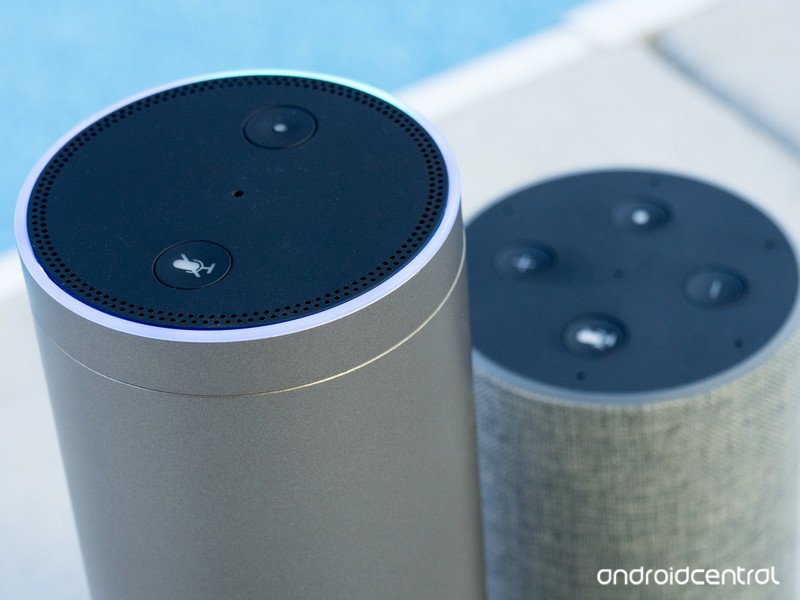
To choose the song that you’d like to wake up to, simply say “Alexa, wake me up to” and then the song of your choice. You can choose a specific title that you’d like to hear first thing in the morning, or you can wake up to a certain genre or playlist if you’d like. Also, if you really don’t care what song you hear, you can always just say “Alexa, wake me up to music” to be woken up by a random selection.
Echo speakers will be able to use music for alarms from Amazon Prime Music, Amazon Music Unlimited, iHeartRadio, Pandora, SiriusXM, Spotify, and TuneIn.
Amazon says this is a feature that’s been highly requested by many of its users, and it’s coming out just in time for the Echo Spot that’s scheduled to go on sale December 19. As for existing Echo hardware, they’ll be able to use this feature starting today.
Amazon Echo
- Tap, Echo or Dot: The ultimate Alexa question
- All about Alexa Skills
- Amazon Echo review
- Echo Dot review
- Top Echo Tips & Tricks
- Amazon Echo vs. Google Home
- Get the latest Alexa news
See at Amazon
Project Fi launches free browser game and a gift for its customers
Free stuff is good stuff.
The holiday season is here, and to help celebrate it, Project Fi just launched a fun little browser game that you can play from either your phone or desktop.
The game has you controlling a yellow character as they ski down a snowy slope, and your objective is to ride as long as you can without running into any trees, logs, or even a yeti. Going over the yellow ramps will give you a nice boost to increase your score even more, and after messing around with it for a few minutes, I can confirm that it’s a great time-killer.
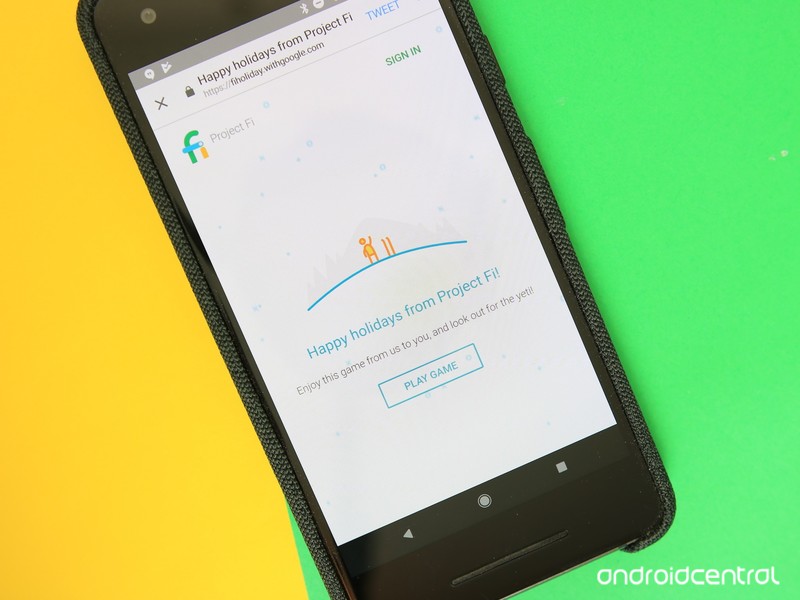
When you go to play the game, you’ll be given the option to log in with your Project Fi account if you have one. There’s a special gift available to those that play the game and use Project Fi, but looking through the Twitter thread for the announcement of the game, it looks like the login functionality is broken for a lot of people.
AC’s Andrew Martonik managed to get logged in without any issues and was rewarded with a promo code for free in-flight Gogo Wi-Fi on one flight that needs to be redeemed by March 31, 2018. It’s not huge, but free’s free.
In any case, if you want to check the game out for yourself, you can play it here.
Google Project Fi
- What is Project Fi?
- Get the latest Project Fi news
- Google Pixel 2 review
- Moto X4 review
- Discuss Project Fi in our forums
- Sign up for Project Fi!

Microsoft offers developers a preview of its quantum computing kit
Developers hoping to get on the quantum computer train early can now get started with Microsoft’s Quantum Development Kit, a free preview version of which was released today. The kit, which was first announced at Microsoft’s Ignite conference in September, includes the Q# programming language, a quantum computing simulator that can simulate 30 logical qubits of power and a companion collection of documentation, libraries and sample programs that will help developers get a better foothold on the complex science behind quantum computing.
The simulator will allow developers to test programs and debug code with their own computers, which is necessary since there really aren’t any quantum computers for them to test their work on yet. Microsoft is also offering a more powerful simulator — one with over 40 logical qubits of computing power — through its Azure cloud computing service. And because the kit is integrated into Microsoft’s Visual Studio developer tool suite, many aspects of the new kit will be familiar.
“What you’re going to see as a developer is the opportunity to tie into tools that you already know well, services you already know well,” Todd Holmdahl, Microsoft’s VP in charge of its quantum effort, said in a statement. “There will be a twist with quantum computing, but it’s our job to make it as easy as possible for the developers who know and love us to be able to use these new tools that could potentially do some things exponentially faster – which means going from a billion years on a classical computer to a couple hours on a quantum computer.”
Source: Microsoft (1), (2)
Amazon’s Alexa can now wake you up with music instead of alarms
One of the greatest perks of connected speakers is waking up to whatever music you like, not just a buzzer or the radio. However, that hasn’t been an option for Alexa-equipped devices like the Echo — until today, that is. Amazon has added a feature to Alexa that lets you wake up to the music of your choice from one of several streaming services, including its own options and Spotify.
To begin with, your criteria can be as broad or narrow as you like. You can name a song, playlist or genre, or ask to play any kind of music if you’re not picky. Alexa can stream radio channels from the likes of TuneIn and iHeartRadio. Naturally, there are a few perks if you use one of Amazon’s music services. You can ask Alexa to wake you based on a mood (like “relaxing”), or find a wake-up song by reciting the lyrics.
This sounds like a minor feature, but it’s potentially very important. If Amazon is going to make the Echo Spot a viable alarm clock, it needs to give the device better functionality than that 20-year-old clock radio sitting on your nightstand. This also makes all Echo models more directly competitive with rivals that have had music wake features for years, such as Sonos. And let’s face it: even if you’re just using Alexa on your phone, Amazon would rather be the one to start your day.
Researchers create prosthetic hand that offers more lifelike dexterity
Researchers at Georgia Tech have developed a prosthetic hand inspired by the bionic one given to Star Wars’ Luke Skywalker. What sets this one apart from other prosthetics is the amount of dexterity it offers, allowing users to move individual fingers at will. With it, Jason Barnes, the amputee working with the researchers, was able to play piano for the first time since losing part of his arm in 2012.
Most available prosthetics use electromyogram (EMG) sensors to translate muscle movement where the limb was removed to hand and finger motions. But those types of sensors are pretty limited in what they can do. “EMG sensors aren’t very accurate,” Gil Weinberg, the professor leading the project, said in a statement. “They can detect a muscle movement, but the signal is too noisy to infer which finger the person wants to move.” So the team took their prosthetic one step further and attached an ultrasound probe. Just as physicians can use ultrasound machines to take a look at a fetus inside of a womb, the probe can see which muscles are moving in an amputee’s arm. Algorithms can then translate that into individual finger movements. “By using this new technology, the arm can detect which fingers an amputee wants to move, even if they don’t have fingers,” said Weinberg.
There are a number of groups working on improving prosthetics and trying to make them more lifelike. Some of those efforts include introducing tactile feedback to let users know where their prosthetic is without having to look and giving prosthetics the ability to see what they need to grasp. DARPA even has an advanced prosthetic named LUKE, also inspired by Skywalker.
This isn’t the first prosthetic built for Barnes by the Georgia Tech team. In 2014, they gave him an arm that let him play drums. It even had a second drumstick that moved based on the music being played and could play faster than any human drummer. About his second, dexterous prosthetic, Barnes said, “It’s completely mind-blowing. This new arm allows me to do whatever grip I want, on the fly, without changing modes or pressing a button. I never thought we’d be able to do this.”
Source: Georgia Tech
Hypocrisy at the FCC and the illusion of transparency
Less than two weeks after being named chairman of the Federal Communications Commission, Ajit Pai said one of his priorities was to “make the agency’s operation more transparent,” beginning with a pilot program to release internal documents pertaining to upcoming FCC meetings. It was a nice sentiment, and one that — on its face — seemed to be an attempt on Pai’s part to do the right thing. If sunlight is the best disinfectant, surely shedding more of it on a government agency that deals in massively important, far-reaching technical policy is a good thing… right?
It has been clear for months, however, that Pai does not intend to do the right thing where the internet — our internet — is concerned.
Just one day after Pai released that statement on transparency, he quickly repealed several orders and reports issued by the FCC as the Obama administration wound down. Pai’s reasoning was that these “midnight regulations” did not have the support of two of the four remaining commissioners and ran “contrary to the wishes expressed by the leadership of… congressional oversight committees.” If you think that rationale sounds a little thin, because it basically boils down to “we didn’t like it,” you’re not the only one. Commissioner Mignon Clyburn responded to Pai’s actions that same day by noting that it’s “a basic principle of administrative procedure” that actions should be explained. She also added that Pai was critical of the commission’s earlier left-leaning majority because for “not providing sufficient reasoning behind its decisions.”
The list of items yanked from the record ranged from a report on potential security concerns around 5G to a paper that addresses progress on reforming discounted internet access for schools. Seemingly important stuff, by the sound of things. Most notably, an investigation into “zero-rating” — a worrisome practice in which telecoms and ISPs don’t count certain services against data caps, giving them distinct advantages over their competitors — was shut down. These are meaty topics that would benefit from more insight, but the haste with which Pai dismissed these reports sure seems to indicate some disdain. Forget about leading by example — Chairman Pai’s push for transparency has been marred by hypocrisy since the very beginning. And things obviously didn’t end there.
Later that month, the commission voted along party lines to revive and revise an exemption that allowed certain ISPs to dodge reporting requirements laid out in the 2015 Open Internet Order. That resuscitated exemption means that any internet service provider with fewer than 250,000 subscribers doesn’t have to disclose information about fees, data caps and ways providers manage their networks to their customers. While this, strictly speaking, doesn’t have much to do with the sort of operational transparency Pai pushed for early in his chairmanship, it’s a chilling admission that the majority of the FCC — Pai included — isn’t troubled by hiding important information from the public.
Prior to the publication of the FCC’s new plan to roll back the open internet protections laid out in the 2015 order, Chairman Pai met with a number of people, including representatives on lobbyist groups like USTelecom. Despite the far-reaching implications of those conversations, the contents of those meetings have never been revealed. Two FOIA requests and a subsequent lawsuit filed by watchdog group American Oversight shed some light on the situation, but what happened inside those meetings remains a mystery. As a result, though, the FCC did eventually release calendar information and related messages about Pai’s meetings, along with communications with Congress and the White House on the subject of net neutrality. This definitely isn’t a good look for a man who began his tenure as FCC chairman claiming to want a more open process.
Before enacting new rules for managing the internet, the FCC must also accept feedback from the public, though it’s been made clear that even an avalanche of pro-net neutrality comments probably won’t make a difference. Unless you’re a lawyer or a telecom insider, your arguments are held in very, very low regard by the FCC. That sort of disregard for feedback was made even more apparent when reports surfaced alleging that many of the nearly 22 million statements the FCC received during its public comment period were fraudulent. An analysis performed by data scientist David Kao found that, after stripping out apparently fake comments, nearly 99 percent of the remaining submissions favored existing net-neutrality rules.
A follow-up report from the Pew Research Center found that only 6 percent of comments submitted were unique, and that the seven copied-and-pasted comments accounted for 38 percent of all submissions. The kicker: Six of those seven comments “argued against net neutrality regulations,” indicating a concerted effort to stuff this virtual ballot box. Pai’s response to all this? Nothing of substance. He instead spent his time in the days leading up to the report’s release taking aim at celebrity critics on Twitter and reaffirmed that the commenting process isn’t an opinion poll “for good reason.” Meanwhile, an investigation into the fake comments led by New York State Attorney General Eric Schneidermann was met by an unhelpful agency and an FCC spokesperson — Mark Wigfield — who derided the whole thing as a publicity stunt.
The FCC inspector general’s office finally relented last week, and signaled that it may — in some way — aid in the investigation. Still, the dragging of feet and the political posturing have prompted even more criticism of the FCC’s handling of net neutrality.
“While I fundamentally disagree with the merits of the FCC’s proposal, what is equally concerning is the lack of integrity to the FCC’s process that has led to this point,” said commissioner Jessica Rosenworcel in a statement. “To review, the FCC has held zero public hearings. The FCC has knowingly maintained a system that has already been corrupted and is susceptible to abuse.”
Recently Pai delivered a keynote address at the Telecommunications and Media Forum at — where else? — Verizon Communications’ Washington, D.C., headquarters. (Quick reminder, if it wasn’t obvious: Verizon owns Engadget’s parent company, Oath, but it has no control over what we cover and how.) The contents of Pai’s address remain secret, as the event’s organizers held to the decades-old Chatham House rule (just because, apparently), which stipulates that “participants are free to use the information received, but neither the identity nor the affiliation of the speaker(s), nor that of any other participant, may be revealed.”
Given Pai’s tenure as a Verizon lawyer, Verizon’s sponsorship of the event and the topics slated to be discussed there, it seems rather convenient that Pai is using an arcane British code to shield his comments. For all we know, Pai might have spent his time pandering to his telecom buddies, or gloating over the impending death of the Open Internet Order. As with many things the FCC has done this year, we’ll probably never know what really happened. Thanks to a video Gizmodo obtained of Pai’s recent address at the Federal Communications Bar Association Dinner, though, we do know that he doesn’t mind joking about being a Verizon shill.
Despite what he has said in the past, Ajit Pai’s version of transparency is willfully ignorant at best and maliciously hypocritical at worst. When the FCC convenes to vote next week, the agency’s ideological fault line will most certainly lead to an unavoidable conclusion. With Commissioner Brendan Carr joining Pai and Michael O’Rielly, the FCC will vote to abolish the common-carrier classification that would force ISPs and telecom giants to treat all data passing through their pipes equally. What happens next remains to be seen, but one thing seems clear: While true transparency might not have changed this outcome, it certainly would’ve helped the rest of us come to grips with the process. Unfortunately, Chairman Pai’s words and actions just don’t match up.
Imgur’s Snacks is a Story-like collection of curated GIFs
Imgur began as a way for Redditors to share images quickly and easily, but has grown into a pretty robust site and accompanying mobile app. Last week, the company announced two new features that should help you find more time-wasting goodness: a tag-based content feed and a new Snacks feature, which echoes Snapchat (and Instagram, Facebook and YouTube) Stories.

Your new feed is accessible from its own tab on your Imgur home screen, right next to the “Most Viral” tab. You’ll need to tap through a few tags of your own interests and your feed will fill up with images and GIFs from the people and tags you follow. You can up/down vote, comment and add favorites from the endless scroll of Imgur content. It’s a nice way to just browse stuff you’re interested in, instead of what’s most viral on the service.
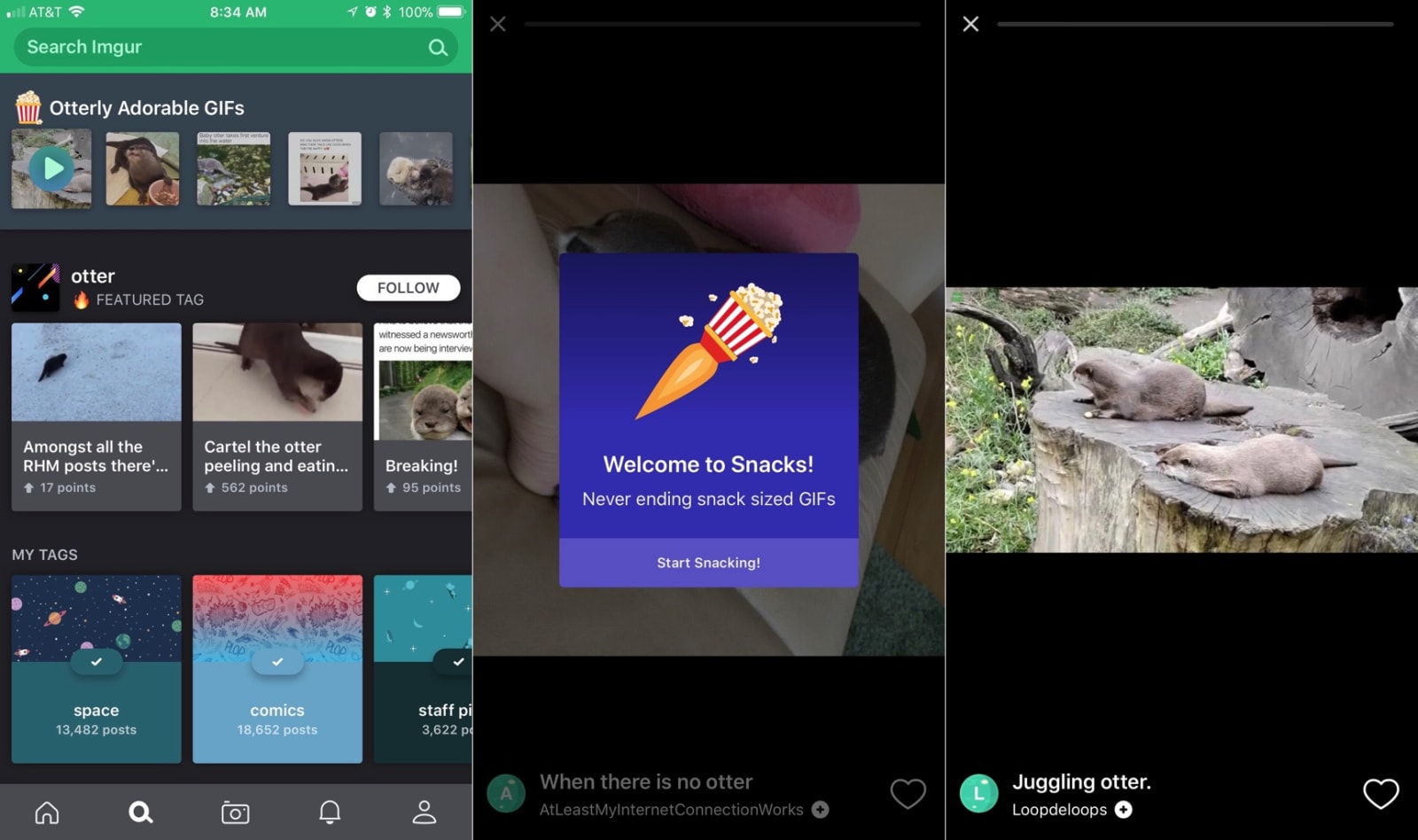
You can find Snacks in the search tab within the Imgur app. You’ll see a bar at the top, just under the search field, with a curated list of GIFs that you can tap and just, well, watch. There doesn’t appear to be a way to create your own list, unfortunately, which separates Snacks from the other social media story features.
Via: TechCrunch
Source: Imgur
New standard sets baseline for HDR on PC displays
As video enthusiasts will tell you, just saying a display is capable of high dynamic range doesn’t say much — you need to know how well it handles HDR. And that’s crucial for PC monitors, where the accuracy and intensity of the picture can make all the difference when you’re playing a game or editing video. The team at VESA wants to do something about it. They’ve unveiled an open standard, DisplayHDR, that sets the baseline levels for HDR quality on PC screens.
There are three tiers, each determined by the maximum brightness. DisplayHDR 400 is aimed more at laptops, where power and size tend to limit what’s possible. A monitor meeting this spec has to reach a brightness of 400 nits, offer true 8-bit color (at 95 percent of the BT.709 gamut), provide global display dimming and support the HDR10 format. That may not sound like much, but it’s 50 percent brighter than typical laptops, many of which ‘cheat’ to get 8-bit color through dithering. DisplayHDR 600 ramps up the brightness to 600 nits while requiring improved black levels and 99 percent BT.709 color accuracy (plus 90 percent of DCI-P3). The most advanced monitors can aim for DisplayHDR 1000, which supplies at least 1,000 nits and even deeper blacks.
The spec is limited to LCD monitors for now, although there are hopes to adapt it to OLED displays and other technology. And you won’t have to wait long to see it in use — VESA is promising DisplayHDR-rated products at CES in January. This doesn’t guarantee that you’ll be blown away by a Netflix movie or an HDR-enabled game, but it should discourage companies from pulling a fast one by slapping an HDR label on a display that doesn’t do the technology justice. Also, it could improve the adoption of HDR among your preferred hardware makers. If they know what to shoot for, they may be more likely to add HDR support instead of holding back out of uncertainty.
Source: VESA
 AIVAnet