


Facebook, Twitter and social media’s road to federal regulation
The extent of Russia’s meddling in the 2016 US presidential election remains unclear, but it’s no secret that social media played a major role. This year brought with it a great deal of scrutiny for tech giants, particularly Facebook, Twitter and Google. These three companies came under the US government’s microscope after news that Kremlin bots and trolls, spearheaded by a group known as the Internet Research Agency, used their sites to tamper with the 2016 presidential election. They spread misinformation (fake news!) and dubious ads across Facebook, Twitter and Google to hundreds of millions of users in the US, with the aim of fomenting hostility among Americans. And it’s safe to say they succeeded.
In October, Facebook revealed to Congress that more than 145 million Americans were exposed to Russian-linked pages and ads in the lead-up to the election — a revelation that laid bare the scope of the Kremlin’s misinformation campaign. That, as it turns out, was actually more damaging than originally disclosed: Facebook first said that 10 million people had seen these types of ads. Twitter discovered more than 2,500 accounts linked to the Internet Research Agency, while Google found Russian-bought ads on its most popular platforms, including Gmail and YouTube.

Facebook, Twitter and Google representatives testifying on Capitol Hill.
As a result, Facebook, Twitter and Google were summoned to testify before the House Judiciary Committee and Senate Intelligence Committee this fall. Members of Congress sought answers about the extent of Russia’s influence during the 2016 presidential election and the role technology played in it, particularly social media platforms. During the hearings, lawyers for Facebook, Twitter and Google were asked by members of the Intelligence Committee about their failure to control Russian bots and trolls from spreading misinformation.
The main point of concern for the committee was the number of deceptive political ads that people potentially saw, including one of Aziz Ansari holding a sign that suggested that you could vote from home using a hashtag. That advertisement as well as thousands of others that hit Facebook and Twitter were targeted at Hillary Clinton supporters.
The plan, it seems, is to trust more actual humans to filter malicious content rather than the algorithms that have already failed us.
Facebook General Counsel Colin Stretch testified that the company is deeply concerned about these threats and is already doubling its engineering efforts to crack down on these “bad actors” going forward. He said Facebook is hiring more ad reviewers and requiring more information from political advertisers, including proof that they’re affiliated with a campaign.
Twitter and Google echoed Stretch’s statements: They both told the Intelligence Committee that they’re working to ensure that the events of 2016 don’t repeat themselves in future elections. The plan, it seems, is to trust more actual humans to filter malicious content rather than the algorithms that have already failed us. Sean Edgett, Twitter’s acting general counsel, said the company is “sharpening its tools” and plans to be more transparent with users and the government in the future. Meanwhile, Google’s Richard Salgado, director of law enforcement and information security, said the company is working on systems that can better detect fake news and fake accounts across its ecosystem.
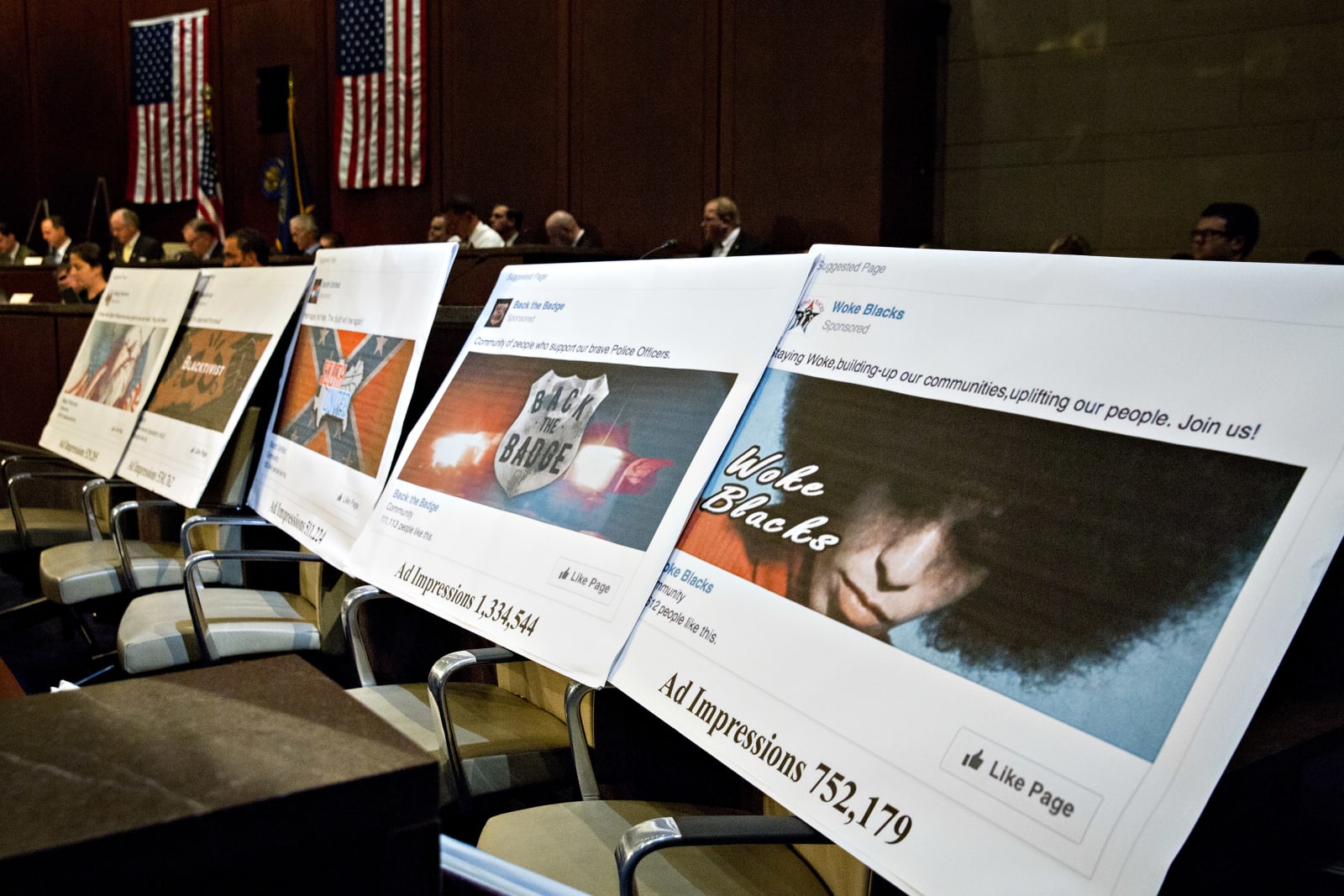
Still, despite promises from tech companies that these issues are being addressed, recent events raise an urgent question: Should the government start regulating political ads and speech on Facebook, Twitter and Google? There are lawmakers on both sides of the aisle who believe so. Indeed, there’s already legislation being proposed. With the Honest Ads Act, for example, the government is proposing that online advertising be regulated the same way print, radio and television are. This would require more transparency from the likes of Facebook, Twitter and Google about who’s paying for political advertisements on their apps or sites.
Senator Mark Warner (D-VA) told NPR earlier this year that the bill, which he introduced alongside Senators John McCain (R-AZ) and Amy Klobuchar (D-MN), was born after months of asking social media companies to “come clean” with the level of Russian interference that took place in 2016. “We don’t want to slow down innovation. We don’t want to slow down individuals’ willingness to use the internet or use these social media platforms,” he said. “But in an era where $1.4 billion was spent on political advertising in the 2016 campaigns — and that number [is] only going to go up — there needs to be equality between traditional radio and broadcast and social media and internet political advertising.”

US Senators Amy Klobuchar (D-MN) and Mark Warner (D-VA) introducing the Honest Ads Act
If Facebook, Twitter and Google were to be regulated, that could be one way to hold them accountable for their oversights and force them to be more transparent — something they roundly failed to do both during and after the 2016 election. Of course, as is often the case with any proposed legislation, it could take some time for the Honest Ads Act or other bills like it to become law. Or it could never happen at all.

There are experts like Paul Levinson, a professor of communications and media studies at Fordham University, who believe that might be for the best, since they don’t see how the government can regulate these companies and what people share on their platforms without infringing on First Amendment rights. After all, not everyone who posts or advertises on Facebook, Twitter and Google is a Russian troll.
“I don’t see Congress trying to legislate an algorithm, because that is beyond the regulatory reach and competence of the government.” — US Representative Adam Schiff (D-CA)
It’s possible that in 2018 Congress will propose more bills like the Honest Ads Act that are designed to curb tech companies’ influence in politics. The efforts to contain them thus far have been bipartisan, suggesting that social media’s road to federal regulation may be more than a pipe dream for the government. Representative Adam Schiff (D-CA), ranking member of the House Intelligence Committee, told Engadget that Congress needs to exercise much more oversight to understand how software algorithms used by Facebook, Twitter and Google work.
But he doesn’t see “trying to legislate an algorithm, because that is beyond the regulatory reach and competence of the government.” He said that because technology changes so quickly, “any prescriptive laws Congress might pass along such lines would likely be made obsolete” in no time. “That doesn’t mean that government should not act where we can, however,” he added, “particularly if the current technologies leave us vulnerable to foreign manipulation or have the effect of deepening divisions in our country.”

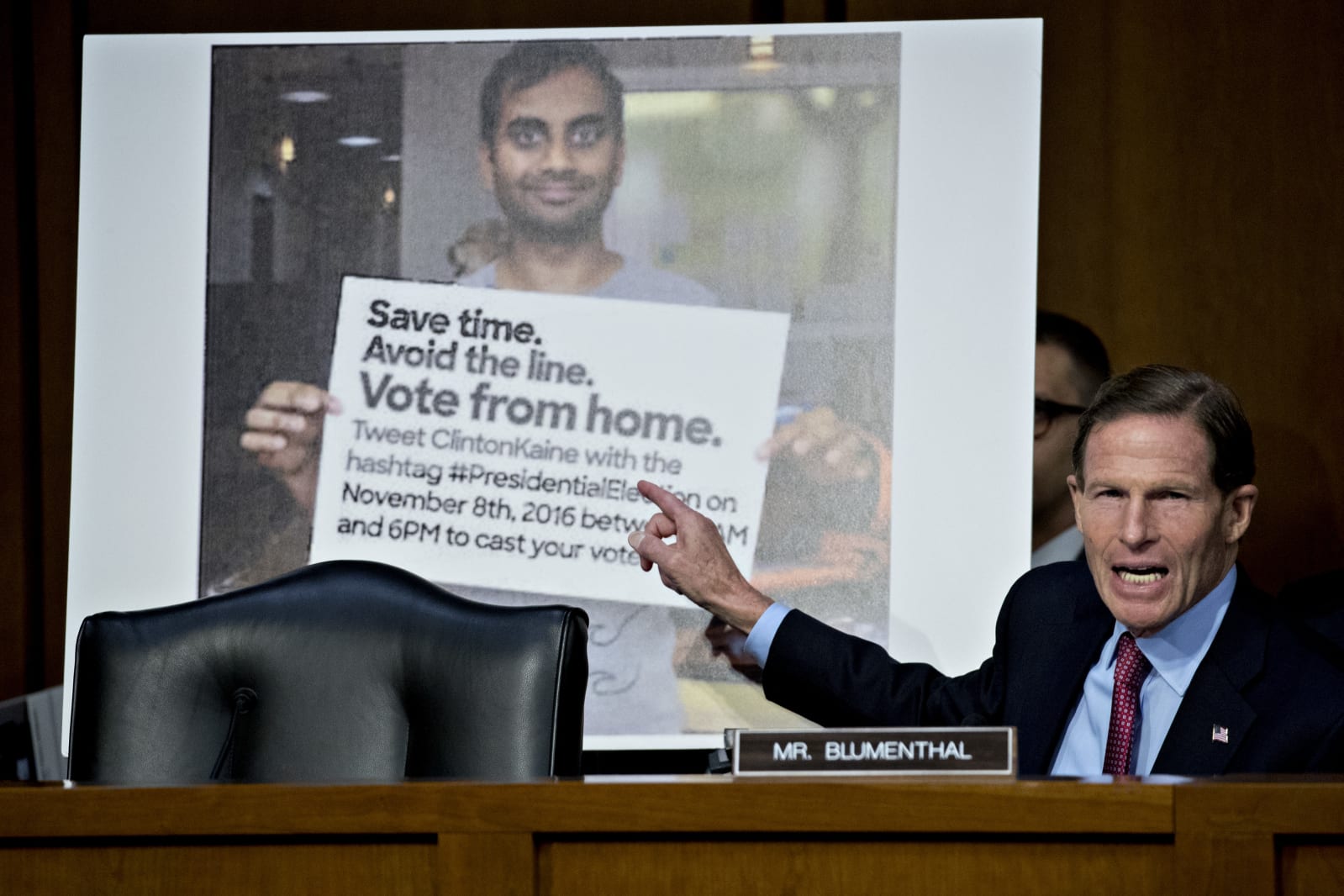
Schiff said there are representatives and senators from both parties interested in legislation that would regulate political-ad disclosures on social media. He also said that, down the road, it will be necessary for the intelligence community to work closely with tech companies to prevent any future attacks on our country’s democratic process.
“When the intelligence community gathers information that a foreign adversary is exploiting the use of these platforms in a clandestine way to influence our elections,” he said, “it should have a mechanism like we use in the counterterrorism context to share that information with the technology companies.” Schiff said that ultimately, these joint efforts between the government and tech firms will be crucial to prepare for any upcoming elections.
“When the intelligence community gathers information that a foreign adversary is exploiting the use of these platforms in a clandestine way to influence our elections, it should have a mechanism like we use in the counterterrorism context to share that information with the technology companies.”
He said that, as part of the Intelligence Committee hearings, he’s asked Facebook, Twitter and Google to create a joint report on how Russia played their systems, so that the committee can be fully informed before making any recommendations that might affect how they do business. “Although the companies have yet to commit to such a report,” he said, “it is my hope that they will do so.”
If a bill like the Honest Ads Act does become law, tech companies could be prone to government fines if they don’t follow set regulations. That would be akin to when US wireless carriers violate consumer disclosures and the FCC has to step in, often slapping them with hundreds of millions of dollars in fines.

What’s clear is that the government isn’t interested in regulating your tweets or Facebook posts about how much you love or hate Donald Trump. (That would be a clear violation of the First Amendment.) Instead, the committee simply intends to keep a better eye on the political ads that you see on social media, to ensure that foreign agents aren’t interfering in our elections. This doesn’t mean you, the user, can be out there promoting hate speech on your timeline, since Twitter or Facebook might take it upon themselves to ban you. (Unless you’re the president of the United States, of course.)
Levinson said that, generally speaking and no matter the reason, the US government shouldn’t try to regulate Facebook, Twitter, Google or any other social media company because “they have no idea what they’re talking about” or how the internet works. If anything, he said, these tech giants should be working harder on self-regulating, which would mean depending less on algorithms and more on humans.
For Levinson, the ideal system to fight bots promoting sketchy political ads and fake news would be to identify fake, ill-minded accounts more quickly and to cancel them immediately. He also said there needs to be a better way to distinguish fake news from real articles or a post from people simply expressing their opinion — even if certain people don’t agree with it. In order for that to happen and be successful, though, Levinson said algorithms from Facebook and Twitter need to experience some trial and error before they can be perfected. That’s why you sometimes see bogus content slip through the cracks.

I am concerned about the government dominating and destroying the essence of the internet.
Paul Levinson, professor of communications and media studies at Fordham University
Levinson added that it’s hard to say how the government could enforce rules on social media companies, but if it comes close to infringing on people’s First Amendment rights, that would cause some civil issues. Levinson said he imagines there would be thousands of cases in the courts, noting that he believes any regulation could be a real threat to the internet as we know it. “Everyone’s so concerned about net neutrality. I don’t really care about whether corporations dominate or don’t dominate, there’s no way any corporation’s going to tell anyone what they can or can’t say,” he said. “But I am concerned about the government dominating and destroying the essence of the internet.”
Regardless of what happens, one thing is indisputable: The government and these tech companies will need to work more closely in 2018 and beyond, in order to ensure that history doesn’t repeat itself. It won’t be easy, because there are business models and, most importantly, people’s First Amendment rights at stake. Hopefully Facebook, Twitter, Google and the government will figure out the best way to keep Russian (and other foreign) trolls and bots at bay. Otherwise we’ll be talking about this again in 2020.
Check out all of Engadget’s year-in-review coverage right here.
The Nintendo Switch’s GPU is key to installing unofficial games
Game console manufacturers don’t particularly like hackers, but Nintendo’s relationship with them has always been particularly tenuous. At a recent hacking conference in Germany a team presented their efforts at getting homebrew games on Nintendo’s latest console, the Switch. As spotted by Wololo, bypassing typical safeguards apparently comes down to Nintendo’s use of an off-the-shelf NVIDIA Tegra chip, and the backdoor that the silicon-maker left for itself.
As with November’s Pegaswitch news, you’ll need to stay on Switch firmware 3.0 once the hackers release their homebrew launcher. And if you’ve kept the hybrid console offline in the hopes of a hack, picking up a physical copy of Pokken Tournament DX will have the firmware version needed for access. Curious to see how the hackers got to where they are with the exploit? Peep the video below.
There isn’t a definite timeline for when to expect homemade games on the console, but hacker Plutoo promises homebrew will be here “soon.” It should be noted hacking your system will void the warranty so if you’re worried about that sort of thing, don’t do it.
Via: Wololo
Source: Media.ccc.de (YouTube)
Facebook deletes accounts of Chechnya leader hit with US sanctions
Ramzan Kadyrov, Head of the Chechen Republic and one of Vladimir Putin’s staunchest allies, was a frequent Facebook and Instagram user up until recently. The controversial leader found himself locked out of both social networks on December 23rd, leaving him unable to post photos of himself snuggling tigers and death threats against Chechnya’s and Russia’s critics. A Facebook rep told The New York Times that the company was legally obligated to boot Kadyrov off its platforms after the US imposed financial and travel sanctions on him.
The United States added Kadyrov to the sanction list due to multiple allegations of human rights violations — his name is frequently linked to torture, kidnapping and murder. While people in the strongman’s crosshairs are probably happy that they won’t have to read his threats on social media, the deletion of his accounts reflects poorly on Facebook. The social network hasn’t banned other people hit by US sanctions, after all, including Venezuelan President Nicolas Maduro who the US describes as “a dictator who disregards the will of the Venezuelan people.”
Clearly, Facebook doesn’t have a hard and fast rule when it comes to dealing with accounts owned by people in the sanction list. If it does have a rule, which doesn’t appear in its community standards page, then it definitely hasn’t been consistently implementing it. The fact that the travel and trade sanctions imposed on Kadyrov have nothing to do with social media is a point of contention, as well.
Jennifer Stisa Granick, a staff attorney with the American Civil Liberties Union’s Speech, Privacy and Technology project, said:
“This sanctions law, which was written for one purpose, is being used to suppress speech with little consideration of the free expression values and the special risks of blocking speech, as opposed to blocking commerce or funds as the sanctions was designed to do. That’s really problematic.”
Russian internet watchdog Roskomnadzor demanded answers from Facebook a few days after Kadyrov’s ban came to light. The man himself says he’s not affected by what he describes as “petty US rat race,” but wants to ask the government: “Where is your praised democracy and the right of citizens to receive information? Or do 4 million followers (his combined Facebook and Instagram followers) mean nothing?”
Source: The New York Times, The Guardian
Japan’s disaster alerts will work with all Android 8.1 phones
Japan gets a lot of natural disasters. Combine the threat of earthquakes, tsunamis and typhoons (however mild), and it’s easy to see why the Japanese government offers alerts across TV, radio and your mobile phone. Those smartphone alerts were usually baked in by carriers, which means if you had an unlocked phone, or a phone that’s running on one of several MVNO phone carriers, you would miss out on the potentially lifesaving heads-up.
The country’s Telecommunications Carriers Association has now announced that, starting on Android 8.1, any phone running Google’s latest OS will also be able pick up these alerts. It’ll also pick up other area-specific disaster information, including terrorist activities. Emergency notifications can be switched on iOS devices in the settings menu, although according to Apple’s support page, it appears to still be tied to Japan’s three major carriers.
The TCA doesn’t offer a specific date, as the onus will be on phone makers (and Google) to get the latest version of Android onto smartphones in order to benefit from the feature. Until then, third-party apps will remain the best bet for disaster warnings in Japan.
Via: Android Police
Source: TCA (Japanese)
Kodi comes full circle with a return to the Xbox
Media streaming software Kodi used to be known as XBMC (Xbox Media Center), but ironically, one of the few devices it hasn’t worked on is the Xbox One — until now. Kodi has unveiled version “18.0-Alpha1” for the Xbox One, giving owners of the console a (rough) streaming option. While it looks just like the Windows 10 and other versions of the app, the current version may be unstable and can’t access your Blu-ray drive or attached storage (via USB 3.0), unfortunately.
In addition, it can only access your video and music folders in a limited way, and network support is limited to NFS:// shares. “Due to the nature of how UWP (Universal Windows Platform) works, our hands are tied in some areas,” Kodi noted. “Some parts are not even finished yet and our developers are still working on getting it up to the regular standard.”
Kodi’s road to an Xbox One app is kind of interesting, if you’re an Xbox history buff. XBMC was originally developed for the Xbox because it was one of the few affordable devices with a TV out, Kodi notes. As smartphones, tablets, the Raspberry Pi, and numerous dedicated boxes came on the market, however, the developers stopped working on the Xbox itself, while porting it to many other platforms.
“It was thought by the team that getting Kodi (XBMC) running on newer Xbox versions would be wishful thinking and we would never see that happen anymore,” Kodi wrote. However, once the team managed to get Kodi repackaged first as a 32-bit UWP app, then in a 64-bit version, the Xbox One port became feasible.
If you’re willing to try out the early alpha app, it’s now available on the Xbox One store. If not, you can always use Xbox One’s built in Media Player or use the popular Plex app (the free version lets you play your own files). You can also stream on Xbox One with the VLC app.
Source: Kodi
Facebook and Twitter could face UK ‘sanctions’ over fake news
The chair of a UK committee investigating fake news has threatened Facebook and Twitter with “sanctions” if they allow the issue to fester on their respective platforms. In an interview with the Guardian, Damian Collins, chair of the Department of Culture, Media and Sport select committee, said a political “mechanism” was needed to ensure companies monitor and swiftly take down deceptive posts. “There has to be a way of scrutinising the procedures that companies like Facebook put in place to help them identify known sources of disinformation, particularly when it’s politically motivated and coming from another country,” he said.
The comments arrive in the middle of an inquiry into the impact of fake news in the UK. As part of that investigation, Collins asked Facebook and Twitter for information about bots and Russian-linked accounts that might have swayed the EU referendum. Both companies wrote back, however Collins found their responses to be “completely inadequate.” Twitter, for instance, pointed to six referendum-related ads purchased by state-sponsored news outlet Russia Today for $1,031.99 last year. Collins, however, had been interested in a study by London’s City University which discovered a network of 13,493 suspected bot accounts in October.
According to the Guardian, Collins has given Twitter and Facebook until January 18th to provide new responses. It’s not clear what, if any penalty will be levied if they fail to supply adequate information. Sanctions could form part of the Committee’s final report, but that won’t be ready for some time. The cross-party group, after all, has scheduled further evidence-gathering sessions in Washington with Google, YouTube and CNN next February. (Representatives from Facebook and Twitter have also been asked to attend.) The UK government can then accept or reject the recommendations in the report, including any hypothetical fines.
Collins’ feelings are pretty clear. “What we need to be able to do is say to the companies: we recognise that you are best placed to monitor what is going on your own site and to get the balance right in taking action against it but also safeguarding the privacy of users,” he told The Guardian. “But what there has to be then is some mechanism of saying: if you fail to do that, if you ignore requests to act, if you fail to police the site effectively and deal with highly problematic content, then there has to be some sort of sanction against you.”
The likelihood the UK government will follow through with sanctions, as Collins’ threatens, is unlikely. A proposed fee system for companies that leave hate speech online, for instance, has been quickly watered down into contributions “on a voluntary basis.” Fines for fake news aren’t unthinkable, though. Back in October, Germany introduced the Network Enforcement Act — known as NetzDG — which can fine social media companies up to 50 million euros. It’s primarily aimed at curbing hate speech but could be used to fine companies that ignore fake news too. Germany and the UK are, of course, quite different, but their goals are the same: to stop malicious actors from deceiving their citizens over the web.
Source: The Guardian
iFixit Reduces Price of All DIY iPhone Battery Replacement Kits to $29 or Less
Yesterday, Apple responded to customer complaints about how the company handles power management features in older iPhone models and decided to reduce the price for out-of-warranty iPhone battery replacements from $79 to $29, beginning in late January and lasting through December 2018. In response, iFixit has decided to match that price point and lower the cost of every DIY iPhone battery fix kit to $29 or less.
iFixit’s kits include every tool that you need to open up an iPhone and swap out an old battery for a new one, and includes coverage for the iPhone 7, 7 Plus, 6s, 6s Plus, 6, 6 Plus, SE, 5, 5c, 5, and 4s. Apple’s lowered price covers “anyone with an iPhone 6 or later whose battery needs to be replaced,” so iFixit’s fix kits also include coverage for older iPhone models excluded from Apple’s new program.
The difference with iFixit is that you’ll have to upgrade and swap out the battery on your own — unlike paying Apple to do it for you — but iFixit explained a few benefits that its DIY fix kits offer.
When we ask our customers why they do the repair themselves rather than take it to Apple, they give us a few reasons:
– Convenience. No need to drive anywhere or wait in line; replace your battery from your kitchen.
– Availability. Many people don’t live near an Apple Store, and don’t have another option for same-day repair.
– Privacy. Some people aren’t comfortable giving their device to someone else.
– Fun. It’s interesting to open up your stuff, find out how it works, and make it function better.
iFixit mentioned that over the last week it has noticed a 3x increase in customers using the site to replace their batteries, and in the last month just over 170,000 people specifically used the iFixit iPhone 6 battery install guide. For all iPhone models, nearly 510,000 people learned how to replace their device’s battery in the last month.
Tag: iFixit
Discuss this article in our forums
Not us! Android makers say they never slow phones because of battery problems
Android phone makers are responding to Apple’s recent public relations nightmare, after it was revealed the company slowed older iPhone models down to compensate for aging batteries, and avoid any problems that may occur due to them. Samsung, LG, HTC, and Motorola have all made statements saying they do not use similar tactics.
Motorola does not throttle processors inside its phones when the battery gets old, the company told The Verge, while HTC said something very similar. LG was more forthright, saying it never has, and never will slow down processors inside its devices, because it, “cares what our customers think.”
Samsung issued a longer statement, saying that in addition to not slowing processors over time, it uses software and built-in safety features to, “govern the battery charging current and charging duration.” This suggests Samsung prefers to manage the battery as it starts to age, rather than temper the processor to reduce strain. Digital Trends has contacted Huawei and OnePlus for comment, and will update when both respond.
While many will be pleased their Android phones won’t hit an artificial speed limit in the future, it doesn’t mean Android phones are immune to problems. The iPhone uses the same battery technology as every Android phone — therefore it degrades in the same way — and replacing the battery inside almost all flagship Android phones today is an equally awkward process too.
Reports of long-term system slowdown for Android phones aren’t rare either, and usually caused by lack of storage space, memory fragmentation, or other system issues. Huawei is one company that has acknowledged this, and made it very clear how it addresses the problem. Introduced in EMUI 5.0, it used machine learning to understand how you use your phone, then allocated resources intelligently to speed things up, along with new processes to manage memory. It promises EMUI 5 and above-equipped phones will remain fast even after 18 months of use.
Apple has responded to criticism by lowering the price of a replacement battery for the iPhone, which fixes any device throttling, and gone into detail about why it implemented these measures in the first place.
Editors’ Recommendations
- Huawei Mate 9 review
- Huawei Mate 10 Pro review
- The best cheap phones you can buy
- LG V30 review
- Huawei Honor 9 review
Deal: Early Pixelbook owners can get a $100 credit from certain retailers
If you were one of the first customers to buy a Google Pixelbook, you can get $100 back and a free Google Home.
The suggested retail price for Google’s base model Pixelbook is $999, but after a little more than a month on the shelves the convertible saw a holiday discount to $899 and a free Google Home from certain retailers. Early adopters who bought the device in the first few weeks may be in luck, depending on where they purchased it.

Some retailers have been issuing refunds for the $100 (plus sales tax) difference between the MSRP and holiday pricing. I spoke with the customer support team at my local Best Buy, and they refunded the $107 difference back to my debit card and let me grab a free Google Home off the shelf. Some users had to escalate the situation to Best Buy’s phone support but were able to get the credit and Google Home in the end.
Those that bought the Pixelbook from other retailers have not been so lucky. Reddit user fizzysota purchased their Pixelbook from the Google Store, and was told they would have to return the device for the original $999 price and re-order it at the $899 price. Other users that bought the device from Amazon had similar results.
Were you able to get a partial refund on your Pixelbook? Let us know down below!
Chromebooks
- The best Chromebooks
- Should you buy a Chromebook?
- Google Play is coming to Chromebooks
- Acer Chromebook 14 review
- Join our Chromebook forums
‘Black Mirror’ season four is here to ruin your holiday spirit
At some point during Christmas and New Year, the days just sort of blend together. Sat silently in your parents’ living room, you’re already bored of your gifts, permanently spaced from ’round-the-clock imbibing, and you can’t possibly eat any more cheese. But snap out of it, because it’s finally time to sink your teeth into season four of Black Mirror. All six episodes of everyone’s favorite dystopian reality check are available to binge on Netflix right this second — and let’s be honest, you are going to binge it, because spoilers will be lighting up the group chat by dinner time. To celebrate the new series (and the end of 2017), Netflix has also released a lovely New Year’s message. Not the trailer you may’ve already seen teasing the latest episodes, but a mosaic of footage taken from previous seasons and the real world, which suggests the line between show and the other side of the glass is growing ever thinner.
 AIVAnet