


What to expect at IFA 2017
IFA is one of the world’s most prestigious technology shows, and a sober European counterpart to the glitz at Las Vegas’ CES. It’s where plenty of big names show off the wares they hope you’ll buy in the run-up to the holidays, including new phones and TVs. The show also hosts a multitude of kitchen appliances, because we all need to keep an eye out for the latest in blender, washing machine and freezer technology. The show kicks off in Berlin in a few days’ time, and before we fly out to Germany, here’s what we’re expecting to see pop up.
Mobile
For years, IFA was where Samsung would unveil the newest version of the Galaxy Note to an increasingly-adoring crowd. But the Korean company now prefers to hold its own, separate event a few days before IFA kicks off. As a consequence, smartphones from LG and Sony have a better chance of stealing the hearts and minds of the folks at the show.

LG’s strategy of telling you everything about its phone before it’s actually been announced means that the V30 is already pretty familiar. We know, for instance, that the device will unlock at the sight of your face or the sound of your voice. The almost bezel-free smartphone should have good photography chops, with the company boasting that the camera has the lowest f-stop seen on a phone.
Sony, similarly, hasn’t been able to keep much of a lid on its plans for the show, and it looks like it has two new devices ready for launch. The Xperia XZ1 and XZ1 Compact are, big surprise, a flagship and its scaled-down sibling that will reportedly pack high-end specs. It’s believed that both handsets won’t come cheap, with British prices for both handsets pegged at £599 ($766) and £499 ($638), respectively.
Motorola, meanwhile, will launch the long-awaited X4 — a device we first heard about in a leak dating back as far as May. Distributors inadvertently published images of the new device, as well as a spec-sheet revealing what’s tucked inside. The 5.2-inch device is packing a 2.2GHz octa-core processor with a choice of 3GB or 4GB RAM and a 3,000mAh battery.
In more surprising news, BlackBerry has posted a video saying that it’s going to do… something at the show. The fact that the company very specifically mentions the KEYOne means that it’s probably not going to be new hardware. GSMArena believes that it could be a reveal of a global release for an all-black version of the phone that initially launched in India. Anything more than that is going to be a very pleasant surprise, for sure.
Wearables
It’s likely that IFA 2017 isn’t going to be the best show for wearables, at least not compared to how many debuted in 2016. The rumors about new devices have dropped off considerably, and we wouldn’t be surprised if things continued to slow down.
Samsung will probably dominate the headlines with a pair of devices for the wrist that we’re expecting to launch at the show. The first is the Gear Fit 2 Pro, an improvement on the original Gear Fit 2 that will be able to play Spotify music offline and track your swimming.

The bigger news, however, will be the fourth entry in the Gear S line, the Gear Sport, that was found in documents submitted to the FCC. Details are justifiably scarce apart from the fact that the device will have an optical heart rate monitor, Bluetooth and WiFi. But, it’s a Gear smartwatch with the word Sport in the name, so you can pretty much guess the rest.
Garmin, a regular fixture at the show, is likely to have an incremental update to its line of fitness-focused watches. Given that the company normally plays to its strengths, expect sleeker, smoother and generally better running watches and activity trackers. Wareable believes that we can expect an update to the Vivoactive with a snazzier design.
We’re also expecting plenty more hybrid smartwatches with analog faces complementing features such as activity tracking and mobile payments. Although given that many of the more prominent watch brands announced the bulk of their wares at Baselworld, IFA will likely showcase the stragglers.
Sound, Vision and Everything Else
There are plenty of other companies that we expect to unveil products at the show, but have yet to hear much through the rumor mill. Since these companies usually wait for IFA opens its doors for the big unveil, it’s quite reasonable to expect the situation to remain in place. Bang & Olufsen, for instance, are likely to wheel out a speaker or new headphones for its lower-end Beoplay line.
Similarly, you can expect to see a bevy of new televisions that are both bigger and better than whatever was announced last year. Samsung, Sony and LG will all want to show off their new TVs with 4K and 8K resolutions, HDR and everything else. In addition, if you’re still clinging to physical formats, expect plenty of Blu-ray players that’ll show off the bleeding edge of what discs can do.
Because IFA is also an appliance show, you can expect to see plenty of cool smart home tech, especially from Philips. The Hue-maker is probably feeling the pinch from so many upstart competitors in the smart lighting space. But there’s a reason that the company has remained king of the hill for so long, with innovative and cool products that you want to put in your living room.

On the personal computing front, very little has filtered through the channels about new devices for the show. But we can at least hope for some refreshed tablets and laptops as we head into the holiday season. Not to mention keep our hearts open for news of new VR and MR headsets from companies looking to lure more than just the early adopter to their platform.
Of course, all of this is idle speculation until the respective CEOs of their respective companies stand on stage and announce their products to the world.
WSJ: Apple Aiming to Use Steve Jobs Theater to Unveil New Products at September 12 Event
Apple will hold a product event on Tuesday, September 12, according to Dow Jones sources cited by The Wall Street Journal.
Apple CEO Tim Cook at the Worldwide Developers Conference in June
Apple is aiming to use Steve Jobs Theater for the event, but its construction timetable could affect timing or location, the report said.
In the past two years it has used San Francisco’s Bill Graham Civic Auditorium, but people close to the company say it is aiming to use the 1,000-seat Steve Jobs Theater on its new headquarters campus. That headquarters, however, isn’t yet finished, and its construction timetable could affect the timing or location of the event, those people said.
At the event, Apple is widely expected to unveil the so-called iPhone 8 with an OLED display, wireless charging, and facial recognition, alongside updated versions of the iPhone 7 and iPhone 7 Plus.
Apple Watch Series 3 models and a new Apple TV with 4K video streaming capabilities and HDR support are also expected to be unveiled, along with release dates for iOS 11, macOS High Sierra, watchOS 4, and tvOS 11.
Apple has held a product event in September for five consecutive years, dating back to the introduction of the iPhone 5 in 2012. September 12 was already rumored as a possible date for this year’s event last week.
There are typically 10 or 11 days between a new iPhone being announced and launching, so this year’s iPhone lineup could be available on Friday, September 22 based on that trend. The lone exception in the past five years was 2015, when there was a 16-day gap between the announcement date and availability.
iPhone pre-orders would likely begin on Friday, September 15 at 12:00 a.m. Pacific Time (3:00 a.m. Eastern Time).
Tag: September 2017 event
Discuss this article in our forums
Fitbit Announces $300 ‘Ionic’ Smartwatch, ‘Flyer’ Bluetooth Headphones, and Subscription Coach App
Fitbit today announced a collection of all-new products and services, centering upon the company’s first smartwatch, the Fitbit Ionic, along with a new subscription coaching service, Fitbit Coach. The Fitbit Ionic includes improved GPS and heart rate tracking, is water resistant up to 50 meters, supports contactless payments, smartphone notifications, on-board music, and more.
Like past Fitbit devices, the Fitbit Ionic includes a variety of fitness-focused features for users to take advantage of, including a “Run Detect” mode that starts workout tracking when the smartwatch notices the user is running. When exercising outside, users can also leave their smartphone behind and track their running data solely using the Fitbit Ionic. In terms of the new water resistance, there’s also a swim workout to track laps and calories burned in a pool.
All of the Fitbit Ionic’s enhanced sensor-tracking features are fueled by the new relative SpO2 sensor, which can estimate blood oxygen levels and “opens the potential” for tracking even more health metrics. Fitbit said that, in the future, this will include sleep apnea. The smartwatch’s new display provides up to 1,000 nits of brightness and is protected by a scratch proof Corning Gorilla Glass 3 touchscreen.
“Ten years ago, Fitbit pioneered the wearables category with the introduction of its first health and fitness tracker. Since then, we have become the leading global wearables brand, setting the pace of innovation in the category and establishing the largest social fitness network that helps millions of people around the world be healthier,” said James Park, co-founder and CEO of Fitbit.
“With Ionic, we will deliver what consumers have not yet seen in a smartwatch – a health and fitness first platform that combines the power of personalization and deeper insights with our most advanced technology to date, unlocking opportunities for unprecedented health tracking capabilities in the future.”
Fitbit Ionic users will be able to pay at any retail store that supports contactless payments thanks to a new “Fitbit Pay” feature. The company said that over the coming months it will introduce support for American Express cards, as well as Mastercard and Visa credit/debit cards that have been issued from ANZ, Banco Santander, Bank of America, Capital One, HSBC, KBC Bank Ireland, OCBC Bank, Royal Bank of Canada, UOB and US Bank. Fitbit Pay will be supported in ten markets globally, with more countries and banks rolling out in the future.
Users will be able to get four full days of charge on their Fitbit Ionic, but GPS or music listening will limit the smartwatch’s charge to just about ten hours. When using the device, users will also be able to access the new App Gallery, allowing them to select apps and watch faces to customize their Fitbit Ionic. Major partner apps available at launch include Pandora, Starbucks, Strava, and AccuWeather, and app support will be continuously expanded thanks to a new Fitbit Studio SDK launching for developers in September.

The on-board music storage can hold up to 300 songs on 2.5 GB, and Fitbit has simultaneously announced a new pair of Bluetooth headphones so users can take advantage of music listening on the new smartwatch. Called the Fitbit Flyer Wireless Fitness Headphones, the sweatproof headphones have in-line controls for playback and smartphone interactions, customizable ear tips, multiple sound settings, and six hours of playback. The Fitbit Flyer Headphones can be pre-ordered today for $129.95.
The new Fitbit Coach iOS app will connect with the Fitbit Ionic to provide premium workout training at $7.99/month or $39.99/year. The company said that this training includes personalized workout videos, which adapt to each user’s activity data gathered from the Fitbit Ionic’s various sensors. Guided Health Programs include a six-week beginner’s running course and a four-week crash course on reducing sugar in food consumption, with more fitness, wellness, and even sleep-focused programs launching soon.

The Fitbit Ionic is available for pre-order today on Fitbit.com for $299.95, and will launch for pre-order on select online retailers tomorrow and in stores this October. The device will debut in three color combinations: silver gray tracker and clasp with blue gray band, smoke gray tracker and clasp with charcoal band, and burnt orange tracker and clasp with slate blue band. Optional accessories will be available, including a Sport Band ($29.95), Classic Band ($29.95), and Perforated Leather Band ($59.95).
In addition to all of these announcements, Fitbit also unveiled a new smart scale called the Fitbit Aria 2. Within the Fitbit ecosystem, the Aria 2 talks with the company’s other devices to provide a holistic view of a user’s health, and Fitbit noted that the scale includes improved accuracy and design, easier set-up, and support for multiple users. The Fitbit Aria 2 is also available for pre-order today at a price of $129.95, and will launch alongside the other products this fall.
Tag: Fitbit
Discuss this article in our forums
Apple Now Selling Beats Solo3, Powerbeats3, and Pill+ Speaker in New ‘Neighborhood Collection’ Colors
Apple is now selling a trio of Beats products in new “Neighborhood Collection” colors on its online store and retail stores around the world.
Solo3 Wireless Headphones and Powerbeats3 Wireless Headphones are now available in Asphalt Gray, Brick Red, Break Blue, and Turf Green. The Beats Pill+ Speaker comes in only Asphalt Gray and Turf Green.
• Solo3 Wireless Headphones ($299.95)
• Powerbeats3 Wireless Headphones ($199.95)
• Beats Pill+ Wireless Speaker ($179.95)
The new Neighborhood Collection products are also available at Target in the United States, and at retailer John Lewis in the UK.
Apple, Target, and John Lewis stores may still be in the process of receiving stock, so it’s best to call ahead. Prices vary in other countries.
Tags: Beats, Apple retail
Discuss this article in our forums
Samsung recruits Panasonic to bring HDR10+ to more TVs and devices
Despite corralling the likes of Sony and TCL into using its high dynamic range tech, it seems not everyone is interested in Dolby Vision. In April, Samsung bucked the trend by announcing its upgraded HDR10+ open standard. It also managed to snap up Amazon as its first video streaming partner. Fast-forward several months, and now the tech giant is looking to widen its net. In partnership with 20th Century Fox and Panasonic, Samsung will start licensing HDR10+ in January. Together, the trio will attempt to lure TV, Blu-ray, and set-top box manufacturers away from Dolby, to their fold.
At present, the two competing software offer similar results. Unlike static HDR10, Dolby Vision and HDR10+ both use “dynamic metadata” to adjust brightness levels on a scene-by-scene basis — and even a frame-by-frame-basis. But, there are a couple of notable differences between the next-gen standards: Dolby Vision boasts a future-proof 12-bit color range and maximum 10,000 nit brightness. Critically, it also charges royalties, whereas Samsung only asks for an administrative fee. Whether that will be enough to convince manufacturers to opt for Samsung’s alternative remains to be seen. Although it may complicate things for buyers in search of their next high-end TV. The same goes for 4K Blu-ray players and discs, and video streaming platforms. To overcome that hurdle, just keep your eyes peeled for products carrying the Ultra HD Premium logo, and you should be fine.
Source: Business Wire (press release)
Fitbit Ionic smartwatch hands-on: A surprisingly well-rounded debut
After a series of reported delays and developmental challenges, Fitbit is finally ready to unveil its first smartwatch. The timing is appropriate, given that this is the tenth anniversary of the company’s first tracker. The Ionic is Fitbit’s most modern device to date, featuring a colorful LCD touchscreen and advanced sensors. It also serves as the launchpad for some new Fitbit services, like a fully fledged operating system called FitbitOS, contactless payment and a subscription-based custom workout guide called Fitbit Coach. The company needs the Fitbit Ionic to be successful — its sales have slowed in recent months, and it faces a lawsuit over its use of haptic feedback. Judging from the few days I’ve had an early version of the Ionic, it appears to have the potential to resuscitate Fitbit’s waning business.
Fitbit sees the Ionic as its flagship device, and naturally the company stuffed it full of features. In addition to a brilliant display, you’ll get an updated heart rate monitor, a new SpO2 blood oxygen sensor (more on that later), onboard GPS and NFC. That last component enables the new Fitbit Pay service, which will be accepted anywhere Mastercard, Visa and Amex contactless payments are supported. I tried it out at a pop-up shop the company set up and was pleased with how easy the process was. I just had to hold down the left button until the image of the card appeared, then tap the watch face against the payment terminal. Loading a card on the watch is slightly tedious; you’ll have to open Fitbit on your phone, find the Wallet app and enter your card number, name and address. It would be more convenient if Fitbit added the option to use your camera to scan those details from your card, but the existing system works fine.
I tested the Ionic’s onboard GPS and water resistance when I took it to the pool one evening. Fitbit uses your location information to track laps, and this worked well during my brief test. The company’s reps suggested I set my pool’s length in the app before starting, but it didn’t have an option for my relatively small (20–25 meters) facility. Still, I set it to 50 yards (the lowest available setting) and quickly swam four laps. I was pleasantly surprised when the Ionic calculated that I had clocked four and a half 20-meter laps — quite accurate considering I had walked about halfway back before stopping the workout.

For now, it isn’t clear how Fitbit intends to integrate the SpO2 sensor data. The optical system uses a combination of LEDs and a camera to detect your blood oxygen and calculate the relative rate of change. Fitbit says relative change in blood oxygen can be used to detect and understand sleep apnea, but that’s something that will be implemented later.
Speaking of, the Ionic will also track your sleep the way previous Fitbits (like the Alta HR and Charge 2) do. The Ionic monitors your pulse and movement to see what stage of sleep (deep, REM, light, etc.) you’re in throughout the night. My previous experience with the Alta HR wasn’t the most assuring — I sometimes woke up to find that the tracker hadn’t registered my sleep stages at all, possibly due to the device’s having moved while I slept.
To that end, Fitbit has designed the Ionic so that it sits more securely. Using a method the company calls nano-molding technology (NMT), the smartwatch curves slightly to hug your wrist. During my few days with the Ionic, I’ve found it more reliable and comfortable to wear to bed than the Alta HR. The new watch is more consistent in tracking my heart rate as I sleep, although it has gotten poorer at identifying when I doze off. For example, I went to bed at 1 AM one night, but the Ionic says I only fell asleep at 4:09 AM, which I know isn’t true, since I remember briefly waking up at 4 AM. After I woke up at 7:45 AM, that put me at a dismal 3 hours and 14 minutes (counting the times I woke up) of sleep for the night. So far, this is a one-time fluke, but it messes up my metrics.

The Ionic also features a unibody design made from aerospace-grade aluminum and a “spherical glass” screen. The surface of the display is slightly curved, but I can barely tell that it is. Those who were hoping for a round screen will be disappointed; the Ionic is as blockish as the rest of Fitbit’s devices. In fact, its rectangular panel, flanked by lugs that slope away from the angular watch face, will remind you of the hexagonal design of the Blaze — Fitbit’s previous smartwatch wannabe.
I wish the Ionic had a round face, but its gorgeous 1.42-inch, 348 x 250 screen makes up for my disappointment. This is the best display I’ve seen on a smartwatch yet, and it provides a sumptuous canvas for FitbitOS. Full-color pictures of people working out look vibrant and clear, while words superimposed on these images are crisp. My favorite thing about the screen, though, has to be its brightness (1,000 nits), which makes it easy to read even in harsh sunlight.

As the company’s first fully fledged app-based platform, FitbitOS is impressively mature, although that is probably thanks to the experience of the Pebble team, which Fitbit acquired this year. You’ll get notifications from your phone for calls, messages and basically any app that can push alerts. I activated those from Gmail, Slack and Hangouts, and they all came through during my testing. Like most smartwatches, the Ionic would vibrate briefly when it received a message, and a preview would pop up on the screen for a few seconds after I lifted my arm.
Swiping up from the home screen reveals accumulated alerts, while swiping left leads to the apps. There is a small selection at launch, including utilities like Alarm, Weather, Timer and Wallet, as well as third-party offerings like Starbucks, Strava and Pandora. Fitbit expects this list to grow in number by the time the watches ship. To encourage developers to create apps for FitbitOS, the company is also launching Fitbit Studio, a web-based platform for coding. The SDK for making Fitbit apps is also based on popular, easy-to-learn standards like JavaScript and SVG.
Fitbit said it learned from Pebble that the key to getting more apps is to make building them as easy as possible. Indeed, the web system is so straightforward that I was able to create a basic watch face in about 15 minutes at a recent demo. Of course, this was with the help of Fitbit’s reps showing me each step, but there is a respectable database of instructions and guides on the Studio website, which will launch in September. Anyone can create an app and share it with their friends via a link, but you’ll have to submit your product to Fitbit for review if you want it included and featured in the app gallery so other people can discover it.

Until more apps become available after Studio launches, you’ll have to make do with the preinstalled offerings. Although the launch selection is limited, at least the applications are useful. The Starbucks app lets you load the barcode for a gift card so you can pay for your latte by scanning your watch. The Ionic is the first wearable to feature a Pandora app, and it lets you play your favorite stations from your wrist (as long as you have a paid account). You can stream music from the Ionic to Bluetooth headphones, whether via the Pandora app or from the watch’s 4GB of onboard storage. (You’ll have to upload them from your computer.) I paired my watch with the new Fitbit Flyer wireless earphones that the company launched in tandem. My impressions of that device are in a separate hands-on here, but suffice it to say that connecting the two gadgets was a cinch. Trying to link third-party Bluetooth headphones was more complicated — there was no menu on the watch nor on the iOS app to connect.
It took me some time to understand how to navigate some of the apps. Although you can get by with tapping and swiping, for the most part, you’ll have to use the two physical buttons on the right of the watch face to launch and end workouts. The single button on the left lets you exit apps or go back to the home screen. It’s meant to prevent you from accidentally starting a workout, but the combination of long presses and choosing between top or bottom buttons left me confused. Still, this is something I can see myself getting used to over time.
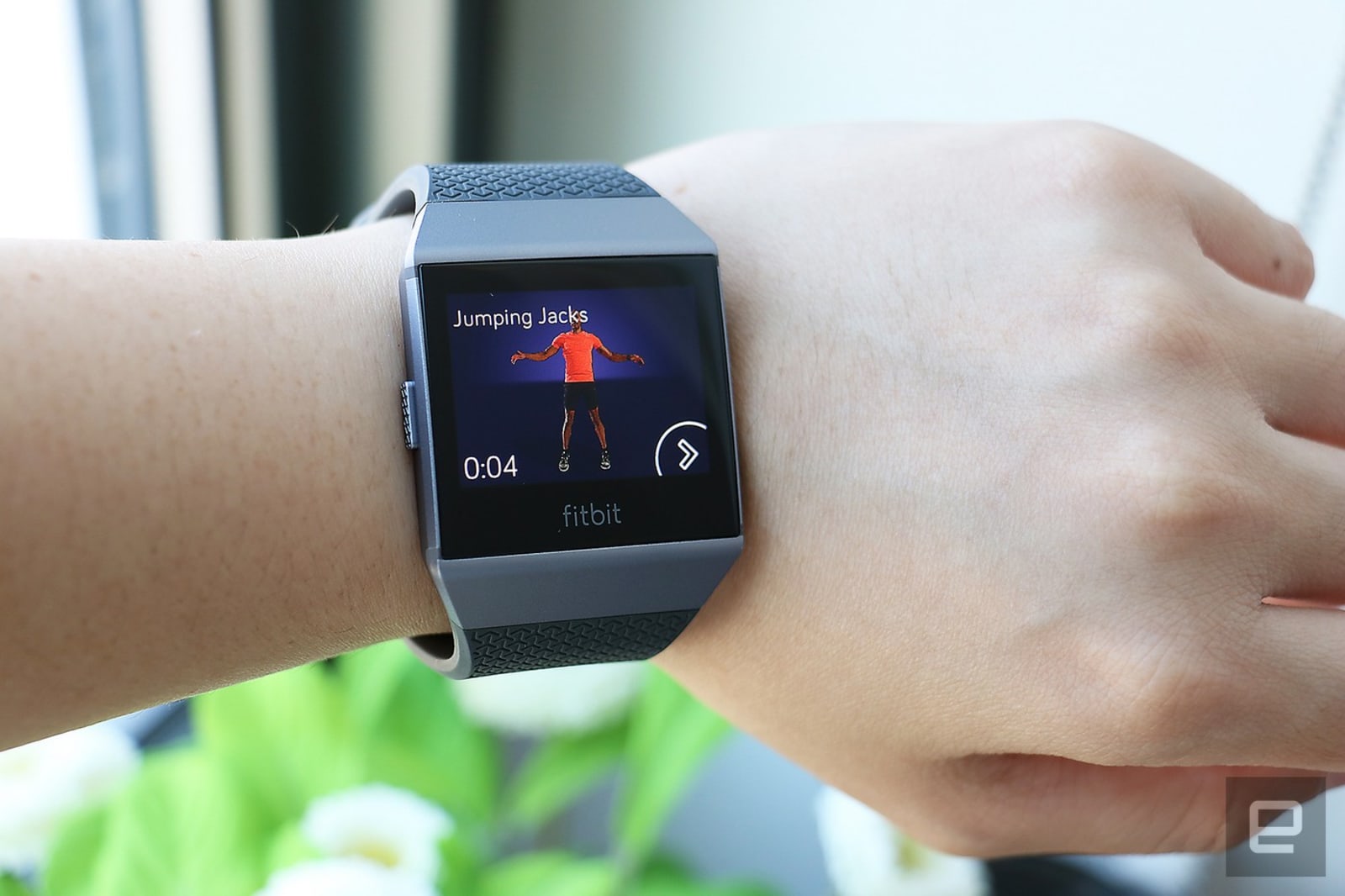
While we’re on the subject of workouts, Fitbit is also introducing a new service called Coach. It’s basically a rebranding of the existing Fitstar tool, which provides workout instructions on the watch, but Coach lets you watch short animations onscreen that demonstrate the movements you need to perform. Before, this was represented by stick figures, but on the Ionic’s display, you’ll get to see videos of actual humans doing the actions. Only a small selection of workouts will be available for free via Coach — you’ll have to pay a fee for more, as well as for programs tailored to your behavior and ability. For the full experience, you’ll have to pay $7.99 a month or $40 a year when the Coach app for Android, iOS and Windows launches in the fall.
In general, the watch’s aesthetic is pretty typical of Fitbit’s devices, which is a deliberate choice: The company said it wants to keep its design recognizable. The Ionic’s strap is wider than I’d like, but at least it’s easy to swap out with a simple button release. Fitbit is releasing a modest variety of straps alongside the Ionic, including sport ($40) and perforated leather ($80) options in a couple of colors each. Speaking of, these bands use the same buckle closure that you’ll find in most conventional wristwatches, but instead of using a loop to secure the tail end, Fitbit opted for a peg-and-hole system. This keeps the strap completely flush against your wrist instead of flapping around at the end.

Last but not least is the Ionic’s estimated battery life. Like most other Fitbits, the Ionic is longer-lasting than the competition. The company expects the watch to last four or so days on a charge, and up to 10 hours when using GPS. This is in line with my experience — my Ionic was at 50 percent when I received it, and conked out after two and a half days (including about 10 minutes of GPS use).
Ultimately, the Ionic represents a big step forward for Fitbit. Not only is it the culmination of years of experience with wearables, it’s also the result of bringing together several important acquisitions (think: Pebble and Coin). I’m most impressed by how simple it is to create apps for FitbitOS, which bodes well for the company to get the massive library of offerings it needs to take on Android Wear devices and the Apple Watch.
But Fitbit is continuing to focus on health and wellness with the Ionic, and that’s something it does better than its rivals. Plus it has an established ecosystem of products that will work well with the watch, including the newly announced Flyer wireless earphones and Aria 2 smart scale. Fitbit also unveiled a multi-year partnership with Adidas to deliver an athlete-focused special edition device and training programs in 2018. At $300, the Ionic is relatively affordable for all that it offers. From my time with the device so far, it appears Fitbit has succeeded in making a well-rounded smartwatch that will find a place even in today’s saturated market.
Dell’s XPS 13 gets the very latest Intel quad-core CPUs
If you want the most portable 13-inch laptop that’s also as fast as possible, Dell’s XPS 13 laptop may be in your future. The new model is available with Intel’s 8th-generation Core i7 or i5 CPUs with quad-core, eight-thread horsepower, a 3,200 x 1,800 (QHD+) display, 40Gbps Thunderbolt 3 and two USB 3.1 Gen 2 (10 Gbps) ports. Yet, all of that fits into what Dell calls “the smallest 13.3-inch laptop on the planet,” with 5.2 mm top and side bezels and as little as 2.7 pounds of heft.
The XPS 13’s small size and power (which is a running theme for the model) is no mean feat, especially since Dell didn’t cheap out on ports or other features. Along with the Thunderbolt and USB ports, there’s a dedicated power connector, SD card reader, headphone jack and fingerprint reader. By contrast, other manufacturers, especially Apple, make you buy extra accessories to get those inputs. It’s also equipped with a “Killer” brand WiFi system that gives you extra connectivity features when paired with a compatible router.
You can get up to 16GB of RAM, 125GB SATA, 256GB or 512GB PCIe SSDs, or a standard 1TB SSD. As with the last few XPS models, the 60 watt-hour battery is built-in and not user-replaceable. Dell says that it’s good for up to 22 hours on MobileMark (13 hours for the QHD+ model) or 13 hours of Netflix streaming (the QHD+ model can go 9 hours). It’s worth noting that Dell has among the best keyboards and trackpads on Windows PC laptops, and we’d expect the new model to follow that theme.

The XPS 13 settles for Intel UHD Graphics 620 on the high-end 8th-gen Intel CPU models, rather than discrete graphics from NVIDIA or AMD. By contrast, NVIDIA’s new Max-Q spec is is pushing powerful gaming models way down in size — MSI’s GS63VR laptop has NVIDIA GTX 1070 graphics, for instance, but is just 3.9 pounds. Still, properly equipped, the XPS 13 can drive a pair of 4K monitors, and thanks to their extra hyper-threading capability, Intel claims its 8th-gen CPUs perform up to 44 percent better than the previous models.
As before, the XPS 13 can be had with a number of accessories, including the 12,000 mAh Dell Power Companion to extend your battery life, a Thunderbolt Dock, adapters and a wireless mouse and keyboard. It’s available in silver or rose gold on September 12th in the US starting at $800 for a basic model with last-gen CPUs. If you want a model with the latest chips, along with more storage and RAM, expect to pay a lot more.
Fitbit Flyer wireless headphones hands-on: Too basic for the price
Fitbit is coming for your ears. The company’s first wireless fitness headphones, called Fitbit Flyer, are designed to accompany you on your workouts, thanks to a sweat-proof, durable body. I got to try out the Flyer, which we’ve seen leaked before, and am satisfied that it works as promised, but wish it did more or performed better.
The Flyer, at least, in gold-and-white, looks attractive and feels sturdy. A black-and-silver version is also available, and looks just as elegant. Its rubbery exterior is similar to that on many other sports-centric earbuds like the Jabra Sport Coach. I’m not a fan of the way in-ear buds in general poke into my ear, but the Flyer is relatively comfortable. Each pair of headphones comes with swappable tips, wings and fins so you can customize your device for a better fit. Many wireless earbuds already come with these add-ons, though.
To be clear, there is a cable connecting the Flyer’s two buds. This isn’t a completely wire-free product like the Bragi Dash Pro, Apple’s AirPods or the Samsung Gear IconX. The Flyer’s cable is long enough to encircle my neck, though, even with my thick hair in the way, and I liked letting the buds dangle down my chest as a sort of open necklace.

The device’s power button is on the top of the right bud, and a thumb-length control box sits on that side of the cable. The box contains three buttons for you to adjust the volume or play, pause and skip tracks, which worked well during my testing, although they were somewhat hard to reach. You can also answer calls through the Flyer, which has a dual microphone to suppress noise for voice quality, although these aren’t novel features either. I switched from my Apple earphones to the Flyer midway through a call, and my friend said she immediately noticed that I sounded clearer. On my side, I could hear sounds from my apartment, like the creak of furniture or my shuffling footsteps, more distinctly than before. This was frankly quite distracting.

The most appealing thing about the Flyer is how easily it connects to Fitbit’s new Ionic smartwatch. All it took was a press of the headphone’s power button and a tap on the watch’s screen for the two to pair. Linking the Flyer with other devices, is trickier, though. The new headphones are supposed to simultaneously connect to two devices at once with Bluetooth 4.2, but you’ll have to make sure the Ionic isn’t in the vicinity or Fitbit’s headphones will connect to it by default. You’ll also have to shut down the headphones, then restart them in pairing mode before other devices can detect them. This is similar to the pairing process for most other Bluetooth earbuds, but made slightly more confusing by the Flyer’s preference for the Ionic smartwatch.
The Flyer’s most essential feature is the promise of “high-quality sound” with “crisp audio, powerful bass and dynamic range.” I listened to a playlist of songs including Taylor Swift’s Look What You Made Me Do, Camila Cabello’s Havana and Macklemore’s Glorious. The Flyer delivered thumping bass and crisp audio even at max volume, although I wished higher notes and vocals were stronger.
The device should, in theory, last up to six hours of playtime, and Fitbit says you can get an hour of juice with just 15 minutes of charging. That’s less than the eight-hour rated runtime for the Jaybird X3, which is a popular option in the space, although it only plays music. But other than working seamlessly with the Ionic smartwatch, the Flyer doesn’t do anything differently from other wireless headphones. Think about it, the Jabra Sport Coach can count your reps for you, and for $10 cheaper than the Flyer. For the $130 asking price, you’ll easily find a wide selection of competing (and more-established) brands like JBL, Bose, Jabra, Jaybird and Plantronics. If you’re considering buying the Flyer, you’d do well to remember that playing music is really all it does, and that there are cheaper options that can do more or better.
Dell makes a VR Visor to go with its Alienware laptops
The Age of VR is quickly settling in around us. A platform that just a few years ago could barely be even be considered niche is now knocking down the walls of the mainstream with hordes of big-name brands at its back. Playstation, HTC, Oculus are all busily building their own hardware while Facebook, YouTube and Twitch — even KFC — frantically race to develop content to meet the rising tide of consumer demand. At IFA on Monday, Dell declared itself a challenger in this VR arena, debuting a proprietary VR headset, the Dell Visor.
Details are pretty thin so far save that the visor will utilize 1440×1440 LCD panels and offer sufficient padding and counterbalancing to ensure that it remains comfortable even during extended gaming sessions. It can reportedly be worn over glasses, clips all of its various wires and cables securely at the back of the unit and sports a hinged faceplate so that users can flip back to the real world without having to remove the entire headset.
The Visor is slated for release this October, though presales will begin some point next month. The headset itself will set you back $360 while compatible controllers will cost you another $100.
Follow all the latest news from IFA 2017 here!
Steam VR is coming to Windows Mixed Reality headsets
After nearly two years, Microsoft is months away from releasing its first Windows Mixed Reality headset to the public. The first out the gate will be Acer’s $300 VR headset, which runs on the same platform as the HoloLens and therefore already has access to a whole plethora of Windows 10 apps. But a VR headset isn’t any fun without games, right? Which is why Microsoft has announced today that Windows Mixed Reality headsets will be compatible with a slew of different titles, include some from one of the biggest names in VR: Steam.
“The introduction of Windows Mixed Reality headsets is a big step forward for VR,” said Valve Software’s Joe Ludwig in a statement. “Working with Microsoft to include Steam VR compatibility with these devices is also a big step in growing VR as an open platform for developers and consumers. With a broad range of hardware options available from leading PC manufacturers, the Steam community will have more choice than ever to experience the amazing potential of VR.”

In a closed door demonstration last week, I tried the Acer headset with several titles that are already available from the Steam store, such as Space Pirate Trainer, Superhot, Arizona Sunshine and Rec Room. I also tried Microsoft’s Windows Mixed Reality controllers for the first time (Unfortunately, I wasn’t allowed to take photos of the hardware). And after a short time with the headset and controllers, I was pleasantly surprised how my experience felt on par with that of either a HTC Vive or an Oculus Rift, both of which cost $100 to $200 more than the Acer (The Acer headset and controller bundle will retail for $399, while an Oculus bundle is $499 and the HTC Vive kit is $599).
The controllers look like a combination of both the HTC Vive wands and the Oculus Touch controllers, mashed into a single device. They’re long and slender like the wands, while the button layout has a thumbstick, a trackpad and a menu button. Underneath, there’s a grip as well as a trigger mechanisms, and sitting on the top part of the wand is a Windows shortcut, which leads you straight back into the Windows Mixed Reality living room environment.
They slipped right on without a lot of fuss, and I got used to the controllers right away. The positional tracking picked them up immediately and I was soon able to see and control my virtual hands. As for the controls, I had thought that using both the thumbstick and the trackpad would be a little confusing, but it really depends on the game. Sometimes I used the trackpad to teleport and the thumbstick to control the camera, while other times I used the thumbstick exclusively. I generally prefer the wand of the Vive and the thumbsticks on the Touch, so for me, the Windows controllers offered the best of both worlds.

While I only had a few minutes or so playing each game, there was hardly any lag at all, and I didn’t spot any notable deficiencies in resolution or image quality of any of the games I played — the Acer headset touts a 1440 x 1440 resolution for each eye, while both the Rift and the Vive has a 1080 x 1200 resolution per eye). I experienced no nausea and felt completely comfortable, whether I was shooting space ships out of the sky in Space Pirate Trainer or punching animated silhouettes in Superhot.
All of the above games were running on a pretty beefy gaming laptop that had an Nvidia Geforce GTX 1080 card. But the beauty of Windows Mixed Reality, according to Microsoft, is that you could also run it on relatively low powered laptops with integrated graphics. To demonstrate this, Microsoft had me try on the same Acer headset, but attached to a 13-inch HP Spectre instead. The graphics didn’t seem quite as bright or sharp, but navigation still felt pretty smooth. Microsoft did warn me that you can’t run super high-powered games with integrated graphics, and you can’t have multiple apps running at the same time either. But I was still able to craft blocky buildings in Minecraft VR and teleport around the virtual living room in Windows.
Steam compatibility is just the beginning. Microsoft teased that it’s working with 343 Industries to “bring future Halo experiences into mixed reality.” The company won’t reveal specifics at the moment, but it apparently has more mixed reality news set for IFA. So stay tuned for more news from Microsoft in Berlin in the coming days.
Follow all the latest news from IFA 2017 here!
 AIVAnet