


The new Google Glass is on sale today (but don’t get it)
Did you regret skipping Google Glass the first time around? You now have a second chance… if you have a specific need for it, that is. Glass for Work partner Streye is now selling the follow-up Glass Enterprise Edition starting at €1,550 (about $1,829). This is clearly intended for business (you get access to Streye’s enterprise streaming services with your purchase), so you really, really won’t want to buy it if you’re just trying to impress your friends. However, this is still the most accessible Glass has been in years — if you do need a wearable eyepiece, it’s theoretically within easy reach.
To recap, this isn’t a night-and-day rethink of the Glass concept. Rather, it’s a logical evolution intended for workers who need hands-free computing. The biggest difference is the much larger 780mAh battery, which should keep it running for more of the workday. You’re otherwise getting twice the storage (32GB), an Intel Atom processor, faster WiFi, an expanded range of sensors (mainly assisted GPS) and a louder speaker. It’s otherwise a collection of minor tweaks. In short, you’d have to be a collector to appreciate this if you don’t intend to use it for professional tasks.
Via: 9to5Google
Source: Streye
The Oculus launcher now works with Steam games
Oculus’ launcher software is, unsurprisingly, focused on running VR apps from the Oculus Store. But that’s probably not how you get all your apps — you may have Rift-ready games in Steam, for instance. That won’t be a problem from now on. Oculus has updated its portal to offer fast access to any Rift-compatible app on your PC, whether it comes from Steam or anywhere else. You won’t have to think about removing your Rift headset just to see the full extent of your app library.
The update also brings a Parties feature that lets you and up to three fellow Rift owners chat across apps, so you don’t have to wonder whether your friends are ready for a multiplayer match.
This should help you maintain immersion while you’re wearing the Rift, of course, but it’s also an acknowledgment that the Oculus Store isn’t quite so central experience as the company might like. If Oculus is going to spur Rift adoption, it needs to show that there are plenty of interesting apps to try… and like it or not, the Store doesn’t have a monopoly on the best examples. If Oculus eats some humble pie now, it might pay off with stronger Rift sales down the road.
Via: Gamasutra
Source: Oculus Forums
Smart hive-monitoring system could help solve the mystery of disappearing bees
Why it matters to you
A smart beehive-monitoring system lets beekeepers check on their hives without disturbing the insects inside.
“What is this? A center for ants?” rages Derek Zoolander in one of the funniest and most quotable scenes of the original 2001 comedy Zoolander. Over at Canada’s Simon Fraser University, graduate student Oldooz Pooyanfar hasn’t exactly built a center for ants, but rather a smart home for bees — which we reckon is every bit as cool. What Pooyanfar has built is a smart hive real-time monitoring system, intended to keep tabs on what thousands of bees in a series of hives are “saying” to one another.
This high-tech monitoring platform is placed along the wall of the hive she wants to analyze. It is fitted with a number of tiny sensors that are equipped with microphones (and, in the future, accelerometers, too) to monitor sound and vibration. The monitoring platform also keeps tabs on temperature and humidity using heat sensors. The smart system collects all of this data and then analyzes it looking for abnormalities, such as possible sickness or the death of the queen. If abnormalities are found, beekeepers are alerted so that they can instantly respond.
It is a more efficient, less intrusive way of monitoring large quantities of bees, whose activities can be severely disrupted for up to 24 hours every single time a hive is opened by beekeepers.
Simon Fraser University
The project was set up as a response to the mysterious decline of bees in the United States. Over the past decade, the North American honey bee population has fallen by 30 percent. Research continues into the so-called “Colony Collapse Disorder,” although no definitive conclusions have yet been reached. Should populations continue to decline, it is imperative that an explanation (and solution) is discovered since fewer bees mean a major impact on both crop pollination and the environment as a whole.
It is this research Pooyanfar, a graduate student in SFU’s School of Mechatronics Systems Engineering, hopes to be able to contribute to. On a macro scale, her smart hive-monitoring project could represent another smart-tech solution to help scientists understand one of the biggest mysteries currently facing the insect kingdom. On a micro scale, it will hopefully turn out to be an incredibly valuable tool for individual beekeepers.
After all, we are not yet at the point where we’re able to replace honey bees with bee robots. And who knows when we will be?
You can now send and receive videos through the YouTube mobile app
Why it matters to you
You no longer have to copy and paste a link from YouTube in order to share it with your contacts. With YouTube’s update, users can direct message videos and start conversations from within the app.
YouTube announced a new addition to its app to help make it easier to share videos. You’ll now be able to direct message any videos on the site to friends and family through private conversations.
Prior to the update, users would have to send videos to another person by copying and pasting the link into another messaging platform. Starting Monday, August 7, you can send and receive videos by sending them directly to someone. You can also carry on a conversation, send emojis, reply with another video, and invite others to join in on the group chat.
All your existing conversations can be accessed in a new tab called “Shared” on the YouTube mobile app. To start using it, you’ll have to invite your friends from your contacts via SMS or by sending an invitation link through a social network, email, or messaging app.
The format looks a lot like Instagram’s direct message feature. If there’s a video you’d like to send, simply tap on the arrow below the video and a list of contacts will show up. You can either send it directly to one person or select multiple people — up to 30 — to create a group chat. You can also include a message before sending it in the text box available underneath the list of people you’re sending it to.
The new feature is similar to Google Messenger — later rebranded as Android Messages. The app allows you to communicate with anyone by using SMS and MMS, among others. You can send group texts along with pictures, audio messages, and videos without having to leave to exit the app.
The goal with YouTube’s new feature is apparent — keep users watching videos and engaging on the platform. Rather than having to switch back and forth between apps only to send videos, the sharing option lets you send an unlimited amount to all your friends by tapping a button. It might actually keep you on the app longer than planned.
The company has been testing the feature since last year, and rolled out the beta version to users in Canada this past January. YouTube’s blog post explains that after receiving feedback it performed further tweaks before releasing the final product. The YouTube update is gradually rolling out globally on Android and iOS.
McDonald’s Boombox review
You’ve got to hand it to McDonald’s. In a time when the sales of traditionally delicious-but-not-very-good-for-you products like Coke have seen sales drop in the face of alternatives like energy drinks, exotic juices, and even plain ol’ water, the Big Mac mavens at McDonald’s have continually experimented with the mega-chain’s menu, its marketing, and its prices. In July, the franchise’s second quarterly report for the year was taken as a sign of good health, even if the food it sells remains the target of health-conscious critics. The latest example can be thoroughly explored via our McDonald’s Boombox review.
McDonald’s put some real money behind the design and engineering of the Boombox.
A prime example of how McDonald’s is trying to stay at the top of its customers’ lists when it comes to QSR – or Quick Service Restaurants, as the industry likes to think of itself — the McDonald’s Boombox is a regular cardboard drink tray imbued with audio powers thanks to a little bit of origami, and a lot of marketing.
The Boombox made a surprise (and extremely limited) appearance at a single location in Toronto on July 28, where it was handed out to any customer who was in the vicinity of the city’s Woodbine Beach that afternoon. It was also accompanied by a free McFlurry, the restaurant’s popular ice-cream dessert.
McDonald’s put some real money behind the design and engineering of the Boombox, enlisting the talents of both audio experts from the University of Waterloo’s Audio Research Group, and industrial design gurus at Stacklab.
The result of their combined efforts is a drink tray that features two pop-up, double-cone polygon speakers, and a central slot that will hold pretty much any smartphone in portrait orientation.
The claims for this creation are equally extravagant:
“Scientifically engineered and lab tested for a design that increases sound pressure levels, effectively doubling a phone’s built-in maximum volume. Helps achieve a maximum decibel level of 70.4 dB, which in everyday terms is roughly the same volume as a vacuum cleaner being used.”
While it’s true your phone will sound louder when sitting in the Boombox, a doubling of the volume was not what we heard
When Digital Trends received its review unit, we wasted no time in putting it to the test. Unfortunately – after trying with various phones including an iPhone 6, Pixel XL, ZTE Axon Mini, and even an aging Nexus 5 – we were (not surprisingly) less than impressed with the sound.
While it’s true your phone will sound louder when sitting in the Boombox, a doubling of the volume was not what we heard. Moreover, even as the volume increased, actual sound quality felt significantly reduced. Low end bass, forever the weakest part of a smartphone’s audio profile, was sacrificed, while high-end frequencies sounded peakier.
For our testing we auditioned some rap, jazz, hard rock, classic surf rock, and even a little classical music. With each phone and each genre, our crack panel of testers (i.e., family and friends) agreed: They sounded better without the help of the Boombox. That said, we feel we are now in a position to say that classic surf rock, like the Ventures’ Wipe Out, suffers the least from being amplified through foil-stamped cardboard speakers.
In fairness, we must acknowledge: We tested the Boombox outdoors. Yes, that’s hardly a lab quality environment, but we figured that if the Boombox was designed to let people share and enjoy their summer tunes, they would probably be doing so in a backyard, on a patio, or maybe on a beach … certainly not in an anechoic chamber.
Also, all of the phones we had at our disposal had only a single speaker, with the exception of the Axon Mini, but its second speaker was on the other end of the phone’s body. Because of this, only one of the Boombox’s polygon speakers was active at any given time, which may explain why we didn’t hear the claimed volume increase. A phone like the iPhone 7, with its stereo, down-firing speakers, would probably have sounded better.
We also listened to the Boombox head-on, because it seemed the only logical way to use it. Turning the one active speaker toward us, made a big difference – increasing the volume considerably – but you really had to be in the direct line of fire in order to hear it, likely thanks to the speakers’ megaphone-like design.
Are we disappointed that the Boombox didn’t deliver a better sound experience? Sure — well, a little anyway. What makes us happy is that even if McDonald’s chooses to “go loud” and distribute the Boombox to a wider audience, at least it’s 100 percent recyclable, which is more than we can say for so many of the freebies the company has given away over the decades.
Firefox 55 joins Google Chrome, Microsoft Edge in supporting browser-based WebVR
Why it matters to you
Firefox users who own an Oculus Rift or HTC Vive VR headset can now use Mozilla’s browser to experience VR on the web.
WebVR is a growing industry standard that aims to bring virtual reality (VR) to web browsers, as well as provide an easy way for developers to create and distribute VR content. Google recently added WebVR support to its dominant Chrome browser, and it rolled out the WebVR Experiments site to highlight new experiences available to browser users. Now, Mozilla has joined in the fun, adding WebVR support in its latest browser release, Firefox 55.
Firefox users who own an Oculus Rift or HTC Vive VR headset can now use Mozilla’s browser to experience VR on the web. All three of the major web browsers now support WebVR, with Microsoft’s addition of support for the standard in its Edge browser in Windows 10. Note that Chrome’s support is limited to Android devices, and for now Edge must be placed in developers mode in Windows 10 Creators Update or later to view WebVR content.
A blog post from Mozilla introduced WebVR support at the beginning of June 2017. It highlighted a Web VR workshop where developers learned more about integrating content in browsers and highlighted vendor and community collaboration in creating the WebVR specification. Going forward, all browser developers will be working together to ensure that WebVR support is consistent across all platforms, and Mozilla invites developers to visit the A-Frame school to learn how to create interactive WebVR content.
In addition to WebVR support, Firefox 55 also brings its Firefox Screenshots feature. Firefox Screenshots has been in beta since July 2017, and its public debut adds built-in screenshot capabilities to Firefox. The feature allows users to easily grab an entire web page or select a portion of the screen, and then download an image to their device or share it on social media.
Firefox 55 will be automatically installed on Wednesday, August 8, and you can download it here if you’re in a hurry. Once the new version is installed, you will also receive the usual performance and security updates to go along with these two major features. Note that Mozilla is promising a major update in Firefox 57, to be released November 14, which will bring the new Photon UI to the second-place browser.
Modius is a neurostimulation wearable that tricks your body into burning fat
Why it matters to you
Who doesn’t want to burn body fat without any effort?
Wear this headset for 45 minutes a day, and you could hack your body into burning more fat resulting in a leaner, meaner look. No, it’s not a “miracle” cure ad for the terminally podgy, but the pitch for the Neurovalens Modius, a neurostimulation device that sounds almost too good to be true. For less time that one would normally spend in the gym, this piece of tech fools your body into thinking it’s exercising, and decreases appetite, all to help you achieve those hard-to-reach weight-loss goals without much effort.
Suspend your disbelief for a second. Here’s how it works. The Modius is a headset worn like a pair of headphones, just without the cups over your ears. Instead, two pads sit just beneath your ears and zap low-power electrical impulses to your vestibular nerve, activating the hypothalamus. This, Neurovalens says, fools the body into thinking you’re a physically active person, even though you’re sitting down watching Netflix.
The nerve stimulated by the Modius prompts the metabolism to kick in and burn more fat, while also decreasing appetite so you don’t reach for the cookies — all of which should mean your body fat falls without having to listen to your stomach growl all day. In its FAQ, the company says this will happen without exercise or diet, but results will be improved if you do both. However, if you’re eating enough to feed several children on your own, then it’s unlikely to make a lot of difference.
The recommended “training” schedule is a 45-minute session each day, for five days a week. An early study showed an 8 percent body fat reduction took place over a 16 week period using the Modius, and the company founder wrote about his experience using the device for a year. It’s not addictive, is safe to use, and apparently has no side-effects; but the sensation may feel a little like a “gentle swaying or rocking” when it’s naughtily tweaking the vestibular nerve, Neurovalens said. Hypothalamus hacking has been around for a while, and has already been linked with appetite suppression, while wearable technology using neurostimulation is also increasing in popularity. For example, the Thync relaxation device uses the same principle, as does the exercise-focused Halo Sport.
If the idea of becoming less round, without actually doing much to bring about that change, is appealing — silly question, we know — the Modius is available on Indiegogo now for $200, and is expected to be released in the fall. The company’s confident the tech works too, and is offering a money-back guarantee if it doesn’t help.
Amazon snags rights to Lucille Ball movie starring Cate Blanchett
Amazon isn’t done seeking Hollywood glory just because it has a couple of Oscars under its belt. The internet giant’s studio wing has snapped up Luci and Desi, a high-profile biographical flick covering the relationship between I Love Lucy co-creators Lucille Ball and Desi Arnaz. The movie is still very much a work in progress (the role of Desi hasn’t even been cast yet), but it already reflects Amazon’s award-seeking intentions: Cate Blanchett will star, and The Social Network’s Aaron Sorkin wrote the script.
There’s no mention of when the movie might be ready, but we’d be patient when the project has been sitting on the backburner for a while. Blanchett and Sorkin were already involved with the movie two years ago. However, it won’t be shocking if Amazon steps up the pace. After all, Netflix hasn’t been shy about scoring top-flight movie deals — Amazon isn’t going to risk losing prestige to its streaming arch-rival by taking a while to bring Lucy and Desi to market. The sooner it finishes production, the more likely it is to scoop up more statuettes and persuade viewers that Prime Video is full of high-quality movies.
Via: Variety
Source: Deadline
‘Spelunky’ and ‘Downwell’ creators have 50 games coming this fall
Good news if you and yours have long worn out Sportsfriends’ appeal — it’s been a few years, so that’s understandable — and you’re hankering for another collection of unique multiplayer games. Next year, the minds behind Spelunky, Downwell, Time Barons, Skorpulac and Madhouse have teamed to bring you UFO 50. “Our goal is to combine a familiar 8-bit aesthetic with new ideas and modern game design sensibilities,” the game’s website reads. That purview includes platformers, puzzle games, RPGs and shooters, for a total of, you guessed it, 50 different games.
There’s even a wrapper tying the disparate experiences together. The developers say that each title was made in the ’80s by a fictional company that was “obscure but ahead of its time.”Everything will feature a 32-bit color palette. And speaking of multiplayer, “roughly a third” of the games (probably 16 or 17) will have either competitive or co-operative play. Sounds like our type of party.
UFO 50 will release this fall on PC for what sounds like a low price, with other platforms to follow. Fingers crossed for a Switch port.
Via: The Verge
Source: UFO 50
LG’s V30 flagship leaks in hands-on footage
Last month, LG teased a reveal for its V30 smartphone, a followup to its audiophile-friendly V20. While renders immediately appeared supposedly showing the upcoming phone’s design, we might have just gotten a real leak. A user on Joseph Gordon-Levitt’s creative repository HitRecord posted a few photos prominently featuring a phone with the V30 logo displayed on its back side. Intentional leak or not, the source video has been wiped from the internet — except for the screengrabs Gizmodo took.
User RandyAzarga’s library of uploaded content is empty now, but it reportedly had a video featuring the phone, as did a now-absent video from user Mcgannfamily. The phone in question looks a lot like a marriage of the V20 and LG’s G6 phone, especially the latter’s glossy back (RIP to the V20’s removable backplate and battery). While there wasn’t much doubt that LG was referring to the upcoming V30 when it teased a next-gen large OLED phone, the leaked photos support that theory.
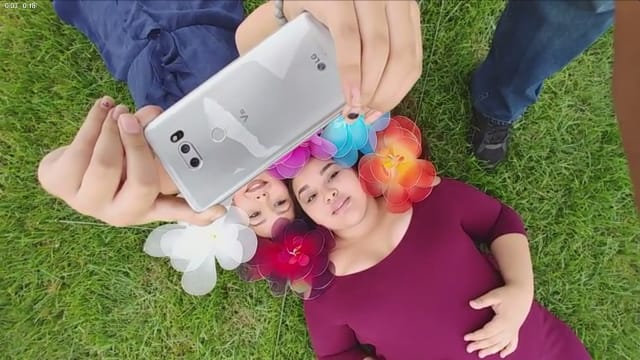
But if this is the V30, then it’s missing a notable feature from its V20 predecessor: A secondary thin screen atop the main display. We didn’t find much use for the touch-sensitive strip when we reviewed LG’s late-2016 flagship phone, so it wouldn’t be a great loss.
For the record, HitRecord and LG partnered up in August 2016 before the V20’s release with plans to showcase photos shot with the then-new smartphone. This followed HitRecord’s first pair-up with the phone company the year before: Fans (and Gordon-Levitt himself) put together a short film shot entirely on LG V10 smartphones.
Source: Gizmodo
 AIVAnet