


‘Hamilton’ app helps you get tickets, take embarrassing selfies
Hamilton: An American Musical is the most popular Broadway production in recent memory, and now it’s coming to your phone — beyond the soundtrack (and mixtape) you’ve had on repeat the last two years. Hamilton: The Official App has just about everything a fan could ask for including $10 ticket lotteries, a merch store, stickers and updates from Lin-Manuel Miranda himself. And yes, you can even put yourself on the $10 bill or don your favorite Schulyer sister’s dress. It’s all very zeitgeisty and best of all, available on Android and iOS.
In the future, it’ll also include “exclusive” access to tickets, some sort of augmented reality functionality and, speaking of the soundtrack, interactive karaoke songs. If you’ve annoyed your friends because you can’t stop singing “Room Where It Happens,” this might be the best app you download all week.

Source: Google Play, iTunes, Hamilton Broadway
Depression simulator ‘Please Knock’ arrives September 7th
Please Knock on My Door is a conversation about depression via video game. Developer Michael Levall created the indie title about his own experiences with depression and the mind-numbing routine of making games. “Every single thing in the game that you get to go through or read through or whatever has some kind of connection to either a true experience that I’ve had, just copy-pasted into the game, or it’s based on an emotion that I’ve felt and I’ve extrapolated that and made a story out of it,” he told Engadget back in March. The game is nearly ready; it will release for PC on Steam and Origin this September 7th.
Depression is a common experience for many in gaming, including those who spend their time working in isolation as independent developers. “I have met many people in our industry who either are or have suffered from depression, and it shouldn’t come as a surprise,” Levall said in March. “For many of us, our work is our passion. The downside to that is that working overtime leads to burnout, which in itself is a gateway to depression. There is also the economical stress of working as an indie developer, or the stress of knowing how hard it is to find a new job should your studio go bankrupt or your project (is) shelved.”
Source: Steam
Behind EA’s push to put more women in sports games
Until two years ago, there was no way to play female characters in FIFA, the world’s most popular gaming franchise. But EA Sports changed that with the introduction of FIFA 16. That’s because, for the first time ever, the studio revealed its flagship game would feature women soccer players. It was a great move toward diversifying the game’s plot, albeit a risky one considering its core demographic: young men. That doesn’t mean FIFA players aren’t open-minded. But in an industry with a reputation for being misogynistic, EA Sports made itself vulnerable to potential backlash. It turns out the company needn’t have worried: FIFA 16 quickly became one of the best-selling titles of the year.
EA Sports’ push to put more women in its sports games didn’t begin with FIFA 16. Back in 2011, the company announced that its then-upcoming hockey game NHL 12 was getting its first female playable character. This decision came after 14-year-old Lexi Peters penned a letter to EA asking why there weren’t any girls in NHL, and why her brother could make a character that looked like him but she couldn’t. “It is unfair to women and girl hockey players around the world, many of them who play and enjoy your game,” Peters wrote. “I have created a character of myself, except I have to be represented by a male and that’s not fun.”
As IGN reported at the time, that letter eventually made its way to David Littman, NHL 12’s lead producer, who was so touched by it that he immediately tried to figure out a way to make Peters’ wishes come true. “Lexi’s letter was a wake-up call,” he said in 2011. “Here’s a growing audience playing our NHL game and we hadn’t done anything to capture them.” In the end, Peters got more than she hoped for: Her face became the default for anyone who wanted to create a female character in NHL 12.

NBA Live 18.
Fast forward to today and EA Sports has taken these inclusion efforts to a new level. In addition to the past two editions of FIFA, as well as the soon-to-be-released FIFA 18, the developer’s next move is to bring WNBA teams to its basketball franchise. Starting with NBA Live 18, which launches on PlayStation 4 and Xbox One in September, official WNBA rosters will be represented in the game. That means you’ll be able to play with athletes like Allisha Gray, Brittney Griner, Maya Moore and the 2017 WNBA Draft’s first pick, Kelsey Plum.
And let’s not forget about EA Sports’ UFC 2, which came out in 2016 and features none other than renowned mixed martial arts fighter Ronda Rousey on the cover alongside Conor McGregor. All told, you’ll find 45 women characters in the MMA game, compared to more than 200 men. While that’s still a large disparity, the company is at least moving in the right direction. In 2014’s UFC, for example, the franchise’s first title to feature female playable characters, there were only eight, including Holly Holm, Miesha Tate, Cat Zingano and, of course, Rousey.
In FIFA, meanwhile, there are 15 women’s national teams, each of which includes roughly 23 players. Naturally, that includes the US squad, led by players such as Alex Morgan, who shared the North American cover of FIFA 16 with arguably the world’s best soccer player, FC Barcelona’s Lionel Messi. All in all, EA now has pro female athletes in most of its sports franchises, including FIFA, NBA Live, NHL, and UFC. The only one missing is Madden, which is complicated considering there aren’t many professional American football leagues for women across the world. Still, EA could let you create your own female player, as it did with NHL 12.
EA is alone in its efforts to put more women in sports games. The company’s direct competitor 2K Sports isn’t doing anything to move the needle. Its most popular game, NBA2K, doesn’t feature any playable female characters — and it doesn’t look like it will anytime soon. 2K Sports declined to comment for this story. Meanwhile, Cam Weber, senior vice president and group general manager at EA Sports, tells Engadget that the company had to find ways to make its games more appealing to wider audiences. Most importantly, he said, EA needed to recognize the phenomenal athletes who compete in soccer, basketball, MMA and other sports. “We want to inspire sports fans of all shapes and sizes, backgrounds and genders from all over,” he said. “It’s important that we can make a positive impact on the world in the games that we do.”
“If you want to make games that appeal to women, you need more women on your development teams as well.”
Weber said that while he doesn’t have a daughter, many members of his team do and they use that as motivation to develop increasingly diverse games. “We believe we’re at our best when we give opportunities to anybody,” he said, “no matter where they’re from, no matter their gender.” He adds that in order for women to be represented accurately, fairly and respectfully in games, the change must come from behind the scenes first. “If you want to make games that appeal to women, you need more women on your development teams as well.” He said this is an area where EA has made “great progress” over the past few years, claiming that the company spends “a lot” of time, energy and resources on ensuring that more female devs work within EA Sports. (EA didn’t share any internal stats that would corroborate his statement.)
Aside from making progress with its sports games, EA is carving a similar path in other genres as well. Last year, the company launched Mirror’s Edge, an action-adventure platformer with a female lead. Meanwhile Star Wars Battlefront II, which is scheduled to arrive in November, will feature a campaign mode starring a strong female character of its own. And with the upcoming FIFA 18, Weber said there’s going to be “really prominent” female in “The Journey,” the game’s popular story mode.

“The industry is starting to realize that there is a strong fanbase interested in human stories outside of the conventional gruff, brooding white dude.”
Anita Sarkeesian, executive director of FeministFrequency.com, said that what tends to perpetuate the invisibility of women protagonists in games is having an old mentality. It’s the “games with female protagonists don’t sell” or “the all-male writing staff doesn’t know how to write for women,” she said. Still, Sarkeesian said she’s been “cautiously optimistic in the past year or so,” as developers such as EA are clearly making progressive efforts. “The industry is starting to realize that there is a strong fanbase interested in human stories outside of the conventional gruff, brooding white dude.” According to the Entertainment Software Association’s 2017 report on the gaming industry, 37 percent of the “most frequent” video game buyers were female.
“We, the girl gamers, have been living under the male shadow.”
Jennifer Franco, 28, plays EA Sports games regularly. She said she got into FIFA in 2003, and that she’s been waiting for women to be featured in the game basically all her life. “We, the girl gamers, have been living under the male shadow,” she said, “Most games are meant for boys, not girls, and that is changing for good. FIFA 16 was a huge breakthrough, but there’s always room for improvement.” That improvement, she said, could come in the form of playing with professional female clubs in FIFA, which currently isn’t possible. When asked if this is something that could happen in future, EA’s Weber said the company had nothing to announce right now.
Weber did say that this shift is major part of EA’s long-term business strategy, claiming that the company will continue investing in women, both in games and in its hiring practices. “You’ll see continued expansion on features, characters and themes that represent a broader audience,” he said. “But in the coming years, without getting too detailed about it, you’ll see a bit of a shift in our approach to how we market, deceive and even talk about our brand in EA sports.” Only time will tell if others will follow suit.
MalwareTech’s arrest shows hacking is still a dangerous game
Many hackers are people who just “happened” into discovering they were good at something that, until recently, wasn’t a career path in school. The calling chose them; their current lives are a result of blindfolded pin-the-tail-on-the-donkey with jobs and technology. Except it’s a game they never know is completely legal or not, and usually neither do the cops. The game is really more Russian roulette than child’s play.
It has been like this for decades, and it’s a hell of a way to live. I’m guessing no one understands this more than a UK-based hacker named Marcus Hutchins, also known online and in the press as “MalwareTech.” Hutchins never wanted anyone to know his name; he was just the guy who noticed that the eejits behind WannaCry forgot to register a domain that acted as a “kill switch” on the nasty, fast-spreading ransomware. He then spent the next few days helping people get out from under a ransom scheme that had hospitals locked up (threatening lives).
Hutchins wanted to keep his identity secret, he told press, because he was fearful of the retaliations he might face for shutting down WannaCry. To his own outrage and dismay, his name and personal details were discovered and published by UK tabloids The Sun, The Daily Mail, and The Mirror. The man hailed as the “NHS hero” tweeted, “I always thought I’d be doxed by skids (people in hacking forums), but turns out Journalists are 100x better at doxing.”
If that was a rude awakening to Hutchins, then what came next was surely a shock to the system from which he may never recover. In July and early August, he was in the US to attend the Black Hat and DEF CON security conferences — a week-plus junket of hacking and security events, trainings, talks, and parties where it’s more or less a given that those working in the field are required to attend.

As Hutchins boarded the plane to fly home to the UK last Wednesday afternoon, he was arrested and detained in Las Vegas along with another researcher. He was taken to a detention center and then moved to an FBI field office. US prosecutors slapped Hutchins with a grand jury indictment, alleging that between July 2014 and July 2015 he helped make and distribute the Kronos banking trojan.
“Defendant MARCUS HUTCHINS created the Kronos malware,” the indictment states.
Hutchins was temporarily cut off from the outside world while he was held; there was a period of about a day in which he could not be reached. He didn’t have a lawyer for 48 hours. His friends and family panicked. Infosec Twitter lost its mind (and would continue to for quite some time, and for some very good reasons, which we’ll get to in a minute). Attorneys who represent hackers were on it like lightning finds the unlucky kid on a golf course during a storm. While Hutchins settled into a Las Vegas jail for the weekend, his friends rallied to pull together an online donation page for legal funds.
In a bizarre coincidence, the same day of Hutchins’ arrest, the Bitcoin wallet holding WannaCry’s ransomware funds was emptied.
As the federal indictment document hit the internet, the world learned that the 23-year-old researcher is facing six counts and up to 40 years for allegedly creating, spreading, and maintaining Kronos. The banking trojan is as nasty as it is clever.
According to ThreatPost, Kronos harvested banking credentials using “Web injects made for every major browser to modify legitimate banking websites.” Then when you log in to your bank, “the web injects look for additional information from the victim, details that are generally not required upon log-in such as ATM PINs or personal information to help with security questions.” Kronos came with a built-in security system that fights off other trojans, as well as updates for those who purchased and ran the trojan — it was a black market product with a price tag of $2K (at the time-period the indictment covers).
To be clear: We have no idea if Hutchins actually has anything to do with Kronos or not. Hutchins denies wrongdoing and is pleading not guilty. Monday he was out on bail and scheduled for transfer to a Milwaukee, Wisconsin courtroom to face charges early Tuesday morning; that appearance has been postponed until August 14th (next Monday).
Hutchins is not allowed to use the internet, his passport has been confiscated, and his movements are tracked. According to researcher and friend of Hutchins, Kevin Beaumont, “He is not allowed to communicate with the co-defendant named in the case. That name is blacked out on the indictment. Neither Marcus’ lawyer nor Marcus know who the co-defendant is.”
When the public found out Hutchins had been nabbed by the FBI, saying that press and infosec had lost its collective mind in several directions would’ve been an understatement. Part of that had to do with the shock and implications of the case and its situation. Though part of the hysteria could’ve been attributed to the fact that very little actual news came out of this year’s two big domestic hacking conferences, which mainstream and corporate press had thrown more money and people at than ever before.
Quantity over quality in coverage in cybersecurity journalism is the worst it’s been, Def Con is a magnifier, and Hutchins once again just happened to be the ant under their looking glass. Every reporter in the world wrote a story on it. Some of them were baseless character attacks, because clickbait is, as clickbait does, I guess.
None of which helped anything that was going on in the infosec world. Many rallied to support and defend Hutchins with legal fundraising and letters to the judge. Those letters countering impressions left by press of Hutchins’ guilt, while those close to the situation published information crucial to anyone following the case, showing a situation far less black and white. Even Orin Kerr explored the question in the Washington Post asking, The Kronos indictment: Is it a crime to create and sell malware?
Unfortunately, online infosec and press chatter also erupted into ugly infighting, limelight-chasing, and posturing. Hutchins’ online life has been combed over and picked apart by people with good intentions, simple curiosity, as well as those seeking negative attention.
The case has shaken up security research communities — and for a lot of good reasons. People who write, reverse, and research malware are scared and angry. Some are proudly proclaiming they write code and are unafraid of sudden arrest, others comment, I do too, and I’m afraid. Again. Because it’s easy to say “my code can be used for anything outside my control, good and bad” it’s just as easy for authorities to condemn you on the same principles.

What happens with Hutchins will be watched closely by everyone. It’s going to set serious precedents for vulnerability research and affect the lives of everyone who writes and reverses malware, in and out of the US.
US attorney Tor Ekeland told press that regardless, what has happened with Hutchins created shockwaves that destabilize relationship-building between the US government and hackers. “There are major implications for cyber security,” he said. “By doing this they’ve made the internet less safe because nobody in their right mind is likely to help the US Government stop attacks now.”
There is a chilling effect here that will leave its mark on every researcher. Commenter Doctor Syntax accurately summarized the vibe saying, “The one bit of solid evidence that’s emerged seems to be that he wrote an explanatory post about some code which was then sent to a Github repository and subsequently incorporated in the trojan. If that’s what the FBI mean by writing malware then I’m sure a lot of people who’ve published code on Github … answered questions on Stackexchange, and the like should avoid visiting the US.”
Infosec is thinking about all of this right now. They’re thinking about how fragile their lives are, and just how much is out of their control, no matter how hard they fight for understanding and legitimacy. They’re also thinking that a trip to DEF CON can end with being abducted by the FBI, cut off from the world, and facing the end of their lives as free people — with no warning, and for crimes they may not have done.
It’s a shadow that can consume you if you’re not careful.
Images: Roberto Baldwin / Engadget (Def Con); Chris Ratcliffe/Bloomberg via Getty Images (Marcus Hutchins)
Russian hackers can reportedly take over unsecured hotel WiFi
Security-conscious travelers typically avoid public WiFi hotspots, instead using VPNs and other tools to make sure their data is safely encrypted as it transmits from computer to unsecured wireless router to the internet. According to networking security website, FireEye, that concern is justified. The security team discovered a malicious document in several emails sent to “multiple companies in the hospitality industry, including hotels in at least seven European countries and one Middle Eastern country in early July.” The document contained a macro that installs GAMEFISH malware, which is associated with a politically-motivated Russian hacking group known as APT28 (or Fancy Bear). This is allegedly the same group that hacked the Democratic National Committee ahead of last year’s US election. Even worse, the tool used after the initial malware installation, EternalBlue, reportedly leaked from the NSA itself.
According to FireEye, the EternalBlue exploit could let hackers access anyone’s computer connected to the hotel WiFi and silently gather usernames and passwords without victims even having to type them in. “It’s definitely a new technique” for this Russion hacker group, FireEye’s Ben Read told Wired. “It’s a much more passive way to collect on people. You can just sit there and intercept stuff from the WiFi traffic.”
The security group warns travelers to be aware of the threat when visiting hotels in other countries (though unsecured WiFi isn’t restricted to foreign hotels), and to take steps to secure their systems. “Publicly accessible WiFi networks present a significant threat and should be avoided whenever possible,” wrote Ben Read and Lindsay Smith in a blog post.
Via: Wired
Source: FireEye
FCC extends net neutrality public comment period until August 30th
It hasn’t been too long since individuals and companies protested the FCC’s plan to gut net neutrality with a national Day of Action. It’s such a hot button issue, that net neutrality supporters basically crippled the FCC website for public comment after HBO’s John Oliver sent fans to register their own complaints (even though the FCC claims it was a DDoS attack, but won’t share any details). With all this fooferah, it’s not super surprising that the FCC has extended the comment period by two weeks, to end on August 30th.
The newly-proposed FCC regs, perversely called “Restoring Internet Freedom,” would allow ISPs to “regulate themselves” in any way the companies see fit. While some telecoms pay lip-service to net-neutrality, it’s not hard to imagine businesses being extremely happy to manage their networks and offering differential high-speed access to content providers who pay an access fee. Net neutrality regulations were written to keep this from happening, making sure that ISPs treat all data equally.
The new public comment deadlines come on the heels of several requests for an extension. “On August 1, 2017, Public Knowledge, Access Now, the American Civil Liberties Union, the Computer & Communications Industry Association, Consumers Union, the Electronic Frontier Foundation, Engine Advocacy, National Consumer Law Center on behalf of its low-income clients, the World Wide Web Foundation, and the Writers Guide of America West (Movants) filed a motion requesting an eight-week extension of the reply comment deadline in this proceeding,” says the FCC document. While the original request was for an eight-week delay, the FCC feels that two weeks is plenty.
Via: The Verge
Source: FCC
Investors demand key VC firm leave Uber’s board in light of lawsuit
Yesterday, it was revealed that Benchmark Capital, an Uber investor with a seat on the company’s board, is suing former CEO Travis Kalanick for fraud. Now, in an equally bizarre move, a group of investors is asking Benchmark to divest a significant portion of its Uber shares and remove itself from the company’s board.
Benchmark’s suit is based around Kalanick’s move to create three additional seats on the board, including one for himself, after he stepped down as CEO. Benchmark wants Kalanick out completely and now other board members want Benchmark out in turn. In an email obtained by Axios, three investors — Shervin Pishevar, Ron Burkle of Yucaipa and Adam Leber of Maverick — claim that Benchmark’s lawsuit is “ethically dubious and, critically, value-destructive rather than value enhancing.” They go on to call the move “fratricidal” and note concerns that it would “cost the company public goodwill, interfere with fundraising and impede the critical search for a new, world-class Chief Executive Officer.”
The email, which was circulated to other investors who were given the opportunity to add their names to it, requests the company remove its board member and sell at least 75 percent of its Uber holdings. It also asks Uber’s board of directors, which is meeting today, to cast a symbolic vote on the lawsuit.
This is a weird shakeup in an already strange situation, but maybe it shouldn’t be all that surprising anymore that Uber continues to find itself in newfound troubles.
Source: Axios
A popular messaging app inspired Times Square’s latest tourist trap
In Japan and South Korea the messaging service Line is king. But it’s almost unknown in North America, let alone the rest of the West. That leaves people this side of the international date line unaware of a cultural phenomenon that’s arguably more beloved than Line itself: the service’s adorable animal mascots. Last week, Line Friends — a standalone company fully dedicated to promoting the characters — opened a storefront in New York’s Times Square, its 73rd brick-and-mortar location worldwide and the first in America. But the shop isn’t just a cursory expansion into the US market. By planting itself in one of the most tourist-trafficked areas in the world, Line Friends hopes curious travelers will peek inside — and take some of the cute characters back to their home country.
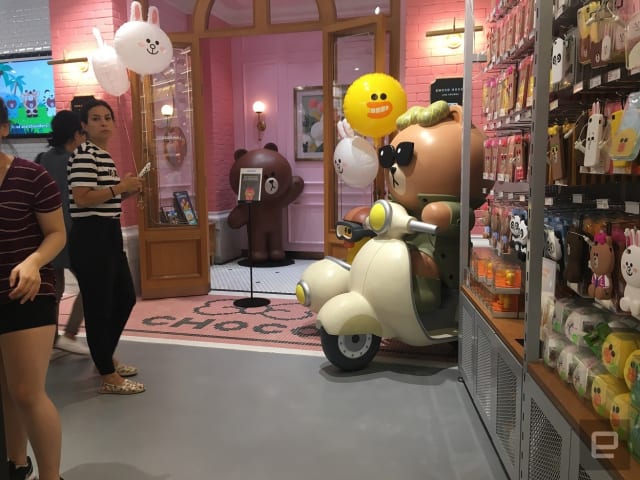
Line Friend’s CEO James Kim was on hand for the public launch of the first American store. Like those other outposts, the Times Square location’s walls are lined with apparel and stuffed versions of the characters. Brown the bear, chief among the brand’s mascots, appears most often, with a colossal 10-foot-tall incarnation greeting visitors at the front entrance. On the official opening day, two people clad in human-size Line Friends costumes met fans of the characters, which are otherwise pretty obscure here in the US.

The story of Line Friends begins with the March 2011 Tōhoku earthquake, which crippled cellular communications in Japan. To fill the gap, engineers from Naver Corp.’s subsidiary NHN Japan built their own internal chat tool. That June, they released it to the public as the Line smartphone app. Even then, Line found itself competing with WeChat, the messaging app from Chinese internet titan Tencent. To set itself apart, Line went after younger users with stickers — oversize emoji, really — including two free sets with a quartet of animal and human characters. Their cutesy appearance and comical antics endeared them to Line users. They have also sold really, really well: Stickers drew in $268 million for the company in 2016.
The stickers were the tipping point: After extensive focus group testing, Line chose characters that resonated with teenage girls, the tastemakers of Japan. The stickers were both evocative and universal, telling silly and heartfelt stories about the individual characters’ daily lives. Line hit 50 million signed-up users within a year of launch. A year after that, it had grown to a total of 300 million users across Japan, South Korea, Taiwan and other Asian nations. The company renamed its main cast of mascots “Line Friends.” Like Hello Kitty’s troupe of cutesy oddballs, Line Friends have fleshed out their cast’s backstory and personalities. The eleventh character and most recent addition, Choco, was introduced in March 2016.
Line Friends became an opportunity to spread the company brand. Japan is known for cuteness: Almost everything, including public transit systems, gets their own adorable mascot. These corporate ambassadors often find their way into themed cafes and shops. Line wanted to do something similar and give fans real-life “experiences” with the characters they’d only known on their smartphones. Line Friends experimented with its first pop-up store in Myeong-dong, South Korea, in October 2013, and then built a permanent location in the city’s Lotte Young Plaza the following April. The shops grew to sell more than just stuffed animals and shirts, expanding into homewares and stationery. In short, they have things for millennials and families who like “modern design with some cuteness,” according to Line Friends America CEO Sehoon Chang.
They’ve also started leveraging the Line Friends to sell tech. Line has bet big on the character designs to sell speakers powered by its AI assistant Clova. Specifically, Brown the bear and Sally the duck will decorate the Champ series, which should come this winter after the first, Wave, debuts in the fall. The Champs will hit the New York City store’s shelves eventually, but they’re likely aimed at the Asian market Google and Amazon haven’t optimized their Home and Alexa products for Asian markets, giving Line an opportunity to sell its AI-powered speakers there first.
The company kept to that strategy — an experimental pop-up, potentially followed by a brick-and-mortar store — as it launched additional stores in Taiwan, Tokyo’s Harajuku district, Hong Kong, Beijing and now, New York (which had pop-up test spaces of its own in 2014 and again last year).
Line has wanted to expand into the US since for five years now but competes with Facebook’s trio of Messenger, WhatsApp and Instagram, which are more popular in this part of the world. But Line Friends doesn’t exist solely to promote the Line app anymore — it’s its own unique brand, and technically even its own organization, having broken off as a subsidiary in 2015.
Part of fleshing Line Friends out into its own entity meant expanding into other media. Line Offline: Salaryman is an animated office comedy that aired in 2013, while the cartoon Line Town followed shortly thereafter. Both share the same identifiable DNA of the stickers, walking fans through antics a little bit sillier than those in their everyday lives. But more recent animations have focused on either teaming up with big brands like Samsung or 7-11, or city-wide promotions like New Year’s celebrations in Hong Kong. That’s digital visibility.
The New York City store is intended to make Line Friends more visible in a different way. On the location’s launch day, Line Friends CEO James Kim noted that Times Square itself gets over 300,000 tourists every day and millions of pictures are hashtagged to the location on Instagram daily. The point isn’t just to have Americans wander into the store: It’s to have visitors from countries where Line isn’t popular discover these products and bring their adoration back with them. Or, at least, note it on social media for their followers at home. Chang estimated that the store’s visitors were likely around 50 percent international tourists, 30 percent Americans visiting from out of state and 20 percent local New Yorkers.

The goal is to spin these characters as their own standalone brand, which is how Line Friends have successfully advertised their cast in East Asia. The real-life locations aren’t just merchandise warehouses: They often have elaborately-designed areas patterned after the characters’ backstories, replicating online lore inside stores. Line Friends’ flagship three-story Itaewon, South Korea location has areas decorated to look like characters’ rooms, while the cafe on the top level has several large versions of the cast seated at tables for visitors to hang out and take photos with.
It’s the kind of endearing experience that even first-time visitors appreciate, of falling into a carefully-built world of broad-strokes delight filled with colorful, lively characters. The same is true of the New York City store: Plushies and apparel line the walls while large, posed statues of the Line Friends cast are carefully positioned in the store’s nooks like set pieces. In one, Brown is dressed in a hoodie and sneakers to match a new theme for the character; In the secluded back area, one wall is modeled after Choco’s room, with the bear sitting in front of a mirror getting ready for the day. The brand, and the craft to maintain it, feel a lot like a Disney park. That’s no accident.
“Disney is a reference for us, and always a textbook for the character business. They give us a lot of inspiration,” Chang told Engadget on the New York City store’s opening day. Then Chang pointed across the street at the Disney store. “There are reasons Disney picked a location in Times Square.”
Brand visibility, he means: a physical location to lure in passersby. But their store has more variety of products than Disney’s, Chang said, citing its range of homeware. Most of these products (aside from pro-NY merchandise) can be found at other locations, but many North Americans are seeing them for the first time. Some things will have to go, Chang said: A massage stick (pictured below) probably won’t appeal to shoppers in New York, while some of the notebooks aren’t sized according to US market norms.

Line’s flagship communication app still faces stiff competition at home. WeChat reached 938 million monthly active users in the first quarter of 2017, while Line seemingly plateaued in the same period at 171 million. Ad revenue grew, but 73 percent of the company’s revenue came from the Japanese market. On the other side of the Pacific, Facebook Messenger reported passing 1.2 billion MAUs in April, while WhatsApp noted in June it had 1 billion.
The stores, then, are one way of distinguishing Line’s service from its bigger competitors, especially as the company seeks new markets to reverse a slight decline in monthly active users. At the end of 2014, while one pop-up experimented in New York City, another opened in Bogota, Colombia. It wasn’t clear if the South American market responded well to the Line Friends merchandise — but if the company is planning to follow up its NYC location with one farther south, it hasn’t announced anything yet. Time will tell whether physical storefronts push Line Friends into the Western cultural consciousness.
Images: Evan Rodgers & David Lumb / Engadget
Asus leaks four ZenFone 4 models on its own website
Last year’s Asus’ ZenFone 3 line of mobile devices included a ton of spinoffs, including the ZenFone 3 Deluxe, ZenFone 3 Laser and the dual-camera ZenFone 3 Zoom this past January. Apparently the potentially confusing naming conventions are going to continue, as Asus just accidentally leaked four new ZenFone 4 models onto its own website, including updated basic, Selfie and Max models. What’s new here is the Selfie Pro, an upgraded handset with two cameras on the front and upgraded specs inside. Does the world really need a professional selfie phone, though?
The leaked handsets could include the aforementioned ZenFone 4 Selfie model, which was shown to have a Snapdragon 430 chipset, a 720p 5.5-inch IPS display and two cameras (20MP and 8MP) on the front. The Selfie Pro, then, might have an upgraded Snapdragon 625 chipset, a 5.5-inch AMOLED screen at 1080p, and the front two cameras come in at 25MP and 5MP. According to the listing, the Pro model will cost an extra 100 Euro over the €399 of the basic ZenFone 4 Selfie.
The removed listings also show a ZenFone 4 basic model with the same display as the Selfie Pro above, a Snapdragon 630 processor, 4GB of RAM and 64GB of expandable storage. There’s also a 3,300mAh battery to keep the thing charged for longer periods. Finally, Asus’ listing showed off the ZenFone 4 Max, which seems to have a smaller battery, a Snapdragon 450 processor, 3GB of RAM and 32GB of expandable storage memory, and a smaller screen. There’s no word yet on if, when or where these devices will be available.
Via: The Verge
Source: Android Police
MacRumors Giveaway: Win a USB-C Pro Hub Adapter From Satechi
For this week’s giveaway, we’ve teamed up with Satechi to offer MacRumors readers a chance to win one of Satechi’s Aluminum Type-C Pro Hub Adapters, designed for Apple’s 2016 and 2017 13 and 15-inch MacBook Pro models. With these machines, a hub is a must because of the limited number of ports and the lack of USB-A.
Satechi’s Pro Hub measures in at 4.5 inches long and 1.1 inches wide, and it plugs right into the side of a MacBook Pro, using two USB-C ports on either the left or right side (or just the one side on 13-inch non Touch Bar models).
Made of aluminum and available in either Silver or Space Gray, the hub matches well with the MacBook Pro, and at just 1.4 ounces, it’s super portable and can even travel plugged right into your machine.

The Pro Hub features an HDMI port that supports 1080p video at 60Hz (4K at 30Hz), two USB-C ports, 2 USB-A ports, an SD card slot, and microSD card slot. The USB-C power delivery port supports 5K video (or 2x4K), 40Gb/s data transfer speeds, and passthrough charging up to 87W, so it works with all USB-C MacBook Pro models. The second USB-C port does not support passthrough charging, but offers data transfer speeds up to 5Gb/s.

Satechi sells the Pro Hub for $99, but we have three to give away to MacRumors readers for free. To enter to win, use the Rafflecopter widget below and enter an email address. Email addresses will be used solely for contact purposes to reach the winner and send the prize. You can earn additional entries by subscribing to our weekly newsletter, subscribing to our YouTube channel, following us on Twitter, or visiting the MacRumors Facebook page.
Due to the complexities of international laws regarding giveaways, only U.S. residents who are 18 years of age or older are eligible to enter. To offer feedback or get more information on the giveaway restrictions, please refer to our Site Feedback section, as that is where discussion of the rules will be redirected.
a Rafflecopter giveawayThe contest will run from today (August 11) at 11:00 a.m. Pacific Time through 11:00 a.m. Pacific Time on August 18. The winners will be chosen randomly on August 18 and will be contacted by email. The winners will have 48 hours to respond and provide a shipping address before new winners are chosen.
Tags: giveaway, Satechi
Discuss this article in our forums
 AIVAnet