


This $14 ODB2 reader can tell your phone what’s wrong with your car
Save some money while figuring out what’s wrong with your car thanks to our pals at Thrifter!
No one likes seeing their check engine light pop on, and it’s even worse when you don’t know what the cause of it is. Sure, there are some places that will scan your car for free to tell you what’s up, but most of them charge for the service. Stop throwing money away having your car scanned, and start doing it for yourself.
Right now you can pick up Kobra’s Wireless ODB2 reader for just $14.39 with the coupon code 83ZIWPVF. This is a savings of nearly $6 from its regular price, and one of the best features of it is that you can connect it right to your smartphone to decipher the cards.

- THE MOST EFFECTIVE OBD SCANNER AND CAR CODE READER YOU HAVE EVER TRIED: Diagnose Your Car – Like a Pro and instantly transform your car into a Smart Car! KOBRA has created a top quality auto diagnostic scanner. This OBD2 Scanner can read generic and manufacturer-specific trouble codes and its database includes over 3000 code definitions.
- CONNECTS TO ANY IOS, ANDROID AND WINDOWS DEVICE VIA WI-FI: Unlike other Bluetooth OBD Scanners available on Amazon, this amazing car code reader OBD scanner can connect to any device including Apple, Android and Windows smartphones and tablets. You just need a Wi-Fi connection and you can diagnose any car problem and unlock massive amounts of data on your car’s performance in real time!
- VARIOUS FREE AND PAID APPS AVAILABLE! Supports OBD Fusion, DashCommand, OBD Car Doctor, etc for iOS and Torque Pro for Android, OBD Auto Doctor for Windows as well as many other ELM327 Apps that require a WiFi OBD2 adapter. Do not worry about compatibility. The KOBRA OBD2 wireless car code reader works with all 1996 to 2018 cars and small trucks in the United States
- UPGRADED VERSION: Thanks to user feedback we have released the new version of the WIFI OBD2 Scanner and Check Engine Code Reader. Upgrades include improved WIFI signal range, enhanced app compatibility, upgraded components, and NO CD. Don’t be fooled by other brands who sell cheaply made obd2 elm327 scanners. Our OBD Diagnostic scanner and Check Engine Light Eliminator is made with top quality materials for optimal performance and durability.
This is a great addition to any garage, and at just $14 it’s hard to pass up. Don’t get caught wishing you ordered one, and instead grab one for yourself now! There is also a Bluetooth-only option for $9.06 with coupon code 2WQM8IBW.
See at Amazon
More from Thrifter:
- What does Amazon’s takeover of Whole Foods mean for you?
- Five free travel apps to help you save big on hotel stays
For more great deals be sure to check out our friends at Thrifter now!
‘Super Meat Boy Forever’ lands on Nintendo Switch next year
Super Meat Boy Forever, the sequel to successful twitch platformer Super Meat Boy, will hit Nintendo Switch with a squishy, bloody splat in 2018.
Super Meat Boy Forever features all of the rapid-fire leaping, sliding and dodging of the original game, but with added moves, daily challenges and a ranking system. It stars Meat Boy (an adorable block of bleeding tissue), Bandage Girl (she’s built out of Band-Aids) and their sweet baby, Nugget. Nugget is captured by the evil Dr. Fetus (you get the idea by now) and players have to platform their way around increasingly treacherous levels stacked with spinning blades, spikes, poison and other deadly traps.
Super Meat Boy Forever lands on Switch in 2018, and it’s also due out for PC and tablets at some point. Nintendo revealed the Switch release date during today’s indie-focused live stream. The original Super Meat Boy was a runaway hit for the Xbox 360’s Xbox Live Arcade program when it hit that system in 2010.
Team Meat is bringing their beefy sequel, @SuperMeatBoy Forever to #NintendoSwitch next year! #Nindies pic.twitter.com/SrGpBTp6AX
— Nintendo of America (@NintendoAmerica) August 30, 2017
MIT’s latest robot politely weaves through crowds
We’re still trying to get robots to walk through difficult terrain (or gallop like ostriches), but sooner or later they’ll need to master another important skill: Not getting in our way. MIT researchers have built a wheeled ‘bot that can safely navigate through crowds of people.
It’s not just staying out from underfoot: The robot is programmed to follow subtle social rules too, like passing on the right and speedwalking past people on their left. The ‘bot uses a suite of RGB cameras and a LiDAR array paired with face-detection tech to recognize humans and situate itself accordingly. Then it anticipates where they’re going and, polite little robot that it is, weaves patiently around pedestrians so as not to get in their way.
That would make it ideal for busy areas with a lot of foot traffic, like malls or hospitals. The robot’s goal isn’t just to stay in its lane but to prioritize human walkers — think of it as a prototype robot butler that’s hyperaware of social cues. It runs a proprietary algorithm to navigate and respect particular traffic rules (passing on the right, which is the preference in the US), but those could easily be reprogrammed to adapt the bot to other cultures’ walking norms. The MIT team, whose research was funded by Ford, will present their findings in a paper at the IEEE Conference on Intelligent Robots and Systems next month.
“The knock on robots in real situations is that they might be too cautious or aggressive,” The paper’s co-author Michael Everett told MIT News. “People don’t find them to fit into the socially accepted rules, like giving people enough space or driving at acceptable speeds, and they get more in the way than they help.”
Sure, there are more pressing navigational priorities when some of our robots can’t help throwing themselves into fountains. But respecting the subtleties of how we walk around and between other humans is downright civilized. The next time someone cluelessly stops moving in front of you on the sidewalk or passes on the wrong side, you can say, ‘A robot would have done better.’
Via: TechCrunch
Source: MIT News
First FDA-approved genetic therapy fights leukemia
The first gene therapy treatment has been approved for use in the United States. The FDA greenlit a procedure that uses a patient’s own cells to combat a particular type of leukemia, but will only permit it for children and young adults up to age 25.
This procedure, known as Kymriah (tisagenlecleucel), works to combat acute lymphoblastic leukemia (ALL), the most common childhood cancer in the US with over 3,000 new cases diagnosed every year. Kymriah extracts a patient’s autoimmune T-cells and sends them to a facility, where they are modified to include a new gene that directs the T-cells to target particular leukemia cells. Then the genetically-modified cells are sent back to be re-inserted in the patient.
“Kymriah is a first-of-its-kind treatment approach that fills an important unmet need for children and young adults with this serious disease,” said Peter Marks, M.D., Ph.D., director of the FDA’s Center for Biologics Evaluation and Research (CBER), in the FDA’s post. “Not only does Kymriah provide these patients with a new treatment option where very limited options existed, but a treatment option that has shown promising remission and survival rates in clinical trials.”
One study cited in the FDA’s announcement treated 63 children and young adult patients with Kymriah, which saw an 83 percent remission rate after three months. The agency granted approval of the gene therapy to Novartis Pharmaceuticals Corp.
Source: FDA
Riptide’s electric skateboard balances power and portability
Electric skateboards have been coming out of the woodwork lately, popping up in all shapes and sizes, with each new company trying to find a niche in the market. There have been examples of extremely tiny models accentuating portability and longboards with hyperextended ranges. It depends on what fits your use case, but I’ve been eyeing boards that match normal decks for scale, along with a belt-driven motor and a relatively affordable price. The newest entry to hit the crowdfunding scene is the Riptide R1, which dropped on Indiegogo today. So far, it’s come closest to what I’ve been looking for on all fronts: size, price and power.
The great thing about having a shorter deck and some kicktail as opposed to the popular longboard designs is maneuverability. You can make far sharper turns and adjust your direction using the tail on boards like the 31-inch Riptide R1. While the popular Boosted Boards line may be the limo of electric rides, a smaller format is preferable when it comes to tight turns, which helps in a fragmented cityscape like New York. The R1 also has handle cutouts on both sides of the deck, making it easy to pick up and carry when you’re not cruising. The board may not be as light as they come, weighing around 13 to 14 pounds, but when handles are added, it seemingly lightens the load.
When it comes to power, Riptide gives Boosted’s boards a run for their money, all at a lower price. As a comparison, Boosted has 1,500- and 2,000-watt belt-drive longboard models ranging from $1,300 to $1,500. The Riptide R1 falls smack in the middle with 1,800 watts of belt-driven power, starting at a retail price of $749. However, that doesn’t even include crowdfunded early-bird pricing, which is available now, starting at $499 for the basic R1 model and $629 for the R1 Elite.
Both versions of the R1 have the same deck, trucks and motor assembly. The standard R1 has blue 83MM / 78A wheels, while the R1 Elite package includes an additional set of taller (and softer) green 90MM / 75A wheels, plus a set of lights for the front and rear of the board. Those would be Shredlights, truck-bolt-mounted skateboard lights that helped Riptide founder Eric Birkemeier get his start.

As usual, there’s a handheld controller to manage speed and braking. There’s a ring grip for your finger, helping to keep it in your hand and a battery-level indicator on the side, and the unit is rechargeable via USB. You get both a standard mode and pro mode, letting you decide whether to cap your top speed at 12MPH or get the full top speeds of either 18 or 20MPH, depending on which model you get.
The regenerative braking works well, perhaps even too well if you’re familiar with some other models that ease into a stop. Riptide boards currently brake a bit more quickly but seem easy enough to get familiar with, and as a brakes go, they have a lot of stopping power. There’s also another button on the side for toggling into reverse mode. It would have been preferable to have braking and reverse bundled into the throttle lever as a single function, but I’ve rarely used reverse unless I overshot a crosswalk at a stoplight and wanted to back it up a bit.
The R1 boards have a range of up to seven or eight miles depending on which model you use, which is comparable to many boards, especially smaller decks with less space for large batteries. Since you’re not pushing around, riding for distances greater than that in one go can tend to cramp up your legs, at least in my experience. Greater range is always a benefit, but chargers are light enough to chuck in a backpack when you need to re-up. As for pushing when the battery is dead? Like many belt-drive models, you can push around, but there is a little bit of resistance if you’re on flat ground or vertical inclines, which is one area that hub motors do improve on.

Like most models on the market, the battery takes about three hours to fully charge, unless you splurge for the fast charger; then you can get juiced up and ready to go in 90 minutes. (If you can swing it, the fast charger is a must-have for any board.) While you’ll technically be able to swap batteries, it’s not a hot swappable setup, so you’d literally be unscrewing the pack to install a new one. The battery pack is made up of 3.6v 18650 Li-on cells and provides a total of 97.2Wh worth of juice, all UL approved. Riptide also notes that this <99 watt-hour rating makes it safe for air travel as well.
If you consider the early-bird pricing, this is a great deal for a board with this amount of power. Even at full retail pricing, it’s comparable to boards like the Elwing, which also has a standard-size deck but uses a less robust (albeit more efficient) hub motor. The Riptide R1 Elite prototype that I tested was easy to get up to full speed quickly, and braking was smooth (once you get used to its rapid slowdown abilities). While being higher off the ground with the larger 90mm Elite series wheels may put a kink in your ollie ability — something I’ve increasing found to be irrelevant for enjoying electric models — they provide a smooth and stress-free ride.
The Riptide R1 and R1 Elite models are live on Indiegogo starting today with early-bird prices ranging from $499 to $629.
[Images: Riptide (R1 controller and deck); Jon Turi/Engadget (R1 Elite top/bottom view)]
The iPhone 8 reportedly swaps the home button for gesture controls
The folks over at Bloomberg got their hands on some images of the next iPhone as well as some information from people familiar with the new model. Some of the features confirmed in their report were already known or at least heavily suspected, but there are also some new details about how the phone will function without the home button.
As has been reported before, the images viewed by Bloomberg show that the iPhone 8 will have thin bezels and a larger screen than the iPhone 7. It’s also going to have a facial recognition sensor that, along with the earpiece and front-facing camera, will be contained in a cutout at the top of the screen. Some other physical details include rounded edges for the screen, a longer power button, a glass front and back and stainless steel edges with antenna cuts on the corners. The app dock is also getting a redesign and looks a lot like the iPad iOS 11 dock, according to Bloomberg.
But one of the bigger changes — the removal of the home button that’s been a part of the phone for a decade — comes with some tweaks to how users will access the features that the home button has brought them to in the past. Now, what was once the home button’s function is going the way of the iPad and Apple’s laptop trackpads. Gesture controls will now bring you to the main app grid and show you which apps are open. The bottom of the screen will host a software bar that can be dragged upwards to open the phone and also to get to the multitasking interface once the phone is unlocked.
The new iPhone is expected to launch on September 12th alongside the 7s and 7s Plus models.
Source: Bloomberg
Watch Samsung’s IFA event at 12PM Eastern
Samsung’s last big event was just one week ago, but it already has another one lined up. The tech giant is hosting its IFA 2017 presentation at 12PM Eastern — and as always, you can tune in to its live stream to catch the news as it happens. This year, the focus is likely to be on wearable tech. Samsung has already confirmed that it’ll launch a new Gear smartwatch at the German trade show, and it’s no secret that the Gear Fit 2 Pro fitness tracker is on the horizon. We wouldn’t be surprised if there’s more, either. Whatever’s unveiled, it’s safe to say that Samsung will have plenty to talk about when it takes to the stage.
Follow all the latest news from IFA 2017 here!
Source: Samsung Newsroom
Samsung Gear Fit 2 Pro hands-on: Tiny changes, big improvements
As the all-important holiday season approaches, companies want to make sure their products have a spot on your shopping list. So Samsung’s trio of wearables launching at IFA 2017 is timely, especially given how well wearables tend to sell ahead of fitness-related New Year’s resolutions. At a relatively affordable $200, the new Gear Fit 2 Pro is poised to be a popular gift. It adds a handful of updates to the existing Fit 2 activity band to make it a better tracker than before, especially for swimmers and runners. During a brief hands-on here at the show, I was impressed by how a few small enhancements helped the Fit 2 Pro feel like a huge improvement on its predecessor.
Perhaps the most important update is the Fit 2 Pro’s water-resistance. Rated at 5 ATM, the Pro can survive being submerged in up to 50 meters of water, like the Gear Sport smartwatch, which Samsung also unveiled today. With that underwater capability, the Fit 2 Pro can track your swims with the company’s own S Health app or a new Speedo app that’s launched alongside the new Gear wearables. The difference between the two is that S Health can track your heart rate during your swim as well, something the Speedo version can’t do. When it detects that you’re underwater, the Fit 2 Pro will go into something called Water Lock Mode, which prevents water bubbles from activating or interacting with your screen. When I tried plunging my wrist into a tank of water while wearing the Fit 2 Pro, its screen simply went black until I pressed a button on the side. Then, the display turned on to show it had been running the swim tracking app that I had launched before dunking my hand.

The Fit 2 Pro now comes in small and large sizes, which will both sport a 1.5-inch curved Super AMOLED screen. That’s a smaller display than last year’s Fit 2, which measures 1.58 inches. Still, the Fit 2 Pro’s bright, colorful screen felt adequately roomy during my preview and it was responsive as I swiped through widget after widget on the band’s Tizen-based OS.
Samsung also unveiled a few new features for this year’s Gears, which I’ve described in detail in my hands-on of the Sport here. But just to give you an overview — the devices now continuously track your heart rate (they only checked it in intervals before) and automatically detect your workouts once you’ve been engaged for at least 10 minutes. Both the Gear Sport and Fit 2 Pro now also let you enter your calorie intake from your wrist, saving you from having to dig around for your phone after a meal. They’ll also show you your net caloric intake for the day and advise you on how to reach your goals. In short: Move more, eat less.

The two devices have 4GB of onboard storage, too, which will let them support a new Spotify offline playlists feature. I tried this out during my hands-on, and was impressed with how intuitive it was to save a playlist, since the process is largely similar to that on a smartphone. You can then stream the music to a pair of Bluetooth headphones.
The Fit 2 Pro now features a buckle clasp instead of the slightly unwieldy peg-and-hole closure from before. Thanks to this change, it was relatively easy to put it on during my demo. Like the Fit 2, the Pro has built-in GPS to make it possible to map your runs and bike rides without your phone, as well as get more-accurate calculations for your running pace.

Many of the updates for the Fit 2 Pro are incremental or software-heavy, but when taken as a whole they make the device a much more useful band for a wider variety of situations. Having Spotify playlists offline makes the Fit 2 Pro a better running or long-distance workout companion, and the new water-resistance and swim-tracking apps add swimming to the list of activities you can monitor with the band. For $200, the Fit 2 Pro is a compelling activity tracker for those who want a full-featured fitness band with smartwatch-like characteristics as well as a brilliant display. It will be available for pre-order on August 31, so you won’t have to wait long to get one. Those who want something that looks more like a traditional watch and more apps should hold out for the Gear Sport smartwatch.
Follow all the latest news from IFA 2017 here!
Samsung Gear Sport hands-on: Promising but incomplete
Samsung may have just unveiled the Galaxy Note 8, but it’s not done with new devices just yet. Here at IFA 2017, the company unveiled a trio of wearables with a deeper focus on fitness — the Gear Sport smartwatch, Gear Fit 2 Pro fitness band and the Gear IconX 2018 wireless earbuds. The Gear Sport, in particular, stands out as a sleeker, more health-centric version of the Gear S3. The Sport borrows its overall aesthetic from the S3, but has some key differences, including an assortment of new features that are very reminiscent of Fitbit’s recently launched smartwatch. Samsung hasn’t shared how much the Sport will cost yet, but we do know it will range between $200 and $350 when it arrives for this year’s holiday season.
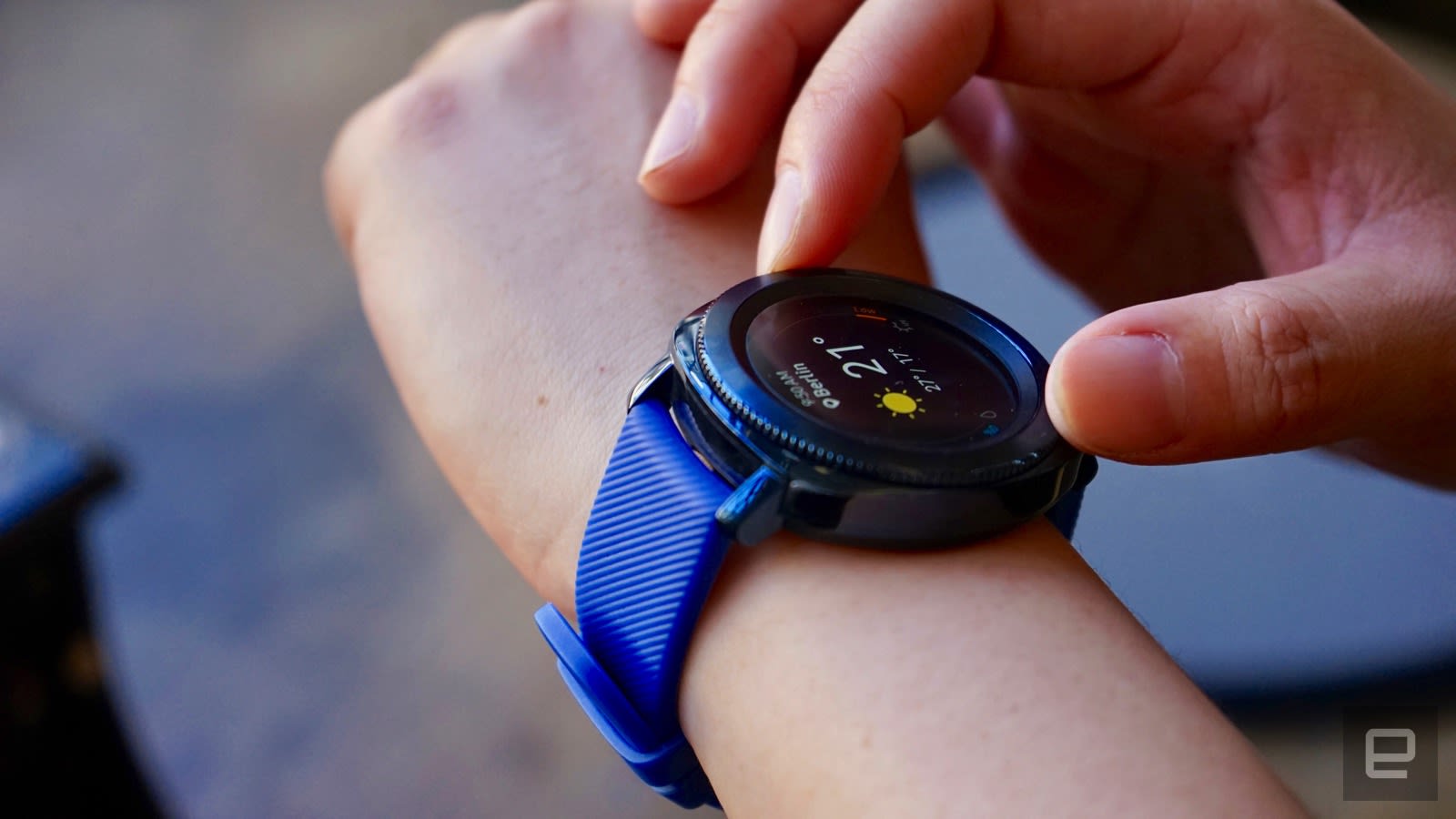
Let’s begin with the similarities to Samsung’s existing flagship wearable, which launched at IFA last year. With its rotating bezel, round face and shiny finish, the Sport could easily be mistaken for the S3 (or even the S2 that came before it). Upon closer inspection, though, you’ll notice differences like the new device’s smaller 42.9mm case and tinier 1.2-inch Super AMOLED display. The straps are also narrower, measuring 20mm wide now instead of 22mm before. Basically, this is a more petite wearable, which is good news for people like myself with slender wrists.
I like the Sport’s dainty size, but I appreciate its versatile aesthetic even more. Despite its name, the Sport doesn’t look like it was made to only be worn at the gym or on a run. It looks a lot like a typical watch that can complement most of my outfits, and you can switch out for the band for a variety of options, including a “leather hybrid strap” that mixes rubber on the underside to wick away sweat with leather on top for a more-premium appearance. That’s similar to the hybrid band Huawei made for its own Watch 2, although Samsung’s features a perforated pattern which I don’t care for.
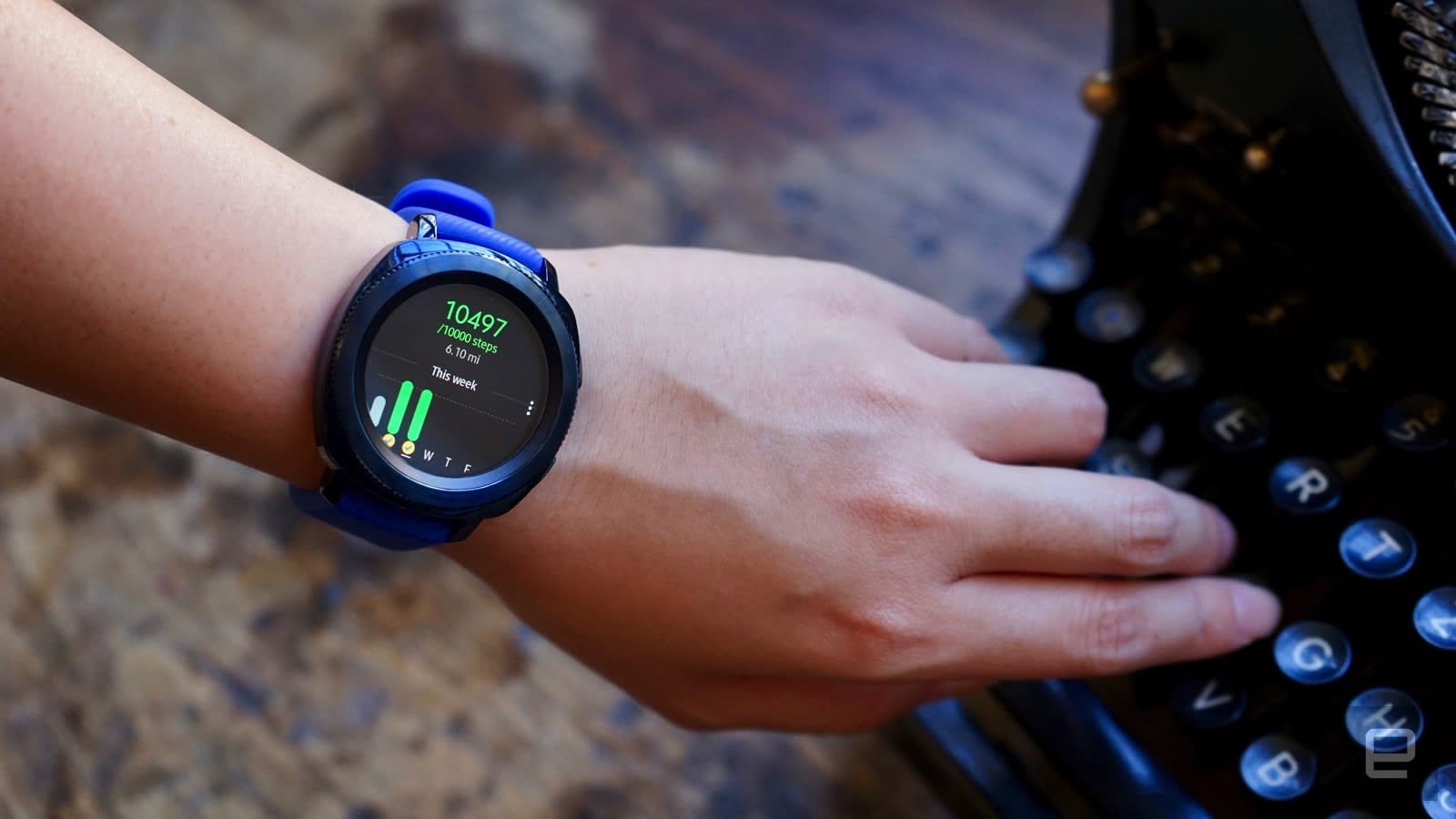
What I love, however, is the Sport’s blue case, which somehow manages to be understated and uniquely attractive at the same time. Samsung also designed a colorful collection of watch faces to complement individual bands for a unified theme. Those watch faces were particularly eye-catching on the Sport’s vibrant display, and although Samsung wasn’t able to provide an exact measurement for brightness yet, the screen was definitely bright enough to see in harsh light.
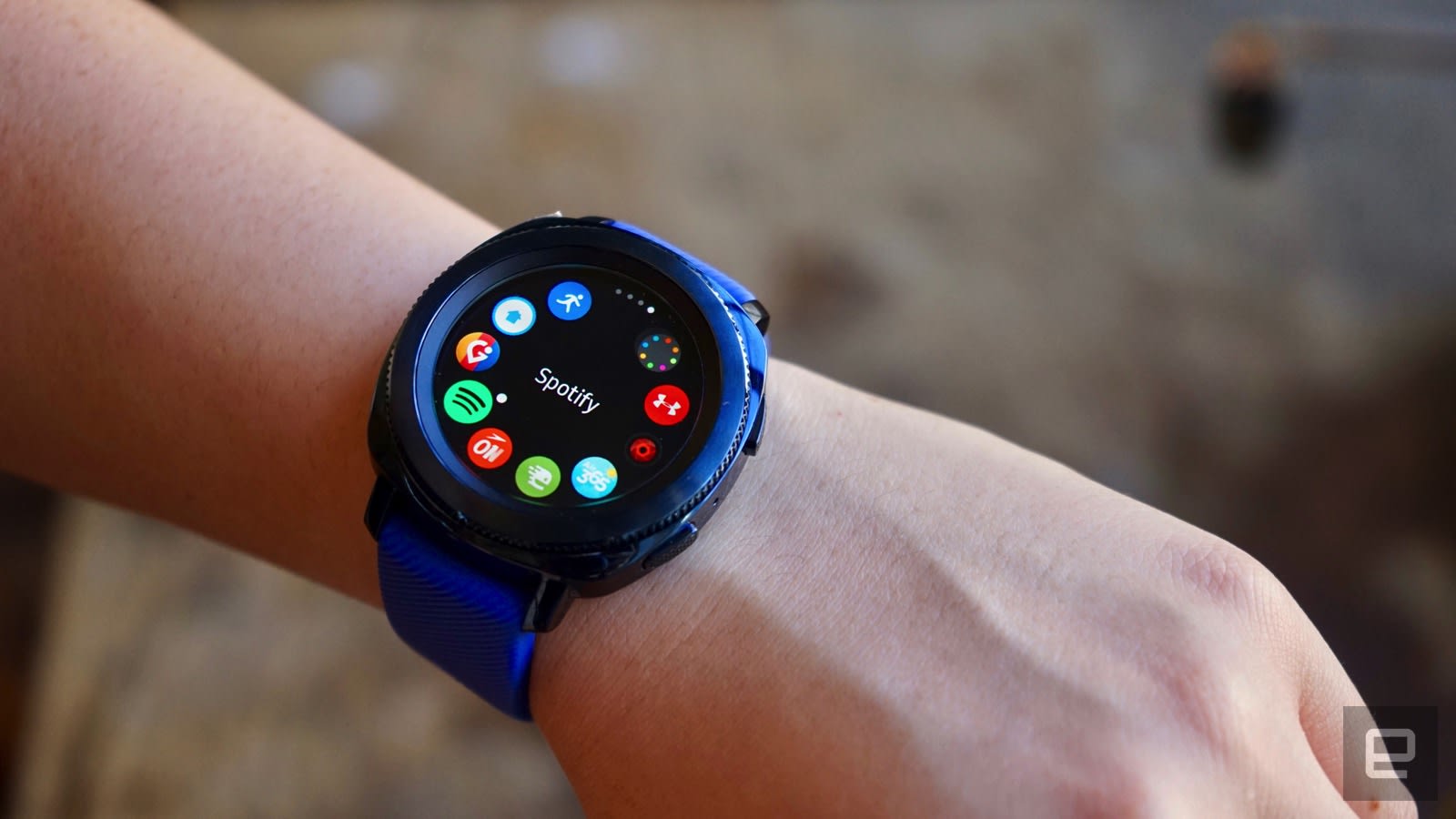
Even though the Sport’s face is smaller than the S3’s, I had little trouble navigating the Tizen OS interface on it, thanks in large part to the nifty rotating bezel that’s the hallmark of the Gear S line. I used the wheel to scroll quickly through widgets and apps to zoom in on the ones I wanted. There are a few new features for the Gear Sport, and I’m most excited about the ability to save Spotify playlists to the watch’s onboard 4GB of storage. The interface I saw during my demo was very similar to the smartphone version of the app, and was intuitive and easy to use. After getting to the playlist you want, you’ll just have to toggle the Download switch to store that selection of songs.
Another new feature is the Speedo app, which is the swimwear company’s first wearable offering. It’ll be preloaded on the Fit 2 Pro, but you can download it for free on the Sport as well. The app will track your laps, monitoring your time taken, calories burned and distance traveled. Don’t worry, the Sport will survive your swim, since it’s rated 5 ATM to withstand submersion up to 50 meters deep. It’s also supposed to survive saltwater, so you can keep your Sport on when you go for a dip in the sea.
If you don’t want to use an app that reminds you of banana hammocks, you can go for Samsung’s own S Health to track your swims. The native app can also track your heart rate under water, so you’ll know what cardio zone you’re in during your swim. The S Health and Speedo apps will communicate with each other, too, so you can switch between the two without losing your workout history. I didn’t get to test the swim-tracking feature at my demo, unfortunately, but I am intrigued at the promise of cardio-monitoring under water.

There are a few more apps for the Sport in addition to the thousands already available for the Gear S3, including MyFitnessPal, MapMyRun and Endomondo. You can use these usually paid-for apps for free for a year on the Sport (and the Fit 2 Pro). These let you track not only your exercises, but also your sleep and nutrition. Speaking of, Samsung also added a new tool to the Sport that lets you enter the number of calories you’ve consumed directly into the watch, so you don’t have to whip out your phone to keep track of your meals. The caveat here is that you’ll have to guess how many calories your meal was instead of looking it up on the watch.
Since the device is also tracking the amount of calories you’re burning throughout the day, it has a good idea of your net calorie loss (or gain) and will encourage you to meet your goals either by being more active or having lighter meals near the end of the day. Again, I didn’t get to try this for myself, but the colorful interface I saw was easy to understand.
Like most of the latest fitness trackers and smartwatches, the Sport comes with GPS built-in to map your runs for more accurate distance and pace calculations. The new Gear wearables now also auto detect your activity once you’ve been working out for at least 10 minutes, and will constantly monitor your heart rate. Other fitness trackers, like the Fitbit Charge 2 and Alta HR, have had these two features for some time now, so Samsung is playing a bit of catch up here.
Samsung also introduced a new service called Fitness Programs (only for the Sport for now) that shows you workout videos that you can follow along on your phone’s screen. You can also cast the content to your Samsung TV, and set scheduled alerts to remind you to work out if you want to meet your goals. With the Sport, you can also display your heart rate on the phone or TV screen so you can keep tabs on your cardio performance. Fitness Programs sounds just like Fitbit’s newly rebranded Coach tool, which offers guided workouts but on the wrist instead of a separate screen. Fitbit charges a fee for the full version of Coach, whereas Samsung’s offering is free, but I prefer having the workouts displayed on my wrist instead of having to bring a phone to the gym with me.
The Sport will also support Samsung Pay like the Gear S3 does, but instead of using MST (magnetic swipe transmission), which is accepted at many more merchants worldwide, the Sport will only have NFC. Samsung says it had to drop MST for the Sport to accommodate the device’s smaller size.
You can also use the Sport to control PowerPoint presentations or navigate VR experiences. At our briefing, Samsung’s David Ng surreptitiously (or not so) clicked through slides by turning the his Sport’s bezel and checked his presentation’s timing, although we weren’t able to try this for ourselves. Another feature that was teased but that we didn’t get to see in action was the Sport’s potential ability to act as a remote control for smart home devices via Samsung Connect. The company says you’ll be able to use the watch like a “realtime dashboard on your wrist” for things like your TV and home appliances that are compatible with Smart Things.
Ultimately, the Gear Sport promises to be a feature-packed smartwatch that retains some of the best features of the S3, although in a limited capacity, while adding some helpful new tools. The Gear S3 will remain available as Samsung’s top-shelf wearable, while the new Sport is a bridge device between the Fit 2 Pro band (which you can read about here) and the high-end smartwatch. So far, the Sport certainly looks like a formidable competitor to Fitbit’s Ionic, but we’ll have to wait till we can test the touted features for ourselves before we can decide. Until then, those looking for a fitness-centric smartwatch should hold off on making a decision.
Follow all the latest news from IFA 2017 here!
Samsung’s refined Gear IconX earbuds now talk to Bixby
The Gear Fit 2 Pro and Gear Sport aren’t the only products Samsung is unveiling at IFA 2017. Today, the company also introduced a revamped version of its Gear IconX wireless earbuds, which feature better battery life (up to five hours of streaming) and support for its virtual assistant, Bixby. That means you can now use your voice to control your music or paired phone, all by simply tapping and holding the side of the IconX earbud. And because runners may be into these, Samsung added a Running Coach mode that gives you real-time, in-ear status updates as you’re working out.
In terms of ergonomics, they’re slightly lighter and have been redesigned to ensure they stay in your ear securely — and, importantly, that they feel comfortable while you’re using them. Samsung didn’t reveal when the improved Gear IconX earbuds will hit stores, but we do know they’ll launch in three different colors (black, gray and pink) this time. There’s no word on pricing either, though the previous IconX Bluetooth set cost $200, so you can expect the new ones to be close to that.
Follow all the latest news from IFA 2017 here!
 AIVAnet