


Intel’s eighth-gen CPUs will be more powerful than we thought
Earlier this year, we didn’t expect much from Intel’s eighth-generation Core processors. But at Computex in May, the company surprised us all by revealing they’ll be 30 percent faster than last year’s chips. That alone would have been notable, but now Intel is making an even bolder claim: They’re actually 40 percent speedier. At least, that’s the case for one of its laptop chips when running through the Sysmark benchmark. And when it comes to five-year-old computers — the kind Intel expects the majority of consumers to upgrade from — they’re twice as fast at productivity tasks.
So how did Intel manage this feat? For the first time, it managed to cram four CPU cores into its U-series chips, which have typically been intended for ultraportable laptops and hybrid devices. To go quad-core with the company’s previous chips, you’d have to step up to its H-series CPUs, which are designed for more performance-focused notebooks. Additionally, Intel managed to squeeze another 500MHz of Turbo Boost performance into the chips, allowing them to reach speeds up to 4.2GHz. Whereas last year’s seventh-generation CPUs were focused on improving 4K performance, the coming offerings will feature far more raw performance.
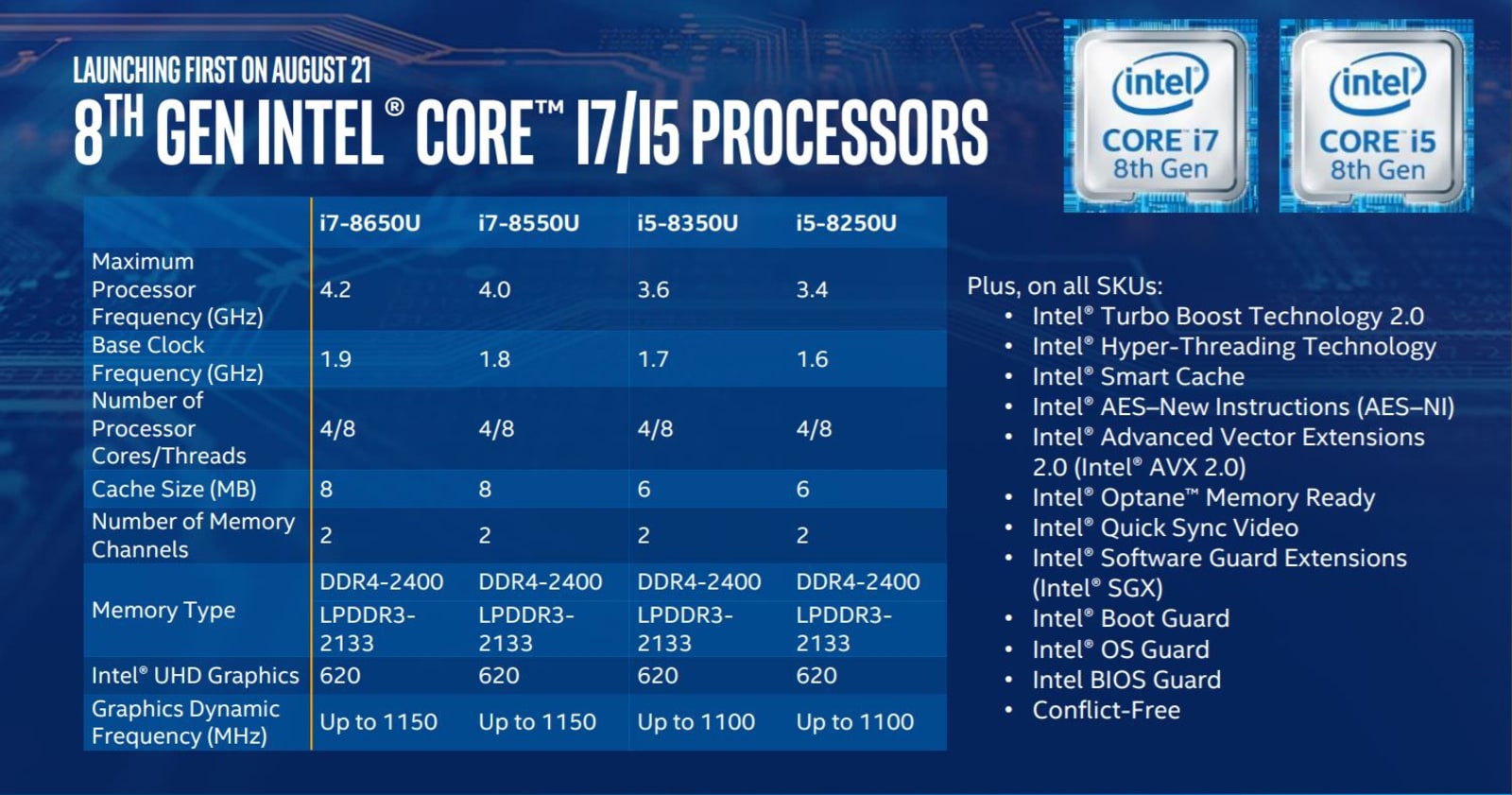
The eighth-generation Core family for ultraportables ranges from the i5-8250U, with speeds between 1.6GHz and 3.4GHz, and the i7-8650U, clocking from 1.9GHz to 4.2GHz. They’re all quad-core chips, but as usual, you can expect better performance from the i7 lineup.
As for other notable stats, Intel claims the 8250U can encode a 4K video 14.7 times faster than a five-year-old PC running a comparable chip. In real-world terms, the eighth-gen chip converted the 4K clip in three minutes, compared with 45 minutes with its third-gen sibling. Unsurprisingly, then, the older your computer is, the bigger performance jump you’ll notice.
Despite having more power under the hood, Intel says the new CPUs won’t be a step backward when it comes to battery life. Unfortunately, there’s nothing really pushing battery life forward, either. Its current benchmarks indicate that laptops running these chips should feature around 10 hours of battery life when playing 4K video. That’s pretty much the same as before. To be fair, though, last year’s chips also reclaimed some battery life with more efficient 4K performance.
Intel is basically following through with its typical game plan: Release a new batch of chips for ultraportables, and then ramp things up on the desktop end. With quad-core performance, we might finally be able to see ultraportable notebooks that can go toe-to-toe with last year’s beefier machines. And the company continues to look ahead; during a private briefing, I got a chance to see a few device prototypes that looked nothing like PCs we have today. I can’t say much about them, but overall, they made it clear that Intel isn’t just planning to coast on traditional PCs forever.
You can expect the first batch of laptops with eighth-generation Intel CPUs in September. Desktop models will follow later in the fall. Looking ahead even further into next year, the company expects to release its first 10-nanometer chips as part of this generation as well.
HTC cuts the Vive VR headset’s price to $599
You knew HTC wouldn’t let the Oculus Rift’s price cut go unanswered for long. As of today, HTC has permanently lowered the price of the Vive headset by $200, to $599/£599. That’s still $100 more than you’d pay for a Rift/Touch combo, but it’s far easier to swallow than before and might keep HTC’s approach to room-scale VR under your consideration. As before, you get trial access to the Viveport monthly app subscription service as well as free titles like Everest VR and Google’s Tilt Brush.
The company tells us this isn’t about clearing inventory, so this isn’t an indication of how well the Vive is selling. It’s strictly a competitive move, in other words, and it’s probably not an indication of new Vive hardware on the horizon.
It’s hard to imagine HTC not cutting the price of the Vive — there was no way people were going to pay $300 more than Oculus’ setup for a comparable experience. Even so, it’s a significant moment for high-end VR. Neither the Vive nor the Rift is what you’d call an impulse purchase after all this (that may have to wait until $200 wireless headsets), but they might now be inexpensive enough that they’re treated less as novelties and more as mainstream (if still costly) peripherals.
Source: Vive
FBI reportedly advising companies to ditch Kaspersky apps
Kaspersky Lab’s tussle with the US government could have ramifications for its dealings with the private sector. A new report claims the FBI has been meeting with companies to warn them of the threat posed by the cybersecurity firm. The briefings are the latest chapter in an ongoing saga concerning the use of Kaspersky’s products by government agencies. Officials claim the company is a Russian stooge that can’t be trusted with protecting America’s critical infrastructure. The company denies these claims — its CEO Eugene Kaspersky has even offered up its source code in a bid to clear his firm’s name.
It appears that olive branch went unnoticed. Throughout the year, the FBI has been meeting with US firms to convince them to remove Kaspersky Lab’s tools from their systems, according to officials that spoke to CyberScoop. In view of the cyberattacks that crippled Ukraine’s power grid in 2016, the FBI has reportedly focussed its briefings on companies in the energy sector. Although, it has also supposedly met with major tech firms too.
The law enforcement agency has apparently been sharing its threat assessment with the companies, including Kaspersky Lab’s alleged deep ties with Russian intelligence. However, the meetings have reportedly yielded mixed results. Whereas firms in the energy sector have been quick to cooperate, tech giants have resisted taking swift action, claims CyberScoop.
The revelations follow a wave of allegations against Kaspersky Lab by the US government. As recently as June, a draft version of a Senate bill proposed barring the Defense Department from doing business with the company. Then, in July, a Congressional panel ordered multiple government agencies to hand over their documents and communications about the cybersecurity software provider.
In a statement released last month, the firm said: “Kaspersky Lab, and its executives, do not have inappropriate ties with any government.” It’s a stance the company has reiterated multiple times to no avail.
Source: CyberScoop
Replacement screens can be used to hijack your phone
A new study has shown that one of the most common fixes to a stock smartphone ailment can be used to steal your data, and compromise your device. In the newly published paper, researchers from Israel’s Ben-Gurion University of the Negev reveal how a replacement screen can easily be altered to override your mobile. By embedding a malicious integrated chip within a third-party touchscreen, the research team were able to manipulate the communications system on a Huawei Nexus 6P and LG G Pad 7.0. This essentially allowed them to record keyboard inputs, snap pictures of the user and forward them via email, install apps, and direct the user to phishing websites. A second class of attack also saw them exploit vulnerabilities in the handset’s operating system kernel.
Scariest of all, the researchers claim these hazardous screens can be made to look identical to the real thing — meaning even handset technicians may not be able to distinguish the difference. Furthermore, the entire process is file-less, allowing it to go undetected by anti-virus software.
This type of low-cost attack is known as the “chip-in-the-middle” scenario. To carry out their malicious tasks, the researchers used an Arduino platform running on an ATmega328 micro-controller module. They also used an STM32L432 micro-controller, adding that most other micro-controllers could also do the job. They then used a hot air blower to separate the touchscreen controller from the main assembly boards, in order to access its copper pads. Next, they soldered a copper wire to attach their chips to the device.
Although this set-up looks far from inconspicuous, the team claims a little more effort could easily hide the altered part within a reassembled device. It’s not just Android phones that are at risk either. The paper also indicates that iPhones could fall prey to the same types of attacks.
Source: Yossi Oren
Watch the ‘Uneekbot’ shoe-making robot stitch sandals on demand
When Portland, Oregon-based Keen Footwear introduced its Uneek sandal back in 2015, the outdoor industry sat up and took notice. The entire shoe is held together by a single cord that weaves its way through both the sole and a lightweight upper. It looks as unique as its offbeat construction.
So, when the company searched for ways to push the Uneek brand in new directions, it knew it had to come with something as original as the shoe itself. It found exactly what it was looking for in the form of the Uneekbot, a specially developed robot capable of building custom versions of the sandal, anytime or anywhere.
The world’s smallest shoe factory
Developed in conjunction with a company called the House of Design — which specializes in making one-of-a-kind automation solutions — the Uneekbot has been dubbed “the world’s smallest shoe factory.” The system consists of two robotic arms, several custom fixtures, and a tablet which serves as the robot’s controller, allowing users to start and stop the shoemaking process or input important variables.
When activated, the two arms work together to create a custom pair of Uneek sandals, automatically selecting the proper colored cord before seamlessly weaving it through the shoe’s other components. In fact, on its fastest setting, the robot completes its task in just six minutes, which is roughly half the time it takes someone to accomplish the same work by hand. The shoe is then handed off to an actual human, who checks the Uneekbot’s work for quality control and finishes the last few steps of its construction.
“The Uneekbot’s hardware consists of off-the-shelf products that can be purchased online, but it’s the software — created by House of Design — that makes it special,” said Rory Fuerst, Jr., Keen’s director of innovation, to Digital Trends. “Everyone else told me it wasn’t possible to create a robot that could do what we wanted but the team at House of Design simply went to work developing the code to make it happen.”
The sandal-making robot hits the road
The result was a portable shoe factory that can go just about anywhere, allowing Keen to take the Uneek story on the road. The system first made its debut at the Outdoor Retailer gear show in Salt Lake City last August and has since traveled to sports shows in Friedrichshafen and Munich, Germany.
Everyone else told me it wasn’t possible to create a robot that could do what we wanted.
Recently, the robot appeared in Tokyo — where the Uneek shoes are in high demand — which, coupled with the Japanese obsession with robots, made the device a popular attraction for those who saw it in action. Crowds gathered around Keen’s pop-up Uneekbot Factory Store in the city’s fashionable Bank Gallery building just to watch the robot go about its work.
“The Uneekbot is really a great way to showcase what we’re trying to accomplish here in Japan,” Naoji Takeda told us — he’s Keen’s manager in Japan and witnessed the brand’s growth first-hand following the introduction of the Uneek sandal. “It not only allows us to deliver custom made shoes in under 30 minutes but it brings the manufacturing process closer to the consumer, making it much more environmentally friendly, too.”
An eye on the environment
Like much of the outdoor industry, Keen’s interested in reducing its carbon footprint whenever and wherever possible. The Uneekbot helps accomplish this by eliminating excess waste and dramatically reducing the time required to create a single shoe. It also eliminates fossil fuel emissions (and costs) associated with shipping footwear to the consumer. In fact, Takeda says the raw materials required to create eight shoes using the robot ship in a single shoe box. Customers simply fill out a form selecting the size and color of their shoe and in 30 minutes, they can grab them on their way home.
“Uneekbot is a bakery,” he said. “The robot is an oven and we make exactly what we sell.”
While the robot is fast and efficient at making shoes, don’t expect for it to take over Keen’s entire production line. In order to maintain current levels of output, a completely robotic workforce simply isn’t economically feasible right now. Still, the company continues to look for ways to improve that process and Uneekbot is a great proof of concept of what the future looks like.
In the meantime, the little robot continues its world tour. After wrapping up its stay in the Bank Gallery, it then headed to the men’s fashion outlet Beams Harajuku before proceeding on to Outdoor Retailer once again. All in a day’s work for Keen and the Uneekbot, which continue to redefine what is possible for the shoe industry.
UN urged to ban killer robots in open letter from AI experts
Why it matters to you
Advances in artificial inteligence have made fully automated weapons systems a lethal reality in today’s world.
Elon Musk of Tesla and Mustafa Suleyman of Google are among the top tech industry pioneers urging the United Nations to ban killer robots. In an open letter signed by AI specialists from around the globe, the industry experts urged the UN to take steps to curtail the development and use of fully autonomous weapons such as drones, tanks, and machine guns.
Calling it the “third revolution in warfare,” the signatories caution of an upcoming killer robot arms race that could have devastating consequences. “Lethal autonomous weapons will permit armed conflict to be fought at a scale greater than ever, and at timescales faster than humans can comprehend,” the letter warns. “We do not have long to act. Once this Pandora’s box is opened, it will be hard to close.”
Specifically addressing attendees at the International Joint Conference on Artificial Intelligence (IJCAI) in Melbourne, the letter urges swift action to add “morally wrong” autonomous weapons systems to the list of weapons banned as part of the 1983 International Convention on Certain Conventional Weapons. Groups such as the Human Rights Watch want the UN to mandate that humans remain in control of weapons systems during combat, including the selection of targets, to ensure compliance with international law.
At a UN conference on the subject in 2015, the U.K. opposed a similar ban, claiming that they were not planning to develop any lethal autonomous systems. As the Guardian notes, however, there’s no real definition of what an “autonomous system” is. Some defense systems already in use, such as the U.S. Phalanx anti-missile cannon, are not only computer-controlled and radar-guided, but also programmed to respond automatically to incoming threats.
“The U.S. is farther along in this field than any other nation. Most advanced militaries are pursuing ever-greater autonomy in weapons,” said Stephen Goose, co-founder of the Campaign to Stop Killer Robots. “Killer robots would come in all sizes and shapes, including deadly miniaturized versions that could attack in huge swarms, and would operate from the air, from the ground, from the sea, and underwater.”
Elon Musk has been particularly outspoken on the dangers of artificial intelligence, and has referred to research on the subject as “summoning a demon.” Even the wealthy elites at the economic forum in Davos have worried about the rise of the machines.
Warfare has been around as long as humans have, and will undoubtedly continue in the future. The dilemma facing world leaders now is what form it will take, and who (or what) will wage it.
UN urged to ban killer robots in open letter from AI experts
Why it matters to you
Advances in artificial inteligence have made fully automated weapons systems a lethal reality in today’s world.
Elon Musk of Tesla and Mustafa Suleyman of Google are among the top tech industry pioneers urging the United Nations to ban killer robots. In an open letter signed by AI specialists from around the globe, the industry experts urged the UN to take steps to curtail the development and use of fully autonomous weapons such as drones, tanks, and machine guns.
Calling it the “third revolution in warfare,” the signatories caution of an upcoming killer robot arms race that could have devastating consequences. “Lethal autonomous weapons will permit armed conflict to be fought at a scale greater than ever, and at timescales faster than humans can comprehend,” the letter warns. “We do not have long to act. Once this Pandora’s box is opened, it will be hard to close.”
Specifically addressing attendees at the International Joint Conference on Artificial Intelligence (IJCAI) in Melbourne, the letter urges swift action to add “morally wrong” autonomous weapons systems to the list of weapons banned as part of the 1983 International Convention on Certain Conventional Weapons. Groups such as the Human Rights Watch want the UN to mandate that humans remain in control of weapons systems during combat, including the selection of targets, to ensure compliance with international law.
At a UN conference on the subject in 2015, the U.K. opposed a similar ban, claiming that they were not planning to develop any lethal autonomous systems. As the Guardian notes, however, there’s no real definition of what an “autonomous system” is. Some defense systems already in use, such as the U.S. Phalanx anti-missile cannon, are not only computer-controlled and radar-guided, but also programmed to respond automatically to incoming threats.
“The U.S. is farther along in this field than any other nation. Most advanced militaries are pursuing ever-greater autonomy in weapons,” said Stephen Goose, co-founder of the Campaign to Stop Killer Robots. “Killer robots would come in all sizes and shapes, including deadly miniaturized versions that could attack in huge swarms, and would operate from the air, from the ground, from the sea, and underwater.”
Elon Musk has been particularly outspoken on the dangers of artificial intelligence, and has referred to research on the subject as “summoning a demon.” Even the wealthy elites at the economic forum in Davos have worried about the rise of the machines.
Warfare has been around as long as humans have, and will undoubtedly continue in the future. The dilemma facing world leaders now is what form it will take, and who (or what) will wage it.
Microsoft co-founder’s remote vehicles find a legendary WWII ship
The USS Indianapolis played an important role in WWII history, including the delivery of parts for the atomic bombs that would eventually drop on Japan. However, it met a grim fate: not only did a Japanese submarine sink it near the end of the war, but its wreck has remained elusive despite multiple expeditions over the past 72 years. Technology just provided some resolution, though. A team piloting Microsoft co-founder Paul Allen’s research vessel, the R/V Petrel, has found the wreck of the Indianapolis at the bottom of the Philippine Sea. The discovery was helped by a mix of better information and the equipment aboard the Petrel itself.
Historian Dr. Richard Hulver had determined that the Indianapolis final resting place was west of the presumed original position. Confirming his belief, however, required some special hardware. The Petrel relied on an autonomous underwater vehicle (the Hydroid Remus 6000 above) that could dive roughly 18,000 feet below the water and hunt about 600 square miles using sonar and bathymetry. Once it found something, the team used another remotely operated vehicle (the BXL 79) to swoop in and capture the AUV’s findings on video. Suffice it to say that the depth alone would be impractical for a manned vehicle.
There’s still a lot of work to be done. The Petrel will spend weeks surveying the wreck, and there are plans underway to honor the crew, including the 22 people alive today. Even so, the mere act of finding the ship accomplishes a lot. It ends a mystery for the survivors and their families. Also, it’s a textbook example of what’s possible with modern sea exploration tech. This isn’t Allen’s first big expedition (it previously found the wreck of Japan’s Musashi and the bell of the HMS Hood), but it suggests that solving additional mysteries is really just a matter of time and effort.

Source: Paul Allen
ICE insists it doesn’t use Stingrays to track undocumented immigrants
In a letter (PDF), the acting director of the Immigration and Customs Enforcement (ICE) said that the agency doesn’t use its Stingray mobile call-intercepting devices while enforcing immigration laws. It does deploy them when pursuing criminal suspects, however, and individual agents might use them while acting in a joint task force with other federal officers.
“However, such use must be conducted in a manner that protects rights afforded by the United States Constitution, and in compliance with applicable statutory authorities, DHS policy and ICE policy,” wrote acting ICE director Thomas Homan.
Homan penned the letter in response to an inquiry by Senator Ron Wyden (D-OR). He confirmed that ICE uses Stingrays in accordance with the DHS’s October 2015 directive on cell-intercepting tech, which require a warrant before deploying the devices. Wyden similarly reached out to the US Attorney General’s office to clarify about how Stingray use affects ordinary Americans, Ars Technica points out. That letter apparently hasn’t received a public response.
Knowing these requirements, the Feds’ recent use of Stingray devices to track down a restaurant worker from El Salvador sounds within legal bounds. He was undocumented, but also guilty of a previous hit-and-run, for which he was deported. That wasn’t the only crime mentioned in the Stingray warrant, though: Another was unlawful re-entry after deportation (specifically, violating 8 USC 1326a), citing when he came back to the US illegally after getting booted out. It stands to reason that any illegal return to the US after deportation might be enough to justify use of Stingrays in future warrants.
Via: Ars Technica
Source: Thomas Homan to Sen. Ron Wyden (PDF)
Microsoft reveals every game enhanced for Xbox One X
Microsoft has dribbled out details of Xbox One X visual upgrades over the past couple of months, but now it’s laying all its cards on the table. The company’s Larry “Major Nelson” Hryb has posted a list of all the games currently slated to get some kind of Xbox One X enhancement. Some of them you’ll already know about or would expect, such as many recent Microsoft-published games (including Quantum Break), Assassin’s Creed Origins and Wolfenstein II. However, there are plenty of older and indie titles also in line, such as Astroneer, Firewatch, Hitman and The Witcher 3: Wild Hunt.
The list looks impressive at first blush, but it’s also important to remember that only some of the games will be Xbox One X-ready when the console launches on November 7th. Many of these titles, like Anthem, won’t ship until many months later. Microsoft also doesn’t explain just what the enhancements mean. You’ll have to dig deeper to find out whether or not a game runs natively in 4K or relies on upscaling tricks (such as checkerboard rendering), as well as whether or not there are any added visual effects. Think of this as a cheat sheet — it’ll give you a quick idea of which games will improve, but it’s up to you to decide whether or not those improvements justify a purchase.
Source: Major Nelson
 AIVAnet