


Watch Samsung’s IFA 2017 press showcase in six minutes
We heard you liked TVs, a bunch of wearables and… AI-linked washing machines. While Samsung’s “new normal” nonsense fell flat, its IFA 2017 sales pitch was an interesting one. The company’s understated Frame TV series is coming in a more sensible size, it believes its washing machines could half the time it takes to do your laundry, and it might have even got the fitness wearable right with two different riffs on the category. Watch on… if you’re normal.
Follow all the latest news from IFA 2017 here!
The Morning After: Thursday, August 31st 2017
Hey, good morning! You look fabulous.
As August comes to a close, IFA 2017 is in full swing, starting with reveals from companies like LG, ASUS and Samsung. We’ll have more news from the show floor over the next few days, which you can keep track of right here.
You’ll never even notice it’s there.Nest’s $169 thermostat keeps it simple

The Thermostat E still looks like a Nest device, but it doesn’t have a metallic ring or a bright phone-like screen. It has a subtle design intended to blend in and simply displays the current temperature. Despite having a lower price than Nest’s flagship $249 thermostat, it has many of the same features with schedule setting, schedule learning and remote control via app.
Pretend this is the G6.LG V30 hands-on

Despite several quality efforts, LG’s phones haven’t gained a reputation matching the competition from Samsung and Apple, but this could be the device to turn that around. Chris Velazco says the V30 is no also-ran, with a clean, comfortable design wrapped around its massive 6-inch OLED screen.
(Almost) no compromises.The latest ASUS 2-in-1 has NVIDIA graphics and weighs 3 pounds

With the latest ZenBook Flip and VivoBook, ASUS is squeezing some serious horsepower into very small devices. Its ZenBook Flip 14 is the “world’s thinnest 2-in-1 laptop with discrete graphics,” thanks to its entry-level GeForce MX150 hardware (a mobile version of the GTX 1030). Meanwhile, the Vivobook S14 shares that same GPU but inside a thin-and-light laptop frame.
Kick, push.Riptide’s electric skateboard balances power and portability

There are tons of options for electric skateboards, but the newest entry to hit the crowdfunding scene is this Riptide R1. According to Jon Turi, “it’s come closest to what I’ve been looking for on all fronts: size, price and power.”
For your wrists and ears.Samsung’s new stuff

Since Samsung already gave us the tea on its Note 8, the company’s IFA 2017 reveals are focused elsewhere. For pure smartwatch fans, there’s the Gear Sport, which puts a health-centric spin on the Gear S3, while the Gear Fit 2 Pro band brings big improvements for activity tracking. Finally, the new Gear IconX Bluetooth earbuds can connect to its Bixby AI assistant.
Amazon and Microsoft AI, together forever.Soon, Alexa and Cortana will work with each other
In the near future, summoning the AI helpers will be as easy as saying “Alexa, open Cortana,” or “Cortana, open Alexa.” That may sound like an odd fit now, but both Amazon and Microsoft are convinced of its perks.
But wait, there’s more…
- iPhone 8 reportedly swaps the home button for gesture controls
- Alienware shows off new 34-inch widescreen gaming monitors with G-Sync
- Olympus gives its entry-level mirrorless camera a 4K upgrade
- Even if Hyperloop fails, public transport will win
- ‘Onliner’ malware spambot targets 711 million email accounts
- Logitech Craft keyboard has a ‘smart’ dial for creatives
The Morning After is a new daily newsletter from Engadget designed to help you fight off FOMO. Who knows what you’ll miss if you don’t subscribe.
Sony’s tiny RX0 is made for VR and multi-camera work
Sony is so on top of its camera game right now that it is ready to try crazy products to attack new markets. Take the new RX0, a $700 camera that is aimed at the virtual-reality and remote camera shooting markets. It’s equipped with a 1-inch, 15.3-megapixel Exmor RS CMOS sensor and a fixed Zeiss 24mm F4 wide-angle lens, giving it the same kind of high image quality you’d see with a new RX100 Mark V, for instance. It can also shoot 4K video, full HD at 240 fps and 16 fps RAW still images.
What’s more, it weighs just 3.9 ounces and measures 2.38 x 1.63 x 1.19 inches, which is a lot tinier than it looks in the above image. The camera is sealed off from dust and rain, and is waterproof to 10 meters (33 feet) on its own (an optional MPK-HSR1 housing lets you take it down to 330 feet). It can also be dropped from up to 6.5 meters and is crush-proof up to 440 pounds.
Those specs tell us a lot about what this camera is for. Its not mean to to always be used alone, but as part of a multi-camera rig for VR, mixed reality and 360-degree videos or stills. As such, it supports multi-camera control via its wireless FA-WRC1M radio commander, allowing up to fifteen RX0s to be triggered simultaneously (it’s planning on increasing that number with an access point, slated for release in 2018). Without that, you can still trigger five RX0 models using Sony’s PlayMemories app.
The water-, drop- and crush-proof options also tell us that it’s meant be used on film productions as drone, underwater or “crash camera.” Producers are willing to sacrifice expensive camera to get shots during explosions, car crashes and the like, but the RX0 seems strong enough to survive most of that. It would also be ideal as an underwater remote camera to capture sharks and other marine life in regular video or VR. With the 3.9-ounce weight, high-quality images and remote control, it’s also ideal as a drone cam.
Sony was perhaps inspired by the fact that a lot of shooters are just stringing a bunch of Sony Alpha A7 cameras together to shoot VR. That allows for the highest resolution possible, but it would be a lot easier with purpose-built camera. The RX0 will ship in October 2017 for $700.
Source: Sony
FDA recalls close to half-a-million pacemakers over hacking fears
Turns out former Vice President (and erratic shooter) Dick Cheney was right all along: Your heart can be hacked. At least if you have a pacemaker, that is. On Tuesday, the FDA recalled 465,000 of the medical devices — the ones that help control your heart beat — citing security vulnerabilities. The pacemakers, which come from health company Abbott (formerly St. Jude Medical), require a firmware update. Fortunately, it can be installed by a health care provider in just three minutes. The models affected include the Accent, Anthem, Accent MRI, Accent ST, Assurity, and Allure.
Security concerns over smart devices have increased over the past few years. Even before Cheney revealed he’d been warned his defibrillator could be used to assassinate him, the topic was made famous on TV. In 2012, an episode of the hit show Homeland depicted a fictional Vice President’s pacemaker getting hacked by terrorists. Some (understandably) laughed off its high drama, but it seems the series was inspired by real life.
Earlier that year, former hacker and security expert Barnaby Jack reverse engineered a pacemaker to release a series of 830 volt shocks. Thankfully, it wasn’t in use at the time. Jack refused to release his video demonstration of the process, claiming he didn’t want to out the device’s manufacturer. Nonetheless, his findings were viewed as instrumental to a GAO report suggesting the FDA increase its security information for medical device manufacturers.
Sure enough, in 2013 the federal agency began warning companies against backdoors in their products’ computer systems. Sine then, similar alerts have been raised by the likes of Europol, which claimed computer attacks on safety equipment could result in injuries and deaths.
On Tuesday, the FDA echoed those same concerns: “As medical devices become increasingly interconnected via the Internet, hospital networks, other medical devices, and smartphones, there is an increased risk of exploitation of cybersecurity vulnerabilities.”
Those in possession of an affected pacemaker can find out more about the firmware update via the St. Jude Medical website.
Source: FDA
Garmin’s latest smartwatch can buy your post-run drink
Garmin’s smartwatches are still largely focused on fitness, but they’re learning a few new tricks — and in one case, they don’t need your phone to do it. The company has unveiled a trio of Vivo smartwatches headlined by the Vivoactive 3 (far left), which introduces Garmin Pay. As the name suggests, it lets you make tap-to-pay purchases without your phone, much in the same way you would with an Apple Watch. If you want to buy an energy drink as the reward for a long run, you don’t have to carry anything in your pockets. The technology requires an eligible credit or debit card from MasterCard or Visa, so you’ll want to check the support list before you leave your phone behind.
There’s more to it than shopping, of course. The Vivoactive 3 adds a “Side Swipe” control that lets you quickly scroll through the interface (akin to the Apple Watch’s digital crown). There’s an always-on Chroma display that should be visible in broad daylight, but still promises a full week of battery life as a smartwatch and 13 hours with GPS running. And like any Garmin watch, fitness is the top priority: it has a heart rate monitor to gauge performance traits like your VO2 max, and 15 sports apps for tracking everything from elliptical workouts to yoga. Garmin is selling the Vivoactive 3 through Best Buy at $300 for a black or white model with a stainless steel trim, or $330 with slate trim.
If you want something that’s a tad more stylish than a fitness watch, you’re covered. Garmin is launching a second-generation Vivomove, the Vivomove HR, that promises to be more useful both as an activity tracker and as a smartwatch. There’s now a heart rate monitor, as the HR badge suggests, but the big party trick is a hidden touchscreen — while this looks like a conventional watch, its hands will move away when you receive a text message or check your BPM. There’s no GPS, but you still get a water-resistant design (at least, with a silicone strap) and a 5-day battery life while in full smartwatch mode, and two weeks as a plain watch. The Vivomove HR goes for $200 in a Sport version and $300 for the leather-toting Premium version, and there are case options ranging from plain black to stainless steel and gold tones (including the rose gold you see above).
The last device, the Vivosport (second from left), is really more of an activity tracker that behaves more like a smartwatch. It’s very much a fitness band, but it has an always-on color touchscreen, takes notifications and even has a LiveTrack option that lets friends and family see where you are in real time thanks to built-in GPS. You’ll find a heart rate monitor here as well, and it can track activities like cardio or strength training as well as sleep. It’s available for $200.
Follow all the latest news from IFA 2017 here!
Source: Garmin
Neato’s newest Botvac integrates with your connected home
We’re at a point where it’s simply not enough for your robotic vacuum cleaner to tidy up your floors at set times each week. Now, it’s vitally important that your smart home itself can summon and dismiss your vacuum cleaner at will. Which is why Neato is making such a big deal that its latest Botvac, the D7 Connected, can blend so seamlessly into your life.
Perhaps the biggest improvement has been to boost the device’s boundary-sensing system which no longer needs physical markers. Instead, the device will take an initial tour of your home, and then set virtual “no go” areas within the Neato app. As a consequence, your home will be that little bit less cluttered and you won’t have to worry about the Botvac driving into your pedestal-bound Ming vase.
The other thing Neato is shouting from the rooftops is that the D7 Connected is, uh, connected to a wide variety of smart home systems. The vac comes with support for IFTTT, Apple Watch, the Neato ChatBot for Facebook, Alexa and Google Home. Which means that you could commission your Botvac to take a tour of your floor from inside your favorite social network.
Of course, there’s also a raft of other improvements, including better brushes and a new metallic finish to ensure the Botvac remains ding-free. The Neato Botvac D7 Connected will launch at some point before the holidays, setting you back $799 / £799 and €899 depending on what country you live in.
Follow all the latest news from IFA 2017 here!
Sony’s smart speaker harnesses the power of Google Assistant
Rather than build its own virtual assistant for a smart speaker, Sony is tapping into the power of Google Assistant. The company is debuting its entry into the category this week at IFA: the LF-S50G. Despite the lack of a catchy name, the device allows to you play and control music from a range of services with a simple “Ok Google” command. As you might expect, you can also ask for weather updates, traffic info and more. And yes, just like Google Home, the LF-S50G can be used to control other smart home devices like lights and thermostats. When you don’t feel like chatting, you can just look over and see the time on the side of the speaker as well.
Other than Google Assistant built-in, Sony isn’t discussing too many finer details about the smart speaker right now. What we do know is that you can pair your phone to the LF-S50G via Bluetooth or NFC and its splash-proof design means you can keep it in the kitchen if you so desire. However, Sony did explain that this isn’t a device that you’ll want to take to the pool, since the IPX3-rated gadget isn’t fully waterproof. To setup the LF-S50G, you’ll use the Google Home app to get the speaker connected to your home network. Chromecast built-in is here as well, so you can Cast your favorite audio apps over Wi-Fi.

In terms of sound, Sony says the LF-S50G beams audio 360 degrees with enough power to fill your kitchen and smaller living rooms. While we’ll be eager to judge the merits of the speaker’s audio quality, the company did say the “full range speaker” gives equal attention to vocals, treble and bass. Again, we’ll want to see if that’s the case when we spend some time with the LF-S50G on the IFA show floor. In terms of on-board adjustments, Sony’s smart speaker can be controlled with touch-free gestures to adjust volume, skip tracks or start playing music.
If you’re already hooked, Sony’s smart speaker will set you back $200 when it arrives in October and you’ll be able to choose from either black and gray color option. Of course, Google just announced that Assistant would be coming to a range of new speakers (and appliances) soon, so if the LF-S50G doesn’t entice you, chances are you’ll have a lot more audio gear to choose from soon enough.
Follow all the latest news from IFA 2017 here!
Sony made its best headphones even better
I’m not exaggerating when I say that Sony’s MDR-1000X headphones are probably the best wireless noise-cancelling option on sale right now. That model took me by complete surprise last year when it sounded better and offered stronger noise cancellation than the Bose QC35. Sony is taking the “if it ain’t broke…” approach when it comes to the follow-up to the MDR-1000X, one of three new models the company is debuting at IFA.
The new version, the WH-1000XM2, features the same noise-cancelling tech, touch controls, ambient sound mode, custom noise cancellation settings and other handy audio tools that made the MDR-1000X so great. What’s new? For starters, this model features up to 30 hours of battery life with active noise cancellation and Bluetooth turned on. That’s 10 hours more than the previous unit. Sony also added a Quick Charge mode that will give you over an hour of battery with a 10-minute charge.
Thanks to the Sony Headphones Connect App, the WH-1000XM2 also offers atmospheric pressure optimization, ambient sound control, an EQ and both surround and sound position control. The best part? This new set of headphones will debut cheaper than the MDR-1000X at $350 when it arrives in September.
If in-ear headphones are more your style, Sony has a new option for you as well. The WI-1000X is the new halo or behind-the-neck style model in the company’s personal audio lineup. For $250, Sony says you can expect up to 10 hours of music with both noise cancellation and Bluetooth in use. When you get a call, the WI-1000X will vibrate to alert you and it can also handle playback of your high-resolution audio collection when it arrives next month. Yes, you can use them with the aforementioned companion app as well.

True wireless earbuds are becoming more common and Sony has a new option for those as well. The WF-1000X employ the company’s noise-cancelling tech for a wireless option that automatically powers on and connects to the most recent device when you remove them from the case. Speaking of the case, it can recharge the earbuds twice, giving you 9 total hours of listening time. Or to put it another way, that’s up to 3 hours of music per charge. Just like the WH-1000XM2 and WI-1000X, the WF-1000X uses Sony’s headphone app to tweak settings and it’s set to go on sale in September. When it does, expect to pay $200 to rid your life of tangled cables.
Follow all the latest news from IFA 2017 here!
Sony Xperia XZ1 hands-on: Pricey camera tricks
I blew my mind earlier this year when I watched my extremely slowed down footage of a bird in mid-flight. I was testing the Sony Xperia XZ Premium’s camera, which can record video at up to 960 fps — four times as slow as the iPhone’s 240 fps. I was mesmerized by the videos, but they still didn’t justify the whopping $800 that Sony is charging for that handset. So when I heard that the company was bringing the same camera features to the more-affordable Xperia XZ1, I was intrigued. Unfortunately, when Sony revealed the XZ1’s price to be $700, most of that enthusiasm evaporated.
That means you’ll only be saving $100 with the XZ1, which has a smaller 5.2-inch screen than the XZ Premium’s 5.5-inch panel. To be fair, the XZ1 is impressive in its own right. Like the Premium, the XZ1 uses the same screen technology that Sony uses in its Bravia TVs. While the Premium goes up to 4K, the XZ1 sports a full HD resolution. Both Xperias support HDR content, and will play HDR video by default on Netflix and Amazon. At a recent briefing in New York, the XZ1’s display looked rich and crisp, although I didn’t get to check out those HDR features during my demo.
I was more fixated on the XZ1’s camera, though. It packs the latest generation of Sony’s “Motion Eye” camera system, which uses a 1GB memory-stacked camera that the company says is five times faster than rival smartphones at processing images. That means you can shoot more photos in rapid succession before running into lag. In addition to the same 960 fps video-recording ability as the XZ Premium, the XZ1 can also produce realistic 3D scans of people and objects in less than a minute.

This is done through the new 3D Creator tool that uses Sony’s algorithms to capture high-quality scans. You can choose from four modes: Head, Face, Food and Freeform. Onscreen instructions tell you to move around your subject while aiming the phone at their head, and once you’ve collected enough information, the phone will start stitching the scan together. The whole process took just about a minute during my testing, and the resulting 3D image was surprisingly smooth and detailed, considering it had been çreated with a 19-megapixel smartphone camera.
You can share these scans with your friends on messenger apps as 3D stickers, use them as avatars, set them as animated wallpaper or send them to 3D-printers. Sony says it is working on getting partnerships with popular 3D-printing services to make that process a bit easier, but for now you’ll likely have to export the file and bring it to a printer yourself.
While the 3D-scanning feature is a cool new trick, it’s not something that you are likely to use everyday. You’ll probably find the new Autofocus burst tool more valuable. It’s an enhanced version of Sony’s existing predictive hybrid autofocus, which debuted in the Xperia X last year. On the XZ1, pictures you shoot in burst mode at 10 fps should remain in focus, even at the camera’s full 19-MP resolution. On my hands-on device, multiple shots of me walking towards the camera all looked clear, with just the last one appearing fuzzy, which is understandable as I had gotten closer than arm’s length away from the phone.
I also tried out the new predictive motion and smile capture features, which are somewhat complicated. When you’re framing up your photo with the XZ1, it will continuously detect smiles or sudden motion and save those moments. Then, when you press the shutter button, the phone will capture the image at the moment you tap the screen, but also moments that it saved in the second before you hit the trigger. After that, it will show you up to four options, and you can pick your favorite to select.
The theory behind this feature is that photo-worthy moments may pass you by as you are getting ready to take the shot. It’s a similar idea to the iPhone’s Live Photos, except Apple records a brief video and offers more frames for you to select after taking the shot. Predictive motion or smile capture can help you save them even if you didn’t hit the button at the exact time an elusive smile or lucky coincidence happened. The trouble is, with the early XZ1 we saw, this was unpredictable and hard to understand. I tried suddenly raising and lowering my arms in front of the unit’s camera while a Sony rep tried to snap my picture. But the pictures that the XZ1 ended up showing didn’t capture the moments I moved my arms, instead showing me standing still. Yes, the device I saw was still a prototype with early software, so it’s possible Sony could have a more-reliable version by the time the phones ship, but for now I remain unimpressed.
Speaking of unnecessary complication, the XZ1’s 960 fps slow-motion video recording is just as difficult to manage as on the XZ Premium. You’ll need to enable slow-mo mode, hit record, then press the trigger button to start recording. As you’re filming, you then have to tap a dedicated onscreen key to save the next three seconds in slow-mo. You can use this repeatedly as you’re recording, but you’ll have to be able to anticipate when you want to slow down the clip as you’re shooting to get the exact footage you want. And that usually only happens with planned or staged shoots.

Poor execution aside, the XZ1’s rear camera still takes crisp, vibrant pictures. Its 13-MP front camera also takes sharp selfies, and Sony finally added a display flash feature that lights up your screen to brighten up portraits in low-light. On my preview unit, I activated this by pressing the flash button on the top left of the viewfinder in selfie mode, and a warm, flattering light took over the screen for a second when I snapped the picture. That’s a nice addition, even if it arrives years after other smartphones.
Another feature that Sony has been late in implementing on the Xperia line is a fingerprint sensor, and the XZ1 also lacks one. You’ll still have to tap in a passcode, PIN or a swipe pattern to unlock your phone. The XZ1 will be the first smartphone to ship with Android 8.0 Oreo, though, so maybe that will make up for the inconvenience of a missing fingerprint scanner.
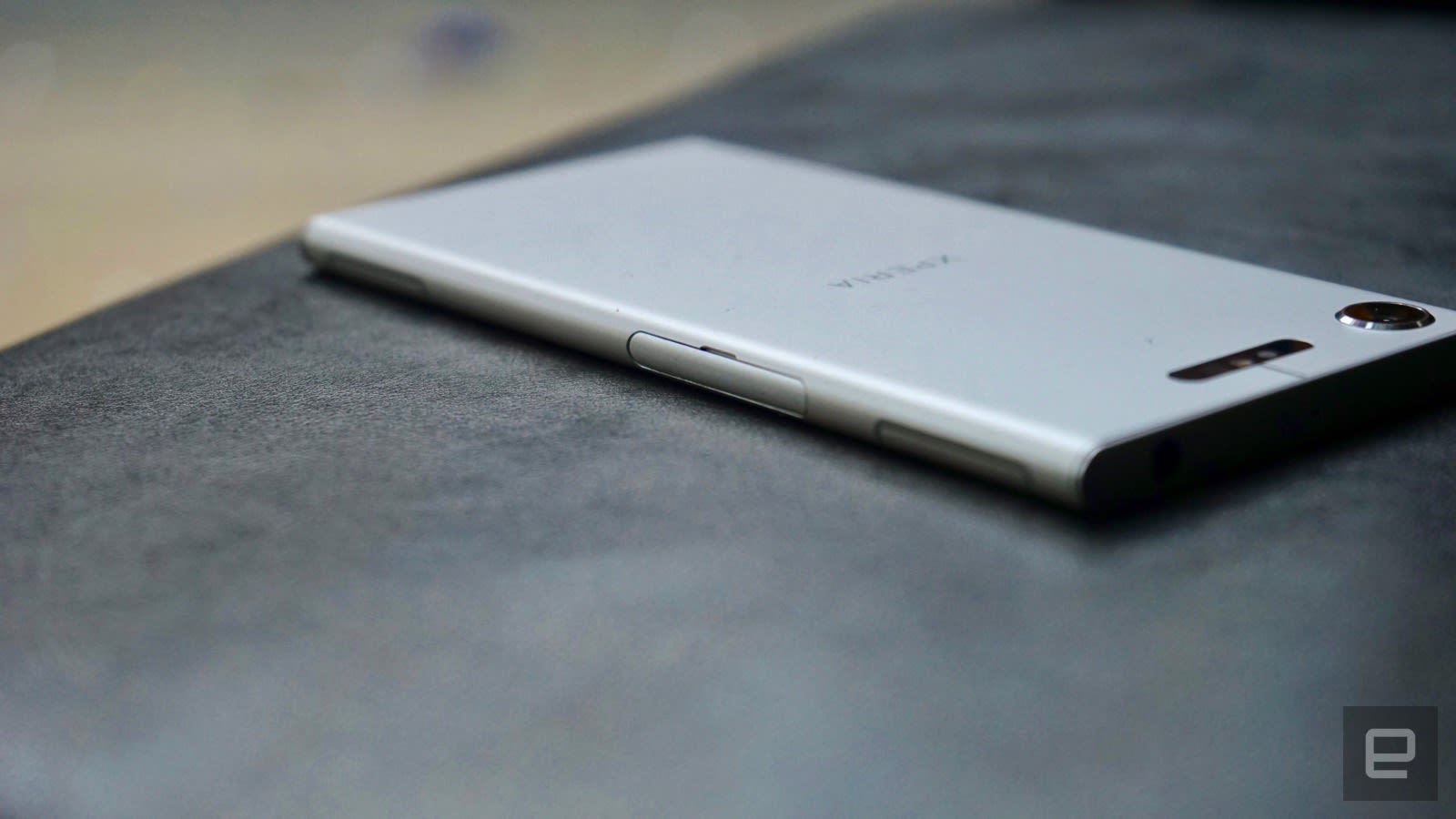
The XZ1 has the same Snapdragon 835 processor as the XZ Premium, so you can expect top-of-the-line performance and gigabit LTE speeds where (or when) they’re available. The new handset has a smaller 2,700mAh battery than the Premium’s 3,230mAh cell. Like you might expect from an Xperia, the XZ1 is rated IP68 for water and dust-resistance and sport distinctive a boxy all-metal design that Sony says helps with antenna performance.
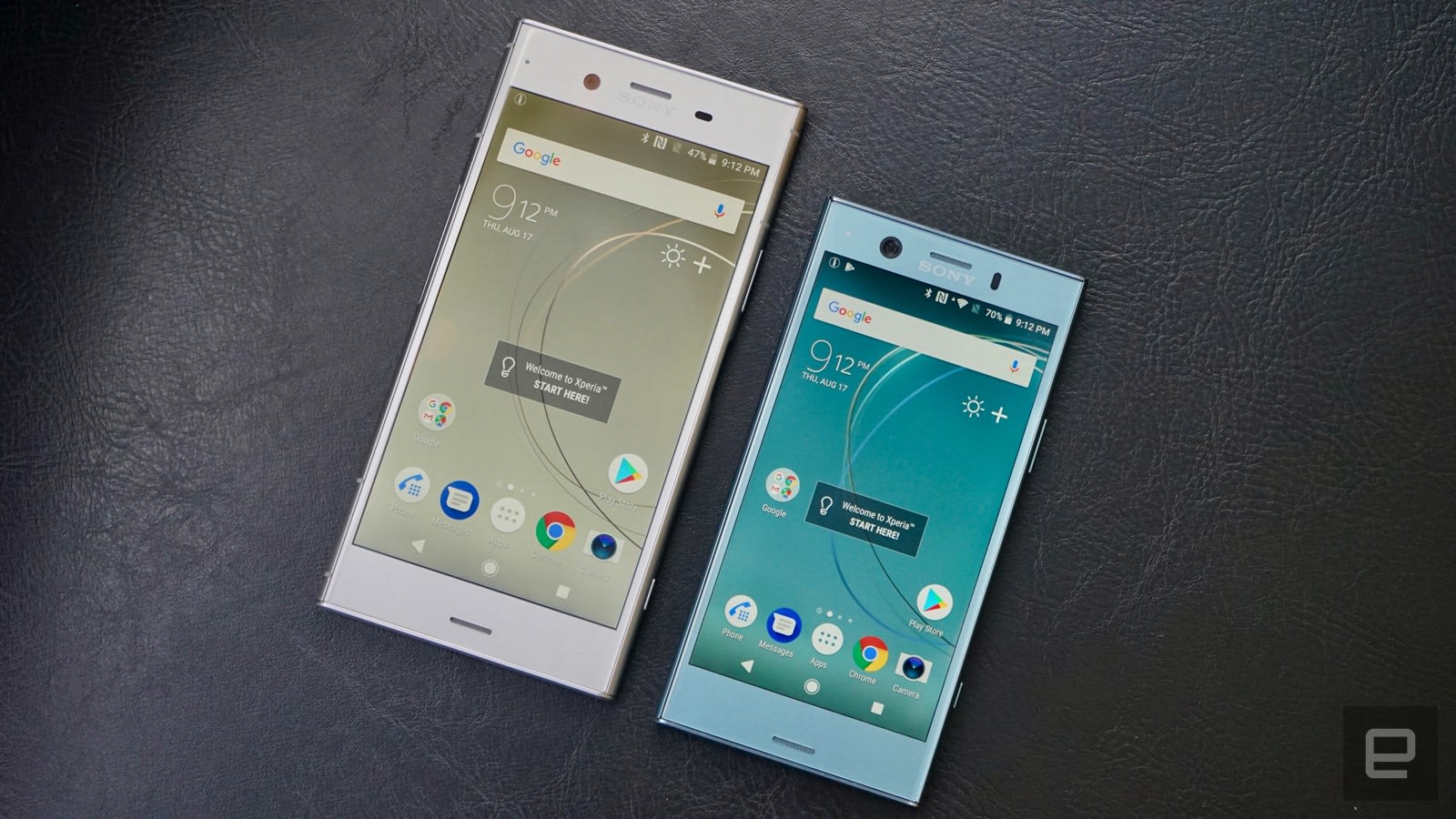
If you want a new Xperia but prefer either a smaller or larger screen, Sony also unveiled the XZ1 Compact and XA1 Plus. The former is a smaller, less-premium version of the XZ1 that will cost $600 when it arrives in October. The Compact has a non-HDR 4.6-inch screen, which is tiny by today’s standards. Some people may appreciate the smaller size, but its 720p resolution is ridiculously underwhelming for the price. The XZ1 Compact will also run Android Oreo when it ships, and sports an 8-megapixel front camera with a wide 120-degree field of view so you can take selfies that include more friends or surroundings. Otherwise, the Compact’s rear camera offers the same bells and whistles as the regular XZ1’s and is powered by the same CPU.
On the other hand, the XA1 Plus is a mid-tier phone that will cost a more-affordable $380 via Amazon when it retails in October. Sony most likely achieved that lower price because it opted for a less-popular MediaTek processor instead of a Qualcomm Snapdragon component. If you’re willing to take a chance on a less-known processor, you may find the XA1 Plus a good deal. Its 5.5-inch screen has a 1080p resolution, and its battery is a generous 3,430mAh. You’ll also get a sharper 23-MP rear camera, although it won’t have all the new features from the XZ line.
Ultimately, Sony’s new XZ1 phones suffer from a flaw that has plagued the company’s premium handsets for years: They are simply too expensive for what they offer. Sony seems to keep thinking it can command the higher prices that Samsung and Apple ask for their flagships. But Sony doesn’t have the smartphone clout and the vast legions of fans that Sammy and Apple do, and the Xperias, while respectable, aren’t quite as advanced as the latest Galaxies and iPhones. They don’t even have fingerprint sensors, which are by now so late they might as well not show up. The latest flagships either already have, or are expected to support, iris and voice authentication tools. Since I’ve only experienced a pre-production version of the XZ1, it’s possible the finished device that retails September 19 may feel refined and competent enough to justify its price. For now, though, I sincerely hope Sony rethinks the way it prices its products.
Follow all the latest news from IFA 2017 here!
Philips’ Hue lights will soon sync with movies, games and music
In the five years since Philips introduced its Hue range, it’s been joined by many other companies offering their own version of its smart lighting. To stay ahead of the competition, the electronics giant has focused on adding platform partners, while introducing new bulbs that appeal to every kind of homeowner. To celebrate its fifth birthday, Philips confirmed today that it will further extend the compatibility of its kit and allow owners to synchronize their lights with movies, video games and music.
The new feature will be called Hue Entertainment and works very similarly to Philips’ other entertainment lighting technology: Ambilight. Instead of utilizing just a multicolored strip of LED lights, Entertainment will link the company’s extensive range of bulbs with supported TVs, media players and consoles to match exactly what you’re seeing on the screen. The company will invite partners and leading entertainment brands to sign up to its early access program in October, ahead of a public launch in December.

The announcement doesn’t come as much of a surprise: the company has been trialing what it calls “surround sound for the eyes” for a number of years. In 2014, we were invited to test Syfy’s Sync app, which we are able to successfully pair with our Hue lights and add an extra dimension to cult classic Sharknado.
In addition to the launch of Entertainment, Philips will also enhance Hue’s Apple HomeKit compatibility in October. Accessories including Hue Tap, Hue Motion Sensor and wireless dimmer switch can be integrated into Apple’s smart home platform, allowing users to create additional app scenes inside their home. “When integrated with other smart home devices, you could even make your window blinds shut, thermostat turn to night temperature settings and lock the doors – ensuring the perfect sleep time set-up,” Philips says.
In terms of bulbs, there are a number of new additions here too. Buratto and Buckram spotlights have been added to the ambiance range, letting you “energize, concentrate, read or relax” in the bedroom or lounge. Felicity lamps are designed for the beside table, while the white ambiance Struana lamp is made for the bathroom, providing lighting for the application of make-up, shaving or a home spa.
Moving forward, Philips says it intends to keep supporting Zigbee’s lighting standard, allowing devices made by other manufacturers to interact with Hue kit. That means Zigbee 3.0 will be present in its new lighting products, scheduled to launch in the first quarter of 2018.
 AIVAnet