


Essential PH-1 review: A beautiful blank slate
Andy Rubin was disillusioned. He helped build the Android operating system. He watched as Google acquired the company, and he steered development on the mobile OS for years after that. And somewhere along the way, he grew a little weary of how the smartphone market worked.
To hear him tell it, the mobile industry prioritized iteration over innovation, to the point where it centered itself around only two companies: Apple and Samsung. Convinced that Apple’s premium phone business model would work for a startup, Rubin set about building his own phone, and here we are. That startup, Essential, offers its new PH-1 as a remedy to the industry’s ills. It’s a premium smartphone with an impeccable pedigree that embodies progress and choice and openness. That was the idea, anyway.
Here’s the thing about lofty goals though: You’re almost never going to achieve them in one shot. And really, that’s the Essential PH-1 in a nutshell. It’s an exceptionally crafted device and a stunning first effort from a company that didn’t exist 18 months ago. While the PH-1 stands as a testament to Rubin’s vision, a few shortcomings keep it from being as truly great as promised.
Hardware
Chris Velazco/Engadget
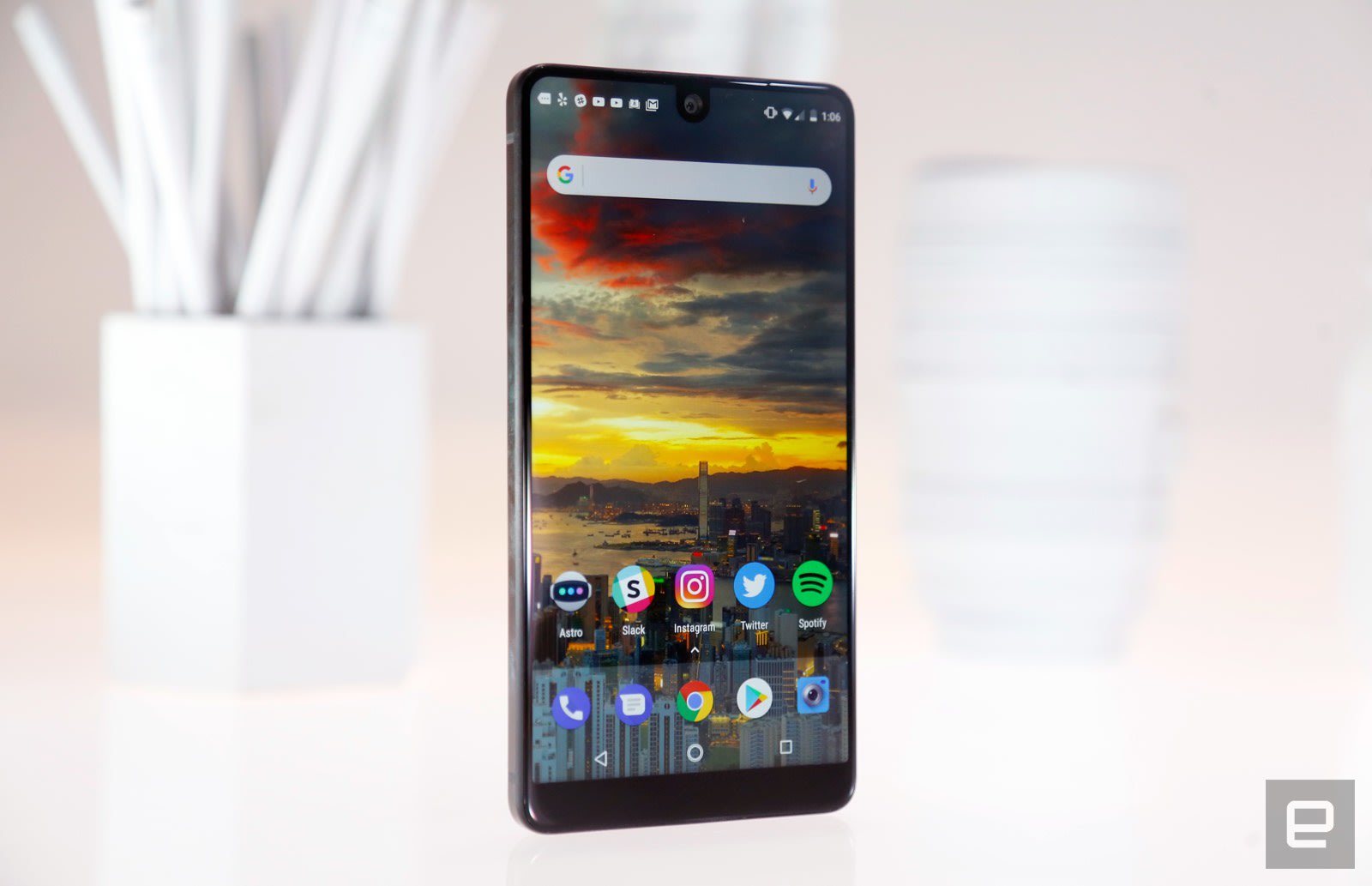
I’ve been testing the black PH-1 ($699), and it looks more like a blank slate than any phone I’ve tested in a while. There are no logos on the phone, no branding, no FCC labels or capacitive buttons (though the company’s engineers did consider them). Peer closely enough around the front-facing camera and you’ll spot a tiny cutout for the earpiece and an even tinier notification LED. Some will find the aesthetic a little too nondescript, but others (like me) will enjoy the intentional starkness. That minimalism gets disrupted when you turn the phone over. There you’ll find an LED flash, a 13-megapixel dual camera, a fingerprint sensor and two tiny, metallic spots.
This is Essential’s (much smaller) take on the Motorola’s Mod connector for its modular smartphone add-ons. Accessories, like a 360 camera I haven’t been able to test yet, magnetically attach to that spot and can transfer power and data into and out of the phone. It might seem a little awkward to snap things onto a phone’s corner, but Essential made the choice deliberately.
By putting the connector on a corner, the company is theoretically able to change the way future devices look without necessarily giving up the option of backward compatibility. Consider the most recent Moto Z phones: Motorola couldn’t change the design much because its Mods have to sit flush against the phone’s backs. Essential’s decision was a savvy one, but we’ll soon see how many companies are actually willing to invest in a startup’s ecosystem of accessories.
The PH-1 also feels dense, in a reassuring sort of way. Part of that is thanks to what the phone is made of. A polished titanium frame forms the PH-1’s skeleton, and its back is made of a shiny ceramic that has been pretty good at shrugging off scratches and dents. (It’s starting to show nicks now though.) I was worried that the PH-1 would exhibit Xiaomi Mi Mix levels of fragility, but so far, so good. The phone’s density is also due to how tightly packed all of its components are under that shiny surface. Jason Keats, Essential’s head of product architecture, said in an interview that there’s basically no extra space at all inside the chassis. Pending a glorious iFixit teardown, I’m inclined to believe him.
What’s inside the phone is a little more prosaic. Like just about every other flagship phone this year, the Essential uses one of Qualcomm’s Snapdragon 835 chipsets, paired with 4GB of RAM and an Adreno 540 GPU. More importantly, every Essential comes with 128GB of internal storage, which is crucial since there’s no microSD slot. That’s not the only notable omission here: There’s no headphone jack, just a USB-C port wedged in between a speaker and the SIM tray. There’s no water resistance here either, for reasons Essential has never entirely explained. These omissions certainly aren’t dealbreakers, but they’re still somewhat disappointing.
Display and sound

Chris Velazco/Engadget
While the phone’s design is intentionally subtle, that 5.7-inch Quad HD screen definitely isn’t. The PH-1’s defining feature is how its LCD display stretches almost completely across the phone’s face, leaving just a few millimeters of black chin beneath the panel. It’s stunning. When the screen is off, we’re left with an obsidian slab; when it’s on, it feels like something out of the future. Well, the near future, anyway. We’ve seen phones with expansive displays before, but there’s something sumptuous and thrilling about a phone that’s basically all screen. Arguably more impressive is how a divot has been cut out of the screen to accommodate the 8-megapixel front-facing camera. It sounds weird in theory, but since Android’s notification bar fills in from the sides, the camera never actually gets in the way.
Yes, it’s almost impossible at first not to gawk at the PH-1’s screen. The gap between the panel and the glass that covers it may as well not exist, so viewing angles are excellent. Colors are clean and vivid, though they lack the telltale punchiness of AMOLED screens (most likely due to cost). As technically impressive as it is, the screen does fall short in a few ways.

For one, I wish it were a little brighter: It’s perfectly readable in broad daylight, but phones like the Galaxy S8 and iPhone 7 are brighter and more clearly legible under the sun. It’s also a bummer to come across apps that don’t take full advantage of that extra screen space. The phone’s dialer, Chrome, Twitter, Spotify and more are all bounded on the top edge by a black bar, robbing you of the visual impact that comes with seeing, say, a Google map that stretches all the way across the phone. Unfortunately, this was the case with most of the apps I’ve tested this past week.
Other apps are prone to different issues. Spotify, for instance, has a lot of extra space below the notification bar, pushing all the actual content down a little more than expected. This issue has been less common, but it’s still mildly annoying whenever I come across it. Considering how niche the Essential phone is right now, it’s unclear when or if developers will update their apps to accommodate this eye-catching screen.

Meanwhile, the Essential’s single speaker mostly just gets the job done. It’s louder than I expected, but audio comes out sounding pretty thin and it’s easy to accidentally cover the grille with your finger when holding the phone sideways. If you spend most of your day listening to audiobooks, podcasts or music that doesn’t feature prominent bass, the speaker shouldn’t bother you much. As always, though, you’re better off using a pair of headphones, which in this case means having to rely on an included USB-C adapter. I had no issues with audio quality through the adapter, and its short, braided cable gave me hope that it would survive a long-term stay in the minefield that is my backpack. I was also a little concerned that such a small earpiece wouldn’t sound good, but it made for pleasant for voice calls; no one on the other end had any complaints about the audio quality either.
Software

And the “blank slate” theme continues. The PH-1 runs a clean, mostly untouched version of Android 7.1.1. I’ve said that about other phones before, most recently the Moto Z2 Force, but Essential takes cleanliness to a different level. I’ve only spotted a handful of changes here. For starters, the typical Android notification bar is thicker than usual, because it has to clear the camera sitting right in the middle of it. There’s also an option in the settings to discreetly send usage and diagnostic data back to Essential so the company can smooth out potential performance issues. Really, the biggest change to bare-bones Android is the inclusion of a custom camera app, which we’ll get to in a little bit.
The situation is a little different for Sprint customers: Upon activation, the My Sprint and Tidal apps are automatically installed. Considering how overzealous some carriers are when it comes to preloading apps to fulfill business agreements, Sprint’s minimal overreach feels downright refreshing. The rest is just Nougat as we all know it, and Essential has pledged to deliver Android updates to PH-1s in the wild for two years and security updates for three years.
Now, as much as I love stock Android, I have to wonder if it’s enough to whet the average consumer’s appetite for functionality. After all, there’s a reason Google offers more than just stock Android on its flagship Pixel phones: It’s all in the name of helping users more easily accomplish the things they want to do. I respect Essential’s devotion to openness and cleanliness, but there’s a way to deliver subtle, powerful changes without completely rewriting the playbook. In any case, I’m sure the decision to deliver one of the purest Android experiences out there won’t hurt the startup’s chances too much. If anything, it offers an extra dose of geek cachet.
Camera

Engadget
Like many of other top-tier smartphones, the Essential packs a dual-camera setup. Unlike a lot of other top-tier smartphones, however, the Essential blends one 13-megapixel color sensor with one 13-megapixel monochrome sensor, as opposed to, say, a wide-angle and telephoto camera. The idea is simple: When shooting normally, color information from one sensor is combined with the extra detail capture from the black-and-white camera to produce photos that embody the best of both worlds. When there’s good light to work with, the results are decently impressive: Colors are a bit more subdued than with rival cameras but still quite nice, and there’s a decent amount of detail to be found. Overall, devices like the Galaxy S8 and last year’s Google Pixels did a better job, but the Essential was never too far behind.


Now, here’s where things get a little tricky. Since I received the phone last week, Essential has pushed out two — two! — updates, both heavily focused on improving the camera. Before any of the updates went live, the PH-1 was frankly awful in low light; you’d find lots of fuzzy edges and an unreasonable amount of grain and discoloration, even when shooting in locales that weren’t that dim. After multiple updates, the performance has leveled off to the point where the Essential is mostly usable in low light (though it helps to keep your expectations low).
Since there’s no image stabilization here, you should still expect to see lots of indistinct edges in the dark, but better image processing has reduced the grain you’ll see to manageable levels. Compared to before, this is a huge improvement. Compared to the rest of this year’s flagship smartphones, the Essential phone’s camera still disappoints. The 8 megapixel front-facing camera works well — at least, most of my selfies were nicely exposed with accurate colors.
No matter which camera you’re using, shooting with the Essential is dead simple. You can shoot a normal photo in auto mode. You can shoot a black-and-white photo with Mono mode. You can shoot a (pretty ugly) slow-motion video. You can take a selfie, and you can record a video. That’s it. While other smartphone cameras pack loads of features and multiple camera modes, the Essential’s camera experience is among the most bare bones I’ve ever seen. For some people, that will be fine: There’s nothing wrong with pointing and shooting. Anyone looking for more nuance and control should look elsewhere. All you can do here is toggle the flash and HDR modes, set a timer, and change the quality of the video you want to shoot.
This wouldn’t be an issue if the Essential took better photos from the get-go, but here we are. I should also point out that, while improved, there’s still some lag when switching between the color and monochrome cameras, and I’ve taken one or two photos over the course of the week that appear to have never been saved to my camera roll. In both cases, I launched the camera by double-tapping the home button, but I still can’t figure out what happened to them.
Performance and battery life

As already mentioned, the Essential PH-1 packs an octa-core Snapdragon 835, 4GB of RAM and a dearth of obnoxious add-on software. Is it any surprise that it runs incredibly smoothly? General navigation feels pleasantly fast — as fast as the Pixels and the S8s, anyway — and frenzied multitasking proved to be no problem either. Visually intense games like Afterpulse ran with no problems as well; frame rates were consistently high, and lag essentially didn’t exist. Impressive, certainly, but maybe not a surprise: This consistently high level of performance is table stakes for a modern, $700 smartphone. Said differently, something would have been very wrong if Essential hadn’t been able to deliver.
If the phone’s performance wasn’t surprising, its battery life certainly was. The phone seemed to struggle getting through our first full workday together, but that was just a peculiar one-off. After that first day, I’ve been able to use the PH-1 for a full day without the need for a recharge. After nights when I forgot to charge it, I still had between 20 and 25 percent at my disposal — that was more than enough to keep me entertained during my morning commute to the office. You can expect more battery drain in areas where cell coverage isn’t great, a problem I’ve run into with Sprint more than other carriers. In places where the phone had trouble locking on to a signal, the battery barely lasted for a day. Long story short, most people will be pleased with the phone’s power consumption, but folks living out in the country may experience a little more trouble.
The competition

Essential has made more progress than most in eliminating bezels from phone bodies, but it’s definitely not alone. Samsung’s Galaxy S8 and S8 Plus remain two of the best smartphones out there, and they pair skimpy bezels with lots of horsepower and some truly excellent displays. Their aesthetics couldn’t be any more different than the Essential’s, but Samsung’s design work has been impeccable: While the PH-1 feels dense and masculine, the S8s feel friendlier and more welcoming. This is obviously a matter of taste, but unless you absolutely insist on pure Android, you can’t go wrong with either of these options.
LG’s G6 is another notable competitor, if only because it takes the exact opposite approach to dual cameras as the Essential. It’s not perfect, but the combination of normal and wide-angle 13-megapixel cameras seems infinitely more useful — not to mention more fun — than Essential’s implementation. Beyond that, the G6 brings slightly more modest levels of performance and battery life, but some will find the trade-off worth it just to have a more flexible camera.
Wrap-up

I had such high hopes for the Essential phone that there’s almost no way the PH-1 could have lived up to them. This isn’t just a reflection of my own unreasonable internal hype though; as truly impressive as the PH-1 can be, it lags behind the competition in some areas. That’s the difficult part about offering people a blank slate of a smartphone. Sure, it can assume whatever role the user wants it to. Since it doesn’t offer many flashy features of its own, though, the phone has to get all the basics right. In its current state, the PH-1 doesn’t.
Still, it’s heartening to see Essential build a phone that otherwise gets so much right on its first attempt. Andy Rubin seems to hold the usual conventions of smartphone making in contempt, so who knows when we’ll see another Essential phone. That’s too bad. After such an impressive first outing, I honestly can’t wait to see his team try again.
Apple’s Iowa data center could make Siri better in the US
Apple has been building data centers powered by renewable energy across the US for some time, now, with facilities in North Carolina, Arizona and Reno. The tech company plans to build it’s latest data center — a 400,000 square foot facitlity — in Waukee, Iowa by 2020. Construction should begin early next year with the resulting center aimed at supporting users of Apple’s online services in North America. “Our new data center in Iowa will help serve millions of people across North America who use Siri, iMessage, Apple Music and other Apple services — all powered by renewable energy,” said Apple CEO Tim Cook in a statement.
Apple says that the center will add 550 construction and operations jobs in the Des Moines area. The company will also contribute up to $100 million to a new Public Improvement Fund for parks, libraries, recreational spaces and infrastructure in Waukee. The city already has plans to build a youth sports center, which includes a greenhouse, playground, fishing pier and sports fields, with the funding.
“We’re honored Apple is choosing Iowa for the site of its most technologically advanced data center to date,” said Iowa Governor Kim Reynolds in a statement. “Apple’s commitment to innovation and renewable energy leadership mirrors our own. This investment in our state is vital as we continue to develop as a technology hub and grow our workforce.”
Source: Apple
Amazon’s acquistion of Whole Foods will make some groceries cheaper
Amazon announced today that its acquisition of Whole Foods will close on Monday August 28th and the finalized deal will come with a few perks to both the grocery chain’s and Amazon’s customers.
First, starting on Monday, prices on a slew of Whole Foods items will drop. Products that will see a price cut include Whole Trade bananas, organic avocados, organic large brown eggs, organic responsibly-farmed salmon and tilapia, organic baby kale and baby lettuce, animal-welfare-rated 85% lean ground beef, creamy and crunchy almond butter, organic Gala and Fuji apples, organic rotisserie chicken and 365 Everyday Value organic butter. And additional items will continue to be discounted in the future.
Further, once the two companies are more thoroughly integrated, Amazon Prime will become the Whole Foods customer rewards program and Prime members will get added discounts and other benefits. Additionally, products under Whole Foods brand labels, such as 365 Everyday Value, will be available for purchase through Amazon.com, AmazonFresh, Prime Pantry and Prime Now. And Amazon will further blend the two markets by introducing lockers at select Whole Foods stores to which customers can ship Amazon.com purchases. They’ll also be able to return Amazon purchases at Whole Foods stores.
“We’re determined to make healthy and organic food affordable for everyone. Everybody should be able to eat Whole Foods Market quality – we will lower prices without compromising Whole Foods Market’s long-held commitment to the highest standards,” Jeff Wilke, CEO of Amazon Worldwide Consumer, said in a statement. “There is significant work and opportunity ahead, and we’re thrilled to get started.”
Source: Amazon
‘Assassin’s Creed’ is crossing over with ‘Final Fantasy’
So this is weird: Square Enix and Ubisoft have announced that this month will mark the beginning of crossovers between Assassin’s Creed and Final Fantasy. Yup, really. “This collaboration is the result of being huge fans,” Ubisoft Montreal game driector Ashraf Ismail says on the UbiBlog. “There’s a lot of respect between the two teams and we couldn’t be more thrilled with the opportunity to pay homage to each other’s work.”
The first part of this will launch August 30th. If you’ve snatched the Moogle egg from the Chocobo Carnival in Final Fantasy XV, you’ll be gifted an Assassin outfit for Noctis. A day later, Square Enix will release a free add-on pack called “Assassin’s Festival” for the latest entry in its long-running role-playing series. In addition to cosmetic changes to the town of Lestallum, the DLC adds “abilities that enable Noctis to explore more like an Assassin and even use some of the Assassins’ more well-known abilities.”
Presumably those feats include jumping from ledges and ramming a wrist-mounted dagger through the spinal cord of your enemies. Need proof? Look no further than the screenshot up above.

The partnership has been going on, unofficially, for a bit. For example, in 2011 Final Fantasy XIII-2 had unlockable costumes from the best Assassin’s Creed protagonist, Ezio Auditore da Firenze. UbiBlog also mentions that there were hints of the partnership in the new Gamescom trailer for Assassin’s Creed: Origins, its announcement trailer and a promo clip for last year’s Final Fantasy XV. Are there more than that? You tell us.
2006 me: man I wonder how Versus will look like when it’s done
2017 me: *sends this GIF back in time with no comment* pic.twitter.com/lHtn2MS4TW
— Nibel (@Nibellion) August 24, 2017
Follow all the latest news live from Gamescom here!
Source: UbiBlog
Netflix snags ‘Def Comedy Jam’ 25th anniversary special
Netflix is adding to its growing comedy slate with a 25th anniversary special honoring Def Comedy Jam. The lineup will include Dave Chappelle, Kevin Hart, Tracy Morgan and Katt Williams.
Def Comedy Jam ran on HBO from 1992 to 1996 and a was revived for two years in 2006. An HBO reboot is also currently in the works that would rebrand the series as All Def Comedy. It’s slated to premiere in November.
Netflix has been stacking its schedule with high-profile comedy specials lately. It has two Chris Rock, three Dave Chappelle and two Jerry Seinfeld specials in its lineup. It also appears to have an Ellen DeGeneres special in the works.
The show will be produced by Russell Simmons — who also produced the original and the upcoming reboot — alongside Stan Lathan, Sandy Wernick and Jesse Collins. Other performers for the anniversary special include Cedric the Entertainer, Mike Epps, Eddie Griffin, Steve Harvey, D.L. Hughley, Craig Robinson, Sommore, JB Smoove and Sheryl Underwood. It’s slated to debut this fall.
Source: Netflix
AI recycle bins could know what you’re throwing away
Is that coffee cup recyclable or compostable? It can be tough to tell, for sure, but a new recycling system from Cambridge Consultants aims to help using image recognition and machine learning. With low recycle rates in the US and UK, possibly due to consumer confusion over what’s possible to recycle, this new retail-focused recycle point could help us all know what to recycle and what to trash. The company envisions a future where you’ll even be rewarded via a phone app with points or a donation to charity when you recycle this way.
When you scan an object at one of these new bins, it should be able to recognize the type of waste deposited and tell you which section to place your item into. It can even learn new materials and products over time, thanks to the included AI. There’s no detail on when you’ll start seeing recycling centers like this, however. We’ve reached out to the company for more information and will update when we hear back.
There have been home recycling units with a scanner on them before, but this is the first recycling system we’ve seen that focuses on retail and commercial uses. The idea here is for consumer brands (think Coca Cola or Pepsi) or food outlets to sponsor a “smarter” recycling point to both reinforce a brand’s customer engagement as well as keeping more recyclables from the landfill. “Consumer brands are coming under increasing pressure from the government, lobby groups and consumers like you and me, to take responsibility for the end-of-life of their products.” Cambridge Consultant’s Sajith Wimalaratne said in a statement. “The smarter recycling system gives a brand a real reason to be in contact with the consumer while showing a commitment to make a positive impact.”
Source: Cambridge Consultants
Spotify’s deal with Warner Music clears path to going public
Spotify just signed a deal with Warner Music to secure its artists for the streaming service’s users worldwide. This is the last big label after Universal Music Group, Merlin and Sony to renew ties with Spotify, and now pretty much everyone’s on board.
Spotify didn’t provide any details on the Warner deal, which has been rumored to be in the works since last month. The streaming company didn’t note whether Warner’s music would be subject to the same conditions as in the deals Spotify struck with other labels — namely, whether new records would be held off the service’s non-paying tier for two weeks after launch, a limit that first surfaced in its agreement with Universal back in April.
“Our partnership with Warner Music Group will help grow the new music economy where millions of artists can instantly connect with fans, and millions of fans can instantly connect with artists,” said Stefan Blom, Chief Content Officer at Spotify.
Regardless, securing Warner means Spotify has arranged for music from every major label, which is good news ahead of the streaming titan’s heavily-rumored plans to go public at some point in the future.
Source: Warner Music Group
Apple Confirms Plans to Build Data Center in Iowa, Contribute Up to $100M to Community Projects
Apple today announced plans to build a 400,000-square-foot data center in Waukee, Iowa, which will provide backend infrastructure for the App Store, Siri, Apple Music, iMessage, and other Apple services in North America.
Apple is investing $1.3 billion into the facility, which it says will create over 550 construction and operations jobs in the Des Moines area.
“Apple is responsible for 2 million jobs in all 50 states and we’re proud today’s investment will add to the more than 10,000 jobs we already support across Iowa, providing even more economic opportunity for the community,” said Tim Cook, Apple’s CEO.
Apple also said it will contribute up to $100 million to a newly created Public Improvement Fund dedicated to community development and infrastructure around Waukee. The fund, to be established and managed by the City of Waukee, will support the development of community projects like parks, libraries and recreational spaces, as well as infrastructure needs.
“We’re honored Apple is choosing Iowa for the site of its most technologically advanced data center to date,” said Iowa Governor Kim Reynolds. “Apple’s commitment to innovation and renewable energy leadership mirrors our own. This investment in our state is vital as we continue to develop as a technology hub and grow our workforce.”
As part of its pledge to power all of its global operations with 100 percent renewable energy, Apple said the data center will run entirely on renewable energy from day one. Apple noted it will be working with local partners to invest in renewable energy projects from wind and other sources to power the facility.

Apple said construction on the data center is expected to start early next year, with plans to bring it online in 2020.
Iowa’s Economic Development Authority reportedly approved a deal on Thursday that will give Apple $208 million in state and local tax breaks to construct two data centers near Des Moines. Apple will reportedly buy 2,000 acres of land for the project, allowing for future development in the area.
Apple’s plans to open the facility were first reported by The Des Moines Register on Wednesday. Apple CEO Tim Cook is in Des Moines today for a meeting related to the data center, Iowa state officials confirmed.
Apple already operates several data centers around the world. In the United States, it has facilities located in Reno, Nevada; Prineville, Oregon; Maiden, North Carolina; Newark, California; and Mesa, Arizona.
Tag: data center
Discuss this article in our forums
Apple to Debut Apple TV With 4K HDR Support at September Event
Apple will introduce a fifth-generation Apple TV with 4K video support at an event planned for September, reports Bloomberg. The device is said to feature a faster processor to support 4K streaming, which is twice the resolution of the 1080p streaming supported on the current fourth-generation Apple TV.
In addition to 4K support, which will only be available on a 4K television, the new set-top box will support High Dynamic Range (HDR) video for brighter, more accurate colors.
Apple is also said to be testing a new version of its TV app that is designed to better highlight live TV content, aggregating live shows from apps that offer live streaming, and it is establishing deals with content makers to provide 4K video.
In order to play 4K and HDR content, Apple will need deals with content makers that can provide video in those formats. The Cupertino, California-based technology giant has begun discussions with movie studios about supplying 4K versions of movies via iTunes, according to people familiar with the talks. The company has also discussed its 4K video ambitions with content companies that already have apps on Apple TV, another person said.
We’ve known Apple has had a new Apple TV with 4K support in the works for some time, and while there were hints that a launch was imminent, there was no confirmation that the device would be introduced in September prior to today.
The Apple TV was last updated in October of 2015, which is when the redesigned fourth-generation set-top box with Siri Remote and a full App Store was introduced.
Along with a new 4K Apple TV, we’re also expecting to see a third-generation Apple Watch with LTE support and three new iPhones, including a radically redesigned 5.8-inch iPhone with an OLED display and facial recognition at Apple’s September event.
Related Roundups: Apple TV, tvOS 10
Tag: bloomberg.com
Buyer’s Guide: Apple TV (Don’t Buy)
Discuss this article in our forums
Solar Squared building blocks could be the next architectural trend
Why it matters to you
If you’re interested in solar power, but not a solar roof, Solar Squared and its glass building blocks may be able to help.
There’s a new trend in home design, and it’s good for your pocketbook. At least, it ought to be in the long term. Solar energy is already being integrated into homes by way of solar panels, roofs, and more, and now, researchers from the University of Exeter’s College of Engineering, Mathematics, and Physical Science have yet another application for the renewable energy source — building blocks called Solar Squared.
Dubbed Solar Squared, these blocks are heralded as a “clean energy solution for buildings that could revolutionize the construction industry.” The idea is to integrate solar technology directly into these glass blocks, which will not only allow light into your home, but generate energy at the same time. Moreover, researchers say that their new invention could provide improved thermal insulation.
“Buildings consume more than forty percent of the electricity produced across the globe,” said Dr. Hasan Baig, who is based at the Environment and Sustainability Institute in Cornwall. “Deployment of standard solar technology is limited by the large area requirement and the negative visual impact. We wanted to overcome these limitations by introducing technologies that become a part of the building’s envelope. We now have the capability to build integrated, affordable, efficient, and attractive solar technologies as part of the building’s architecture, in places where energy demand is highest, whilst having minimal impact on the landscape and on quality of life.”
According to the Exeter team, Solar Squared’s design allows it to capture a significant quantity of the diffuse components of sunlight, even when the blocks are set in a vertical pattern. This, the researchers say, makes the building blocks particularly well-suited to capture solar energy in cities. And thanks to the modular aspect of Solar Squared, they can be easily scaled and embedded in traditional construction materials.
“Given that we have the know-how of the latest developments in solar, it’s simply about getting the right marriage between the product and the technology,” says Dr Baig. “We can tailor it to fit any product, working with the current manufacturing process rather than demanding a change to that process. In this way, we can slot into established manufacturing chains and product markets.”
Ultimately, the group hopes that its Solar Squared blocks will be cheaper than conventional glass blocks. The team is currently looking into further tests and investors who want to see these solar blocks on houses throughout the world.
 AIVAnet