


Semi-autonomous truck convoys due to hit UK roads next year
Convoys of semi-autonomous trucks are expected to be tested on public roads in the UK before the end of next year, the government announced today. The Department for Transport and Highways England have rustled up £8.1 million in funding between them to pass on to the Transport Research Laboratory (TRL), the independent organisation that’ll conduct the trials. TRL will start with simulation studies and driver training before moving onto a test track and finally, public roads by the end of 2018.
Platooning, as it’s known, is one of the simpler ways of harnessing self-driving technology. While the truck at the front of a convoy remains under human control, trailing vehicles follow its lead autonomously. Wireless connections (aka vehicle-to-vehicle communication) keep all trucks talking to each other so the self-driving members of the conga line can immediately respond to changes in the lead lorry’s direction and speed.
With software managing the distance between vehicles, it should be possible to create a much tighter convoy than would be safe if human limbs were in charge of the wheel and pedals. This has the potential to ease congestion, but more importantly reduces drag on the trailing trucks, meaning better fuel efficiency and lower emissions.
TRL has already done some preliminary feasibility studies on the government’s instruction. In fact, platooning trials on UK motorways were originally due to start in late 2016, but the project has been delayed for one reason or another. At the time, the Financial Times reported that various manufacturers of heavy goods vehicles were just not particularly keen on taking part.
Several real-world trials of semi-autonomous convoys are taking place elsewhere, and TRL is looking at how these are addressing the technical and practical challenges of public platooning tests. There’s no substitute for conducting your own in situ, though, which is why TRL will investigate everything from fuel efficiency to safety, acceptance by drivers and the public, the suitability of UK infrastructure and future, commercial viability.
Not everyone is convinced the UK is the best place for platooning trials, however, with the AA and RAC Foundation already voicing concerns. AA president Edmund King told the BBC: “We all want to promote fuel efficiency and reduce congestion but we are not yet convinced that lorry platooning on UK motorways is the way to go about it. We have some of the busiest motorways in Europe with many more exits and entries. Platooning may work on the miles of deserted freeways in Arizona or Nevada but this is not America.”
Source: Department for Transport
‘Humans of New York’ is getting its own Facebook TV show
Facebook is steadily rolling out its new Watch section for original shows on desktop and mobile. But, what good is a new video platform without a stocked lineup of programming? To give you more options, the social network is ordering a new, 12-episode docuseries from the creator of the Humans of New York photoblog.
Brandon Stanton’s project started out in 2010, and went on to become a viral sensation, amassing over 18 million page likes on Facebook alone. Aside from interviewing 10,000 New Yorkers, it also took the photographer around the world, and became the subject of two bestselling books.
For the new docuseries, Stanton will return to the streets of New York, where the blog began. In a Facebook post, he claims he’s amassed an archive of 1200 filmed interviews, shot over the past four years. “Instead of posting these videos one day at a time, I held onto them so that one day I could combine them into something special,” he writes. Viewers can expect to see more candid interviews with city dwellers who have a personal story to tell. Only this time round, Stanton is working with some notable collaborators, including Oscar nominated exec producer Julie Goldman (known for producing Weiner, and Life, Animated).
The show arrives on Facebook next week, and new episodes will be released weekly, according to The Hollywood Reporter. The docuseries will join Mike Rowe’s Returning the Favour and MLB’s Game of the Week livestream on the newly-launched Watch tab.
Source: Humans of New York (Facebook)
‘iPhone 8’ Could Start at $999 for 64GB Capacity
Multiple rumors have suggested the upcoming “iPhone 8” could be the most expensive that Apple has ever released, with several analysts calling it a “premium” device costing upwards of $1,000. While not exactly contradicting those rumors, a report out this week indicates Apple’s OLED iPhone line-up may in fact start at a fraction below that figure.
In a column for The New York Times, Brian X Chen quotes anonymous sources who reveal that among Apple’s refreshed iPhones next month will be a “premium model” priced “at around $999”.
Chief among the changes for the new iPhones: refreshed versions, including a premium model priced at around $999, according to people briefed on the product, who asked to remain anonymous because they were not authorized to speak publicly. Apple made room for a bigger screen on that model by reducing the size of the bezel — or the forehead and the chin — on the face of the device. Other new features include facial recognition for unlocking the device, along with the ability to charge it with magnetic induction, the people said.
Daring Fireball’s John Gruber believes Chen’s source indicates the iPhone 8 will indeed start at $999, with a higher storage capacity model at $1099 and maybe another at $1199. Based on alleged leaks earlier this week, these price points could correspond with 64GB, 256GB, and 512GB, respectively.
One other possible scenario previously suggested by Goldman Sachs analyst Simona Jankowski is that the iPhone 8 will be available in 128GB and 256GB capacities, for $999 and $1,099, respectively (the 256GB iPhone 7 Plus already sells for $969). It’s unclear how these prices will reflect in other countries, in particular the U.K., where many Apple products now mirror dollar prices in pound sterling.
Factors like the OLED display, inductive wireless charging, new biometric features, and camera improvements – including a 3D sensing capability – are believed to have driven up the price, but Apple is also thought to be pitching the OLED iPhone as either a luxury item or a “pro” level device, or perhaps a mixture of both.
Reliable KGI Securities analyst Ming-Chi Kuo believes the OLED iPhone will cost in excess of $1,000, as does an inside source that spoke to Fast Company, so nothing is confirmed yet. Apple is expected to send out media invites next week to its September iPhone launch event, which could fall on September 12, according to the most recent rumors.
Related Roundup: iPhone 8
Discuss this article in our forums
Apple’s ‘App Development with Swift’ Curriculum Expanding to Dozens of Community Colleges
Apple today announced that its App Development with Swift curriculum will now be offered in more than 30 leading community college systems across the United States in the 2017-2018 school year.
The full-year course, available for free on the iBooks store, teaches students how to build apps using Apple’s open source programming language Swift. Apple says the course takes students with no programming experience and enables them to build fully-functional apps of their own design.
“We’ve seen firsthand how Apple’s app ecosystem has transformed the global economy, creating entire new industries and supporting millions of jobs,” said Tim Cook, Apple’s CEO. “We believe passionately that same opportunity should be extended to everyone, and community colleges have a powerful reach into communities where education becomes the great equalizer.”
The community college systems adopting the App Development with Swift curriculum in the fall include Austin Community College District, Northeast Mississippi Community College, Northwest Kansas Technical College, and additional campuses in the Alabama Community College System.
“We’re thrilled to have Apple join our mission to make Austin more affordable for people who already live in the city,” said Austin Mayor Steve Adler. “Apple is going to be a force multiplier in the community’s ongoing efforts to lift 10,000 out of poverty and into good jobs over the next five years.”
Austin town mayor Steve Adler said Apple CEO Tim Cook is in Austin today. While there, it’s possible Cook may have other announcements on his agenda.
Tags: Swift, Tim Cook, App Development with Swift
Discuss this article in our forums
Google expands its offline YouTube Go app to Indonesia
Google is rolling out a flurry of products in Indonesia. Chief among the new additions are YouTube Go and Google Assistant. The announcements (made at its second annual Google for Indonesia event) tie into the web giant’s plan to get its apps to the “next billion” internet users. Until now, this strategy has mainly focused on India. But, it seemed inevitable that Google would expand its reach to more emerging (mobile-first) countries.
To refresh your memory, the beta version of YouTube Go launched in India in April. It essentially adds some clever compression tech to Google’s popular service, making it easier to watch videos with poor connectivity. Users can save videos to watch offline, check the data demands for clips, and even share them over Bluetooth.
Google Assistant is also receiving a bunch of country-centric updates for Indonesia, via the Allo chat app. Users can now ask questions and get answers from the virtual assistant in Bahasa Indonesia. Similarly, the country will also be one of the first to get locally-tailored answers to questions about health on Google Search. These too will be in Bahasa. Additional features include tappable shortcuts on the Search mobile app, for topics like food and drink, movie showtimes, and directions.

Waze is getting a few nifty updates too. The app is adding a new routing feature, hands-free Bahasa voice commands, and navigation with street names. Users will also be able to record and use their own voice for directions. Oddly, there was no mention of Android Go: A special configuration of Android Oreo, designed to run on low-end smartphones. The OS highlights Google’s apps aimed at bilingual users in underserved markets.
To ensure all these services won’t go ignored, Google is committing to bolster Indonesia’s online infrastructure. The Google Station initiative will work with local ISPs to install hundreds of Wi-FI hotspots in Java and Bali. Google also took the event to announce a number of training and humanitarian programs. You can get the low-down on all its updates via its blog.
Source: Google (blog)
Samsung leader found guilty of bribery and embezzlement
Samsung will have to operate without its acting leader for a few years, now that a South Korean court has found Lee Jae-yong guilty of bribery and embezzlement. The executive has been sentenced to five years in prison, much shorter than the 12 years he was facing. According to The New York Times, though, that’s long enough to be considered a heavy penalty for a country that’s used to doling out light sentences to major business figures.
Also known as Jay Y. Lee, the executive is technically the “chaebol’s” Vice Chairman, but he’s been running the company for a few years now after his father suffered a heart attack. Lee was arrested earlier this year after Samsung’s involvement in President Park Geun-hye’s scandals came to light. Apparently, he bribed four foundations built to support the former presidents political initiatives with a total of $38, effectively ensuring the regulatory approval needed to merge two Samsung-controlled companies. A lot of shareholders were opposed to the $8 billion merger, but it passed without issues due to the government’s backing. It’s worth noting that the Samsung conglomerate is involved not just in electronics, but also in shipping, medicine and many other industries.
The court said prosecution presented enough evidence to prove that the Samsung chief bribed the government to gain its support for the controversial merger. Further, the move expanded his power over Samsung Electronics, the division in charge of its phones, TVs and other devices, which is considered the chaebol’s top earner. Samsung has been doing quite well globally and frequently tops the list for smartphone shipments worldwide. It’ll be interesting to see how it does in the next few years, considering it credits Lee with providing its long-term strategic vision.
Source: The New York Times
CIA uses a secret tool to spy on NSA, FBI and other intel partners
Apparently, nobody’s exempt from the CIA’s intelligence gathering, not even its own intelligence partners. According to a set of documents published by WikiLeaks, the CIA uses a tool called “ExpressLane” that hides behind a fake software update to collect information from agencies around the world that use its biometric collection system. In the US, the list includes fellow government agencies like the FBI, the NSA and Homeland Security. These partners are supposed to share data with the CIA, but clearly, the intelligence service wants to make sure they’re not keeping anything from the agency.
Based on the info written in the documents, the CIA pre-installed ExpressLane in the systems of newer partners. For older ones, it gets installed by an agent personally visiting a partner site under the guise of installing a software update. ExpressLane disguises itself as a harmless exe file in Windows’ System 32 folder, but it actually collects files of interest. When an agent inserts a thumb drive to run the fake software update, ExpressLane automatically uploads the compressed and encrypted files it gathered.
That thumb drive will also install a “kill date” that disrupts the system by a certain date, forcing the partner to call the CIA for service. This tactic guarantees agents can collect data even if a partner refuses the shady software update. It’s unclear what the CIA plans to do with all that biometric data — it could be using them for a secret operation, but it could also be collecting them for no particular reason. Either way, the more info it gathers, the more powerful it becomes, so it’s not really surprising for the agency to ensure that nobody can keep secrets from it.
Via: The Verge
Source: WikiLeaks
Samsung Galaxy J7 Pro review: Finally on the right path
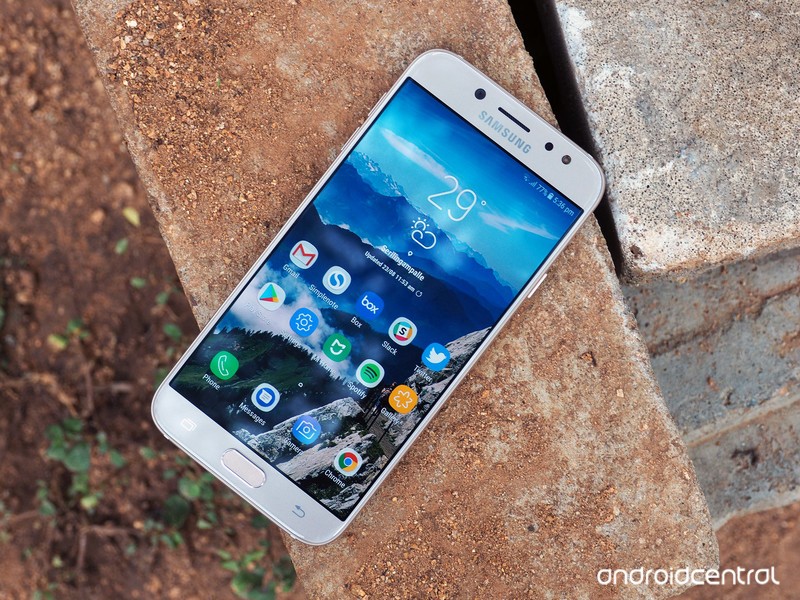
Sleek design and Samsung Pay integration make the J7 Pro the company’s best showing yet in the Galaxy J series.
Samsung has a long history of reusing components in its budget devices. It has done so to varying amounts of success in the past, and we’ve seen several models in the Galaxy J series running horribly outdated hardware. The Galaxy J lineup is now in its third generation, and Samsung is finally taking steps to address the issue.
Although the Galaxy J7 Pro is powered by the Exynos 7870 Octa —which made its debut in last year’s J7 2016 — the company has rolled out updates in other areas — the phone has a 1080p panel, an all-new metallic chassis, 64GB of internal storage, Samsung Experience 8.1 UX based on Nougat, and Samsung Pay integration. The last point is crucial, as the J7 Pro is the first mid-range phone from Samsung to offer its digital payments service.
But is that enough to make the J7 Pro relevant in a segment that features the likes of the Redmi Note 4 and the Moto G5 Plus? Let’s find out.
About this review
I (Harish Jonnalagadda) am writing this review after using the Galaxy J7 Pro for two weeks in Hyderabad, India on Jio’s 4G network. The phone was on the J730GMDXU1AQF9 build and the June 1, 2017 security patch, and didn’t pick up any updates over the two weeks. The unit was provided to Android Central for review by Samsung India.
Specs
| Operating System | Samsung Experience 8.1Android 7.0 Nougat |
| Display | 5.5-inch Super AMOLED, 1920×1080 (401 ppi)AOD |
| Chipset | Exynos 7870 OctaOcta-core 1.60GHzCortex A53 cores |
| GPU | Mali-T830MP2 |
| RAM | 3GB |
| Storage | 64GB |
| Expandable | YesUp to 128GB |
| Battery | 3600mAh |
| Charging | Micro-USB |
| Water resistance | IP54 |
| Rear Camera | 13MP, f/1.7, LED flash |
| Front Shooter | 13MP, f/1.9, LED flash |
| Connectivity | Wi-Fi ac, 4G with VoLTE, Bluetooth 4.1, NFC, |
| Security | One-touch fingerprint sensor at the front |
| SIM | Dual Nano SIM |
| Dimensions | 152.5 x 74.8 x 8.0mm181g |
| Colors | Gold, Black |
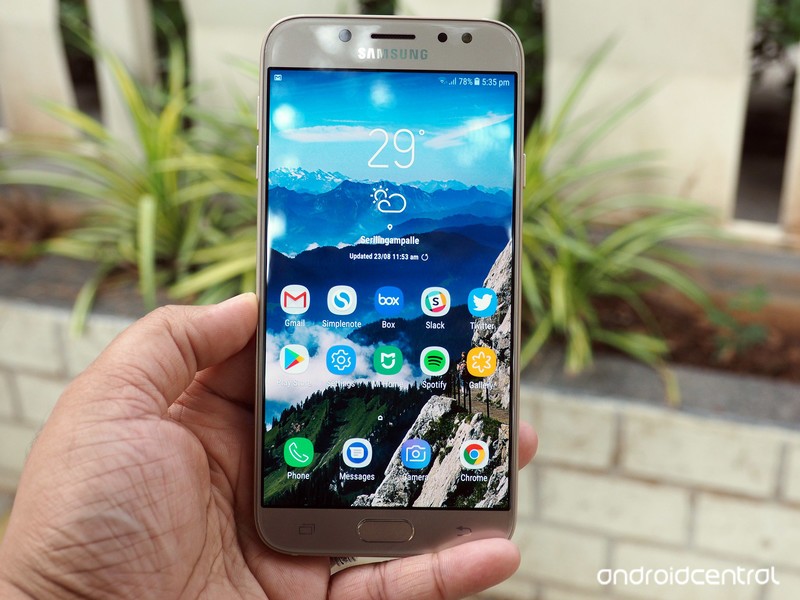
Galaxy J7 Pro Hardware
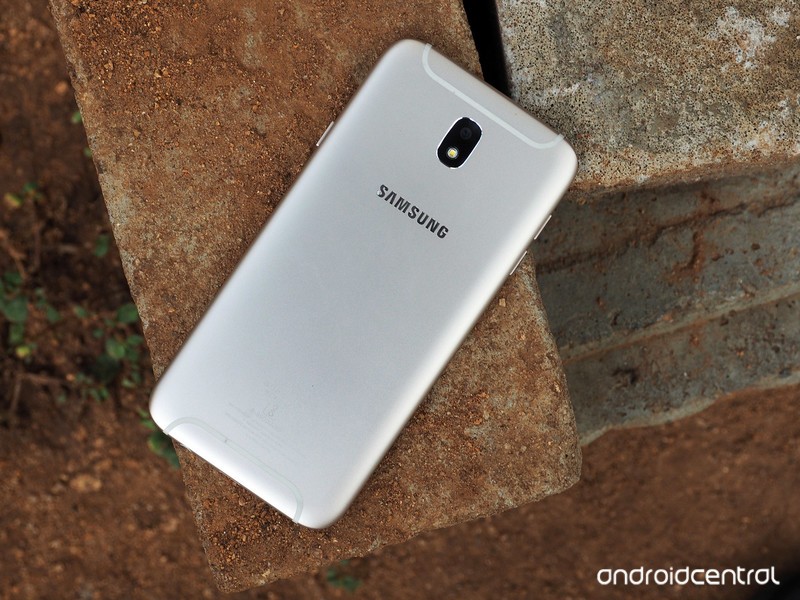
Chinese manufacturers have been offering phones with all-metal designs for several generations now, but Samsung has been slow to incorporate it into its Galaxy J series. The J7 2016 featured a metal frame and a plastic back, and with the J7 Pro, we’re finally getting an aluminum unibody design. And it looks great.
The antenna bands are located at the top and bottom of the device, and they create a pattern that gives the J7 Pro a distinct flair when it comes to the design. The bands also offer a nice contrast to the overall color scheme, particularly with the gold color option.
The phone has sizeable bezels at the top and bottom, but Samsung did a good job of minimizing the side bezels. There’s a home button up front with an embedded fingerprint sensor, and like last year’s Galaxy S7, you can double press the button to quickly launch the camera.
The power button is located on the right, and the volume buttons on the left, and all three buttons have decent tactile feedback. The 3.5mm jack is at the bottom, next to the Micro-USB charging port. More and more manufacturers are switching out to USB-C in this segment, but Samsung was reticent to move to the new standard for its flagships until this year, so it looks like we’ll have to wait until next year to see USB-C ports on the company’s budget devices.
In an interesting design choice, the speaker is located next to the power button. The speaker gets sufficiently loud, and its position means you won’t accidentally cover it when holding the phone. Another thing the J7 Pro gets right is the SIM card tray. Unlike most phones in this segment, the J7 Pro has dedicated slots for two SIM cards and a microSD card.
The Galaxy J7 Pro is Samsung’s best-looking budget by a country mile.
Samsung nailed everything from the build quality to the execution, and the result is that the J7 Pro feels and looks like a device priced twice as much. That’s a big deal considering Samsung basically rolled out one uninspiring phone after another in this category thus far.
If you’re wondering about the Pro moniker, the only difference between the standard J7 2017 and the J7 Pro is that the latter has 64GB storage and the aforementioned Samsung Pay. In all other areas, the J7 Pro is identical to the standard variant. As such, Samsung isn’t going to release the J7 2017 in India, instead focusing on the J7 Pro to be the standard-bearer for the Galaxy J series this year.
Coming to the display, the J7 Pro offers a 5.5-inch Full HD Super AMOLED panel with a pixel density of 401ppi. The screen looks great, with excellent controls levels and color reproduction. it also gets sufficiently bright for outdoor viewing, and you also get the option to adjust the color temperature. A new feature in the J7 Pro is Always On Display, giving you quick access to the clock, calendar, and incoming notifications while the screen is off. You’ll be able to set schedules for AOD and choose from four clock styles.
The J7 Pro has a sleek design and a great display, but it still features last year’s Exynos 7870. The chipset isn’t the fastest out there, and Samsung’s decision to stick with it is particularly infuriating considering the phone has picked up sizeable upgrades in other areas. The Exynos 7870 just doesn’t cut it anymore, and when you look at the fact that the J7 Pro is now pushing a Full HD panel, it makes it all the more annoying.
Even regular tasks like browsing the web on Chrome cause the phone to stutter. Although the Exynos 7870 has eight Cortex A53 cores, they’re clocked up to a maximum of 1.6GHz. Qualcomm’s Snapdragon 625 also has eight A53 cores, but they go up to 2.0GHz for the performance cluster.
Battery life
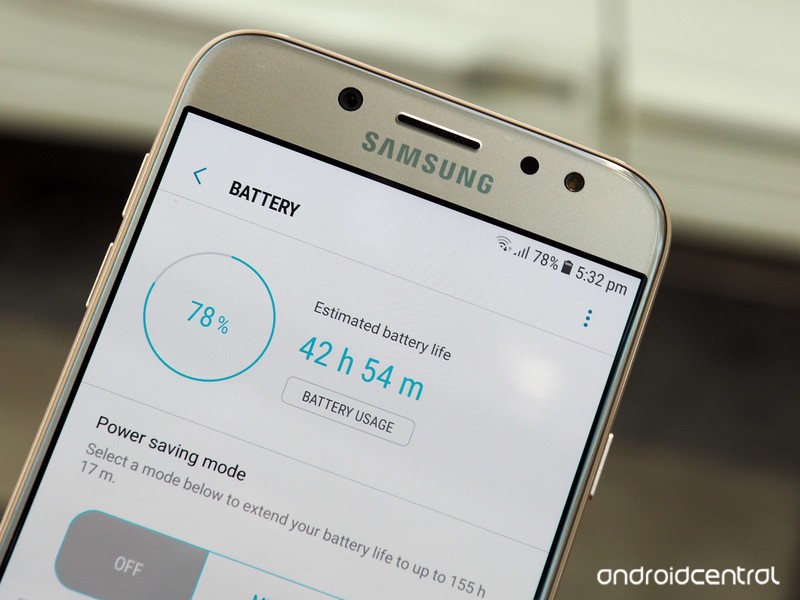
Although the 14nm Exynos 7870 may not be the most powerful chipset in this segment, it is certainly frugal. The phone easily manages to last a day on a full charge thanks to the energy-efficient chipset and 3600mAh battery, and you can further extend battery life by enabling power saving modes.
The main drawback when it comes to battery life is the lack of a fast charging option — the J7 Pro takes an agonizing two hours to fully charge up.
Samsung Pay
The highlight of the J7 Pro is that it is the first phone in the budget category to feature the full-fledged version of Samsung Pay. Samsung’s digital payments service works over NFC as well as the older MST standard, and as a result it requires proprietary hardware in the form of a metal coil located underneath the back plate. The hardware transmits information wirelessly to POS machines, essentially mimicking a card swipe.
Samsung Pay in India: Everything you need to know
That’s the biggest advantage with Samsung Pay, and the fact that it is available on a phone that costs ₹20,900 makes it that much more accessible to a wider audience. And as Samsung claims, you really will be able to use Samsung Pay at most offline retailers. The payments service also offers the ability to transfer money over UPI, and you can link your Paytm wallet to add funds to your account with ease.
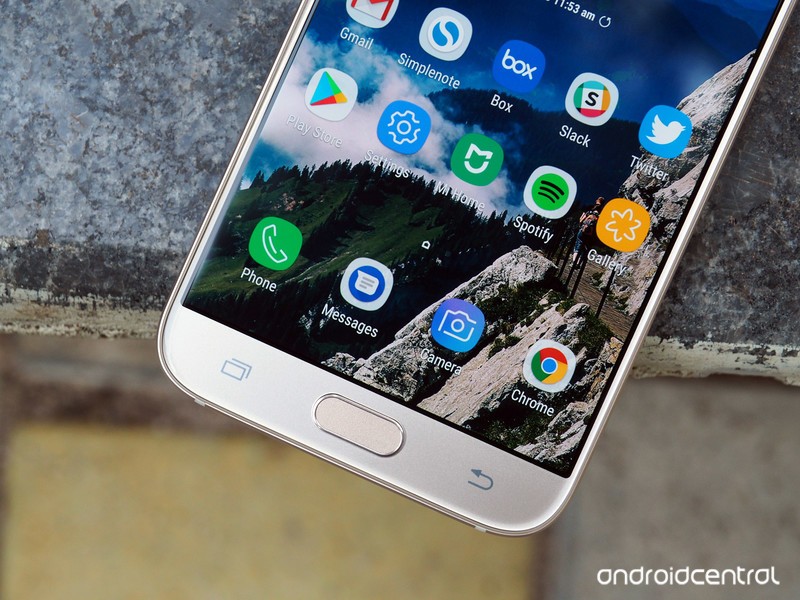
Galaxy J7 Pro Software
Samsung made several changes to its UX earlier this year, and we’re seeing those improvements trickle into the budget segment with the J7 Pro. The phone features the latest Samsung Experience 8.1 atop Android 7.0 Nougat, and the overall experience is akin to what you’d find on a Galaxy S8.
The app drawer is accessible with a slide up or down gesture from anywhere on the home screen, but if you like the older implementation, there’s a setting to enable the apps button. Doing so doesn’t disable the swipe up/down gesture, however. Samsung’s excellent Multi Window mode is present, as is the theming engine that lets you alter the overall look of the interface.
Other noteworthy features include a one-handed mode, blue light filter, display scaling options, Direct share, Secure Folder, and Samsung’s device maintenance hub. There’s also a Dual Messenger mode, which lets you run two instances of an app simultaneously. The UX also has new iconography, and a settings pane that’s easier to navigate. Overall, Samsung has done a great job of bringing its latest UX to the budget device.
Galaxy J7 Pro Camera
The imaging sensor used in the J7 Pro (Sony IMX258) is the same as that of the Redmi Note 4, and the camera quality is decidedly average. Like the rest of the software, the camera interface is near-identical to what you get on a Galaxy S8, including options to share your photos on social networks with ease.






When it comes to taking images, however, the J7 Pro is nowhere near as fluid as the Galaxy S8. The phone takes too long to focus on a subject, and it has a tendency to underexpose images. Manually enabling HDR fixes the problem, but it slows down the device down even further. As for low-light imagery, most shots I took just ended up coming muddy and full of noise.
Galaxy J7 Pro Bottom line
Samsung Pay is a marquee feature, and it’s great that Samsung is bringing its payments service to the budget segment. While the rest of the additions make the J7 Pro the best device yet in the Galaxy J series, it doesn’t hold up very well when compared to the competition. The budget segment is fiercely contested in India, and there are plenty of great alternatives in this category that cost nearly half as much and offer more value for your money.
Samsung’s brand cachet means it doesn’t have to go up against the likes of Xiaomi, and for the most part, that has worked in previous years. Xiaomi has catered to the online segment, while Samsung leveraged its robust distribution network to push millions of units of phones. However, ready availability of the Redmi Note 4 at thousands of retail stores across the country has cut into Samsung’s margins, and as mainstream consumers become more aware of brands like Xiaomi and Huawei, Samsung needs to alter its strategy in this segment.
With the J7 Pro, the company has shown that it can be cognizant of consumers’ needs. But by reusing components from last year, Samsung made the overall experience worse. Were it not for the older Exynos 7870 chipset, the J7 Pro would have been one of the best devices in the ₹20,000 segment, particularly considering it is the only phone in this category to feature Samsung Pay.
See at Samsung
‘Half Life’ writer reveals what could’ve been Episode 3
Nearly ten years after the debut of Half-Life 2: Episode Two, the world is still waiting for Valve to deliver the final episode in the trilogy, but we may have to settle for something else. Just a few months after the last of the game’s writers left Valve, and 21 years to the day since the company started, lead writer Marc Laidlaw has posted “Epistle 3” to his personal website (it’s overloaded and inaccessible now, but you can view it on Archive.org). With some light editing to change a few key names, the post lays out a plotline for the Episode Three that never appeared, although it’s hard to say if it will give gamers any closure after all this time.
Epistle 3 https://t.co/8BEG25AV7A
— Marc Laidlaw (@marc_laidlaw) August 25, 2017
Source: Marc Laidlaw, Archive.org
Apple CEO Tim Cook in Austin to Make Announcement(s) Tomorrow Ahead of September Event
Apple CEO Tim Cook is on work-related travel this week, and his trip may include a stop in Austin, Texas for a major announcement tomorrow.
Tim Cook at Apple’s Worldwide Developers Conference in June
Public flight data shows that, on Thursday, a private jet landed at Austin-Bergstrom International Airport, nearly two hours after departing from Des Moines International Airport. The plane is chartered by a company that provides business professionals like Cook with partial access to private jets.
FlightAware, a website that provides live flight tracking, shows the aircraft earlier flew from Mineta San Jose International Airport, near Apple’s headquarters in Cupertino, to Cincinnati-Northern Kentucky International Airport.
While there is no way of confirming that Cook was aboard these flights, the private jet’s recent trajectory from San Jose to Cincinnati to Des Moines lines up with Cook’s visits to those cities over the past 24 hours.
There’s plenty of reasons that Cook could be in Austin, which has become a major tech hub in the United States. He could be planning to visit Apple’s large seven-building campus there, or the Flextronics factory that assembles the Mac Pro, as he did in 2014. Maybe, though, he has bigger news to share.
 Apple’s campus in Austin, Texas via The Austin American-Statesman
MacRumors received an anonymous tip earlier this week from a reader that claims Cook plans to announce Apple’s rumored September event at an undisclosed location in downtown Austin on Friday.
No sources have confirmed this information, however, so treat this rumor with a proverbial grain of salt for now. Apple typically announces its September events in late August by sending invites to members of the media via email, and Cook simultaneously announcing the event would certainly be out of the ordinary.
The tipster informed us that Apple may have selected Austin due to its growing presence of AR/VR startups, so it’s possible Cook’s announcement could be related to ARKit. Cook has repeatedly expressed his profound interest in augmented reality. Or, it’s quite possible he might not announce anything at all.
Earlier today, Cook visited Cincinnati Test Systems in Harrison, Ohio, a small city in the Cincinnati-Northern Kentucky metropolitan area. CTS is a leading manufacturer of leak testing equipment that helped ensure the iPhone 7 and Apple Watch Series 2 are as water resistant as advertised.
Cook then met with Iowa governor Kim Reynolds in Waukee, Iowa, part of the Des Moines area, shortly after Apple announced plans to build a 400,000-square-foot data center in the city at a cost of $1.3 billion. While in the area, Cook also visited Waukee High School and an Apple retail store in West Des Moines.
Apple has hosted special events in September for five consecutive years, dating back to the iPhone 5 introduction in 2012. This year’s event is rumored for September 12, but September 6 would also be a suitable date.
Update: At a town hall meeting, Austin mayor Steve Adler said Cook will be announcing a training program of some kind that will be launched across the United States. Cook likely has other plans on his agenda throughout the day. Skip to the 48:15 mark in the video below for Adler’s comments.
(Thanks, Scott H. and Joe D.!)
Tags: Tim Cook, September 2017 event
Discuss this article in our forums
 AIVAnet