


Is that Chanel counterfeit? AI scanner distinguishes real from fake goods
Why it matters to you
The Entrupy scanner wants to keep you from purchasing counterfeit products.
Many fashionistas may be confident they can tell the difference between a real Louis Vuitton purse and a fake one, but in reality, it is not always so simple. The differences often require a close inspection to spot — and even then they might be so slight that they are practically imperceptible.
Thankfully, artificial intelligence is here to help. A new machine-learning system developed by researchers from New York University is able to distinguish between genuine and counterfeit products by analyzing microscopic characteristics that are invisible to the human eye.
“We built Entrupy as a scalable and versatile platform in response to the rapidly growing counterfeiting issue and need for trust when it comes product transactions,” Vidyuth Srinivasan, co-founder of Entrupy, the company that has commercialized the technology, told Digital Trends.
The non-intrusive Entrupy system uses a dataset of 3 million microscopic images, including goods and materials like fabrics, leather, electronics, toys, and shoes.
“Entrupy’s technology is a mix of machine learning and microscopy,” Ashlesh Sharma, Entrupy’s fellow co-founder, told Digital Trends. “We train our machine-learning algorithms to pick up data points from millions of microscopic images looking for qualities like texture, contrast, topology, geometric shapes, thread counts, minor manufacturing artifacts such as scratches in the hardware stamps, wear, and many more details that you wouldn’t be able to easily see. These details are in fed into our custom machine learning pipeline, allowing us to determine a product’s authenticity. ”
Sharma said the system is currently 98.5 percent accurate but that, as a machine-learning system, it is improving with every use. “With machine-learning technology, our algorithms are always getting better, building a better database of what makes a product authentic, and even more importantly, what details mark a counterfeit,” she said.
There are, of course, other methods to distinguish genuine and counterfeit products, but they are generally invasive and may end up damaging the product. Entrupy boasts that all it needs is its scanner and image database, which do not interfere with the product itself.
As Entrupy’s price suggests, the device is not intended to be sold to the individual shopper — unless you happen to be a big spender. Rather, it is a way for retailer and wholesalers to make sure they are selling the real thing, offering a certificate of authenticity to customers. The system and scanner cost $99 for five scans per month, $399 for 30 scans, and $999 for 100.
Did your surgeon wash their hands effectively? This AI-powered camera can tell
Why it matters to you
AI-equipped camera technology could have a big impact on bugs spreading in hospitals.
Having security cameras is one thing, but having security cameras equipped with cutting-edge image recognition algorithms is quite another. It means that, instead of having to have a human physically monitoring the camera feed at all times to act on it, the cameras themselves can spot items of interest. Previously, we covered artificial intelligence-equipped cameras that could make construction sites safer, as well as ones which may prove even better than polygraphs at recognizing when a person is lying.
Now, researchers at Stanford University have used similar technology to develop security cameras for hospitals which can automatically identify when people use or skip out on using the provided alcohol-based gel dispensers when they go from ward to ward. The technology could have an important role to play in cutting down on infection rates in hospitals.
The researchers started by training their system on footage of people using the gel (or not, as it happened!) on two wards. Of the 170 people who entered a patient’s room at various times, just 30 used the dispensers. This data was then used to train the system to recognize the difference between a person using the gel or not using it. After a training process, the cameras were able to recognize with an accuracy level of 75 percent whether or not people were using these dispensers. According to the researchers, a human doing the same monitoring job — as a way of testing the camera’s efficacy — managed just 63 percent accuracy.
The pilot program apparently went so well that the researchers are now providing the cameras to three hospitals for a period of one year to study whether or not they can have a positive impact on infection rates.
Although the technology cannot physically make someone use the alco-gel to clean their hands, the information can be used in different ways. For instance, insights gathered could be used by hospital managers to help inform staff training, select new locations for alcohol gels (if some locations have a better “hit rate” than others), prompt the putting up of extra safety posters, and so on. Trained on other hospital-related tasks or actions, it is possible to imagine a similar system could be used to monitor vital signs, look for possible distress among patients, check for falls, and more. The technology would not take away jobs from doctors or nurses but could help them in improving safety among the hospital’s residents.
Did your surgeon wash their hands effectively? This AI-powered camera can tell
Why it matters to you
AI-equipped camera technology could have a big impact on bugs spreading in hospitals.
Having security cameras is one thing, but having security cameras equipped with cutting-edge image recognition algorithms is quite another. It means that, instead of having to have a human physically monitoring the camera feed at all times to act on it, the cameras themselves can spot items of interest. Previously, we covered artificial intelligence-equipped cameras that could make construction sites safer, as well as ones which may prove even better than polygraphs at recognizing when a person is lying.
Now, researchers at Stanford University have used similar technology to develop security cameras for hospitals which can automatically identify when people use or skip out on using the provided alcohol-based gel dispensers when they go from ward to ward. The technology could have an important role to play in cutting down on infection rates in hospitals.
The researchers started by training their system on footage of people using the gel (or not, as it happened!) on two wards. Of the 170 people who entered a patient’s room at various times, just 30 used the dispensers. This data was then used to train the system to recognize the difference between a person using the gel or not using it. After a training process, the cameras were able to recognize with an accuracy level of 75 percent whether or not people were using these dispensers. According to the researchers, a human doing the same monitoring job — as a way of testing the camera’s efficacy — managed just 63 percent accuracy.
The pilot program apparently went so well that the researchers are now providing the cameras to three hospitals for a period of one year to study whether or not they can have a positive impact on infection rates.
Although the technology cannot physically make someone use the alco-gel to clean their hands, the information can be used in different ways. For instance, insights gathered could be used by hospital managers to help inform staff training, select new locations for alcohol gels (if some locations have a better “hit rate” than others), prompt the putting up of extra safety posters, and so on. Trained on other hospital-related tasks or actions, it is possible to imagine a similar system could be used to monitor vital signs, look for possible distress among patients, check for falls, and more. The technology would not take away jobs from doctors or nurses but could help them in improving safety among the hospital’s residents.
Best Android Phone for Kids

The time has come. You’ve decided your kid needs a phone. These are their best options!
Best overall
Moto G5 Plus

See at Amazon
Motorola has been the budget phone champion for years now, and its most recent releases are no exception. The Moto G5 Plus is inexpensive without being cheap, especially when it comes to a solid battery and better-than-average camera. The software is solid and simple, with the promise of consistent updates to ensure the phone stays secure.
Bottom line: This is a great phone before you look at the price tag, which makes it that much easier to recommend.
One more thing: This phone is available on Amazon’s offers and ads program for a discount, but the current $180 price tag is more than reasonable for what you get.
Why Motorola’s Moto G5 Plus is the best
For many people, buying a smartphone is all about getting the most important features at the most reasonable price. When purchasing a phone for their children, parents have a tendency to emphasize price over features. The Moto G5 Plus is a phone that genuinely lets you have both. While not quite as capable as the more expensive flagship phones, Motorola’s budget line has a history of not feeling like a cheap experience when you use it. On top of consistent security updates, so you know your kid is using a phone that will keep their data safe, you’re giving your child a great overall experience. This is hands-down the best phone for the money right now, and it’s a phone that will work on any U.S. carrier should you decide to pack up and leave your current provider.
Best Features
OnePlus 5

See at OnePlus
The folks at OnePlus have a history of being David to the Goliaths that are Apple and Samsung. These phones are often hundreds of dollars cheaper than the “best” while offering nearly every high-end feature you can get with those other phones. The OnePlus 5 continues that tradition by being noticeably less expensive than the price tags you’ll see in the store, but without sacrificing much when it comes to features. You’re going to get a superior camera, great battery life, and all of the top features for $479.
Bottom line: This is the phone you get when you want your older kid to have something nice, but aren’t ready to shell out the $800 for one of the bigger names.
Best on Verizon
Samsung Galaxy J3 Eclipse

See at Verizon Wireless
If you find yourself sitting in a Verizon Wireless waiting to add a phone to your account for a little one, there’s a good chance you’ll have iPhones or high end Samsung phones recommended to you by the folks in the store. Before you put any money down, ask to see the Galaxy J3 Eclipse by Samsung. It’s a simple phone which claims 10 days of standby time and an extreme battery save mode that ensures your child should always be reachable. It’s also only free on Verizon’s payment plan if you don’t want to pay the $168 up front, so anyone can afford it.
Bottom line: If you need a Verizon phone and aren’t looking to spend a lot, this is what you need.
Conclusion
Smartphones give you a little more information regarding where you kids are and what they’re doing, but they also give your kid some freedom to have a little fun or get in some trouble. If you want the best for your kid, Motorola’s G5 Plus is what you want. If you’re eager to spend a little more for some higher-end hardware, OnePlus offers something great with the new 5 model. Verizon Wireless subscribers who would rather buy in a store, be sure to ask about the Galaxy J3 Eclipse from Samsung.
Best overall
Moto G5 Plus
See at Amazon
Motorola has been the budget phone champion for years now, and its most recent releases are no exception. The Moto G5 Plus is inexpensive without being cheap, especially when it comes to a solid battery and better-than-average camera. The software is solid and simple, with the promise of consistent updates to ensure the phone stays secure.
Bottom line: This is a great phone before you look at the price tag, which makes it that much easier to recommend.
One more thing: This phone is available on Amazon’s offers and ads program for a discount, but the current $180 price tag is more than reasonable for what you get.
Updated August 2017: All of the latest choices for 2017 have been added to help you make the best choice!
What to do when your VR app is asking for Gear VR instead of Daydream

Make sure your VR headset launches the right version of the app.
The Daydream compatibility update has rolled out to users of Samsung’s Galaxy S8 giving them far more options for VR than any other phone can deliver right now. The ability to play both Gear VR and Daydream games on one device is huge and delivers access to dozens of new apps and games. However, some folks have run into an issue where their phone asks for Gear VR when you launch a Daydream app.
There are a few ways to deal with this problem if it crops up for you, but here’s how you deal with it!
Read more at VR Heads!
OnePlus and DJI team up with back to school bundles
OnePlus and DJI are teaming up to offer back to school bundles.
As the new school year approaches, a lot of companies are looking to offer back to school deals to entice students. OnePlus and DJI are combining forces to offer a rather enticing bundle.

Right now, OnePlus and DJI are offering a bundle with the DJI Osmo Mobile (MSRP: $299) and a OnePlus 5 (MSRP: $479) for only $724, a savings of $54 compared to buying the items individually. Another bundle features the OnePlus Travel Backpack (regular price: $69) combined with the DJI Osmo Mobile for only $342, a savings of $26.
For the drone enthusiasts, the companies are offering the OnePlus Travel Backpack alongside the DJI Mavic Pro (MSRP: $999) for $1,028, a savings of $40 compared to buying the items separately. Also on offer is the newer and less expensive DJI Spark (regular price: $499) and a OnePlus Travel Backpack for $538, a savings of $30.
OnePlus is also offering other bundles on its own. These are the Dash Power bundle (a Dash wall charger and compatible cable) for 25% off, the Join the Family bundle (a Travel backpack and “Never Settle” T-shirt) for 30% off, the Get Charged bundle (a OnePlus messenger bag and a Dash Charge T-shirt) for 30% off, and the Ready for Action bundle (a protective case, tempered glass screen protector, bullet headphones, and a Dash charging cable and wall adapter) for 25% off.
For those that are unsure of these bundles or don’t want a OnePlus phone, check out our 2017 back to school guide!
Are you interested in any of the OnePlus and DJI bundles? Let us know down below!
See at OnePlus
Grab a Huawei Watch for as little as $200, Fit Sport Watch for $70
Our friends at Thrifter are back again, this time with some great deals on a brand-new Huawei Watch!
Update: B&H dropped the price of the Huawei Watch by $50 since we last posted. The blue Fit Sport watch also dropped by $20 on Amazon
B&H Photo currently has some great deals on both the Huawei Watch and Huawei Fit Sport Watch, dropping prices down to as low as just $79.99. The Android Wear-powered Huawei Watch is starting at $149.99 with a black stainless steel band (open box) or $199.99 brand new. The Huawei Watch is still one of the best Android Wear smartwatches, but keep in mind that it is 2 years old at this point, and isn’t likely to receive many more updates.

If you don’t need the full Android Wear integration, you can pick up the Fit Sport Watch for $79.99 or $89.99, depending on color preference. The Fit Sport Watch offers heart rate monitoring, IP68 waterproof rating, fitness tracking, phone notifications, and more. Amazon also has the blue version for $69.99
See at B&H Photo
More from Thrifter:
- How to get the most out of your Amazon Prime membership
- How to save money when driving
For more great deals be sure to check out our friends at Thrifter now!
Android compatibility comes to the Schlage Sense Smart Deadbolt
Schlage adds Android compatibility to its Schlage Sense Smart Deadbolt.

Schlage has been around for a long time — if you’ve gone to a hardware store, you’ve likely seen its locks and deadbolts front and center. And like any legacy home security company, Schlage has found its way into the connected home space through products like its $229.99 flagship Schlage Sense Smart Deadbolt, which appends Bluetooth connectivity to a traditional front door keylock.

When the Schlage Sense shipped in 2015, it was only compatible with the iPhone, and was one of the first front door locks to gain Apple HomeKit support — which is fine, but that doesn’t address the entire market. Now, Schlage is updating its deadbolt with Android support, allowing millions of new users the opportunity to unlock their front doors with a tap — or a code.

One of the Schlage Sense lock’s more interesting features is a touchscreen number pad, which allows for up to 30 unique codes to be used to unlock the door, in addition to a Bluetooth connection to the phone. These codes can be shared with friends, family or temporary guests, but the system is also secure: with an additional accessory providing remote access, users can disable the codes from anywhere or set timers so they expire after a certain period – which is great for, say, Airbnb guests. The benefit of such a system is that, unlike most connected locks, visitors don’t need to download the Schlage Sense app if they don’t want to.
To shore up additional functionality, Schlage is also releasing a $69.99 Schlage Sense Wi-Fi Adapter, which connects the previously Bluetooth-only lock to Wi-Fi, allowing homeowners to unlock and administer the Sense lock from anywhere in the world. The adapter is small and plugs into any outlet, easily connecting to a Wi-Fi router.
The app is available now, and both the Schlage Sense deadbolt and Schlage Sense Wi-Fi adapter are shipping.
See at Amazon
Schlage Announces Android Phone Compatibility and New Companion Wi-Fi Adapter for Schlage Sense™ Smart Deadbolt
— Solution Puts Control in Android™ and iPhone Users’ Fingertips to Access Their Smart Locks From Anywhere —
Carmel, Ind. (Aug. 15, 2017) – Schlage®, a brand of Allegion® that has been creating stylish, innovative door hardware for more than 95 years, today announced its Schlage Sense™ Smart Deadbolt now has Android™ smartphone compatibility. Schlage is also introducing the Schlage Sense™ Wi-Fi Adapter, a simple wall plug-in that provides Android™ and Apple users access to their locks remotely.
With this update, consumers with an Android™ phone can now use the Schlage Sense Smart Deadbolt. Additionally, consumers can add the Schlage Sense Wi-Fi Adapter (sold separately) to their home Wi-Fi networks to control their Schlage Sense from anywhere on their Android™ phone or Apple devices. The Schlage Sense Wi-Fi Adapter offers remote access to both iOS and Android™ smartphone users through the Schlage Sense app.
The Schlage Sense Smart Deadbolt is easy to set up and use thanks to the dedicated, free app, which is available to Android™ phone users through the Google Play Store and Apple users through the App Store. With no connection to an existing home automation system or monthly subscription charge, the free app allows you to:
- Create and delete up to 30 unique access codes so trusted friends and family can enter using their code at the lock’s touchscreen.
- Schedule access codes so guests can only enter when you want them to.
- Use the Wi-Fi Adapter to lock and unlock from anywhere, check on the lock’s status and receive push notifications when the lock is used.
- View past activity to see which codes have been used and when.
- Update settings and check battery life.
“The No.1 customer question we have received regarding the Schlage Sense lock since its launch has been, ‘when are you going to offer Android™ phone compatibility?’” said Chris Sutton, Electronics Business Leader at Schlage. “We also wanted to provide a solution, like the Schlage Sense Wi-Fi Adapter, that would allow a homeowner to connect to their lock remotely without having a smart home platform. We are excited to offer compatibility to a wider range of users looking to incorporate smart products into their homes.”
The experts at Schlage have been creating innovative smart locks since 2009, designed to blend seamlessly with the décor and style of any home. The Schlage Sense Smart Deadbolt is available in two of the brand’s most popular styles, traditional Camelot and contemporary Century, as well as a variety of finishes including Matte Black, Satin Nickel and Aged Bronze to suite with Schlage interior door hardware and complete the look throughout the home.
The Schlage Sense Smart Deadbolt is now available for $229 MSRP in select Apple, Lowe’s and Home Depot stores and on HomeDepot.com, Lowes.com, Amazon.com, Build.com and Apple.com. The Schlage Sense Wi-Fi Adapter is available at THD.com, Lowes.com, Amazon.com and Build.com for $69.99 MSRP. For more information on the Schlage Sense lock, visit http://www.schlage.com.
About Allegion
Allegion (NYSE: ALLE) is a global pioneer in the field of safety and security. We keep people and their property safe, wherever they are, bringing together simple solutions and advanced technology. Allegion is a $2.2 billion company, with products sold in almost 130 countries. For more, visit http://www.allegion.com.
Android™ is a trademark of Google, Inc. iPhone® is a trademark of Apple Inc., registered in the U.S. and other countries.
Facebook Camera adds GIFs, colorful text and the ability to go live
Facebook is beefing up its Camera functionality with a trio of Snapchat- and Instagram Live-inspired updates. Starting today, iOS and Android users have the ability to go live, create GIFs and share colorful blocks of text directly from the Facebook Camera.
When going live via the Camera, users can mess around with the creative effects like facial filters and doodles, and share the whole thing to their Story on in a post on their Timeline. The GIF functionality is simple enough: Film two-second, looping videos in the Camera and broadcast them via Story, Direct or straight to the News Feed.

Finally, there’s the text update. You’ve most likely seen those blocks of white text on colorful backgrounds popping up in your Facebook News Feed recently — hell, you’ve probably written a few of them yourself. Today, this medium is available in the Camera, allowing anyone to share full-screen text posts to Story, News Feed or Direct.
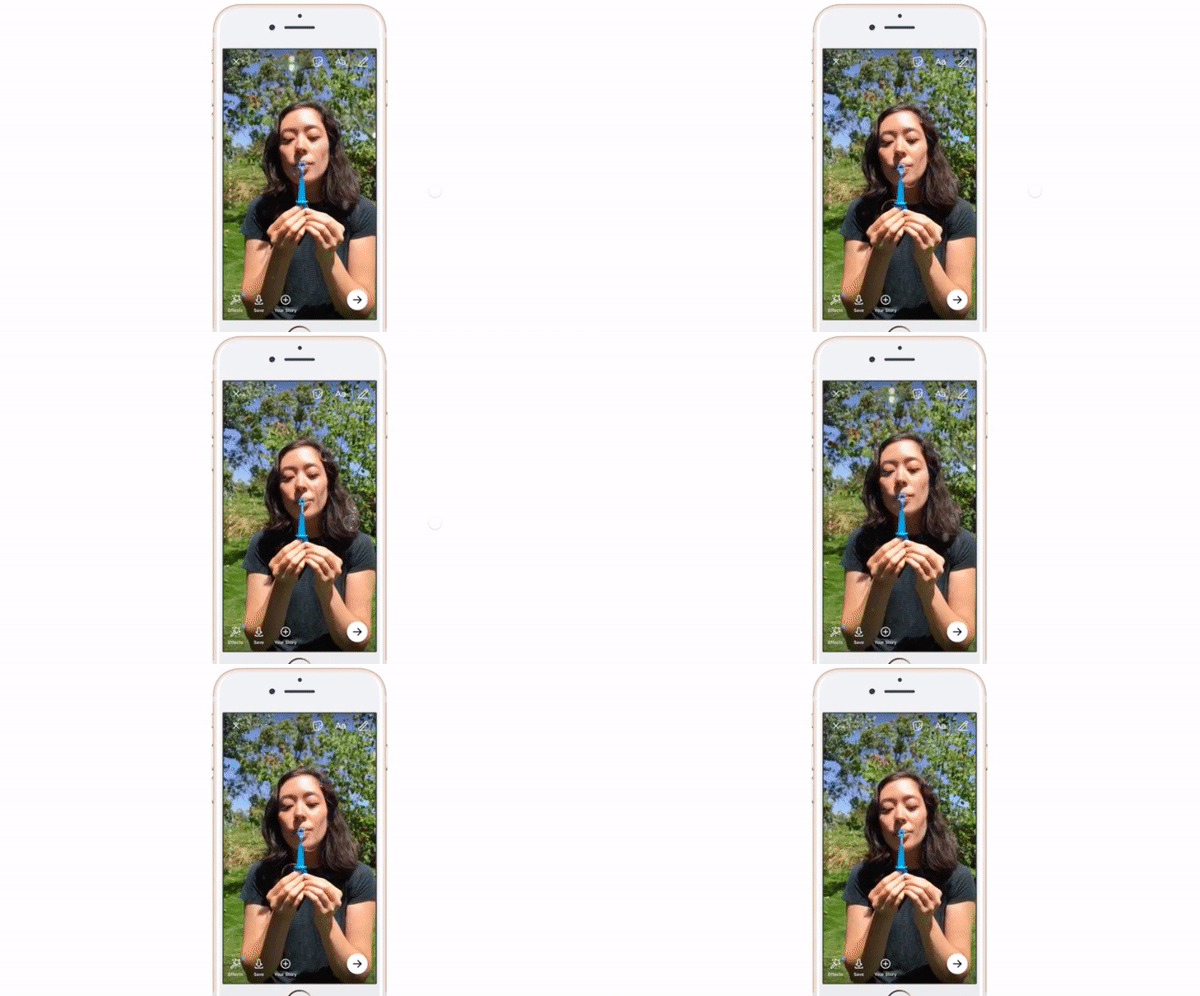
Facebook is of course taking inspiration from Snapchat here, but it’s also stealing ideas from itself at this point. Instagram — which is owned by Facebook — rolled out live broadcasting in December, and has since added GIF-like capabilities with Boomerang, plus the ability to send image and video replies, and share live videos after streaming.
Instagram tidies up comment sections with threaded responses
Instagram doesn’t care if you see all your friends’ posts in chronological order. But it does want you interacting with the month-old photos its algorithm picks to appear above and below more recent posts. The latest example is a change to how commenting on posts works. Instead of responses all getting grouped together, replying to a comment will automatically create a thread. Handy! It’s a minor tweak, sure, but one that somehow wasn’t present until now. Maybe an opt-in button for the algorithm-driven timeline will be next. Wait, why are you laughing?

Source: Instagram
 AIVAnet