


The best unlocked phones you can buy
Many people still buy their smartphones directly from a carrier with a service contract attached, but buying phones unlocked is growing in popularity, so we’ve put together a list of the best unlocked phones. You’ll usually have to pay the full price upfront, but some companies offer payment plans, so you can pay your phone off month by month. An unlocked phone can potentially be used on different networks, and that means you can switch carriers when you feel like it, simply by changing your SIM card. With an unlocked phone, you can also sell or trade up whenever you want, instead of having to wait for the end of your contract.
Before you buy one of these phones from our list, be sure to double check that the phone you’re buying works on your carrier’s bands. Our smartphone bands guide explains how you can tell the difference.
Our pick
iPhone 7 Plus
Why should you buy this: It’s the best iPhone on the market, thanks to that dual-lens camera.
Our Score
The best
Apple iPhone 7 Plus
Wide carrier support in a stylish, powerful, secure package, with a great camera.
$769.00 from Apple
$877.98 from Amazon
Who’s it for: Apple fans who want an unlocked phone to work with any carrier.
How much will it cost: $770+
Why we picked the iPhone 7 Plus:
The iPhone 7 Plus edged the win in our best smartphones roundup because it’s powerful, secure, and sports a wonderful camera. Apple’s classic aluminum design doesn’t hurt and it’s also the first iPhone to be water resistant. The complete package is slick and there are no major weaknesses (aside from the lack of a headphone jack).
Buy unlocked directly from Apple, and your iPhone 7 Plus will work with all four major U.S. carriers and a long list of others besides. It will also work pretty much anywhere you care to wander, so globetrotters will be well covered. You can find the full list of supported carriers at Apple’s website.
It’s an obvious pick for anyone invested in Apple’s ecosystem, but it is expensive. If you want something smaller and cheaper, then check out the iPhone 7 or even the iPhone SE. If you’re happy to look beyond Apple’s wares, keep reading for plenty of great alternatives.
Our full review
The best unlocked Android phone
Google Pixel XL
Why should you buy this: For a pure and powerful Android experience, the Pixel XL can’t be beat.
Our Score
The best unlocked Android phone
Google Pixel XL
A premium design, fantastic camera, and the latest Android innovations in a global phone.
$769.99 from Verizon
$649.00 from Google Store
Who’s it for: Android fans seeking a slick, unlocked phone that will work on any carrier.
How much will it cost: $770
Why we picked the Google Pixel XL:
Google matches the iPhone on every front with its Pixel line and the Pixel XL is still the best Android phone on the market right now. It has a stunning display, a powerful processor, and a truly great camera. It also ducks some of the usual Android problems, with regular security updates, and super slick software that shows off Google’s elegant software design.
Buy the Pixel XL unlocked directly from Google, and you can use it on any U.S. carrier and on many, many other carriers worldwide. The full list of supported bands can be found on Google’s website.
The Pixel XL is also a pricey phone and it’s quite big, so you might consider the Pixel as an alternative that offers exactly the same fully unlocked credentials in a smaller, cheaper package. There’s very little difference between the two, apart from size.
Our full review
The best unlocked alternative phone
Galaxy S8
Julian Chokkattu/Digital Trends
Why should you buy this: It’s a beautifully stylish phone with all the features you could want.
Our Score
The best unlocked alternative phone
Samsung Galaxy S8
Stunning design, feature-rich, and you can use it anywhere.
$574.99 from Amazon
$574.99 from Samsung
Who’s it for: Samsung fans after the best-looking global phone around.
How much will it cost: $750+
Why we picked the Galaxy S8:
No one sells more phones than Samsung, and this is the current cream of the crop. Samsung refined its innovative curved display design with the Galaxy S8, packing a 5.8-inch screen into svelte body, and it’s absolutely gorgeous. The specs are not to be sniffed at either, with a fast processor, vibrant display, and an excellent camera. Samsung also stirred water resistance, quick charging, the Bixby voice assistant, and a few other extras into the mix.
An unlocked Samsung Galaxy S8 will work on all four major U.S. carriers and a bunch of smaller ones, too. It will also serve frequent travelers well, with support for countless carrier networks worldwide. However, there are a lot of different models of the S8, and you don’t want to buy the wrong one. The model number to look for is SM-G950UZKAXAA. You can find the full list of supported bands at Samsung’s website.
If you want something bigger and you’re willing to pay a bit more, then you could go for the Galaxy S8 Plus — the model number to look for is SM-G955UZKAXAA.
Our full review
The best $400 unlocked phone
ZTE Axon 7
Why should you buy this: You get an amazing flagship phone for a lot less money.
Our Score
The best
ZTE Axon 7
An all-metal body, great display, powerful dual speakers, and all the bells and whistles make this a compelling bargain.
$449.99 from Amazon
Who’s it for: People who don’t care about the big brands.
How much will it cost: $400+
Why we picked the ZTE Axon 7:
After glancing at the spec list for the Axon 7, you’d be forgiven for expecting a premium price tag, but you can actually snap it up for $400. It’s a speedy performer with a decent display and solid camera, though the highlights are the battery life and the superb audio quality. In terms of features and design, the Axon 7 holds its own with the current flagship line-up.
The ZTE Axon 7 supports a wide range of bands, and you’ll have no problems with it on AT&T, T-Mobile, and many other GSM carriers. It does also support CDMA, and so technically, it can work with Verizon or Sprint service, but that doesn’t mean it will. Neither carrier officially supports the device. Some people have got it working on Verizon, but not flawlessly, and it doesn’t seem to be working with Sprint at all right now.
Make sure that you check that it will work with your carrier before you buy. There are also a couple of different model numbers; the one you want is A7G333.
If you recoil at the idea of paying $700 or more for a smartphone, then the Axon 7 is well worth taking a chance on. If your budget doesn’t stretch to $400, but you like the look of the Axon 7, then you might consider the Axon 7 Mini at $300. But be warned, there are a few compromises, most notably the drop to a mid-range processor. ZTE also offers a payment installment plan, so you can pay the phone off in monthly payments. The Axon 7 is a year old, but it’s still a solid option.
Our full review
The best budget unlocked phone
Moto G5 Plus
Kyle Wiggers/Digital Trends
Why should you buy this: It boasts an impressive range of features and outperforms many more expensive phones.
The best $250 phone
Moto G5 Plus
This near stock Android phone boasts a solid camera, big display, and plenty of power.
$229.99 from Motorola
$299.99 from Newegg
Who’s it for: Bargain hunters looking for a decent phone to work on any carrier.
How much will it cost: $230+
Why we picked the Moto G5 Plus:
When you dive into the budget end of the pool, you should be careful, because deal-breaking compromises are common. Thankfully, Lenovo’s Moto G5 Plus is mercifully free of them. This phone ticks all the boxes, with a big, bright display, good performance in terms of speed and battery life, and a camera that easily outshines the budget competition.
Buy this phone unlocked directly from Motorola, and you’ll be able to use it on a wide range of carrier networks, including the big four in the U.S. You can find the full list at the Motorola website; the only notable omissions are US Cellular and Virgin.
Our full review
How we test
We are obsessed with smartphones here at Digital Trends and we test them to the limit. The phones we review serve as our main devices for at least a week, usually longer, and we use them for everything from messaging and calls, to photos and gaming. They go to work with us, they go to bed with us, and they even go to the toilet with us. We never recommend a device that we wouldn’t be happy using ourselves.
When it comes to unlocked phone testing, we make sure that the phones we recommend actually work on the majority of networks and warn you if there are caveats.
Will the phone works on your carrier?
You must be careful when buying an unlocked phone. Some retailers will advertise phones as unlocked, but that doesn’t necessarily mean that they will work with any carrier. Some carriers have stricter controls than others, and even if a phone could technically work on their network, they might not allow it.
Start by checking which bands your device supports and what carriers they correspond to. The vast majority of unlocked handsets will work with GSM networks (like AT&T and T-Mobile), but many won’t work with CDMA networks (like Verizon and Sprint).
Ideally, you’ll be able to find someone talking about using your chosen phone with your chosen carrier simply by searching in Google. For example, search “Axon 7 Verizon” and you’ll see a number of forum posts about the issues people have had. If in doubt, check with your carrier and do further research.
Manufacturers also sometimes produce different models of the same phone with different band support, so you must do your homework to ensure that your pick will work on your preferred carrier. The Will My Phone Work website is another good resource to help you.
Read our full guide here
Update: We updated this list with the Galaxy S8 and the Moto G5 Plus.
Amazing ‘biochip’ reprograms your skin cells to do whatever your body needs
Why it matters to you
Smart biochip can help repair injuries and restore the function of aging tissues, including organs, blood vessels, and nerve cells.
Imagine a smart chip that’s able to heal injuries by reprogramming skin cells when pressed onto a part of the body and given a quick jolt of electricity. It might sound like science fiction, but it’s actually the basis for new technology developed by researchers from the Ohio State University’s College of Engineering and Wexner Medical Center. Referred to as Tissue Nanotransfection (TNT), the device generates any cell type that’s required for treatment within a patient’s body. That means transforming the original cells into the building blocks necessary to do everything from repair injuries to restore the function of aging tissues, such as organs, blood vessels, and nerve cells.
In a demonstration, researchers used the biochip to reprogram skin cells to become vascular cells in a badly injured leg lacking proper blood flow. After a single week, active blood vessels appeared in the injured leg, and by the second week, the leg had been saved. Lab tests also showed that it was possible to reprogram skin cells into nerve cells. These were then injected into brain-injured mice to help them recover from strokes.
“Our TNT biochip is able to deliver large biomolecules, such as DNA and other genes, into the cells on the surface of a tissue or organ using a minimal invasive approach to achieve high dosage and minimal tissue or organ damage, not achievable by any existing technologies,” L. James Lee, professor of chemical and biomolecular engineering, told Digital Trends. “We found that the cell transfection effect may propagate quickly from surface cells to reach all cells in skin and muscle, leading to the formation of new blood vesicles and ‘difficult to reproduce cells,’ such as neurons in situ.”
Lee points out the technology’s use of a patient’s skin as a bioreactor means that the required “therapeutic cells” which are then delivered back to a damaged or malfunctioning organ carry minimal rejection and toxicity concerns.
“We believe the near-term clinical applications include wound healing via enhanced blood vessel formation in the local area, and the use of patient skin as a bioreactor to produce needed somatic cells,” Lee said. “In the long term, this technology may be extended to surgically exposed organs to facilitate treatment.”
At present, the TNT biochip has only been used in a mouse study. Next up, the team will conduct large animal studies, before hopefully progressing to clinical trials. Between this and some of the other smart biomedical breakthroughs we’re seeing, it’s certainly an exciting time for medicine.
A paper describing Ohio State University’s work was recently published in the journal Nature Nanotechnology.
FaceApp does a face plant — it launches, then removes ethnicity filters
Why it matters to you
The backlash against ethnicity filters on FaceApp is part of an ongoing struggle against discrimination in AI — and where to draw the line with facial filters.
Artificially-intelligent selfie editor FaceApp is once again taking heat from critics after an app update allowed users to apply a filter to change their race. After the backlash, FaceApp removed the ethnicity filters from the app on Wednesday, August 9, the same day the update launched, and this is not the first time the company has released, then removed, a controversial feature.
FaceApp uses AI and facial recognition to change faces, including aging an image, switching genders, changing expressions, or adding a goatee. The latest “ethnicity change filters” allowed users to upload a photo, of themselves or someone else, and use the software to morph into a different ethnicity. The update included 10 face-editing filters — and four of them were designed to alter race.
Wow… FaceApp really setting the bar for racist AR with its awful new update that includes Black, Indian and Asian “race filters” pic.twitter.com/Lo5kmLvoI9
— Lucas Matney (@lucasmtny) August 9, 2017
The company’s CEO, Yaroslav Goncharrov, said that filters for enhancing beauty would leave ethnicity intact, while the ethnic filters would change faces equally and even be listed in random order. FaceApp users, however, thought the app took things too far with the ethnic filters and the company later removed them in response.
FaceApp took heat earlier this year for its “hotness” filter, an effect that favored, among other things, lighter skin tones. The developer initially re-named the app before releasing a full fix, apologizing for what the company said resulted from a training bias in the AI program.
The practice of altering a face with software may inevitably attract controversy, raising such questions as who creates beauty standards, which will naturally vary among cultures. And FaceApp isn’t the only firm to come under fire for its choice of augmented reality face edits — Snapchat was ridiculed last year for a “yellowface” filter that created Asian caricatures.
Developers are often quick to place the blame on the AI. The software learns from feeding the computer thousands of examples — but if those examples are mostly white males, for example, the resulting program will have a bias towards those images. Discrimination in AI is the subject of several research projects, while the White House has itself identified discrimination as a challenge.
For now, face-altering apps are probably better off with turning selfies into cats and adding glasses and hats.
Could gene-edited pigs be used as organ donors for humans?
Why it matters to you
Pigs could be a solution to the shortage of transplant organs. CRISPR gene editing makes them safer candidates.
There is a massive shortage of transplant organs worldwide, and scientists are desperate to come up with a solution — whether that be boosting patient’s immune systems to let them accept otherwise incompatible organs, or creating technology for preserving organs after they are harvested. A new international research initiative has another approach: Using CRISPR gene editing on pigs to make them into safe organ donor candidates for humans.
The reason pigs are desirable as possible sources of organs is that their organs are similar to humans in both size and anatomy. Unfortunately, they also carry viruses — known as porcine endogenous retroviruses (PERVs) — embedded in their DNA. As this research demonstrated, this can be passed on to humans, although gene editing can be used to eradicate it.
“Currently, the major problem of human transplants is the great shortage of transplantable human organs,” Lin Lin, a researcher in the department of biomedicine at Denmark’s Aarhus University, told Digital Trends. “While using pig organs, we can in principle use as many as we need. Eradicating PERVs makes porcine organs safer for human transplants. However, there are still several other barriers that we have to cross in order to make pig organs better for human transplants. This is now achievable with the great development in CRISPR gene editing.”
Using an optimized CRISPR-Cas9 gene editing technology and porcine somatic cell nuclear transfer, this work successfully generated viable pigs that are 100 percent PERV-inactivated. Thirty-seven PERV-inactive piglets have so far been born, with 15 remaining alive. The oldest of these is four months old, which means it will need to be monitored for a longer period of time to make sure it suffers no ill-effects.
“The next major step is to solve the problem of vigorous immune responses, such as complement activation, coagulation and thrombosis, triggered by xenotransplantation,” Lin said. “Many previous works have demonstrated that the immunological incapability can be alleviated through tailoring the pig genome. Thus, a serial of very sophisticated gene editing and modifications will be further introduced into the PERV-inactivated pigs and tested in higher primates.”
A paper describing the research was recently published in the journal Science.
Google Play Movies & TV now available for Vizio smart TVs
Vizio TV owners will now have another option to watch their purchased content.
Google has announced its Movies and TV application is now available to Vizio TV owners.
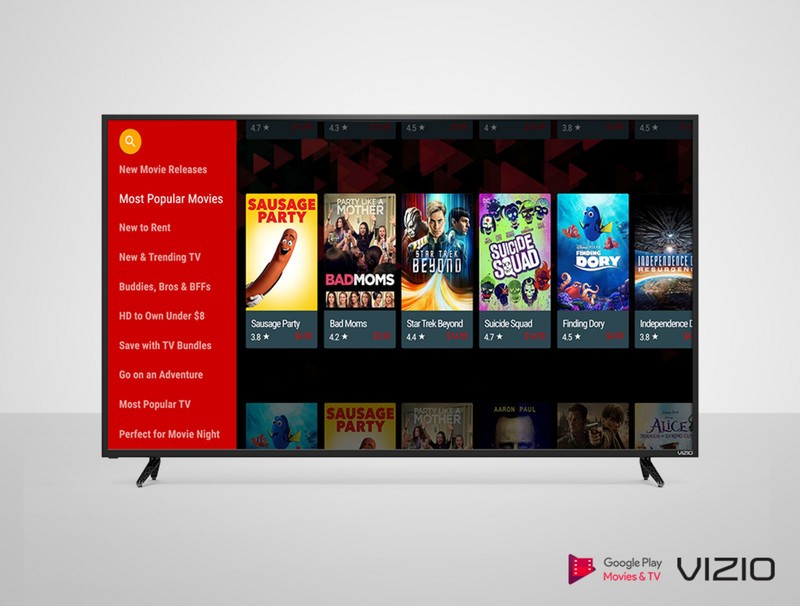
Vizio previously used Google Cast as the only smarts for its TVs, but the company rolled out an actual interface for the TVs earlier this month following customer feedback. The company was also fined $2.2 million by the U.S. Federal Trade Commission for improperly collecting customer data and selling that data to data brokers.
Google Play Movies and TV is also available for Samsung’s smart TVs, LG’s WebOS TVs, Roku and of course, Android TV and Chromecast. Play Movies and TV also integrates with Disney Movies Anywhere, and most recent Disney releases come with a code for a digital version of the movie that can be added to a Play Movies and TV library.
Learn more about Google Play Movies and TV
Mantis Headphones complete your PlayStation VR experience!

Clip on headphones are a great alternative to earbuds.
Stepping into another world is a part of the awesome glory of enjoying a game in VR. If you don’t have a decent pair of earbuds, or headphones though, you won’t really be able to truly immerse yourself in the experience. I’ve been using the earbuds that originally came with my PlayStation VR since I picked it up in October, but the truth is that I hate earbuds. Finding a pair of wired headphones that fit comfortably just hasn’t been happening for playing in VR, so of course, I was curious about Bionik’s Mantis headphones.
These bad boys clip directly onto the PlayStation VR headset, deliver excellent sound, and are a solid alternative. I spent some time with them, and I’ve got everything you want to know right here!
Read more at VRHeads
‘Hamilton’ app helps you get tickets, take embarrassing selfies
Hamilton: An American Musical is the most popular Broadway production in recent memory, and now it’s coming to your phone — beyond the soundtrack (and mixtape) you’ve had on repeat the last two years. Hamilton: The Official App has just about everything a fan could ask for including $10 ticket lotteries, a merch store, stickers and updates from Lin-Manuel Miranda himself. And yes, you can even put yourself on the $10 bill or don your favorite Schulyer sister’s dress. It’s all very zeitgeisty and best of all, available on Android and iOS.
In the future, it’ll also include “exclusive” access to tickets, some sort of augmented reality functionality and, speaking of the soundtrack, interactive karaoke songs. If you’ve annoyed your friends because you can’t stop singing “Room Where It Happens,” this might be the best app you download all week.

Source: Google Play, iTunes, Hamilton Broadway
Depression simulator ‘Please Knock’ arrives September 7th
Please Knock on My Door is a conversation about depression via video game. Developer Michael Levall created the indie title about his own experiences with depression and the mind-numbing routine of making games. “Every single thing in the game that you get to go through or read through or whatever has some kind of connection to either a true experience that I’ve had, just copy-pasted into the game, or it’s based on an emotion that I’ve felt and I’ve extrapolated that and made a story out of it,” he told Engadget back in March. The game is nearly ready; it will release for PC on Steam and Origin this September 7th.
Depression is a common experience for many in gaming, including those who spend their time working in isolation as independent developers. “I have met many people in our industry who either are or have suffered from depression, and it shouldn’t come as a surprise,” Levall said in March. “For many of us, our work is our passion. The downside to that is that working overtime leads to burnout, which in itself is a gateway to depression. There is also the economical stress of working as an indie developer, or the stress of knowing how hard it is to find a new job should your studio go bankrupt or your project (is) shelved.”
Source: Steam
Behind EA’s push to put more women in sports games
Until two years ago, there was no way to play female characters in FIFA, the world’s most popular gaming franchise. But EA Sports changed that with the introduction of FIFA 16. That’s because, for the first time ever, the studio revealed its flagship game would feature women soccer players. It was a great move toward diversifying the game’s plot, albeit a risky one considering its core demographic: young men. That doesn’t mean FIFA players aren’t open-minded. But in an industry with a reputation for being misogynistic, EA Sports made itself vulnerable to potential backlash. It turns out the company needn’t have worried: FIFA 16 quickly became one of the best-selling titles of the year.
EA Sports’ push to put more women in its sports games didn’t begin with FIFA 16. Back in 2011, the company announced that its then-upcoming hockey game NHL 12 was getting its first female playable character. This decision came after 14-year-old Lexi Peters penned a letter to EA asking why there weren’t any girls in NHL, and why her brother could make a character that looked like him but she couldn’t. “It is unfair to women and girl hockey players around the world, many of them who play and enjoy your game,” Peters wrote. “I have created a character of myself, except I have to be represented by a male and that’s not fun.”
As IGN reported at the time, that letter eventually made its way to David Littman, NHL 12’s lead producer, who was so touched by it that he immediately tried to figure out a way to make Peters’ wishes come true. “Lexi’s letter was a wake-up call,” he said in 2011. “Here’s a growing audience playing our NHL game and we hadn’t done anything to capture them.” In the end, Peters got more than she hoped for: Her face became the default for anyone who wanted to create a female character in NHL 12.

NBA Live 18.
Fast forward to today and EA Sports has taken these inclusion efforts to a new level. In addition to the past two editions of FIFA, as well as the soon-to-be-released FIFA 18, the developer’s next move is to bring WNBA teams to its basketball franchise. Starting with NBA Live 18, which launches on PlayStation 4 and Xbox One in September, official WNBA rosters will be represented in the game. That means you’ll be able to play with athletes like Allisha Gray, Brittney Griner, Maya Moore and the 2017 WNBA Draft’s first pick, Kelsey Plum.
And let’s not forget about EA Sports’ UFC 2, which came out in 2016 and features none other than renowned mixed martial arts fighter Ronda Rousey on the cover alongside Conor McGregor. All told, you’ll find 45 women characters in the MMA game, compared to more than 200 men. While that’s still a large disparity, the company is at least moving in the right direction. In 2014’s UFC, for example, the franchise’s first title to feature female playable characters, there were only eight, including Holly Holm, Miesha Tate, Cat Zingano and, of course, Rousey.
In FIFA, meanwhile, there are 15 women’s national teams, each of which includes roughly 23 players. Naturally, that includes the US squad, led by players such as Alex Morgan, who shared the North American cover of FIFA 16 with arguably the world’s best soccer player, FC Barcelona’s Lionel Messi. All in all, EA now has pro female athletes in most of its sports franchises, including FIFA, NBA Live, NHL, and UFC. The only one missing is Madden, which is complicated considering there aren’t many professional American football leagues for women across the world. Still, EA could let you create your own female player, as it did with NHL 12.
EA is alone in its efforts to put more women in sports games. The company’s direct competitor 2K Sports isn’t doing anything to move the needle. Its most popular game, NBA2K, doesn’t feature any playable female characters — and it doesn’t look like it will anytime soon. 2K Sports declined to comment for this story. Meanwhile, Cam Weber, senior vice president and group general manager at EA Sports, tells Engadget that the company had to find ways to make its games more appealing to wider audiences. Most importantly, he said, EA needed to recognize the phenomenal athletes who compete in soccer, basketball, MMA and other sports. “We want to inspire sports fans of all shapes and sizes, backgrounds and genders from all over,” he said. “It’s important that we can make a positive impact on the world in the games that we do.”
“If you want to make games that appeal to women, you need more women on your development teams as well.”
Weber said that while he doesn’t have a daughter, many members of his team do and they use that as motivation to develop increasingly diverse games. “We believe we’re at our best when we give opportunities to anybody,” he said, “no matter where they’re from, no matter their gender.” He adds that in order for women to be represented accurately, fairly and respectfully in games, the change must come from behind the scenes first. “If you want to make games that appeal to women, you need more women on your development teams as well.” He said this is an area where EA has made “great progress” over the past few years, claiming that the company spends “a lot” of time, energy and resources on ensuring that more female devs work within EA Sports. (EA didn’t share any internal stats that would corroborate his statement.)
Aside from making progress with its sports games, EA is carving a similar path in other genres as well. Last year, the company launched Mirror’s Edge, an action-adventure platformer with a female lead. Meanwhile Star Wars Battlefront II, which is scheduled to arrive in November, will feature a campaign mode starring a strong female character of its own. And with the upcoming FIFA 18, Weber said there’s going to be “really prominent” female in “The Journey,” the game’s popular story mode.

“The industry is starting to realize that there is a strong fanbase interested in human stories outside of the conventional gruff, brooding white dude.”
Anita Sarkeesian, executive director of FeministFrequency.com, said that what tends to perpetuate the invisibility of women protagonists in games is having an old mentality. It’s the “games with female protagonists don’t sell” or “the all-male writing staff doesn’t know how to write for women,” she said. Still, Sarkeesian said she’s been “cautiously optimistic in the past year or so,” as developers such as EA are clearly making progressive efforts. “The industry is starting to realize that there is a strong fanbase interested in human stories outside of the conventional gruff, brooding white dude.” According to the Entertainment Software Association’s 2017 report on the gaming industry, 37 percent of the “most frequent” video game buyers were female.
“We, the girl gamers, have been living under the male shadow.”
Jennifer Franco, 28, plays EA Sports games regularly. She said she got into FIFA in 2003, and that she’s been waiting for women to be featured in the game basically all her life. “We, the girl gamers, have been living under the male shadow,” she said, “Most games are meant for boys, not girls, and that is changing for good. FIFA 16 was a huge breakthrough, but there’s always room for improvement.” That improvement, she said, could come in the form of playing with professional female clubs in FIFA, which currently isn’t possible. When asked if this is something that could happen in future, EA’s Weber said the company had nothing to announce right now.
Weber did say that this shift is major part of EA’s long-term business strategy, claiming that the company will continue investing in women, both in games and in its hiring practices. “You’ll see continued expansion on features, characters and themes that represent a broader audience,” he said. “But in the coming years, without getting too detailed about it, you’ll see a bit of a shift in our approach to how we market, deceive and even talk about our brand in EA sports.” Only time will tell if others will follow suit.
MalwareTech’s arrest shows hacking is still a dangerous game
Many hackers are people who just “happened” into discovering they were good at something that, until recently, wasn’t a career path in school. The calling chose them; their current lives are a result of blindfolded pin-the-tail-on-the-donkey with jobs and technology. Except it’s a game they never know is completely legal or not, and usually neither do the cops. The game is really more Russian roulette than child’s play.
It has been like this for decades, and it’s a hell of a way to live. I’m guessing no one understands this more than a UK-based hacker named Marcus Hutchins, also known online and in the press as “MalwareTech.” Hutchins never wanted anyone to know his name; he was just the guy who noticed that the eejits behind WannaCry forgot to register a domain that acted as a “kill switch” on the nasty, fast-spreading ransomware. He then spent the next few days helping people get out from under a ransom scheme that had hospitals locked up (threatening lives).
Hutchins wanted to keep his identity secret, he told press, because he was fearful of the retaliations he might face for shutting down WannaCry. To his own outrage and dismay, his name and personal details were discovered and published by UK tabloids The Sun, The Daily Mail, and The Mirror. The man hailed as the “NHS hero” tweeted, “I always thought I’d be doxed by skids (people in hacking forums), but turns out Journalists are 100x better at doxing.”
If that was a rude awakening to Hutchins, then what came next was surely a shock to the system from which he may never recover. In July and early August, he was in the US to attend the Black Hat and DEF CON security conferences — a week-plus junket of hacking and security events, trainings, talks, and parties where it’s more or less a given that those working in the field are required to attend.

As Hutchins boarded the plane to fly home to the UK last Wednesday afternoon, he was arrested and detained in Las Vegas along with another researcher. He was taken to a detention center and then moved to an FBI field office. US prosecutors slapped Hutchins with a grand jury indictment, alleging that between July 2014 and July 2015 he helped make and distribute the Kronos banking trojan.
“Defendant MARCUS HUTCHINS created the Kronos malware,” the indictment states.
Hutchins was temporarily cut off from the outside world while he was held; there was a period of about a day in which he could not be reached. He didn’t have a lawyer for 48 hours. His friends and family panicked. Infosec Twitter lost its mind (and would continue to for quite some time, and for some very good reasons, which we’ll get to in a minute). Attorneys who represent hackers were on it like lightning finds the unlucky kid on a golf course during a storm. While Hutchins settled into a Las Vegas jail for the weekend, his friends rallied to pull together an online donation page for legal funds.
In a bizarre coincidence, the same day of Hutchins’ arrest, the Bitcoin wallet holding WannaCry’s ransomware funds was emptied.
As the federal indictment document hit the internet, the world learned that the 23-year-old researcher is facing six counts and up to 40 years for allegedly creating, spreading, and maintaining Kronos. The banking trojan is as nasty as it is clever.
According to ThreatPost, Kronos harvested banking credentials using “Web injects made for every major browser to modify legitimate banking websites.” Then when you log in to your bank, “the web injects look for additional information from the victim, details that are generally not required upon log-in such as ATM PINs or personal information to help with security questions.” Kronos came with a built-in security system that fights off other trojans, as well as updates for those who purchased and ran the trojan — it was a black market product with a price tag of $2K (at the time-period the indictment covers).
To be clear: We have no idea if Hutchins actually has anything to do with Kronos or not. Hutchins denies wrongdoing and is pleading not guilty. Monday he was out on bail and scheduled for transfer to a Milwaukee, Wisconsin courtroom to face charges early Tuesday morning; that appearance has been postponed until August 14th (next Monday).
Hutchins is not allowed to use the internet, his passport has been confiscated, and his movements are tracked. According to researcher and friend of Hutchins, Kevin Beaumont, “He is not allowed to communicate with the co-defendant named in the case. That name is blacked out on the indictment. Neither Marcus’ lawyer nor Marcus know who the co-defendant is.”
When the public found out Hutchins had been nabbed by the FBI, saying that press and infosec had lost its collective mind in several directions would’ve been an understatement. Part of that had to do with the shock and implications of the case and its situation. Though part of the hysteria could’ve been attributed to the fact that very little actual news came out of this year’s two big domestic hacking conferences, which mainstream and corporate press had thrown more money and people at than ever before.
Quantity over quality in coverage in cybersecurity journalism is the worst it’s been, Def Con is a magnifier, and Hutchins once again just happened to be the ant under their looking glass. Every reporter in the world wrote a story on it. Some of them were baseless character attacks, because clickbait is, as clickbait does, I guess.
None of which helped anything that was going on in the infosec world. Many rallied to support and defend Hutchins with legal fundraising and letters to the judge. Those letters countering impressions left by press of Hutchins’ guilt, while those close to the situation published information crucial to anyone following the case, showing a situation far less black and white. Even Orin Kerr explored the question in the Washington Post asking, The Kronos indictment: Is it a crime to create and sell malware?
Unfortunately, online infosec and press chatter also erupted into ugly infighting, limelight-chasing, and posturing. Hutchins’ online life has been combed over and picked apart by people with good intentions, simple curiosity, as well as those seeking negative attention.
The case has shaken up security research communities — and for a lot of good reasons. People who write, reverse, and research malware are scared and angry. Some are proudly proclaiming they write code and are unafraid of sudden arrest, others comment, I do too, and I’m afraid. Again. Because it’s easy to say “my code can be used for anything outside my control, good and bad” it’s just as easy for authorities to condemn you on the same principles.

What happens with Hutchins will be watched closely by everyone. It’s going to set serious precedents for vulnerability research and affect the lives of everyone who writes and reverses malware, in and out of the US.
US attorney Tor Ekeland told press that regardless, what has happened with Hutchins created shockwaves that destabilize relationship-building between the US government and hackers. “There are major implications for cyber security,” he said. “By doing this they’ve made the internet less safe because nobody in their right mind is likely to help the US Government stop attacks now.”
There is a chilling effect here that will leave its mark on every researcher. Commenter Doctor Syntax accurately summarized the vibe saying, “The one bit of solid evidence that’s emerged seems to be that he wrote an explanatory post about some code which was then sent to a Github repository and subsequently incorporated in the trojan. If that’s what the FBI mean by writing malware then I’m sure a lot of people who’ve published code on Github … answered questions on Stackexchange, and the like should avoid visiting the US.”
Infosec is thinking about all of this right now. They’re thinking about how fragile their lives are, and just how much is out of their control, no matter how hard they fight for understanding and legitimacy. They’re also thinking that a trip to DEF CON can end with being abducted by the FBI, cut off from the world, and facing the end of their lives as free people — with no warning, and for crimes they may not have done.
It’s a shadow that can consume you if you’re not careful.
Images: Roberto Baldwin / Engadget (Def Con); Chris Ratcliffe/Bloomberg via Getty Images (Marcus Hutchins)
 AIVAnet