


Up your game and save money with these Razer deals on Amazon
Razer remains a dominant force in the world of PC gaming peripherals thanks to its wide-ranging lineup of popular mice, keyboards, headsets, and mouse pads. If you’re looking to take your gaming to the next level, we’ve handpicked some of the best Razer deals on Amazon right now, including some of our all-time favorite accessories that are currently available for discounts of up to 26 percent off.
Razer Firefly Chroma mouse pad ($46)
Mouse pads are generally treated as an afterthought, but a good one can make a big difference when you’re gaming for extended periods of time. Not only does the Razer Firefly look great thanks to its built-in, customizable LEDs, it also features a micro-textured surface for increased comfort and mouse accuracy. The LEDs on the sides and bottom of the Firefly offer a wide array of customized lighting effects and can sync with your other Razer Chroma peripherals to create a brilliant desktop ambiance.
The Razer Firefly mouse pad is now $46 on Amazon. This price is for both the soft and hard versions of the Firefly.
Buy it on Amazon for $46
Razer Naga Chroma MMO mouse ($59)
Although designed with MMO players in mind, the Razer Naga will please gamers of all stripes who want extra inputs built right into their mouse. The older Naga was one of our favorite gaming mice and the current model is even better, with an upgraded and more precise 16,000 DPI sensor. Nineteen programmable buttons – including a 12-button thumb grid – give you plenty of inputs for a customized setup suitable for virtually any game, from arena-style shooters to MMOs and Mobas. Chroma LEDs offers a myriad of built-in lighting options, and the mouse connects with other Chroma-enabled devices for a desktop setup that reflects your unique style.
A $21 discount on Amazon brings the Razer Naga wired gaming mouse down to just $59.
Buy it on Amazon for $59
Razer Mamba Tournament Edition mouse ($70)
If the Naga has a little more than you need button-wise and a simpler gaming mouse is more your speed, the Razer Mamba Tournament Edition is a solid and highl rated alternative that earned an enthusiastic score of 8.0 from our review team. The Mamba sports an ultra-precise 16,000 DPI sensor that’s similar to the Naga’s, placing it among the most sensitive and accurate mice on the market. Rubberized side panels provide a secure grip for extended gaming sessions, and the Mamba also features nine programmable button inputs and a tilt-click scrolling wheel.
The Razer Mamba Tournament Edition normally goes for $90, but a $20 discount brings the price down to $70 on Amazon.
Buy it on Amazon for $70
Razer BlackWidow Ultimate mechanical keyboard ($81)
Serious gamers know the importance of a good keyboard, with many favoring the accuracy and tactile feedback that mechanical keys provide. The Razer Blackwidow Ultimate is an excellent and affordable option if you are looking to take the plunge into the world of mechanical keyboards. Razer’s own highly rated mechanical switches provide increased speed and precision over standard rubber dome keyboards, and are rated for up to 80 million keystrokes during its life span. The keys are fully programmable, and customizable green backlighting adds to the keyboard’s distinctive Razer look.
The Razer BlackWidow Ultimate mechanical keyboard comes in at just $81 on Amazon after a tidy $29 discount. If the audible clicking sound of mechanical keys is an annoyance, the Stealth model with silent switches is also available for the same price.
Buy it on Amazon for $81
Razer ManO’War wireless headset ($149)
The final entry on our list — and another one of our favorites — is the Razer ManO’War headset. The ManO’War offers latency-free 7.1 virtual surround sound via 2.4GHz wireless connectivity and 50mm neodymium magnet drivers that help you can hear every in-game detail without lag. The digital microphone is retractable and thick padded ear cups provide maximum comfort during extended gaming sessions. Programmable Chroma LEDs add custom lighting options to the sleek appearance of the ManO’War headphones as well.
The wired version of the Razer ManO’War gaming headset earned a great score of 8.0 in our review, and you can now get the wireless model for $149 on Amazon after a $21 discount.
Buy it on Amazon for $149
MORE DEALS
- Best Raspberry Pi 3 DIY Bundle Deals and Discounts
- TruVision Computer Reading Glasses Deal: Score a Pair for Just $30
- Best Laptop Deals, Sales, and Specials That Can Save You up to $230
Looking for more great deals on tech and electronics? Check out our DT Deals to score some extra savings on our favorite gadgets.
Update: Removed Expired offers and updated pricing.
Android may soon tell you when your Bluetooth headphones need to charge
Why it matters to you
If you use Bluetooth-connected devices, you likely know the pain of being out and about, only to have your headphones run out of battery.
Android may soon get a helpful feature for those that use Bluetooth headphones — the ability to tell you exactly how much battery your Bluetooth devices have left. The feature recently gained support from the Android Open Source Project (AOSP), XDA Developers reports. What that means is that Android, by default, will allow users to check their Bluetooth devices battery on their phone.
Now, as noted by some engineers in the original post, some third parties — including Samsung, LG, and OnePlus — have supported the feature in their software for some time now, as has iOS. So in this case, Google is finally adding a feature to stock Android devices that others have been thinking about for a while. It is also not clear exactly when the feature will make its way to a full Android release — though considering the next Pixel is rumored to do away with the headphone jack, it wouldn’t be all that surprising to see it pop up in Android O.
We also do not yet know exactly how the feature will be implemented on Android. As noted in a report from The Verge, the battery status may show up in a notification or somewhere in the settings. Thankfully for phone manufacturers, it looks like the feature is customizable, so they can have it show up wherever they want or wherever it fits into their software.
Android O is the next major release of Android and its set to bring a number of new features. For example, as we noted in our hands-on review of the latest Android O Developer Preview, notifications are set to get revamped with Notification Dots — making the operating system a little more like iOS. On top of that, users will now also be able to snooze alerts and set them to pop up at a later time. To do that, you drag a notification to the right-hand side of the notification shade, and a little clock icon will appear. Tap on that will bring up the ability to reschedule the notification. Another major new feature in Android O is “Copy Less,” which basically uses machine learning to predict when you want to copy and paste text and the feature will do it automatically.
Spotify reaches 60 million paid subscribers in streaming music milestone
Why it matters to you
Spotify remains the most popular paid music streaming service, and continues to grow faster than its competitors.
The world of streaming music may still have issues with profitability, but as Spotify reaches 60 million paid subscribers, it remains the fastest growing market participant in this space.
The Swedish company announced its new subscriber milestone, along with other performance metrics for the month of July, and stated that it currently has over 60 million paid monthly users. As of June, the company had over 140 million monthly users overall, though the majority of its listeners are streaming music via the company’s free tier, which includes advertisements, and which lacks mobile on-demand playback.
The streaming music service had 50 million paid subscribers in March, meaning that it gained 10 million subscribers in just four months. That means Spotify is outpacing the growth of its competitors, including Apple Music, which boasted 27 million paid subscribers as of June — a gain of about 7 million since Apple Music reached the 20 million subscriber milestone last December. Spotify operates in over 60 markets around the globe.
Spotify is currently a privately held company, but its executives are considering bringing the company public. Music streaming firms have generally remained unprofitable, with Spotify and other players in this space frequently requiring cash infusions to remain in operation, but investors may now see the light at the end of the tunnel.
Many of the financial issues facing Spotify stem from its ad-supported free tier, which the company operates at a loss in order to lure paid subscribers. Investors in the company likely hope that once it goes public, it can be transformed into a profitable enterprise by some form of re-think when it comes to the free tier, with income fueled by a increased number of paid monthly subscribers.
Steadily increasing growth on the subscriber side of the business likely has leaders of Spotify feeling a bit less of a tug at their collars from the company’s financiers, even if the company’s long-term business plan may still need a bit of adjustment to ensure that it achieves and maintains profitability.
In the meantime, the company is close to signing a new deal with Warner Music — a necessity before it goes public, according to Reuters.
DNA-based sunscreen could get stronger the longer you wear it
Why it matters to you
Innovative sunscreen could help battle cancer by getting stronger as it’s exposed to more UV light.
It goes without saying that sunscreen is pretty darn crucial in defending your skin against damaging, cancer-causing ultraviolet (UV) light. But commercial sunscreen could certainly bear improvement — like, say, if you only had to apply it once, and subsequent exposure to UV light only made it stronger!
While that feature is not yet available, new research from scientists at Binghamton University, State University of New York (SUNY) suggests that it one day could be. In a study published in the journal Scientific Reports, Binghamton researchers developed a transparent crystalline DNA film which becomes more effective at blocking UV light over time.
This ultra-thin film was formed from a solution of liquid DNA (derived from salmon sperm, although it’s probably best not to think about that when you’re lying on the beach during your vacation), which was then spread on a sheet of glass and allowed to dry. In trials, the DNA film blocked 90 percent of UVB light (responsible for tanning and sunburn) and 20 percent of UVA light (which is theorized to be responsible for premature aging). Both of these are linked with skin cancer, which makes this a potentially invaluable discovery. Most impressive of all was the fact that the film got more effective as it was exposed to more UV light, although the team isn’t yet sure whether this is a block of reflecting or absorbing light.
In addition to sunscreen, the film could also be used to help reduce the risk of dehydration, since it was found to reduce evaporation in areas on which it had been coated. The researchers additionally theorize that it might be useful for accelerating wound healing.
Okay, so rubbing yourself all over with DNA sounds all kinds of wrong, but if it means that you don’t have to reapply your sunscreen every couple hours, it would totally be worth it.
“In terms of next steps, we are currently working hard to better understand how UV light alters the structure of the DNA films,” senior study investigator Guy German, assistant professor of biomedical engineering at Binghamton University, told Digital Trends. “We are also investigating methods to improve film UV attenuation.”
The eventual goal, German said, is to develop a product that can be made commercially available to consumers. Hey, if there’s some way this work could be combined with other innovative creations like Yale University’s sunblock that binds to the skin or even this nifty sunscreen-dispensing wearable, they could really be onto a winner!
A heatsink that works is a beautiful thing

Beat the heat in VR with this heatsink!
The fact that Daydream heats up your phone is no surprise, but the fact that you can mitigate this issue can be news to plenty of people. We took the time to test out a heat sink for Daydream and see whether it really did make a difference in our VR experience.
Read more at VRHeads
Dive into the world of Philips Hue with a refurb Starter Kit for $45
Our friends at Thrifter are back again, this time with the most affordable way to get into the Philips Hue ecosystem!
We’ve seen a lot of Philips Hue deals lately, and they’ve all been quite popular. The folks at Daily Steals are getting in on the fun now, and are offering a refurbished 2nd-gen Starter Kit (white) for just $44.99 when you use the coupon code THRFTRHUE5. This is a $5 discount from the everyday Daily Steals price, and makes it $10 less than buying one at eBay. Brand new versions of this Starter Kit are selling for $64.99 at Amazon currently.

This kit comes with the Philips Hue Bridge and two A19 White LED Bulbs.
- Enhance your home with soft white lighting, controlled remotely wherever you are. Set timers and light schedules, automating your lights to make it seem like someone is home even when you are away.
- With everything you need to get started, this easy-to-use kit comes with two A19 LED smart bulbs, able to fit standard table lamps and the Philips Hue Bridge that can control up to 50 lights.
- Install the LED lights as you would install ordinary bulbs. They are pre-paired with the Hue Bridge, which allows you to control smart-bulb-equipped lamps and overhead lights via the Philips Hue App.
- Easily expand your lighting system with accessories (sold separately), such as a Hue Dimmer Switch, Hue Tap, or Hue Motion Sensor. Pair it for automation with your existing Nest or SmartThings system.
- With voice control for Alexa, Apple HomeKit, or Google Assistant, each kit includes two dimmable soft white A19 bulbs, a Hue Bridge, ethernet cable, power adapter, manual
If you’re picking up the Starter Kit, you’ll also want to grab yourself a discounted Hue Motion Sensor for its new low price of just $22. Daily Steals is offering a 90-day warranty on the refurbished kit, and also has a 30-day return policy.
See at Daily Steals
More from Thrifter
- Tips for leveraging Uber as a side gig
- How to buy and resell your wedding decor
For more great deals be sure to check out our friends at Thrifter now!
Unlock VR mode in ‘Alien: Isolation,’ if you dare
Alien: Isolation is a terrifying game, even before you add VR to the mix. But, for those of you dying to experience the survival horror in all its immersive (underwear-spoiling) glory, you can now play it on the current-gen Oculus Rift. An alpha version of the “MotherVR” mod that works with the original game is available to download right now. Installation is straightforward too: simply copy a DLL from the archive into the game folder and you’re good to go. Just be sure you have the nerve to take it on first.
Although Alien: Isolation came with a hidden Rift DK2 mode, it wasn’t previously compatible with the consumer version of the headset. And, despite releasing a bunch of DLC, it seems Sega never felt there was enough demand to release a VR update. That hasn’t stopped the game’s fans from taking the DIY approach with the mod — hurrying it out it as an alpha so others can get their hands on it immediately.
Alas, the experience isn’t without its hitches. The VR mod is designed for seated play only and works with an Xbox controller or keyboard and mouse. There are also no snap-turns — which could make for a queazy ride — and scaling issues mean that interactive objects can be hard to focus on. Fortunately, these are known bugs that the mod’s creator /u/Nibre is working on fixing. Additional features are also in the pipeline (including Vive support). It is an alpha after all, so it’s best to jump in and test it for yourself. That is, if you have the guts (and the stomach) for it.
Via: Road to VR
Judge rules lawsuit claiming Apple broke FaceTime can proceed
Apple was hit with a lawsuit earlier this year that claims the company purposefully broke FaceTime on iOS 6 in order to push people to upgrade to iOS 7. And as of late last week, Apple failed to get the suit dismissed as District Judge Lucy Koh ruled that iPhone 4 and 4S users can pursue claims against Apple.
The whole situation is a result of Apple wanting to reduce the cost of using third-party servers to manage FaceTime calls. Doing so was costing the company millions of dollars per month in fees, so with iOS 7, Apple changed the way FaceTime functioned so that the third-party servers weren’t used as often. However, users of iPhone 4s and 4Ss were still using iOS 6 so, allegedly, Apple let a security certificate lapse in order to break FaceTime for iOS 6 and force customers to upgrade their operating systems.
In its attempt to get rid of the lawsuit, Apple claimed that users didn’t suffer economic loss because FaceTime is free. But in her decision, Koh said, “Plaintiffs paid for their iPhones, and FaceTime is a ‘feature’ of the iPhone and thus a component of the iPhone’s cost. Indeed, Apple advertised FaceTime as “one more thing that makes an iPhone an iPhone.”
Apple also tried to argue that iPhone users weren’t entitled to FaceTime service saying that the Plaintiffs “have no right to uninterrupted, continuous, or error-free” FaceTime. To which, Judge Koh responded, “Plaintiffs do not allege that FaceTime operation was interrupted, or that it contained errors. Rather Plaintiffs allege that Apple in effect made FaceTime unavailable to owners of iPhone 4 and 4S devices…The unavailability of FaceTime is different from ‘interruptions’ or ‘errors’ in FaceTime.”
The plaintiffs are seeking both loss and punitive damages in amounts that will be determined at trial.
Via: Reuters
Source: District Court Decision
The exquisite art and subculture of Def Con’s (unofficial) badges
A series of tweets sent me and other Def Con attendees scrambling to get to the Caesers Palace pool as quickly as possible. I cut short a conversation, shoved my gear in my bag and ran out of the press room without an explanation. I was after a piece of art. A piece of tech. But mostly I was excited about adding to my growing collection. I was on the hunt for Puffy, one of dozens of unofficial Def Con badges available for sale at the annual hacker conference from build-teams from all over the world. It’s a piece of electronics shaped like a fish, and I decided I must have it.
For myself and other attendees, it’s a bit like a treasure hunt. Waiting patiently for a tweet that’ll reveal the location of a sale of a blinking PCB (Printed Circuit Board) that we’ll wear around our necks like futuristic Mr. Ts. To the builders, it’s participating in a community that grows every year.
This year’s official Def Con badge is, well … disappointing. A few weeks ahead of the conference, the organizers dropped the news that there would be no special badges and no challenges. A huge blow to the attendees that have come to expect the conference would give them a unique keepsake filled with puzzles, tech or even radiation. Instead, the official event badges (the badge that actually gets you into the conference) are homages to yesteryear. The main “human” badge looks like the Def Con 1 badge. It’s a nice throwback, but people have come to expect more.
But while the conference proper was trying to how to go forward without using the company that has been designing the badge for years, a community of badge makers toiled away for months well ahead the opening day in Vegas trying to get their creations ready. Some of the design concepts were thought up years ago and only recently came to fruition. Others were thought up at last year’s conference and are the result of 12 months of hard work. What’s on display around the necks of those willing to part with cash are the fruit of many hours, burnt fingers from soldering and frustratingly mundane nights of flashing (adding the base software).

This year, the community outdid itself with features like botnets, games, RPGs, challenges, amazing art work and so many blinking lights. With prices ranging from free up to a few hundred dollars, the badges are far from money-making projects. Between design, testing and final assembly, even with the PCBs being created at factories, the actual work done by the individuals numbers in the hundreds of hours. When asked about the biggest obstacle to building a badge, one of the team members of the Mr. Robot Badge said, “Time. That’s the answer you’re going to hear from absolutely everybody that’s building a badge.” That crew alone lost three weeks because of shipping components between team members in other states.
Some creators are just hoping to break even, at least when it comes to hardware costs. Others are using the money to raise cash for a good cause. The DC801 badge is helping to fund its hackerspace, 801 Labs. But mostly, it’s a labor of love with the creations referencing pop- and hacker-culture and the conference theme of “community, discovery and the unintended uses of technology” with a “retro-futurist” vibe. You know, 8-bit stuff.
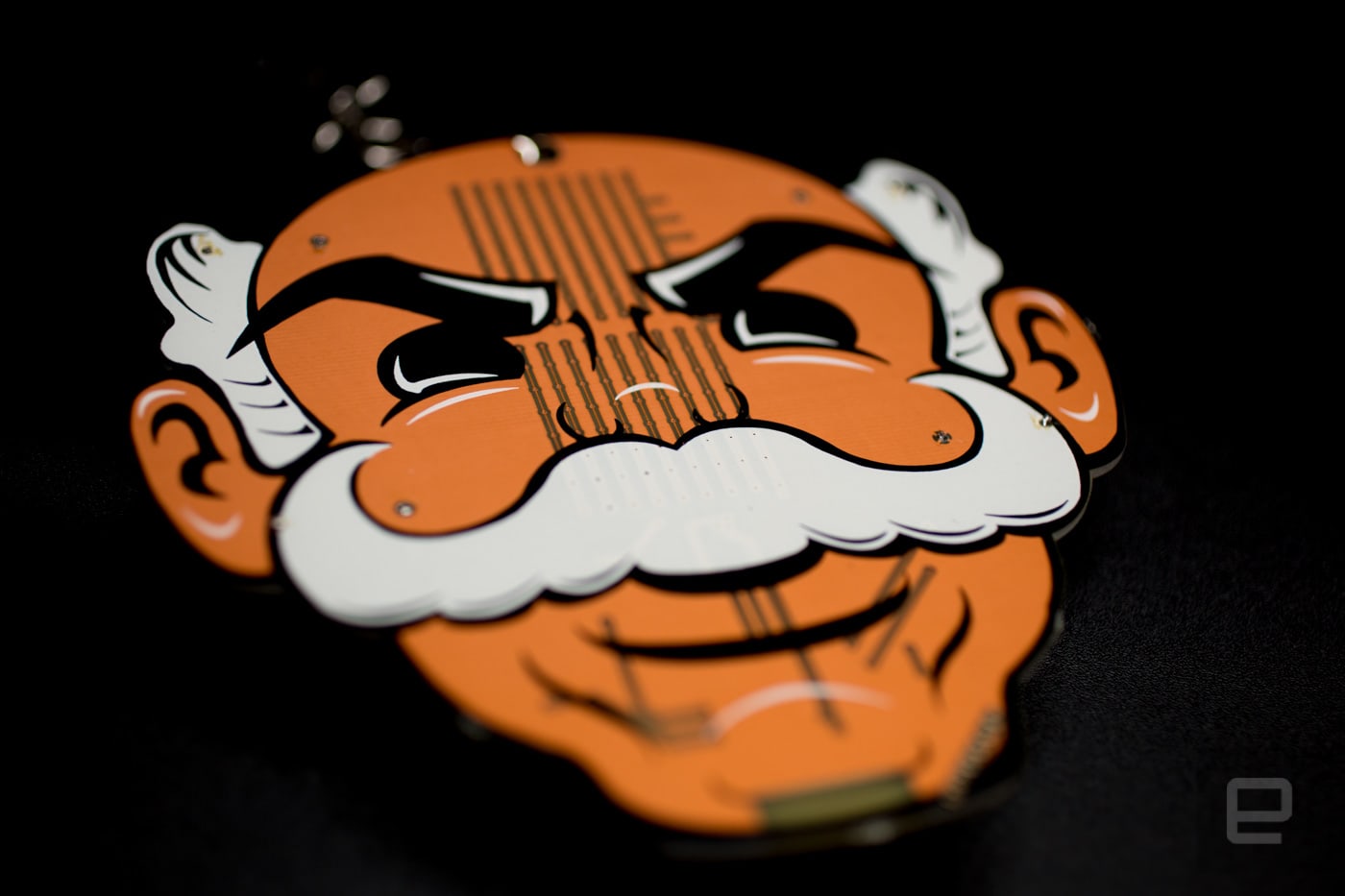
One badge that made a splash this year that’s based on a TV show popular with Def Con attendees is the Mr. Robot badge. The unauthorized face of the show made an appearance on Twitter before the conference even began. One of the team members who goes by @MrRobotBadge (many Def Con attendees insist on anonymity) noted that their badge is the key to an ARG (augmented reality game). Clues are being dropped on Twitter and within the badge itself as players try to determine, “Who is Mr. Robot?” Clearly something ripped directly from the show itself.
In addition to the ARG, the orange face also includes Tetris, Snake, Paint and what the team calls “wireless fun.” Like many of the badges, there’s a sense of discovery attached to them. You don’t just buy one — you investigate it. You dig into its secrets. It’s a thrill for the users and creators. “I love watching people getting to learn about the badge and actually use them and wear them around and be happy that they have it,” RuShan, a team member of the DC801 party badge, told Engadget.

DC801 party badge worked off the Caesars Palace theme and designed a sheep with a Hermes hat from Roman mythology. It has the requisite LEDs but also a tiny display and BLE. The designers created a badge that unlocks features as you attend events. It truly is the party badge. But it also interacts with other badges like the AND!XOR badge over a botnet. The badges are talking to one another and in some cases, battling.
Meanwhile, this is the AND!XOR’s team’s second year building a badge, and like last year, they went with the owner of everyone’s favorite shiny metal ass, Bender. But this time crossed with Hunter S. Thompson. The response they got last year to the Futurama character caught the team a bit off-guard. They tweeted the location of their sale on Twitter, and all hell broke loose. “Thirty seconds later we hear screams and all six elevators open up at the same time and people just start flooding in.” Zapp of team AND!XOR said. There were 300 people and only 70 badges available.

This year, they’ve bulked up their inventory (over 400), and Bender does more than just blink. Like the DC801, the robot is part of a botnet. It talks to and battles other nearby AND!XOR badges in a kind of low-level RPG battle. In addition to the screen showing you your character as it fights random strangers, it plays GIFs, games like a Flappy Bird clone (Flappy Defcon). You can also control the LEDs that line the teeth and make up the eyes and end of the cigarette, connect via an official app and even rickroll yourself. (BTW, I rickrolled myself.) It even has airplane mode, because of the WiFi and Bluetooth radios.
Like a lot of the other badges, and in theme with the show, you can hack it. Access to the badges is usually via USB or GPIOs (general-purpose I/Os). Attendees can modify the software or even create their own hardware add-ons. They are hackers, after all, and well, hackers are gonna hack.
But the level of complexity isn’t without its issues. The AND!XOR team ended up having to flash badges with new firmware. My personal DC801 badge also needed a flash after the buttons stopped working. Both were done without any fuss. The AND!XOR folks even set themselves up at a vendor booth and tweeted out their location for badge owners to get their Benders updated. Software, while not easy, isn’t quite as tough as hardware, which The Ides of Def Con and Mr Blinky Bling teams learned the hard way.

“It’s a lot of work. A lot of heartache. A lot of headache and a lot of late nights. Eventually you end up making them work, but the hardest thing with any manufacturing is yield,” John Adams said. Their badge’s “yield” included an issue with the CPU and the footprint it sits on. It’s a 64-pin piece of silicon on an 8-millimeter-by 8-millimeter square that the team had to reflow to the board in their room with a very fine soldering gun and a microscope. Unfortunately, that created another issue with the LEDs that don’t handle reflow and heat very well. It meant spending the night before Def Con sitting in a hotel room getting their elaborate badge ready for the masses.
The result is an impressive badge that resembles an old handheld console with the case ripped off. Like the DC801 badge, it also pays homage to the Caesars Palace venue with a botnet RPG of Roman characters (spoiler: There’s an Easter egg to make your character Bender).

Team member Bill Paul worked on the electrical and firmware, and wrote a bunch of the apps. Adams worked on additional apps and brought the game to life with game designer Egan Hirvela. Plus, being long-time Def Con attendees, they added a “constant retry” to attacks as redundancy to deal with the conference’s extremely noisy wireless environment. But even experience doesn’t protect you at Def Con.
The Mr. Blinky Bling team deals with hardware on a daily basis. That’s their business — they create custom badges for events. But when their badges showed up to Def Con on Thursday from the manufacturer in China, there was a deviation from the final test boards they received. These “final” boards were missing a diode, and the badge wouldn’t work with AA batteries. “We’re in Vegas — there’s no time for this,” said Blenster, co-founder of Blinky-Bling, reacting to the situation.

Most of the badges had already been paid for by Kickstarter backers, and many of those had opted for the less-expensive AA-battery version. So they got on the phone and Twitter and started looking for 250 LiPos (rechargeable lithium polymer battery). It turns out the Car Hacking Village had the batteries the team needed.
The badges with new batteries were handed out to backers at no extra cost. But while I was picking up mine, people were throwing down a few extra dollars to help cover the cost of the new piece of hardware. “The badge community really came together for us and helped us brainstorm ideas and looked for batteries for us,” Blenster said. Some hadn’t met in real life before the conference.
At the beginning of Def Con, the badge makers had a get-together. For months, many had corresponded on a dedicated Slack channel about what they were building. Over the internet, they talked ideas, traded tips and shared the names of companies for sourcing components. Now they gathered in a small beige conference room, marveling at each other’s creations, trading badges and telling stories of last-minute changes.

The community and its Slack channel are the only reason Kerry Scharfglass finished his exquisite dragonfly Sympetrum badge, based on the book The Diamond Age: “It was instrumental in the willpower to finish.” Scharfglass worked on his badge almost entirely alone (his mom did the silkscreening), and while it doesn’t have a battlemode or screen, its form-factor and random color cycling of LEDs are spellbinding. Yet it also also has an IR sensor, and when multiple badges are within sight of each other, they sync up their color variations.
It’s that level of detail that makes these badges so intriguing and collectible. Hardware is hard. Thousands of hardware products have popped up on crowdsourcing sites in recent years, and only a very small percentage of them ever actually make it to backers on their promised ship date, if ever.

These teams have been able to accomplish just that (some with the help of Kickstarter for funding). Still, all of the badge-makers were concerned that maybe their creation wouldn’t sell. That the Def Con hordes would look at their badges, turn up their collective noses and head to the next session about IoT or car-hacking.
Instead, people watched their phones for Twitter clues on where sales would take place. They stalked the creators and stopped strangers walking the halls to inquire about the hardware hanging around their neck. People bring hundreds to dollars to get as many badges as possible.
It’s a club within a club of like-minded hackers and researchers joining together to share their latest findings and just catch up with old friends in the middle of Sin City. But nowhere is that bond of long-term friendship more apparent than with the Telephreak badge that’s actually a motorcycle vest. Conceived four years ago on the drive back from Def Con, the “badge” is the brainchild of ch0l0man. Each vest has the area code of the wearer along the bottom of the back and the Telephreak name stitched across the top for select wearers.

When asked if they would do it again, every badge maker I talked to said yes. Even with the technical setbacks, concerns about cash flow and last-minute scrambles for batteries haven’t deterred them.
As I spoke with The Ides of Def Con team, Paul said, “we’ll probably make it a lot simpler next year.” Adams talked about hardware changes they could have made that would have led to an easier build with fewer issues. But after listening to Adams wax on about better chips and LEDs and how those components would have yielded fewer issues, I finally butted in.
“You say you want to do something simpler, but it sounds like you’re already figuring out a way to make another complex badge for next year.”
“Yeah, you’re right,” he admitted. “I’ll tell you: if you could make a board this complex and make it repeatable, increase the yield and reduce the failure rate, why not?”

In the end, Puffy sold out before I was able to find the team behind the badge. But I’m guessing they’ll be back next year with something better, and like other attendees, we’ll be waiting, cash-in-hand, for our own piece of hacker art.
What we’re using: The Razer Blade and switching back to Windows
Welcome to IRL, our series dedicated to the things that Engadget writers play, use, watch and listen to. This week, Features Editor Aaron Souppouris explains his switched to Windows and a new laptop, after an extended stint dedicated to MacBooks and Mac OS. How did that work out?
Aside from a few months with the “lamp” iMac and a brief affair with Linux, I grew up exclusively using Windows. That changed in 2011, when I traded my aging Sony Z1 laptop for a MacBook Pro. After just a year with macOS, I became the type of person who uses a MacBook, iPad and iPhone, and never really considered anything else. And so I watched last fall’s MacBook Pro announcement with great interest.
I was hoping to upgrade from my mid-2015 15-inch Pro, which, even when I bought it, was a little long in the tooth. But what Apple offered up was far from what I wanted. The Touch Bar seemed, and still seems, less convenient than function keys for someone used to keyboard shortcuts; the dearth of ports bothered me a little too, but it was the marginal CPU and GPU improvements that really stung, and the sharp like-for-like price increases only compounded my decision: It was time to look beyond Apple, and back to Microsoft, for my next laptop.
This might sound strange if you’ve never been immersed in Apple’s hardware ecosystem, but buying a new Windows machine can be a little scary. There is so much choice, so many different factors to consider. Even among Microsoft’s hardware options, you find vastly different takes on what a PC even is. I began asking myself what I actually wanted from a laptop; I’d spent so long letting Apple dictate a narrow set of options, I wasn’t really sure.
So I made a little checklist for what I needed. I travel a fair amount, so portability is quite important: I didn’t want anything heavier than my 4.5-pound MacBook. Battery life isn’t a huge concern for me — I only need enough juice to get me from outlet to outlet, and perhaps see me through the occasional live blog. In terms of ports, USB, USB-C, HDMI and an SD slot would be ideal. Performance is by far the most important factor for me: I have Photoshop running near-permanently, I like training neural networks to do stupid things and I also use InDesign, Premiere and Illustrator very regularly.
Then there’s gaming. The switch to Windows would grant me access to a giant library of games — should gaming performance be a consideration too?
I looked at tons of machines, but none of them were really a good fit. The front-runners were the Surface Book, which is immaculate but too small, and Dell’s XPS 15, which is super-portable but not quite powerful enough for my needs. It soon became clear that, at least in terms of performance, a gaming laptop was perfect for someone switching from a “Pro” Apple system to Windows.
I’ve got a strange affection for ASUS’ ROG lineup, but the models I like tend to weigh the same as me, and so I found myself looking at Razer’s laptops. I guess it makes sense: The Blade Stealth, Blade and Blade Pro essentially seem like ultra-powerful, matte black versions of the MacBook Air, the 15-inch Macbook Pro and the old 17-inch MacBook Pro. Sure, they’re a little gaudier — especially with the illuminated green snake logo and Chroma keyboard — but I was reassured that you can turn off all of the lights, should you wish.
After reading through countless reviews, I settled on a Razer. More specifically, a Razer Blade. It had almost everything I was looking for. The model I picked had an i7-6700HQ processor, a 6GB Nvidia GTX 1060, 16GB of RAM and a 1TB SSD. The screen — a 14-inch 3,200 x 1,800 panel — was a little smaller than I wanted, and it doesn’t have an SD reader, but the next option up in Razer’s range is the Blade Pro, which, despite being impressively thin, wasn’t quite portable enough, thanks to its 17-inch display.
It’s now been six months since I picked up the Blade, and I’m happy. But it took me nearly all of that time to get there.
Life with Windows
Switching over from macOS to Windows was simple enough. Almost all the apps that I use daily — Chrome, Creative Suite, Slack and Steam — offer the same or a better experience in Windows vs. macOS. But there are some I still miss on a daily basis. For the past few years, I’ve used Tweetbot for my personal Twitter and Notational Velocity to both write and take notes. If there’s a Windows app equal to Tweetbot, I’ve yet to find it, and I’ve tried using Simplenote (the note-taking service that Notational syncs with) for writing, but it lacks the streamlined interface and keyboard shortcuts of the app I’m used to.
Perhaps the hardest thing to come to grips with on the software side is Windows itself. It’s almost back to Windows 7 in terms of simplicity, but I still struggled for weeks with basic navigation. On macOS, I launch everything through Finder, and using the Start Menu for the same thing proved tricky. Running apps by pressing the Start key and typing works fine, but the rest of Finder’s functionality is sorely lacking in Microsoft’s implementation.
The main issues are that file searching through the Start Menu is very hit-and-miss, and that Windows 10 ignores your browser and search preferences, opening them in Edge and Bing, respectively. The former, as best I can tell, is because Windows’ file system isn’t journaled like macOS’s, while the latter seems like a desperate and user-hostile way of fighting Google’s dominance in those markets.
After a while struggling — and even installing third-party apps to divert Start Menu searches back to Google and Chrome — a friend recommended I try Wox, which is essentially a Finder/Alfred clone for Windows. It loads apps just as well as the Start Menu, opens web links and searches according to your preferences and also taps into the Everything disk-journaling app for near-instant file searches.
My remaining issue is one of troubleshooting. I can customize macOS with my eyes closed through System Preferences or Terminal, and diagnosing and fixing problems also comes naturally. In Windows, tweaking simple things often becomes a game of cat-and-mouse as I search through the inexplicably distinct Control Panel and Settings menus. This isn’t really a knock against Windows; it’s more that I’m still getting attuned to the way Microsoft has organized things.
Life with the Blade

My first impressions of the Blade were great. Its black aluminum shell is very attractive, and it’s slightly thinner and lighter than my old Pro. The 14-inch 1800p display is attractive, with well-balanced colors, good max brightness and only moderately reflective glass. The black levels aren’t quite as deep as Apple’s, but this doesn’t get to the point where it really bothers me. I run Windows at a 200 percent scale, so my desktop resolution is effectively 1,600 x 900, which can be a little cramped, especially coming from a MacBook with a larger display. Part of me wishes I’d gone for the 1080p matte version, but I do appreciate the extra sharpness in Creative Suite.
Two things I was very worried about at first were the keyboard and the trackpad. I’ve tried some atrocious Windows laptops over the years, but I didn’t really find much to complain about here. The keyboard is a little shallower than my MacBook’s, sure, but it has better travel than Apple’s new models. And the trackpad, after tweaking a few settings, is nearly as accurate and smooth as my MacBook’s. I usually have a mouse plugged in for gaming and a tablet for Creative Suite anyway.
Everyday performance outpaces my older MacBook, as you’d expect, but battery life was a huge problem. When I first started with the Blade, I was getting highly erratic results: Sometimes it would last six hours, other times just two. That inconsistency meant that, when it came to picking a machine to take with me on a work trip, I opted for the old MacBook every time. (It’s almost two years old, so the battery isn’t perfect, but it’s still good for around four hours.) I finally got around to working out what was wrong after returning from my last trip away, and I think I’ve fixed the issue by changing a mixture of Windows-, Intel- and Nvidia-specific settings. I now regularly get around five hours unplugged, in exchange for slightly less smooth performance.
Then there’s that other big problem with gaming laptops: fan noise. Out of the box, the Blade was beyond loud. Its idle noise was similar to my MacBook’s at full load, which itself isn’t exactly quiet when the GPU kicks in. When playing even simple games, the whine was so unbearable that I either had to use headphones or turn the game volume up high. Thankfully, a firmware update (which apparently came out in March, but I only found out about it a few weeks ago) changed the fan curves so significantly that there’s barely any noise coming from it at idle now. It still has the capacity to be a noisy machine when gaming or rendering video, but it rarely gets as loud as it once did, and playing something like Dead Cells barely registers.
The one downside I haven’t been able to mitigate in any way is heat. While it never gets dangerously hot, I basically use the Blade exclusively at a desk because of how warm it makes my lap. Maybe in the winter it’ll be a nice feature, but right now my apartment is 85 degrees and it makes me want to die.
MacOS or Windows?
I’m using the Blade a lot now, but I still haven’t managed to ditch the old MacBook Pro entirely. I wrote the majority of this article on my couch with my MacBook on my lap, partly because of the heat thing and partly because I still feel a little more comfortable working in macOS.
On a regular workday — I’m writing this on a Sunday — I tend to sit at my desk with two laptops in front of me. I’ll write and edit articles, chatter away at colleagues and generally browse the internet on my MacBook, while heavy tasks — Creative Suite, mostly — are designated to the Blade. When I’m not at my desk, it’s a mix. Razer’s machine has slightly stronger WiFi range than the Mac, so I take that out with me when I’m working on my balcony. On the other hand, because the Pro is so much cooler, it’s my go-to couch computer. It’s a pretty ridiculous setup, I know, but for now I’m stuck between two computers, not entirely happy with either.
The one thing I am 100 percent satisfied with is the Blade’s gaming performance. I haven’t really been a “PC gamer” since the mid-2000s, but now I guess I have to label myself one. Outside of … being outside (where the Switch and 3DS are my go-to machines), it’s only platform-exclusive games like Persona 5 for PS4 that I play on consoles now.
While there are very few games that are playable at the Blade’s native 1800p resolution, I can basically run everything on “high” settings at 1080p. The keyboard is comfortable enough at a desk that I need only plug in a mouse to get playing, and when I’m playing a game better suited to a pad, I tend to neatly stow the Blade behind my TV. An unexpected side effect of welcoming a gaming PC into my home is that I canceled my plans to buy an Xbox One — Microsoft has essentially pledged to treat Windows and Xbox as equals when it comes to exclusive game releases, so there’s really no need.
I’ve heard that switching OSes can be a slow process. An old colleague of mine took about three years to unlearn Apple and finally switch back to Windows, gradually replacing MacBooks with Ultrabooks and iMacs with Surface Studios. I might get there too, but I’m wavering slightly. Since I picked up the Blade, Apple has promised pro-level Macs, and Nvidia has started supporting macOS. Maybe the next MacBook refresh will come with a more “Pro” Pro. If I’m not fully acclimated to Windows by then, it’ll be a difficult proposition to refuse. But until that happens, I am very happy to be giving the Blade a shot. And at least, whatever happens, I have a gaming system that’ll last me half a decade.
“IRL” is a recurring column in which the Engadget staff run down what they’re buying, using, playing and streaming.
 AIVAnet