


Augmented Empire brings an awesome story-drive cyberpunk strategy game to Gear VR

It’s time to join the revolution.
It’s a dark future with revolution brewing amongst the lower tiers of citizens in New Savannah, and the elite gathering for the ascension of Willa Thorne to the ultimate citizen, Level 10. When her estranged mother breaks in to warn her and is then gunned down, a series of events is set into motion that will take Willa far from the hallowed halls of the city and into the depths of the world she inhabits. With a robot aiding her, a plan to make a heist, and revolution on the horizon, there is a lot going on.
Augmented Empire delivers an awesome experience that will have you begging for one more mission as you try to unravel what is going on. It’s available on Oculus now, and we’ve got all the details for you here!
Read more at VRHeads
How to fix OnePlus 5 battery life problems
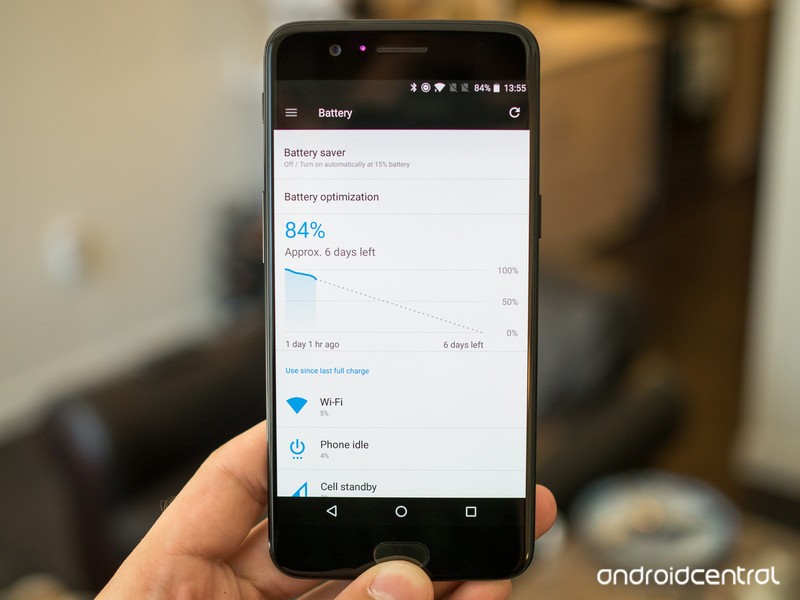
No matter how long your battery lasts, there will always be someone who needs more.
The OnePlus 5 has above-average battery life thanks to its lean software, efficient processor, and 3300mAh battery. But not everyone uses their phone the same way or has the same demands from the limited power supply — some of us need more longevity than others. This difference in configuration means that some may have a combination of factors leading to lower battery life than expected.
If you’re in need of longer battery life from your OnePlus 5, we have a handful of great tips to help you out. Read on.
Look for unnecessarily power-hungry apps
Misbehaving apps are one of the most common causes of bad battery life, and they can often be the easiest ones to diagnose as well. Head into your Settings and then Battery to see your usage over the last charge cycle — it’s best to do this near the end of the day to get the most complete picture of things.
Apps should be conscious of your battery life, too.
You’ll see many typical battery drainers here like Wi-Fi, cell standby, Android System, and the screen, but if you see an individual app cracking the top few places in usage there’s a good chance it’s doing something it isn’t supposed to. Now if you just spent the last 3 hours streaming Google Play Music, it’s understandable that it used a lot of battery, but if you haven’t opened Facebook all day and it took up 8% of your battery, it’s worth investigating.
The best thing you can do is reboot your phone or at least force close the app in question, followed by clearing its data to start over from scratch. If it continues to drain your battery, consider uninstalling it altogether.
Turn off Google Play auto updates

Google Play has this pesky habit of automatically updating apps, and sometimes with app updates actually changing its settings back to auto-update apps. You can understand why, because most people don’t want to think about app updates, but then again most we want to control just what happens on our phones too.
To save battery life, you can turn off automatic updating of apps through Google Play. Go into Google Play, open the sidebar menu and tap Settings then tap Auto-update apps to adjust the setting. Most people will be okay with letting app updates happen on Wi-Fi, but if you want to keep your battery life in check you should turn it off entirely.
Just remember to check periodically for updates or at least turn on notifications for pending updates so you don’t forget.
Turn off radios you’re not using
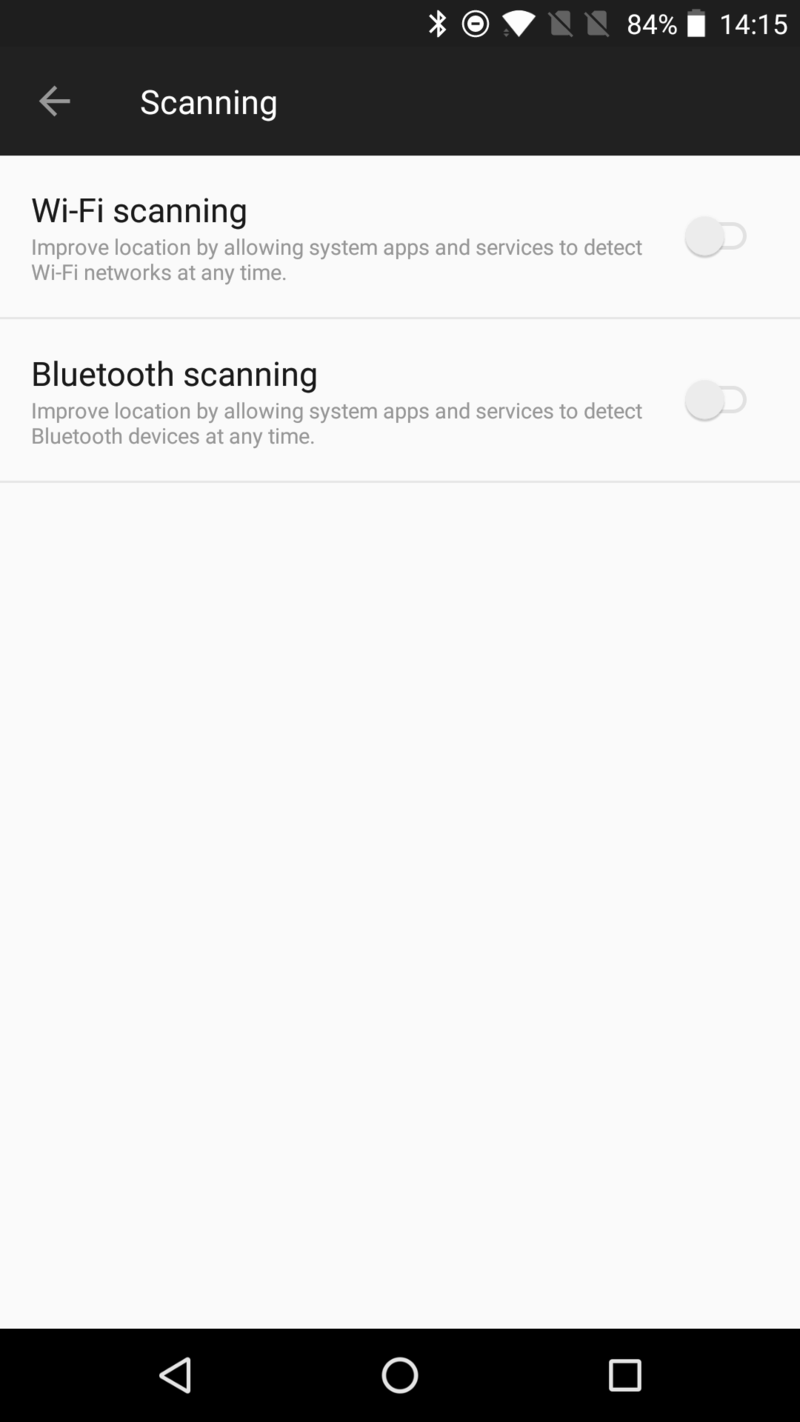
This is something simple you can to to save battery life, though the amount saved isn’t necessarily going to be substantial. If you’re not going to be using Wi-Fi or Bluetooth for a long period of time, it’s worth simply turning them off.
If you’re extra worried about battery life and want the full effect, you should also turn off the feature that lets the phone scan for Wi-Fi networks and Bluetooth devices to improve location services. You can find the setting in Settings, Location and Scanning under the menu button. You can turn off one or both as you see fit — just remember that this may negatively impact an app’s ability to accurately locate your device in the world.
Tweak your display settings
Smartphone screens are more efficient than ever, and the OnePlus 5’s 1080p panel really doesn’t use much juice, but there is still a direct correlation between screen brightness and battery usage. To save battery, consider dropping the screen brightness using the slider in the notification shade quick settings.
Extra battery life is great, but so is being able to see your screen.
Unless you can remember to constantly be on top of adjusting your brightness, the best balance of usability and battery will be simply using the “Adaptive brightness” setting. When you’re outside or in a bright room it’ll crank up so your view isn’t impacted, but when it’s darker it will save battery (and your eyes) by lowering it. Extra battery life is great, but so is being able to see your screen in every situation!
While you’re in the display settings of your phone, consider turning down the “Sleep” time. This is the interval at which your screen will dim and turn off when it hasn’t been touched. Simply moving from 1 or 2 minutes down to 30 seconds will have a positive influence on your battery life over the course of the day.
Use Battery saver mode
The built-in “Battery saver” mode does exactly what it says: saves you battery. It does so by reducing your brightness, throttling back performance, cutting back vibration, limiting location services and cuts way back on apps accessing data in the background. Adding it all up, it can seriously improve longevity without dramatically impacting your experience.
Battery saver walks a nice line of improving battery life while keeping your phone usable.
You can turn on Battery saver manually from the notification shade quick settings, or you can also set it to come on automatically — most people will choose the latter. In Settings, Battery and Battery saver you can choose when it comes on. Simply choose between 15% and 5% battery to have it trigger; if it is on, it’ll turn off automatically when you plug your phone in.
You won’t want to use your phone in Battery saver mode all of the time, but if you’re in a situation where you know your battery is draining quickly and you can’t afford to have it die on you before the end of the day it’s worth being proactive and tossing on Battery saver early.
Take advantage of Dash Charge
Yes, we know, this doesn’t exactly make your battery itself last longer — but it does help your phone get through the heavier-than-usual days you sometimes encounter. If you get to the point where your battery is draining faster than expected, and you have a long day ahead of you, the best thing you can do is toss it on a proper Dash Charge charger for a little bit.
Because of the way Dash Charge works, you can get an incredible amount of charge back in just 15 or 30 minutes — probably enough to comfortably make it through the rest of you hectic day. There’s a Dash Charge charger in the box with the OnePlus 5, and you can also get a compatible car charger from OnePlus.
OnePlus 5
- Complete OnePlus 5 review
- OnePlus 5 specs
- Which OnePlus 5 model should you buy?
- Camera comparison: OnePlus 5 vs. Galaxy S8
- The latest OnePlus 5 news
- Join the discussion in the forums
OnePlus
ASUS getting back into phones in the UK starting with Zenfone AR
After a few years away, ASUS has announced it will begin selling smartphones in the UK again.
It begins with the Google Tango powered Zenfone AR which will be up for pre-order from ASUS directly beginning on July 21.

ASUS isn’t coming back with a budget phone, then. The Zenfone AR will cost a fairly hefty £799, and the premium is certainly added with having Tango. Folks who pre-order will also get a Google Daydream View included for free, while the first 30 will get a swanky box full of goodies.
Those super early orders will come in a wooden chest with the phone, Daydream View, some headphones, a case, screen protector and a whole lot of style.
The Zenfone AR has plenty of hardware to go with the price, too. You’re getting a 5.7-inch QHD display, 8GB of RAM, Snapdragon 821 processor and 128GB of internal storage.
More: Early hands-on with the Zenfone AR
It’s also not the last phone Brits will be seeing from ASUS. While the U.S., Asia and even other parts of Europe have seen the more recent Zenfone launches, the UK hasn’t had anything since the very first Zenfone. Which wasn’t very good.
The next one we’ll be expecting to see hasn’t been announced yet, but it doesn’t take a genius to imagine that will be the Zenfone 4, since 4 comes right after 3. Nevertheless, it’s good to see another name throwing its hat into the British smartphone ring, even if the Zenfone AR isn’t probably going to attract the mass market.
Google Street View takes you aboard the ISS
Astronauts aboard the International Space Station just got an adorable floating camera, but what do we get? While nobody’s handing out free rides to the ISS, you can digitally explore it now that it’s up on Google Street View.
Since there’s no gravity, the astronauts make use of surfaces in every direction, so the Street View in space truly spans 360 degrees. But that’s not all: Google included info nodes for the curious to learn more about the station’s technical machinery and points of interest. As TechCrunch points out, there happened to be a SpaceX Dragon capsule docked to the ISS during shooting, so you can spot that too.
While Street View’s controls are a little wonky for three-dimensional navigation, it’s still a fascinating and accessible tour of a place many of us will never see in person. Start your orbital journey of humanity’s most remote manned outpost here.
Via: TechCrunch
Source: Google Street View
Tidal’s redesigned app puts more emphasis on music discovery
Tidal’s been in the news recently, as Jay-Z debuted his new album 4:44 as a Tidal-Sprint exclusive (which wasn’t without some controversy, as last-minute subscribers to the streaming music service weren’t allowed access to the album). Then, just a week later, the album was released to other streaming services (well, except Spotify). But now, Tidal has some non-Jay-Z related news: An updated version of Tidal’s app is out today, and it’s got a completely new layout. In fact, it looks a lot like Apple Music and Spotify.
Overall, there’s more emphasis on music discovery and recommendations. Now, when you pull up the Explore tab, you’ll find a new Genre + Moods section, along with suggested new artists and album at the bottom. The homepage also displays different genres and new editorial picks; it’s updated every day.

The navigation has also changed; it’s moved to the bottom, like other streaming services. The Now Playing screen has become easier to navigate as well. You can swipe right to see the queue of songs you have up next, swipe left to see new song suggestions or tap the album cover to see the album’s credits.

We always appreciate an emphasis on usability, so these new updates from Tidal are welcome. You can download version 2.0 of the app in the App Store and Google Play Store starting today.
Google brings its fancy Motion Stills GIF-making app to Android
Motion Stills has existed in a strange space for the past year. It’s a Google-made app but it’s been available only on iOS, piggybacking off Apple’s Live Photos function to create dramatic, stabilized GIFs and short videos. Android owners, Google’s main user base, were left out of the fun entirely — until today.
Motion Stills is available on Android, complete with a handful of updates. A new recording interface allows users to capture a short video with a single tap, like snapping a photo, or condense a longer recording (up to one minute long) with the Fast Forward function. On Android, Motion Stills comes with a fresh trimming algorithm that’s designed to protect against accidental camera shakes and pocket shots. Just like on iOS, users can capture their shots without an internet connection.

Google redesigned the Android app’s video pipeline so that it processes each frame of a video as it’s recorded. “By computing intermediate motion metadata, we are able to immediately stabilize the recording while still performing loop optimization over the full sequence,” the Google Research blog says. “All this leads to instant results after recording — no waiting required to share your new GIF.”
Now that Motion Stills is on Android, Google says it’s considering integrating the tech into its proprietary tools like Google Photos.
Apple users, don’t fear: When iOS 11 launches later this year, it’ll bring Motion Stills-esque updates to Live Photos. That might be one reason Google decided to (finally) move Motion Stills to Android.
Source: Google Research
Facebook Pages can now build their own communities
Today, Facebook is rolling out a new feature called “Groups for Pages,” which will let artists, brands, businesses and newspapers create their own fan clubs. The company says the idea stems from two reporters at The Washington Post who started a Facebook group called PostThis, where they interact with some of “the most avid fans” of the paper on a daily basis. Facebook says right now there are more than 70 million Pages on its platform, so this going to be great for many users who want to let their loyal supporters feel more connected to them.
Via: TechCrunch
Source: Facebook
IBM’s AI can predict schizophrenia by looking at the brain’s blood flow
Schizophrenia is not a particularly common mental health disorder in America, affecting just 1.2 percent of the population or around 3.2 million people, but its effects can be debilitating. However, pioneering research conducted by IBM and the University of Alberta could soon help doctors diagnose the onset of the disease and the severity of its symptoms using a simple MRI scan and a neural network built to look at blood flow within the brain.
“This unique, innovative multidisciplinary approach opens new insights and advances our understanding of the neurobiology of schizophrenia, which may help to improve the treatment and management of the disease,” Dr. Serdar Dursun, a Professor of Psychiatry & Neuroscience with the University of Alberta, said in a statement.

MRI scans showing statistically significant differing blood flows within the brain – Image: IBM
The research team first trained its neural network on a 95-member dataset of anonymized fMRI images from the Function Biomedical Informatics Research Network which included scans of both patients with schizophrenia and a healthy control group. These images illustrated the flow of blood through various parts of the brain as the patients completed a simple audio-based exercise. From this data, the neural network cobbled together a predictive model of the likelihood that a patient suffered from schizophrenia based on the blood flow. It was able to accurately discern between the control group and those with schizophrenia 74 percent of the time.
“We’ve discovered a number of significant abnormal connections in the brain that can be explored in future studies,” Dursun continued, “and AI-created models bring us one step closer to finding objective neuroimaging-based patterns that are diagnostic and prognostic markers of schizophrenia.”
What’s more, the model managed to also predict the severity of symptoms once they set in. These insights could lead researchers to more effective diagnostic tools and treatment options. And why wouldn’t they? IBM’s most famous AI, Watson, has already shown that neural networks are surprisingly adept at coming up with effective cancer treatment regimens.
‘Call of Duty: WWII’ takes zombies back to the front lines
Of course zombie mode is back for Call of Duty: WWII, and developer Sledgehammer Games just dropped a trailer for the undead nightmare mode. Of course, you and pals are tasked with eradicating the Nazi zombie scourge. The trailer’s YouTube description is as follows:
“Players will embark on a chilling and mysterious journey through a snowy Bavarian village in Mittelburg, Germany, as they attempt to recover priceless works of art stolen by the Axis powers in World War II. This village holds a shadowy secret key to an unimaginable and monstrous power. Nothing is as it seems in this zombies horror, as a dark and sinister plot unfolds to unleash an invincible Nazi army of the dead.”
There isn’t by way of concrete info in the trailer, aside from the fact that a Nazi scientist claims he’s created “the devil himself.” He sounds like he’d be a real blast to have at parties. There may be even more info releasing soon, but for now, you’ll just have to loop the video embedded below until Sledgehammer fills us in.
Here’s to hoping that we’ll have more news ahead of WWII’s November 3rd release date across PC, PlayStation 4 and Xbox One.
Source: Call of Duty (YouTube)
Moto Z2 Force reportedly has smaller battery than its predecessor
In April, some spec leaks gave us a look at what Motorola’s Moto Z Force follow up had in store. We learned that the Moto Z2 Force would have a 5.5 inch display, a Snapdragon 835 chip upgrade, a dual rear camera system and the return of the audio jack. Today, we get some more details thanks to specs shared with VentureBeat but it’s not all good news.
The Moto Z2 Force will have two 12-megapixel modules rather than a single 21-megapixel camera like its predecessor and the front-facing camera is unchanged at 5-megapixels. But when it comes to memory, the US is getting the short end of the stick. The US version will have 4GB of RAM compared to 6GB for other versions. And while the Chinese Moto Z2 Force gets 128GB of internal storage, everybody else gets 64GB. Every version will have a microSD slot, however, that can support cards with up to 2TB of storage. Previous leaks showed that the model would also be thinner than the one before it, but that reportedly leads to a 22 percent smaller battery — a move Motorola also made with its Moto Z2 Play.
The Moto Z2 Force will come in Super Black, Fine Gold or, for T-Mobile customers only, Lunar Grey shades and reports say that the phone’s body will be covered with a water-repellant nano coating. It’s unclear when the phone will be released, but it’s likely we’ll get that information at the Motorola launch event on July 25th.
Source: VentureBeat
 AIVAnet