


A car-tracking dongle could make self-driving systems better
George Hotz is intrigued by artificial intelligence. The man who hacked the iPhone and PlayStation 3 as a kid, has moved on to self driving cars with his company Comma AI because of the autonomous vehicle technology’s reliance on machine learning. After an initial hiccup that involved the company cancelling a device that would make cars semi-autonomous (because of a run in with regulators), Comma AI is back The new $88 Panda OBD II dongle, like most universal car interfaces, plugs into your car (1996 or newer) and gathers data.
“It’s amazing how little information there is about the plethora of sensors in your car. Information should be free,” Hotz said.
The data that is collected is usually shared with the driver and typically includes, speed, location (if the car has GPS), fault codes and a few other bits, like how much fuel is in the tank. The Panda takes it further. According to Hotz, it surfaces information that up until now, was only accessible to the manufacturer.
It supports 3 CAN (Controller Area Network, the main vehicle interface standard), 2 LIN (Local Interconnect Network) and 1 GMLAN (General Motor Local Area Network) for access to almost all of the sensors in most of the cars on the road. The dongle ships with WIFi and a USB port to interface with your computer and charge your smartphone. The result is a barrage of data. To help parse all that information Comma AI also launched Cabana a CAN analysis tool.
Cabana takes all the information from the Panda and video collected by Comma AI’s Chffr app and syncs it. Drivers can watch a video of their drive in Cabana and see how and which sensors are reacting. The only issue is that the company doesn’t actually know what each sensor in every car does. It’s counting on header files within vehicles to help figure some of that stuff out. But for anything else, it’s looking to the community to help fill those gaps.
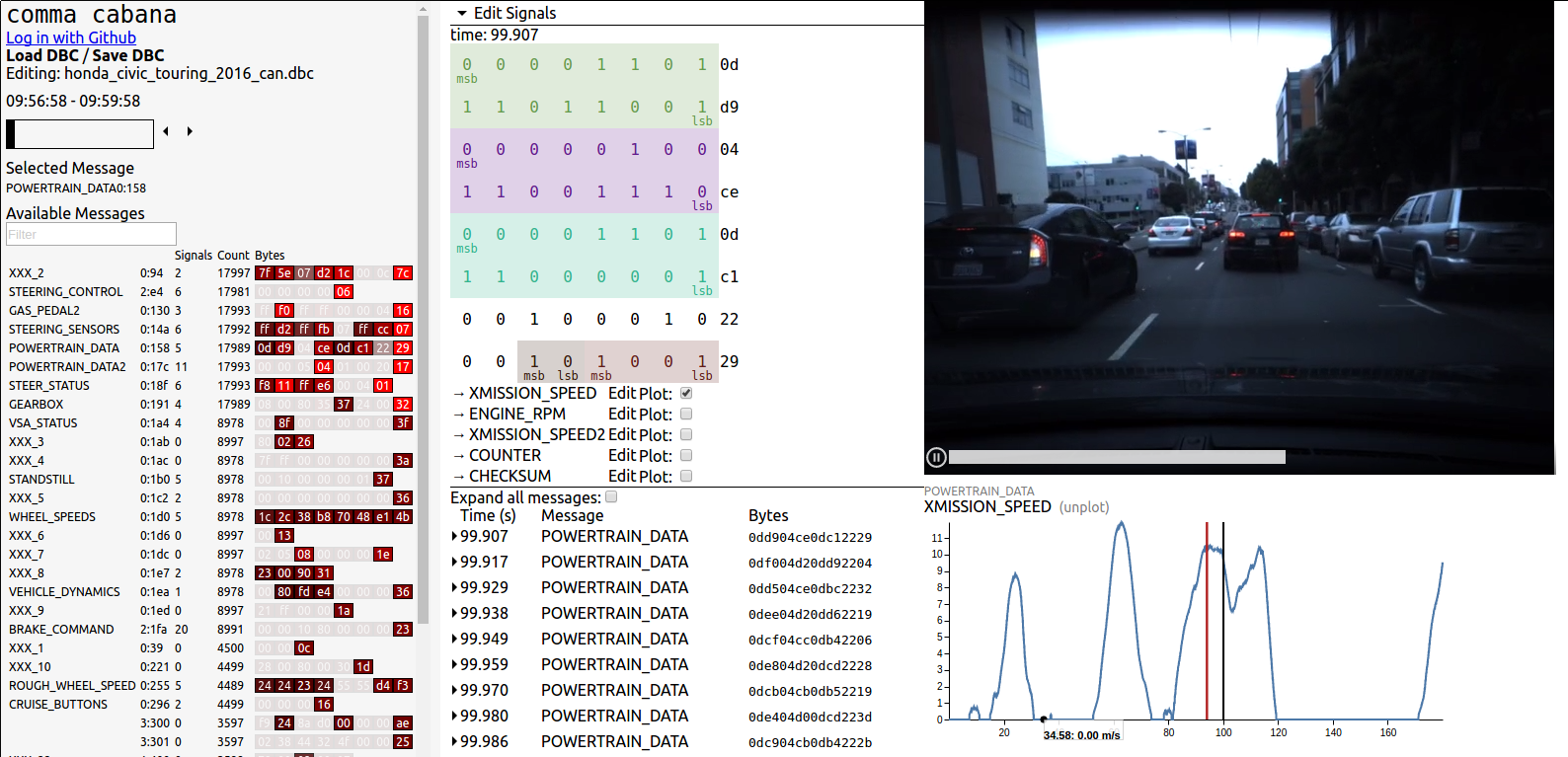
In fact the entire scheme is open source with a GitHub repo for sharing the DBC files (the auto industry’s standard file format) generated by the community’s findings. Comma AI says the goal of the open dbc project “is to build a repository with a DBC file for every car ever manufactured and democratize access to the decoder ring for your car.”
Hotz says that his company share all of its opnedbc information with the community. There won’t be an internal database separate from what the community helps build. The company is also going to release APIs so developers can build apps and services on top of what’s learned with the Panda.
“The real point of shipping Panda out to people is to create that interface that cars don’t have. We want to plug cars into computers.” Hotz told Engadget.

Hotz hopes that Panda, Cabana and opendbc will help his company generate the data it needs to realize his goal of building a self-driving car add-on for vehicles already on the road even if it takes a few years. He’s also hoping to help build a robust car hacking and car tuning community thanks to Comma AI’s low cost Panda dongle. “We’re going to make Panda the most universal car interface ever to exist.”
Pre-orders are available now with Pandas landing in customer mailboxes in about four to 12 weeks.
Source: Comma AI
Google is funding AI writers for local UK news reporting
The UK Press Association (PA) will soon hand writing duties on thousands of local news stories to robots. Cue headlines about the death of news media (seriously, though, this might be a problem).
The news agency just won a €706,000 ($622,000) grant from Google to run an automated news service with the help of a start-up called Urbs Media, according to The Guardian. The project — dubbed Radar for “Reporters And Data And Robots” — will see computers create 30,000 news stories for hundreds of local papers.
AI has been used in newsrooms in the past, but it isn’t without its faults. Tests have shown that despite being faster than humans, computers can come up short in terms of writing style and readability. And, in most cases, some level of human oversight is required. Radar is no different. The project will depend on human writers to choose the stories (on topics such as crime, health, and employment) that the AI will then write. The computers will also auto-generate graphics, video, and pictures to match the articles.
Although it may not be groundbreaking, the PA believes Radar will provide a boost to local news outlets at a difficult time. Regional news providers are struggling with shrinking budgets, while interest in localized news remains just as high. Automating articles on a mass scale is seen as a practical way of meeting that demand.
Via: The Guardian
Source: Press Association
Apple Maps Transit Directions Now Available in Calgary and Southern Alberta
Apple Maps has been updated with comprehensive transit data in Calgary, Alberta, enabling iPhone users in the Canadian city to navigate with public transportation, including the CTrain light rail system and buses.
Apple Maps transit directions are also available for buses in the smaller Southern Alberta cities of Red Deer, Lethbridge, and Medicine Hat.
Apple Maps enabled transit routing in Calgary just in time for the 2017 Calgary Stampede, which runs between July 7 and July 16.
Apple Maps gained a Transit tab in iOS 9. The feature lags several years behind Google Maps, but Apple’s public transportation support is exhaustive, mapping all station entrances and listing departure times.

At launch, the feature was limited to Baltimore, Berlin, Boston, Chicago, London, Los Angeles, Mexico City, New York, Philadelphia, San Francisco, Sydney, Toronto, and over 300 cities in China. Since then, Apple has been working to expand support for public transportation to other cities around the world.
Newer additions include Atlanta, Columbus, Dallas, Denver, Detroit, Honolulu, Houston, Kansas City, Madrid, Manchester, Melbourne, Miami, Minneapolis–Saint Paul, Montréal, New Orleans, Paris, Portland, Pittsburgh, Prague, Rio de Janeiro, Sacramento, Salt Lake City, San Antonio, San Diego, Seattle, and Singapore.
For a complete list of cities with Apple Maps transit directions, visit the iOS Feature Availability page on Apple’s website.
(Thanks, Bernd!)
Tags: Apple Maps, Canada, transit
Discuss this article in our forums
Jay-Z’s Album ‘4:44’ Ends Tidal Exclusivity and Debuts on Apple Music and iTunes
Last week, Jay-Z’s new album “4:44” debuted exclusively on his own music streaming service Tidal, and then reports predicted that the album would expand to Apple Music and other services one week later. Now, 4:44 has begun streaming on Apple Music, and is available for $9.99 on iTunes [Direct Link].
Earlier in the week, Jay-Z debuted a video for one of 4:44’s tracks, The Story of O.J., on Apple Music while the album was still a Tidal exclusive. Even during its one-week exclusivity window, 4:44 went platinum in under a week, certifying that the record has sold 1 million equivalent album units in the United States. One equivalent album unit represents one full album sale, ten tracks sold from an album, or 1,500 on-demand audio and/or video streams from an album as of February 2016.
In the midst of Jay-Z’s new album launch, Kanye West — one of Tidal’s initial sixteen artists/co-owners — was reportedly seeking to end Tidal’s exclusivity rights over his new music and break from the service (via Billboard). West was said to claim he was owed “more than $3 million” because his album “The Life of Pablo” “resulted in 1.5 million new subscribers to Tidal, for which he was supposed to get a bonus but the company hasn’t paid.”
Now, a source close to West has said that Tidal’s exclusivity rights to his music have been terminated, “based on what is alleged to be Tidal’s failure to honor its financial obligations.” West has been vocal in the past about company rivalries negatively affecting the music industry as a whole, eventually allowing The Life of Pablo onto Apple Music after first saying it would “never” happen.
In addition to Apple Music, 4:44 has also begun streaming on Amazon Music Unlimited, although Spotify has not been included in the expansion of Jay-Z’s newest album. Earlier this year, Jay-Z removed his entire catalog of music from Apple Music and Spotify, without giving a clear indication as to why, and while many of the songs reappeared on Apple Music a few days later, most of it remains missing from Spotify.
Tags: Apple Music, Tidal
Discuss this article in our forums
Apple Predicted to Become Trillion Dollar Company Within 12 Months
Apple’s stock price has declined around 9 percent from its all-time high of $156.10 in May, but Wall Street analyst Brian White believes the recent sell-off represents “yet another buying opportunity” as investors turn their focus to the so-called “iPhone 8” rumored to launch this fall.
White believes Apple remains “among the most underappreciated stocks in the world,” according to his research note distributed to clients today. A copy of the report was obtained by MacRumors.
In our view, Apple’s quarterly results will be less important this summer as investors are focused on the iPhone 8 this fall, along with the company’s raised capital distribution initiative, depressed valuation and new innovations as showcased at WWDC. We still believe Apple remains among the most underappreciated stocks in the world.
White, an Apple bull, added that the upcoming iPhone cycle is setting up Apple to reach his $202 price target over the next 12 months, which would value the iPhone maker as over a trillion dollar company based on market capitalization. Apple’s current market capitalization is around $737 billion.
Similar to the bottoming process in Apple during the summer of 2013 that drove a strong rally into the spring of 2015, we believe the bottom in the stock during May 2016 and the upcoming iPhone cycle is setting up Apple to reach our $202.00 price target over the next 12 months.
In May, RBC Capital Markets analyst Amit Daryanani also said Apple could reach or exceed a trillion dollar market cap within 12 to 18 months, with a stock price of $192-$195. Like White, Daryanani said the “iPhone 8” will be a major catalyst towards Apple’s path to a trillion dollar valuation.
White maintains the highest price target for Apple’s stock among all institutional analysts. AAPL closed at $142.73 on Thursday.
Tags: Brian White, AAPL, Drexel Hamilton
Discuss this article in our forums
FAA offers to refund drone registration fees and wipe details
Why it matters to you
If you want your five bucks back and your personal details wiped from the FAA’s database, then it’s a simple case of submitting a form.
Much was made of the launch of the drone registry in 2015, which forced hobbyist pilots to fork out five bucks to have their details sit on a database in case you decided to do something silly with your flying machine and the authorities needed to track you down.
Up to a million drone owners have so far done as they were told, hitting the Federal Aviation Administration’s (FAA) website to register their information. But then in May a U.S. appeals court affirmed an earlier lower court ruling that said the policy was in violation of a preexisting law banning regulation of model aircraft. So for the last few months, buyers of new drones have been able to fly them without first registering their details.
But the story doesn’t end there. Although the FAA is still encouraging hobbyist drone owners to register their details voluntarily, May’s ruling has led the agency to start offering a refund to registered users and for their details to be wiped from the database.
To obtain your $5 refund and have your registration details deleted, you’ll need to fill out this FAA form, which requires you to confirm that you only fly your drone for hobby or recreational use. Commercial drones still need to be registered.
Submitting the form will guarantee the deletion of your records, though you’ll need to check a box and give your bank details if you want your $5 back.
The odd thing is, another ruling could be on the way that stipulates owners of consumer drones must register their flying machine, which would mean that anyone who unregisters their drone now will have to register it again, possibly for a future system that allows a drone in the sky to be identified by officials on the ground. So is it really worth the hassle of taking yourself off the database now?
When it launched toward the end of 2015 in response to the growing popularity of remotely controlled quadcopters and the like, the FAA said its registration system would “foster a greater awareness on the part of users to learn the rules about flying safely” in U.S. airspace, and would also enable the authorities to trace ownership of a drone in the event of an incident.
The FAA also launched a B4UFLY iOS and Android app to teach owners about drone safety. The app lets you know if there are any flight restrictions at your current location. Responses could include, “Proceed with Caution,” “Warning — Action Required,” or “Flight Prohibited.”
Bluesmart’s slick smart suitcase is back, and it has brought some friends
Why it matters to you
Smart luggage takes the worry out of losing your case, laptop, and even passport when traveling.
Bluesmart started off with a single, connected piece of luggage back in 2014. It was a big crowd-funding success, with more than 10,000 backers wanting a smarter suitcase by their side. Now, Bluesmart is back with its Bluesmart Series 2 smart luggage range, and this time it’s not arriving with one suitcase, but two, along with a laptop bag and a passport holder. They’re smarter than ever before, with a new app, sensors, and plenty more. Despite launching on Indiegogo only recently, the campaign has already passed $1 million in funding.
What makes these cases smart? The Bluesmart app is the key to the suitcase, and it unlocks when you’re close, and locks when you move away. It allows you to track the case’s exact location with free GPS/3G/Bluetooth connectivity, shows the remaining battery power, and even links with airlines to show travel itineraries. While the app chats with your airline, the 29-inch Bluesmart Series 2 suitcase’s built-in weight sensors ensure you won’t pay any excess baggage fees, and alerts you if it’s likely to tip the scales over the limit.
The cases conceal a 10,400mAh battery pack to keep your phone, laptop, and other gadgets topped up with power while traveling, and its own power bank doesn’t need charging for 30 days, a major improvement over the one week offered by the first Bluesmart case. All of this is wrapped up inside a weatherproof polycarbonate body with a retractable handle, and hub-less 360-degree spinning wheels. Bluesmart Series 2’s two suitcases share the same technology, and vary only in size, and the lack of weight sensors on the smaller case. The 22-inch version is suitable for use as carry-on with 38 liters of storage space, while the larger 29-inch case has 80 liters of space inside, and is for checking in.
Joining the two cases is a 15-inch laptop bag and passport pouch. Both connect to the app for 30-days recharge-free Bluetooth location tracking, and distance alerts if you happen to accidentally leave them behind. The laptop bag contains a 10,400mAh battery charging pack with two USB ports, while the passport holder comes with a 1,000mAh battery pack for 90 days standby, and RFID protection. Both are made from weather-resistant fabric, and the laptop bag has a TSA-friendly pocket, so you won’t have to unpack everything at security.
Backers of the Indiegogo campaign can buy the Bluesmart Series 2 cases at a considerably lower price than when they hit retail stores. The 22-inch case is $295, the 29-inch is $325, the laptop bag is $195, and the passport holder is $95. Bundles are available, too. For example, a 22-inch case with the laptop bag and the passport holder is $495, or a complete set of all four Bluesmart Series 2 products is $795.
Order before the campaign ends, and delivery is expected to take place in November. Will Bluesmart pass its previous $2.2 million in funding with Series 2? It’s certainly headed that way.
Bluesmart’s slick smart suitcase is back, and it has brought some friends
Why it matters to you
Smart luggage takes the worry out of losing your case, laptop, and even passport when traveling.
Bluesmart started off with a single, connected piece of luggage back in 2014. It was a big crowd-funding success, with more than 10,000 backers wanting a smarter suitcase by their side. Now, Bluesmart is back with its Bluesmart Series 2 smart luggage range, and this time it’s not arriving with one suitcase, but two, along with a laptop bag and a passport holder. They’re smarter than ever before, with a new app, sensors, and plenty more. Despite launching on Indiegogo only recently, the campaign has already passed $1 million in funding.
What makes these cases smart? The Bluesmart app is the key to the suitcase, and it unlocks when you’re close, and locks when you move away. It allows you to track the case’s exact location with free GPS/3G/Bluetooth connectivity, shows the remaining battery power, and even links with airlines to show travel itineraries. While the app chats with your airline, the 29-inch Bluesmart Series 2 suitcase’s built-in weight sensors ensure you won’t pay any excess baggage fees, and alerts you if it’s likely to tip the scales over the limit.
The cases conceal a 10,400mAh battery pack to keep your phone, laptop, and other gadgets topped up with power while traveling, and its own power bank doesn’t need charging for 30 days, a major improvement over the one week offered by the first Bluesmart case. All of this is wrapped up inside a weatherproof polycarbonate body with a retractable handle, and hub-less 360-degree spinning wheels. Bluesmart Series 2’s two suitcases share the same technology, and vary only in size, and the lack of weight sensors on the smaller case. The 22-inch version is suitable for use as carry-on with 38 liters of storage space, while the larger 29-inch case has 80 liters of space inside, and is for checking in.
Joining the two cases is a 15-inch laptop bag and passport pouch. Both connect to the app for 30-days recharge-free Bluetooth location tracking, and distance alerts if you happen to accidentally leave them behind. The laptop bag contains a 10,400mAh battery charging pack with two USB ports, while the passport holder comes with a 1,000mAh battery pack for 90 days standby, and RFID protection. Both are made from weather-resistant fabric, and the laptop bag has a TSA-friendly pocket, so you won’t have to unpack everything at security.
Backers of the Indiegogo campaign can buy the Bluesmart Series 2 cases at a considerably lower price than when they hit retail stores. The 22-inch case is $295, the 29-inch is $325, the laptop bag is $195, and the passport holder is $95. Bundles are available, too. For example, a 22-inch case with the laptop bag and the passport holder is $495, or a complete set of all four Bluesmart Series 2 products is $795.
Order before the campaign ends, and delivery is expected to take place in November. Will Bluesmart pass its previous $2.2 million in funding with Series 2? It’s certainly headed that way.
Casio’s G Shock is the new definition of a ‘hybrid’ smartwatch
Hands up if you want a smartwatch that’s water resistant, able to resist forces felt most often by fighter pilots, connects to a smartphone, and looks super-cool on the wrist? We’re confident it’s not just our arm waving about in the air right now. While all these aspects don’t often come together in a single device, watchmaker Casio may have the answer.
Casio recently opened a G Shock store in London’s famous Carnaby Street, and Digital Trends made the trek to meet with Alex Owen, trade marketing executive at Casio, to talk about the company’s future plans. Having already released Android Wear watches, Casio is putting more emphasis on hybrid smartwatches, and will launch the first smart, connected G Shock model in the coming months. What’s more, it turns out a G Shock is pretty packed with cool tech already.
“Casio has always been at the forefront of technology,” Owen said, explaining why it embraced Android Wear early on. “We made the world’s first touchscreen watch, the world’s first weather predicting watch, and the world’s first databank watches; so it’s very natural for Casio to progress into smartwatches. Android Wear gives us so many new opportunities.”
“Smartwatches don’t begin and end with Android Wear.”
Casio has two Android Wear smartwatches, the WSD-F10 and the WSD-F20, which are a part of its Pro-Trek range. However, smartwatches don’t begin and end with Android Wear.
“Smartwatches aren’t going to be for everybody,” Owen said. “There are limitations with battery life at the moment, which is something we’re working to improve; but still, not everyone wants to charge their watch every night.”
But it’s not just battery life that stops people buying Android Wear watches.
“Then there are the aesthetics,” Owen pointed out. “Many prefer a traditional looking watch, so an area we’re focusing on now is Casio Connected, which is a hybrid smartwatch. Our new watches that come out in the fall will be centered around this. They’re designed to bridge the gap between a traditional timepiece and a full-on Android Wear watch. The will have a Bluetooth connection, but without the battery life downsides. Instead, the watches will be solar powered, and will look like a traditional Casio watch.”
Andy Boxall/Digital Trends
Andy Boxall/Digital Trends
Andy Boxall/Digital Trends
Andy Boxall/Digital Trends
Casio Connected watches will self adjust their own time, and add features like a phone finder, multiple alarms, a world time mode, and more — all controlled by an app on the phone. Unfortunately, we shouldn’t expect fitness-tracking features, which are common on competing hybrids, such as those from the Fossil Group. While the beginnings of Casio’s smart technology has been seen in the Ediface range of watches, it’ll come to the G Shock range for the first time in 2017.
You may be familiar with the Casio’s G Shock watches due to their chunky, funky design and ability to withstand plenty of abuse due to impressive water and shock resistance. There’s also a surprising amount of cool technology inside these watches. Owen explained it to us.
“I always felt G shock was a little underrated when it comes to technology,” he said. “Everyone knows they’re tough watches, but few people get to appreciate the additional technology that goes into them.”
A Tough Movement G Shock will resist g forces up to 15G.
We’re not talking about the music-controlling G-Mix G Shock models here. It goes deeper than that. A great example is its Tough Movement tech, which is found in high-end G Shock watches, and combines features like solar charging and automatically updating time. The most recently introduced feature is centrifugal gravity resistance, which goes a step beyond the already comprehensive shock protection.
“If you hit a watch against something with enough force, the internal movement gets pressed very hard against the internal shock absorbers, which affects the shock absorption rate in the future. For Tough Movement watches, each individual part is coated in resin and secured with screws to stop it moving too far when this happens.”
This clever solution means a Tough Movement G Shock will resist g forces up to 15G. Yes, 15G.The world’s best jet fighter pilots will deal with a maximum of about 12G, meaning we’d be very unlucky to experience anything close to the watch’s limit in our lives.
Delve deeper into Casio’s technology and we come to a unique solution dealing with misaligned watch hands. This is where the hands don’t always point exactly to where they should – due to impact or magnetism — which is not only frustrating, but can cause inaccurate time readings.
Andy Boxall/Digital Trends
“With Tough Movement, each cog in the movement has a series of holes that align with an LED light and a sensor. Every 60 minutes, it checks to make sure they all match up. If there are any discrepancies, it simply automatically realigns.
It’s a neat, no-bother alternative that’s way more reliable than a manual reset option, and makes sure the watch on your wrist is always as accurate as possible. Just remember, all this is squeezed into a wristwatch. Yes, a G Shock is hardly small, shy and retiring; but it’s still a pretty tight space for a lot of tech, and we’re not finished yet.
With a full solar charge, the watch could be hidden in a drawer for 22 and a half months, and still be working when you took it out.”
Solar charging is a major feature on Casio watches, and one which will be part of the new Casio Connected models too. You may assume it operates using the crystal over the face, but that wouldn’t fit in with Casio’s dedicated to toughness. On a Casio watch with solar charging, the photovoltaic cells are printed onto the watch face itself.
“There’s no point in putting a piece of glass in there that’s going to break,” Owen pointed out. “We have one of the best power reserves in the industry too, extending up to 23 months. With a full solar charge, the watch could be hidden in a drawer for 22 and a half months, and still be working when you took it out.”
For a single 24-hours day’s use, the little cell needs to see sunlight for just eight minutes, 30 minutes of sunlight through a window, or eight hours of indoor lighting. Incorporating solar power into its watches is an important step in the toughening process for Casio, because it removes the need for battery changes, which would disturb the delicate o-rings and other gaskets necessary for water proofing. Even the screws holding the watch together are important. They’re all tightened to a specific torque setting, ensuring the body meets shock proofing requirements, which is why sometimes the screw heads don’t all “match” across the body and point in the same direction.
Casio’s Connected G Shock hybrid smartwatches coming later this year will include the Tough Movement, meaning we can be sure it stays operational and in one piece, almost regardless of what we’re doing. Water resistance, high levels of durability, and long-lasting batteries are usually wish-list features on our gadgets, but Casio’s hybrid watches will tick all those boxes.
“Casio Connected is going to be our big thing for the end of the year,” Owen said.
Learning about the tech that’s already inside a G Shock, with the prospect of more to come, makes us excited for them too.
IBM’s ultimate Model F mechanical keyboard makes a brief comeback
Why it matters to you
If you’ve been pining over that IBM Model F keyboard that you lost 30 years ago, here’s your chance to buy another one.
For some people, a keyboard is a keyboard is a keyboard. If the keys don’t stick and the right letters appear on the screen when the keys are pressed, then any keyboard is as good as another. That doesn’t describe everyone, however, particularly anyone who types thousands of words a day and who’s particularly sensitive to a keyboard’s quality. For such a person who’s also old enough, the IBM Model F keyboard is probably the gold standard.
The biggest problem with the Model F, however, is that it was originally released in the early 1980s with the IBM PC 5150 and it ended production by the end of the decade. What made the Model F special was the buckling spring switch technology that IBM developed in the 1970s, and for anyone who remembers its satisfying tactile feel, there’s great news — the Model F is now available for purchase for a limited time.
Interestingly, it’s not IBM that has resurrected the Model F, but rather keyboard enthusiast Joe Strandberg, as PCMag reports. Strandberg invested roughly $100,000 on the endeavor, lining up a Chinese factory and organizing the production of Model F keyboards that are identical to the original. Duplicating the Model F design wasn’t an individual effort, however, but rather involved numerous Deskthority, Reddit, and Geekhack community members.
At the heart of the keyboard is the buckling spring switch technology that IBM developed and that provides what many people consider to be the ultimate in mechanical switch action. Today’s mechanical switch keyboards are essentially modeled after the IBM switches, aiming to provide the same responsiveness, accuracy, and comfort that created such a following, In addition, the Model F was constructed from durable materials, including more than five pounds of steel and other metals.
Time is running out to order one of Strandberg’s Model F keyboards, however. He’s only taking orders through July 31, 2017 for the first run, with a price of $325 for a metal base keyboard without keys. Key sets start at $29, and layout options include ANSI, ISO, and HHKB-style. This isn’t a crowdfunded effort, however — much of the up-front costs have already been paid and that’s the final price for a keyboard that will ship in two to three months. If you’re interested in taking a moderately priced trip back in time, then head here to order your own Model F, or you’ll be waiting until next year for another chance.
 AIVAnet