


The frantic swordfighting of ‘Nidhogg 2’ arrives on August 15th
If you’re a fan of in-person two-player games, there’s a good chance you’ve heard of Nidhogg. Its frenetic swordfighting is easy to pick up, difficult to master and oozing with Atari 2600-style visual charm. There’s only been so much you could do with its handful of levels and single-weapon gameplay, though, so it’s a good thing that a sequel is right around the corner. Messhof has revealed that Nidhogg 2 will reach the PS4, Mac and PC on August 15th, with PS4 pre-orders starting on July 18th. The title preserves the core mechanics — you’re still trying to slash through (or around) an opponent and make it to a screen on the far end of the map — but a lot has changed in the 3 years since the original.
The most obvious change, as you might have noticed, is the style. The studio decided to ‘upgrade’ to a 16-bit appearance for the sequel, so that means ’90s-like vivid colors and bitmapped graphics that let you customize your character. Also, you have more than your sword to fight with: bows and daggers help you throw curveballs into your rival’s strategy. There are ten arenas, to boot, so the game should stay fresh for that much longer. Nidhogg 2’s look is polarizing (some have complained about the shift from a serious tone to silly), but the expanded gameplay might overcome any artistic quibbles.
Source: PlayStation Blog
The best fireproof document safe
By Nick Guy
This post was done in partnership with The Sweethome, a buyer’s guide to the best homewares. When readers choose to buy The Sweethome’s independently chosen editorial picks, it may earn affiliate commissions that support its work. Read the full article here.
Everyone has crucial documents—birth certificates, passports, old photographs—that would be difficult or impossible to replace in the event of a disaster. For things you need easy access to, a fireproof document safe can make more sense than an off-site security deposit box. After subjecting five top-rated models to an actual trial by fire, we found First Alert safes are the best for most homes, and we specifically recommend the First Alert 2017F.
Who should get this
Document safes are meant to provide protection from fire, water, and to a degree, theft, without your having to keep anything off-site. They’re best for important documents—such as passports or birth certificates—or small items like hard drives or USB sticks.
To be clear, fireproof safes are not meant to be burglarproof, or to serve as impenetrable time capsules. If you have jewelry, precious metals, or anything of high value you don’t need frequent access to, consider a safe anchored to your floor, or a safe deposit box at a local bank. The fireproof document safes in this guide are also not gun safes, and should not be used as such.
How we picked and tested

The fire in progress. Video: Kimber Streams
For this guide, we weren’t looking for expensive professional installations or gun safes, but rather small, fireproof safes that fit under a desk or in a closet. This is the kind that’s heavy and secure but still ready to be lifted and moved if necessary. A document safe needs to be fireproof and watertight (so “flood proof,” too), with a locking mechanism that keeps opportunistic intruders out.
Most fireproof safes are tested and rated by the safety organization UL and the inspection firm Intertek, using the “ETL” mark. We spoke to John Drengenberg, consumer safety director at UL, about the organization’s testing procedures. He said UL tests to different ratings, depending on what kind of rating the manufacturer wants. Most household safes are rated to last 30 minutes at 1,550 °F, a standard based on modern firefighting response and how a fire typically moves through a house.
We surveyed about 200 Wirecutter readers to determine what they kept in a fireproof safe, or would plan to. Documents were the clear leader in demand at 97 percent, with digital media such as flash drives and CDs coming in second at 69 percent. A little less than half of the survey participants said they needed something suitable for jewelry, and 30 percent indicated that they wanted something for precious metals/coins and photographs, respectively. With digital media ranking so high in that survey, we required that our picks keep their contents below 125 °F, the failure threshold for digital media, according to UL.
Three major brands make most of the fireproof safes for home use: First Alert, Honeywell, and SentrySafe. We checked out every home document safe from all three companies, 35 in total. From there we narrowed the list, eliminating models that have been discontinued, were too expensive, or couldn’t fit an unfolded sheet of paper inside.
We whittled the list to five test models. We evaluated how well items fit inside, how easy the locks were to use, and how sturdy each safe seemed. Then it was time to burn. With the help of trained fire professionals, we built a 4-by-8-foot room out of plywood and two-by-fours, and installed drywall inside to radiate heat. Then we filled it with flammable couch cushions, a carpet, cardboard, and some wood, put the safes in, and lit it.
We filled each safe with the same contents: five printed photos in an envelope, a newspaper, a flash drive with various video files, and a DVD with a movie file burned to it. Within minutes, the fire was up to about 1,300 °F. We let it run its course for about half an hour before asking firefighters to put it out with a fire hose. When the safes were cool to the touch, we opened them to check out the aftermath. To learn more about our testing (and to see videos of us burning the safes), be sure to read our full guide.
Our pick

Photo: Nick Guy
The best fireproof document safe for most people is the First Alert 2017F, a smaller version of the now-discontinued 2030F that survived our tests and was our previous top pick. The two safes share the same construction and composition, but the 2017F has half the interior space. Though we haven’t yet fire-tested the 2017F, we’re confident in the results we’ve seen from First Alert safes in the past, and the company’s assurances that the 2017F is the same but smaller. The 2017F is also among the least expensive options of comparable size, and is deep enough to fit a fair number of documents.
In our active fire test, the 2030F performed just as we hoped. It kept all traces of water out, and the contents were unscathed. Neither the photos nor newspaper showed any signs of heat damage, and the contents of the flash drive and DVD were both accessible. We expect the same performance from the 2017F.
Both safes lock with a simple key and latch. We can’t vouch for how burglarproof the lock is, but it is secure enough to not pop open when you don’t want it to. Note that the locking mechanism, along with the entire exterior of the safe, was destroyed in our test fire. We had to pry the remnants of the safe open to get inside, because we had no chance of using the key (as was the case with all the safes we tested).
The 2017F has an internal capacity of 0.19 cubic feet, measuring 2.91 by 13.23 by 8.58 inches, which is large enough to hold sheets of paper without your having to fold them. It has a handle and weighs 19 pounds.
A bigger option for file folders
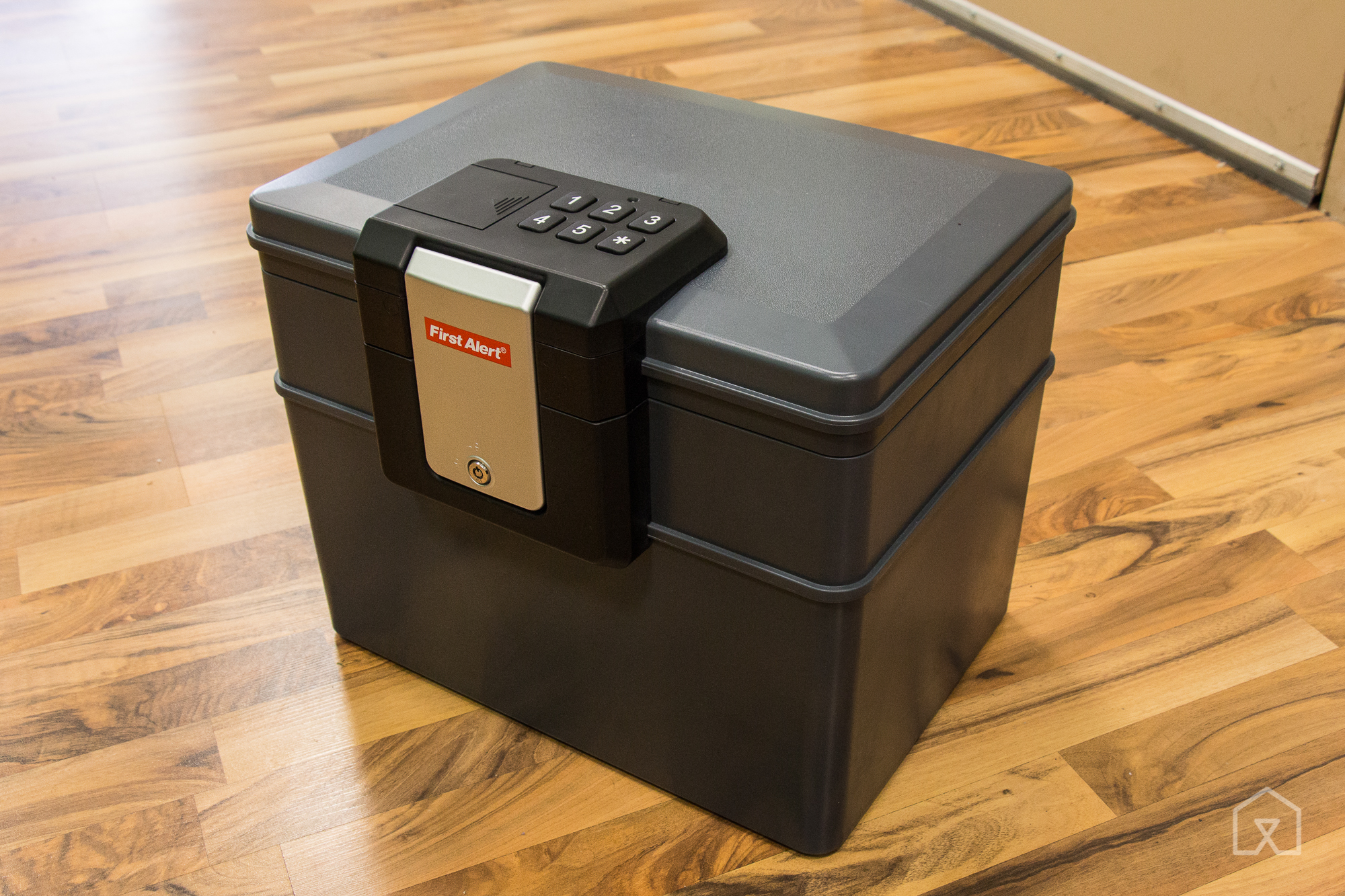
Photo: Nick Guy
The First Alert 2603DF is a larger option (with a 0.62-cubic-foot capacity) for anyone who prefers enough space to hang file folders but expects the same amount of fire and water protection. Although its design is very similar to that of the 2030F, this upgraded model also includes an easy-to-use keypad locking mechanism (with a manual-key backup).
On top of the chest is an electronic keypad, which you can use to enter a code between four and eight digits long. We like the keypad for quick access, though you’ll need the regular key if the AA batteries die and you don’t have replacements on hand.
Aside from the size difference and the keypad, the 2603DF performed just as well as its smaller counterpart. The materials we put inside survived our fire and water onslaught with no damage and remained readable, even though the safe itself was destroyed.
This guide may have been updated by The Sweethome. To see the current recommendation, please go here.
Note from The Sweethome: When readers choose to buy our independently chosen editorial picks, we may earn affiliate commissions that support our work.
Awesome tech you can’t buy yet: Put your drone and your toothbrush on autopilot
At any given moment, there are approximately a zillion different crowdfunding campaigns happening on the Web. Take a stroll through Kickstarter or Indiegogo and you’ll find no shortage of weird, useless, and downright stupid projects out there – alongside some real gems. We’ve cut through the Pebble clones and janky iPhone cases to round up the most unusual, ambitious, and exciting new crowdfunding projects out there this week. That said, keep in mind that any crowdfunding project — even the best intentioned — can fail, so do your homework before cutting a check for the gadget of your dreams.
Raspberry Shake 4D — compact seismograph
Please enable Javascript to watch this video
The Raspberry Shake 4D is a “professional personal Earth monitoring device” that puts you in the shoes of a seismologist, allowing you to track the Earth’s vibrations and predict earthquakes a few minutes before they occur. Building upon the success of the original Raspberry Shake (which was a resounding success on Kickstarter about a year ago), the Raspberry Shake 4D makes use of four precision sensors to monitor seismic activity, allowing users to observe all vibrations happening in their area, big or small.
“Now it is possible to see double the range of vibrations across all dimensions (laterally and vertically) making the 4D the most powerful personal seismograph in existence,” Ángel Rodríguez, the designer of the device, claimed. But unlike full fledged seismograph machines, which generally cost thousands of dollars, the Raspberry Shake 4D costs just a few hundred on Kickstarter.
Airdog ADII — advanced autofollow drone
Please enable Javascript to watch this video
Back in 2014, a little-known company called Airdog launched something that would transform the drone landscape forever: a quadcopter that automatically followed (and filmed) its subject, thereby eliminating the need for manual piloting. Sure, this is a standard feature on just about every card-carrying drone that’s released these days, but Airdog was arguably one of the first to take the idea and run with it. The only problem, however, was that as soon as Airdog’s kickstarter campaign gained a good deal of attention, big companies like DJI and Yuneec adapted the idea for their own products.
But Airdog’s creators didn’t let copycats deter them. They kept tweaking, iterating, and pushing their auto-follow technology forward. Now, the fruit of that labor, the ADII, is up for pre-order on Kickstarter, and it takes auto-follow to a whole new level.
With the ADII, you can customize the drone’s flight path, altitude, and shooting style before before you even start filming. That might not sound like much, but it allows you to set up the perfect shot and ensure that your drone wont hit any obstacles, without having to manually pilot the drone. Check out the Kickstarter vid for details — you won’t want to miss this one.
IllumiSoap — motion-activated soap dispenser night light
Please enable Javascript to watch this video
Remember Illumibowl? That motion-activated night light that illuminates your toilet bowl when you wake up and stumble into the bathroom in the middle of the night? If not, you clearly don’t spend enough time browsing crowdfunding sites. Illumibowl is one of Kickstarter’s biggest success stories. The company behind the device mounted not one, but two successful crowdfunding campaigns, and even made an appearance on Shark Tank at one point. But the creators aren’t stopping there. This week, the company is back with yet a new gizmo.
Just as the admittedly uninspired name suggests, the Illumisoap is based on the same core idea, but instead of lighting up your toilet bowl when you walk in, it lights up your soap dispenser. The underling tech is almost exactly the same — it’s a set of multicolored LEDs triggered by a motion sensor. That way, if you should ever need to wash your hands after doing your business, you’ll never have trouble finding the soap. Sure, it’s not quite as innovative as the original, but its certainly a lot more interesting than your average night light.
Flex E-board — all-terrain electric longboard
Please enable Javascript to watch this video
Electric longboards are an undeniably convenient way to get around the city. They’re just as quick as a bike or a scooter, but are also small enough to pick up and take on a bus or train when a longer journey is necessary. However, they also have one pretty significant drawback: they can’t handle rough terrain very well. Anything outside of smooth pavement usually means you have to pick up your board and hoof it. But what if there was a board that could handle dirt, gravel, and everything in between?
That’s precisely the idea behind Flex E-board’s new Rough Stuff longboard. Just like every other electric skate in the game, it’s equipped with a set of powerful hub motors and some lithium ion batteries to keep them spinning — but it’s also got a few other tricks up its sleeve that make it better for rough terrain.
First, a flexible deck helps absorb bumps and other shocks. Second is the inclusion of a set of interchangeable wheels. If you know you’re going to hit some less-than-ideal roads on your way, just slap on the soft 85A convex wheels and you’ll be able to charge over gravel roads.
Amabrush — automatic toothbrush
Please enable Javascript to watch this video
Tired of all the squeezing, scrubbing, spitting, rinsing, gargling, and flossing required to keep your pearly whites clean? For decades now, your only recourse from this mildly laborious task has been the electric toothbrush. But while these automatically oscillating tooth scrubbers are definitely a step in the right direction, they still don’t remove all the tediousness and time consumption from the act of brushing your teeth. What if there was a way to get the same job done, achieve the same level of cleanliness, and do it in a fraction of the time?
Enter the Amabrush, the first fully automatic toothbrush that (allegedly) finishes the job in just 10 seconds, giving you more time to do … well, anything else. Here’s how it works. The device itself is essentially a big, bristly mouthpiece. You start by shoving it in your mouth and switching it on, at which point it will oscillate at a high frequency to scrub your pearly whites. While this happens, microchannels built into the mouthpiece deliver toothpaste directly to where its needed. The whole process allegedly takes just 10 seconds, and cleans your teeth just as thoroughly as normal brushing.
Awesome tech you can’t buy yet: Put your drone and your toothbrush on autopilot
At any given moment, there are approximately a zillion different crowdfunding campaigns happening on the Web. Take a stroll through Kickstarter or Indiegogo and you’ll find no shortage of weird, useless, and downright stupid projects out there – alongside some real gems. We’ve cut through the Pebble clones and janky iPhone cases to round up the most unusual, ambitious, and exciting new crowdfunding projects out there this week. That said, keep in mind that any crowdfunding project — even the best intentioned — can fail, so do your homework before cutting a check for the gadget of your dreams.
Raspberry Shake 4D — compact seismograph
Please enable Javascript to watch this video
The Raspberry Shake 4D is a “professional personal Earth monitoring device” that puts you in the shoes of a seismologist, allowing you to track the Earth’s vibrations and predict earthquakes a few minutes before they occur. Building upon the success of the original Raspberry Shake (which was a resounding success on Kickstarter about a year ago), the Raspberry Shake 4D makes use of four precision sensors to monitor seismic activity, allowing users to observe all vibrations happening in their area, big or small.
“Now it is possible to see double the range of vibrations across all dimensions (laterally and vertically) making the 4D the most powerful personal seismograph in existence,” Ángel Rodríguez, the designer of the device, claimed. But unlike full fledged seismograph machines, which generally cost thousands of dollars, the Raspberry Shake 4D costs just a few hundred on Kickstarter.
Airdog ADII — advanced autofollow drone
Please enable Javascript to watch this video
Back in 2014, a little-known company called Airdog launched something that would transform the drone landscape forever: a quadcopter that automatically followed (and filmed) its subject, thereby eliminating the need for manual piloting. Sure, this is a standard feature on just about every card-carrying drone that’s released these days, but Airdog was arguably one of the first to take the idea and run with it. The only problem, however, was that as soon as Airdog’s kickstarter campaign gained a good deal of attention, big companies like DJI and Yuneec adapted the idea for their own products.
But Airdog’s creators didn’t let copycats deter them. They kept tweaking, iterating, and pushing their auto-follow technology forward. Now, the fruit of that labor, the ADII, is up for pre-order on Kickstarter, and it takes auto-follow to a whole new level.
With the ADII, you can customize the drone’s flight path, altitude, and shooting style before before you even start filming. That might not sound like much, but it allows you to set up the perfect shot and ensure that your drone wont hit any obstacles, without having to manually pilot the drone. Check out the Kickstarter vid for details — you won’t want to miss this one.
IllumiSoap — motion-activated soap dispenser night light
Please enable Javascript to watch this video
Remember Illumibowl? That motion-activated night light that illuminates your toilet bowl when you wake up and stumble into the bathroom in the middle of the night? If not, you clearly don’t spend enough time browsing crowdfunding sites. Illumibowl is one of Kickstarter’s biggest success stories. The company behind the device mounted not one, but two successful crowdfunding campaigns, and even made an appearance on Shark Tank at one point. But the creators aren’t stopping there. This week, the company is back with yet a new gizmo.
Just as the admittedly uninspired name suggests, the Illumisoap is based on the same core idea, but instead of lighting up your toilet bowl when you walk in, it lights up your soap dispenser. The underling tech is almost exactly the same — it’s a set of multicolored LEDs triggered by a motion sensor. That way, if you should ever need to wash your hands after doing your business, you’ll never have trouble finding the soap. Sure, it’s not quite as innovative as the original, but its certainly a lot more interesting than your average night light.
Flex E-board — all-terrain electric longboard
Please enable Javascript to watch this video
Electric longboards are an undeniably convenient way to get around the city. They’re just as quick as a bike or a scooter, but are also small enough to pick up and take on a bus or train when a longer journey is necessary. However, they also have one pretty significant drawback: they can’t handle rough terrain very well. Anything outside of smooth pavement usually means you have to pick up your board and hoof it. But what if there was a board that could handle dirt, gravel, and everything in between?
That’s precisely the idea behind Flex E-board’s new Rough Stuff longboard. Just like every other electric skate in the game, it’s equipped with a set of powerful hub motors and some lithium ion batteries to keep them spinning — but it’s also got a few other tricks up its sleeve that make it better for rough terrain.
First, a flexible deck helps absorb bumps and other shocks. Second is the inclusion of a set of interchangeable wheels. If you know you’re going to hit some less-than-ideal roads on your way, just slap on the soft 85A convex wheels and you’ll be able to charge over gravel roads.
Amabrush — automatic toothbrush
Please enable Javascript to watch this video
Tired of all the squeezing, scrubbing, spitting, rinsing, gargling, and flossing required to keep your pearly whites clean? For decades now, your only recourse from this mildly laborious task has been the electric toothbrush. But while these automatically oscillating tooth scrubbers are definitely a step in the right direction, they still don’t remove all the tediousness and time consumption from the act of brushing your teeth. What if there was a way to get the same job done, achieve the same level of cleanliness, and do it in a fraction of the time?
Enter the Amabrush, the first fully automatic toothbrush that (allegedly) finishes the job in just 10 seconds, giving you more time to do … well, anything else. Here’s how it works. The device itself is essentially a big, bristly mouthpiece. You start by shoving it in your mouth and switching it on, at which point it will oscillate at a high frequency to scrub your pearly whites. While this happens, microchannels built into the mouthpiece deliver toothpaste directly to where its needed. The whole process allegedly takes just 10 seconds, and cleans your teeth just as thoroughly as normal brushing.
Awesome tech you can’t buy yet: Put your drone and your toothbrush on autopilot
At any given moment, there are approximately a zillion different crowdfunding campaigns happening on the Web. Take a stroll through Kickstarter or Indiegogo and you’ll find no shortage of weird, useless, and downright stupid projects out there – alongside some real gems. We’ve cut through the Pebble clones and janky iPhone cases to round up the most unusual, ambitious, and exciting new crowdfunding projects out there this week. That said, keep in mind that any crowdfunding project — even the best intentioned — can fail, so do your homework before cutting a check for the gadget of your dreams.
Raspberry Shake 4D — compact seismograph
Please enable Javascript to watch this video
The Raspberry Shake 4D is a “professional personal Earth monitoring device” that puts you in the shoes of a seismologist, allowing you to track the Earth’s vibrations and predict earthquakes a few minutes before they occur. Building upon the success of the original Raspberry Shake (which was a resounding success on Kickstarter about a year ago), the Raspberry Shake 4D makes use of four precision sensors to monitor seismic activity, allowing users to observe all vibrations happening in their area, big or small.
“Now it is possible to see double the range of vibrations across all dimensions (laterally and vertically) making the 4D the most powerful personal seismograph in existence,” Ángel Rodríguez, the designer of the device, claimed. But unlike full fledged seismograph machines, which generally cost thousands of dollars, the Raspberry Shake 4D costs just a few hundred on Kickstarter.
Airdog ADII — advanced autofollow drone
Please enable Javascript to watch this video
Back in 2014, a little-known company called Airdog launched something that would transform the drone landscape forever: a quadcopter that automatically followed (and filmed) its subject, thereby eliminating the need for manual piloting. Sure, this is a standard feature on just about every card-carrying drone that’s released these days, but Airdog was arguably one of the first to take the idea and run with it. The only problem, however, was that as soon as Airdog’s kickstarter campaign gained a good deal of attention, big companies like DJI and Yuneec adapted the idea for their own products.
But Airdog’s creators didn’t let copycats deter them. They kept tweaking, iterating, and pushing their auto-follow technology forward. Now, the fruit of that labor, the ADII, is up for pre-order on Kickstarter, and it takes auto-follow to a whole new level.
With the ADII, you can customize the drone’s flight path, altitude, and shooting style before before you even start filming. That might not sound like much, but it allows you to set up the perfect shot and ensure that your drone wont hit any obstacles, without having to manually pilot the drone. Check out the Kickstarter vid for details — you won’t want to miss this one.
IllumiSoap — motion-activated soap dispenser night light
Please enable Javascript to watch this video
Remember Illumibowl? That motion-activated night light that illuminates your toilet bowl when you wake up and stumble into the bathroom in the middle of the night? If not, you clearly don’t spend enough time browsing crowdfunding sites. Illumibowl is one of Kickstarter’s biggest success stories. The company behind the device mounted not one, but two successful crowdfunding campaigns, and even made an appearance on Shark Tank at one point. But the creators aren’t stopping there. This week, the company is back with yet a new gizmo.
Just as the admittedly uninspired name suggests, the Illumisoap is based on the same core idea, but instead of lighting up your toilet bowl when you walk in, it lights up your soap dispenser. The underling tech is almost exactly the same — it’s a set of multicolored LEDs triggered by a motion sensor. That way, if you should ever need to wash your hands after doing your business, you’ll never have trouble finding the soap. Sure, it’s not quite as innovative as the original, but its certainly a lot more interesting than your average night light.
Flex E-board — all-terrain electric longboard
Please enable Javascript to watch this video
Electric longboards are an undeniably convenient way to get around the city. They’re just as quick as a bike or a scooter, but are also small enough to pick up and take on a bus or train when a longer journey is necessary. However, they also have one pretty significant drawback: they can’t handle rough terrain very well. Anything outside of smooth pavement usually means you have to pick up your board and hoof it. But what if there was a board that could handle dirt, gravel, and everything in between?
That’s precisely the idea behind Flex E-board’s new Rough Stuff longboard. Just like every other electric skate in the game, it’s equipped with a set of powerful hub motors and some lithium ion batteries to keep them spinning — but it’s also got a few other tricks up its sleeve that make it better for rough terrain.
First, a flexible deck helps absorb bumps and other shocks. Second is the inclusion of a set of interchangeable wheels. If you know you’re going to hit some less-than-ideal roads on your way, just slap on the soft 85A convex wheels and you’ll be able to charge over gravel roads.
Amabrush — automatic toothbrush
Please enable Javascript to watch this video
Tired of all the squeezing, scrubbing, spitting, rinsing, gargling, and flossing required to keep your pearly whites clean? For decades now, your only recourse from this mildly laborious task has been the electric toothbrush. But while these automatically oscillating tooth scrubbers are definitely a step in the right direction, they still don’t remove all the tediousness and time consumption from the act of brushing your teeth. What if there was a way to get the same job done, achieve the same level of cleanliness, and do it in a fraction of the time?
Enter the Amabrush, the first fully automatic toothbrush that (allegedly) finishes the job in just 10 seconds, giving you more time to do … well, anything else. Here’s how it works. The device itself is essentially a big, bristly mouthpiece. You start by shoving it in your mouth and switching it on, at which point it will oscillate at a high frequency to scrub your pearly whites. While this happens, microchannels built into the mouthpiece deliver toothpaste directly to where its needed. The whole process allegedly takes just 10 seconds, and cleans your teeth just as thoroughly as normal brushing.
Go wireless with 1Voice earbuds for only $53
Wired earbuds can be cumbersome, especially if you’re working out or want to listen to audio from your laptop or desktop PC. Why be tethered to a device when you can have complete freedom of movement, while still listening to your favorite tunes, podcasts, or video audio.
Ditch the wires now! Learn more
A great pair of Bluetooth headphones is a must own for most folks these days, since you’ll be able to connect to virtually any Bluetooth device that produces audio (and you probably own more than a couple). Over-ear headphones, however, can be heavy and probably aren’t ideal in every situation, like working out or traveling, so a solid pair of earbuds can go a long way.

The 1Voice Bluetooth earbuds are designed to fit comfortably in your ears and offer a minimalist design that’s unassuming and functional. Many Bluetooth earbuds have enormous receivers that look quite odd, but the 1Voice earbuds are merely little cylinders that don’t look much different from regular earbuds. Were you to buy these ‘buds in-store, you’d end up spending $120, but through Android Central Digital Offers, they’re just $52.99, a savings of 55%.
1Voice wireless earbuds for only $53! Learn more
These earbuds can work individually or as a pair, each featuring its own battery and microphone, so you can take calls and activate your AI assistant on the go. You’ll get four hours of playback on a single charge playing in stereo or five to six hours of mono playback. Included in the box is a carrying case, charging cable, and rubber ear tips. Invest in a decent set of wireless earbuds, but don’t pay through the nose and don’t settle for big, awkward receivers. Spend only $53 at Android Central Digital Offers and save big.
Get the most out of your Samsung Gear VR with these tips and tricks!

We’ve got the tricks to help you get the most out of your Samsung Gear VR.
If you’ve just gotten your Samsung Gear VR then you might be wondering how to get the most out of your awesome new VR headset. If that’s the case, then have no fear. We’ve got a few tips and tricks to help you optimize your experience it, and enjoy it as much as possible.
Just keep reading for all the details!
Read more at VR Heads!
After Math: Are you not entertained?
It’s been an exciting week for the entertainment industry. Netflix is leading Emmy season with 18 nominations, Oculus permanently dropped the price of its VR headset and Whiz Khalifa has been crowned the new king of YouTube. Numbers, because how else are you going to count the domestic box office gross?
Ashley Madison will pay $11.2 million to data breach victims
Ashley Madison is still picking up the pieces two years after the massive data breach that exposed millions of users’ information. The parent company of the cheat-on-your-spouse website continues to deny any wrongdoing, but it has agreed to settle the preliminary class-action lawsuit filed on behalf of 37 million users whose personal details were dumped onto the dark web. Ruby Corp is ready to pay $11.2 million for the settlement, though the amount still has to be approved by a federal judge in St. Louis.
According to Reuters, the data breach cost Ruby Corp over a quarter of its revenue. It had to spend a lot of money to boost security and privacy in an effort to win over new users, and now to settle lawsuits the breach caused. In addition to the $11.2 million it has to pay people who were affected by the breach, the company also settled charges from the FTC and 13 states for $1.6 million last year.
Those who were affected by the security breach can claim up to $3,500, depending on how well they’ve documented their losses due to the event. Since it’s a website that encourages cheating on one’s spouse, though, $3,500 might only cover a small fraction of what some people lost.
Source: Reuters
Facebook celebrates World Emoji Day by showing how many are shared each day
Why it matters to you
Any excuse to eat some cake, right?
July 17 is World Emoji Day — and to celebrate, Facebook decided to find out exactly which emojis are used most around the world. After all, Facebook is responsible for 60 million emojis every day — and that’s excluding the five billion used on Messenger every day.
Around the world, emojis seem to best convey laughing — the LOL emoji with tears of laughter is the most widely used in the world, Facebook says. That’s followed by the love or heart-eyed emoji and the kissing emoji.
Emojis use on Facebook also vary widely by region. While the U.K. keeps with the world’s most popular LOL, the U.S., along with Indonesia, favors the “rolling on the floor version” or that slightly tilted laughing emoji. France favors a wink while Germany and Thailand prefer what’s perhaps the progenitor of all emojis — a smiley face. Spain and Italy favor that kissing emoji while Mexico and Brazil are big on the heart eyes.
That emoji map looks quite different on Messenger, however. For private and group messages, users in the U.K., Canada and Thailand prefer the heart. Users in both the U.S. and India prefer to send kissing face emojis. Indonesia favors the full-toothed grin, Australia a blushing smile, and France a heart that’s been shot by Cupid.
To celebrate World Emoji Day, Messenger added stickers of several emojis to the platform over the weekend, including characters from The Emoji Movie, which opens July 17. Since the new content is in that sticker format, not the emoji format, the new stickers are accessible by tapping the smiley icon in the text field inside Messenger. To find the newest stickers, users can search for “Emoji Movie.”
Emojis are increasingly influencing how users interact online — big brands are now using them in advertising, there’s an emoji dictionary, and, apparently, “emoji translator” is now an actual job title. Facebook has embraced the graphic emotional representation, recently expanding emoji reactions into not just post likes but comments, too.
Whether the prevalence of emojis makes you turn into a real-life LOL or melt into a puddle of tears, maybe an emoji-shaped cake is on order for World Emoji Day, Monday, July 17
 AIVAnet