


‘Destiny 2’ PC beta starts August 28th
We already got a taste of Destiny 2 during the beta test last weekend on consoles, but Bungie is finally revealing when PC gamers (who didn’t make the trip to E3) will have their chance . The beta test will run from August 28th to the 31st, with gamers who’ve pre-ordered going in first, again, before doors open to everyone on the 29th. Bungie has also published minimum and recommended specs, as well as a suggestion about hardware available to buy today that would be a worthwhile upgrade.
Minimum:
CPU
- Intel – Core i3-3250
- AMD – FX-4350
GPU
- Nvidia – GeForce GTX 660 2GB
- AMD – Radeon HD 7850 2GB
RAM
- 6GB
Recommended:
CPU
- Intel – Core i5-2400
- AMD – Ryzen R5 1600X
GPU
- Nvidia – GeForce GTX 970
- AMD – Radeon R9 390
RAM
- 8GB
The game officially launches September 6th, and while Bungie didn’t reveal any other details or stats about the previous beta, it has posted another ad for people wavering about pre-ordering. This one teases the exotic rifle “Coldheart” that’s waiting for everyone who pays early. Otherwise, you can check the blog post for details on how to get your Clan ready for Destiny 2, or participate in the last Iron Banner special event scheduled for Destiny 1.
Source: Bungie
You can now order an unlocked Moto Z2 Play
The unlocked Moto Z2 Play is coming soon.
After nearly two months as a Verizon exclusive, the Moto Z2 Play is soon going to be available unlocked directly from Motorola for $499.
The version you’ll soon be able to buy is $91 more expensive than the aforementioned Verizon variant, but it lacks bloatware and is compatible with all four major U.S. carriers — AT&T, T-Mobile, Sprint and, yes, Verizon — making it much more versatile. It also comes with an extra gigabyte of RAM, bringing it to 4GB altogether, along with double the storage at 64GB, making it considerably more future-proofed than the Verizon model.

Here’s what I said about it back in early June:
I love this phone. I don’t even want to go back to my Samsung Galaxy S8 right now because the Moto Z2 Play does everything I need it to, and has the deep (and growing deeper) Moto Mods ecosystem to help do what it can’t out of the box. That’s great.
I am also aware that the phone is probably too expensive, at $499 unlocked.
I still feel that way, even with the announcement and impending release of the at-least-$750 Moto Z2 Force. The Moto Z2 Play is great value at $408 from Verizon, but at $499 it may be too expensive for many people to stomach, since it fits somewhere in the middle of the mid-range and the premium segment. That said, the bulked-up specs must count for something, and the phone shows no signs of slowing down after two months of solid use. It will also be compatible with the new Moto 360 Camera Mod, which is nice.
Interested? It’s available in Lunar Gray and Fine Gold variants.
See at Motorola
Essential offers a sneak peek at its camera capabilities
Essential Phone’s dual camera setup explained in company blog post.

Between all their various space, cost and computation constraints, smartphone cameras are hard. Producing great photos from a tiny lens and sensor in a pocket-sized device is a serious challenge, even at the high end.
Essential, makers of the Essential Phone is one of the many manufacturers adopting a dual rear camera system in its handset, with one sensor capturing color detail and another capturing monochrome images for improved clarity.
Yazhu Ling, lead image quality engineer at the Andy Rubin-led startup, walks through exactly how this dual camera setup works in a new post on the Essential company blog:
The first rear-camera is designed for color, and like most cameras, it applies a red, green, or blue color filter at different pixel locations, and then assigns that pixel a value. As a result, the camera must interpolate the neighboring pixels to produce the final image. What does this mean? If only some of the pixels are assigned color values, the camera must infer what the rest of the image should look like, and this often leads to less-than-ideal resolution. That’s why we made our second rear camera a true monochrome camera, which does not require any color filter. The lack of a color filter means that no interpretation is necessary—every pixel is assigned a true black or white value, which enables the camera to produce images with much less noise and much higher resolution, no matter the lighting conditions.
That’s all well and good, but combining data from the monochrome and RGB sensors into a pleasing photo is another challenge altogether.
As an image quality engineer, all of this is a lead up to the main thrust of my work. To convert imaging information from the sensor data into a final image, the camera must employ a complex Image Signal Processing (ISP) pipeline. Getting this right requires months of tuning, and it has been the focus of my work since October of last year.
The blog post itself is well worth a read if you’re interested in how you go from photons hitting a sensor to JPEGs in your Gallery app. Ling also offers an interesting comparison of the same image captured throughout the different stages of camera tuning — from March through until present.
The Essential Phone is due for release in the next few weeks, having missed its original target window of July 2017.
SpaceX schedules Falcon Heavy’s maiden launch for November
SpaceX chief Elon Musk has revealed that the company is sending its heavy lift rocket to space for the first time in November. The company was originally gunning for a summer launch, but in June, the CEO told a Twitter follower that Falcon Heavy’s cores will take two to three months to reach Cape Canaveral. SpaceX will need a bit of time after they arrive to prepare the rocket.
Falcon Heavy maiden launch this November
A post shared by Elon Musk (@elonmusk) on Jul 27, 2017 at 6:10pm PDT
Falcon Heavy is powered by three Falcon 9 cores, which gives it thrice the payload capacity of the smaller launch vehicle. Earlier this year, the private space corporation was thinking of trying to reland and recover its upper stage during its maiden flight. That seems off the table now, though — in fact, Musk set expectations pretty low for the launch. At a space conference in Washington last week, he said there’s a good chance that Falcon Heavy won’t even reach orbit the first time it leaves the atmosphere.
The rocket will take off from NASA’s historic launch pad 39A at the Kennedy Space Center, but the company hasn’t decided on the exact date and time yet. It’ll likely announce those details in the next few months, as well as confirm whether it will stream the event online.
Source: Elon Musk (Twitter)
Case study finds the drawbacks of Facebook’s ‘free’ internet
Facebook’s successor to its Internet.org “web for all” service, Free Basics, has had a troubled rollout. India notoriously shut it out of the country back in February 2016 for violating net neutrality (prioritizing Facebook services), with Egypt blocking it months later over privacy concerns. Still, the social titan has deployed Free Basics’ free internet to 63 countries in Africa, Asia and Latin America — and wants to bring it to the United States soon. But a report released today criticizes the service’s shortcomings and claims its decision to allow access to some sites but not others violates net neutrality.
Citizen media nonprofit Global Voices summarized their 36-page paper with several key complaints. First, Free Basics does not adequately meet the linguistic needs where it operates, especially in its failure to operate in more than one language in multilingual countries like Pakistan and the Philippines. The thousand-odd sites supported by the service are mostly provided by corporations in the US and UK, leaving a huge gap of services relevant to local issues and needs. In short, it doesn’t connect users to the full internet — and even prevents them from accessing competing social media services — but continues to collect data on them.
It’s this prioritized access to some services, and continually pressuring users to sign up for Facebook’s app, that leads Global Voices to claim Free Basics violates net neutrality. The platform separates third party services into two tiers: Those that meet particular technical requirements that are difficult for low-resource organizations to fulfill (as well as route their traffic through Facebook’s servers) which are prominently presented, and those that don’t which are tucked away. Further, Free Basics pointedly doesn’t include email — or even Twitter — limited user ability to communicate online. Plus, Facebook is harvesting user behavior data the whole time.
This isn’t surprising criticism, given India’s resistance to these very practices — not just from Free Basics, but from every “zero-rating” service, as they’re known. But beyond the report’s broad complaints are specific statistics suggesting people aren’t even using Free Basics for its intended purpose as a primary internet connection. A survey of 8,000 Free Basics users by the Alliance for Affordable Internet found that only 12 percent had never been on the internet before. Furthermore, 35 percent use Free Basics as a supplementary service to regular data plans and public WiFi.
When reached for comment, Facebook rejected the sample size of the study as not representative of its many users.
“Our goal with Free Basics is to help more people experience the value and relevance of connectivity through an open and free platform,” a Facebook spokesperson said. “The study released by Global Voices, and the subsequent article in the Guardian, include significant inaccuracies. The study, based on a small group of Global Voices contributors in only a handful of countries, does not reflect the experiences of the millions of people in more than 65 countries who have benefited from Free Basics.”
Source: Global Voices
Culinary co-op ‘Overcooked’ arrives on Nintendo Switch
Overcooked, the game from publisher Team17 and developer Ghost Town Games that has players chaotically cooking recipes and serving dishes is now available for Nintendo Switch. The game has been well received with nominations for multiple Independent Games Festival awards earlier this year and two BAFTA award wins.
Overcooked: Special Edition allows up to four players and supports local multiplayer competitions. There are 44 campaign levels that you can play alone or with others and nine versus levels where two or four players can go head-to-head. This edition has 22 different chefs you can choose to play as — including humans, raccoons, robots and reindeer — and features all of the kitchens included in the main game as well as two expansions: “The Lost Morsel” and “Festive Seasoning.” The Switch edition also incorporates HD rumble support.
The game is available now and costs $20. Overcooked is also available for PlayStation 4, Windows PC and Xbox One.
Source: Nintendo
Florida Company Sues Apple, Says Apple TV’s ‘What Did He Say?’ Feature Copies Its Movie Software
Florida company CustomPlay filed a patent infringement lawsuit against Apple today, claiming the fourth-generation Apple TV’s rewind with closed captioning tvOS feature copies its movie companion software.
Using the Siri Remote, Apple TV users can ask “what did she say?” and tvOS will rewind the TV show or movie by 10-15 seconds and resume playing with closed captioning temporarily enabled.
Skip to roughly the 1:02:13 mark of Apple’s September 2015 event video below to see a live demo of the feature.
Skip to roughly the 1:02:13 mark of the video
CustomPlay owner Max Abecassis essentially argues he invented the idea first, based on U.S. Patent No. 6,408,128 B1, filed in 1998 and granted in 2002. A relevant excerpt from the patent’s description:
A remote control capable of activating a replay function comprises a WHAT? button, key, or other replay function key or means, to enable a viewer by activating the replay function to automatically cause the system to: i) rewind or skip backwards the playing of the video a system default or a viewer specific previously defined amount, e.g. 20 seconds; ii) turn on the subtitle to a system default or a viewer specific previously selected subtitle language, e.g. English; iii) turn off the subtitle at either the point the WHAT? button was pressed or at some viewer specific previously defined point with respect to the time at which the WHAT? button was pressed, e.g. five seconds prior to, or after, the point the WHAT? button was pressed; and iv) increase the audio/dialog volume during the segment replayed.
In its complaint, filed with the U.S. District Court for the Southern District of Florida, CustomPlay says it has software that uses the patent available for download on its website. The company’s homepage lists apps such as PopcornTrivia and CustomPlay, each available on the App Store for iPhone.
For one app, named One Screen, CustomPlay describes a “What?” feature that does sound similar to the Apple TV’s feature.
The What? function rewinds the movie a user-defined amount of time, e.g. 20 seconds, and continues playback with the subtitles automatically enabled only during the replayed portion.
One Screen, however, is the only app listed as “coming soon” on CustomPlay’s website. The company still intends to make the software available to end users, according to its complaint. It’s unclear if similar functionality is included in its PopcornTrivia and CustomPlay apps, or in its DVD software for PCs.
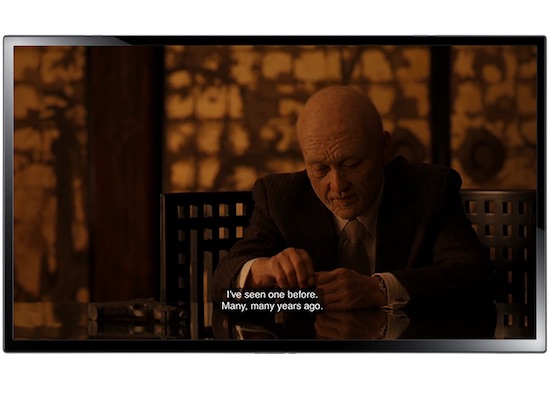 CustomPlay’s so-called “What”? feature
CustomPlay says it contacted Apple about the potential for an exclusive business relationship in 2014. The company believes Apple is aware of its patent and, without a license, proceeded to implement its patented technology in its tvOS operating system for the latest Apple TV model, launched October 2015.
Court documents obtained by MacRumors show CustomPlay seemingly mailed letters to Apple CEO Tim Cook and three iTunes executives in July 2014, and Abecassis sent a few follow-up emails to Cook later in the year, but it’s unclear if Apple responded. There is no indication of Apple responding at the very least.
Apple has an unsolicited idea submission policy to prevent potential misunderstandings or disputes when the company’s products or strategies might seem similar to ideas it has received, but it’s unclear if it would apply in this situation, and it does not automatically excuse Apple from patent infringement.
CustomPlay’s website says it is affiliated with Nissim Corporation, which appears to be a non-practicing entity, also owned by Abecassis. Nissim sued Apple last September for allegedly infringing upon seven patents related to DVD specifications. The two companies reached an unknown settlement in December.
Nissim’s website says it has brought lawsuits against major companies such as Apple, Paramount Pictures, Time Warner, and 20th Century Fox Home Entertainment. All of those companies, excluding Apple, are also listed as Nissim’s licensees, alongside Acer, Bose, Dell, HP, Lenovo, LG, Microsoft, Sony, and others.
CustomPlay is seeking damages of an undetermined amount from Apple, plus legal costs, and it has requested a jury trial.
Related Roundups: Apple TV, tvOS 10
Tag: lawsuit
Buyer’s Guide: Apple TV (Don’t Buy)
Discuss this article in our forums
China just deployed a fleet of sophisticated submarine drones in the South China Sea
Why it matters to you
These latest underwater drones could potentially track enemy submarines, and could escalate tensions over disputed South China Sea territory
For years, China has considered the South China Sea part of its territory, despite international tribunal rulings stating otherwise. Needless to say, staking claim to these international waters has created quite the rift with the international community — namely the United States. Adding fuel to this fire, China has now unveiled and tested a new fleet of the highly advanced underwater drones with potential military capacities.
These so-called glider drones, known as “Haiya” — meaning “sea wings” in Mandarin — are more durable and more energy efficient than previous iterations. Most importantly, these latest drones are capable of instantly relaying underwater data to the military — a technological achievement the US has yet to accomplish. China claims it has successfully released 12 of these state-of-the-art drones into the farthest reaches of the South China Sea — to allegedly collect environmental data.
During tests in March of this year, the gliders reportedly dove to a depth of nearly 21,000 feet (almost four miles), shattering the previous world record dive of 16,964 feet held by the US. In 2014, utilizing a new battery and special pressure-resistant coating, a underwater drone controlled by the Chinese broke a world record by traveling 635 miles without stopping over the course of 30 days.
The deployment of these submarine drones is just the latest move in China’s ongoing effort to control the South China Sea. The Chinese military has built artificial islands in the region, complete with communications systems and potentially even missile launchers. In 2016, the Chinese even captured a US underwater drone in international waters. Covering a total area of nearly 1,500,000 square miles, the South China Sea is the largest sea in the Western Pacific region. As such, if an all-out war were to break out in the area, there’s a huge amount of territory to cover. And with a maximum depth of 16,457 feet along the China Sea Basin, any subsurface advantage could be decisive for militaries involved.
As noted previously, these unmanned drone tests were considered environmental missions, and the Haiya were not carrying weapons at the time. However, these gliders could be easily be used to detect, monitor, and potentially even “catch” US underwater assets (namely submarines) in the South China Sea. Stay tuned for all of the latest, “environmental testing” in the Pacific powder keg.
Facebook Messenger’s update could make communicating with brands easier
Why it matters to you
With the new features, you might find the experience of communicating with businesses much easier and more enjoyable.
Facebook launched Messenger Platform 2.1 on Thursday with new and improved tools for businesses to connect with customers through conversations. The features include built-in natural language processing, new buttons, chat extensions for global pages, and more to help enhance communication between brands and consumers.
The latest version comes only a few weeks after Facebook announced it was expanding its Messenger ads beta globally. It gives any advertiser in the world the option to purchase ads in Messenger for users to see in the Messenger home tab. The beta is also meant to provide a more unique and personalized experience by using an ad to direct users to a Messenger window.
Using natural language processing that is built into the platform, Messenger 2.1 automatically detects meaning and information in the text of messages before sending it over to the bot. So far, the first version can detect common words like thanks, hello, date and time, location, and phone number, among others. When one of these particular words are detected, the bot then sounds out an automated response.
With the handover protocol feature, it enables businesses to incorporate more personalized customer support into the consumer experience. By creating multiple experiences with one bot, businesses can use it to answer common questions through automation and then pass it over to live agents. That way, if there is a particular question a bot cannot answer, the agent will be able to further assist the customer.
In terms of payments, version 2.1 also comes with a newly designed software development kit to make the payment process easier. Customers can now pay through a one step process simply through Messenger webview. However, payments through the platform are currently in beta and available only in the U.S. as of now.
Businesses will also be able to add new call-to-action buttons to their page in an effort to drive people to Messenger. While “Send Message” already exists, additional options include actions like “Shop Now,” “Get Support,” and “Get Updates.” By being more transparent with the actions, Facebook feels that customers will have a better idea of what to expect when starting a conversation with a particular business.
Other new features include enabling chat extensions for Global Pages — where businesses can build collaborative experiences — and policy enforcement notifications that notify developers when a bot has been blocked or if there is a policy issue.
Professor Einstein: Your Personal Genius educational toy review
We have seen everything from a smart bra to an electric skateboard here at Digital Trends, but we never imagined a 14.5-inch Professor Einstein robot would be strutting around on our coffee table explaining what a volcano is. This cute, walking, talking, automaton was designed by Hanson Robotics to teach the basics of science to kids, teenagers, and interested adults.
Professor Einstein lectures, answers questions, and even tells jokes. With the aid of an iPad or Android tablet, he can also quiz you to test your knowledge. We first saw a demo back in January when the Kickstarter campaign launched. It was successful, so we’ve spent the last week with the finished product. He’s recommended for ages 13 and up, but we enlisted my dinosaur-obsessed, astronomy-mad eight-year-old son, and his inquisitive five-year-old sister to help us with our Professor Einstein: Your Personal Genius review.
Why Professor Einstein?
Famed German physicist Albert Einstein had a profound impact on modern physics when he developed the theory of relativity. He went on to win a Nobel prize in 1921, and so great was his intellectual influence, that his very name has become slang for genius.
Professor Einstein lectures, answers questions, and even tells jokes.
There’s no doubt that Einstein is an iconic character, but he’s also morphed into something of a caricature in pop culture, and that’s exactly what this diminutive robot is – a caricature. The long white hair, the bushy moustache, and the expressive eyebrows are instantly recognizable, even for an eight-year-old.
Professor Einstein has a series of motors inside that allow him to shuffle around, roll his realistic eyeballs, point at you, and even pull expressions like sticking out his tongue. His voice is distinctly robotic, but with the same speech patterns and clipped German accent you’ll hear in every Einstein impression.
Getting started with Professor Einstein was one of the smoothest gadget set-ups we’ve ever experienced. You plug the rechargeable batteries into his legs, pull down his pants to flick on the power switch on his posterior, and download the free Stein-o-Matic app for iOS or Android.
We had a blast with the tech support voice that guides you through pairing, and the ‘50s theme carries through into the gorgeous app art. Once Einstein’s personality and intellect has been downloaded and he’s hooked up to your Wi-Fi network, you can create profiles and take your first step on the enlightening path to genius.
Educational, but relatively fun
Professor Einstein is capable of a few things on his own, but he’s really designed to be used in concert with the Stein-o-Matic app. We were immediately impressed with the quality of the software. There are a few bite-sized introductory videos covering the universe, the brain, motion, and special relativity, which Einstein narrates, giving the impression of a multimedia lecture.
There’s also a large selection of data cards, which provide information on topics from astronomy to biology to geology, with multiple choice questions designed to test your knowledge. The presentation is great and the formats have been tweaked to make them a little more engaging. For example, you must choose the wrong statement from a choice of three, or match up four terms with the relevant branch of science.
Simon Hill/Digital Trends
At the easiest difficulty level, my eight-year-old was able to answer a lot of questions correctly, and the multiple-choice format allows for a process of elimination approach. You can also ramp the difficulty up beyond my scant scientific knowledge, so there should be enough of a challenge there for teens. Hanson Robotics recommends Professor Einstein for ages 13 and up, but we think younger kids will get a kick out of it, particularly if they’re developing an interest in science.
My daughter was fascinated by Einstein at first, but immediately got bored with the app because she’s only five. She later confided that she found Professor Einstein a bit creepy, and he can be. There’s a small camera in his tie which enables him to see people and he can obviously hear, so he does turn to address whoever poses a question and sometimes points his finger at you. Although he’s clearly a caricature, he has realistic eyes and often pulls distinctly odd facial expressions. The fact they’re accompanied by a lot of loudly whirring motors doesn’t add to the illusion.
Beyond the lectures and quizzes, you can also play a couple of games. Mag-Neato is a puzzle game based on magnetism and momentum. Launch Lab challenges you to control a rocket in space, and will be immediately familiar to anyone who has played Asteroids. There’s also a series of mini games based around various scientific concepts. One top-down scroller challenges you to guide a bat through a maze using echo-location, another is based on the idea of combining different colored lasers to find a target color.
Einstein elevates the presentation, but can feel like a side prop when he should be the main event.
The games in Stein-o-Matic are a mixed bag. Most of them are accessible and relatively fun, but a few, like the one where you must deflect asteroids by dragging the moon around the earth, are an exercise in frustration. They’re intended to encompass scientific concepts in a fun package, but our eight-year-old actually preferred the data cards and questions to the games.
For each profile you create (you can create up to five), you gain points by completing activities, earning a word of praise from Einstein and advancing up the “Genius levels”. The well-designed app has a mildly addictive hook that keeps you coming back for more, but, while Professor Einstein elevates the presentation, he can feel like a side prop when he should be the main event.
A misunderstood genius?
During a conversation with a colleague on quantum mechanics, Einstein reportedly said “I can’t be sure that I understand you because you are using the wrong words.” Unfortunately, the robot Professor Einstein failed to understand us on countless occasions, but not because of semantics.
When he’s offline, Professor Einstein is severely limited. You can say “Question” and then ask him how he is, or say “Hey Professor” and then tell him to take a walk or stick out his tongue. It’s a problem we’ve encountered before, with the Cognitoys Dino, which employs IBM Watson as its brain. You need to be able to go online to get the best from Professor Einstein.
If you link Professor Einstein up to your Wi-Fi connection, then you can ask him a number of different questions and he’ll search for an answer. Queries are encrypted and routed to the cloud where Hanson Robotic’s AI formulates an answer. Einstein can tell you who he is, crack a terrible joke, or explain a trapezoid or a dynamo. At least he can in theory. In practice, we found him very clunky. You have to say, “Hey Professor” to get his attention, then wait for him to respond before posing your question.
Sometimes he would be unresponsive for a few seconds, before responding “Yes, that’s me!” Even with clear enunciation, we often got a confused or negative response to our queries, or, more often, a request to repeat the question. My kids are used to Alexa, because we have an Amazon Echo, so they understand the importance of phrasing and clarity, but Professor Einstein simply isn’t as capable. We got a software update that seemed to improve his responses slightly, but overall, conversations with Professor Einstein were a real disappointment.
Volume is another issue. Professor Einstein talks quite loudly and he doesn’t seem to have a volume control, which is an odd omission.
Following a successful Kickstarter campaign, Professor Einstein is available exclusively on eBay for the next two weeks at $250. From August 6, you’ll be able to buy him at Amazon or http://www.professoreinstein.com for $300.
If you’re going to spend that kind of money, then you really want a responsive robot. Reflecting on our time with Einstein, most of what we liked was actually in the app, he just served as an extremely weird prop. If Hanson can improve his conversational skills, then he could help inspire kids to a career in science, but for now we’d pass on the Professor.
 AIVAnet