


Keep all your gear charged no matter what with these RavPower deals
Amazon’s Gold Box deals of the day includes a selection of RavPower gear on sale. The items on sale include a 6-port quick charge hub, a portable battery pack, and a 5-pack of micro USB cables.

The 6-port Quick Charge hub is down to $22.99 with this deal. That’s a drop of about $12 from its normal $35 price. This hub has 60W of power and comes with lifetime warranty. The top port is a QuickCharge 3.0 port that can charge at a much faster rate. The whole thing sits nicely on your desktop and can keep your phone, tablet and computer charged up at once.
RavPower’s battery pack is down to $39.99 from its normal price of $55. This thing has a lot of juice with 26800mAh. It also has three ports so you can charge multiple devices at the same time. It only takes 13 hours to get completely ready to go and can charge your phone for nine days.
This 5-pack of micro USB cables is on sale for $10.39. It normally sells around $13. The pack comes in several assorted sizes: one 1 ft, two 3 ft, one 6 ft, and one 10 ft. That’s a cable for pretty much every situation. Put one or two in your car, keep one by your bed, and stick the extra long one in that hard-to-reach power strip behind your desk. Never go into a room without the ability to charge your stuff.
See at Amazon
Prime Day 2017 is coming! Follow along with our live blog to discover the best deals first!
US military will finally start encrypting soldiers’ emails
You’d think the military’s email service mail.mil would be more secure than Gmail and other free alternatives, but that’s apparently not the case. A Motherboard investigation in 2015 revealed that while it does have systems in place to protect classified messages, it doesn’t even use STARTTLS — a 15-year-old encryption technology that prevents emails from being intercepted in transit. That exposes unclassified emails to surveillance and leaves them vulnerable as they make their way to recipients. Now, after getting a lot of flak over the lack of security, Pentagon says it will finally start encrypting soldiers’ emails… but not until July 2018.
See, Gizmodo discovered that the military’s email service doesn’t use STARTTLS, because it would prevent the Defense Information Systems Agency (DISA) from screening each message for malware, phishing attempts and exploits. A letter from DISA, which oversees the military’s emails, says its detection methods developed using national level intelligence “would be rendered ineffective if STARTTLS were enabled.” To be able to implement the technology and make it a default feature, it would have to migrate to a “new email gateway infrastructure,” and migration won’t be done until July next year.
DISA has revealed its plans to migrate the military’s email service in a letter addressed to Senator Ron Wyden, who questioned the agency for not using a “basic, widely used, easily enabled cybersecurity technology.” Wyden said in a statement that the move is definitely a step in the right direction, but he’s also pretty unhappy that it’ll take DISA a year to migrate. “Protecting the communications of American servicemen and women should be a priority,” he said, “so I hope the agency accelerates its timeline.”
Source: Gizmodo, Motherboard
Touch-friendly controls are coming to Chrome OS
Google’s lightweight Chrome OS was never intended for touch, but that didn’t stop the likes of Samsung and Acer creating touch-enabled Chromebooks. It probably helped that the OS was set to receive access to millions of Android apps. All that was left was to put those touch displays to good use. And, the updated launcher for Chrome Canary (the experimental iteration) is a sign of things to come.
As you can see in the video, the new touch-friendly launcher sits at the bottom of the screen with just the Google search bar and suggested apps visible. From there, you can swipe up to reveal all your apps. Additionally, you can tap to use the voice search function, which will open your request in a new Chrome window.
Canary comes with the latest, untested features — meaning it can also be pretty buggy — and runs alongside the regular Chrome. If you’re one of those people that’s interested in the code behind new builds, you can find that here.
Source: François Beaufort (Google Plus)
Soon you’ll be able to gift ‘Forza’ to Xbox friends
What could be better than firing up your Xbox One and discovering a new game? Unless you went on a bender and forgot, that scenario was never likely because you can’t be gifted games on that console (or the PS4, for that matter). Microsoft appears ready to change that, however, judging by a tweet from VP Mike Ybarra. In response to the query, “How far off are we from getting the ability to gift a new purchase for a friend?” He tweeted “Not far!”
Not far!
— Mike Ybarra (@XboxQwik) July 6, 2017
To be frank, this seems like a no-brainer for console-makers, giving them an easy way to boost sales. As Steam discovered with its Gift program, however, it’s not that simple, because sometimes there are massive game price differences between regions. If Microsoft didn’t account for that, you could dodge taxes or high pricing just by having a friend send you the game.
Nevertheless, the feature is in high demand, judging by the number of votes on a request in the Xbox forums. Ybarra didn’t say exactly when it would come, but normally features follow fairly quickly when a Microsoft executive tweets something. If you can’t wait, don’t forget that you can already buy Xbox Gift Cards in your local currency and do the gifting that way. That’s not quite as nice as finding someone that perfect game, but it’ll have to do for now.
Source: Mike Ybarra (Twitter)
Tesla is building world’s largest backup battery in Australia
After blackouts left 1.7 million residents without electricity, Elon Musk famously guaranteed that Tesla could supply 100 megawatts of battery storage in 100 days. The company has announced it will do just that, supplying a Powerpack battery storage system that can run over 30,000 homes. The 100-megawatt project “will be the highest power battery system in the world by a factor of three,” tweeted CEO Elon Musk. It will back up the 315 megawatt Hornsdale Wind Farm, charging during low energy usage and providing electricity for peak hours.
Though the company seemed destined to get the job, the South Australian government picked it after a “competitive bidding process,” Tesla said. It added that the size of the system will be enough to cover the 30,000 or so homes in the region that were affected by blackouts.

Tesla’s Powerpack battery storage system (AOL/Roberto Baldwin)
Those power outages set off a political conflagration that culminated in a very testy press conference with South Australia’s Premier and the Federal Environment Minister. Shortly afterwards, Prime Minister Malcolm Turnbull unveiled a $1.5 billion plan to expand the power grid to run an additional 500,000 homes, including backup battery storage.
That was when Tesla Energy head Lyndon Rive stepped in and made his “100 megawatts in 100 days” pledge, and (his cousin) Musk upping the ante by promising the system would be free if they didn’t achieve the goal.
Musk confirmed that he’d keep the promise, telling Australia’s ABC News that “if South Australia is willing to take a big risk, then so are we.” The 100 day pledge reportedly begins once the grid interconnection agreement is inked, and Musk estimates that it will cost him “probably $50 million or more” if the installation isn’t completed in time.
This will be the highest power battery system in the world by a factor of 3. Australia rocks!! https://t.co/c1DD7xtC90
— Elon Musk (@elonmusk) July 7, 2017
Via: Elon Musk (Twitter)
Source: Tesla
TV shopping giants QVC and HSN merge to take on Amazon
QVC is combining with its rival Home Shopping Network (HSN) in a deal worth $2.1 billion. The move is the latest indication that TV shopping channels are feeling the strain from online giants, such as Amazon.
QVC, which already owned a 38 percent stake in HSN, claims the merger will boost revenues for both companies. In the face of falling ratings and declining sales, the two brands will now focus on “evolving” to fit today’s retail and digital environment.
The reasoning behind this shift is a no-brainer: online shopping has overtaken traditional retail. And Amazon’s unstoppable rise, in particular, has left retailers scrambling to keep up. Some (like American Apparel and J. Crew) have either gone bankrupt or suffered devastating losses. While others (like Walmart and Target) are trying to ape Amazon’s delivery perks.
Although Amazon’s recent innovations (the Echo and Prime included) have generally been hits, it’s one misstep came when it tried to emulate the likes of QVC. Last year, the online retailer launched a live show called Style Code Live in an attempt to bridge its on-demand video service with its shopping site. Amazon was hoping to entice a younger crowd to make impulse buys like their parents did during QVC’s glory days. Like TV shopping channels, Style Code Live even incorporated celebrity guests in a bid to attract more viewers. However, the show turned out to be a rare misfire and Amazon abruptly canceled it in May of this year.
Via: The New York Times
Source: Liberty Interactive Corp.
Google launches a company to make geothermal heating affordable
A secret project that started in the labs of X, Alphabet’s moonshot factory previously known as “Google X,” is now a standalone company called “Dandelion.” According to its website, Dandelion aims to make geothermal heating and cooling systems more accessible and affordable, since they’re pretty expensive compared to their alternatives. In a statement about the company’s launch, Dandelion chief Kathy Hannun said that they started the project, because they “knew if installing a geothermal heat pump was a simpler and more affordable process… homeowners would have access to a better product that’s also better for the climate.”
A geothermal system includes a heat pump placed inside your house and pipes called “ground or earth loops” buried underground. National Geographic has a detailed write-up of how the technology works, but simply put, when it’s hot inside your house, the pump absorbs the heat and dumps it into the earth. In the winter, it absorbs heat from the ground and pipes it into your home instead. That’s made possible by the fact that the temperature underground remains relatively constant all throughout the year.
Unlike Waymo, another X spinoff that’s operating under Alphabet, Dandelion will run independently outside the tech titan’s umbrella of companies. It’s now accepting inquiries from interested homeowners, starting with those located in upstate New York — just type in your ZIP code on its website to find out if your area is already covered.
Via: Business Insider
Source: Dandelion (1), (2)
A car-tracking dongle could make self-driving systems better
George Hotz is intrigued by artificial intelligence. The man who hacked the iPhone and PlayStation 3 as a kid, has moved on to self driving cars with his company Comma AI because of the autonomous vehicle technology’s reliance on machine learning. After an initial hiccup that involved the company cancelling a device that would make cars semi-autonomous (because of a run in with regulators), Comma AI is back The new $88 Panda OBD II dongle, like most universal car interfaces, plugs into your car (1996 or newer) and gathers data.
“It’s amazing how little information there is about the plethora of sensors in your car. Information should be free,” Hotz said.
The data that is collected is usually shared with the driver and typically includes, speed, location (if the car has GPS), fault codes and a few other bits, like how much fuel is in the tank. The Panda takes it further. According to Hotz, it surfaces information that up until now, was only accessible to the manufacturer.
It supports 3 CAN (Controller Area Network, the main vehicle interface standard), 2 LIN (Local Interconnect Network) and 1 GMLAN (General Motor Local Area Network) for access to almost all of the sensors in most of the cars on the road. The dongle ships with WIFi and a USB port to interface with your computer and charge your smartphone. The result is a barrage of data. To help parse all that information Comma AI also launched Cabana a CAN analysis tool.
Cabana takes all the information from the Panda and video collected by Comma AI’s Chffr app and syncs it. Drivers can watch a video of their drive in Cabana and see how and which sensors are reacting. The only issue is that the company doesn’t actually know what each sensor in every car does. It’s counting on header files within vehicles to help figure some of that stuff out. But for anything else, it’s looking to the community to help fill those gaps.
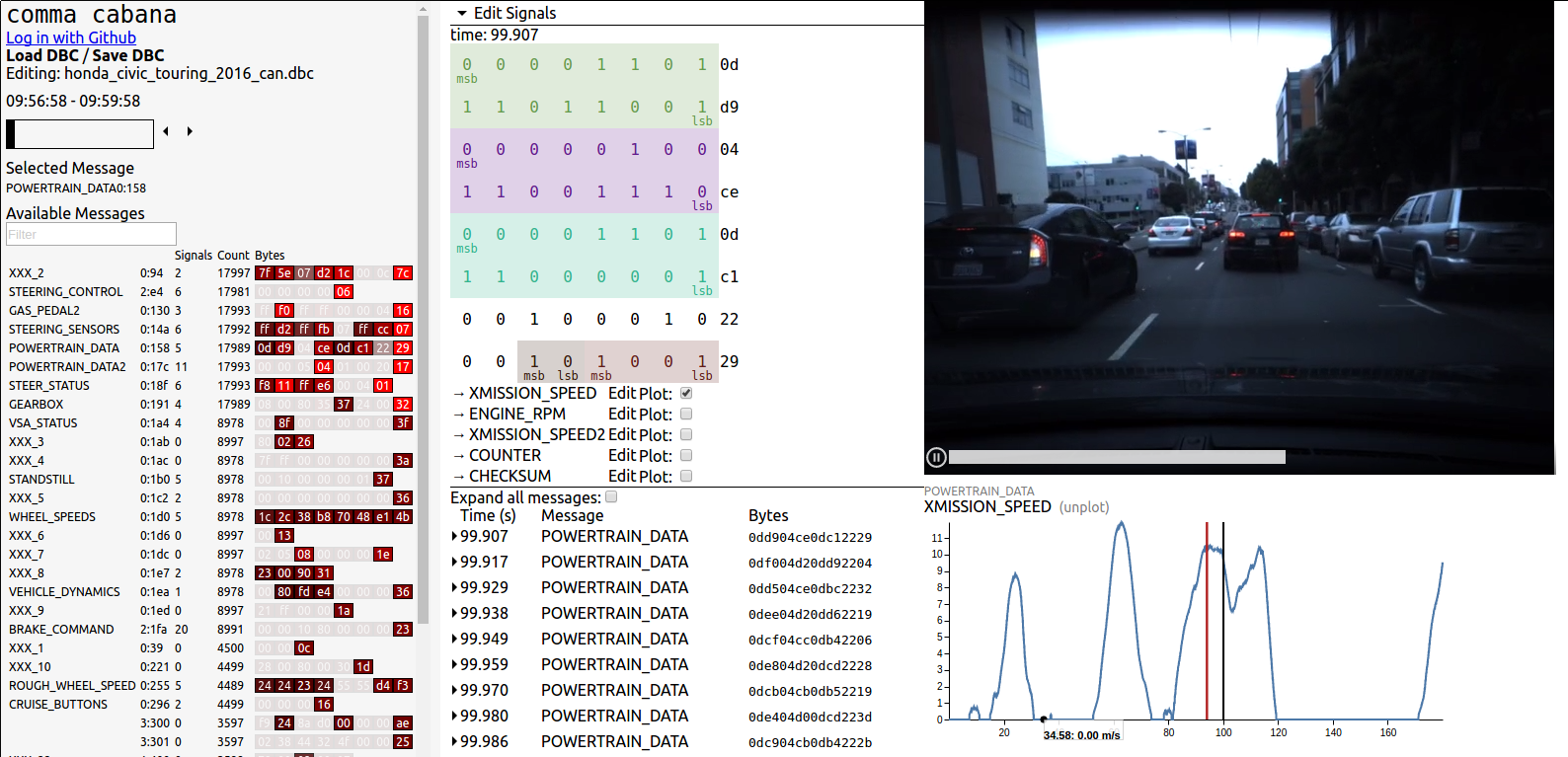
In fact the entire scheme is open source with a GitHub repo for sharing the DBC files (the auto industry’s standard file format) generated by the community’s findings. Comma AI says the goal of the open dbc project “is to build a repository with a DBC file for every car ever manufactured and democratize access to the decoder ring for your car.”
Hotz says that his company share all of its opnedbc information with the community. There won’t be an internal database separate from what the community helps build. The company is also going to release APIs so developers can build apps and services on top of what’s learned with the Panda.
“The real point of shipping Panda out to people is to create that interface that cars don’t have. We want to plug cars into computers.” Hotz told Engadget.

Hotz hopes that Panda, Cabana and opendbc will help his company generate the data it needs to realize his goal of building a self-driving car add-on for vehicles already on the road even if it takes a few years. He’s also hoping to help build a robust car hacking and car tuning community thanks to Comma AI’s low cost Panda dongle. “We’re going to make Panda the most universal car interface ever to exist.”
Pre-orders are available now with Pandas landing in customer mailboxes in about four to 12 weeks.
Source: Comma AI
Google is funding AI writers for local UK news reporting
The UK Press Association (PA) will soon hand writing duties on thousands of local news stories to robots. Cue headlines about the death of news media (seriously, though, this might be a problem).
The news agency just won a €706,000 ($622,000) grant from Google to run an automated news service with the help of a start-up called Urbs Media, according to The Guardian. The project — dubbed Radar for “Reporters And Data And Robots” — will see computers create 30,000 news stories for hundreds of local papers.
AI has been used in newsrooms in the past, but it isn’t without its faults. Tests have shown that despite being faster than humans, computers can come up short in terms of writing style and readability. And, in most cases, some level of human oversight is required. Radar is no different. The project will depend on human writers to choose the stories (on topics such as crime, health, and employment) that the AI will then write. The computers will also auto-generate graphics, video, and pictures to match the articles.
Although it may not be groundbreaking, the PA believes Radar will provide a boost to local news outlets at a difficult time. Regional news providers are struggling with shrinking budgets, while interest in localized news remains just as high. Automating articles on a mass scale is seen as a practical way of meeting that demand.
Via: The Guardian
Source: Press Association
Apple Maps Transit Directions Now Available in Calgary and Southern Alberta
Apple Maps has been updated with comprehensive transit data in Calgary, Alberta, enabling iPhone users in the Canadian city to navigate with public transportation, including the CTrain light rail system and buses.
Apple Maps transit directions are also available for buses in the smaller Southern Alberta cities of Red Deer, Lethbridge, and Medicine Hat.
Apple Maps enabled transit routing in Calgary just in time for the 2017 Calgary Stampede, which runs between July 7 and July 16.
Apple Maps gained a Transit tab in iOS 9. The feature lags several years behind Google Maps, but Apple’s public transportation support is exhaustive, mapping all station entrances and listing departure times.

At launch, the feature was limited to Baltimore, Berlin, Boston, Chicago, London, Los Angeles, Mexico City, New York, Philadelphia, San Francisco, Sydney, Toronto, and over 300 cities in China. Since then, Apple has been working to expand support for public transportation to other cities around the world.
Newer additions include Atlanta, Columbus, Dallas, Denver, Detroit, Honolulu, Houston, Kansas City, Madrid, Manchester, Melbourne, Miami, Minneapolis–Saint Paul, Montréal, New Orleans, Paris, Portland, Pittsburgh, Prague, Rio de Janeiro, Sacramento, Salt Lake City, San Antonio, San Diego, Seattle, and Singapore.
For a complete list of cities with Apple Maps transit directions, visit the iOS Feature Availability page on Apple’s website.
(Thanks, Bernd!)
Tags: Apple Maps, Canada, transit
Discuss this article in our forums

