


Caltrain will finally go electric thanks to FTA funding
The future of California’s high-speed rail project relies in part on an initiative to migrate Silicon Valley’s Caltrain corridor from a fleet of outdated diesel engines to a more modern electric system. That electrification project was put in jeopardy earlier this year when state Republicans asked Trump’s Department of Transportation Secretary Elaine Chao to block a $650 million federal grant, claiming it should be shut down due to cost overruns. Now, in response to Caltrain’s petition, the Federal Transit Administration has announced it will approve the funds and the upgrade can finally move forward after decades of delays.
The project is not only expected to bring faster, cleaner and more reliable train service to the 51-mile Caltrain system that connects San Francisco to Silicon Valley and San Jose, but according to the San Jose Mercury News, the project is expected to create 10,000 jobs in California and around the country. Beyond Silicon Valley, the electrification project is intertwined with the plan to build a bullet train between the Bay Area and Los Angeles.
The commitment from the FTA comes at the last possible moment. As recently as last week, Secretary Chao had said that she couldn’t approve the grant because her department didn’t have the funds to spare and if the funds hadn’t been approved by June 2nd, Caltrain would have lost key contracts for the work. The announcement means the project will get $100 to start, but the remaining $550 in federal funding is still subject to future approval by Congress. The rest of the project’s $2 billion budget will come from state and local sources.
“I did not predict this,” San Jose Mayor told the Mercury News. “I’m thrilled to witness the triumph of sound policy over senseless politics. There’s not a project in the United States that’s more shovel-ready than this one.”
Source: San Jose Mercury News
Tronsmart’s Element T2 is an affordable waterproof Bluetooth speaker with spunk
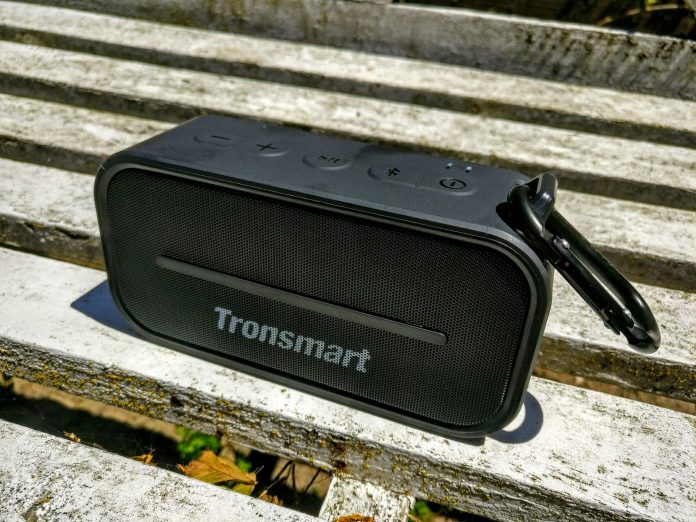
Let’s get this out of the way – Tronsmart’s Element T2 is not a sexy piece of hardware. It’s a basic Bluetooh speaker that offers solid performance, rugged durability, and lets you answer phone calls without having to pick up your phone. That being said, it’s well worth the $24 it costs on Amazon. Now that you’re properly warned of the perks and drawbacks of owning this little piece, let’s dive into what actually makes it tick.
Features
 For not having any gimmicky features that are so prevalent in Bluetooth speakers these days, the Element T2 has surprisingly solid specs all around. Let’s start with the basics – Bluetooth 4.2 – while not the state-of-the-art Bluetooth 5 that’s coming into vogue, Bluetooth 4.2 still presents a number of excellent qualities of the more common 4.1 – most notably, a significantly reduced power consumption. A 1900mAh, 12-hour battery means you’ll probably not have to charge it for about a week unless you’re listening to music for hours and hours on end.
Hardware
 The Element T2 is hefty, for only being the size of a soda can. It feels solid, and the rubberized buttons, outer rim, and accessory compartment feel nice and durable. A small clip is built into the frame, allowing you to attach the included carabiner and carry it around with your with ease. Two small high-friction plastic “feet” are set into the bottom, ensuring that it won’t slip around easily.
A built-in microphone ensures that you won’t have to switch between your phone and the speaker when getting a call – especially handy if you’re in an environment where you’d be at risk of dropping your phone in water. And speaking of which, the Element T2 is Ingress Protection rated IP56 – meaning that it can handles heavy sprays of water (but not immersion) and is protected against dust and sand – making it a great choice for the beach. A MicroSD slot, Aux port, and MicroUSB port are hidden under a rubberized flap on the side – do not, under any circumstances, forget to close that flap before taking this thing out in the wild.
Functionality
I gotta be honest, here – this is easily one of the easiest-to-use speakers I’ve had the pleasure of using. Setup is ridiculously simple – powering the thing on immediately launches it into pairing mode, meaning you can power on and pair in about fifteen seconds flat. There are five buttons on the device; Power, Bluetooth, Play/Pause, +, and -. The first three are pretty obvious, but the last two have a clever dual functionality; short-pressing each one individually raises or lowers the volume, while long-pressing either performs the Skip functionality. Long-pressing the Bluetooth button allows you to pair a second Tronsmart speaker using TWS – True Wireless Stereo. 
Sound
Sound on the Element T2 is loud and booming, with a bass that can be felt from a full inch from the speaker grill. The volume is considerable for such a little package – it surprised the crap out of me, honestly. This is where things get a little weird; while both sides of the speaker are identical and symmetrical, there is clearly a front and back to the thing. One side plays considerably louder and clearer than the other – presumably because the little subwoofer is partially blocking the other side. It’s not so bad that it affects the quality of sound coming from the speaker, but it is noticeable.
When it comes down to it, Tronsmart’s Element T2 is what it is – a solid, if unspectacular, sequel to the T1. It’s reliable, weathers the elements well, and doles out big sound in a small package. Get it on GeekBuying for $35 or on Amazon for $25.
App Highlight: Tempest – Pirate Action RPG

The App
Developed by HeroCraft Ltd who is tagged as a top developer on the Google Play Store, Tempest Pirate Action RPG is a new app with only 1000-5000 installs. Having been updated on April 21, 2017, the developer is constantly fixing various bugs and introducing performance enhancements. The game allows you to become a pirate, assemble your crew, and battle and defeat other pirates and monsters such as the Kraken, the Leviathan, and others.
 What it does
You’ll be placed in an open world with an arsenal of cannons, mortars, flame throwers, and a lot of other various weapons to overcome a number of quests across dozens of islands in three regions. You can share the huge world of Tempest with two friends and it is up to you if you decide to become companions or wage war against each other. You’ll need to buy and upgrade your ships by robbing galleons, sinking warships, and destroying forts.
 Why we like it
I always like a good pirate game and this one is one of the best. It’s one of the most immersive I’ve ever played. The instructions on how to play could do with a little work and prompting as to what each thing does. There is a question mark that will give hints but I think this could be improved and made part of an overall tutorial. With great graphics and lots of quests, this is a great game that you need to check out.
How to get it
Tempest: Pirate Action RPG is available for $7.99 from the Google Play Store. You can download it right here.
Netflix is making the internet’s Rihanna/Lupita buddy movie
According to Entertainment Weekly, a movie dreamed up on social media based on nothing more than a picture of Lupita Nyong’o and Rihanna is actually going to happen. The two were captured sitting next to each other during Paris Fashion Week 2014 when a writer named Roxy posted this caption on Tumblr “They look like they’re in a heist movie with Rihanna as the tough-as-nails leader/master thief and Lupita as the genius computer hacker.” The idea resurfaced as a tweet this past April and quickly became a viral meme “Black Twitter” and beyond, with fans tagging both stars and tossing in more suggestions for the flick they’d like to see.
Both Rihanna and Lupita tweeted that they’d be up for it, and based on EW sources, Netflix outbid several others for the rights to a buddy movie starring the two that will be directed by Ava Duvernay (Selma, 13th), with Issa Rae (Insecure, Awkward Black Girl) in talks to write it. There hasn’t been an official announcement, but Duvernay tweeted “We deserve nice things. ✌🏾️” with a link to the story.
My post from 2015 https://t.co/iicF60TNIK
— roxy (@elizabtchtaylor) April 24, 2017
Rihanna looks like she scams rich white men and lupita is the computer smart best friend that helps plan the scans https://t.co/PhWs1xd3nj
— WHOOPHERASSKOURTNI (@1800SADGAL) April 18, 2017
I’m down if you are @rihanna https://t.co/vwHBWeCbFZ
— Lupita Nyong’o (@Lupita_Nyongo) April 21, 2017
I’m in Pit’z https://t.co/Kz0o3lBEmL
— Rihanna (@rihanna) April 23, 2017
@MikelleStreet @rihanna Lights set. Camera’s up. Ready to call action for these #queens. 👑 pic.twitter.com/NVgqpFeTnu
— Ava DuVernay (@ava) April 24, 2017
@dvrrxll @rihanna pic.twitter.com/XG2WMribGJ
— Issa Rae (@IssaRae) April 23, 2017
Source: Entertainment Weekly
3D-printed Stradivarius replica is nearly indistinguishable from the real thing
Why it matters to you
This 3D-printed replica can put one of the world’s most famous violins into your hands.
Usually we associate 3D printing with ultramodern technologies like cutting-edge medical implants or futuristic space fabrics. Music technology researcher Harris Matzaridis’ ViolinoDigitale project has gone in totally the opposite direction, however.
What Matzaridis has created through the digital magic of additive manufacturing is an accurate replica of an original Stradivarius violin, the Sunrise Stradivari — one of the incredibly expensive and rare master violins built by the Italian family Stradivari during the 17th and 18th centuries.
“ViolinoDigitale is essentially all about developing a specific ‘making’ process as an additional tool to better understand the sound mechanics of the best-sounding musical instruments out there,” Matzaridis told Digital Trends. “With 3D-printed violin replicas, anyone can have a small ‘taste’ of an old master instrument, without wearing out the original. 3D-printed violins can incorporate a fresh approach not only in instrument making, but also in acoustics research studies.”
The amazing project took two years to create, and required the printing of more than 40 individual parts, as well as some impressive (and more old school) handcrafting. Many of the 3D-printed parts were printed using a wood filament. “The hardest overall challenge was to make a functional violin that does not deform or break under string tension, while sounding rich, fully natural and as least plastic as possible,” Matzaridis continued.
While we’ll admit to having something of a tin ear for the finer points of musicology, it seems that Matzaridis succeeded — since not only does the finished piece look like the instrument it’s meant to, Matzaridis says that it shares acoustic and tonal similarities with its inspiration.
Next up, Matzaridis said the plan is to build more violin replicas, along with larger acoustic instruments.
“Museums or research institutions can freely ask for their violins to be replicated for their museum indoor use, it is something that can be done as we speak,” Matzaridis concluded. “Also any organization or tech exhibition can invite me to speak and showcase my work in their premises. The violin is playable so they can even invite a violinist of their choice to play it so everyone can have a chance to hear it in person. I am currently constantly analyzing audio results, making comparative tests between printed and non-printed violins and preparing for academic journals’ proposals to publish those results.”
Moderating explicit and illegal content on Facebook isn’t getting any easier
Why it matters to you
Finding a way to deal with the explicit or illegal content on Facebook remaining an ongoing and constantly evolving issue.
Facebook has come a long way since its days of connecting college students to those in other dorms. More than a decade and a billion users later, the social network has become a powerful hub of content, but with that power comes great responsibility. And those who must bear the brunt of that responsibility are tasked with the rather onerous duty of evaluating potential cases of revenge pornography and “sextortion” — more than 50,000 times a month.
Per a leaked document first obtained by The Guardian, the social media platform ultimately disabled more than 14,000 accounts as a result of sexual abuse, with 33 of the cases involving children. While these may seem like gargantuan numbers, they could represent just the tip of the iceberg. The Guardian reports that because abusive content must be reported (and is not proactively sought out), the true extent of abuse on the platform could be far larger than even Facebook realizes.
Not only is scale an issue but in some sense, scope presents a problem as well. Moderators often have trouble following Facebook’s complex and sometimes ambiguous policies, with a source telling The Guardian, “Sexual policy is the one where moderators make most mistakes It is very complex.” But Facebook says that it is actively working to improve these processes. “We constantly review and improve our policies,” said Monika Bickert, head of global policy management at Facebook. “These are complex areas but we are determined to get it right.”
Facebook has come under fire in recent months for how it handles some of these “complex areas,” particularly with regard to child pornography. In March, the company came under fire after it failed to remove “dozens of images and pages devoted to apparent child pornography” flagged by the BBC. At the time, Facebook said that it reviewed the material in question and “removed all items that were illegal or against our standards.” The company added, “We take this matter extremely seriously and we continue to improve our reporting and take-down measures.”
But it’s still a dicey issue. Facebook’s manual on how to address various sexual abuse cases is no shorter than 65 slides long and simply cannot address the full breadth of potentially problematic content that may appear online.
“Not all disagreeable or disturbing content violates our community standards,” Facebook said. “For this reason we offer people who use Facebook the ability to customize and control what they see by unfollowing, blocking or hiding posts, people, pages and applications they don’t want to see.”
All the same, the social media platform says it is committed to “building better tools to keep our community safe,” noting, “We’re going to make it simpler to report problems to us, faster for our reviewers to determine which posts violate our standards and easier for them to contact law enforcement if someone needs help.”
Volvo’s new self-driving truck follows trash collectors like a dog
Why it matters to you
Volvo’s self-driving garbage truck may make trash collection safer and more sustainable.
Garbage collection is an important profession but it’s not the most glamorous. As artificial intelligence seems to be integrated into every job, it’s about time AI help us clean up waste.
Volvo announced last week that it has started testing a self-driving garbage truck in partnership with Swedish waste and recycling company Renova. Rather than entirely automating the task, the truck is designed to work alongside a trash collector, reversing from house to house to make garbage collection more efficient.
“There is amazing potential to transform the swift pace of technical developments in automation into practical benefits for customers and, more broadly, society in general,” Lars Stenqvist, Chief Technology Officer at Volvo Group, said in a statement.
“Our self-driving refuse truck is leading the way in this field globally, and one of several exciting autonomous innovations we are working with right now,” he added.
The truck uses sensors and GPS to map each new neighborhood it enters. It reverses to follow the trash collector as he/she walks between trash cans, meaning the trash collector doesn’t waste timing walking around the vehicle, allowing him/her to spend more time out of the cab. Volvo thinks this could make collection safer for the collector and those around him.
“One important benefit of the new technology is a reduction in the risk of occupational injuries, such as wear in knee joints – otherwise a common ailment among staff working with refuse collection,” said Stenqvist.
Volvo’s garbage truck borrows much of its technology from the company’s autonomous mining vehicle, which it unveiled last year. It is equipped with sensors that help it detect objects in its surroundings and navigate around them safely.
Beyond improving efficiency, Volvo claims its autonomous truck will be more sustainable than traditional methods since it is designed for optimum performance, steering, and speed. These combined features would help decrease emissions and fuel consumption.
The trials will run until the end of 2017.
Volvo’s new self-driving truck follows trash collectors like a dog
Why it matters to you
Volvo’s self-driving garbage truck may make trash collection safer and more sustainable.
Garbage collection is an important profession but it’s not the most glamorous. As artificial intelligence seems to be integrated into every job, it’s about time AI help us clean up waste.
Volvo announced last week that it has started testing a self-driving garbage truck in partnership with Swedish waste and recycling company Renova. Rather than entirely automating the task, the truck is designed to work alongside a trash collector, reversing from house to house to make garbage collection more efficient.
“There is amazing potential to transform the swift pace of technical developments in automation into practical benefits for customers and, more broadly, society in general,” Lars Stenqvist, Chief Technology Officer at Volvo Group, said in a statement.
“Our self-driving refuse truck is leading the way in this field globally, and one of several exciting autonomous innovations we are working with right now,” he added.
The truck uses sensors and GPS to map each new neighborhood it enters. It reverses to follow the trash collector as he/she walks between trash cans, meaning the trash collector doesn’t waste timing walking around the vehicle, allowing him/her to spend more time out of the cab. Volvo thinks this could make collection safer for the collector and those around him.
“One important benefit of the new technology is a reduction in the risk of occupational injuries, such as wear in knee joints – otherwise a common ailment among staff working with refuse collection,” said Stenqvist.
Volvo’s garbage truck borrows much of its technology from the company’s autonomous mining vehicle, which it unveiled last year. It is equipped with sensors that help it detect objects in its surroundings and navigate around them safely.
Beyond improving efficiency, Volvo claims its autonomous truck will be more sustainable than traditional methods since it is designed for optimum performance, steering, and speed. These combined features would help decrease emissions and fuel consumption.
The trials will run until the end of 2017.
Robot-made Voxel chair is 3D printed from a single, unbroken strand of plastic
Why it matters to you
This innovative 3D printing process not only creates cool designs, it’s faster and uses less material, too.
Fancy ditching your regular office chair for a futuristic throne built by a robot? Of course you do. That’s why you should check out this amazing plastic creation, conjured up using the magic of 3D-printing software by designers from the Bartlett School of Architecture in London.
Unlike regular printing, which involves a layer-by-layer printing process, this chair was created by printing a continuous line of melted plastic, a bit like squirting molten glue out of a glue gun and using it to make a unique-looking object.
“The process we developed allows us to not print in layers like with normal 3D printing, but in three dimensions,” Gilles Retsin, co-director of the Design Computation Lab behind the chair, told Digital Trends. “This is very difficult to control, because you have to prevent the nozzle hitting structures that are already printed. Our software allows exactly that. It’s the first software that allows users to design objects directly with the toolpaths themselves, and send this data directly to a robot. This makes large-scale robotic fabrication and 3D printing available for a large public. It goes from academic exercise to direct application.”

The chair itself is modeled after the famous S-shaped Panton chair, created by Danish designer Verner Panton. It’s called the Voxel chair, named after so-called “voxels” which act as pixels in three-dimensional space. It is made from transparent, biodegradable PLA plastic.
“This process is very cheap and fast, allowing for larger objects to be manufactured,” Retsin continued. “The ability to print in the air saves a lot of time in the printing process. you can go much faster and you have to use less material.”

While there are no plans to bring the chair to market any time soon, Retsin says that the software will be released some point this year.
“We think it’s very interesting not only for architects and designers, but specifically for engineers in automobile and aerospace,” Retsin said. “This basically allows them to really optimize and tailor large 3D-printed structures and therefore save lots of material. The software essentially offers something that no other software on the market does now. Some structure optimization softwares allow to chose a pattern for internal structures, but as a designer or engineer you can’t play around with it that much. This is a game changer and the first software that allows you to directly design and organize millions of toolpaths for 3D printing.”
With names like Burf Pink and Bank Butt, a paint algorithm fails spectacularly
Why it matters to you
AI have proven to be incredibly helpful when they succeed but they are also pretty funny when they falter.
Algorithms have outperformed humans at everything from board games to driving, but we are still the masters of creativity. Case in point: Naming paint colors.
Computer scientist and artist Janelle Shane developed a neural network that creates and names new paint colors. It sounds like an easy enough task. You and I might even match the pros at Sherwin-Williams. Shane’s AI, on the other hand, struggled.
Shane fed her neural net around 7,700 of Sherwin-Williams’ paint colors, including their red/green/blue color values, and told the algorithm to create new colors while assigning them appealing names. Maybe it would come up with Sensuous Cyan, Melancholy Mauve, or Smokey Drapes. (Those are our attempts, at least.)
Instead, some of the standout names included Dorkwood, Stanky Bean, Gray Pubic, and Bank Butt. Here’s another small sample in the image below.

Janelle Shane
In the neural net’s defense, it did invent some more clever — and potentially useful — names, like Power Gray, Ghasty Pink, and Rover White. But the majority came out in the vein of Burf Pink and Rose Hork.
And to be fair, the task was pretty tough for an algorithm that did not have that much context to work with.
“The names in the original dataset are highly varied and very dependent on associations with words and concepts outside the dataset,” Shane told Digital Trends. “A neural network is good at learning recurring patterns, but since a word was rarely used twice in the dataset, the neural network didn’t have a good chance of being able to determine that a geranium, for example, is a flower that’s often red or pink.”
Without context or an outline of what it is doing, the neural network is grasping for words. But that doesn’t mean the AI was totally incompetent and sometimes its names sounded pretty sophisticated even if they didn’t make much aesthetic sense. Shane explains: “The other thing that neural networks are good at is figuring out how to generate pronounceable English words. The neural net was able to come up with new words that weren’t in the original dataset — but had no context that might tell it that words like ‘butt’ and ‘hork’ were to be avoided.”
See more of Shane’s creations over on her Tumblr page.
 AIVAnet