


‘Battlefield 1’ DLC adds a playable female soldier class
By turning the clocks back to World War 1, DICE has created arguably one of the best games in the Battlefield series. Now, with Battlefield 1’s latest DLC, the developer is using our tragic past to drag its franchise kicking and screaming into the 21st century. Taking inspiration from Russia’s infamous 1917 military unit, The Women’s Battalion of Death, this summer’s ‘In the Name of the Tsar’ expansion introduces a female soldier class to Battlefield for the first time.
As you’d expect from a unit with such an intimidating name, these soldiers were pretty badass, taking over 200 prisoners as they fought valiantly on the Western Front. The new multiplayer class these real world soldiers have inspired is called the Russian Scout — and that’s all that we know so far. EA has said it will reveal more information about the Russian Scout at E3, alongside the new maps that fan can expect from the upcoming expansion.
With the first Battlefield game launching back in 2002, it’s strange to think that it’s taken 15 years for the franchise to include a female class. Yet, unfortunately, this isn’t just a Battlefield specific problem, but arguably a genre one. Online shooters have a bit of a reputation of being a boy’s club, and with female characters still a rare sight in most first person shooters, adding women into the mix is still seen as just as much of a milestone as changing the game’s setting.
Thankfully, things are changing. Overwatch is a shooter that features a brilliant mix of genders and ethnicities without feeling like a cynical box-ticking exercise, and unsurprisingly, women are flocking to the game. With angry gamers on Twitter ironically complaining about the inclusion of female soldiers in Battlefield 1 not being historically accurate, it begs the question, why are so many male gamers threatened by the idea of women in video games?
Source: Battlefield (Twitter)
The law isn’t ready for the internet of sexual assault
If the Mirai botnet taught us anything, it’s that no device connected to the internet is safe from hacking.
In that incident, malware hijacked thousands of devices, including DVRs, modems and security cameras. But as the worlds of sex and technology begin to intersect, the threat of hacking will enter a new, potentially more dangerous realm. Already, one connected vibrator has had its security called into question, and it won’t be the last. When the inevitable happens, is there a legal framework to deal with such a crime?
The following article contains a discussion of topics that some may find upsetting.
There is no universal definition of rape. In the US, the law varies from state to state, but the FBI and Title 10 of the United States Uniform Code of Military Justice both reflect a common standard. For rape to occur, there needs to be penetration of a person’s anus or genitals (the FBI includes “mouth” in its definition). This penetration can either be with the attacker’s body or with an object.
It’s crucial to prove that the act took place without the consent of the victims. That can be because they did not consent, their consent was obtained under duress or they were incapable of giving consent. In addition, it’s not legal to “trick” a person into consenting by withholding information or actively deceiving them.
We are slowly approaching a world in which people can be intimate without being physically close to one another. The internet allows us to have sex with people situated on the opposite side of the world. To bridge that distance, we use web-connected devices like masturbation sleeves and vibrators.
What would the legal implications be if, say, skilled and malicious hackers were able to hijack one of these devices? On one hand, they will have gained control of an object that is used to penetrate, and therefore are potentially responsible for it. On the other, the device’s owner is likely to have overall control of the hardware and, we assume, consents to its use.
“That would, I suppose, be sexual assault,” says robot ethicist Dr. Kate Devlin, a senior lecturer at Goldsmiths, University of London. Writer and broadcaster Girl on the Net agrees, saying that “controlling someone’s sex toy without their consent is sexual assault.” She adds that “you’re doing something that someone has not fully consented to, at least by not knowing who you are.”
But it may be the case that US law, as of right now, doesn’t support these assertions about what constitutes online sexual assault. Much like the definition of rape, the country has a patchwork of laws that cover the crime, many of which require unwanted sexual touching. For instance, Title 18 of the US Code states that “sexual contact” must be made — but where is it in our example?
Think about the hacking of a sex toy: The offense is electronic, but the harm it causes is human.
A functional criminal justice system creates a series of boxes into which you can categorize offenses and their punishments. We do this in order to avoid individuals being punished differently for committing a materially similar crime. But when these laws were written, there was no idea of what the future would hold. Think about the hacking of a sex toy: The offense is electronic, but the harm it causes is human. There are other crimes that, as of right now, are enabled and magnified by the internet yet aren’t yet codified in statute.
Another example: In 2011, a Los Angeles court sentenced California resident Luis Mijangos to six years in federal prison. Mijangos was found to have hacked into dozens of computers, many of which were owned by underage girls. Mijangos appropriated nude images and recorded their keystrokes, webcam feeds and intimate voice conversations. He then threatened to publish those files to the girls’ close friends and family unless they provided more images to him.
Those threats weren’t idle. When one of his victims attempted to raise the alarm through a friend, Mijangos knew. In revenge, he posted nude images of her to her MySpace page for all to see. In court, District Judge George H. King said that Mijangos had engaged in “psychological warfare” and “cyberterrorism.” His victims say they have been traumatized and terrorized, with many exhibiting signs of severe stress.
But the crime that Mijangos committed — covered under the umbrella of “online sextortion” — doesn’t exist in either federal or state law. It’s an issue that was highlighted by the think tank the Brookings Institution. It published a paper early last year explaining how digital sextortion was not anticipated by the law.
Like online sexual assault, digital sextortion is a sexual crime, and as such, getting accurate data on the issue is a problem. Brookings researchers admitted that they struggled to find cases for analysis, thanks to issues with underreporting. America’s largest anti-sexual-violence organization, RAINN, believes that two out of every three instances of sexual violence are not reported.
“These cases … produce wild, and in in our judgment indefensible, disparities in sentencing.”
The Brookings Institution
It should be noted that in instances involving crimes against minors, stringent child-pornography laws are in place. But, as the Brookings paper outlines, adult sextortion crimes are prosecuted under a “hodgepodge of state and federal laws,” a Wild West of lawmaking that results in “indefensible disparities in sentencing.” Mijangos, for instance, was given a “dramatically lighter sentence” than he would have received for a physical attack on a “fraction of the people” he victimized. Another perpetrator, Joseph Simone, was sentenced to just three years in jail despite “victimizing up to 22 young boys.”
The Brookings paper points out that predators can take advantage of this inconsistency to target their attacks. Because there is such a wide disparity in sentencing, it’s possible to seek out victims who are based in states with weaker laws. A well-read criminal could direct attention toward victims in Rhode Island, where punishments are soft, and avoid Maryland, where penalties are far harsher.
More generally, states don’t seem to be able to join up their thinking on how to sentence connected crimes — yet. In New York state, for instance, hacking someone else’s computer is a Class E nonviolent felony that carries a sentence between 16 months and four years on probation. Sexual assault, meanwhile, is a Class B violent felony that carries a custodial sentence of anything up to 25 years.
If we are to avoid similar controversies in the future, it is likely that we will need to create a law that covers this type of crime. The Brookings paper asserts that there needs to be a federal sextortion law that will cover threats of online sexual exploitation. Similarly, it seems clear that we need legislation that will cover instances of online sexual assault. Thankfully, we may be able to draw inspiration from a good example on the opposite side of the pond.
Neil Brown is an English lawyer and co-founder of decoded:Legal, a law firm with a specific interest in technology law. He says a clause in the Sexual Offenses Act 2003 could be the magic bullet. “When you look at the act,” he says, “you’ve got this quite interesting provision at Section 62.” In it, people are guilty of a sexual offense if they commit any offense with the intent to commit a sexual offense.
“There is a lack of current legislation to deal with online sexual issues.”
“Let’s say that it was an internet-connected vibrator,” says Brown, and someone hacked the device “with the intent of committing either sexual assault or assault by penetration.” The crime is likely to fall “both under the computer-misuse framework and the provisions of Section 62.” This hybrid offense would also aid sentencing; Brown says that a computer-misuse crime has a maximum “of up to two years in prison. “But,” Brown adds, “if you commit a computer-misuse offense with an intent to commit a sexual offense, then that can go up to 10 years.”
California attorney Michael Fattorosi, who has expertise in adult law, agrees about the need for new laws to cover such a crime. “There is a lack of current legislation to deal with online sexual issues,” he said, “whether it be rape, revenge porn or sexual assault.” The issue will continue to exist “until more legislators around the US wake up and understand current technology,” he said.

Anatomy of a sex-toy scare
If we’re going to begin creating legislation based on the potential harms of digital sex crimes, it’s worth analyzing if those dangers are real.
Svakom is a sex-toy manufacturer based in the US and China that produces the Siime and Siime Eye lines of connected vibrators. These devices are famous, or infamous, for having a small camera embedded in the tip. Such technology caters to those with a penchant for footage taken from a more anatomical angle than is usual in traditional pornography. It is also sufficiently attention-grabbing to have received special attention from security researchers.
Earlier this year, British security firm Pen Test Partners purchased a Siime Eye to examine the security of its camera feed. Pen Test claimed it was possible to gain access to the device remotely over the internet. As well as the risk of having the device controlled by a third party, users are also at risk of having strangers see images of their genitals. In addition, because the device offers itself up as a WiFi hotspot, broadcasting its SSID, it risks outing its owner.
Of course, Siime Eye is such a niche device that reporting on the story provided an easy win for journalists. Some tabloids called it a “spybrator,” while others said that the hardware could be hijacked remotely over the internet to let hackers “livestream the inside of your vagina.” Other stories latched onto a throwaway comment in the report suggesting that there was potential for the Siime Eye to connect to a Skype account. The controversy prompted US privacy organization Access Now to demand that the FTC ban the device from sale.
RenderMan is the pseudonym of a Canadian security researcher who runs the Internet of Dongs project, an initiative to educate sex-toy manufacturers on the risks that connected devices face. He posted a rebuttal to the Pen Test report, saying that its findings were both “sensationalist” and “designed to make a splash in the press.”
In an interview with Engadget, RenderMan explained that the Siime Eye’s key WiFi vulnerability does not enable remote attacks. Only users within the device’s 30-meter broadcast range would be able to attempt to gain access to it. And on that point, RenderMan quipped that “if you’re that close that you’re connecting to it and issuing commands directly, I mean, stick a camera in the window.” He added that an issue like this is not likely to affect general internet users or “every single [Svakom] customer” but is likely to be isolated “to that one person with a stalker.”
“Wardriving” is the practice of touring a location like a city and cataloging the SSIDs of local WiFi networks. Wardrivers upload their findings to an open database, like Wigle.net, that allows other users to search the information. But RenderMan believes the risk of being outed by the device’s SSID in this way has been overstated. He said that in the two years since the device has been on sale, only two have ever been found in this way, and both were demo units in a Tokyo sex shop.
Anuj Saroch is the digital marketing manager for Svakom, makers of the Siime Eye, who disputed some of Pen Test’s claims. For instance, he says that the “WiFi features of Siime Eye do not support networking” and that the device “cannot connect to Skype” at all. Pen Test “did so much research to hack this device,” Saroch adds, but “we don’t agree that they really hacked the device.”
Saroch believes that “currently, the device is still secure” and that his company has “answered each and every question” asked of it. Despite this, Svakom is working on an update to the product that he says will arrive within two months. The fix will ensure that the Siime Eye will connect only to smartphones, and the app will remind users to update their passwords.
Have the risks of having your connected sex toy taken over by a malicious third party been overstated and sensationalized? RenderMan doesn’t believe so; he says he has found “many instances of account takeover vulnerabilities” in his research. “It’s a very real threat, but one that, so far, has remained thankfully theoretical,” he added.
Svakom is not the only company that has come under public pressure for its attitude toward privacy.
In 2016, Standard Innovation was the subject of a class-action lawsuit stemming from its data-collection policies. The company, which produces the We-Vibe range of connected vibrators, tracked the temperature of each hardware unit and the vibration patterns used.
Standard Innovation later explained that the data collection was for hardware diagnosis and that it needed to be more explicit about its policy. It had to pay around $3.75 million in settlement fees to customers whose information had been stored without their consent. Standard Innovation’s motivation may have been innocent — as far as it claims — but the idea of collecting data in this way troubles many.
Devlin, the University of London robot ethicist, believes that such data collection creates two distinct risks for users. In the short term, the information could be compromised, “like the Ashley Madison breach.” From there, it’s a short step to hacking, blackmail and, according to some reports, even suicide.
In the longer term, however, users who buy devices from companies that harvest all of their relevant data could be at even greater risk. “You’re signing the terms and conditions now,” she said, “but what is going to change further down the line? … There are people who say, ‘If you’ve got nothing to hide, you’ve got nothing to fear,’ but I don’t think that’s true at all.”
You could travel to another country where your private life could land you in trouble. “You say, ‘Why would they care about my sex tech records?’” Devlin says. But imagine if during a trip to, for example, Chechnya, and people learn you are gay. Given that gays and lesbians are currently being murdered in that region, this type of data collection is a potential threat to people’s lives.
This sort of oppression also takes place in the United States, and Devlin is reminded of Alabama’s Anti-Obscenity Enforcement Act. The law prohibits the sale of sex toys in the state, and those in violation face up to 10 years in jail. It’s not that far from where we are at the moment, now that surveillance agencies can learn “something about your sexual behavior that could be used to discriminate against you.”
So…if I gave a distinct pattern of blowjobs…I could look for that pattern in the global shared data set & identify my partner’s history
— Sarah Jamie Lewis (@SarahJamieLewis) March 3, 2017
Privacy researcher Sarah Jamie Lewis believes that the ability to collect and track data is even more pernicious. She said data stored by quantified sex devices — such as the quantified cock ring Lovely — could be enough to identify individuals. “If you do a blowjob in such a way that it has very unique characteristics when you observe the data,” she said, “then you could identify that pattern in the data and track back.” At this point, it’s all “very theoretical and messy,” but there is a potential that anonymous tracking data could be used to “fingerprint” people.
Brown agrees, saying that manufacturers need to “think long and hard” about whether their devices need to be connected. His concern is that, much like in the Ashley Madison breach, these companies’ central repositories make a good target for hackers. He added that it’s virtually impossible to anonymize the data “so that it doesn’t identify an individual, or [is] stored in such a way that it simply cannot be compromised.” And, much like Devlin, Brown feels that the risks to reputation, well-being and life cannot be overstated.

We cannot, and should not, blindly trust manufacturers to be eternally vigilant about threats against us.
We know that there is a hole in the current law, and we know that there is a risk — however small — that this may take place.
Users should be educated about those dangers; as Girl on the Net says, “All sexy situations involve some level of risk.” But, she adds, those who are dipping a toe into the world of teledildonics “are unprepared for what can happen.” Potential attackers too should be reminded about the real harm their actions could cause.
RenderMan believes there is a huge moral imperative for manufacturers to do everything they can to ensure the security of their devices. He says that “the emotional trauma from a remote assault may be on par with a physical assault.” Prevention, therefore, is better than cure. “The possibility of remote hacking should be front of mind,” says Girl on the Net.
Those inside the industry agree, with Svakom’s Anuj Saroch says manufacturers will “have to take care of these things.” Stephanie Alys, co-founder of MysteryVibe, a British sex-toy manufacturer, says that “like any other industry, [sex toy] companies have a responsibility to protect their customer data.”
Alys also believes that to avoid another We-Vibe-esque situation, businesses need to be up front about data collection. “We are talking about sex, so people should be able to give informed consent,” she added.
Lewis thinks that manufacturers are already missing out on easy methods of improving their security. “Communication between sex devices should be like a Signal or WhatsApp message — end-to-end encrypted.” In addition, there should be “no way for a company to be able to extract that data out of the device.” The alternative is “a very weird and complex issue around what happens when this data is stolen, interfered with or swapped,” she says.
Lewis says users should closely scrutinize the data-collection practices of the companies they buy toys from, ensure their devices are encrypted, and take care not to leave any piece of gear with someone they do not trust. Alys, meanwhile, suggests that users create separate online identities to connect to their sextech to help avoid detection.
We cannot, and should not, blindly trust manufacturers to be eternally vigilant about threats against us. We must be thoughtful and careful about how we use our connected sex toys. We must also accept that, inevitably, this theoretical issue will become a practical one. As a consequence, we should urge our lawmakers to develop a proper federal framework to ensure that those who commit crimes are punished for it, and as few people suffer as possible.
T-Mobile Will Pay Off Your iPhone If You Switch From Verizon
T-Mobile today introduced a limited time promotion to encourage Verizon customers with select iPhone models to switch to their network.
Starting May 31, when a Verizon customer with an iPhone 7, iPhone 7 Plus, iPhone 6s, iPhone 6s Plus, or iPhone SE brings their smartphone to T-Mobile, they’ll be able to keep the device, and have any remaining monthly payments owing towards it paid off in full, whether it’s $1 or $1,000.
The catch is that Verizon customers will be required to pay $15 per month for T-Mobile’s Premium Device Protection Plus insurance program in addition to their new T-Mobile ONE plan. The insurance program protects an iPhone from loss, theft, and accidental damage, and provides AppleCare+ perks.
The offer will be available at T-Mobile stores across the United States next week. T-Mobile says the balance of any remaining device payments will be provided in the form of a digital prepaid MasterCard in approximately 15 to 30 days.
Tags: T-Mobile, Verizon
Discuss this article in our forums
Apple Said to Aim for Trial Production of Micro-LED Displays by End of 2017
A new report posted by Digitimes today has taken a look into the micro-LED ambitions of multiple companies, including the timeline by which Apple might begin its trial production of micro-LED displays. Although it’s yet to be confirmed, Apple is likely to use such display technology on a version of the Apple Watch launched in 2018 or later.
The report, citing industry sources, states that Apple’s current aim is to manufacture a “small volume” of products with micro-LED displays towards the end of this year. Reports over the past few weeks have referenced similar timelines for Apple’s micro-LED plans, and today’s news also corroborates the location of Apple’s trial production run, expected to be housed in a plant in Taoyuan, Taiwan.
A few makers engaged in R&D for micro LED display products, despite many technological bottlenecks, are expected to take the initiative to begin trial production in the second half of 2017 at the earliest, according to industry sources.
Apple has been keen in the development of micro LED technology following its acquisition of LuxVue in 2014, and recent market speculations also indicate that Apple is likely to crank out a small volume of micro LED display products from its plant in Taoyuan, northern Taiwan at the end of the year.
Rumors of an Apple Watch with a micro-LED display began last summer, when it was suggested that such a device may launch in 2017, but with the current reports of late-in-the-year trial productions on micro-LED displays it’s likely that the 2017 “Apple Watch Series 3” will continue to use OLED technology. In regards to advantages, devices with micro-LED have the chance to be thinner, lighter, see an improved color gamut with increased brightness, and sport higher resolutions.
Apple’s production on micro-LED is said to be the final realization of its acquisition of low-power microLED-based display maker LuxVue in 2014. Similarly, Samsung has been rumored to acquire micro-LED company PlayNitride, which is expected to begin a trial production on the displays sometime in the second half of 2017. Foxconn has also announced plans to acquire display startup eLux, “for development of next-generation micro-LED display technology.”
Although no direct connection with Apple has been made by the manufacturers, their previous history as suppliers for the Cupertino company points toward either company, or both, as additional micro-LED suppliers for a future generation Apple Watch. According to industry sources speaking on Foxconn’s eLux purchase, “The acquisition could provide a fast track for Foxconn to commercialize micro-LED technology,” bringing it to a wider range of consumer products.
Related Roundups: Apple Watch Series 2, watchOS 3
Tags: digitimes.com, Micro-LED
Buyer’s Guide: Apple Watch (Neutral)
Discuss this article in our forums
Sphero Launches $300 iPhone-Controlled Lightning McQueen From Disney/Pixar’s Cars
Continuing its partnership with Disney, Sphero today revealed its newest iPhone-controlled toy, this time themed after the Disney/Pixar Cars character Lightning McQueen. Sphero calls him the “Ultimate Lightning McQueen,” letting users drive Lightning remotely via Bluetooth by using an iOS or Android application.
Lightning himself has authentic movement and animations which Sphero calls “emotive suspension,” which allows Lightning to perform movie-accurate animations beyond simply driving around. According to TechCrunch, which spoke to Sphero about the launch, “his left and right sides also twitch up and down with excitement, and he’ll speak and move in response to taps on his roof, hood and doors.”
There’s a full LCD display on Lightning’s windshield that animates the character’s eyes, and an animatronic mouth that moves as he talks. During playtime, users can drive Lightning away from them up to 100 feet, and one charge will last around 40 minutes.
Sphero worked closley with Pixar creative director Jay Ward and supervising animator Bobby Podesta, to ensure Lightning’s personality and look was as close as possible to his representation in the movies.
“As our partnership with Disney has evolved, we’ve been able to start to look at further properties within the Disney portfolio,” explained Product Manager Jenica Watts. “One of the teams had the opportunity to build an amazing, lifelike Lightning McQueen.”
This was all supervised by Pixar’s Jay Ward, who’s creative director for the Cars franchise, with advice from Bobby Podesta, supervising animator on Cars 3. The end result is that Ultimate Lightning McQueen has a real sense of personality — enough so that after we’d been charging him for a few minutes in the corner of the TechCrunch New York office, we had to put him to sleep because of his constant demands for attention.
In the iOS app, users will be able to drive Lightning around at speeds of up to 6 mph, with controls enabling reverse and drifting options. The app will allow users to directly interact with Lightning as well, with Sphero saying that there are “more than 150 animations for Lightning to perform.”

Users will be able to string together various animations and voice lines into scripts with an “acting studio,” creating their own miniature Cars storylines. He’ll even offer his own commentary when a Cars movie is playing, thanks to an included microphone that will pick up the film’s audio. The launch of Ultimate Lightning McQueen coincides with the upcoming release of Cars 3 in June.
Those interested can purchase their own Ultimate Lightning McQueen from Sphero’s website today for $299.99.
Tag: Sphero
Discuss this article in our forums
Comcast tries to shut down pro-net neutrality site
Internet advocacy group, Fight for the Future, says Comcast sent it a cease-and-desist order demanding the group take down Comcastroturf.com on the grounds that it violates the company’s “valuable intellectual property.” The site appeals for help identifying what it claims are fraudulent comments posted on the FCC’s own site, supporting FCC chairman Ajit Pai’s plans to rollback net neutrality rules. Many comments have already been flagged as spam, or posted under people’s names without their permission. (It’s not the first time something like this has happened.)
Evan Greer, Fight for the Future’s campaign director, said that the cease-and-desist order is indicative of why net neutrality is needed: “If Ajit Pai’s plan is enacted, there would be nothing preventing Comcast from simply blocking sites like Comcastroturf.com that are critical of their corporate policies.”
Fight for the Future is protesting the FCC’s moves to overturn the reclassification of broadband internet. The change, back in 2015, formed the rules for protecting net neutrality; that ISPs should treat all data served to customers at equal speeds and uncensored — rules that were sometimes dodged.
Comcast told the Daily Dot that it “supports strong, legally enforceable net neutrality rules and does not and will not block websites or content.” The cable and internet company says it’s an outside vendor that’s responsible for monitoring websites that uses its brands without authorization. This vendor then routinely sends out notices to suspicious sites. The statement added that the site in question raised other legal issues, as it asked for user details and that the site didn’t have a privacy policy.
The cease-and-desist order itself is innocuously worded, stating that Comcastroturf’s name is “confusingly similar” to Comcast. (There are more confusing similarities in tech.) The notice added that the company wants the site turned over to it, or it will proceed with legal action. Comcast said that it doesn’t currently plan to proceed with legal action.
Nintendo’s Switch has a retro gamepad option thanks to 8Bitdo
If you’ve got a Nintendo Switch and an 8Bitdo gamepad lying around, there’s good news: the two can now play together. 8Bitdo has released a firmware update that will let its entire controller family connect to Nintendo’s hot new console. That includes the NES30 Pro, FC30 Pro, NES30, Zero and N64 controller, all styled in homage to classic Nintendo models.
You don’t get vibration, rumble, NFC and motion control like you do with the included Joy-con or Switch Pro controllers. However, 8Bitdo models are well-regarded for their design and build quality and no one can deny the retro appeal. Prior to the firmware updates, all models were only compatible with Windows, Android, macOS and Steam.
Many gamers that bought an 8Bitdo pad probably did so because they’re Nintendo fans, so it’s pretty likely that they also have a Switch. With the new release, all they’ll need to do is download and install the free firmware, making the devices a lot more valuable — which is nice, since they’re not exactly cheap.

The 8Bitdo family are some of the very few third-party controllers available for the Switch. If you’re concerned about how well it plays with Nintendo’s hardware, one user on the /r/NintendoSwitch Reddit forum said “Switch support is a fucking dream,” and another added that it “works flawlessly.”
Via: Nintendo Life
Source: 8Bitdo
The new Nokia 3310 is too basic for 2017
Nostalgia’s a funny thing. It makes us leave the house in the dead of night to imprison a wild Clefairy and scramble over each other to buy an NES Classic Edition decades after we sold our original consoles for a pittance at yard sales. Companies are always finding new ways to push our sentimental buttons, and for HMD Global, that means launching a new Nokia 3310 more than 16 years after the original made its debut in 2000. But does anyone really have fond memories of a cellphone that was only good for calling your dad to come pick you up from school?
Aside from having a similar shape, the new Nokia 3310 is “streets ahead” of its namesake, with features my 15-year-old self could’ve only dreamed of. A 2.4-inch (240 x 320) color display, for instance, though it’s barely visible in direct sunlight. And how about that 2-megapixel camera with flash? It’s pretty bad, and you have to move snaps over to a PC to view them at an acceptable resolution, but it’s better than nothing, which is exactly what you got with the original 3310.
Then there’s the FM radio and MP3 player, MP3 ringtone support, voice note recorder, calendar and weather apps. The device has a video player, too, which doesn’t immediately make sense, besides playing back clips recorded through the 2MP camera. But there are websites that let you easily convert YouTube videos in 3GP format, which you can then bung onto a microSD card — yep, the new 3310 has a microSD slot — and watch through the player. Elaborate, I know, but it works.
Even some of the simplest features on the new 3310 would’ve looked alien on a phone at the turn of the millennium, like the loudspeaker and 3.5mm headphone jack, let alone Bluetooth support for pairing wireless headphones and speakers. Having had no experience with feature phones for as long as I can remember, I’m relatively impressed with everything the new 3310 is capable of.

You’ve got the basic Opera Mini WAP browser for web surfing, though most websites are a mess of unreadable text as they try to render on the tiny display. You can still check your Gmail at a push, and there are simple apps available for Twitter, Facebook and Facebook Messenger that scale appropriately to the conservative resolution. Doing anything online is long-winded and frustrating, however, because you’re forever waiting on the sluggish 2.5G connection (there’s no WiFi to speak of, unfortunately). It’s the worst, and a sobering reminder of everything we take for granted in the 4G smartphone era.
But it works both ways, because the new 3310 embodies some of the user-friendly things we’ve long forgotten about. Remember when your phone would last a whole week without needing to be recharged? Or when your phone wouldn’t shatter into uselessness at the mere suggestion of a 3-foot drop? How about the feeling of real feedback you only get with the glorious click of physical buttons? On a related note, predictive text is awfully accurate considering one key press can be any of three or four letters — not that I want to go back to the pre-full keyboard days.


In various ways, the new 3310 harks back to simpler times, but it also misremembers some important details. How dare HMD even call this a 3310 when you can’t replace the front and back shells? The scope for customization was one of the best things about the old model. Back then, a couple of bucks would buy you a shiny metallic peach number with spring-loaded keypad cover and, naturally, infinite cool points. Now you’ve only four colors to choose from: yellow, red, blue and gray. Boring …
Also, there’s some strange new abomination of Snake made by Gameloft that’s barely recognizable from the semi-infinite arcade game of old. It’s colorful and has levels, power-ups and a choice of control schemes (I don’t like change). Worse yet, there’s no ringtone creator, which was part musical instrument, part game, and the perfect way to wind down after an intense Snake session on the school bus.

All things considered, I really have no clue who HMD Global is making this phone for, and for what reason anyone would legitimately buy one. I almost understand why the new 3310 ended up being the biggest announcement at this year’s Mobile World Congress conference. There’s nothing like a retro product to whip the internet into a frenzy. All HMD had to do was recycle the 3310 name, and you’ve got people like me writing amusing headlines and people like you excitedly sharing memories from your old 3310 days in Facebook shares.
But having used the new 3310 as my primary phone for the best part of a week, I’m not all that interested in pseudo-reliving the Nokia heydays. It’s small and light, colorful and cute, but think about all the apps you use on a daily basis. There’s no loading up Google Maps to navigate an unfamiliar part of town, or checking train times. No WhatsApp or Instagram or Tinder or Spotify or YouTube. I quickly learned I couldn’t copy my Google contacts onto my SIM card so the 3310 could read them. IPhones simply don’t have that functionality these days. And the only SMS messages I receive are takeaway-restaurant spam, so prepare to be completely unaware of what’s going on in your group IM chats.

What’s more, the new 3310 is expensive for what it is. The phone launches in the UK today for £50, or roughly $65. You can buy smartphones for that kind of money — not attractive, powerful devices running the latest version of Android, but fully fledged smartphones from the likes of Alcatel, ZTE and Archos all the same. And if you really, really want a basic phone — a don’t-mind-losing “festival phone,” for example, though I’m sure this use case is just an urban myth — then grab a Nokia 216 from Carphone Warehouse for £29. It runs exactly the same Nokia Series 30+ software, so it does everything the new 3310 does plus you get a front-facing camera. In short, it’s both better and cheaper.
Now, it’s all well and good for me to throw shade at the new 3310 for its limited functionality, but I’m well aware that feature phones are still very much relevant in some parts of the world — HMD is planning to launch the phone worldwide, but whether the company will actually get around to releasing a model that supports North American 2G bands is still up in the air.

According to Strategy Analytics, almost 400 million feature phones were shipped last year, with over 35 million bearing the Nokia name. But if you look at a particularly popular market like India, where feature phone sales outpace those of smartphones, the new 3310 is still confusing. It recently launched there for 3,310 rupees (roughly $50/£40), but a quick look on Amazon India tells me you can get the better Nokia 216 for 2,494 rupees. It’s a no-brainer.
There are other forces at play here, though. Finnish firm HMD Global acquired the rights to use Nokia’s name only on certain products this time last year, so it’s still pretty fresh in the public consciousness — not ideal when you’re trying to drum up interest in a new range of Android smartphones bearing Nokia logos, especially after Microsoft’s failure to make a success of the Lumia brand. Whichever way you look at it, the new 3310 just isn’t applicable in 2017. But as a master class in brand-awareness marketing? Mission well and truly accomplished.
Samsung’s cheaper, cuter Gear 360 cam arrives May 25th
Samsung’s updated Gear 360 is almost here — you’ll only have to wait one more day to be able to get it in the US. The 360-degree camera will be available tomorrow, May 25th, in store and online from Best Buy and its website, Amazon, AT&T, Sprint, T-Mobile, Verizon, US Cellular, Samsung’s website and through the ShopSamsung app. In addition to being cuter than its predecessor, it can also capture real 4K videos and has the ability to livestream 360-degree footage at 2K resolution through a compatible phone, including newer iPhones. Even better, it’s also cheaper at $229 — the older Gear 360 was priced at $350 when it launched stateside, though you can get one from Amazon these days for around $160.
The updated camera isn’t without its faults, though. When we took it for a spin in March, we found its base less stable than the older one’s tripod legs. Also, it has a smaller battery than its older sibling, which translates to shorter battery life. If you still dig it despite those and you’re also looking to buy a Galaxy S8 or S8+, take note that you can get the new Gear 360 for only $49 if you also buy one of the Korean conglomerate’s latest flagship devices from May 25th to June 19th.
Garmin Announces ‘VIRB 360’ Camera With iPhone-Compatible Mobile Editing and AR/VR Support
Garmin today announced a new 360-degree camera called the “VIRB 360,” which is compatible with a connected iOS app that allows users to edit, stabilize, share, live stream, and add data overlays to videos. The $799.99 compact camera itself captures video up to 5.7K at 30fps, and has a quad microphone set up so audio is captured from every direction as users record content.
The VIRB 360 is waterproof up to around 30 feet, and works with Garmin’s mounts as well as other standard camera mounts and attachments, and the company said it can shoot more than one hour on a single charge. The device’s screen was specifically designed to be read in the sun, so users can easily find the camera’s battery level, storage, mode, and connectivity indicators anywhere outdoors.
The device ensures that videos won’t be shaky as well, thanks to 4K spherical stabilization that automatically smooths out quick movements and vibrations so users don’t have to worry about keeping the VIRB 360 steady when recording. The in-camera stitching feature — which automatically combines video captured by the device’s dual lenses — captures video in a resolution of up to 4K/30fps.
“The VIRB 360 lets you relive personal experiences and share them with your friends – from a different point of view, every single time,” said Dan Bartel, Garmin vice president of global consumer sales. “VIRB 360 owners will no longer need to worry about trying to capture the perfect angle or setting up the perfect shot. The camera’s easy-to-use feature set will make even the most inexperienced users look like experts.”
In addition to videos, the camera can take auto-stitched, 360-degree, 15 megapixel spherical photos with modes including single capture, burst shot, and time lapse. All of the content that the VIRB 360 creates is compatible with most virtual reality headsets, so users can relive their own footage in VR. There’s also an augmented reality feature that includes various data overlays — barometer, elevation, GPS, etc. — placed on top of a video.
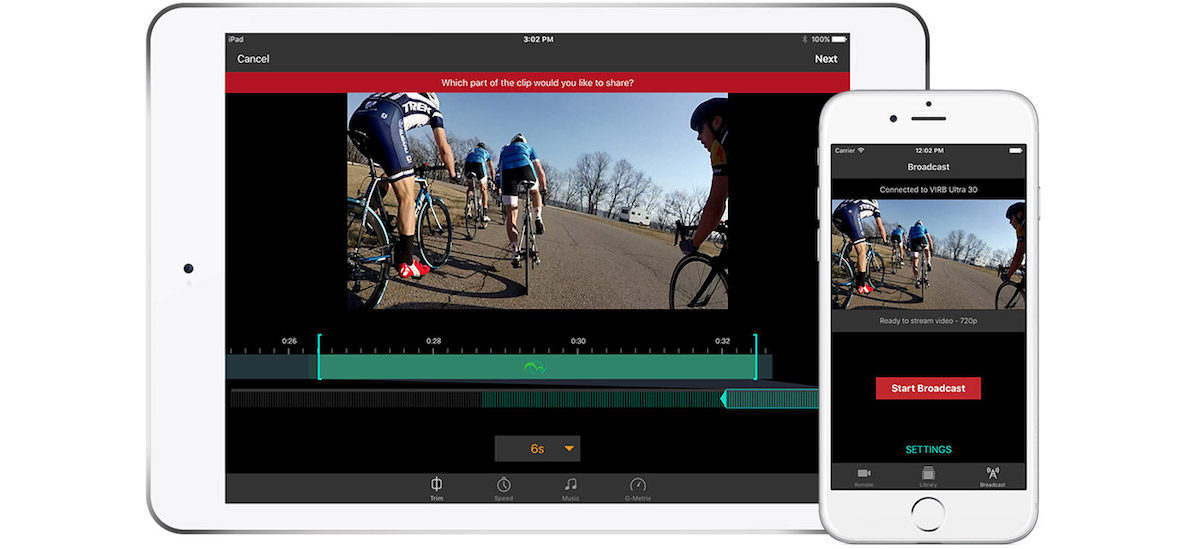
Users will be able to control the camera through voice commands that tell the device when to start or stop recording, switch capture modes, or even remember a specific moment in a video so it can be easily discovered later. The VIRB 360’s voice control system is awakened by the statement, “OK Garmin.”
The VIRB Mobile app [Direct Link], as well as the desktop-based VIRB Edit software, lets users edit, stabilize, share, and add data overlays into videos. Once an iOS or Android device is connected, it can be used as a remote control for the camera with live 360 degree video feeds appearing on the smartphone, or users can even instantly view the content live in VR with compatible headsets. Live streaming to YouTube and Facebook is available only on iOS devices.
Garmin hasn’t announced a specific launch date yet, but the company confirmed that the VIRB 360 camera will debut sometime in June, costing $799.99. More information about the camera can be discovered on Garmin’s website here.
Tag: Garmin
Discuss this article in our forums
 AIVAnet