


Rugged is an understatement with Kyocera’s three-camera DuraForce Pro
Kyocera, no stranger to making rugged smartphones, is releasing a successor to the DuraForce XD, which debuted in January. The upcoming DuraForce Pro is being touted as the only rugged smartphone with a “Super Wide View FHD Action Camera.”
And that’s what the Kyocera is marketing. Rather than carrying a GoPro around during your adventurous exploits, why not lessen the load and use a smartphone that complies with the Military Standard 810G, meaning it’s shockproof, drop-proof, dust-proof, can withstand temperature extremes, solar radiation, humidity — you get the idea. Oh, and if that’s not enough, it’s IP68-rated, meaning that you can take it underwater up to 2 meters deep for 30 minutes.
Here’s everything you need to know.
Pricing and availability
Kyocera’s DuraForce is now available on T-Mobile. It’s $425 outright, or $17 down and $17 per month for 24 months on a payment plan.
That’s in line with pricing across the other three major U.S. carriers.:
- Verizon is offering the DuraForce Pro for $408, or $17 per month for 24 months.
- Sprint is selling it for $432, or $18 per month for 24 months.
- AT&T has it for $419, or $14 for 30 months.
Action Overlay mode
The DuraForce Pro’s good for more than weathering the elements. A recent software update introduced Action Overlay mode, which is exclusive to the T-Mobile version of the DuraForce Pro. With it, you can record video clips with a head-up display (that you’ll have to buy separately) and see stats like your speed, distance traveled, g-force, altitude, elapsed time, and date.
Specs
The 5-inch, Android 6.0-packed DuraForce Pro has a resolution of 1920 x 1080 pixels that’s powered by Qualcomm’s Snapdragon 617 — the same chip in the new Moto G4 and ZTE ZMax Pro. It comes with 2GB of RAM, 32GB of internal storage, dual front-facing speakers, and a large 3,240mAh battery that supports QuickCharge 2.0 and wireless charging. And it sports NFC, a fingerprint sensor, Bluetooth 4.2, and a boatload of other sensors such as a barometer.

The specialty of this smartphone is its dual camera set up on the rear — a 13-megapixel camera sits next to the “Super Wide View” 1080p camera that has a 135-degree lens. It’s an action camera, meaning it has an “underwater mode, sports mode, slow motion, time-lapse” and can capture 1080p video. Of course, there’s a 5-megapixel front-facing camera as well if you want to snag some selfies.
Kyocera looks to take things several steps further with support for “popular action-camera mounts,” but the company was quite vague with the terminology. Overall, the DuraForce Pro is not much to look at with big bezels and thick buttons, but that’s what you get when you want a device that can withstand almost anything.
Article originally published in August 2016. Updated on 05-26-2017 by Kyle Wiggers: Added pricing information for all four major carriers, plus details of Action Overlay mode.
Adobe partners with design firm to bring iconic typefaces to Creative Cloud
Why it matters to you
Creative Cloud subscribers now have free access to many iconic typefaces from one of the most recognized design firms, House Industries, in addition to the nearly 7,000 fonts available.
Font fanatics, rejoice. One of the most iconic typeface companies is bringing several of their fonts to Adobe Typekit, for free. Adobe announced a partnership with House Industries, a company that crafts custom lettering and fonts that are widely recognized, from the Jimmy Kimmel Show to the New Yorker magazine. The partnership brings seven free-to-use fonts to the Typekit library for Creative Cloud subscribers, while 50 will be available in the marketplace for individual purchase without a subscription.
According to Matthew Rechs, Adobe’s Typekit director, House Industries fonts are iconic, essential, and often immediately recognizable among the design community, both for their style and quality. “This is absolutely one of the most prestigious partners I could imaging winning the trust of,” Rechs said. “The reason we have been able to do that, and bring partners like these into the ecosystem, is that we’ve made a business that works for them.”

Adobe
House Industries is a boutique graphics company with over 25 years of font design experience. Along with developing fonts, the Delaware-based company has also designed custom lettering for well-known brands. The brand is so iconic that it has earned a permanent collection at the Smithsonian’s design museum, as well as a major exhibition at the Henry Ford Museum (opening May 27).
While 49 House Industries fonts will be coming to the Typekit marketplace for purchase, several are included with Creative Cloud subscriptions, including Sign Painter, a script font that mimics hand-drawn lettering. Those fonts are available within applications like Photoshop, Illustrator, and InDesign; select the “Add fonts from Typekit” from the type menu.
The new additions include a variety of styles, including script fonts, a style that Rechs explains is easy to find, but hard to do well with the right rhythm and spacing.
“A lot of time when people think about type, they think of style, but designers think of type as tools,” he said. “[Fonts are] not necessarily about style, fashion or getting a particular look, they are trying to solve a particular problem most of the time. They have a kind of look and a kind of fashion, it’s very expressive and emotional, but a lot of it has specific utility.”
“When Rich Roat and I started House Industries 25 years ago, I was an idealistic 21-year-old with one foot in the analog world and one in the digital,” said Andy Cruz, co-founder, owner, and art director at House Industries. “Adobe’s tools have always helped us merge both of those worlds together. We’re happy that our fonts are now even more accessible to Adobe users.”
Typekit now has nearly 7,000 included fonts and almost just as main paid options, with Adobe adding thousands of new options since acquiring the platform nearly six years ago.
Filename bug can bluescreen older versions of Windows through a website
Why it matters to you
The smallest bug can be exploited to torment users and if you’re still running an older version of Windows, you might be at risk.
If you’re among the holdouts still sticking with Windows Vista, Windows 7 or Windows 8.1, you should be aware of a newly discovered bug that can bluescreen your system if you happen to visit an affected website. The issue is related to the way filenames are constructed and calls to mind a similar problem that affected users in the 1990s.
Windows has long since employed several special filenames that refer to things other than individual files located on disk. The nature of these special filenames dictates that they need to be accessible from any location in the file system and they can cause the operating system to hang if they are not used properly.
The special filename at the heart of this bug is $MFT, which is the name given to a particular kind of metadata file used in Microsoft’s proprietary file system, according to Ars Technica.
$MFT is not visible under normal circumstances, the majority of software cannot access it directly, and Windows will block attempts to open the file. However, if there is an attempt to open $MFT as if it were a directory, a Windows driver will enforce a lock on the file that will never be released.
All attempts to access the file system will be blocked as a result, which will cause problems for any active applications. The computer might not necessarily bluescreen, but it will not be good for much until you reboot it.
Including a dodgy filename as an image source on a web page can successfully trigger the bug on a visitor’s computer. Some browsers are unaffected, as they don’t offer the ability to access local system resources in this manner — but apparently, Internet Explorer has no such restrictions and, as such, can be targeted quite easily.
Window 95 and Windows 98 were affected by a similar issue relating to special filenames that referred to hardware devices. Windows 10 is seemingly unaffected by the new iteration of the bug.
Surface Pro 4 makes sleep mode more efficient with latest update
Why it matters to you
Microsoft is keeping the Surface Pro 4 competitive with regular updates, even if they aren’t the most exciting.
Tweaks to hibernation and sleep modes are at the forefront of Microsoft’s latest update for the Surface Pro 4. These changes will improve battery life and stability for a system that will now runs better when you’re not using it. There are also a handful of tweaks to touch up functionality and brightness controls.
With the advent of Windows 10, Microsoft made a big commitment to keep updates for its various hardware and software platforms coming regularly. It’s done a pretty solid job of that, but that does mean that occasionally there are releases which don’t exactly shake the world up. That’s what this latest release for the Surface Pro 4 is like — a nice quality of life improvement, but no big feature updates.
Available via Windows Update, or from the Surface Pro 4 drivers and firmware page (thanks MSPowerUser), the update aggregates a number of updates released recently for Surface Integration and Intel Precise Touch Device drivers. The Surface Embedded Controller Firmware update should improve battery life when the 2-in-1 is in sleep mode and touch support will also be disabled when the cover is closed. It’s said to improve overall system stability, too.
The Surface Integration update tweaks the way hibernation works, while the update to the Surface System Aggregator Firmware resolves problems with screen brightness when bringing the convertible laptop out of sleep mode.
Other improvements in this release include an update to touch functionality, an update to the Surface UEFI which refines the brightness settings, and a Surface Touch update to further optimize its functionality.
All of these improvements might be small, but they help keep the Surface Pro 4 a relevant piece of equipment when it’s being compared to the latest Surface Pro convertible tablet. Picking one or the other isn’t easy, as they’re both great devices. When that new Microsoft 2-in-1 is compared to Apple’s MacBook Pro 13 though, things are a little more clear-cut.
EVGA’s sub-zero Kingpin Edition graphics card could set new GPU clock records
Why it matters to you
When one of the world’s top overclockers lends their name to a graphics card, you know it’s going to be an impressive piece of equipment.
EVGA may be setting itself up to have the world’s most overclockable GTX 1080 Ti graphics card, with a teaser of a Kingpin Edition, built in conjunction with the world-famed overclocker. The as-yet-unannounced card is said to have a new high-efficiency power design, as well as unprecedented overclocking potential.
The GTX 1080 Ti is not only one of the world’s most powerful single-core graphics cards — second only to the Nvidia Titan Xp — but it has proven to be very overclockable, too. Vince Lucido, otherwise known as Kingpin, previously pushed it to break all sorts of records by hitting a frequency as high as 3GHz on the core. This new design could end up being even more capable.
Although no official announcements have been made for the card, EVGA product manager Jacob Freeman has been tweeting out images of a secretive card, said to offer “overclocking perfection.” He claims the card is currently undergoing liquid nitrogen testing at “Kingpin’s lab,” so the connection is certainly there.
Visiting Kingpins lab pic.twitter.com/U17MPjQsub
— Jacob Freeman (@EVGA_JacobF) May 25, 2017
Other images spotted on Lucido’s Facebook page (via Hexus) show a custom Kingpin logo on the PCB of a card, describing it as being highly efficient and indicating that it uses a “next gen KP power design,” which delivers “Pascal OC perfection.” Considering Lucido has had so much success overclocking the Pascal core on the GTX 1080 Ti, it would make sense that whatever custom card he’s working on, it’s based on the same reference design.
The final image on his page tells us that it’s “almost time” too, so whatever card this does turn out to be can’t be too far away from release. Chances are it will be expensive and not a card aimed at the average user, but if you’re a hardware enthusiast who loves pushing your system to the limit, there may only be one card of choice for you when this one rolls around.
Of course though, that discounts AMD’s impending potential disruption of the high-end graphics card market. With Vega just around the corner, it may be a good idea to wait and see what reviewers think of that new line of cards before buying anything new.
Lyft hopes to convince drivers it is better than Uber with scheduled rides
Why it matters to you
Scheduled rides will hopefully make getting to your destination a bit of an easier, more reliable experience.
If ever there were a time for Lyft to strike, this would be it. Between a maelstrom of bad PR around Uber’s CEO and some questionable business practices as they relate to drivers, Lyft has something of a golden opportunity to rise above the din. And it looks like it is grabbing that opportunity with both hands. On Friday, the transportation company made life easier for its drivers, allowing passengers to schedule rides in advance that drivers can accept hours or even days beforehand, essentially helping them set a schedule.
“It gives the drivers to control their schedule and think about what they’re going to do,” Tali Rapaport, Lyft’s VP of Product, told Business Insider. “We can now give certainty.”
This is the first time that a major player in the transportation space has offered such a feature to its workforce. Sure, a flexible schedule has always been heralded as something of a benefit of being a driver, but this new feature also allows for some order and regularity.
That is not the only new thing Lyft is offering. There is also a brand new driver app and “power zones” that promise bonuses on each and every trip. These power zones, as the name implies, are areas that will boost drivers’ earnings, because how many people really want to be driving around in Times Square in midday?
“…It helps us get drivers on the road when passengers really need them,” Rapaport said. “It kind of gives drivers control over what they’re making.”
Ultimately, Rapaport noted, “There isn’t going to be one silver bullet to make the experience better for drivers.” Rather, Lyft is hoping that a confluence of features will help convince drivers to have a preference working for the company.
Of course, these updates are good for the rider, too. Thanks to the new scheduled pickups, you can have drivers book your ride up to seven days in advance. And the power zones ought to send more drivers to areas that you are most eager to leave (or in some cases, get to).
The entirety of the new feature suite is expected to roll out to Lyft drivers over the summer.
Gionee S10, S10B, and S10C: News and release date
Why it matters to you
Gionee’s quad-camera S10 sets a new bar for smartphone photography.
Gionee’s no stranger to boundary-breaking smartphone design. Its W2017 features two fast-charging batteries packed into a compact body, and it claims that the M6 and M6 Plus are among the “most secure” phones around. So it’s not exactly surprising that its revamped S Series — the newest to join the company’s growing smartphone portfolio — is no less innovative.
The S10, S10B, and S10C were announced for Chinese markets in May 2017, but could launch in more territories in the coming months. Here’s everything you need to know.
Design

The S10, S10B, S10C may not look especially distinctive — Gioneer’s S-Series aesthetic is something of a cross between an iPhone 7 and HTC’s U11. But there’s more to the phones’ design than meets the eye.
The S10, S10B, S10C have rounded and chamfered edges, and an oval-shaped fingerprint sensor on the front flanked by two touch-sensitive navigation buttons (a back button on the left, and a shortcut to the list of apps running in the background on the right). Gionee has implemented a unique antenna design that has eliminated the need for plastic seams, and has added protective glass on the S-Series with a “2.5D” shape that curves around the phones’ bodies.
All three phones have hybrid slots that allow either Dual SIM or MicroSD storage expansion.
Specs
Gionee S10
The S10, the highest-end offering of the S-Series bunch, boasts the most impressive hardware, unsurprisingly.
On the front’s a 5.5-inch 1080p (1,920 x 1,080 pixels) In-Cell display with a MediaTek Helio P25 processor and 6GB of RAM. There’s 64GB of storage onboard, a 3,450mAh battery that delivers 40 hour of call time and 12 hours of video playback.
But the S10’s four cameras are the highlight. Two on the front (one 20MP sensor and one 8MP sensor), and two on the rear (one 16MP sensor with a f/1.8 aperture and one 8MP sensor), deliver superior shots in low light. Gionee’s “Hardware Engine image processor” powers the four shooters, and an ISP algorithm generates real-time depth of field blur effects.
Gionee S10B
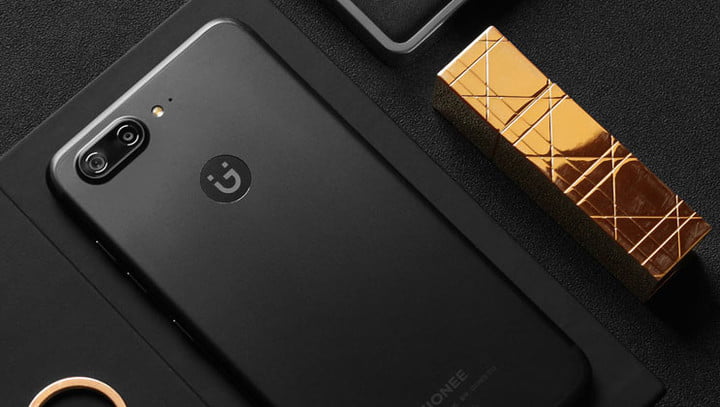
The S10B, the midrange S-Series offering, is a slight step down from the S10.
It has 5.5-inch Full HD display, a MediaTek Helio P10 processor, and 4GB of RAM (as opposed to the S10’s 6GB). There’s 64GB of internal storage, and a 3,700mAh battery.
The cameras are the most obvious compromise. The S10B has lower-quality dual cameras on the rear — one 13MP and one 5MP — and 1 single 6MP selfie cam. And it lacks the S10’s image-processing hardware.
Gionee S10C
The S10C, the most affordable in Gionee’s S-Series lineup, has a smaller, 5.2-inch HD screen and a Qualcomm Snapdragon 427 processor coupled with 4GB of RAM. There’s 32GB of storage under the hood, and a 3,100mAh battery.
A single 13MP front sensor and 16MP rear sensor juggle picture-taking duties.
Software

The S-Series ships with Gionee’s Jinli security suite, which protects against fraudulent phone calls, text messages, and phishing websites, and offers quick access to Allipay and WeChat, China’s most popular payment platforms — double-clicking the home button launches the payment service you’ve specified in the Settings menu.
Gionee’s health app records activities like running and walking, and applies machine intelligence to “show more comprehensive health data” and track sleep. And Grabber uses “semantic intelligence” to highlight locations, times, and phone numbers in text messages and websites, supplying a corresponding “smart card” with related info and sharing shortcuts — sort of like Google’s Now on Tap.
Release date and availability
The G10 starts at CNY 2,599 (roughly $380). The cheaper S10B retails for CNY 2,199 (roughly $320), and the S10C is CNY 1,599 (roughly $233).
Gionee’s S-Series phones will ship in gold, black, blue, and green when they go on sale in China. The S10C is available now, and the Gionee S10 and S10B launch on June 9.
Nvidia claims its MX150 is four times faster than onboard graphics chips
Why it matters to you
Nvidia’s new mobile chip could lead to a new generation of portable devices that offer stronger performance and battery life.
Nvidia released some specifications and made ambitious claims about the performance of its upcoming mobile graphics chip, the MX150. It is said to offer much-improved performance efficiency over the Maxwell-based 940MX from the previous graphics generation, it also claims that the performance can be as much as four times that of integrated Intel graphics.
Although graphics cards and chips are often talked about in the same conversation as high-end gaming, they do have their uses elsewhere. For non-gamers, having a dedicated graphics chip can make a big difference to the time it takes to edit photos, or in remastering video. Those content creators are the ones Nvidia is targeting with its new release, claiming that the MX150 is a must-have for their next upgrade.
In terms of specifications, this chip sports 384 CUDA cores, according to Tech Powerup, which while the same as the 940MX, comes in a 16nm package, a full 12nm smaller than the older generation. It also partnered up exclusively with GDDR5 memory. As reported, clock speeds should also be higher, though the specifics of that will likely depend on the device the chip is used in and how strong its cooling solution is.
 Nvidia
 Nvidia
 Nvidia
 Nvidia
The architectural changes lead to big gains in performance and efficiency, according to Nvidia. The MX150 is said to have three times the performance per watt, when compared with the 940MX and enables photo editing up to 2.5 times as fast as Intel’s HD520 onboard graphics chip.
Video remastering sees a 33 percent improvement over the 940MX too, operating at four times the speed of the HD520. Overall, this is said to give the MX150 four times the performance over that same Intel chip and not far off the same of the HD620.
The added efficiency from the new chip design should give hardware manufacturers many more options when it comes to the power draw and performance they offer. If they so choose, they could utilize the added efficiency to provide stronger battery life and reduced temperature output for smaller, lighter devices, alongside the more powerful alternatives.
Qualcomm’s settlement with BlackBerry has reached a whopping $940 million
Why it matters to you
Qualcomm’s chip monopoly reportedly edged out competition, inflating the prices of smartphones.
BlackBerry just keeps on winning against Qualcomm. While the company was previously awarded $815 million in its case against Qualcomm, the settlement has now reached a hefty $940 million — a sum that Qualcomm has agreed to pay on or before May 31. BlackBerry confirmed the news in a press release.
The specifics of the refund remain unclear — Qualcomm said it is for sales of “subscriber units” — but at the core of the dispute is licensing fees BlackBerry paid in advance to Qualcomm. The smartphone maker argued that an agreed-upon caps on royalties was never applied, and Qualcomm argued that the payments were nonrefundable.
Qualcomm, unsurprisingly, said it disagreed with the court’s ruling. But it acknowledged that it was binding and that it “[had] no impact on agreements with any other licensee,” a Qualcomm spokesperson said.
It’s the latest in a string of legal blows against Qualcomm. In January, the U.S. Federal Trade Commission sued the San Diego, California-based company for anti-competitive practices, accusing it of using its dominant market position to edge out competition. The FTC alleged that Qualcomm gave its partners two choices: Pay pricey royalties for the use of its patents or limit the sale of their devices to smaller markets.
The FTC said that Qualcomm abused standards-essential patents — patents that must be licensed at fair, reasonable, and non-discriminatory rates — by refusing to license them directly to competing suppliers. The FTC characterized Qualcomm’s fees as “disproportionately high” relative to its competitors and said that consumers ultimately paid the inflated prices.
Apple later filed its own $1 billion lawsuit against Qualcomm (and subsequent suits in two other countries) over royalties for basic patents, claiming that Qualcomm forced it to pay excessive fees and withheld nearly $1 billion “as retaliation for responding truthfully to law [South Korean] enforcement agencies investigating them.”
“Despite being just one of over a dozen companies who contributed to basic cellular standards, Qualcomm insists on charging Apple at least five times more in payments than all the other cellular patent licensors we have agreements with combined,” Apple said in a statement.
Qualcomm cut Apple a discount in exchange for agreeing not to source competitors’ wireless modems for five years. That reportedly hampered silicon giants like Intel, which for years have tried to break into the smartphone chip space.
In a statement, Qualcomm general counsel Don Rosenberg said that Apple had “intentionally mischaracterized” Qualcomm’s practices and has been “actively encouraging regulatory attacks on Qualcomm’s business” around the world. “We welcome the opportunity to have these meritless claims heard in court, where we will be entitled to full discovery of Apple’s practices and a robust examination of the merits,” Rosenberg said.
Updated on 05-26-2017 by Christian de Looper: Added news that settlement has reached $940 million.
Computer scientists develop AI that gets curious about its surroundings
Why it matters to you
An AI that’s curious about its environment could help machines learn general skills that can be transferred to other environments.
Artificial intelligence is showing a greater range of abilities and use-cases than ever, but it’s still relatively short on desires and emotions. That could be changing, however, courtesy of research at the University of California, Berkeley, where computer scientists have developed an AI agent that’s naturally (or, well, as naturally as any artificial agent can be) curious.
In tests, they set the AI playing games such as Super Mario and a basic 3D shooting game called VizDoom, and in the games, it displayed a propensity for exploring its environment.
“Recent success in AI, specifically in reinforcement learning (RL), mostly relies on having explicit dense supervision — such as rewards from the environment that can be positive or negative,” Deepak Pathak, a researcher on the project, told Digital Trends. “For example, most RL algorithms need access to the dense score when learning to play computer games. It is easy to construct a dense reward structure in such games, but one cannot assume the availability of an explicit dense reward-based supervision in the real world with similar ease.”
But given that Super Mario is — last time we checked — a game, how does this differ from AI like the DeepMind artificial intelligence that learned to play Atari games? According to Pathak, the answer is in its approach to what it is doing. Rather than simply trying to complete a game, it sets out to find novel things to do.
“The major contribution of this work is showing that curiosity-driven intrinsic motivation allows the agent to learn even when rewards are absent,” he said.
This, he notes, is similar to the way we show curiosity as humans. “Babies entertain themselves by picking up random objects and playing with toys,” Pathak continued. “In doing so, they are driven by their innate curiosity, and not by external rewards or the desire to achieve a goal. Their intrinsic motivation to explore new, interesting spaces and objects not only helps them learn more about their immediate surroundings, but also learn more generalizable skills. Hence, reducing the dependence on dense supervision from the environment with an intrinsic motivation to drive progress is a fundamental problem.”
Although it’s still relatively early in the project, the team now wants to build on its research by applying the ideas to real robots.
“Curiosity signal would help the robots explore their environment efficiently by visiting novel states, and develop skills that could be transferred to different environments,” Pathak said. “For example, the VizDoom agent learns to navigate hallways, and avoid collisions or bumping into walls on its own, only by curiosity, and these skills generalize to different maps and textures.”
 AIVAnet