


Give your desk — and devices — a boost with these playful novelty chargers
Portable chargers and power banks aren’t the most exciting pieces of technology, but there’s no reason these handy devices need to be boring. Below, we’ve rounded up some of our favorite deals on novelty chargers that can help you brighten up your daily routine and flash your nerd credentials to your friends and co-workers.
Pokémon Go Poké Ball power bank

Nothing puts a damper on your quest to become a Pokémon master like a dead Pokédex. Thankfully, Smart Electronics Solutions has you covered with this Poké Ball power bank. This portable charger packs a 10,000mAh internal battery for multiple charges of all of your tech, and the unit lights up to show off its Pokémon-themed cutout design. When not in use, it looks like the standard red-and-silver Poké Ball we all know and love.
The Smart Electronics Solutions Poké Ball power bank comes in an attractive gift box and would make a great present for any aspiring Pokémon trainer. This fun novelty charger rings in at just $23 on Amazon after a 15 percent discount.
Amazon
ThinkGeek BB-8 car charger
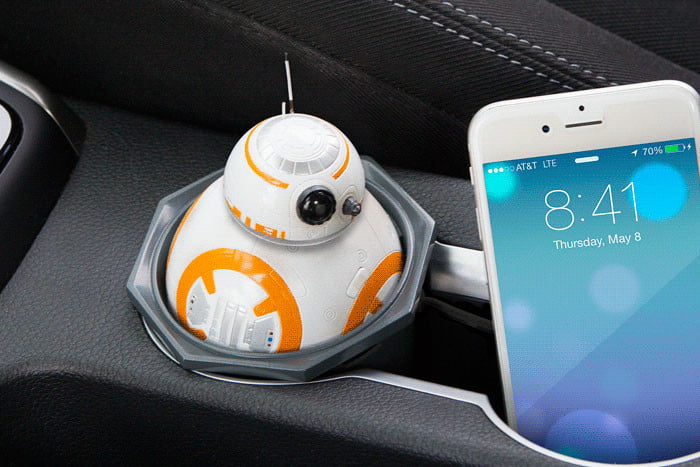
If you’re in the market for a car charger, then this might be the droid you’re looking for. Every good pilot needs a trusty astromech, and whether you’re making a trench run or a doughnut run, this BB-8 car charger has your energy needs covered with 2.1A USB ports that can charge two of your devices simultaneously. The unit plugs right into your vehicle’s 12V power outlet and fits neatly into any standard cup holder.
Available exclusively from ThinkGeek, the BB-8 car charger can be your wingman for just $28 after a limited-time $12 discount.
ThinkGeek
MimoPowerTube Star Wars V2 charger

The MimoPowerTube charger may not be a real lightsaber, but at least it won’t result in immediate self-dismemberment when you turn it on. Although its relatively small 2,600mAh battery won’t fully charge many devices, this fun little power bank is perfect for giving your tech a quick boost, especially if you happen to be a Star Wars fan. The included USB cable features multiple adapters for different connector types including micro USB, mini USB, and Apple Lightning.
Along with Darth Vader’s lightsaber, the MimiPowerTube Star Wars novelty charger is available with Boba Fett, Yoda, and R2-D2 skins. A 50 percent discount knocks the price down to $15 on ThinkGeek.
ThinkGeek
Warcraft Alliance and Horde power banks

Are you a member of the noble Alliance or a warrior of the mighty Horde? Show your allegiance (and taunt your friends) with these Warcraft-themed power banks. Available in both Alliance and Horde crests, these portable chargers are the perfect gift for Warcraft addicts, and offer 6,720mAh of power for when your mana is running low. Two USB ports allow for charging multiple devices.
The officially licensed Warcraft Alliance and Horde power banks are currently available from ThinkGeek for $60 each.
Alliance Horde
Emie kitten charger
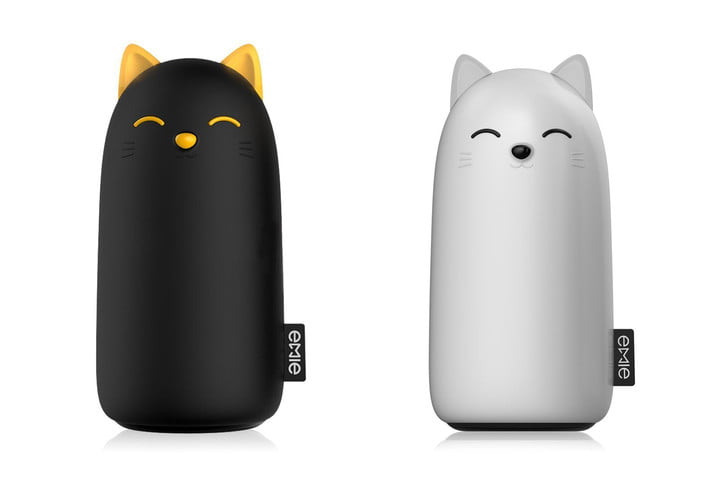
Unlike your real cat, the Emie kitten charger does more than lie around and get hair everywhere. This chubby charger contains a large 10,000mAh battery for multiple recharges, and built-in LED lights in the cat’s ears let you know when it’s “hungry” and needs a charge of its own.
The Emie kitten power bank is available in black and white for $30 on Amazon after a savings of $13, but you dog lovers aren’t forgotten: The 5,200mAh Samo dog charger is also on sale for just $20 after an even deeper 50 percent discount.
Cat Dog
Uforest Dog Power Bank

If animals are your thing but you want something a bit more plush, check out the adorable puppy power bank from Uforest. Its generous 10,000mAh battery and 2.1A power output delivers plenty of juice and snappy charge times for all of your USB, micro USB, and Apple Lightning devices. A free iPhone cable is included, and you can stow a charging cord away in the doggo’s backpack.
The puppy power bank even comes with a removable sweater, so you can lovingly dress him up while receiving concerned looks from your co-workers. The Uforest Dog Power Bank is on sale on Amazon for $30, giving you a $16 savings.
Amazon
Minecraft redstone torch USB wall charger

Looking for a way to keep the Creepers at bay? The Minecraft redstone torch wall charger, another exclusive gem from the folks at ThinkGeek, is just the ticket. Along with serving as a handy dual-USB power station, this wall charger doubles as a fun Minecraft-themed night light that puts out a warm glow with the flip of a switch.
Although not a portable power bank, the redstone torch USB wall charger is a great pick for any Minecrafters out there who want something to ward off things that go boom in the night. It’s priced right, too, at just $30 from ThinkGeek.
ThinkGeek
Fab WattzUp emoji chargers

If the other novelty charger deals on our roundup don’t tickle your fancy, check out these ones from Fab. The WattzUp series of portable chargers are based off of popular emojis including unicorns, a happy cat, and everyone’s favorite — the poop emoji. (If your boss asks, just tell him it’s ice cream.) The pocket-sized power banks feature 2,600mAh batteries, great for smaller devices or when you just need a quick boost to prevent your phone from dying.
The Fab WattzUp emoji chargers normally go for $40 but are currently on sale at a 25 percent discount, which shaves $10 off the price. Snag these fun power banks for $30 apiece from Fab’s online store.
Fab
Which phone are you using right now, and why? [Roundtable]

See what phones the people write about phones for a living are using.
A perk of working for Android Central is that you get to use a lot of different phones throughout the year. Of course, we all have a favorite that we keep going back to or never want to switch away from. In that respect, we’re just regular smartphone users like everyone else!
With 2017 almost half finished, see which phones the AC staff is using and why. Then let us all know which phone does it for you in the comments!
Russell Holly

The smaller Galaxy S8 is for me, because I don’t need that extra tall mess in my life right now.
I’m on the Galaxy S8 right now. The smaller one, since I don’t need that extra tall mess in my life right now. The battery life is exactly what I need, the camera is exceptional, and while I’m not a big fan of disabling all the extra Samsung crud to get the experience I want, I found that process less tedious this time around. I love that I have wireless charging again, and once I found a “case” I liked for the phone it became the phone I reached for most often.
It’s also a practical choice for work right now. The Galaxy S8 is soon to be the only Android phone with Gear VR and Daydream support, which means I can enjoy both and share those experiences with others. But if I’m honest, it’s mostly because of the other stuff.
Jen Karner

I kinda fell in love with my Pixel XL back in December, and it’s still my phone for the time being. Although, to be fair, the Samsung Galaxy S8 is definitely making me think that I might want to switch soon. The Pixel takes care of me in all the right ways, namely giving me access to Daydream, along with a great camera, and plenty of room for apps and games.
I’ve been in love with the Pixel XL since December.
I haven’t had any issues with my Pixel XL, and so far it hasn’t let me down. I take most of my photos using my phone so having a device with an excellent camera is always on my mind. The big pull for me is really being able to use Daydream View with it. I always want to be able to access the best in VR, and for the most part, my Pixel delivers on that. Until the Galaxy S8 gets that feature, too.
Ara Wagoner

Galaxy S8 and HTC 10 are how I roll.
I’d love to say that the Samsung Galaxy S8 is my daily driver right now… but I can’t put my AT&T SIM card in it, so I am dual-dailying right now. I keep the S8 for apps, music, gaming, and pretty much everything I do that doesn’t require my personal SIM, which is in my HTC 10. I switched from the Pixel back to the HTC 10 for some irking little reasons, but now that there’s an OTA beta for O out, I might stick my SIM back in there and dual-daily the Pixel and S8 so that I can play around with that.
I’ve loved the S8 so far, I’m even starting to get used to that stupid fingerprint scanner placement. My biggest issue with the phone so far are the weird bugs it’s been having with Google Play Music, but I don’t hold that against the phone… yet. Battery life has been steady, BT and call audio has been consistent, the camera is excellent. If I could stick my SIM card in it, it’d be the only phone I carry. And until it is, I’m gonna carry it around anyway.
Daniel Bader
via GIPHY
I’m actually using a super secret phone that I won’t be able to talk about until next week, but I really like it and I’m sure you will, too. Tease over.

Right before I switched, though, I was using the Galaxy S8+, which took over from the Galaxy S8 a few weeks back (yes, I have a problem). There are a few reasons I prefer the Plus, battery life aside: it feels like a small tablet, which means I have no issues at all watching TV shows, movies, and YouTube videos on the screen while traveling. I haven’t touched a tablet since I began using it.
The Galaxy S8 does everything better than the competition.
Ultimately, though, after all the nitpicking and minor criticisms over fingerprint reader placement and usability concerns with the curved glass, the Galaxy S8+ is just a competent smartphone. It does most everything well, better than the competition. I tried returning to the LG G6 for a few days after using the S8+ and just couldn’t; it felt somehow incomplete and flawed.
I am not impressed that the Galaxy S8 series shipped with Android 7.0, though: I’d have liked to see 7.1.1 at launch. And I don’t think the camera is quite as good as it could have been given Samsung’s previous year-over-year improvements. But every time I stop reviewing it and start using it, I realize how much I enjoy using the Galaxy S8+, and that’s a pretty steep hill to climb for a guy that uses dozens of phones every year.
Andrew Martonik

I’ve been using the HTC U11 since Google I/O last week. It’s an “amazing silver” model that is, unfortunately, a Taiwanese review unit (network bands don’t all line up with the U.S.), but despite a couple missing radio bands I’ve been sticking with it anyway.
The HTC U11 nails all the basics and is fast.
After not really caring for the U Ultra earlier this year, I’m super happy with the U11 right now. The phone is beautiful and built with typical HTC solidity, and the company just continues to nail the basics like its build quality, buttons, haptics, fingerprint sensor, and speakers (no, I won’t hear any more crying over not having the “old” BoomSound). The software is fast and responsive in a way that evokes memories of using the Pixel XL. And it turns out the camera is really good too.
The U Ultra’s design feels a bit last-gen set next to the Galaxy S8 and LG G6, but that’s not enough to put me off of a phone that’s otherwise really great in daily use. I’ll be sticking with it for a while.
Marc Lagace

I made the switch to the Galaxy S8 from the Pixel because new shiny things are awesome — though I’m tempted to switch back to the Google Pixel to check out the Android O beta. Samsung has sure made it tough to switch back to anything else, though, because the Galaxy S8 is the real deal. It’s blazing fast, feels great to hold and the infinity display lives up to the hype.
The Galaxy S8 is the real deal.
Really, the only thing that’s bothering me about using the Galaxy S8 is Bixby. I’d much prefer to use the superior Google Assistant, but I keep hitting the Bixby button on accident. I know there are apps and methods to remap the button, and Google Assistant is still accessible on the GS8, but I really fell in love with Google Assistant on the Pixel and really appreciate how Google built the Pixel’s software around it.
Harish Jonnalagadda

I switched to the Xiaomi Mi 6 earlier this month, and I’m liking it a lot. The phone is a huge improvement over the Mi 5 in several areas, and the murdered-out black color option, in particular, looks great. With the Indian variant of the Galaxy S8 powered by the Exynos 8895, the Mi 6 is the first phone I’ve used that runs the Snapdragon 835. It definitely runs smoother than both the Mi 5 and Mi 5s, and the 128GB of storage gives me more than enough room to install all the apps I need.
My murdered-out black Xiaomi Mi 6 is my go to.
The dual camera setup is a welcome addition, but more importantly, the main 12MP camera is leagues better than the Mi 5. The software situation has also been improved, with the phone running an MIUI 8 build atop Android 7.1.1 Nougat. The main drawback with the Mi 6 is that it doesn’t have a 3.5mm jack, but I recently picked up a Sony MDR-1000X, so its omission doesn’t annoy me as much as it used to.
Florence Ion

I still haven’t switched over from the Pixel XL, but why bother? This phone has carried me through many a trying time, as well many an International trip. This thing is the second-most reliable smartphone I’ve ever carried — the first was the HTC Incredible, which lasted me a whopping three years of use. How apropos, then, that the manufacturing brains behind the Pixel XL is HTC.
The Pixel XL is ready to go when I am.
Anyway, I know I’m kind of boring in my smartphone usage these days, but I’ve spent the last couple of years constantly switching back and forth between devices. And it’s true that there are now more worthy Android-powered smartphones than ever, but when it comes to daily life, I just need something that’s always ready to go when I am. Let’s hope that Google’s next smartphone release is just as reliable after eight months with it.
Jerry Hildenbrand

I’m using the BlackBerry KEYone. But because my “real” phone number is attached to Project Fi, I also keep my Pixel around. I’m just too busy lazy to port the number out and sign up for a new Fi number. That’s like a lot of hassle and I’d have to do it because some of my people still (gasp) make phone calls. That’s the number they have. It’s cool tho, the Pixel is a really damn good phone too. #firstworldproblems
You had me at QWERTY.
I just really dig everything the KEYone has to offer. Disable all the BlackBerry stuff (I just don’t use it and hate to try new things) and it’s close enough to plain-jane Android that I know where everything is and there’s nothing getting in my way that I don’t want. My needs in a phone are simple, yet I’m pretty picky and they have to be met: The phone has to have the latest software patch and not do secret things in the background that connect to some server from the company that made it. That’s hard to find, unfortunately, but the KEYone does it.
And that keyboard. I’m a sucker for a good keyboard.
Your turn
You probably have a phone in your hand reading this! Jump into the comments and let us all know which one, and why you love it.
Uber is free to operate in Italy on a long-term basis
If you’re in Italy, you can use Uber. A court in Rome today annulled a temporary ban placed on Uber in early April that prevented the company from advertising and operating throughout the country. This didn’t completely stop Uber from infiltrating Italy, though: The ban was suspended about a week after its implementation as the company appealed, and Uber has been allowed to operate since then. Today’s ruling deletes the ban from the books entirely.
“We are happy to announce that you will be able to keep using our app in Italy,” Uber Italy tweeted today, as translated by Reuters.
Italian taxi drivers claim Uber unfairly penalizes their businesses because the app is loosely monitored; taxi drivers in the country operate under stiff regulations. The fight between traditional taxis and app-based services doesn’t end with today’s ruling — the Italian government promises to introduce clear regulations for ride-hailing apps by the end of the year.
“We are thrilled for the thousands of drivers and riders who can continue using Uber in Italy,” a company spokesman tells Reuters. “However, Italy now needs to reform its outdated laws so that all its citizens and cities can benefit from modern technology.”
This isn’t Uber’s first dust-up with frustrated taxi drivers and government officials: France, the UK and cities around the world have attempted to suspend or ban the app. Generally, these battles end with Uber operating in these places anyway under a new set of regulations tailored to the region.
Source: Reuters
Forget flying cars and get ready for air taxis
Flying cars are dumb.
Yes, the cars in Blade Runner, The 5th Element and Back to the Future are cool, and who wouldn’t want to push a button and take to the sky in their Honda Civic? But it’s not going to happen any time in the next few decades, if ever. Frankly, the average driver can’t be trusted with anything that breaks free of the earth. Plus, adding potentially millions of vehicles to the sky is a logistical nightmare that’s sure to end in more than a few collisions that, unlike earth-based vehicles, would end with potentially hundreds of injured or killed bystanders. But that doesn’t mean the only time we’ll take to the skies for transit will be via international airports.
Instead of flying cars, get ready for fleets of small “air taxis” zipping from hub to hub within a region, delivering passengers to their destinations. There’s a reason Uber is so bullish on this idea — it’s an outstanding complement to its current business model. The company wants a world where you take an Uber to one of its flight hubs, hop into a eVTOL (electric vertical take-off and landing) craft and be whisked to another hub on the other side of town. You’d then finish the trip in, you guessed it, an Uber.
It’s also not too hard to imagine current airlines wanting in on the action too; most already offer commuter flights. Plus, of course, there’s going to be an onslaught of random startups hoping to be the “Uber of the sky.”
But Uber’s dream requires partners, new regulations, a change to air traffic control and an infrastructure that doesn’t exist today. Plus, you need actual flying vehicles, whatever they might look like.
Fortunately, there’s commercial interest in building these air taxis of the future. Airbus’ A3 and Aurora Flight Sciences (an Uber partner that happens to work with the DoD) are both working on eVTOL craft. Neither aircraft being developed by these companies resembles a car. Instead they look like futuristic tiny planes. Both take off like a helicopter but fly like a plane, which makes them perfect for short (under 50 to 60 miles) jaunts for two people. But as these get closer to full production (both companies are targeting 2020 for full-size test vehicles), it’s clear that one of those seats will be filled by a pilot.
“Pilot” is probably not what the person behind the wheel (or maybe joystick) will be called. Maybe a controller is the better description. Flying one these multi-rotor craft would be impossible without a computer stabilizing the flight with tiny adjustments being made to each motor at all times. A typical helicopter has two rotors that have to be adjusted constantly by the pilot. Adding six more to that mix and a human wouldn’t be able to keep control. “It’s obviously impossible to fly this plane fully manually. This plane has to be a fly-by-wire system out of the out of the box.” said Diana Siegel, eVTOL program manager at Aurora.
Full autonomy may come eventually, but like self-driving cars, a lot of work needs to be done. Ken Goodrich, research engineer at NASA’s Langley Research Center, believes it might be 20 years before we see a pilot-less aircraft zipping around an urban area. “You’ll certainly find people that say, ‘oh no, you know that will happen in five years 10 years.’ You know, truthfully nobody knows. But we probably will have to take an evolutionary process to get there, just like it’s taking place with driver-less cars today.”
Autonomy won’t stop in the air though. Air traffic control is going have to evolve to handle all these extra craft. According to Goodrich, at certain times there are as many air traffic controllers on the ground as there are planes in the air. That model would be unsustainable if a city were to add multiple hubs and potentially hundreds of air taxis.
“The individual’s ability to manage airplanes quickly becomes an issue. If you try to scale that up, not only is it individuals that run into bottlenecks but just hand offs between individuals is also a bottleneck. It has to become much more automated,” Goodrich told Engadget.

The FAA, for its part, has been talking to manufacturers and is “taking a flexible, risk-based approach to integrating innovative new technologies” said Ian Gregor, FAA public affairs manager. Gregor also noted that the agency is looking at the AI-controlled future, “Several areas need further research, particularly identifying the operational risks, making sure the automation that ‘flies’ the autonomous vehicle is safe, and how the automation will interact with the air traffic control system.”
Zach Lovering, project executive of A3’s Vahana eVTOL, seems enthusiastic about the agency’s course, “While it’s true that historically the FAA has been slow to adopt new technologies, recent work being performed across many divisions of the FAA marks a significant shift in their approach. Not only is the FAA working to modernize the small aircraft certification process, but they are also working to integrate unmanned vehicles into our airspace.”
But even if the air taxis can fly and the FAA is ready to add them to US airspace there’s still one big hurdle that technology might not be able to tackle: The people living near the hubs.
The biggest issue will be sound. There’s a reason houses near the airport are cheaper. That said, the creators of these aircraft insist that they won’t be any louder than nearby roads. “Our design goal is really to be able to take off and blend in with road traffic that are 70-75 decibels,” said Siegel. That’s possible thanks to the electric motors that’ll be powering the rotors on the craft.
After the initial vertical take, the craft will fly forward like a plane and be even quieter. But potential neighbors will probably want to see a demonstration before they’re cool with a tiny airport in their hood.

Additionally, who will be the first customers? Taking a new type of car across town is one thing, flying in a new type of craft might take a while to catch on. Plus, there’s a good chance that it’s going to be way pricier than driving. In addition to the aircraft, you need a hub with landing spots, chargers, buildings and staff to act as local traffic control, customer service and maintenance. So initially it’ll be confined to executives, Fyre Festival trust fund kids and lottery winners.
But eventually, the rest of us would be able to ride across the town when we’re in a huge hurry. Although for some, their first trip will likely be because of an emergency. These eVTOLs would make great ambulances in a congested urban area. However they’re used and how soon the rest of us will be able to fly in one without a pilot is just a matter of getting full-size craft in the air which should happen in the next three to five years. Maybe sooner.

I’m sorry, you’re not getting a flying car, but if your grandchildren are lucky they might get something that flies to get them around town. “We think it’s kind of funny when people call us a flying car — if Vahana is a flying car then so is a helicopter!” Lovering told Engadget. Siegel concurs, “If we can get away from [the phrase] ‘flying car’ that would be wonderful.”
So let’s keep the cars on the ground. Because the sky belongs to something else.
Welcome to Tomorrow, Engadget’s new home for stuff that hasn’t happened yet. You can read more about the future of, well, everything, at Tomorrow’s permanent home and check out all of our launch week stories here.
Qualcomm pays BlackBerry $940 million in royalty spat
Qualcomm hasn’t been very successful with its licensing practices. It’s gotten into trouble in South Korea for charging phone makers over an “unnecessarily broad set of patents” It has also been dealing with lawsuits from the FTC and Apple for similar tactics. Qualcomm was ordered to pay BlackBerry $815 million in an arbitration settlement last April. BlackBerry announced today that the two companies have reached a final agreement amount of $940 miillion, which includes the original arbitration amount along with interst and attorneys’ fees. The release says that Qualcomm will pay the full amount before the end of May.
BlackBerry has been trying to change its fortune after getting out of phone design. It brought in $286 million in revenue last quarter, making this $940 million settlement a much needed infusion of cash to can help the beleaguered company pivot towards self-driving cars. For its part, Qualcomm seems to be weathering the storm of lawsuits and anti-trust fines with countersuits and settlements like the current BlackBerry agreement. Qualcomm’s chips power a large number of mobile devices, with a Snapdragon system-on-chips in high-end Android phones. The company also continues to expand to as many other devices as possible, including IoT and connected cars. We’ve reached out to Qualcomm for comment on this story and will update when we hear back.
Source: Blackberry
The Facebook president and Zuck’s racist rulebook
If a political campaign is an engine then propaganda is its oil, and its gas is the medium of communication with voters.
The hacking of the DNC and tonnes of raw crude in propaganda mined out through WikiLeaks, Breitbart and Daily Stormer was black gold for the Trump campaign.
We’re now learning, thanks to the Facebook Files and the campaign’s ability to connect with and inflame its racist, anti-immigrant base, that the accelerant was Facebook itself. Facebook’s internal rulebook could be considered the Trump campaign’s blueprint for its highly successful ad strategy’s race-fueled messaging on the social network.
“Donald Trump is our first Facebook president,” concludes The New York Review of Books, after spending considerable time with Prototype Politics: Technology-Intensive Campaigning and the Data of Democracy by Daniel Kreiss and Hacking the Electorate: How Campaigns Perceive Voters by Eitan D. Hersh.
“His team figured out how to use all the marketing tools of Facebook,” NYRB wrote. “They understood that some numbers matter more than others—in this case the number of angry, largely rural, disenfranchised potential Trump voters—and that Facebook, especially, offered effective methods for pursuing and capturing them.”
Indeed it did, because Facebook’s own rules around speech and censorship appear to make the social media site a safe space for racists and terrorists in equal measure. We knew it wasn’t a safe place for LGBT populations, vulnerable teens and certainly not for domestic violence victims or women who talk about human sexuality.
But until the publication of the Facebook Files by The Guardian this week did we have a firm grasp on the inverse question: Just who is Facebook safe for, anyway?
A clean, well-lit place for racists
Racists, revenge porn perpetrators, Holocaust deniers and people who think immigrants are filth: One look at the company’s rulebook on content moderation reveals these upstanding members of Facebook’s community get a free pass on cultivating hate. As long as they don’t run afoul of a very slim, arguably subjective set of edge case rules, that is.
Holocaust denial is a particular piece of “free expression” that Facebook is keen to defend — to the point of only enforcing its takedown in countries it thinks it might get sued in. The Guardian explains a Facebook training manual states it only hides or removes Holocaust denial content in four countries (France, Germany, Israel and Austria).
The manual says, “Some 14 countries have legislation on their books prohibiting the expression of claims that the volume of death and severity of the Holocaust is overestimated. Less than half the countries with these laws actually pursue it. We block on report only in those countries that actively pursue the issue with us.”
When reached for comment, Facebook told us, “We currently prevent access to Holocaust denial content in the following countries: Italy, Spain, Netherlands, Belgium, France, Germany, Israel and Austria. We keep our policies under continual review and our policy and legal teams are currently looking at our obligations in respect of Holocaust denial.”
The company’s head of global policy management, Monika Bickert, added, “We recognize the importance and the sensitivities around the issue of Holocaust denial and have made sure that our reviewers are trained to be respectful of that sensitivity.”
While it’s not quite a “we’re sorry you feel that way,” we only hope that Facebook understands that Holocaust denial is less like a nut allergy and more like ignoring the facts of genocide for the express purpose of harm.
Bad press about this would be the only way to get Facebook to pretend to behave responsibly about this, but it’s a loss out of the starting gate for a company that clearly doesn’t get what’s wrong with this in the first place.
And something is very deeply wrong here, on a company-culture level, for this to even be happening in the first place. Should Facebook respond to the bad press about its support of Holocaust denial under the flimsy rhetoric of “free speech,” it will just be a target-specific response. Meaning, they’ll fix one thing, while the bigger problems remain.
Those problems being its inability to grasp why it is such an excellent incubator for hate, and its willingness to fix things only after we’re all totally fucked.
Fertile ground for Trump voters
The Guardian‘s Facebook Files are an abridged version of the company’s content moderation policies, and they reveal an obvious forgiveness for the cultivation of hatred against immigrants, and thus, people of color. While Facebook is lightning fast to censor a gay man’s post saying Trump supporters are “a nasty, fascistic lot,” anyone characterizing immigrants as rapists or robbers gets a free pass (as long as they’re not “equating” them with rapists or robbers).
Facebook’s permissible statements include: “Islam is a religion of hate. Close the borders to immigrating Muslims until we figure out what the hell is going on”; “migrants are so filthy”; “migrants are thieves and robbers”; and “Mexican immigrants are freeloaders mooching off of tax dollars we don’t even have.” These are all statements in Facebook’s rulebook marked as “ignore” when reported.
In the documents we learn that “All terrorists are Muslims” is okay to say on Facebook, but not “All Muslims are terrorists.” The Guardian explains that this is because “terrorists are not a protected category, whereas Muslims are – which is why the first remark can be ignored and the second should be deleted if flagged.”
Oh, okay. Because the people saying these things will totally get the difference, as they have all been educated about the way Facebook interprets the meanings of these things. In fact, the people saying these things won’t see any difference by their very nature. According to the Southern Poverty Law Center, people who are swayed by the rhetoric of hate groups have two primary characteristics: They seek community and have a “low tolerance for ambiguity.” Meaning, Facebook can split hairs all day on the subject of their sentences because for the behaviors of cultivating hate, it’s all about the general context. Racists literally don’t care about “grey areas.”

In a way it doesn’t matter anyway because Facebook’s documents end in a shrug when it comes to things that are difficult to decide — the default is always to leave it up. Moderators only have around ten seconds to make that decision anyway.
Facebook’s Bickert told Engadget: “Keeping people on Facebook safe is the most important thing we do. We work hard to make Facebook as safe as possible while enabling free speech. This requires a lot of thought into detailed and often difficult questions, and getting it right is something we take very seriously.”
For its part, Facebook told us, “Mark Zuckerberg recently announced that over the next year, we’ll be adding 3,000 people to our community operations team around the world — on top of the 4,500 we have today — to review the millions of reports we get every week, and improve the process for doing it quickly.”
Facebook’s moderation rules appear to have been created backward: They quibble over the company’s beliefs about protected groups, while failing to grasp the bigger picture about what kind of environment is created by these kinds of misguided, made-in-a-bubble rules.
Rather than focus on creating a large collection of safe communities, the rules seem formed to fold in preexisting xenophobias and racism and give them Facebook’s tools to thrive; one might call it “a clean, well-lit place for fascism.” Meaning, the moderation rulemakers either really don’t understand how hate groups form and grow, or they’re fine with whatever as long as there’s no bad press and everyone remains an active user. Gotta chase those ad dollars, yo.
Facebook has become a hate-group incubator; the company can’t even wrap its head around the problem of fake news enough to prevent its own program to fight fake news from failing — which it is. Not surprisingly, fake news is weighted by neo-Nazi, pro-Trump propaganda, though Facebook won’t quite admit that key piece of information that could stop its spread. Instead, Facebook’s weak excuse of a program to mark fake news as “disputed” is being seized upon and promoted, shared widely (wider than it likely would’ve) by alt-righties who marshal their sizable Facebook troops and disseminate it with cries of “censorship!”
A lot of noise was made in the press after the election about the Trump campaign’s use of Cambridge Analytica and the way the skeezy data company exploited Facebook users (in addition to the 30 million Facebook users exploited for Trump by an unnamed data mining company). But The New York Review of Books tells us that Facebook was already packed with people ready to vote for Trump, and “Facebook’s real influence came from the campaign’s strategic and perfectly legal use of Facebook’s suite of marketing tools.”
Brad Parscale was the genius who put together Trump’s Facebook outreach strategy. “A few weeks before the election,” NYRB wrote, “he said he had a hunch from reading Breitbart, Reddit, Facebook, and other nontraditional news sources, and from the campaign’s own surveys, that there were whole segments of the population — people who were angry and disaffected — that were being missed by traditional pollsters and the mainstream media.”
And so he went to work during the primaries, purchasing $2 million in Facebook ads — eventually ramping that up to $70 million a month, with most of it in Facebook ads. The New York Review of Books quotes Trump digital team member Gary Coby telling WIRED that, “On any given day…the campaign was running 40,000 to 50,000 variants of its ads … On the day of the third presidential debate in October, the team ran 175,000 variations.”
NYRB detailed:
“He then uploaded all known Trump supporters into the Facebook advertising platform and, using a Facebook tool called Custom Audiences from Customer Lists, matched actual supporters with their virtual doppelgangers and then, using another Facebook tool, parsed them by race, ethnicity, gender, location, and other identities and affinities.
From there he used Facebook’s Lookalike Audiences tool to find people with interests and qualities similar to those of his original cohort and developed ads based on those characteristics, which he tested using Facebook’s Brand Lift surveys.”
Unlike the Democrats, NYRB diagrams how Trump’s team figured out how to use Facebook “to successfully sell a candidate that the majority of Americans did not want.” They used Facebook’s own tools, refined at targeting those most vulnerable to suggestion, to influence those ripening under Facebook’s own rules that coddle Holocaust denial, and anti-immigrant, and anti-Muslim sentiment. This could be plainly seen in Trump’s Facebook ads.
As NYRB explains, Trump’s campaign “understood that some numbers matter more than others—in this case the number of angry, largely rural, disenfranchised potential Trump voters—and that Facebook, especially, offered effective methods for pursuing and capturing them.”

There was a joke after the election that Facebook’s motto “Move fast and break things” was better spoken as “Move fast and break democracy.” But this is bigger than that.
In the United States, racist speech is considered free speech because it is opinion. Also in the US, hate groups are not illegal, but they are kept in check by a system of federal laws that monitor against hate crimes. Now, imagine that Uber has evolved to be allowed to determine what can and cannot be encouraged regarding communities dedicated to sexual harassment and abuse, and you can see why this might not work.
Facebook is not a country, yet it is assigning and removing rights about censorship and speech. It is not a civil rights organization, yet it decides that immigrants don’t have protected status within its walls.
It’s a company. One that is creating censorship tools so it can do business in China. It is a behemoth that complies with censorship demands from the governments of Thailand, Turkey, India, Israel, Pakistan and Vietnam.
It’s also a company to which there is no alternative.
Images: REUTERS/Brendan McDermid (Protestors); REUTERS/Jim Young (Facebook, Zuckerberg)
Sergey Brin’s secret airship will deliver aid and schlep his family
Last month, news dropped that Google co-founder Sergey Brin is building an airship on the sly — not a traditional airplane but an honest-to-god helium-filled dirigible. While he insisted the project wasn’t operating under the tech titan, which had previously announced backing its own “flying car,” it wasn’t clear what Brin would be doing with the world’s largest current aircraft. Now, details are starting to come out: Apparently, the zeppelin will split its time between delivering humanitarian supplies to remote locations and serving as a luxurious “air yacht” for Brin’s friends and family.
Sources told The Guardian that Brin’s as-yet-unnamed aircraft will cost between $100m and $150m and be the largest flying object in the world (but still smaller than the iconic Hindenberg). While it can’t claim a title over its historical predecessor, it’s also filled with non-flammable helium, avoiding its superior’s tragic fate. While more details haven’t been revealed, as it’s still under construction in the Navy’s old wartime airship hangers in Northern California’s Ames airfield, the craft is planned to be 200m long — which is kind of hard to hide when Brin does decide to take it out for its first test drive.
Source: The Guardian
Don’t scream: The new ‘Friday the 13th’ game is out today
After a slight delay, the first official Friday the 13th game since 1989 is available today on PC, PlayStation 4 and Xbox One. If you want to jump right into the action at Camp Crystal Lake, though, you might have to wait for Friday the 13th: The Game’s servers to accommodate the apparent rush of people trying to kill the counselors/survive the maniacal Jason Voorhees. The official Twitter account has been dropping updates since the wee hours of this morning, so if you’re having issues make sure to check there first.
WE ARE LIVE
GO KILL EACH OTHER IN VIDEO GAMES AND SHIT.— Friday the 13th Game (@Friday13thGame) May 26, 2017
Source: Steam, PlayStation Store, Xbox Game Store, Kickstarter
Theresa May wants to force tech giants to curb extremist content
British Prime Minister Theresa May called on global leaders at the G7 conference in Sicily to force internet and social media companies stop the spread of terrorist content available online. “Make no mistake: the fight is moving from the battlefield to the internet,” she said in a statement. May called on companies to develop tools to automatically identify and remove extremist materials, block the users who post it and report such activity to the authorities. The Prime Minister also announced the creation of an international forum to encourage industry leaders to share information and technologies to curb the spread of terrorist content. In addition, May proposed that regional governments cooperate by returning and prosecuting foreign fighters via improved “intelligence-sharing, evidence gathering and bolstering countries’ police and legal processes. The Guardian’s Anushka Asthana reported on Twitter that May’s initiatives have the backing of President Trump, as well.
May’s comments come just days after a terrorist attack in Manchester. Her call is for governmental action, but tech companies have already stepped up to try and curb the spread of terrorism. Facebook, Microsoft, Twitter and Alphabet-owned YouTube are creating a shared database of “hashes” for any terror-related content they remove from their services. Twitter tripled the amount of terrorist accounts it suspended last year and Google launched a series of ads aimed at dissuading would-be terrorists from joining extremist organizations. Engadget has reached out to several tech companies for comment on this matter. Twitter responded by pointing us to this past March’s Transparency Report, which contains details on the company’s proactive steps to curb content like this.
There is a fine line between protecting free speech and cracking down on violent groups bent on killing in the name of an extremist cause, of course. May’s proposals likely have the best of intentions to protect citizens around the globe, but some administrations some administrations have a mixed history of blanket solutions that may cause more harm than good.
Via: BuzzFeed News, The Evening Standard
Source: gov.UK
MIT 3D-printed the shape-shifting future of pasta
A new research project from the Massachusetts Institute of Technology’s Tangible Media Group combines 3D printing, molecular gastronomy and macaroni. According to MIT News, researchers Wen Wang and Lining Yao have engineered flat sheets of gelatin and starch into shape-shifting noodles that react and fold when exposed to water. While Yao’s goal of one day creating a self-folding dumpling is still out of reach for now, the research team thinks their breakthrough could help reduce food shipping costs and lead to new trends in fine dining.
Wang and Yao were actually working with bacterium that respond to humidity when they started playing around with edible materials that would have a similar effect. The noodles are made of thin layers of gelatin with different densities. As the dense top layer absorbs water, it bends over the less-dense bottom layer creating a simple piece of tube-shaped pasta. By 3D-printing strips of cellulose starch over the top layer, the research team was able to control the final shape of the noodles and create everything from traditional rigatoni to avant-garde mushrooms and blossoming flowers. To show off their research, the team worked even with chef Matthew Delisle from Boston’s L’Espalier restaurant to create noodles that could be incorporated into dishes worthy of their own Chef’s Table segment:
While the noodles are definitely fun to look at, the Tangible Media Group came up with another, more pedestrian application for them as well: pasta makers could create flat-packed noodles to reduce volume, packaging waste and shipping costs. “We did some simple calculations, such as for macaroni pasta, and even if you pack it perfectly, you still will end up with 67 percent of the volume as air,” Wang said. “We thought maybe in the future our shape-changing food could be packed flat and save space.”
While the MIT team had access to a lab-grade 3D printer and modeling software, they’ve also laid out instructions for creating shape-shifting pasta with lower-tech methods like screenprinting. There’s also a database of pasta patterns that anyone can use to print their own versions in the future and the team envisions a system where anyone can just order up custom pasta shapes online. There’s only one problem at the moment: while Wang says the noodles “had great texture and tasted pretty good,” her colleague Yao pointed out to Popular Science that the noodles are still mostly gelatin — meaning they’re pretty, but might not have the same satisfying starchiness of real pasta. Still, Yao is hopeful that her pasta research, which was partially funded by Target’s Food + Future incubator, will continue to develop new starch-heavy gelatin films and folding methods. As for the self-folding dumpling: “It turns out that’s really hard,” Yao says. “We can get there eventually, I think.”
Via: Popular Science
Source: MIT News
 AIVAnet