


Verizon’s Wear24 Android Wear 2.0 smartwatch is finally on sale May 11
Just in case you were clamoring for a carrier-made smartwatch.
After quietly releasing its first Android Wear smartwatch with an expected availability of March, Verizon is finally ready to sell the Wear24 on May 11. The Wear24 is a pretty generic looking watch, but is rather sleek considering all of the features it packs. You’re getting a 1.39-inch circular display, 450mAh battery, 768MB of RAM, 4GB storage and of course a Snapdragon Wear 2100 processor.

Naturally the Wear24 is designed to be used with Verizon’s LTE network, including streaming music, using maps and making calls tied to your main phone’s number. Verizon claims 18 hours of usage or 60 hours of standby (under ideal conditions, of course), which seems about right compared to the likes of the LG Watch Sport. The Wear 24 isn’t small, but it’s about average considering what’s inside: 13.4 mm thick, 42 mm across and weighing in at 85 grams.
Having Android Wear 2.0 software means you’re getting the latest from Google without much Verizon intervention — aside from a couple Verizon apps and some extra watch faces, of course.
The Wear24 comes in silver, black or rose gold color options, and prices out at an industry standard $349 — you can also pick it up for $299 with a data plan and two-year contract, or finance it for $14.58 per month for two years.
See at Verizon
Android Wear
- Everything you need to know about Android Wear 2.0
- LG Watch Sport review
- LG Watch Style review
- These watches will get Android Wear 2.0
- Discuss Android Wear in the forums!

Netflix HDR arrives on Android, but only for the LG G6
Netflix isn’t content to simply stream movies in high dynamic range to your compatible TV — it’s taking the experience mobile, too. As 9to5Google notes, any device with an HDR-capable screen will support the new feature, but the only phone with an HDR display that Dolby has approved — for its Dolby Vision tech — is the LG G6. It’s very possible that your shiny new Galaxy S8 from Samsung will get the blessing in the future as well.
Naturally, your Netflix plan needs to be up to par. But if you happen to stream HDR movies and shows at home through a TV or one of NVIDIA’s Shield set-top box and have a G6 in your pocket, you should already be good to go.

Via: 9to5Google
Source: Netflix, Google Play
iBooks Store to Switch to Local Currencies in Several South American and European Countries
Apple is making some changes to the way customers are charged for books in several South American and European countries around the world, switching to local currencies for purchases in Chile, Columbia, Peru, Bulgaria, Czech Republic, Hungary, Poland, and Romania.
The currency changes will be enabled 14 days or later from May 9, which will be on or after May 23.
Apple’s email says the company will do a one-time automatic conversion using the foreign exchange rate that is in effect at the time that content is processed in anticipation of the currency conversion.
Developers who have books in the store in the above listed countries will be paid in local currency and will be able to change the pricing of their content once the currency change is completed.
Discuss this article in our forums
Windows 10 hits 500 million active devices
Windows 10’s install base is still growing steadily. Microsoft CEO Satya Nadella announced today that the OS now has 500 million monthly active devices, up from 400 million last September. That’s significant progress, though it’s still much slower than Windows 10’s growth when Microsoft was offering free upgrades for older machines. The company points to its push to unify its platforms under Windows 10, as well as “strong pickup” among businesses as a big reason for its progress so far.
Still, it’s clear that Microsoft saw the slowdown coming. While it originally planned to have a billion Windows 10 installs by 2018, it later revised that projection to sometime after next year. One thing’s clear, if Microsoft wants to reach that goal soon, it’ll need to figure out a way to bring the OS to even more devices. The company won’t be able to stall its mobile strategy for much longer.
Click here to catch up on the latest news from Microsoft’s Build 2017.
HP and Intel are building Cortana-powered devices
HP and Intel are both working on connected-home devices that run on Microsoft’s Cortana platform. Microsoft announced the devices as part of its Build 2017 conference this morning, but didn’t provide details about form, function or release window.
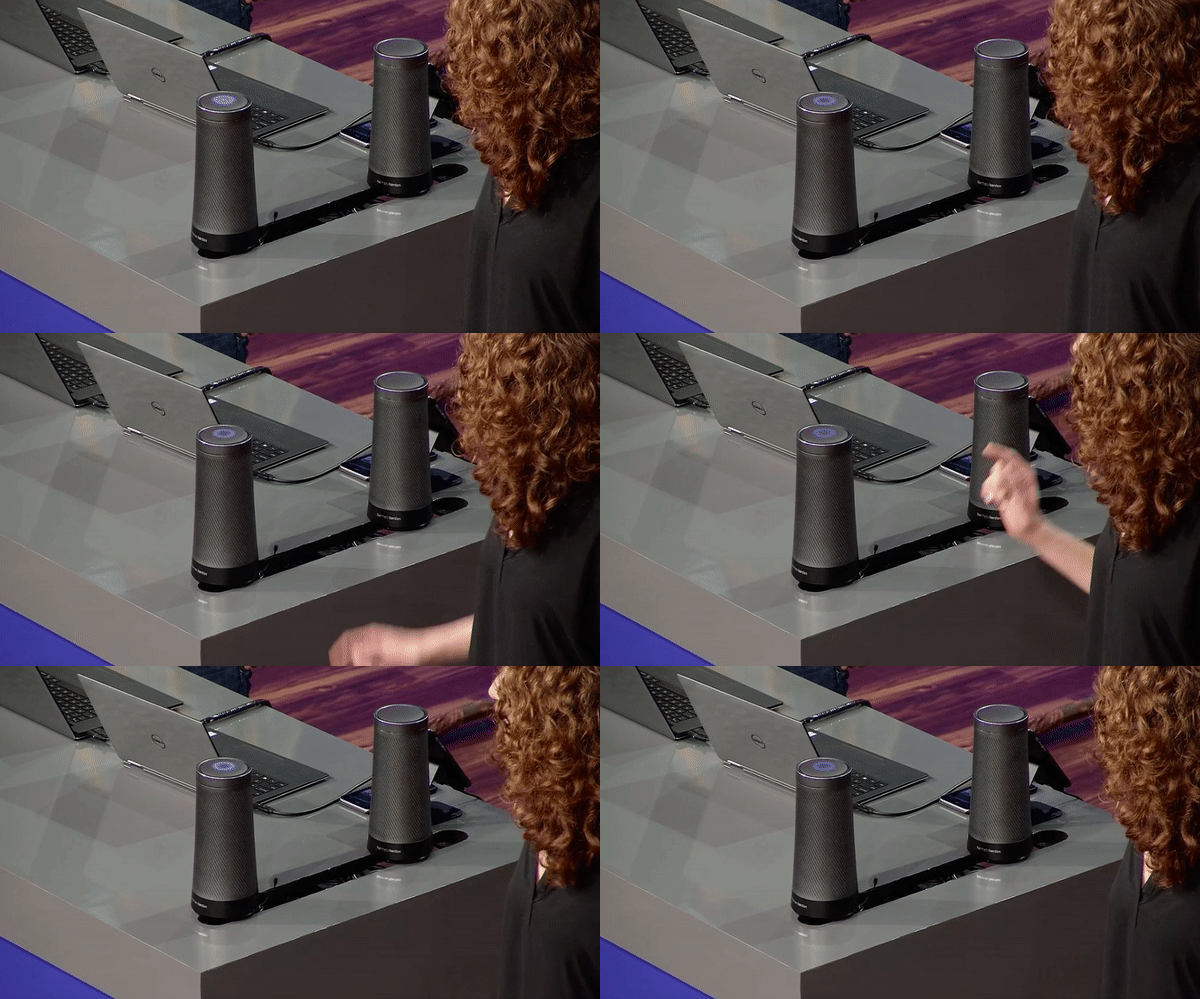
The gadgets from HP and Intel follow this week’s announcement of Invoke (GIF below), the first-ever third-party Cortana device. The connected speaker comes from Harman Kardon and it can “favorite music, manage calendars and activities, set reminders, check traffic, deliver the latest news and much more.”

The Invoke and other Cortana-run devices will encroach on a hot IoT market currently dominated by Amazon Alexa and Google Assistant.
In another move meant to bolster Microsoft’s entrance in the connected-home game, the Cortana Skills Kit is now live in public preview in the US. This allows developers to create Cortana-powered apps and programs across Android, iOS, Windows 10 and the Invoke.
Click here to catch up on the latest news from Microsoft’s Build 2017.
Self-driving cars make me nauseous
One of the major benefits of our self-driving future is just how much more gosh-darn productive we’re all going to be. Instead of wasting brain power driving our cars to work, we’ll sit back and let the ride do it for us. Suddenly, that time can be harnessed for our leisure or, more likely, to cram even more work into our days. But what will happen to all the people like me, who get sick at the thought of sitting in a car?
I’m not much of a car guy, because when I think about cars, my overriding memory is vomiting on the side of the highway. That smell of an overwarm car interior, heated by the air blowers turned up too high, makes me retch even to this day. In fact, even now, I can only avoid travel sickness by driving myself, with the aircon turned down low while chewing strong, mint-flavored gum.
So there’s a slightly selfish motive in visiting Ansible Motion, an automotive engineering company that claims to have the world’s most accurate car simulator. Most sims are built to train drivers, or for fun, but this one is intended for car designers to help them build new cars. Engineers can sketch out a new vehicle, plug the vital statistics into Ansible’s platform and test drive it straight away.
Ansible Motion is based at the Hethel Engineering Center, a European Union-funded startup incubator on the outskirts of Norwich, England. Even for a non-petrolhead like myself, I’m aware that I’m standing hallowed ground. If you step out of this building and walk across a neighboring field for five minutes, you’ll stumble across the anonymous-looking headquarters of Lotus Cars.

The $3.8 million simulator is no substitute for real-world testing, but it can help designers avoid costly mistakes. Engineers traditionally had to wait until a prototype was built before knowing if they’d spent years creating a design that’s flawed. Ansible’s simulator is apparently so accurate that mistakes can be spotted and fixed before a single piece of metal is welded.
A fortunate side effect of Ansible Motion’s unprecedented fidelity is that it can also be used to examine car sickness. In the near future, it’ll be the testbed for an extensive research project at an as-yet unnamed British university into mitigating the issue. But before those experiments began, I got to see if this simulator really was good enough to induce sickness.
The simulator itself has six axes of motion, thanks to three platforms that are essentially stacked one on top of each other. Perched on top of that is the “car,” a crudely-drawn cockpit that’s shaped like a black wedge; a stealth fighter built by hobbyists. Inside the clamshell hatch is a pair of bucket racing seats, a steering wheel connected to a fierce-looking motor and a simple dashboard. Oh, and the whole thing is lined with the same automotive fabric that I remember from my youth.
A 240-degree screen, wrapped almost all the way around the cockpit dominates the room. Five projectors are mounted in the ceiling above, while hidden behind the screen is the rack of five servers that run the show. Once I’ve clambered in and strapped myself down, I’m asked to wear a pair of AKG headphones with a boom microphone. It’s here that I’ll be speaking to the control room and listening to binaurally-recorded sound that helps replicate the experience of driving.
Before we begin, the simulator powers up and I can, suddenly, feel the rumble of an idling engine below me. Then, the display loads and I’m able to control a generic rear-wheel drive vehicle around a custom-designed racing circuit. The graphics aren’t much better than a older iteration of Gran Turismo, but that’s not the issue, really. They’re realistic enough to trick your eye and no more, and it does the job pretty well.

After a few laps of competent, yet slow, roaming around the track that’ll be familiar to any 80 year old dad, I’m told the self-driving component will soon kick in. There’s a countdown, and I let go of the steering wheel to let the simulator drive me around the track on its own. The system is quick, but conservative, but manages to go faster around the track than I’d managed.
It wasn’t long, however, before the stale air inside the cabin began to get to me, and the cloth lining began to get warm. I’d planned, at some point, to start pulling out my phone and living the dream of our self-driving future. But it clearly wasn’t going to happen, because I was already starting to feel nauseous.
It was ridiculous to admit it, given that I was sat almost perfectly still in a two-story garage in Hethel. We switched back and forth a few times, me taking the wheel in an attempt to cool down my nausea before returning control to the car. But every time I let the autonomous system take over, that all-too familiar sense of discomfort returned.
Getting sick in a simulator isn’t a rare problem, however, it even has a name: Simulator Adaptation Syndrome. Companies like Ansible are leaning into the concept to create systems that will purposely trigger sickness. After all, it’s only after researchers know how something is caused, that will we be able to properly mitigate against it. That gives me hope that someone, somewhere, isn’t too far away from developing a solution that means I won’t need to buy a bucket.
Of course, one random travel sick guy isn’t going to affect our self-driving future, or is it?. You see, there may be plenty of people who don’t realize that they are terrible passengers because they always drive — for now, at least. A 2015 study out of the University of Michigan suggests that motion sickness symptoms are going to spike when people start letting vehicles take over.

Motion sickness is, essentially, caused by a disconnect between what your body and your brain perceive. Your eyes may know that you are moving, but your vestibular system — which governs balance — does not. Around a third of the participants in the Michigan study said that they plan to kick back and read, text, play games or watch movies. All things that will affect the vestibular balance in your brain, triggering nausea or vomiting.
The study suggests that car manufacturers do what they can to reduce the effects of motion sickness. Proposed solutions include making wind shields bigger and wider, overlaying graphics only onto the front window and not installing swiveling seats.
I wonder if there’s going to be a shock when all of these people start getting sick after their first trip inside a self-driving car. We may believe, or hope, that an autonomous vehicle will magically eliminate the issues that have dogged passengers for a century. But a self-driving car is still a /car/, and unless things change,many of us are still going to get sick in it.
Microsoft takes aim at Alexa with Cortana Skills Kit
Amazon’s Alexa is miles ahead of rivals like Microsoft and Google with its “skills” — around 10,000 mini-apps that let you use your voice to control your lights or music, order an Uber, learn first aid and more. To help close that gap, Microsoft has finally launched the Cortana Skills Kit in a public preview, allowing developers to build new skills or convert them from Alexa or Microsoft’s new Bot Framework.
Developers will be able to use the kit to build skills and publish them to a new Cortana channel on its Bot Framework. Right now, the skills will work on Cortana for Windows 10, Android, iOS and the recently announced Cortana-enabled Harman Kardon Invoke speaker.
A key piece of Microsoft’s Cortana strategy is Echo-like hardware, but it hasn’t revealed its own device (yet). Instead, the first Echo-like device is from a third-party supplier, Harman Kardon, with the Invoke. At the Build conference today, HP also said it would build Cortana-specific devices, and Intel revealed that it would develop reference designs for the AI assistant.
Microsoft has been testing the Cortana Skills Kit in a private beta with select developers to work out the kinks. So far, early partners include Expedia, Capital One and handyman outfit TalkLocal. However, that list should grow rapidly — today at its Build conference, its holding a training session, showing developers how to design, build, test and publish Skills using the Azure Bot Framework. Other sessions will follow over the next two days on building voice-centric experiences and business-oriented apps.
In a demo during build, Microsoft’s Laura Jones showed that developers can create Cortana skills across various platforms, including PCs, Harman Kardon’s Invoke, your car’s infotainment system or mobile devices. For instance, you can tell Cortana to enter a business meeting appointment at home, and once on the road, it can inform you about an accident that will make you late and notify attendees. “Because Cortana is aware of the device I’m on, she can provide me with contextually-aware responses,” says Jones.
Click here to catch up on the latest news from Microsoft’s Build 2017.
Icon A5 plane crash kills two, including its lead designer
A fatal crash has left the amphibious Icon A5 personal aircraft’s fate mired in uncertainty. Lead engineer Jon Karkow and coworker Cagri Sever were killed in the accident outside of Icon’s Vacaville, California training facility, AVweb reports. Karkow was piloting the aircraft at the time and the pair had been airborne for around 20 minutes.
The crash may be the result of a “steep vertical descent,” according to Wired. Given that the A5 was designed to make flying easier, the crash is all the more curious. Especially, like Wired notes, when Karkow had flown more aggressive and challenging craft in his time at Scaled Composites. Before joining Icon, Karkow helped design Virgin Atlantic’s GlobalFlyer and SpaceShip Two.
An investigation by the Federal Aviation Administration and National Transportation Safety Board is underway. Coupled with layoffs and a recent scaling back in delivery estimates for the aircraft with foldable wings, how Icon and the A5 fare from here isn’t clear.
Via: Wired
Source: AVweb
Sprint will launch its 5G network in late 2019
Sprint isn’t going to sit by the wayside while AT&T, T-Mobile and Verizon make a fuss over their 5G wireless plans. The carrier has revealed that it’s working with its parent company SoftBank and Qualcomm to launch its 5G network in late 2019. Details are scant at this point (it’s over 2 years away, after all), but Sprint expects to use its existing 2.5GHz airwaves for the ultra-fast cellular link.
The timing is competitive, though not spectacular. AT&T is hoping to launch 5G as soon as late 2018, while T-Mobile would still be in mid-rollout when Sprint arrives. However, the news leaves more than a few questions. How soon will 5G be available nationwide? What happens to Sprint’s existing networks? Those are important — 5G won’t matter much if it takes a long time to reach your neighborhood, and it won’t be easy if Sprint has to repurpose parts of its 4G network to jump to 5G.
Sprint does have good reason to hurry, though, as its rivals aren’t standing still. Verizon, Cisco and Samsung just started the first multi-company 5G trial in Ann Arbor, Michigan. They’re relying on Verizon’s preliminary 5G spec (a standard is still a long ways off), but this proves that tech from a range of providers can work smoothly together in real-world conditions. In other words, Verizon’s 5G network testing this spring is likely on track. Sprint won’t necessarily be that far behind, but it hasn’t even confirmed testing plans yet — it’s hard to know whether or not its 2019 goal is realistic.
Source: Sprint
Childish Gambino’s latest vinyl release comes with a VR headset
Say what you will about the vinyl resurgence, but artists keep turning to the ancient media format to try out high-tech tricks. The latest in that trend is Donald “Childish Gambino” Glover, Pitchfork notes. When his Awaken, My Love! album from late last year lands at your local record store (or, more likely, an online retailer) on May 19th, it’ll come packed with a cardboard VR headset and an app that gives access to live performances recorded in 360-degrees from Glover’s “PHAROS Experience.” Next week in London, you could even attend a VR screening party for the record if you’re so inclined.

The Motown-esque album doesn’t come cheap, however. Its twin 45 RPM LPs, glow-in-the-dark cover art and other accoutrements will set you back somewhere around $60 depending on where you buy it.
Most recently, rap duo Run the Jewels released Run the Jewels 3 with an augmented reality component for not only the vinyl version of the record, but all of the group’s merchandise. RTJ also toyed with virtual reality in their 360-degree video for the single “Crown.”
And for plain old engineering wizardry, look no further than Jack White’s Lazaretto record. That Ultra LP features vinyl-only hidden tracks under each side’s label, with one playing at 45 RPM and the other 78 RPM. That’s in addition to locked groove songs on each side in and a number of other special features.
Meanwhile, the high-tech physical format that sought to replace vinyl in the ’80s (the compact disc) continues its death spiral seemingly everywhere outside of Japan. For a preview of what your $60 will get you from Awaken, My Love!, check out the 360-degree video for album opener and lead single “Me and Your Mama” below.
Via: Pitchfork
Source: Awaken My Love

