


In record-breaking weekend, Germany got 85% of its electricity from renewables
Why it matters to you
Germany is showing the world what’s possible with a sufficient investment in renewable energy.
Germany is kicking all kinds of sustainable butt when it comes to its use of renewable energy sources. According to recently released figures, for the last weekend of April, the country established a jaw-dropping new national record in this department — with 85 percent of all electricity consumed in Germany being produced through wind, solar, biomass, and hydroelectric power.
Aided by a seasonal combination of windy but sunny weather, during that weekend the majority of Germany’s coal-fired power stations weren’t even operating, while nuclear power stations (which the country plans to phase out by the year 2022) were massively reduced in output.
To be clear, this is impressive even by Germany’s progressive standards. By comparison, in March just over 40 percent of all electricity consumed in the country came from renewable sources. (According to the most recent figures we could find, in 2015 just 16.9 percent of the electrical generation in the United States came from renewable sources.)
However, while the end-of-April weekend was an aberration, the hope is that it won’t be for too much longer. According to Patrick Graichen of the country’s sustainability-focused Agora Energiewende Initiative, German renewable energy percentages in the mid-80s should be “completely normal” by the year 2030.
This is all thanks to an aggressive focus on investing in renewable energy resources, which have seen a massive boost since 2010. Despite criticism from some parts of the media, the push to embrace sustainable energy sources has received strong support from the German public, as well as from chancellor Angela Merkel.
In all, it’s a timely reminder of what renewable energy sources are able to deliver if given the chance. While private companies like Apple in the U.S. have made their pro-sustainability stance clear, for the most part this is still an area the United States is lagging behind other parts of the world — particularly Germany.
Microsoft is laying the foundation for a sci-fi future at Build 2017

Microsoft Build is a developer’s conference. Frank Shaw, Microsoft’s VP of Corporate Communications, made light of that fact at a press preview the day before Build began. “It’s a developer conference,” he warned with a dead-pan tone. “There will be coding.”
This can make Build seem arcane and, well, a bit boring – if you’re not a developer or engineer. The terminology goes over our heads. Yet that doesn’t mean it’s unimportant. In fact, Build 2017 put forth a cohesive vision for not just Microsoft’s future, but also for how everyone will interact with technology in the coming years.
Faster, smarter
Microsoft CEO Satya Nadella was first to take the stage at Build, as usual, and he set the tone for what was to come. He said that Microsoft is not just “cloud-first,” as has been stated in the past. The company is pushing forward, moving to what it calls the era of “intelligent cloud” and “intelligent edge.”
Microsoft is moving on to what it calls the era of “intelligent cloud” and “intelligent edge.”
“Intelligent cloud,” is the easier of these buzz words to figure out. It refers to various techniques designed to improve data use in the cloud. The data is not just stored, but also processed, analyzed, and manipulated to power new services and applications. Microsoft’s Azure Cosmos DB, announced at Build, is the conference’s leading example. It lets developers deploy and replicate data across the globe. If an application is seeing more demand in Asia, for instance, Cosmos lets developers easily shift resources there, so users see lower latency and improved reliability.
None of this will be visible to you, the user. The app will just work. You’ve likely already come to expect that, but it’s solutions like Cosmos that make seamless performance a reality.
Living on the Edge
It’s the second buzz word, “intelligent edge,” that requires more explanation. What is the edge, anyway? Home users might first think of Microsoft’s new web browser, but in fact the two aren’t related. Microsoft is instead referring to “edge devices,” which provide an entry point into the network. An edge device can be many things; a security camera, a thermometer, even a smartphone.
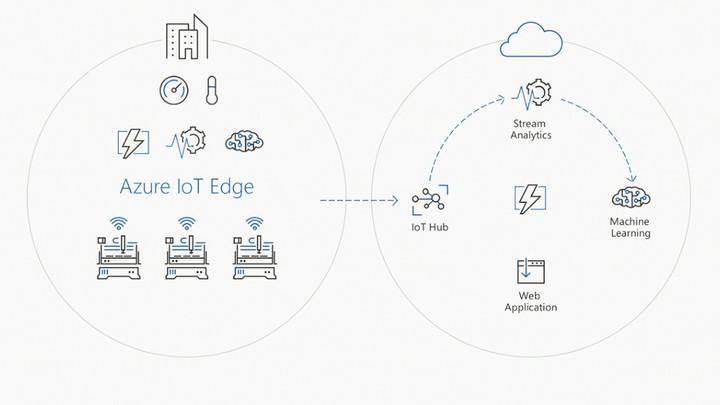
The cloud has bestowed these devices with new power. They can now be accessed from anywhere a data connection is available, providing use to people thousands of miles away. This new power comes with a problem, however. If the cloud becomes unavailable, the devices become useless.
Microsoft provided a Carnival cruise ship as one example. Normally, the ship has a constant internet connection through a satellite uplink, but a storm can disrupt that and, in turn, mess with onboard systems. Problems can even arise in normal conditions, due to the latency between the edge devices and the cloud.
Developers can push code that runs in the cloud to edge devices, so they’ll continue to work if the cloud is unavailable.
Azure IoT Edge provides a solution for that. It gives developers the capability to push code that runs in the cloud to edge devices, as well, so they’ll continue to work properly if the cloud is unavailable. When the cloud returns, they can link back up, as if an interruption had never happened. This is Microsoft’s “intelligent edge.” The devices are capable of exercising functionality on their own, even when disconnected from the cloud.
That’s a big deal. Imagine, for instance, a security system that uses facial recognition to detect who is and isn’t authorized to be in an area. A system that relies on the cloud would normally have a hard time if the internet went down. It’d stop functioning altogether. With Microsoft’s Azure IoT Edge, however, the system can continue to work with interruption.
In theory, at least. It’s worth noting that Azure IoT Edge is in preview, so it’s not ready for widespread deployment. If history’s any guide, we’ll likely hear more about it at next year’s Build, after it’s had time to prepare for release.
Coding for safety
It’s easy for Microsoft to say it has a vision for an “intelligent cloud, intelligent edge” future. The harder task is showing how buzz words translate to the real world. Fortunately, the company came prepared.
An early demo used a fictional construction site to show how the company’s combined services can interact in real time with a real workplace. The site was, of course, littered with tools, one of which was a jackhammer. Microsoft’s image recognition service recognized the tool as such, and could tell workers the tool’s location when asked through a smartphone app.
That’s impressive, but also just the start. Microsoft’s services were also able to determine the orientation of the tool, which was balanced precariously against a workbench, and flag it as a safety issue. Better still, facial recognition services identified the workers at the worksite, and flagged a violation when an unauthorized person came into the demo area to pose with the jackhammer for a ridiculous selfie.
“This technology will change the world.” That quote, or something like it, eventually slips from the mouth of every CEO in the tech sector. It’s rare, however, to see a demo that provides reason to think it’s true. Microsoft’s worksite demo was one such rarity. It showed how AI, edge devices, and cloud connectivity might come together to do things that seemed like science-fiction even a half-decade ago.
Building for Cortana, everywhere
Another demo brought similar innovations even closer to home using Microsoft’s digital assistant, Cortana.
While the demo itself was about Cortana, the real stars are Microsoft’s platforms.
The demo showed a fictional morning routine. It started with a Cortana-enabled speaker at home, continued to a Cortana-enabled car, and ended with a Cortana-assisted meeting. Through the demo, Cortana changed how it worked based on the device through which the user interacted with it.
In a car, it relied on voice, and worked largely to provide schedule, map, and traffic information. While at work, Cortana connected to Skype, and could create action items based on what happened in the meeting.
Admittedly, this presentation felt a bit more fanciful than the preceding workplace demo, perhaps because Cortana is already a real product we can use. Cortana can’t do everything that was shown, and it isn’t as reliable in the real world as the demo wants us to think.

Still, the demo provided another example of how Microsoft’s geeky advancements could change everyday life. While the demo itself was about Cortana, the real stars are Microsoft’s platforms. The company wants developers to understand they can be used to improve almost anything. What works to make an industrial machine safer can also make scheduling a meeting easier.
Over your head, yet down to Earth
Passing Build off as “just a developer conference,” is easy to do. Most people find the announcement of a new Surface laptop, or new Windows 10 update, far more exciting.
What happens at Build shouldn’t be discounted. In fact, it’s more relevant than ever. Microsoft has evolved from an operating system company into a far-reaching company that shapes the framework of how tomorrow’s technology is used. Remember that when a few years from now, you find yourself clocking into work simply by showing up at the office.
Owlchemy Labs is now part of Google’s VR family
It’s not a Job Simulation: The VR magicians at Owlchemy Labs are now part of Google.
Google and Owlchemy Labs have announced that they are joining forces and that means awesome things for fans of VR.

Owlchemy Labs are the folks who brought us Job Simulator and Rick and Morty: Virtual Rick-ality to the HTC Vive and Oculus Rift, two great VR experiences that blend all things fun (and funny) into some seriously good times through your headset. Google has picked up this team and that means we can expect more of the same.
Today, we’re thrilled to welcome Owlchemy Labs to Google. They’ve created award-winning games like Job Simulator and Rick and Morty: Virtual Rick-ality which have really thoughtful interactive experiences that are responsive, intuitive, and feel natural. They’ve helped set a high bar for what engagement can be like in virtual worlds, and do it all with a great sense of humor!
Together, we’ll be working to create engaging, immersive games and developing new interaction models across many different platforms to continue bringing the best VR experiences to life. There is so much more to build and learn, so stay tuned!
We’re especially excited to see talk about different platforms, as products like Google Daydream and Samsung’s Gear VR make VR and AR more accessible and easier. Restraints like heat and power drain make building VR for mobile a real challenge and knowing that some great talent will now be working in-house at Google we anticipate things to get even better. While this news is good for Owlchemy Labs and Google, it’s even better for fans of VR at any level.
We expect to see great and silly things in the future!
Tesla Solar Roof: Everything you need to know
Tesla has begun letting customers pre-order its Solar Roof.
Six months after announcing the eco-friendly product, the car-maker has finally shared all the details about Solar Roof, including how the roof’s solar tiles work, how much they cost, and what the “Solar Roof experience” includes. So, we’ve gathered all this information and explained it below, with the hopes of helping you decide whether this is the perfect home solar setup for you.
- Tesla Solar Roof will power your home and look good in the process
- Elon Musk’s SolarCity will sell roofs made of solar panels
- Tesla: Everything you need to know
Tesla
What is a Tesla Solar Roof?
Popping a solar panel on your roof is a great way to generate free, sustainable energy for your home, but there’s one major drawback: It is often unsightly. However, Tesla’s latest product, Solar Roof, would be approved of by anyone and everyone. It covers the entire top of a house, and yet you wouldn’t notice because each tile is a smaller solar panel. They’re made of tempered glass with a solar cell contained inside.
Tesla Solar Roof was announced during a special Tesla event last October. Keep in mind Tesla acquired Solar City last year. It’s a San Mateo, CA-based company that provides energy services, such as the designing, financing, and installing of solar power systems. Musk co-founded SolarCity. You can read more about SolarCity and why Tesla acquired the company in Pocket-lint’s guide here.
Tesla
How does Tesla Solar Roof work?
Integrated Powerwall
Solar Roof turns sunlight into electricity, obviously. But with an integrated Tesla Powerwall battery, the energy collected during the day can be stored and made available any time, “effectively turning your home into a personal utility”, Tesla said. That also means you can have access to uninterrupted electricity during grid outages. To learn more about the Powerwall 2, check out Pocket-lint’s guide here.
Tesla’s Solar Roof only connects to the Powerwall 2, the second-generation of its home battery, and it’s capable of storing 14kWh of energy, with a 5kW continuous power draw, and 7kW peak.
Solar tiles and non-solar tiles
Tesla actually offers two types of glass tile, solar tile and non-solar tile, and both appear the same from street level. You can customise the amount of solar tiles you need, and every solar tile is warrantied for the lifetime of your house. During a conference, Musk said that in some cases, depending on the roofs, customers will be able to have up to 70 per cent solar tiles, but in most cases, it will be about 40 per cent.
Tesla offers a calculator directly on its website so you can get an estimate of what you need. All the solar tiles are made with tempered glass and are supposed to be more than three times stronger than standard roofing tiles. They’re also printed in a way so that they aren’t visible from the road and should look opaque or even be mistaken for regular roofing tiles (unless you’re looking down on them from above).
Tesla said the tiles will not degrade over time, like regular asphalt or concrete tiles do. Here’s a video of a “hail cannonball” shattering into pieces when chucked against a solar tile in slow-motion:
Slo-mo hail cannonball impacting Tesla solar roof tile
A post shared by Elon Musk (@elonmusk) on May 10, 2017 at 12:32pm PDT
Tile styles
Although there are two types of tiles being offered by Tesla, solar and non-solar, there are actually four different style types: tuscan, slate, textured, and smooth. The first two tiles, smooth and textured, are going into production this summer. Tesla said it decided to go with those two styles first because they received the highest number of inquiries after being announced last autumn.
You can learn more about the different styles from Tesla’s website.
Solar Roof experience
Tesla said that every customer who orders a Solar Roof will get the entire “Solar Roof experience – from the removal of your existing roof through design, permitting, installation, operations and maintenance of the new Solar Roof.” The company estimated that the installation should take approximately the same time to install as a regular roof installation. In other words, about five to seven days.
Tesla
How much does Tesla Solar Roof cost?
Here’s what Tesla says on its website:
“The estimated cost of your Solar Roof includes materials, installation, and the removal of your old roof. Taxes, permit fees and additional construction costs such as significant structural upgrades, gutter replacement, or skylight replacements are not included. The Solar Roof cost is based on estimated roof square footage for your home, provided by Google Project Sunroof where available, and the portion of your roof covered with solar tiles.”
According Tesla’s calculator, the average US customer can expect to pay $21.85 per square foot of solar panels. A Tesla Solar Roof for a two-story, 2,000-square-foot home in New York state should be around $50,000 to install after federal tax cuts. But it would generate $64,000 in energy savings over three decades, so Tesla said the upfront cost is “more than offset by the value of energy the tiles produce”.
Tesla includes an installed 14kWh Powerwall 2 in every quote. It can be removed, but Tesla thinks that most people will want to have the home battery pack for backup energy. Tesla also estimated that its non-solar tiles are cheaper than regular tiles.
Does Tesla offer financing?
Yes. Tesla will offer financing for Solar Roofs in the US in late 2017.
Tesla
When will Tesla Solar Roof be available?
Tesla has started taking pre-orders for its Solar Roof. A $1,000 deposit is required when ordering online from Tesla. Homeowners outside of the US can also order, but apparently, they shouldn’t expect installation until 2018. We’ll keep you posted when learn the specifics of UK pricing.
Want to know more?
Check out the Tesla Solar Roof FAQ page.
PBS made an adorable Chromecast-like TV streaming stick for kids
PBS thinks your kid may want to be a cord-cutter too.
There are a dozens of ways you can access your favourite TV shows and movies, whether you own a streaming set-top box, such as Apple TV or Roku, or even a streaming stick/HDMI dongle such as Google Chromecast. Although some of these devices do offer parental controls, they’re all geared toward teens and adults. However, PBS has just introduced its own HDMI dongle – and it’s specifically meant for kids.
The PBS Kids Plug & Play is apparently the first streaming stick for children – and it even looks like a toy car. It promises kid-friendly content and doesn’t even need a Wi-Fi connection. It comes with 100 hours of content stored locally on its 16GB of storage, as well as offline games that kids can play with using the included remote. If you do connect it to Wi-Fi, it offers access to the 24/7 PBS Kids live stream.
- Chromecast 2 review: Make any TV smart, effortlessly
- What is Google Cast for Audio?
- Chromecast now has a guest mode: Here’s how to turn on the feature
- What is Google Chromecast and why should you care?
Children will be able to watch additional PBS Kids on-demand content developed in partnership with local PBS stations as well. The device is powered by microUSB, has 1GB of RAM, features an SD card slot, and is available online now for $49.99. The Plug & Play will also be available at Walmart stores in the US from 24 May. Other retailers are expected to sell the device later this year.
PBS is an American public broadcaster and distributor, while PBS Kids is the brand that airs most of PBS’ programming for children.
- Roku Streaming Stick vs Google Chromecast
- Amazon Fire TV Stick vs Google Chromecast vs Roku Streaming Stick
- What is Google Chromecast and why should you care?
EU will push Apple, Google to treat app developers fairly
Spotify and other services aren’t happy with being at the mercy of internet giants like Apple and Google. If those behemoths want to stifle competition, they only have to impose strict app rules or promote their own products over others. Well, the smaller outfits may get some government help with loosening that grip. In the wake of a complaint letter from companies like Spotify and Deezer, the European Commission has announced that it’s readying “legislative instruments” to tackle the possibility of unfair contracts and trade practices. Just what those entail isn’t certain, but the Commission has already offered some clues through the initial results of an investigation.
The regulator pointed to instances where companies pulled products with little warning, limited access to your data or didn’t offer enough transparency with their search rankings. Accordingly, any laws would both set conditions for fair practice, create a system to resolve squabbles and boost transparency. If Spotify thinks an app store operator is holding it back, it might not have to choose between a grin-and-bear-it attitude or a messy court battle.
Whether or not legislation is a good idea depends on who you ask. Independent music labels tell Reuters that they’re in favor of the idea — they believe the power imbalance “distorts competition.” Not surprisingly, the groups representing Apple and Google have other ideas. EDiMA sees the proposed legislation as a step backward from “progressive” ideas that didn’t treat companies as “gatekeepers,” while the lobbyists at CCIA Europe would rather see the Commission rely on case-by-case uses of competition law instead of more rules.
We wouldn’t count on the EC changing its mind. Although there’s no certainty that there will be laws, it already has both evidence and an idea of what it wants. The real question is whether or not any future rule set would do enough to promote fair competition without seriously hurting larger firms.
Via: Reuters, 9to5Mac
Source: European Commission
Tesla’s Solar Roof is available for pre-order
Tesla didn’t quite fulfill its promise to start Solar Roof sales in April, but you thankfully haven’t had to wait that much longer to pull the trigger. As of today, you can pre-order Tesla’s stealthy solar power cells in textured or smooth variants ahead of the first US installations in the summer (2018 elsewhere). While the price will vary depending on your home, of course, the company estimates that a “typical” buyer will pay about $21.85 per square foot instead of $24.50 for a regular roof. Not that there will be much mystery regardless of what you pay — Tesla is offering a cost calculator to figure out your real-world expenses.
The tool uses your roof size, local electricity prices and even regional sunlight levels to both gauge the cost of the roof as well as the value of the energy you’d generate. Tesla is convinced you’ll likely save money in the long run, but this gives you a way to find out whether that’s true for your particular abode. Even if you’re skeptical of Tesla’s methods, this should at least tell you whether or not a Solar Roof is viable. You might not want to spring for one if you’re in a perpetually gloomy area.
Whatever you decide, this is definitely one of Tesla’s grander experiments. The company has already dipped into energy through its Powerwall batteries (which come with the Roof) and SolarCity’s existing sales, but it’s another matter entirely to offer cutting-edge solar power directly to customers. There’s a considerably wider audience for solar power than there is for stand-alone batteries, and it’s unclear how many people will take to this versus playing it safe with conventional panels. With that said, Tesla’s name and clever tech might at least get its foot in the door.
Source: Tesla (1), (2)
Beautiful melee MMO ‘Absolver’ lands August 29th
A year after indie studio Sloclap introduced the melee combat-only MMO it’s releasing with publisher Devolver Digital, Absolver, the indie studio has announced its release date for PS4 and PC: August 29th. To tide you over, they’ve also dropped a trailer explaining the combat mechanics for the gunless massively multiplayer game.
Players inhabit Prospects, masked journeyman fighters training to one day join the elite ranks of the titular Absolvers, which keep the peace in the fallen city of Raslan. As we saw in our hands-on preview at E3, the new trailer shows off Absolver’s various forms and stances that players switch through on the fly to land devastating combos — or parry and counter their opponent’s blows. Combat unlocks different moves you can slot in to mix up your moves, but players can also apprentice themselves to NPC mentors and learn their secrets.
The combat system is a novel core to this MMO, but the lush animation style deserves mention, painting the game’s environment in vivid color. Whether Absolver lives up to its promise of easy-to-learn, difficult-to-master fighting and brings players back to the tired MMO genre is something we won’t know til the game lands in August.
Source: PlayStation
Facebook limits News Feed links to scammy ad-filled sites
Facebook regularly tweaks your news feed to make sure you only see “quality” posts and ads. It’s banned fake news sites from using the Facebook ad network, added an easy way to report false news posts, and has even hired third-party fact-checkers. Today, however, the company announced that it would focus its efforts on websites that contain “little substantive content and that is covered in disruptive, shocking or malicious ads.” The news feed update is meant to help reduce the “incentives of financially-motivated spammers.”
There is already a policy in place to prevent these kinds of scammers from advertising on the social network. Facebook intends to enforce it as it focuses on organic News Feed posts. The team uses artificial intelligence trained on “hundreds of thousands” of websites with this kind of ad-farm content to discover posts that link to them. When identified, these posts should show up farther down your feed and they won’t be eligible to become a Facebook ad.
“This is one of the first times we’re actually using information from the experience that people will have once they click something to help inform the ranking in News Feed,” product manager Greg Marra told Recode.
The new system should roll out over the next few months. If you’re publishing high-quality posts from your own Facebook Pages, you may see a small increase in traffic as users see more of your stuff than spammy links to low-quality websites.
Via: Recode
Source: Facebook
Anti-net neutrality bots are swarming the FCC’s comments
It’s not just proponents of net neutrality that are flocking to the FCC’s website — opponents are there as well… in a manner of speaking. Reports from ZDNet and elsewhere have revealed that one or more bots are posting thousands of identical comments (at least 128,000) in favor of the FCC’s proposal to gut net neutrality rules. The automated code cycles alphabetically through a list of real names and addresses, pretending to support the FCC on their behalf. The agency declined to comment on the bot attack citing a policy where it doesn’t discuss specific filings.
So who’s behind this astroturfing campaign? It’s unclear, but there was an effort in 2014 where cable companies funded anti-net neutrality groups to make it look like there was more opposition to the regulation than there was in practice. It’d be easy to suspect that telecoms were behind this move as well, especially since the fake statement uses lobbyist-speak like “bipartisan light-touch regulatory consensus.” With that said, a bot would undoubtedly go beyond the pale — it’s one thing to run a fake grassroots campaign, it’s another to impersonate real people.
Whoever’s behind the bot flood, it shows just how intense this battle is getting. Things really got heated after Last Week Tonight host John Oliver rallied support for net neutrality during his May 8th episode, steering people toward a website that makes (legitimate) commenting easy. The FCC’s website buckled soon afterward, but it’s not clear who was responsible. While the FCC maintains that a denial of service attack made it difficult to comment, critics are concerned that this might be a cover to downplay the surge of support for existing net neutrality rules. For all intents and purposes, the FCC’s comments have become a battleground.
Source: ZDNet, FCC (PDF)

